
Ocean wave ensemble Degui Cao Hendrik Tolman Marine
Ocean wave ensemble Degui Cao, Hendrik Tolman Marine Modeling and Analysis Branch NOAA/NCEP/EMC, Camp Springs, MD Acknowledgement: Zoltan Toth, Bo Cui, Yuejian Zhu, Binbin Zhou, Mozheng Wei October, 2008. Camp Springs, Maryland, USA

Generation and evolution of ocean wave The generation and evolution of the wind waves are strongly dependent on external wind forcing. The wave nonlinear term plays the stabilization role on the wave perturbation in the wind-wave evolution. Wind sea is not sensitive to its initial conditions (spectrum, frequency ) unlike the chaotic systems. This makes the wave (wind sea) weak nonlinearity. Swell is sensitive to its initial conditions, and should include perturbation consistent with its generation. Wind sea: actively generated waves Swell: freely propagating waves with no local forcing
Status of ensemble systems l Old wave ensemble system This system had been operational from May 2005 to May 2008. Running on old deterministic global model grid (1. 25°× 1°) as the control 10 wave members generated through GEFS using the breeding method. Same initial conditions for all members. 5 day (126 h) forecast. Wind data: raw wind data
Status of ensemble systems l Current operation ensemble system Wave ensemble has been operational running since June, 2008 Running on 1°× 1° wave model grid as the control. 20 wave members generated through GEFS using ETR method Cycling initial conditions for individual members to introduce uncertainty in swell results. 10 day forecast using the GEFS bias corrected 10 m wind (future operation) 5 day (126 hour) forecast using the raw wind data ( testing only)
Status of ensemble systems l Validation: 145 buoys in the northern hemisphere altimeter wave data (ENVISAT, GFO, Jason-1)
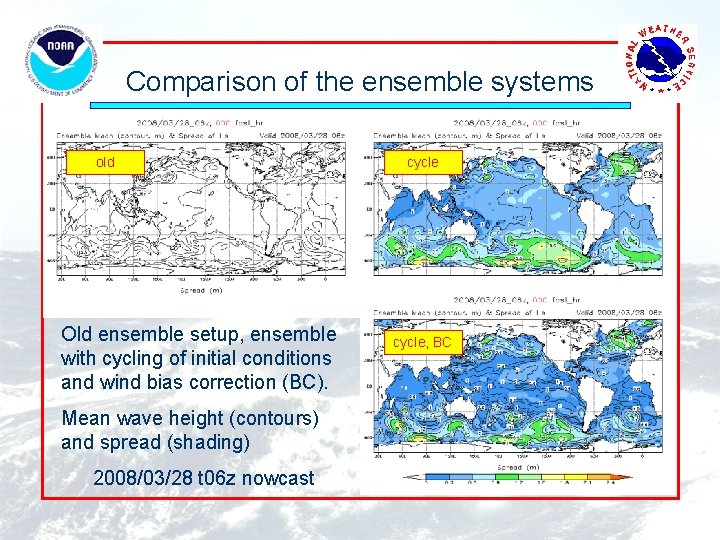
Comparison of the ensemble systems old Old ensemble setup, ensemble with cycling of initial conditions and wind bias correction (BC). Mean wave height (contours) and spread (shading) 2008/03/28 t 06 z nowcast cycle, BC
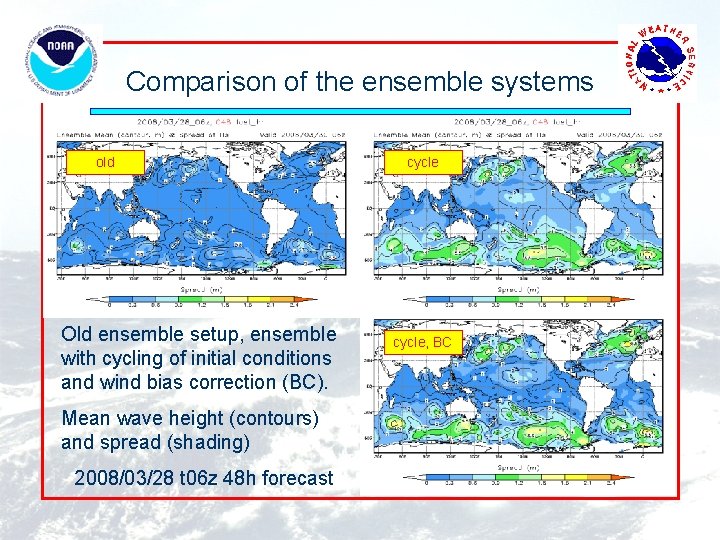
Comparison of the ensemble systems old Old ensemble setup, ensemble with cycling of initial conditions and wind bias correction (BC). Mean wave height (contours) and spread (shading) 2008/03/28 t 06 z 48 h forecast cycle, BC
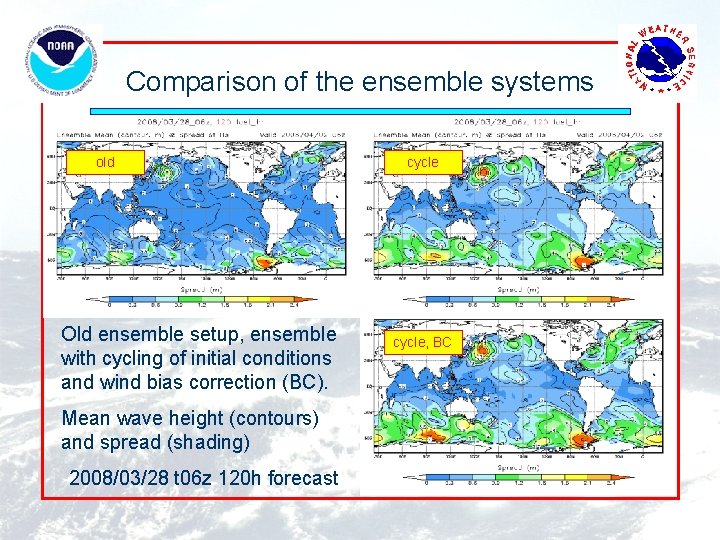
Comparison of the ensemble systems old Old ensemble setup, ensemble with cycling of initial conditions and wind bias correction (BC). Mean wave height (contours) and spread (shading) 2008/03/28 t 06 z 120 h forecast cycle, BC
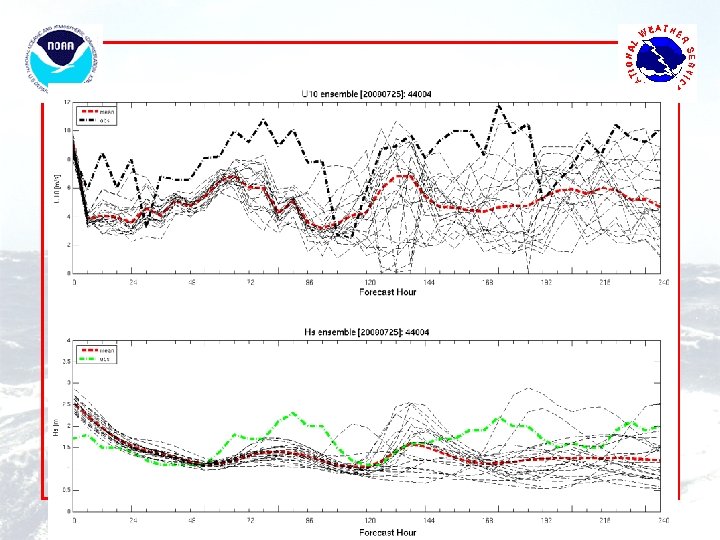
Conclusions The current ensemble system shows 2 -5 day “memory” of wind perturbations in wave system. Tentatively realistic swell perturbation Continuity in perturbations in GEFS between model cycles is critical.
Future plan Validate the operational ensemble system with buoys and altimeter data l Make a comparison Bias corrected wind from GEFS is expected to reduce (remove) wave bias in ensemble. Cycling of initial conditions will increase variability of wave heights (partial solution ? ) l Work towards a combined NCEP-FNMOC ensemble l Analyze the role of swell played in the wave ensemble l
- Slides: 11