
Ocean Surface Topography Science Team Meeting Precise Orbit
Ocean Surface Topography Science Team Meeting Precise Orbit Determination Splinter North-South miscentering of the Jason-3 orbit observed by its yaw-flip capability Eléonore Saquet, Alexandre Couhert, Flavien Mercier
OSTST 2020 Introduction • • Context Previous approaches Normal offset (GPS int ambiguity) Flips approach (GPS int ambiguity) Normal offset (other measurements) Flips approach (other measurements) Conclusion 2
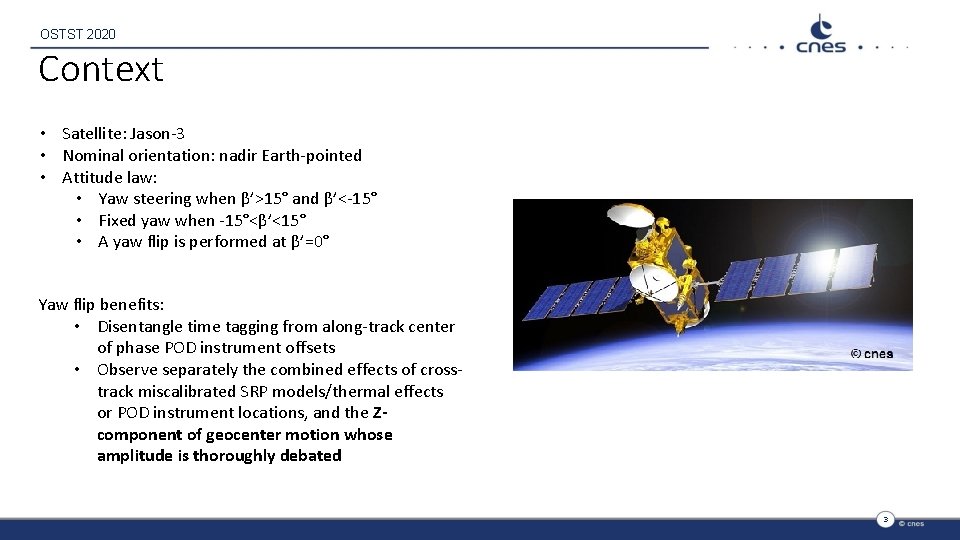
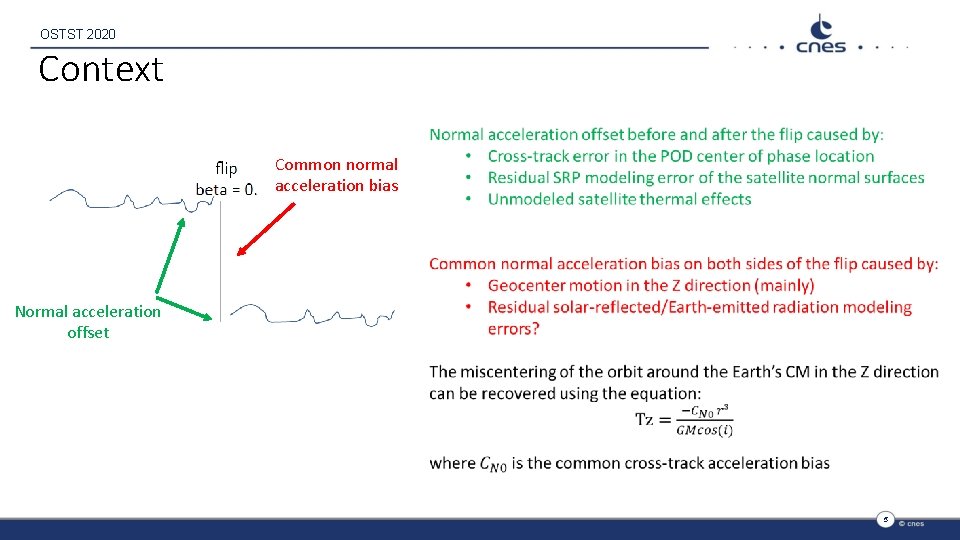
OSTST 2020 Context • Satellite: Jason-3 • Nominal orientation: nadir Earth-pointed • Attitude law: • Yaw steering when β’>15° and β’<-15° • Fixed yaw when -15°<β’<15° • A yaw flip is performed at β’=0° Yaw flip benefits: • Disentangle time tagging from along-track center of phase POD instrument offsets • Observe separately the combined effects of crosstrack miscalibrated SRP models/thermal effects or POD instrument locations, and the Zcomponent of geocenter motion whose amplitude is thoroughly debated 3
OSTST 2020 Context Goal: • Monitoring of the residual normal perturbations • Observation of the geocenter motion estimates in the Z (North-South) direction • Comparison with previous methods Approach: • Focus on orbit arcs where flip events occur • Definition of the 8 -day orbit arcs: 4 days before and after the flip events • Estimated empirical parameters: o constant cross-track accelerations with 4 -day intervals o periodic once-per-revolution accelerations in the along/cross-track directions with 1 -day intervals o constant along-track accelerations with 2 orbital period intervals 4
OSTST 2020 Context Common normal acceleration bias Normal acceleration offset 5
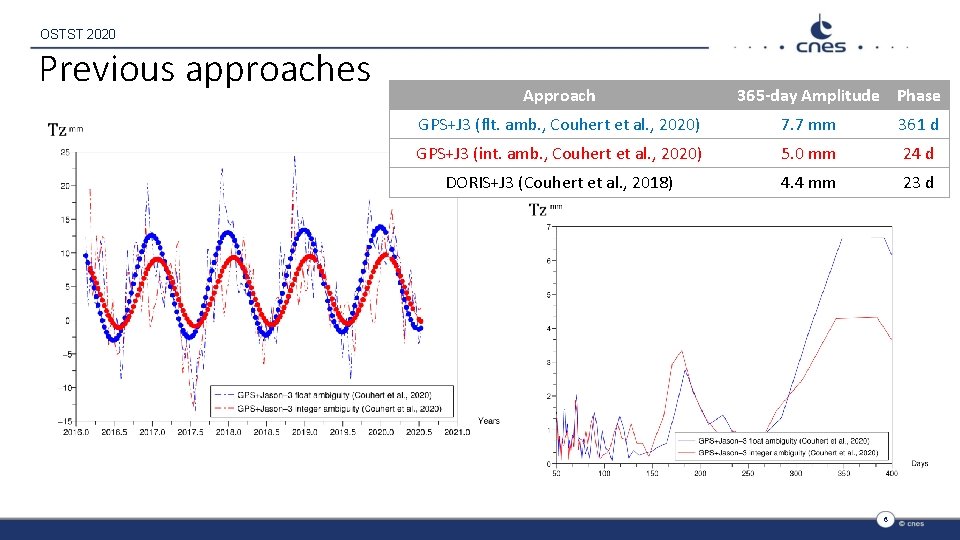
OSTST 2020 Previous approaches Approach 365 -day Amplitude Phase GPS+J 3 (flt. amb. , Couhert et al. , 2020) 7. 7 mm 361 d GPS+J 3 (int. amb. , Couhert et al. , 2020) 5. 0 mm 24 d DORIS+J 3 (Couhert et al. , 2018) 4. 4 mm 23 d 6
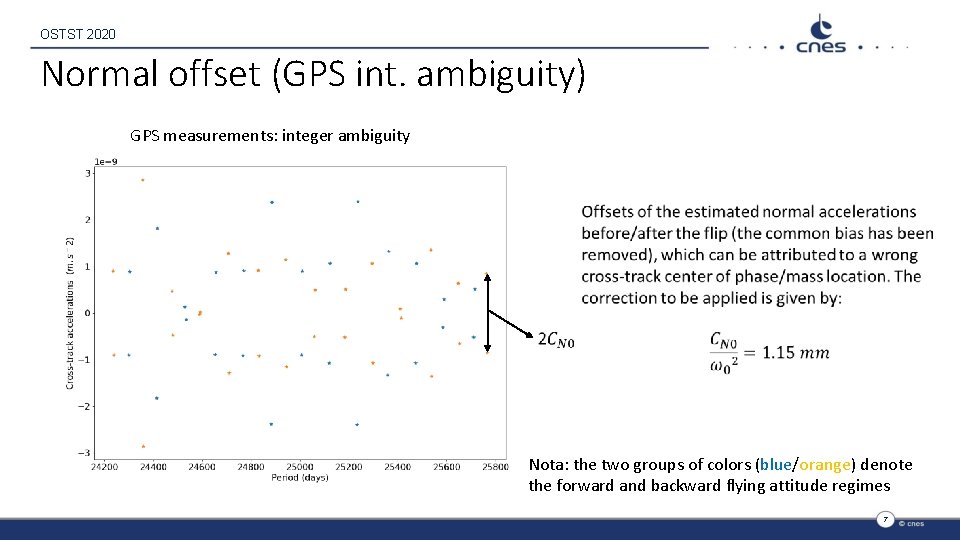
OSTST 2020 Normal offset (GPS int. ambiguity) GPS measurements: integer ambiguity Nota: the two groups of colors (blue/orange) denote the forward and backward flying attitude regimes 7
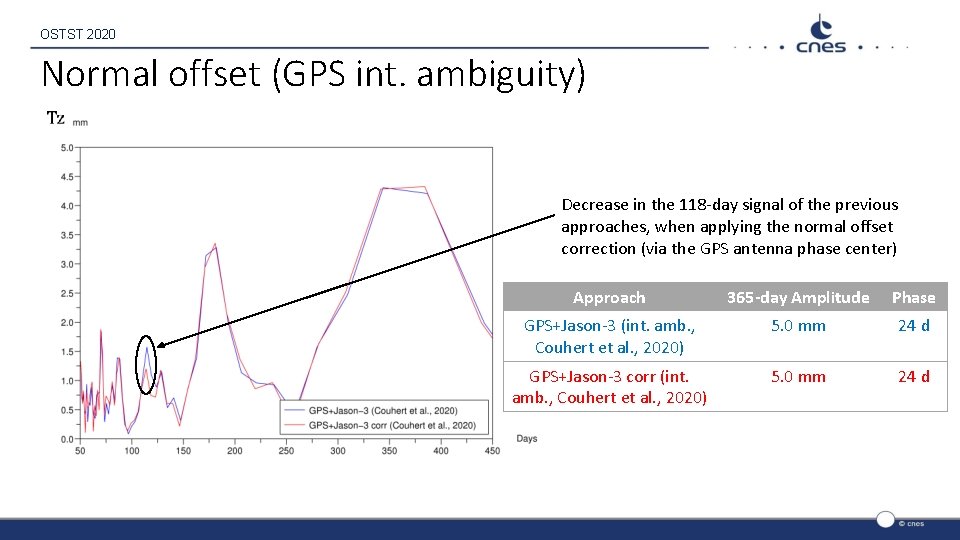
OSTST 2020 Normal offset (GPS int. ambiguity) Decrease in the 118 -day signal of the previous approaches, when applying the normal offset correction (via the GPS antenna phase center) Approach 365 -day Amplitude Phase GPS+Jason-3 (int. amb. , Couhert et al. , 2020) 5. 0 mm 24 d GPS+Jason-3 corr (int. amb. , Couhert et al. , 2020) 5. 0 mm 24 d
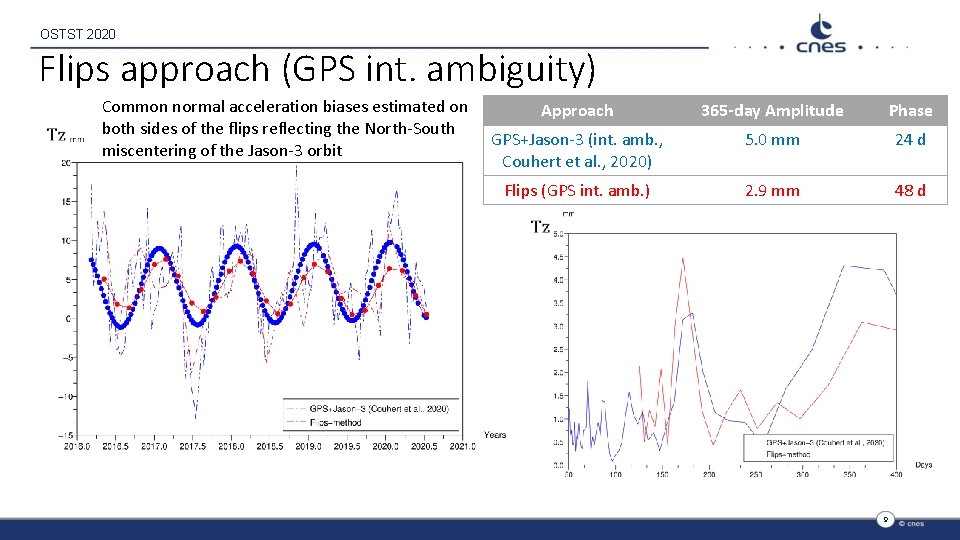
OSTST 2020 Flips approach (GPS int. ambiguity) Common normal acceleration biases estimated on both sides of the flips reflecting the North-South miscentering of the Jason-3 orbit Approach 365 -day Amplitude Phase GPS+Jason-3 (int. amb. , Couhert et al. , 2020) 5. 0 mm 24 d Flips (GPS int. amb. ) 2. 9 mm 48 d 9
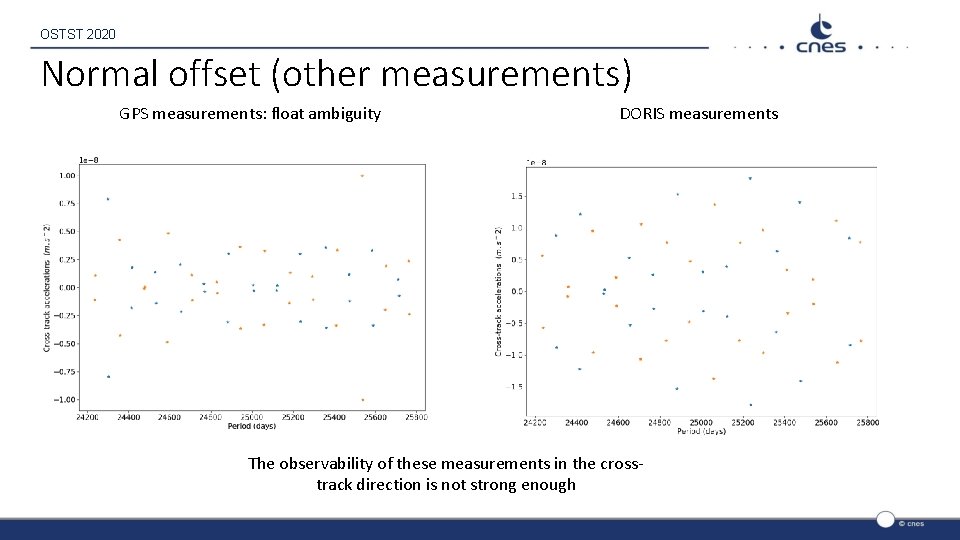
OSTST 2020 Normal offset (other measurements) GPS measurements: float ambiguity DORIS measurements The observability of these measurements in the crosstrack direction is not strong enough
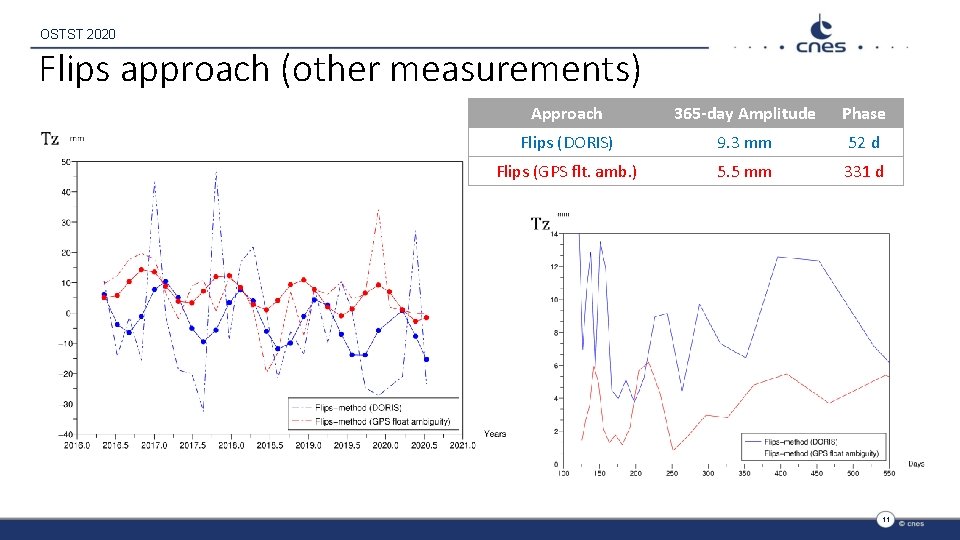
OSTST 2020 Flips approach (other measurements) Approach 365 -day Amplitude Phase Flips (DORIS) 9. 3 mm 52 d Flips (GPS flt. amb. ) 5. 5 mm 331 d 11
OSTST 2020 Conclusion • The flips approach allows us to observe specifically the geocenter motion along the Z (North-South) axis. • The 60 -day sampling and/or residual errors in the modelling of solar-reflected/Earth-emitted radiations could explain the differences in the annual TZ geocenter estimates between the flips and previous approaches. • Yaw flips are specific to the T/P and Jason missions. A recommendation of the OSTST POD group is to maintain the yaw flips for the Sentinel-6/Jason-CS mission. 12
- Slides: 12