
Ocean SeaIce Model Intercomparison Replication of observed sealevel
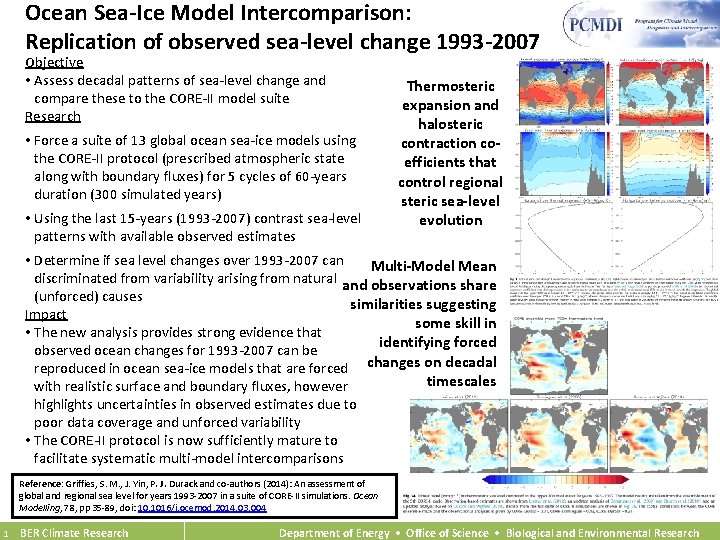
Ocean Sea-Ice Model Intercomparison: Replication of observed sea-level change 1993 -2007 Objective • Assess decadal patterns of sea-level change and compare these to the CORE-II model suite Research • Force a suite of 13 global ocean sea-ice models using the CORE-II protocol (prescribed atmospheric state along with boundary fluxes) for 5 cycles of 60 -years duration (300 simulated years) • Using the last 15 -years (1993 -2007) contrast sea-level patterns with available observed estimates Thermosteric expansion and halosteric contraction coefficients that control regional steric sea-level evolution • Determine if sea level changes over 1993 -2007 can Multi-Model Mean discriminated from variability arising from natural and observations share (unforced) causes similarities suggesting Impact some skill in • The new analysis provides strong evidence that identifying forced observed ocean changes for 1993 -2007 can be reproduced in ocean sea-ice models that are forced changes on decadal timescales with realistic surface and boundary fluxes, however highlights uncertainties in observed estimates due to poor data coverage and unforced variability • The CORE-II protocol is now sufficiently mature to facilitate systematic multi-model intercomparisons Reference: Griffies, S. M. , J. Yin, P. J. Durack and co-authors (2014): An assessment of global and regional sea level for years 1993 -2007 in a suite of CORE-II simulations. Ocean Modelling, 78, pp 35 -89, doi: 10. 1016/j. ocemod. 2014. 03. 004 1 BER Climate Research Department of Energy • Office of Science • Biological and Environmental Research
- Slides: 1