
Ocean Observatories Initiative Introduction to the OOI Acquisition

Ocean Observatories Initiative Introduction to the OOI Acquisition Process Blocks 1 - 4 May 12, 2011 1
Purpose This webinar series has the following objectives: • Provide a better understanding of the acquisition process • Assist vendors in understanding the RFPs' structure and submission requirements • Improve quality of proposals to facilitate OL's review/award process 2
Organization of Information This acquisition discussion will be divided into this initial presentation and future follow on Blocks. The initial Blocks for today are shown on the next slide and future Blocks follow on the next slide after that one. • Block 1: OOI overview, procurement overview, and RFP Section A • Block 2: Producing the Proposal - RFP Section C, Bid to Tables, Technical Data Package • Block 3: Format of the Proposal Package Part One - Format of the Technical Proposal (Volume I) - Format of the Past Performance Proposal (Volume II) • Block 4: Format of the Proposal Package Part Two - Format of the Management Proposal (Volume III) - Cost Proposal (Volume IV) 3
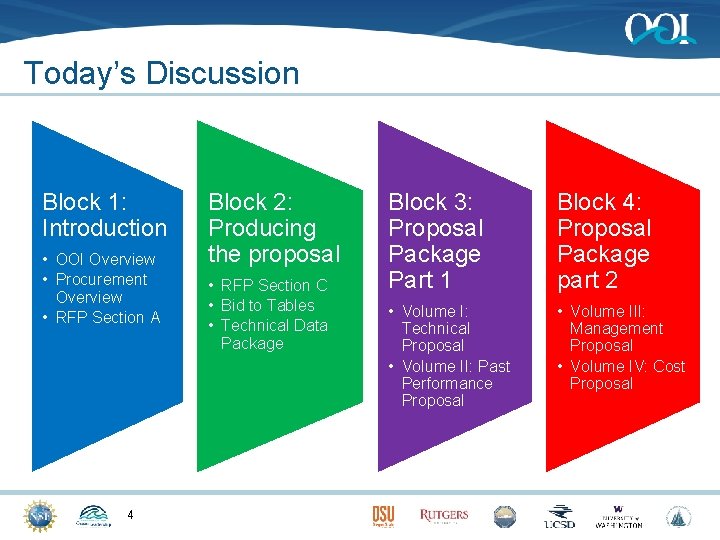
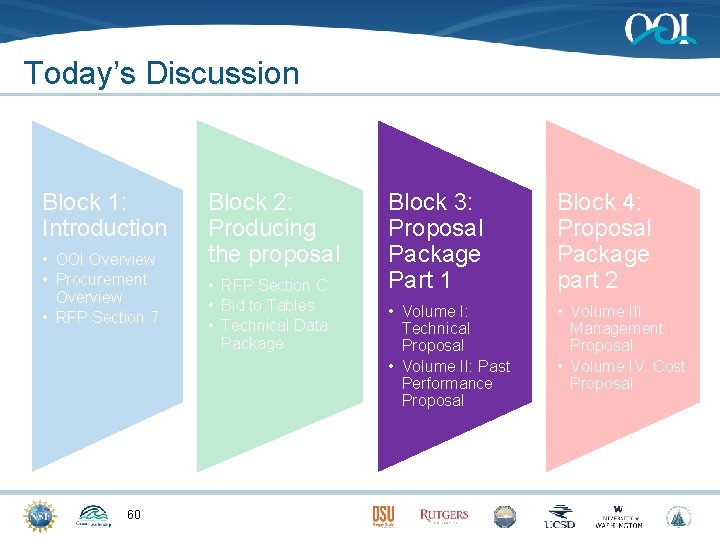
Today’s Discussion Block 1: Introduction • OOI Overview • Procurement Overview • RFP Section A 4 Block 2: Producing the proposal • RFP Section C • Bid to Tables • Technical Data Package Block 3: Proposal Package Part 1 Block 4: Proposal Package part 2 • Volume I: Technical Proposal • Volume II: Past Performance Proposal • Volume III: Management Proposal • Volume IV: Cost Proposal
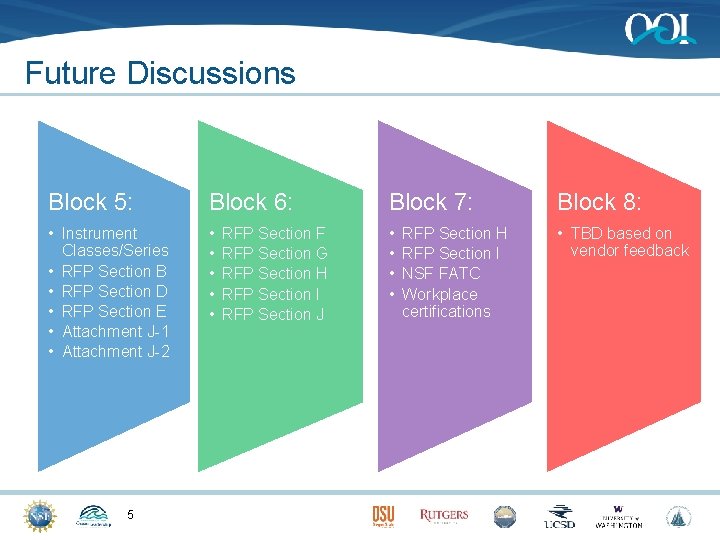
Future Discussions Block 5: Block 6: Block 7: Block 8: • Instrument Classes/Series • RFP Section B • RFP Section D • RFP Section E • Attachment J-1 • Attachment J-2 • • • TBD based on vendor feedback 5 RFP Section F RFP Section G RFP Section H RFP Section I RFP Section J RFP Section H RFP Section I NSF FATC Workplace certifications
Future Discussions • Block 5: Instrument Classes/Series, RFP Sections B – E, Attachments J-1 and J-2 • Block 6: RFP Sections F – J • Block 7: RFP Sections H & I, NSF FATC, workplace certifications 6
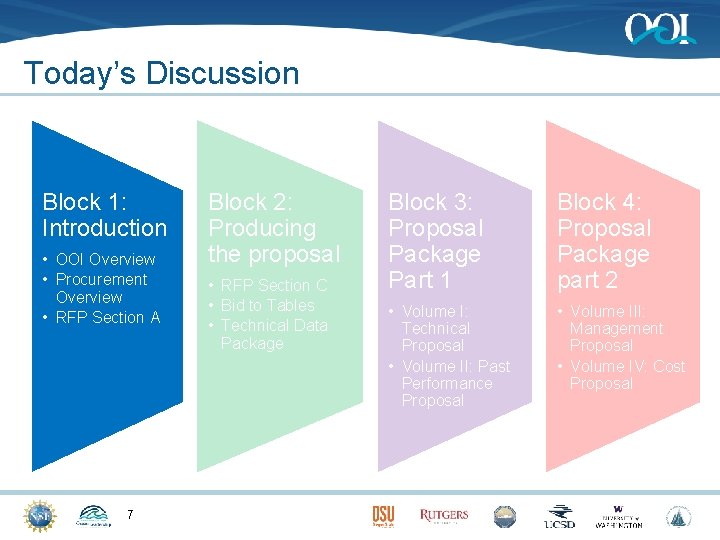
Today’s Discussion Block 1: Introduction • OOI Overview • Procurement Overview • RFP Section A 7 Block 2: Producing the proposal • RFP Section C • Bid to Tables • Technical Data Package Block 3: Proposal Package Part 1 Block 4: Proposal Package part 2 • Volume I: Technical Proposal • Volume II: Past Performance Proposal • Volume III: Management Proposal • Volume IV: Cost Proposal
Block 1 Overview • OOI Overview • Universal Contract Format • Science Themes • Purpose of RFP • Overview • IQC contract • OOI Products • Organizational Roles • CG, RSN, and CI roles • Typical Steps – get proposals • Final Network Design in on time and questions in • Common Specification early • Instrument Specifications • Mobile Instrument Specifications 8 • Compliance Matrix
OOI Overview The Ocean Observatories Initiative (OOI) is a long-term, NSF-funded program to provide 25 -30 years of sustained ocean measurements to study climate variability, ocean circulation and ecosystem dynamics, air-sea exchange, seafloor processes, and plate-scale geodynamics. -- OOI Brochure 9

OOI Science Themes • • • Ocean-Atmosphere Exchange Climate Variability, Ocean Circulation, and Ecosystems Turbulent Mixing and Biophysical Interactions Coastal Ocean Dynamics and Ecosystems Fluid-Rock Interactions and the Sub-seafloor Biosphere Plate-scale, Ocean Geodynamics Additional Science Foci • Ocean ecosystem health • Climate change • Carbon cycling • Ocean acidification 10

OOI Products and Platforms To Support OOI Science Themes: • OOI is integrating 764 Core Instruments on 56 Platforms into an Integrated Observatory OOI Platforms include: • Moorings: Surface and Subsurface buoys and instruments • Benthic Nodes: Benthic Experiment Packages (BEP) and Multifunction Nodes (MFN) • Profilers: surface piercing, wire following, shallow, deep, hybrid • Gliders/AUVs OOI Data Products will be available in near-real time and represent the best possible data set that can be obtained by the instruments that make up the OOI 11 11
OOI Implementation OOI implementation is carried out by: • Consortium of Ocean Leadership – overall management of the project and direct NSF awardee • Implementing Organizations (IOs) carry out construction, operations and maintenance, all aspects of data handling and distribution (Cyberinfrastructure), and education and public engagement 12 12
OOI Implementing Organizations OOI IOs are: • Woods Hole Oceanographic Institution with Oregon State University and Scripps Institute of Oceanography – Global and Coastal Nodes (CGSN) IO • University of Washington –Regional Scale Nodes (RSN) IO • San Diego State University – the Cyberinfrastructure IO • Rutgers University – the Education and Public Engagement (EPE) IO 13 13
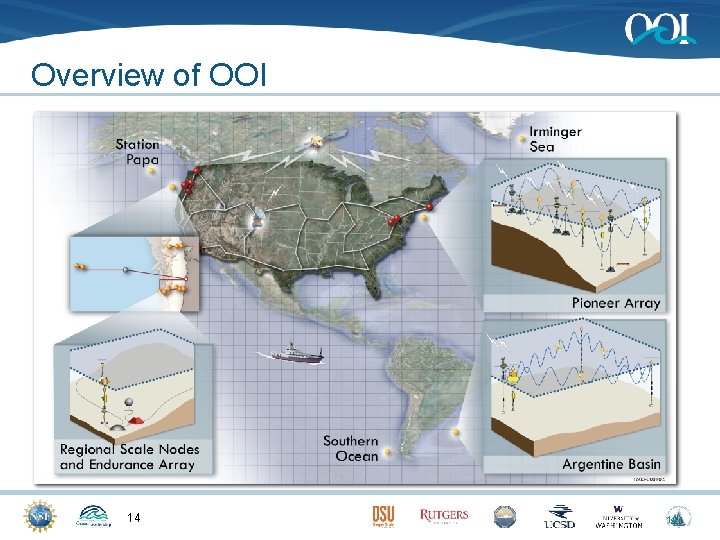
Overview of OOI 14 14
OOI Final Network Design • OOI Final Network Design (FND) Document contains an description of the OOI science goals, infrastructure design, history, and requirements and is found at: • http: //www. oceanleadership. org/wpcontent/uploads/2009/02/1101 -00000_FND_OOI_ver_206_Pub. pdf • See the Preliminary Design review and the Science Prospectus • http: //www. oceanobservatories. org/about/planninghistory/preliminary-design-review/ • http: //www. oceanleadership. org/files/Science_Prospectus _2007 -10 -10_lowres_0. pdf 15
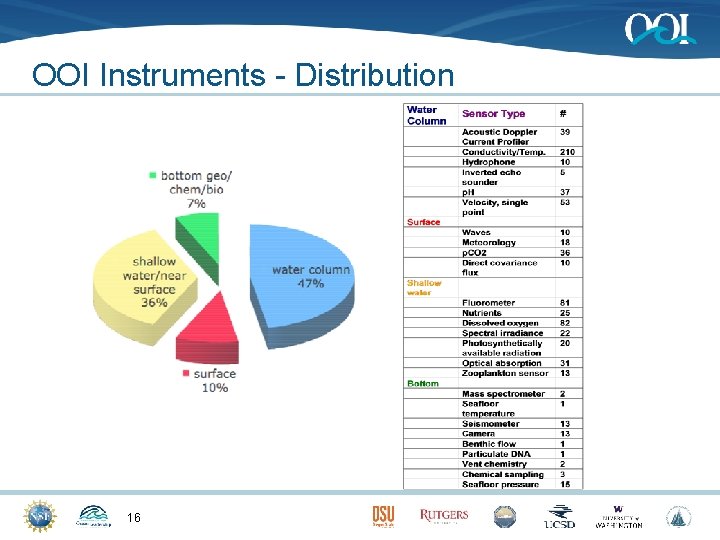
OOI Instruments - Distribution 16
OOI Instruments - Specifications OOI Instruments are purchased through a competitive process directed by OL for instruments needed across the marine IOs or by the IOs for instruments needed only within one IO. Instruments on mobile platforms such as gliders, AUVs, and wire-following profilers are generally obtained as part of the platform package. Instrument specifications describe the OOI’s needs (shall statements) and wants (should statements) for both science and engineering aspects of the instruments’ performance. The Common Instrument specification and individual instrument specifications are discussed in the RFP section of this presentation. 17
Uniform Contract Format (FAR 15. 204 -1) Sections A – M of the RFP: A B C D E F G H I J K L M Solicitation / Contract Form Schedule (Contract Line Items) Description / Specifications / Statement of Work Packaging and Marking Inspection and Acceptance Deliveries or Performance Contract Administration Data Special Contract Requirements Contract Clauses List of Attachments Representations, Certification and Other Statements Proposal Instructions to Offerors Evaluation Factors for Award Cover letter must address adhering to Terms and Conditions 18
Purpose of RFP • The Offeror whose proposal provides the best value to the project when price and other factors are considered will be awarded the contract • Best Value is defined as an award based on the greatest overall benefit in response to the requirement • Each of the classes of instruments may be awarded to the same Offeror or may be awarded to separate Offerors (more detail in the RFP) 19
IQC contract • Requires the OOI to buy a Guaranteed Minimum Amount under the contract but leave actual requirements to later determination • Commitment of funds (beyond the guaranteed minimum) does not occur until actual orders are placed 20
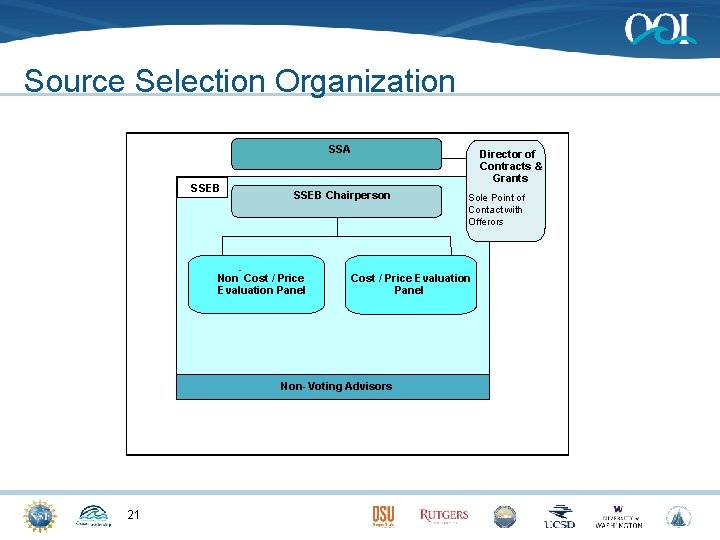
Source Selection Organization SSA SSEB Director of Contracts & Grants SSEB Chairperson Non Cost / Price Evaluation Panel Sole Point of Contact with Offerors Cost / Price Evaluation Panel Non- Voting Advisors 21
Typical Timeline for Evaluation • RFP issued • Submit request to participate in virtual Bidder’s Conference • Virtual Bidder’s Conference • Deadline for submitting questions (questions may be accepted after this date) • Responses to questions posted • Proposals due • Clarifications requested on Initial Proposals • Consensus on Offeror proposals • Source Selection Decision • Memorandum of Negotiation to NSF • Contract Award • Typical goal is to get contract awarded within 10 weeks of proposal receipt 22
Compliance Matrix • Volumes Submitted (Per Section L. -4. 1) • Submitted (Y/N) - Volume 1 - Technical Proposal - Volume 2 - Past Performance - Volume 3 - Management - Volume 4 - Cost / Price 23
Compliance Matrix • General - Section Reference A. 3 and L. 4. 2 - Mail: One (1) signed original, two (2) hard copies, and two (2) electronic copies of each proposal volume on CDs - A. 4 and Attachment J-5 - Conformance Checklist - Cover letter must address adhering to Terms and Conditions • L. 4. 2 - Cover page with volume identified • L. 4. 2 - 8 ½” x 11” paper with 1 -inch margins around all edges, 12 -font type • L. 4. 3 - Complete information for Offeror Points of Contact • Section K - Signed Representations and Certifications 24
Compliance Matrix Volume 1—Technical • L-4. 4. 2. 1 - Completed Table L-1 (Word version to complete is included in an attachment to this RFP) • L-4. 4. 2. 1 - Completed Table L-2 (Word version to complete is included in an attachment to this RFP) • L-4. 4. 2. 2 - Describe calibration procedures and details • L-4. 4. 2. 3 - Describe bio-fouling susceptibility and mitigation • L-4. 4. 2. 4 - Describe risks and risk reduction steps 25
Compliance Matrix Volume 2—Past Performance • L-4. 4. 3 - Fill out Table L-3 and include in Volume 2 • L-4. 4. 3 - Descriptions of three relevant past efforts • L-4. 4. 3 - Contact information for all Points of Contact for all references supplied • L-4. 4. 3 - Production Capacity to deliver instruments 26
Compliance Matrix Volume 3—Management • L-4. 4. 4 and C-2. 1 - Project Management and Communications Document • L-4. 4. 4 - Attach Existing Quality Management Plan • L-4. 4. 4 - Management techniques employed to meet delivery, schedule, management techniques • L-4. 4. 4 - Include Schedule for conducting testing • L-4. 4. 4 - Existing internal test procedures for Seafloor Pressure instruments • L-4. 4. 4 - All management requirements 27
Compliance Matrix Volume 4—Cost • L-4. 5. 1. 1 - Narrative support for cost methodology • L-4. 5. 1. 2 - Cost assumptions • L-4. 5. 1. 3 - Completed Table B-1 for proposed FFP CLINs 0001 and 0002 • B. 5 and L-4. 5. 1. 3 - Address availability of spare parts and components, for information only • L-4. 5. 1. 4 - Provide proof of financial stability, including documentation from past 2 fiscal years 28
Today’s Discussion Block 1: Introduction • OOI Overview • Procurement Overview • RFP Section A 29 Block 2: Producing the proposal • RFP Section C • Bid to Tables • Technical Data Package Block 3: Proposal Package Part 1 Block 4: Proposal Package part 2 • Volume I: Technical Proposal • Volume II: Past Performance Proposal • Volume III: Management Proposal • Volume IV: Cost Proposal
Block 2 Overview – Producing the Proposal • Section C • Required Schedules • Produce the Instruments as • Delivery Order and Delivery described in J-1 and J-2 Data Requirements • Bid to Table • Software • Project Management and • Technical Data Package Communications • Configuration Management • Quality Management • Calibration • Kickoff Meeting 30 • Additional Documentation • Deliverables
Section C, Background • This Statement of Work (SOW) is for an indefinite quantity contract (IQC) that will be issued by Ocean Leadership • The contract will consist of a base contract managed by Ocean Leadership and multiple Delivery Orders for Instruments issued by six Procuring Organizations • Delivery Orders may require spare parts and services, such as Instrument calibration 31
Production of the Instruments • The Contractor shall produce ordered Instruments over the lifetime of this contract as detailed in this SOW and further defined in attachments J-1 and J-2 - J-1 Common Specifications for Instruments on Fixed Platforms - J-2 Specification for Instrument on Fixed Platform • The Contractor shall ensure that the Instruments perform within the environment prescribed in attachments J-1 and J-2 • The Contractor shall deliver instruments in accordance with the Delivery Orders received 32
Section C, Statement of Work • The SOW defines the required activities (e. g. , meetings, updates to schedule, modifications, action item lists), deliverables and reports that the Contractor must perform to support delivery of the Instruments described in the SOW and in RFP attachments J-1 and J-2 • The Contractor shall furnish all personnel, materials, services and facilities necessary to perform all requirement as set forth in the SOW 33
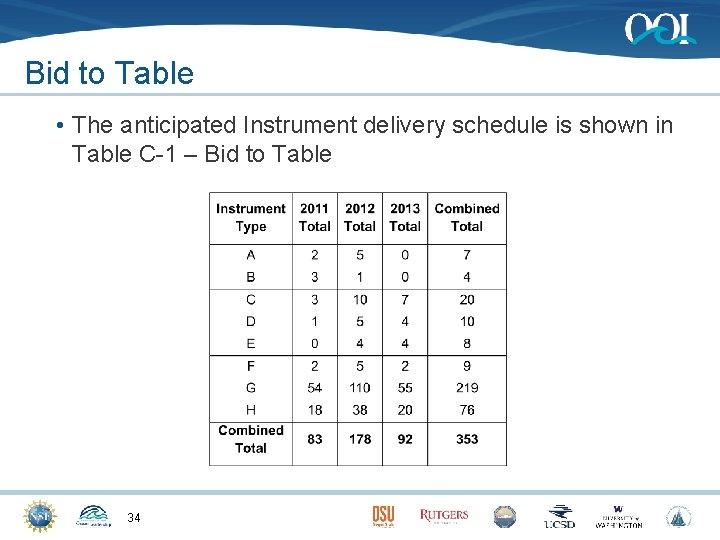
Bid to Table • The anticipated Instrument delivery schedule is shown in Table C-1 – Bid to Table 34
Procuring Organizations 1. Woods Hole Oceanographic Institution (WHOI), Woods Hole, MA 2. Regents of the University of California, San Diego (UCSD) 3. Oregon State University (OSU), Corvallis, OR 4. University of Washington (UW), Seattle, WA 5. Consortium for Ocean Leadership (OL), Washington, D. C. 35
Project Management and Communications • The Contractor shall include a description document for Project Management and Communications as part of its proposal in accordance with Section L of the RFP - This document shall be the basis for all Contractor Project Management and Communications activities under this contract • The Contractor shall provide, to Ocean Leadership, updates to the Project Management and Communications document whenever there any changes to items in the document 36
Project Management and Communications, continued • The Contractor shall be available for twice a month phone call meetings not to exceed 1 hour per call when requested by the Procuring Organization or Ocean Leadership • The Contractor shall document and track any action items generated during such meetings 37
Configuration Management • The Contractor shall follow a documented Configuration Management process to manage all changes to the Instruments throughout the production effort • OOI Configuration Management Plan - Document ID: 1000 -00000_CMP_OOI_2010 -10 -05_ver_291_Pub. pdf - On-line: http: //www. oceanleadership. org/newsresources/requests-for-proposals/ 38
Configuration Management, continued • The Contractor shall notify the Ocean Leadership Contracting Officer’s Technical Representative (COTR) 90 days prior to any proposed changes in form, fit, or function of the instrument(s) as affected by product upgrades, improvements, or modifications according to practices laid out in the OOI Configuration Management Plan • The Contractor shall notify the Ocean Leadership COTR 90 days prior to any planned cessation of production of hardware or software support 39
Configuration Management, concluded • The Contractor shall notify Ocean Leadership COTR of any changes to the software or to documentation (as outlined in Sections C. 3. 11. 2 and C. 3. 11. 3 of the RFP) • Any replacement parts, sensors, or instruments must meet or exceed the original specifications as contained in Attachments J-1 and J-2 40
Quality Management • The Contractor shall operate in accordance with the copy of its existing Quality Management Plan (Provided as part of its proposal in accordance with Section L of the RFP) • The Quality Management Plan should include the following: - Contractor's existing Quality Assurance or Quality Management Plan - Discrepancy Reporting System - Critical Defects Report 41
Calibration • The Offeror shall include, as part of its proposal, a copy of its existing calibration procedures • These procedures should cover the following: - Calibrations the Contractor shall perform prior to all instrument deliveries (new instruments or otherwise) - Calibration procedures to be carried out by the Procuring Organization • Test Procedures - The Offeror shall include, as part of its proposal, the Test Procedures used for the Instrument 42
Kickoff Meeting • Within two weeks after contract award, the Contractor shall host a Kickoff Meeting for Ocean Leadership and other invited organizations • The scope of this meeting shall include a review of the contents of the Project Management and Communications document • Processes for the Contractor to accept Delivery Orders from Procuring Organizations shall be documented and finalized at the meeting and updated to the Project Management and Communications document 43
Kickoff Meeting, continued • Key Contractor and Subcontractor personnel (if any) shall attend the Kickoff Meeting and be available to respond to questions • Following the meeting, the Contractor shall: - prepare the meeting minutes - prepare the initial Action Item List - track action items and post them according to the OOI Configuration Management Plan 44
Kickoff Meeting, concluded • Authorization for the Contractor to proceed shall be contingent on Ocean Leadership acceptance of the outcome of the Kickoff Meeting • This acceptance shall be in the form of official written notification from the Ocean Leadership Director of Contracts and Grants 45
Delivery Orders • The Contractor shall prepare a Delivery Order schedule upon receipt of each Delivery Order. • Schedule shall indicate the dates, at a minimum, the following: - Completion of Contractor Instrument testing - Calibration of Instruments - Delivery to the Procuring Organization • The Delivery Order schedule shall be provided to the Procuring Organization and to Ocean Leadership • The Procuring Organization shall be notified of any schedule changes within 24 hours, via e-mail 46
Delivery Orders, concluded • Testing Performance • The Contractor shall carry out testing of its Instruments in accordance with the testing procedures described in their proposal and incorporated into this contract • The Contractor shall: - document the results of its testing in a test report - deliver the test report to the Procuring Organization • After Contractor testing is satisfactorily completed, and the test report document delivered, the Procuring Organization will provide written signoff approval to the Contractor to deliver the Instruments 47
Calibration and Delivery Instructions Calibration • The Contractor shall calibrate all Instruments in accordance with calibration procedures prior to shipping to the Procuring Organization Instrument Delivery • The Contractor shall deliver Instruments, including installed firmware necessary for the instrument to function, in accordance with the delivery schedule • The following shall be delivered with the instrument: - Associated software and software documentation - Instrument documentation - Standard spare parts and repair kits 48
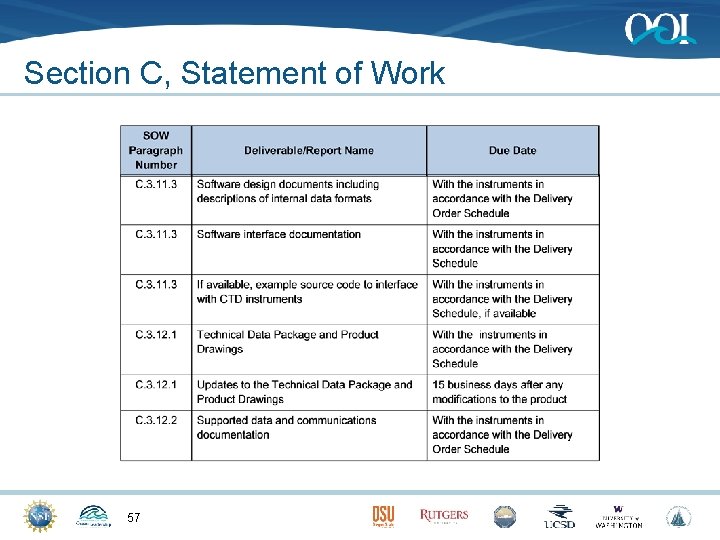
Software Documentation • The Contractor shall make available the following software documentation at the time the Instruments are delivered: - Software installation instructions - Software user instructions - Software design documents including descriptions of internal data formats - Software interface documentation that will enable the Procuring Organization to write Input/Output drivers - Any available source code to interface with the Instruments 49
Technical Data Package (TDP) • The Contractor shall provide to the Procuring Organization a Technical Design Package (TDP) describing the product to be delivered • The TDP may consist of all applicable technical data such as: - Drawings - Circuit diagrams - Specifications - Standards & Performance requirements - Quality Assurance requirements - Packaging details 50
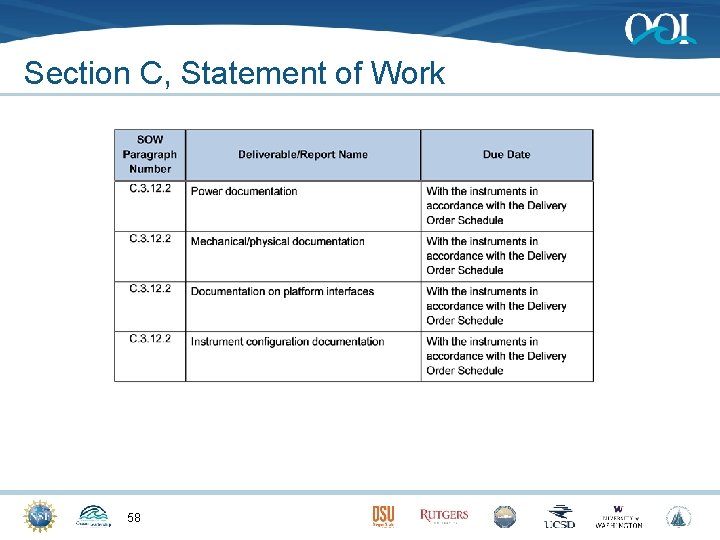
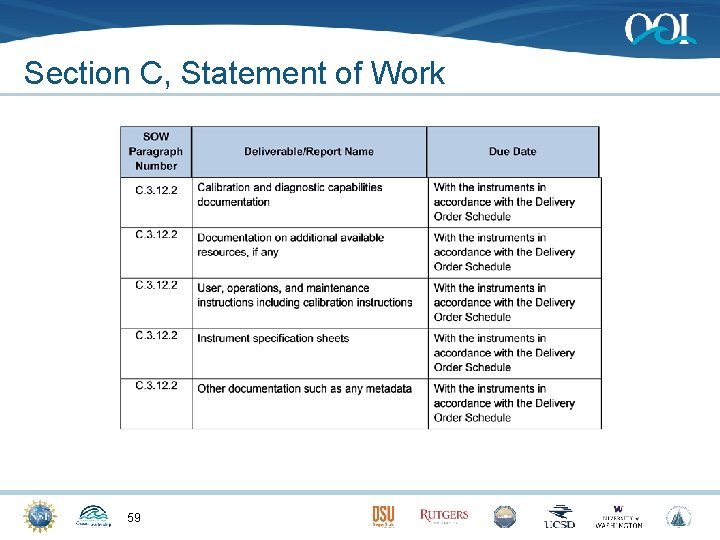
Additional Documentation • The Contractor shall make available the following documentation: - Supported data an communications (interfaces, protocols, data rates, output data formats, etc) - Power (internal supply, external interface, etc) - Platform interfaces describing how the Instrument is attached to a platform (mechanical, electrical, optical, etc) - Instrument configuration (parameters, remote control capabilities, upload/download of configuration files, etc) - Contractor’s calibration and diagnostic capabilities - Additional available resources (for configuration, maintenance, etc) 51
Additional Documentation, continued - User, operations, and maintenance instructions(s), including calibration and installation instructions - Instrument specification sheets - Identify and provide MSDS for any hazardous materials in the Instrument - 3 -D Model in formats compatible with Solid. Works or Auto. CAD, if available - Listing of any material in contact with seawater - Estimate the instrument dimensional changes at operational depth 52
Deliverables: • The following table summarizes the deliverables and their due dates. This table is available in the RFP – Section C, Table C-2 Deliverables and Reports • The Contractor may combine or more deliverables into a single document as they deem appropriate • All documentation deliverable shall be provided electronically in Adobe Reader (pdf) format, MS Office format (Word, Excel) or other agreed to format 53
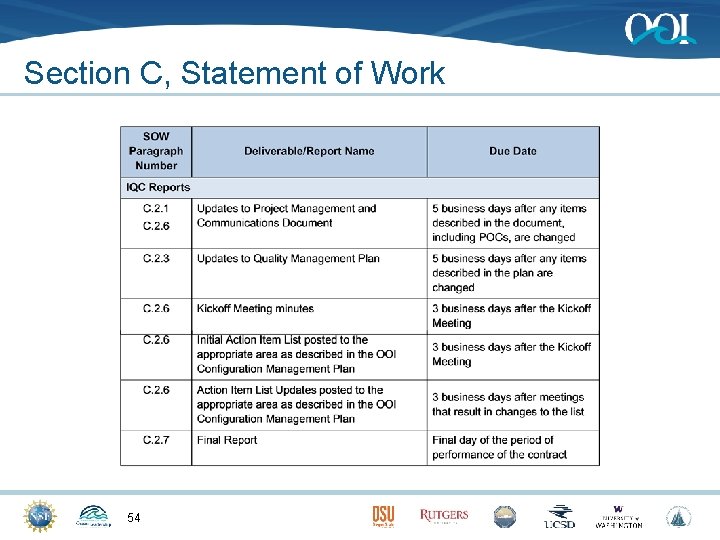
Section C, Statement of Work 54
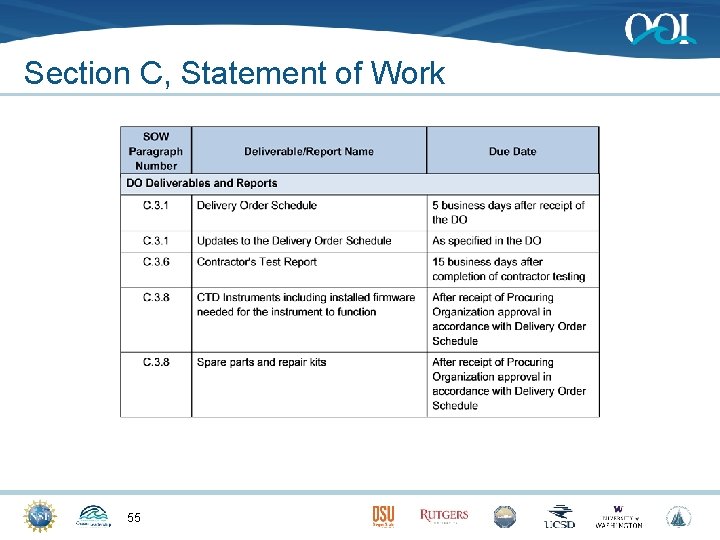
Section C, Statement of Work 55

Section C, Statement of Work 56
Section C, Statement of Work 57
Section C, Statement of Work 58
Section C, Statement of Work 59
Today’s Discussion Block 1: Introduction • OOI Overview • Procurement Overview • RFP Section 7 60 Block 2: Producing the proposal • RFP Section C • Bid to Tables • Technical Data Package Block 3: Proposal Package Part 1 Block 4: Proposal Package part 2 • Volume I: Technical Proposal • Volume II: Past Performance Proposal • Volume III: Management Proposal • Volume IV: Cost Proposal
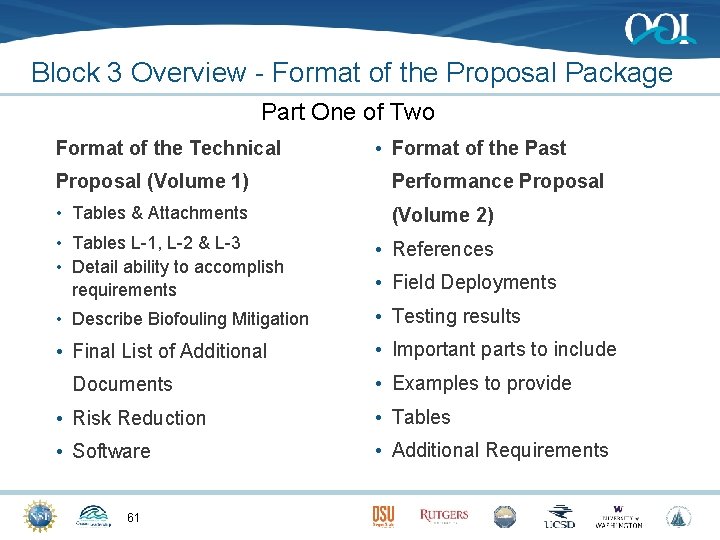
Block 3 Overview - Format of the Proposal Package Part One of Two Format of the Technical • Format of the Past Proposal (Volume 1) Performance Proposal • Tables & Attachments (Volume 2) • Tables L-1, L-2 & L-3 • Detail ability to accomplish requirements • References • Describe Biofouling Mitigation • Testing results • Final List of Additional • Important parts to include Documents • Field Deployments • Examples to provide • Risk Reduction • Tables • Software • Additional Requirements 61
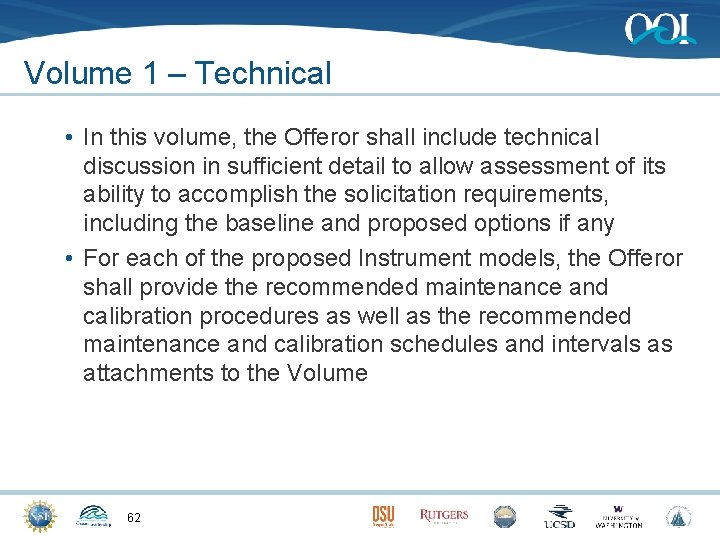
Volume 1 – Technical • In this volume, the Offeror shall include technical discussion in sufficient detail to allow assessment of its ability to accomplish the solicitation requirements, including the baseline and proposed options if any • For each of the proposed Instrument models, the Offeror shall provide the recommended maintenance and calibration procedures as well as the recommended maintenance and calibration schedules and intervals as attachments to the Volume 62
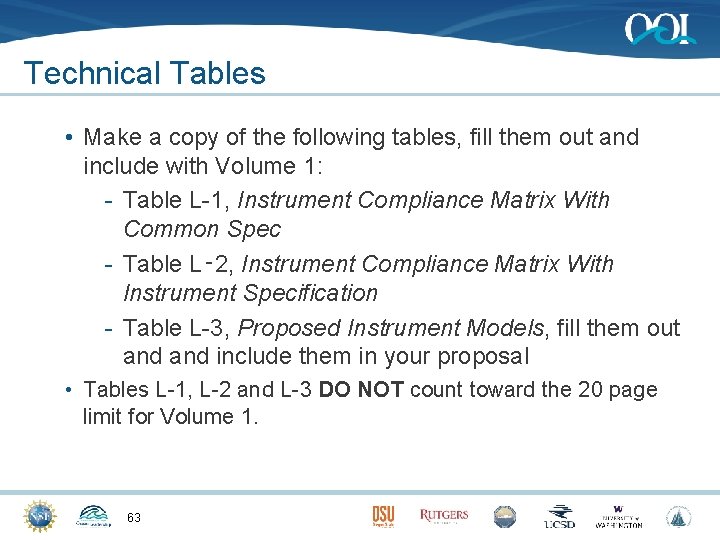
Technical Tables • Make a copy of the following tables, fill them out and include with Volume 1: - Table L-1, Instrument Compliance Matrix With Common Spec - Table L‑ 2, Instrument Compliance Matrix With Instrument Specification - Table L-3, Proposed Instrument Models, fill them out and include them in your proposal • Tables L-1, L-2 and L-3 DO NOT count toward the 20 page limit for Volume 1. 63
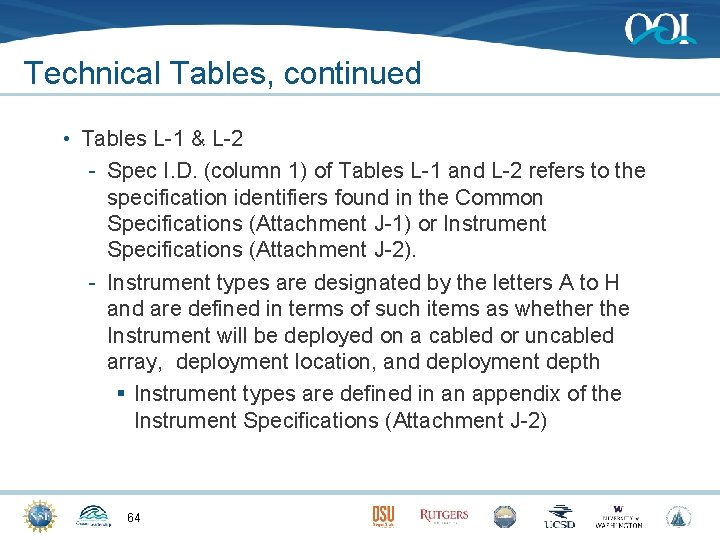
Technical Tables, continued • Tables L-1 & L-2 - Spec I. D. (column 1) of Tables L-1 and L-2 refers to the specification identifiers found in the Common Specifications (Attachment J-1) or Instrument Specifications (Attachment J-2). - Instrument types are designated by the letters A to H and are defined in terms of such items as whether the Instrument will be deployed on a cabled or uncabled array, deployment location, and deployment depth § Instrument types are defined in an appendix of the Instrument Specifications (Attachment J-2) 64
Technical Tables, concluded Tables L-1 & L-2 • Fill in the Parameter Value by Instrument Type columns with the parameters of your proposed instrument. Please use the units specified in the Units column. • Where available, cite specific references in the Substantiation column that substantiate the value listed. No substantiation needed where N/A is shown. • The same references can be used multiple times in the Substantiation column. Example references include: Independent test results; Independent research papers; and Engineering Analysis. 65
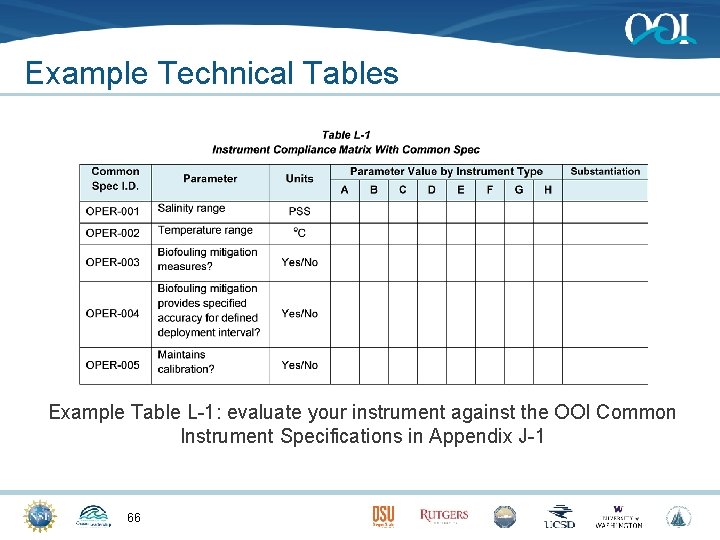
Example Technical Tables Example Table L-1: evaluate your instrument against the OOI Common Instrument Specifications in Appendix J-1 66
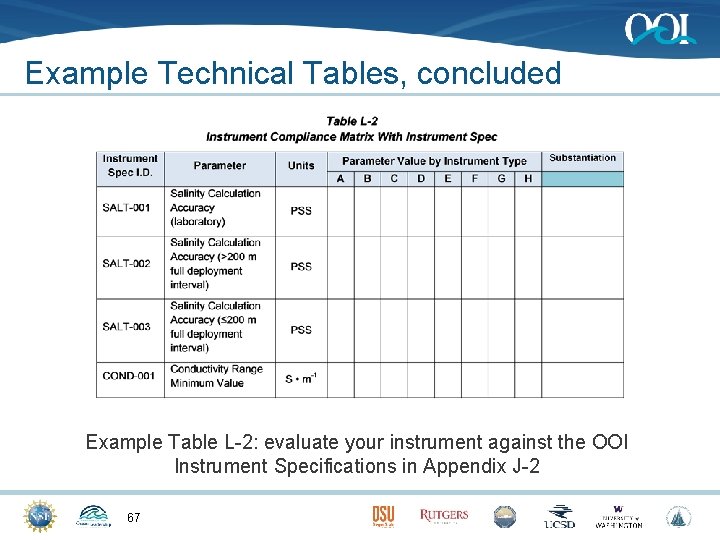
Example Technical Tables, concluded Example Table L-2: evaluate your instrument against the OOI Instrument Specifications in Appendix J-2 67
Table Instructions Table L-3 • List each of your proposed Instrument models for each type of Instrument needed • In the example provided, eight Instrument types are needed (listed as A-H) • You may have one instrument that can be used multiple times (e. g. one Instrument would meet the specifications for Type A, B, C and D) • The Instrument types you propose must correspond to the Parameter Value by Instrument Type listed in Tables L 1 & L 2 68
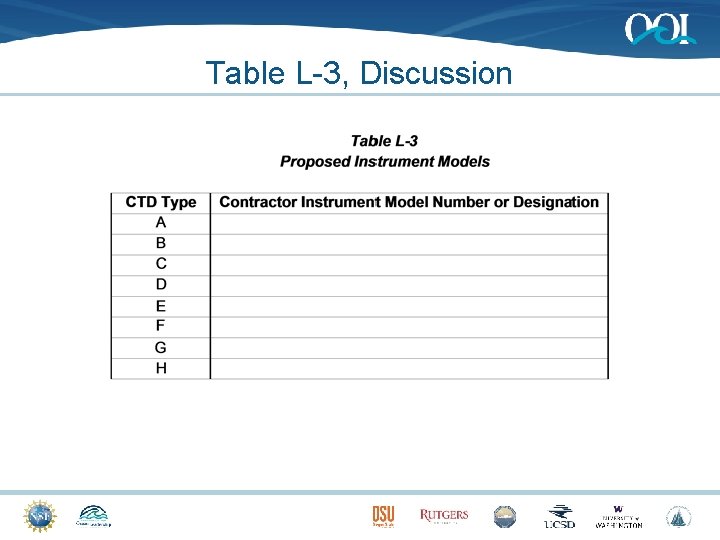
Table L-3, Discussion
Technical Information to Address Include the following information in Volume 1: • Describe biofouling mitigation design features of proposed Instruments • Describe recommended calibration procedures • List the software items that are provided with the purchase of the proposed Instruments – Examples include: Firmware, Input/Output drivers, additional software • Describe any specific steps taken that will reduce risks associated with Cost, Schedule, and Performance 70
Volume 2 – Past Performance • The Offeror shall submit Past Performance information on contracts that the Offeror considers most relevant to demonstrate the ability to perform the proposed effort • The Offeror shall identify three contracts under which it has delivered similar instruments within the past three years, or is presently delivering, and which contracts are similar to this solicitation • Make a three copies of and complete Table L-4, Past Performance for Each Contract 71
Past Performance Contacts, continued • Provide information that describes the relevance of each effort to the current acquisition as well as any problems encountered during these efforts and their resolution 72
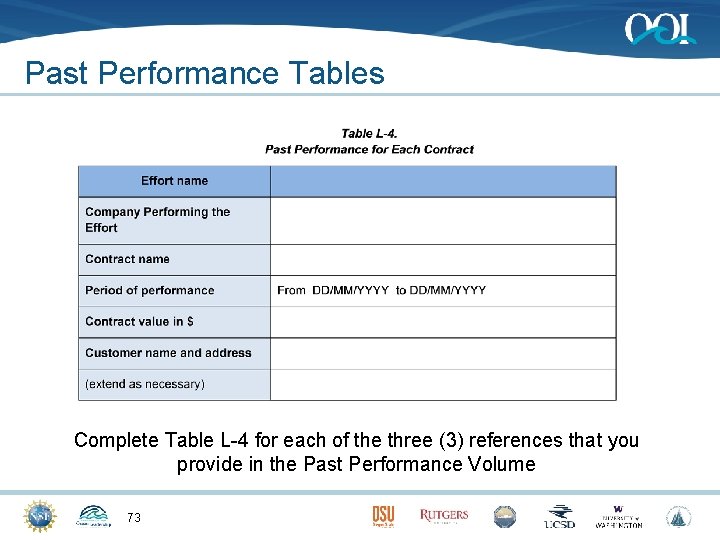
Past Performance Tables Complete Table L-4 for each of the three (3) references that you provide in the Past Performance Volume 73
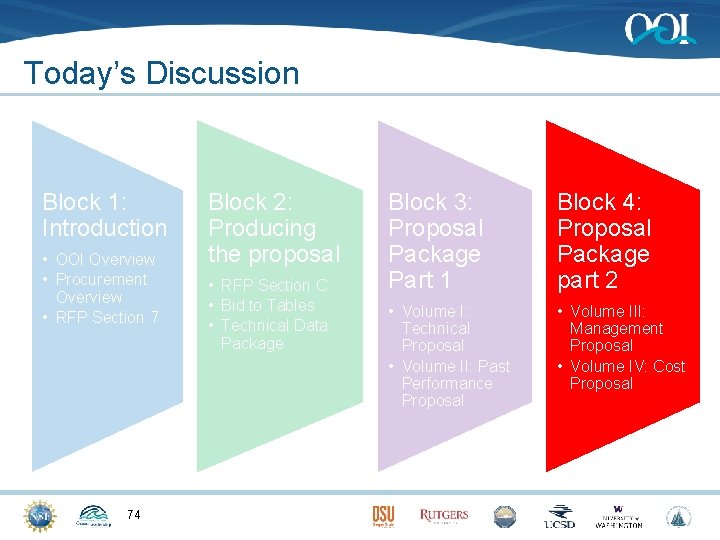
Today’s Discussion Block 1: Introduction • OOI Overview • Procurement Overview • RFP Section 7 74 Block 2: Producing the proposal • RFP Section C • Bid to Tables • Technical Data Package Block 3: Proposal Package Part 1 Block 4: Proposal Package part 2 • Volume I: Technical Proposal • Volume II: Past Performance Proposal • Volume III: Management Proposal • Volume IV: Cost Proposal
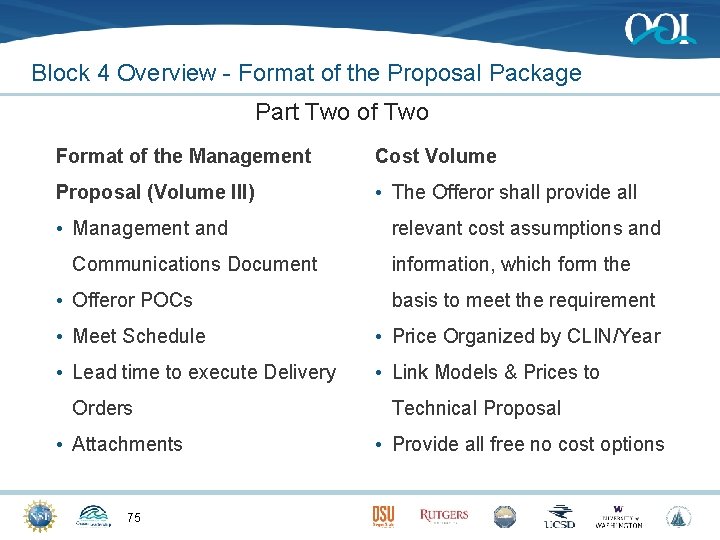
Block 4 Overview - Format of the Proposal Package Part Two of Two Format of the Management Cost Volume Proposal (Volume III) • The Offeror shall provide all • Management and Communications Document • Offeror POCs relevant cost assumptions and information, which form the basis to meet the requirement • Meet Schedule • Price Organized by CLIN/Year • Lead time to execute Delivery • Link Models & Prices to Orders • Attachments 75 Technical Proposal • Provide all free no cost options
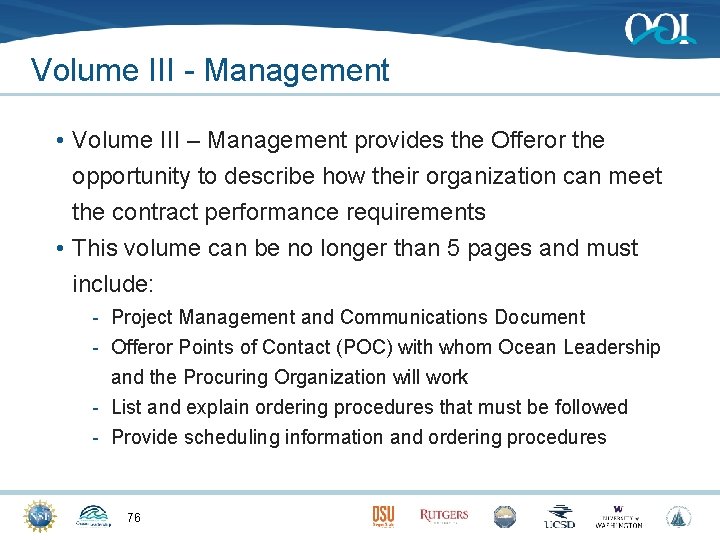
Volume III - Management • Volume III – Management provides the Offeror the opportunity to describe how their organization can meet the contract performance requirements • This volume can be no longer than 5 pages and must include: - Project Management and Communications Document - Offeror Points of Contact (POC) with whom Ocean Leadership and the Procuring Organization will work - List and explain ordering procedures that must be followed - Provide scheduling information and ordering procedures 76
Scheduling and Ordering Procedures Offeror shall provide: • Offeror POC and POC who will manage the contract • Lead time to execute Delivery Orders • Procedures for accepting Delivery Orders • Production capacity • Process for reporting and tracking • Lead time for instrument maintenance, including repair, refurbishment, and calibration • Lead time and details for any change in the configuration of any Offeror proposed instruments 77
Management – Other Content • Volume III should also include the Offeror’s: - Ability to meet the instrument delivery schedule § This can be demonstrated by providing delivery guarantees, simplified ordering requirements, and short lead times for placing orders - Management techniques that will be employed to meet the milestones outlined in RFP Section C - Ability and commitment to maintain (e. g. repair and calibrate) the instruments purchased by Ocean Leadership and the Procuring Organizations 78
Management Volume Attachments • Attachments to Offerors’ Volume III should include: - Existing Quality Management Plan (or explicitly state that no plan exists) - Schedule for conducting testing on instruments - Existing internal test procedures for instruments (or explicitly state that no plan exists) Note: Attachments do not count towards Volume III page limit and can be in the Offeror’s own format 79
Volume 4 – Cost/Price • Cost/Price Proposal: No Page Limit • Provide the prices for the Items and Services offered to meet the requirements • Explicitly state discounts provided • Provide a complete list of no-cost options that are available • Provide links to product descriptions so we can identify specifically what is being offered for the proposed price • Cost evaluation will be done separately team from the Technical, Past Performance, and Management evaluations 80
Volume 4 – Cost/Price, continued • The Offeror shall provide all relevant cost assumptions and information, which form the basis of its proposal • Cost assumptions and information include, but are not limited to, order size, order frequency, advanced procurement costs, and long lead costs • Prices shall be organized per the CLIN structure in Section B and the prices may vary over time 81
Volume 4 – Cost/Price, concluded • Link Models & Prices to Technical Proposal • Provide information on the available configurations • Provide information on similar configurations that do not meet the specifications • Provide all free no cost options • Explain if there is a maximum credit for items such as connectors or coatings • The Offeror shall fill out the form included in this solicitation as Attachment J-4 and include the completed form, “Certificate of Current Cost and Pricing Data, ” as an attachment to the Cover Letter 82
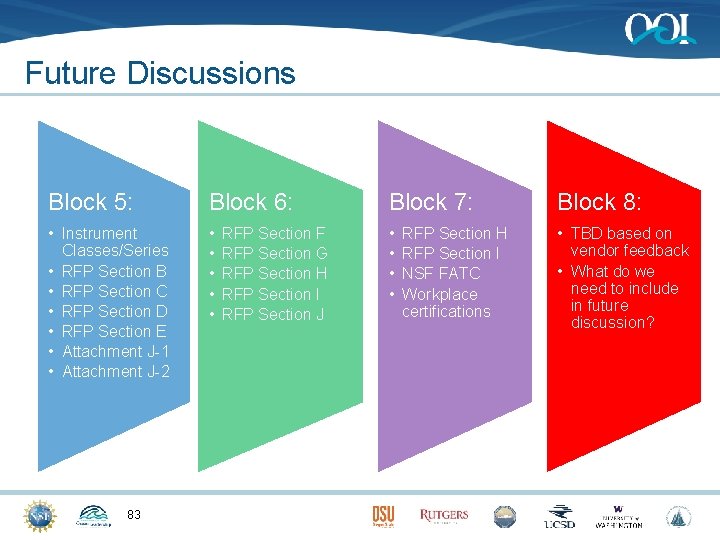
Future Discussions Block 5: Block 6: Block 7: Block 8: • Instrument Classes/Series • RFP Section B • RFP Section C • RFP Section D • RFP Section E • Attachment J-1 • Attachment J-2 • • • TBD based on vendor feedback • What do we need to include in future discussion? 83 RFP Section F RFP Section G RFP Section H RFP Section I RFP Section J RFP Section H RFP Section I NSF FATC Workplace certifications
Future Information • Contact with the procuring organizations is through the contracts officials… • All RFPs are posted on the OOI website… • Email responses are tailored to each RFP… • All information provided in response to questions will be posted on the website (all information is shared)… 84
- Slides: 84