
Ocean Color Radiometer Measurements of Long Island Sound





- Slides: 21
Ocean Color Radiometer Measurements of Long Island Sound Coastal Observational platform (LISCO): Comparisons with Satellite Data & Assessments of Uncertainties Presenter: Soe Min Hlaing Mentor/ Co-Mentor: Dr. Samir Ahmed/ Dr. Alexander Gilerson NOAA - CREST, City College of New York
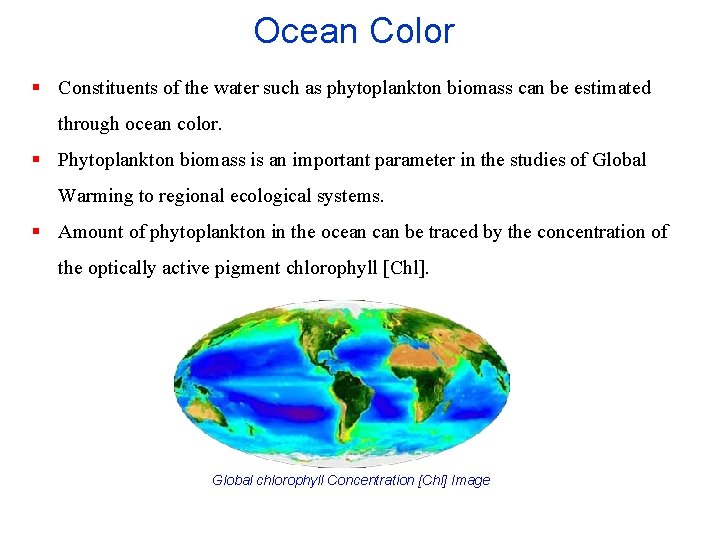
Ocean Color § Constituents of the water such as phytoplankton biomass can be estimated through ocean color. § Phytoplankton biomass is an important parameter in the studies of Global Warming to regional ecological systems. § Amount of phytoplankton in the ocean can be traced by the concentration of the optically active pigment chlorophyll [Chl]. Global chlorophyll Concentration [Chl] Image
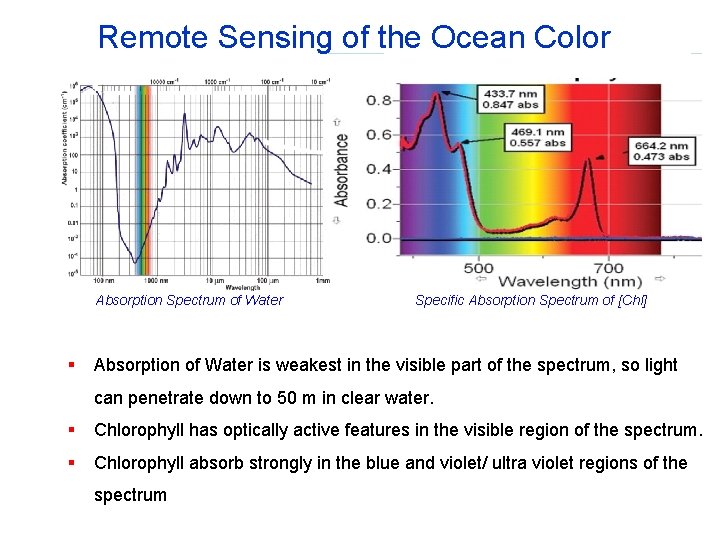
Remote Sensing of the Ocean Color Absorption Spectrum of Water § Specific Absorption Spectrum of [Chl] Absorption of Water is weakest in the visible part of the spectrum, so light can penetrate down to 50 m in clear water. § Chlorophyll has optically active features in the visible region of the spectrum. § Chlorophyll absorb strongly in the blue and violet/ ultra violet regions of the spectrum
Reflectance spectra of the open ocean Remote Sensing Reflectance Spectra of Ocean Water with Different Level of [Chl] Chlorophyll Concentration [Chl] as function of Blue – Green Ratio § In the open ocean chlorophyll is the main constituent of the water. § With increasing [Chl] water changes its color from blue to green. § Therefore [Chl] can be well characterized by blue-green ratio. § Blue-Green ratio algorithm does not work in coastal due to the complication of color dissolved organic matters (CDOM)
Ocean Color Satellite Sensors § Sea. WIFS (NASA) on Geo. Eye's satellite Ø 8 spectral bands (from 412 to 865 nm) with 1. 1 km resolution § MODIS (NASA) on Terra and Aqua satellite Ø 36 spectral bands (from 412 to 15 μm) with 250 m - 1 km resolutions § MERIS (ESA) on ENVISAT satellite Ø 16 spectral bands (from 412 nm to 14. 4 um) with 250 m - 1 km resolutions § OCM 2 (India) on Oceansat-2 satellite Ø 8 spectral bands (400 to 900 nm) with 1 – 4 km resolutions § VIIRS (NASA) future replacement of MODIS, planned to launch in 2011 Ø 22 Spectral bands (370 nm to 12. 5 um) with 650 m resolution
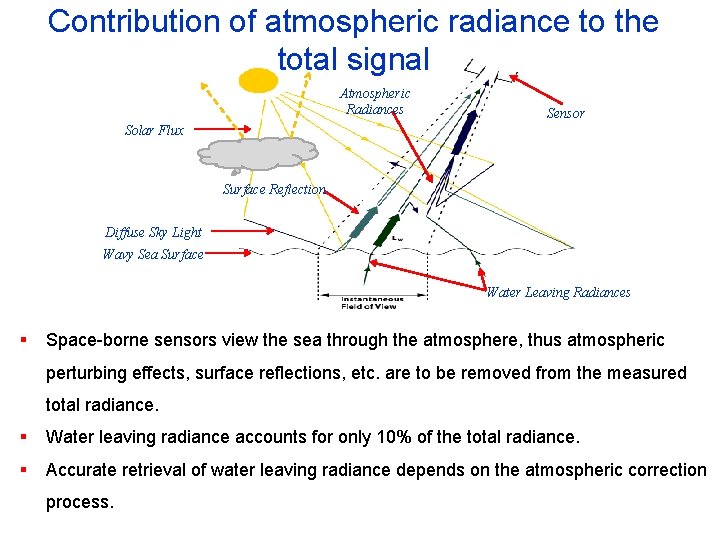
Contribution of atmospheric radiance to the total signal Atmospheric Radiances Sensor Solar Flux Surface Reflection Diffuse Sky Light Wavy Sea Surface Water Leaving Radiances § Space-borne sensors view the sea through the atmosphere, thus atmospheric perturbing effects, surface reflections, etc. are to be removed from the measured total radiance. § Water leaving radiance accounts for only 10% of the total radiance. § Accurate retrieval of water leaving radiance depends on the atmospheric correction process.
Validation of the Ocean Color Satellite Sensors § Effectiveness of the water leaving radiance retrieval needs to be accessed and validated. § Special system for calibration and validation of the Ocean Color satellites should be established. § Objective of this work is to assess the capability of validation using above water observations and evaluate the associated uncertainties
AERONET-Ocean Color AERONET – Ocean Color: is a sub-network of the Aerosol Robotic Network (AERONET), relying on modified sun-photometers to support ocean color validation activities with highly consistent time-series of water leaving radiance and aerosol optical thickness measurements. Rationale: • Autonomous radiometers operated on fixed platforms in coastal regions; • Identical measuring systems and protocols, calibrated using a single reference source and method, and processed with the same code; • Standardized products of normalized water-leaving radiance and aerosol optical thickness. G. Zibordi et al. A Network for Standardized Ocean Color Validation Measurements. Eos Transactions, 87: 293, 297, 2006.
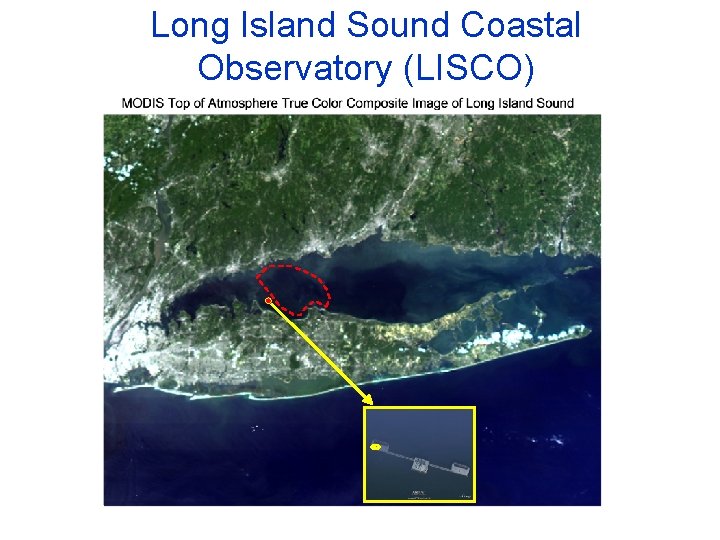
Long Island Sound Coastal Observatory (LISCO)
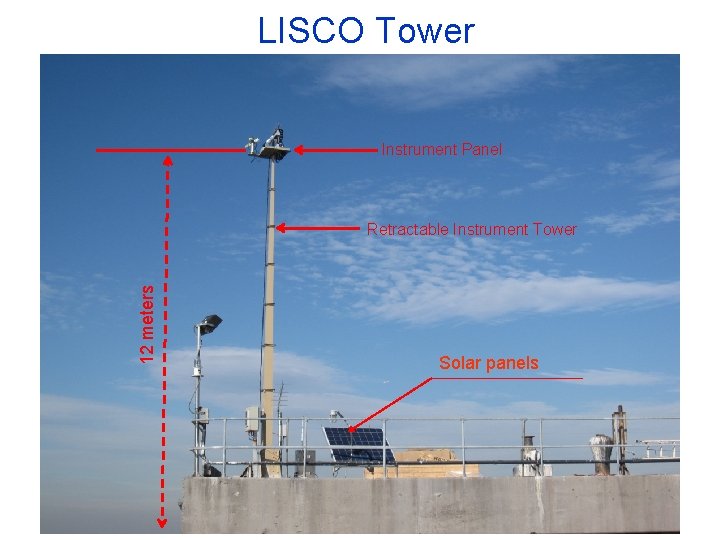
LISCO Tower Instrument Panel 12 meters Retractable Instrument Tower Solar panels
Sea. PRISM and Hyper. SAS instruments installed on the tower Sea. PRISM Instrument Hyper. SAS Instrument • Water Leaving Radiance • Direct Sun Irradiance and Sky Radiance • Sky Radiance and Down Welling Irradiance • at 413, 443, 490, 551, 668, 870 and 1018 nm Wavelengths • Hyper-Spectral 305 to 900 nm wavelength range.
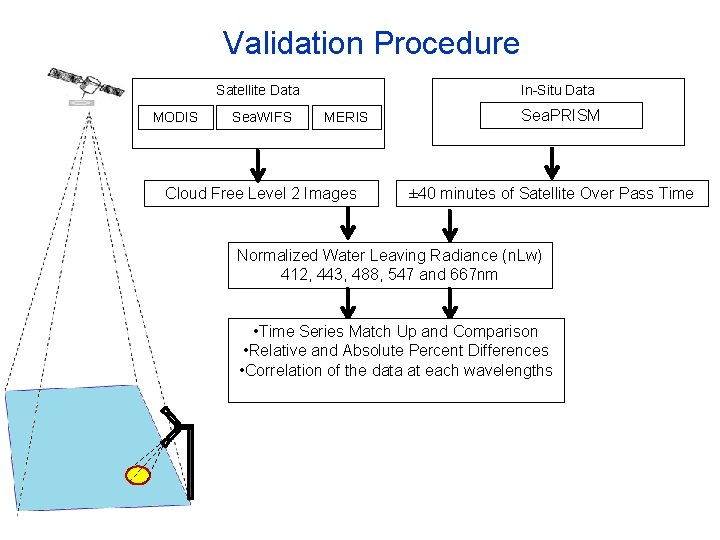
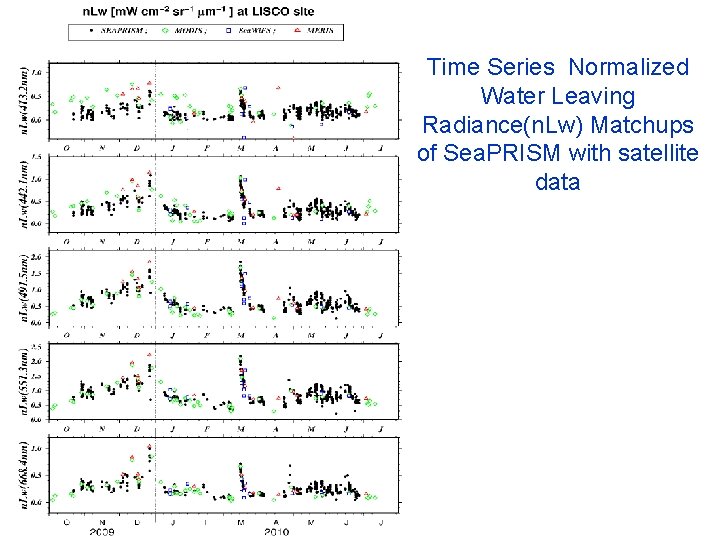
Validation Procedure Satellite Data MODIS Sea. WIFS In-Situ Data MERIS Cloud Free Level 2 Images Sea. PRISM ± 40 minutes of Satellite Over Pass Time Normalized Water Leaving Radiance (n. Lw) 412, 443, 488, 547 and 667 nm • Time Series Match Up and Comparison • Relative and Absolute Percent Differences • Correlation of the data at each wavelengths
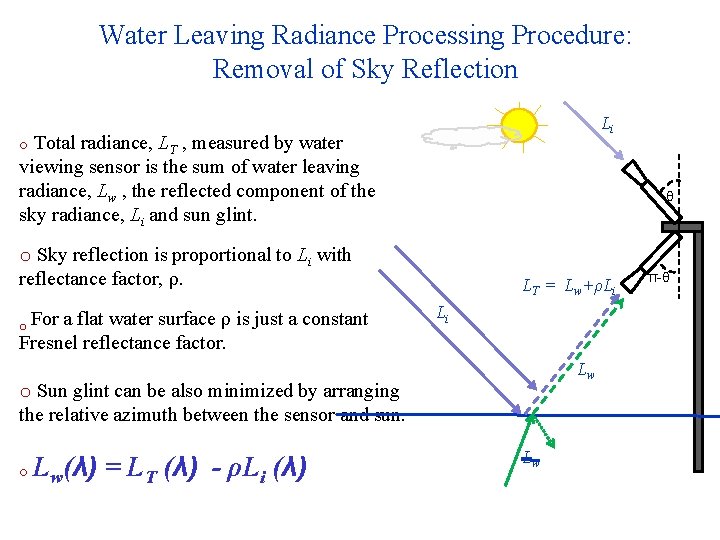
Water Leaving Radiance Processing Procedure: Removal of Sky Reflection Li o Total radiance, LT , measured by water viewing sensor is the sum of water leaving radiance, Lw , the reflected component of the sky radiance, Li and sun glint. θ o Sky reflection is proportional to Li with reflectance factor, ρ. o For a flat water surface ρ is just a constant Fresnel reflectance factor. LT = Lw+ρLi Li Lw o Sun glint can be also minimized by arranging the relative azimuth between the sensor and sun. o Lw(λ) = LT (λ) - ρLi (λ) Lw π-θ
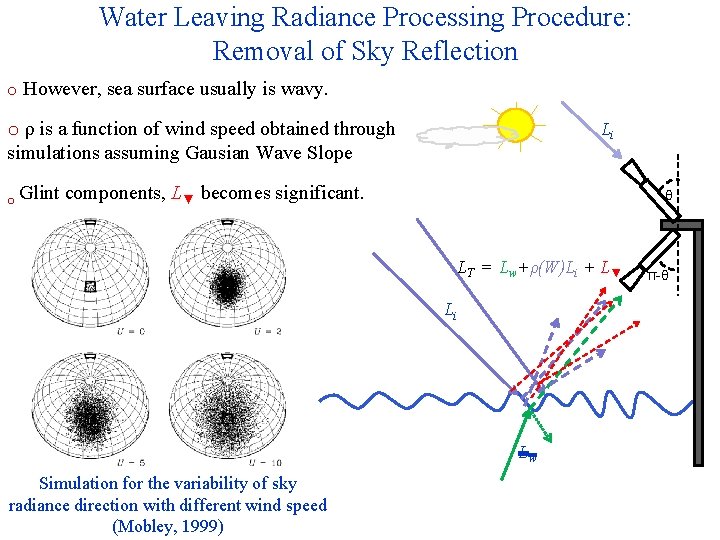
Water Leaving Radiance Processing Procedure: Removal of Sky Reflection o However, sea surface usually is wavy. o ρ is a function of wind speed obtained through simulations assuming Gausian Wave Slope o Glint Li components, L▼ becomes significant. θ LT = Lw+ρ(W)Li + L▼ Li Lw Simulation for the variability of sky radiance direction with different wind speed (Mobley, 1999) π-θ
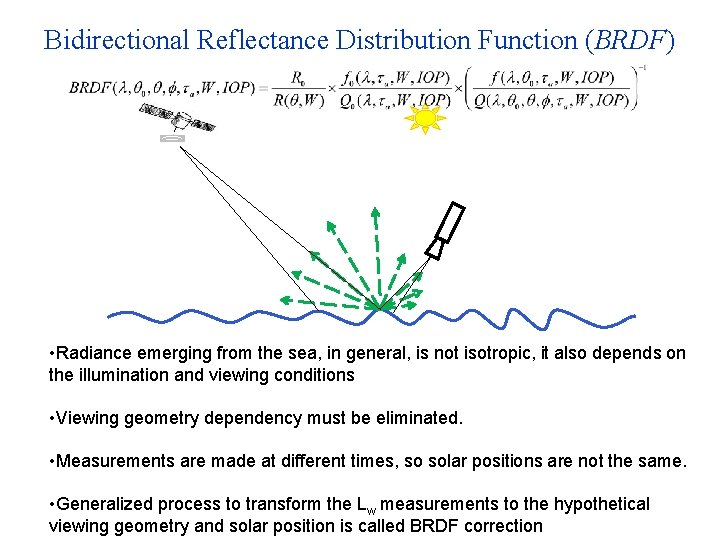
Bidirectional Reflectance Distribution Function (BRDF) • Radiance emerging from the sea, in general, is not isotropic, it also depends on the illumination and viewing conditions • Viewing geometry dependency must be eliminated. • Measurements are made at different times, so solar positions are not the same. • Generalized process to transform the Lw measurements to the hypothetical viewing geometry and solar position is called BRDF correction
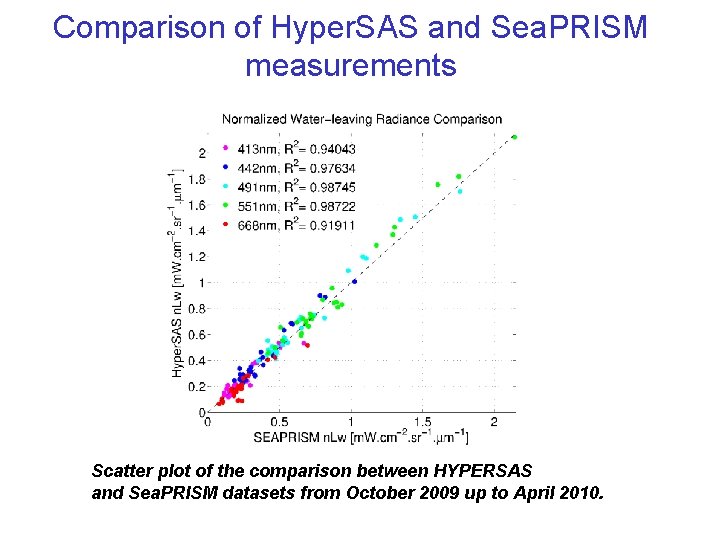
Comparison of Hyper. SAS and Sea. PRISM measurements Scatter plot of the comparison between HYPERSAS and Sea. PRISM datasets from October 2009 up to April 2010.
Time Series Normalized Water Leaving Radiance(n. Lw) Matchups of Sea. PRISM with satellite data
Comparison of Sea. PRISM and Satellite Data
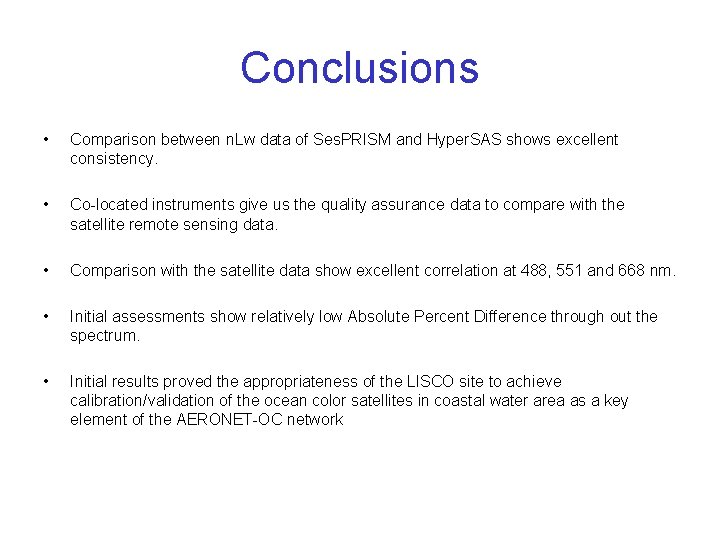
Conclusions • Comparison between n. Lw data of Ses. PRISM and Hyper. SAS shows excellent consistency. • Co-located instruments give us the quality assurance data to compare with the satellite remote sensing data. • Comparison with the satellite data show excellent correlation at 488, 551 and 668 nm. • Initial assessments show relatively low Absolute Percent Difference through out the spectrum. • Initial results proved the appropriateness of the LISCO site to achieve calibration/validation of the ocean color satellites in coastal water area as a key element of the AERONET-OC network
Acknowledgement • This study was supported and monitored by National Oceanic and Atmospheric Administration (NOAA) under Grant - CREST Grant # NA 06 OAR 4810162. • The statements contained within the manuscript/research article are not the opinions of the funding agency or the U. S. government, but reflect the author’s opinions.
Thanks ?