
Ocean Biogeochemistry C O 2 N P Achievements
Ocean Biogeochemistry (C, O 2, N, P) Achievements and challenges Nicolas Gruber Environmental Physics, ETH Zürich, Zurich, Switzerland. Using input from the following CWP: Hood; Ship-based Repeat Hydrography Monteiro; A global sea surface carbon observing system Feely; An � Observational Network for Ocean Acidification Gruber; Adding Oxygen to Argo Claustre; Bio-optical profiling floats Byrne; Sensors and Systems for Marine CO 2 System Variables Adornato; In Situ Nutrient Sensors Borges; Carbon Dynamics in Coastal Oceans
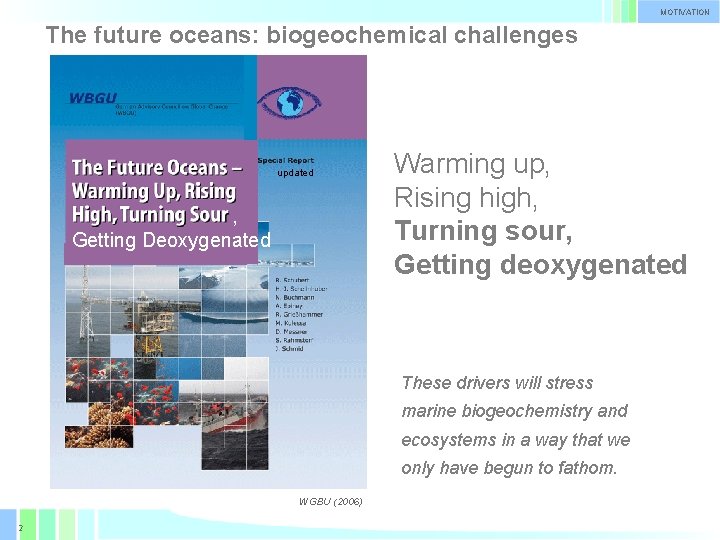
MOTIVATION The future oceans: biogeochemical challenges updated , Getting Deoxygenated Warming up, Rising high, Turning sour, Getting deoxygenated These drivers will stress marine biogeochemistry and ecosystems in a way that we only have begun to fathom. WGBU (2006) 2
OUTLINE Outline 1. Ocean carbon sink: Revelle’s perpetual quest or why we still need VOS and a repeat hydrography program 2. Ocean acidification: The flip-side of the coin or why there is no free lunch 3. Ocean deoxygenation: or why we would like to add oxygen sensors on Argo 4. Toward an integrated observing system: or how should all of this work together? 3 OBSERVING OCEAN BIOGEOCHEMISTRY
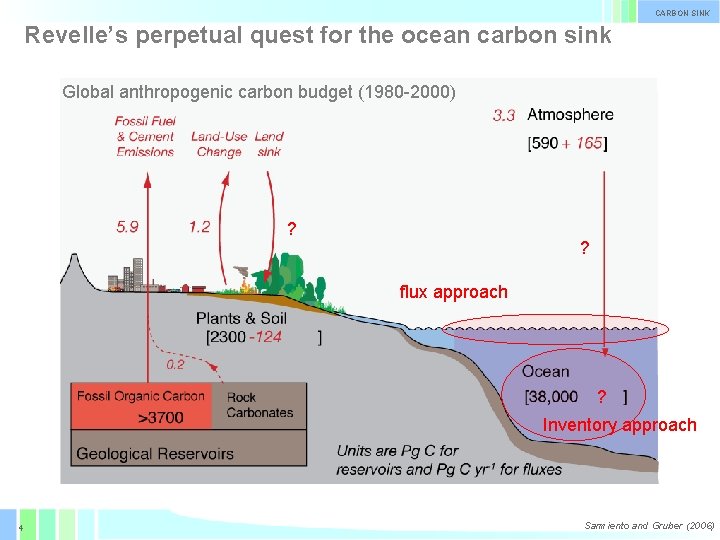
CARBON SINK Revelle’s perpetual quest for the ocean carbon sink Global anthropogenic carbon budget (1980 -2000) ? ? flux approach ? Inventory approach 4 Sarmiento and Gruber (2006)
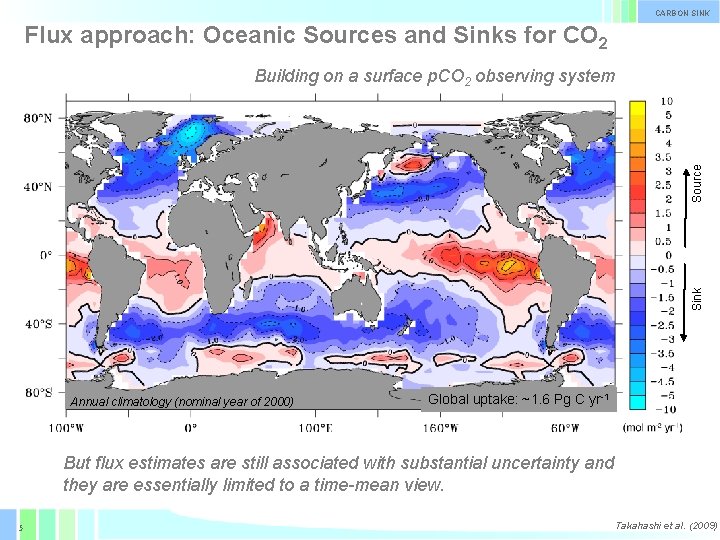
CARBON SINK Flux approach: Oceanic Sources and Sinks for CO 2 Sink Source Building on a surface p. CO 2 observing system Annual climatology (nominal year of 2000) Global uptake: ~1. 6 Pg C yr-1 But flux estimates are still associated with substantial uncertainty and they are essentially limited to a time-mean view. 5 Takahashi et al. (2009)
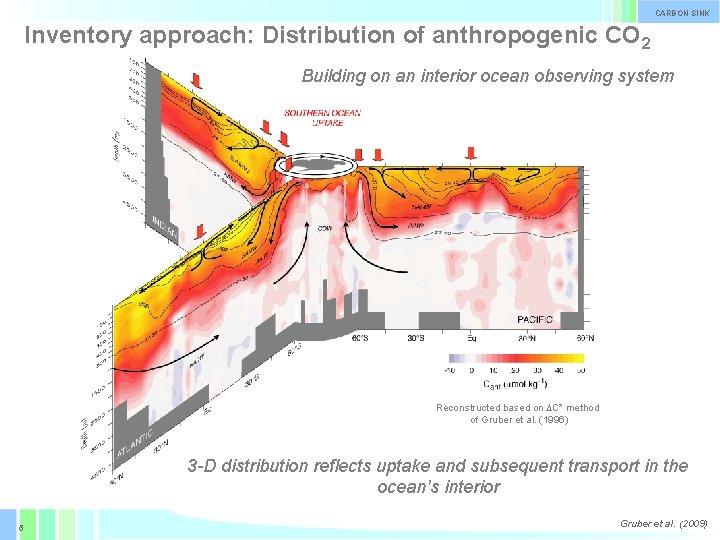
CARBON SINK Inventory approach: Distribution of anthropogenic CO 2 Building on an interior ocean observing system Reconstructed based on C* method of Gruber et al. (1996) 3 -D distribution reflects uptake and subsequent transport in the ocean’s interior 6 Gruber et al. (2009)
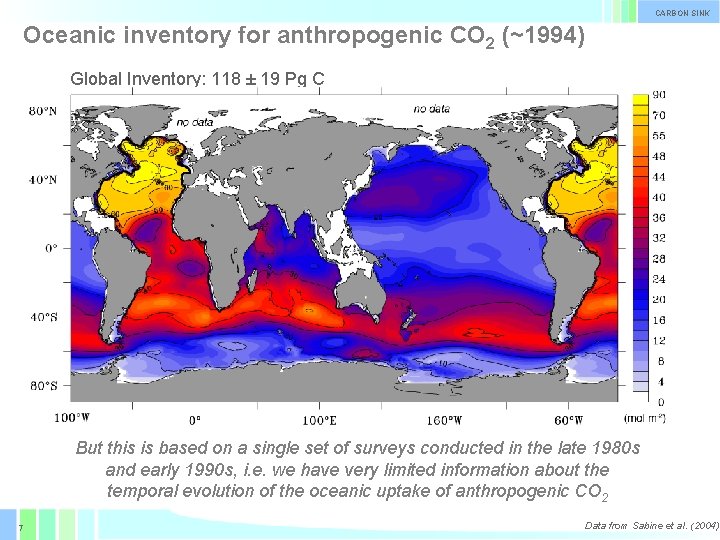
CARBON SINK Oceanic inventory for anthropogenic CO 2 (~1994) Global Inventory: 118 ± 19 Pg C But this is based on a single set of surveys conducted in the late 1980 s and early 1990 s, i. e. we have very limited information about the temporal evolution of the oceanic uptake of anthropogenic CO 2 7 Data from Sabine et al. (2004)
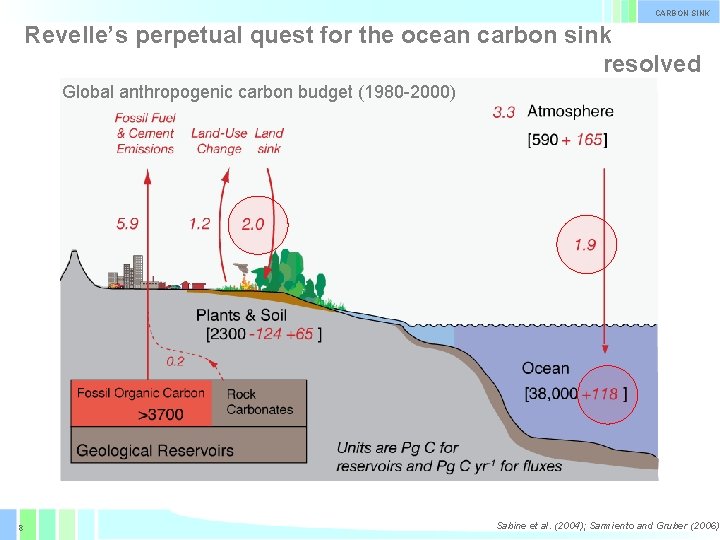
CARBON SINK Revelle’s perpetual quest for the ocean carbon sink resolved Global anthropogenic carbon budget (1980 -2000) 8 Sabine et al. (2004); Sarmiento and Gruber (2006)
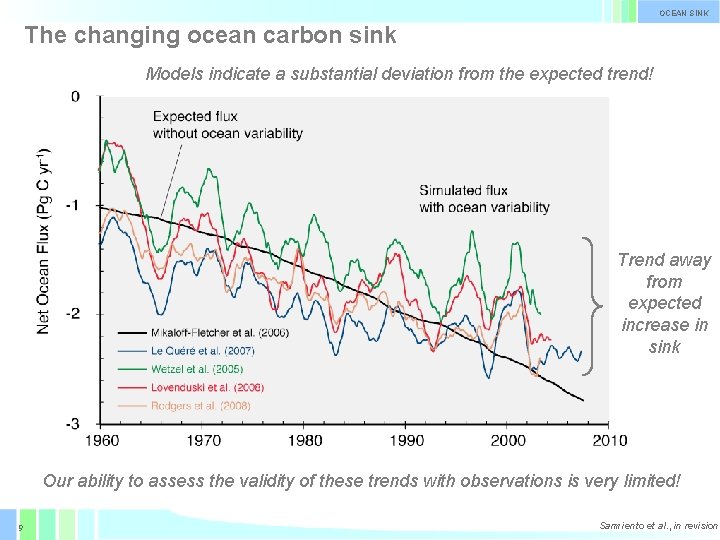
OCEAN SINK The changing ocean carbon sink Models indicate a substantial deviation from the expected trend! Trend away from expected increase in sink Our ability to assess the validity of these trends with observations is very limited! 9 Sarmiento et al. , in revision
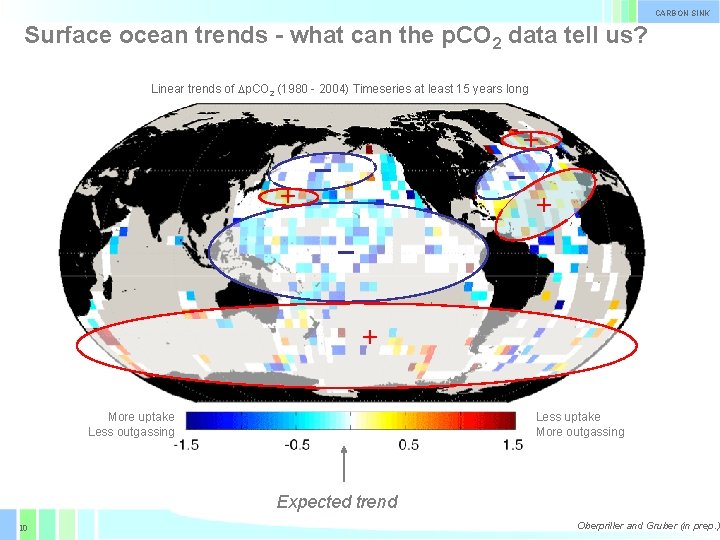
CARBON SINK Surface ocean trends - what can the p. CO 2 data tell us? Linear trends of p. CO 2 (1980 - 2004) Timeseries at least 15 years long + + – – + More uptake Less outgassing Less uptake More outgassing Expected trend 10 Oberpriller and Gruber (in prep. )
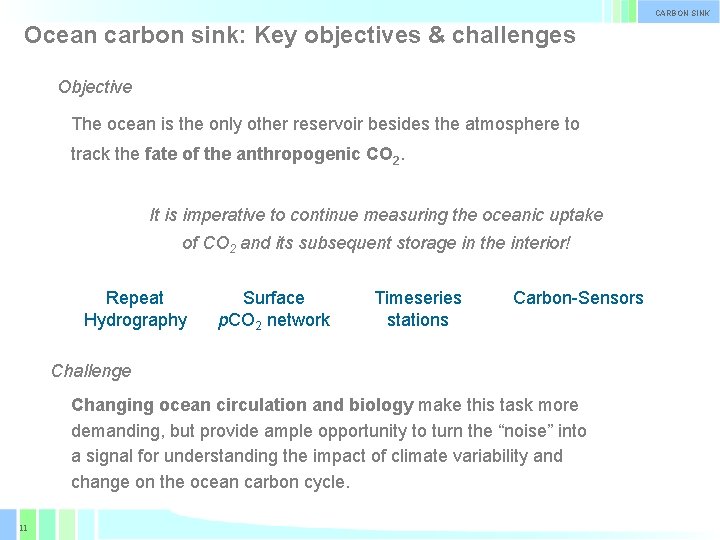
CARBON SINK Ocean carbon sink: Key objectives & challenges Objective The ocean is the only other reservoir besides the atmosphere to track the fate of the anthropogenic CO 2. It is imperative to continue measuring the oceanic uptake of CO 2 and its subsequent storage in the interior! Repeat Hydrography Surface p. CO 2 network Timeseries stations Carbon-Sensors Challenge Changing ocean circulation and biology make this task more demanding, but provide ample opportunity to turn the “noise” into a signal for understanding the impact of climate variability and change on the ocean carbon cycle. 11
OUTLINE Outline 1. Ocean carbon sink: Revelle’s perpetual quest or why we still need VOS and a repeat hydrography program 2. Ocean acidification: The flip-side of the coin or why there is no free lunch 3. Ocean deoxygenation: or why we would like to add oxygen sensors on Argo 4. Toward an integrated observing system: or how should all of this work together? 12 OBSERVING OCEAN BIOGEOCHEMISTRY
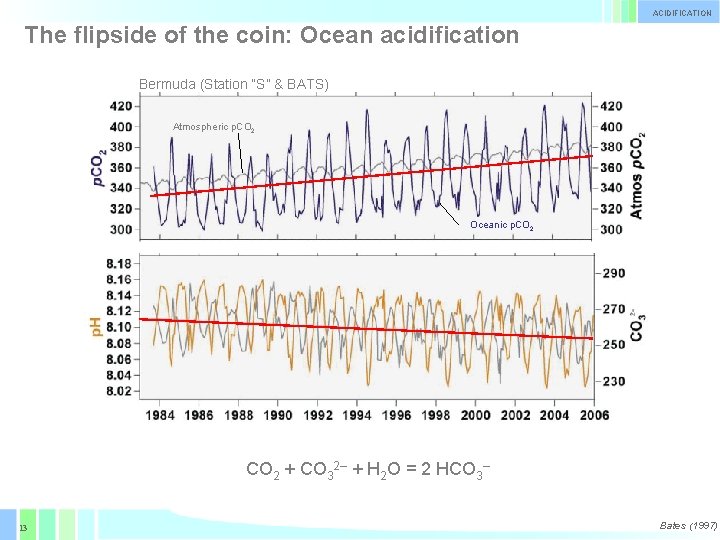
ACIDIFICATION The flipside of the coin: Ocean acidification Bermuda (Station “S” & BATS) Atmospheric p. CO 2 Oceanic p. CO 2 + CO 32– + H 2 O = 2 HCO 3– 13 Bates (1997)
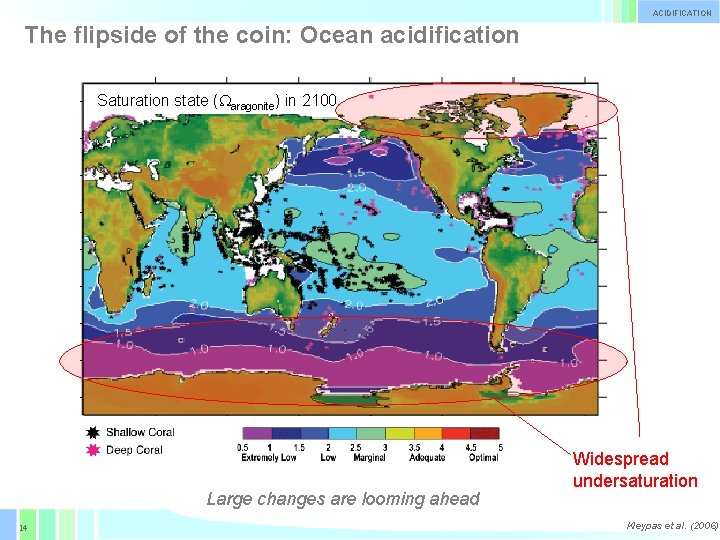
ACIDIFICATION The flipside of the coin: Ocean acidification Saturation state ( aragonite) in 2100 Large changes are looming ahead 14 Widespread undersaturation Kleypas et al. (2006)
OUTLINE Outline 1. Ocean carbon sink: Revelle’s perpetual quest or why we still need VOS and a repeat hydrography program 2. Ocean acidification: The flip-side of the coin or why there is no free lunch 3. Ocean deoxygenation: or why we would like to add oxygen sensors on Argo 4. Toward an integrated observing system: or how should all of this work together? 15 OBSERVING OCEAN BIOGEOCHEMISTRY
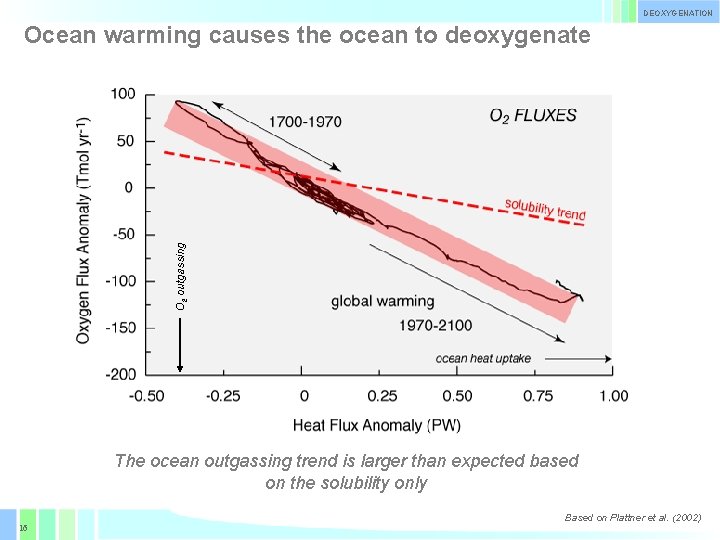
DEOXYGENATION O 2 outgassing Ocean warming causes the ocean to deoxygenate The ocean outgassing trend is larger than expected based on the solubility only 16 Based on Plattner et al. (2002)
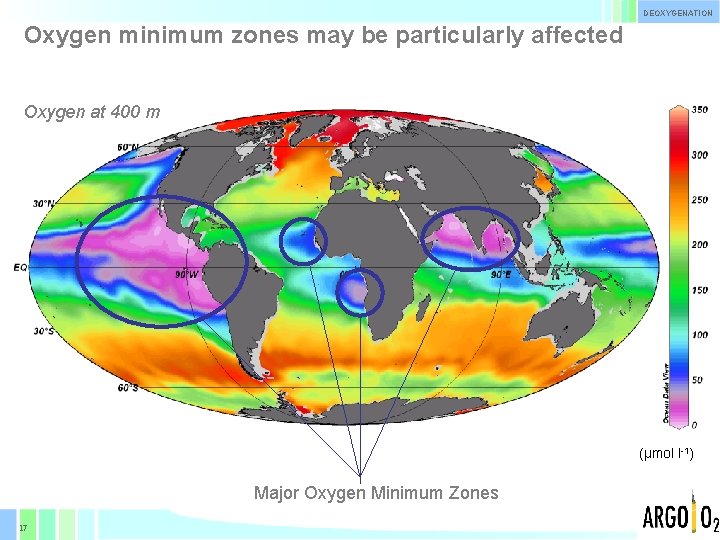
DEOXYGENATION Oxygen minimum zones may be particularly affected Oxygen at 400 m (µmol l-1) Major Oxygen Minimum Zones 17
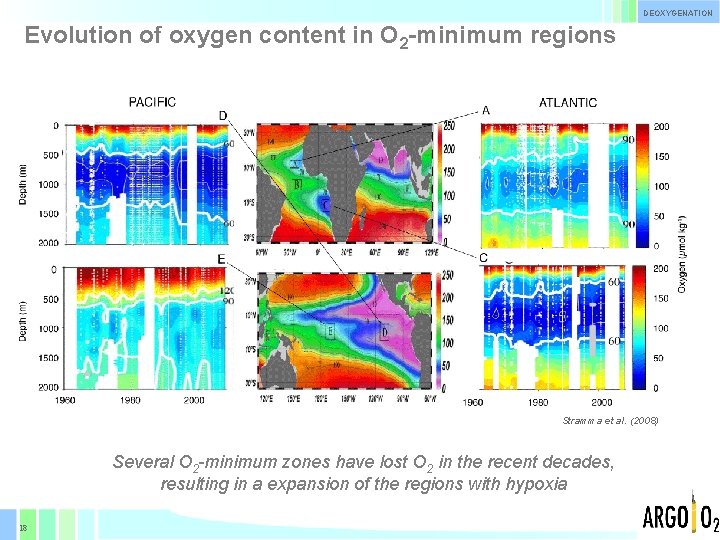
DEOXYGENATION Evolution of oxygen content in O 2 -minimum regions Stramma et al. (2008) Several O 2 -minimum zones have lost O 2 in the recent decades, resulting in a expansion of the regions with hypoxia 18
DEOXYGENATION Ocean deoxygenation: Key goals & challenges The ocean will be losing substantial amounts of oxygen in response to ocean warming and stratification. Oxygen on Argo provides a unique opportunity to document this loss and to develop strategies to mitigate its impact on ecosystems Oxygen on Argo provides also a window of opportunity to study seasonal dynamics of ocean production and export and many other things! But, a large-scale pilot project still needs to be undertaken. . . 19
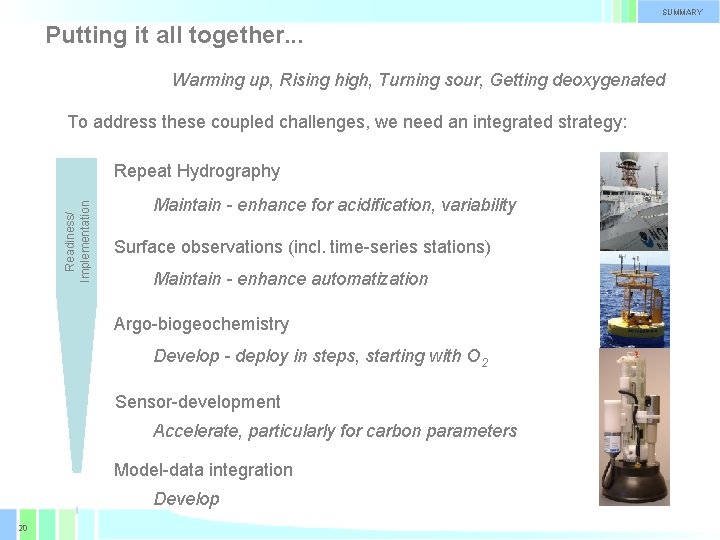
SUMMARY Putting it all together. . . Warming up, Rising high, Turning sour, Getting deoxygenated To address these coupled challenges, we need an integrated strategy: Readiness/ Implementation Repeat Hydrography Maintain - enhance for acidification, variability Surface observations (incl. time-series stations) Maintain - enhance automatization Argo-biogeochemistry Develop - deploy in steps, starting with O 2 Sensor-development Accelerate, particularly for carbon parameters Model-data integration Develop 20
The End. 21
- Slides: 21