
Ocean Acidification Research at the Alaska Fisheries Science
- Slides: 20
Ocean Acidification Research at the Alaska Fisheries Science Center Jeffrey Short Ted Stevens Marine Research Institute
Ocean Acidification in the North Pacific Ocean Vulnerabilities and Challenges AFSC Research Capabilities AFSC Research Agenda
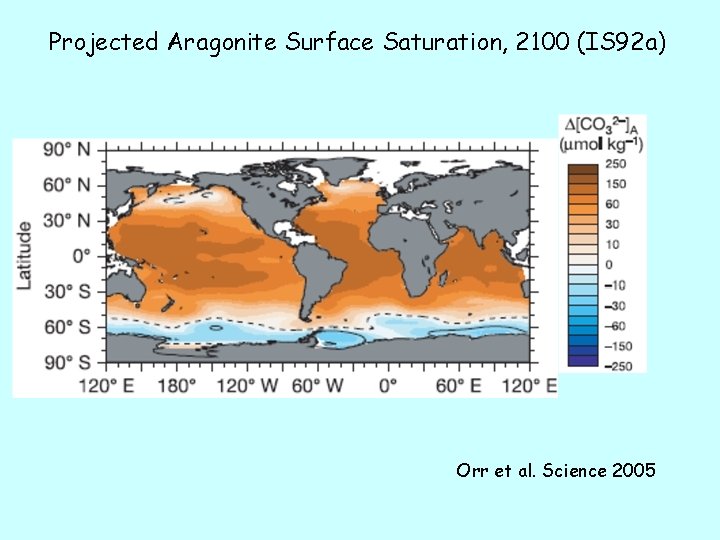
Projected Aragonite Surface Saturation, 2100 (IS 92 a) Orr et al. Science 2005
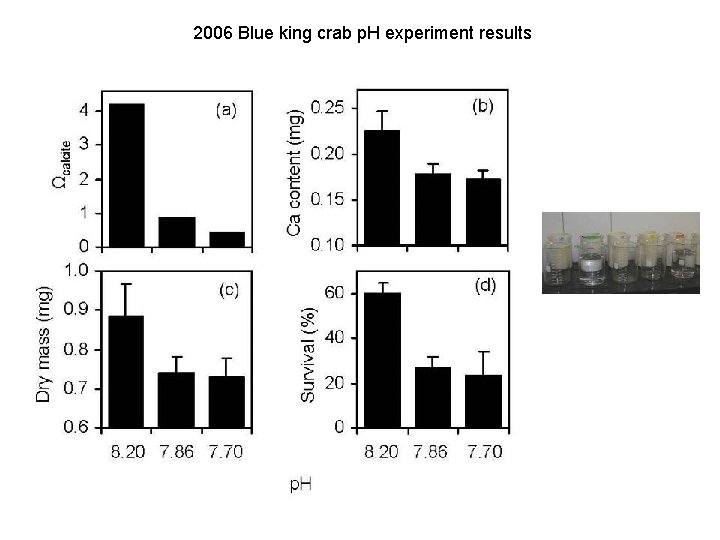
2006 Blue king crab p. H experiment results
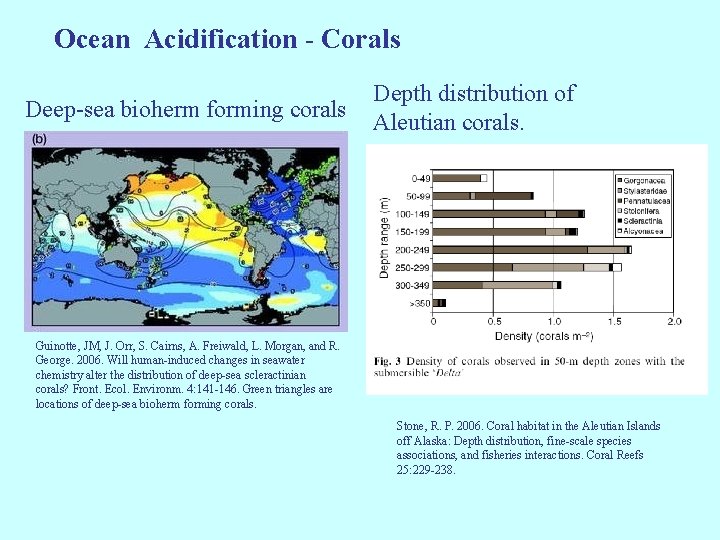
Ocean Acidification - Corals Deep-sea bioherm forming corals Depth distribution of Aleutian corals. Guinotte, JM, J. Orr, S. Cairns, A. Freiwald, L. Morgan, and R. George. 2006. Will human-induced changes in seawater chemistry alter the distribution of deep-sea scleractinian corals? Front. Ecol. Environm. 4: 141 -146. Green triangles are locations of deep-sea bioherm forming corals. Stone, R. P. 2006. Coral habitat in the Aleutian Islands off Alaska: Depth distribution, fine-scale species associations, and fisheries interactions. Coral Reefs 25: 229 -238.
Ocean Acidification in the North Pacific Ocean Vulnerabilities and Challenges AFSC Research Capabilities AFSC Research Agenda
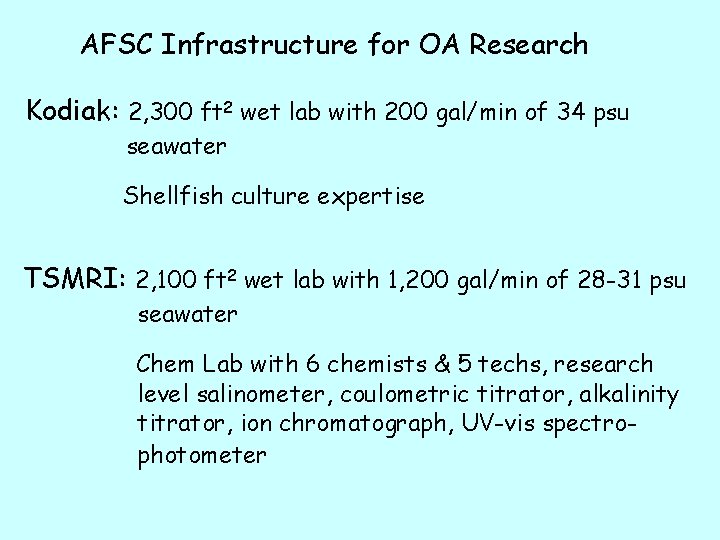
AFSC Infrastructure for OA Research Kodiak: 2, 300 ft 2 wet lab with 200 gal/min of 34 psu seawater Shellfish culture expertise
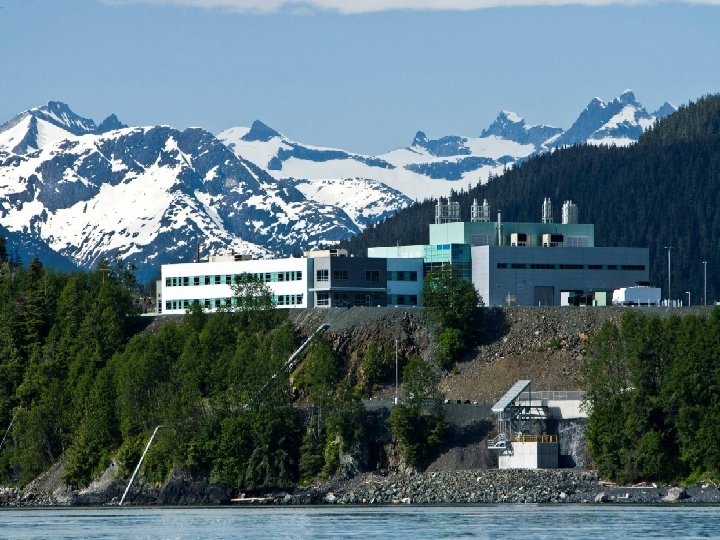
AFSC Infrastructure for OA Research Kodiak: 2, 300 ft 2 wet lab with 200 gal/min of 34 psu seawater Shellfish culture expertise TSMRI: 2, 100 ft 2 wet lab with 1, 200 gal/min of 28 -31 psu seawater Chem Lab with 6 chemists & 5 techs, research level salinometer, coulometric titrator, alkalinity titrator, ion chromatograph, UV-vis spectrophotometer
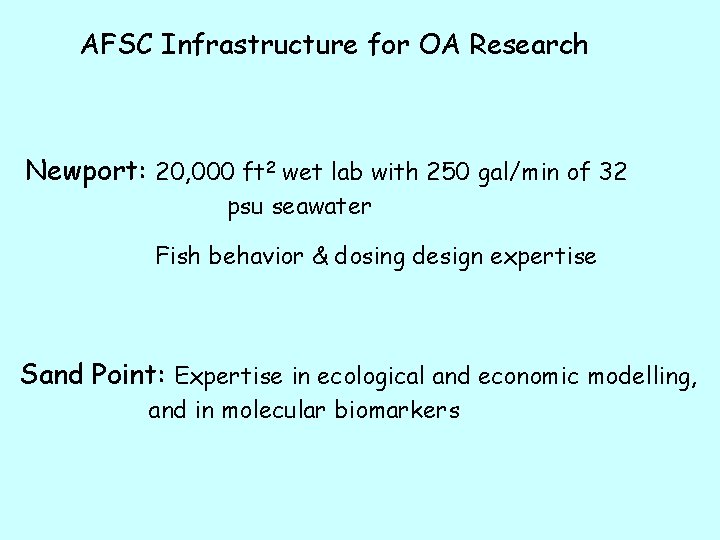
AFSC Infrastructure for OA Research Newport: 20, 000 ft 2 wet lab with 250 gal/min of 32 psu seawater Fish behavior & dosing design expertise Sand Point: Expertise in ecological and economic modelling, and in molecular biomarkers
Ocean Acidification in the North Pacific Ocean Vulnerabilities and Challenges AFSC Research Capabilities AFSC Research Agenda
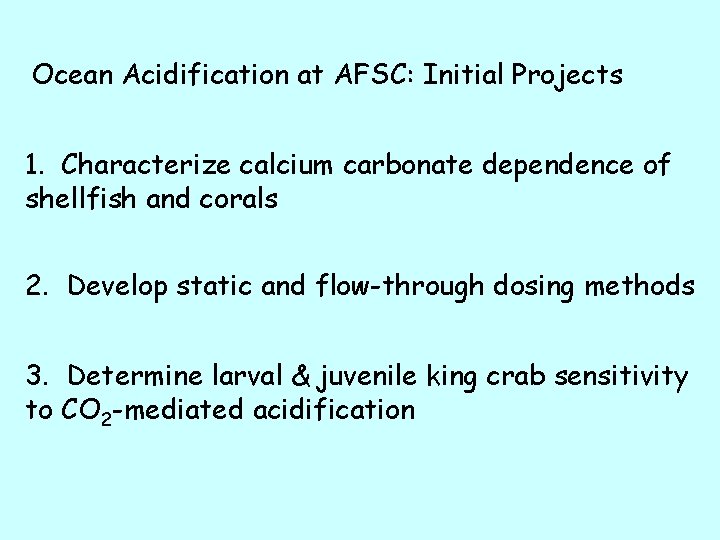
Ocean Acidification at AFSC: Initial Projects 1. Characterize calcium carbonate dependence of shellfish and corals 2. Develop static and flow-through dosing methods 3. Determine larval & juvenile king crab sensitivity to CO 2 -mediated acidification
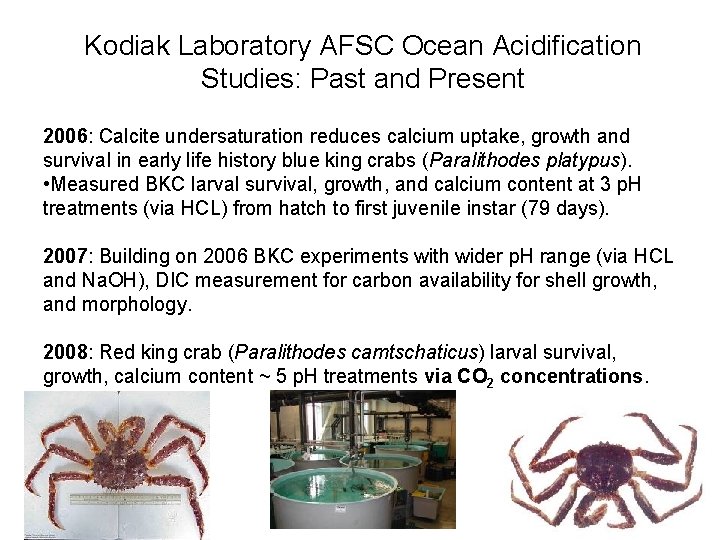
Kodiak Laboratory AFSC Ocean Acidification Studies: Past and Present 2006: Calcite undersaturation reduces calcium uptake, growth and survival in early life history blue king crabs (Paralithodes platypus). • Measured BKC larval survival, growth, and calcium content at 3 p. H treatments (via HCL) from hatch to first juvenile instar (79 days). 2007: Building on 2006 BKC experiments with wider p. H range (via HCL and Na. OH), DIC measurement for carbon availability for shell growth, and morphology. 2008: Red king crab (Paralithodes camtschaticus) larval survival, growth, calcium content ~ 5 p. H treatments via CO 2 concentrations.
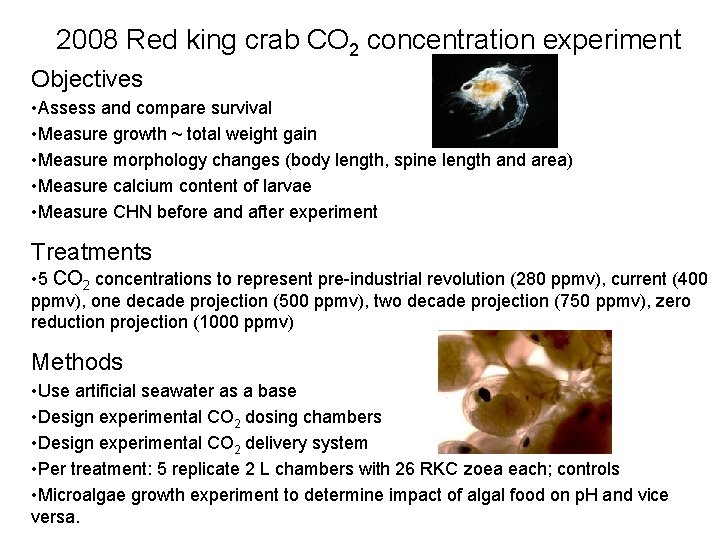
2008 Red king crab CO 2 concentration experiment Objectives • Assess and compare survival • Measure growth ~ total weight gain • Measure morphology changes (body length, spine length and area) • Measure calcium content of larvae • Measure CHN before and after experiment Treatments • 5 CO 2 concentrations to represent pre-industrial revolution (280 ppmv), current (400 ppmv), one decade projection (500 ppmv), two decade projection (750 ppmv), zero reduction projection (1000 ppmv) Methods • Use artificial seawater as a base • Design experimental CO 2 dosing chambers • Design experimental CO 2 delivery system • Per treatment: 5 replicate 2 L chambers with 26 RKC zoea each; controls • Microalgae growth experiment to determine impact of algal food on p. H and vice versa.
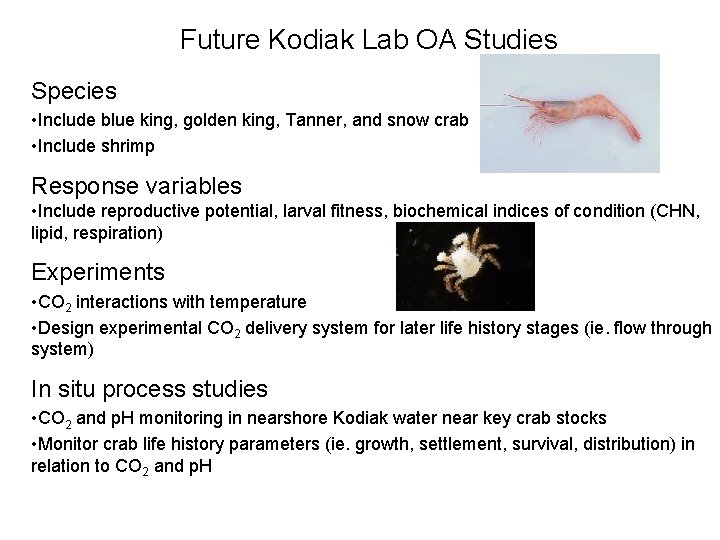
Future Kodiak Lab OA Studies Species • Include blue king, golden king, Tanner, and snow crab • Include shrimp Response variables • Include reproductive potential, larval fitness, biochemical indices of condition (CHN, lipid, respiration) Experiments • CO 2 interactions with temperature • Design experimental CO 2 delivery system for later life history stages (ie. flow through system) In situ process studies • CO 2 and p. H monitoring in nearshore Kodiak water near key crab stocks • Monitor crab life history parameters (ie. growth, settlement, survival, distribution) in relation to CO 2 and p. H
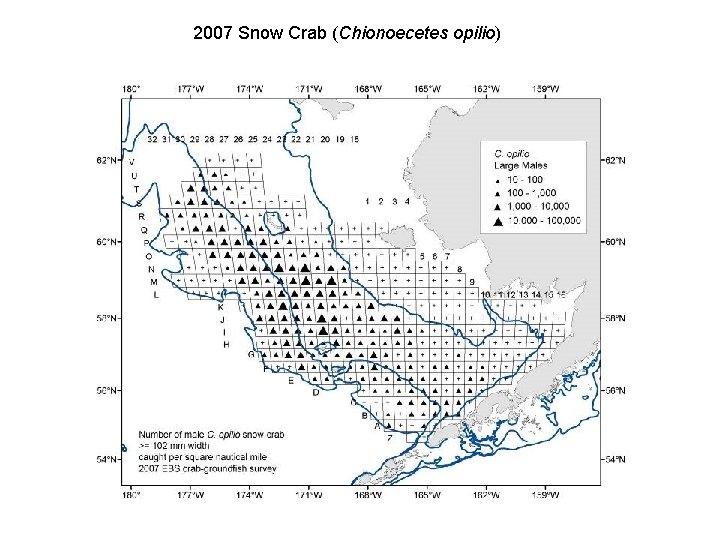
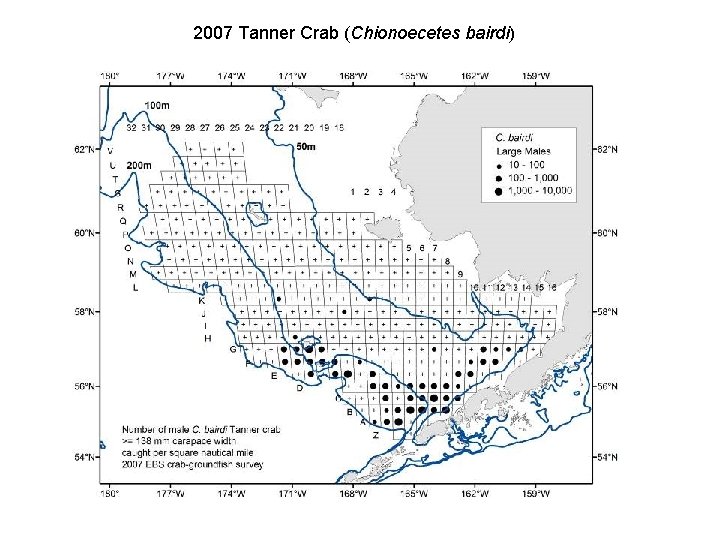
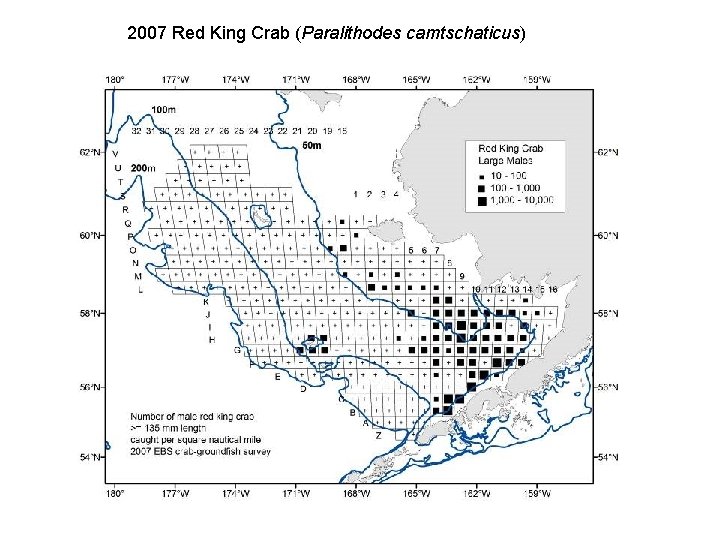
Future Kodiak Lab OA Studies Predictions based on depth and distribution • Model likelihood of impact on crab stock distributions in the Eastern Bering Sea in collaboration with oceanographic data collections. • Apply laboratory finding to spatially and temporally model magnitude of impact on various life history stages of EBS crab. • Compare mechanisms of CO 2 influence on spatial (across shelf and depth) distribution of crab (see following distribution maps).
2007 Snow Crab (Chionoecetes opilio)
2007 Tanner Crab (Chionoecetes bairdi)
2007 Red King Crab (Paralithodes camtschaticus)
Ocean Acidification at AFSC: Longer-Term Projects 1. Link lab & field process studies to ecological and economic models 2. Develop molecular biomarkers for OA impacts 3. Develop coastal seawater monitoring network in Alaska?