
Ocean Acidification of the Greater Caribbean 2011 NASA
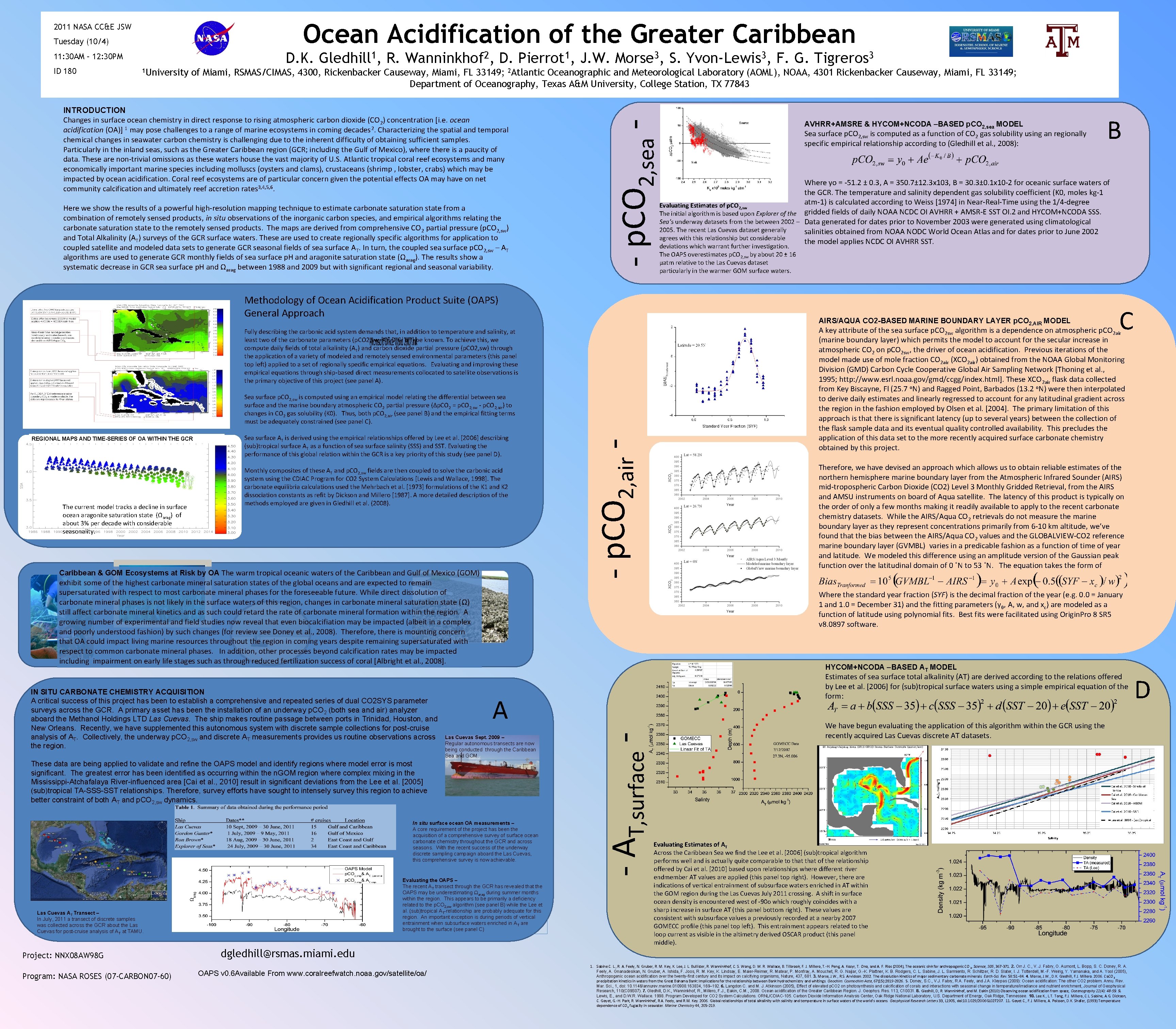
Ocean Acidification of the Greater Caribbean 2011 NASA CC&E JSW Tuesday (10/4) D. K. 11: 30 AM – 12: 30 PM 1 University R. 2 Wanninkhof , D. 1 Pierrot , J. W. 3 Morse , S. 3 Yvon-Lewis , F. G. 3 Tigreros of Miami, RSMAS/CIMAS, 4300, Rickenbacker Causeway, Miami, FL 33149; 2 Atlantic Oceanographic and Meteorological Laboratory (AOML), NOAA, 4301 Rickenbacker Causeway, Miami, FL 33149; Department of Oceanography, Texas A&M University, College Station, TX 77843 INTRODUCTION Changes in surface ocean chemistry in direct response to rising atmospheric carbon dioxide (CO 2) concentration [i. e. ocean acidification (OA)] 1 may pose challenges to a range of marine ecosystems in coming decades 2. Characterizing the spatial and temporal chemical changes in seawater carbon chemistry is challenging due to the inherent difficulty of obtaining sufficient samples. Particularly in the inland seas, such as the Greater Caribbean region (GCR; including the Gulf of Mexico), where there is a paucity of data. These are non-trivial omissions as these waters house the vast majority of U. S. Atlantic tropical coral reef ecosystems and many economically important marine species including molluscs (oysters and clams), crustaceans (shrimp , lobster, crabs) which may be impacted by ocean acidification. Coral reef ecosystems are of particular concern given the potential effects OA may have on net community calcification and ultimately reef accretion rates 3, 4, 5, 6. Here we show the results of a powerful high-resolution mapping technique to estimate carbonate saturation state from a combination of remotely sensed products, in situ observations of the inorganic carbon species, and empirical algorithms relating the carbonate saturation state to the remotely sensed products. The maps are derived from comprehensive CO 2 partial pressure (p. CO 2, sw) and Total Alkalinity (AT) surveys of the GCR surface waters. These are used to create regionally specific algorithms for application to coupled satellite and modeled data sets to generate GCR seasonal fields of sea surface A T. In turn, the coupled sea surface p. CO 2, sw – AT algorithms are used to generate GCR monthly fields of sea surface p. H and aragonite saturation state (Ωarag). The results show a systematic decrease in GCR sea surface p. H and Ωarag between 1988 and 2009 but with significant regional and seasonal variability. - p. CO 2, sea - ID 180 1 Gledhill , AVHRR+AMSRE & HYCOM+NCODA –BASED p. CO 2, sea MODEL Sea surface p. CO 2, sw is computed as a function of CO 2 gas solubility using an regionally specific empirical relationship according to (Gledhill et al. , 2008): B Where yo = -51. 2 ± 0. 3, A = 350. 7± 12. 3 x 10³, B = 30. 3± 0. 1 x 10 -2 for oceanic surface waters of the GCR. The temperature and salinity dependent gas solubility coefficient (K 0, moles kg-1 atm-1) is calculated according to Weiss [1974] in Near-Real-Time using the 1/4 -degree Evaluating Estimates of p. CO 2, sw The initial algorithm is based upon Explorer of the gridded fields of daily NOAA NCDC OI AVHRR + AMSR-E SST OI. 2 and HYCOM+NCODA SSS. Sea’s underway datasets from the between 2002 – Data generated for dates prior to November 2003 were generated using climatological 2005. The recent Las Cuevas dataset generally salinities obtained from NOAA NODC World Ocean Atlas and for dates prior to June 2002 agrees with this relationship but considerable the model applies NCDC OI AVHRR SST. deviations which warrant further investigation. The OAPS overestimates p. CO 2, sw by about 20 ± 16 μatm relative to the Las Cuevas dataset particularly in the warmer GOM surface waters. . Methodology of Ocean Acidification Product Suite (OAPS) General Approach AIRS/AQUA CO 2 -BASED MARINE BOUNDARY LAYER p. CO 2, AIR MODEL Fully describing the carbonic acid system demands that, in addition to temperature and salinity, at least two of the carbonate parameters (p. CO 2, sw, AT, DIC, p. H) be known. To achieve this, we compute daily fields of total alkalinity (AT) and carbon dioxide partial pressure (p. CO 2, sw) through the application of a variety of modeled and remotely sensed environmental parameters (this panel top left) applied to a set of regionally specific empirical equations. Evaluating and improving these empirical equations through ship-based direct measurements collocated to satellite observations is the primary objective of this project (see panel A). The current model tracks a decline in surface ocean aragonite saturation state (Ωarag) of about 3% per decade with considerable seasonality. Sea surface AT is derived using the empirical relationships offered by Lee et al. [2006] describing (sub)tropical surface AT as a function of sea surface salinity (SSS) and SST. Evaluating the performance of this global relation within the GCR is a key priority of this study (see panel D). Monthly composites of these AT and p. CO 2, sw fields are then coupled to solve the carbonic acid system using the CDIAC Program for CO 2 System Calculations [Lewis and Wallace, 1998]. The carbonate equilibria calculations used the Mehrbach et al. [1973] formulations of the K 1 and K 2 dissociation constants as refit by Dickson and Millero [1987]. A more detailed description of the methods employed are given in Gledhill et al. (2008). Caribbean & GOM Ecosystems at Risk by OA The warm tropical oceanic waters of the Caribbean and Gulf of Mexico (GOM) exhibit some of the highest carbonate mineral saturation states of the global oceans and are expected to remain supersaturated with respect to most carbonate mineral phases for the foreseeable future. While direct dissolution of carbonate mineral phases is not likely in the surface waters of this region, changes in carbonate mineral saturation state (Ω) still affect carbonate mineral kinetics and as such could retard the rate of carbonate mineral formation within the region. A growing number of experimental and field studies now reveal that even biocalcifiation may be impacted (albeit in a complex and poorly understood fashion) by such changes (for review see Doney et al. , 2008). Therefore, there is mounting concern that OA could impact living marine resources throughout the region in coming years despite remaining supersaturated with respect to common carbonate mineral phases. In addition, other processes beyond calcification rates may be impacted including impairment on early life stages such as through reduced fertilization success of coral [Albright et al. , 2008]. IN SITU CARBONATE CHEMISTRY ACQUISITION A critical success of this project has been to establish a comprehensive and repeated series of dual CO 2 SYS parameter surveys across the GCR. A primary asset has been the installation of an underway p. CO 2 (both sea and air) analyzer aboard the Methanol Holdings LTD Las Cuevas. The ship makes routine passage between ports in Trinidad, Houston, and New Orleans. Recently, we have supplemented this autonomous system with discrete sample collections for post-cruise analysis of AT. Collectively, the underway p. CO 2, sw and discrete AT measurements provides us routine observations across the region. HYCOM+NCODA –BASED AT MODEL Las Cuevas Sept. 2009 – Regular autonomous transects are now being conducted through the Caribbean Sea and GOM. In situ surface ocean OA measurements – A core requirement of the project has been the acquisition of a comprehensive survey of surface ocean carbonate chemistry throughout the GCR and across seasons. With the recent success of the underway discrete sampling campaign aboard the Las Cuevas, this comprehensive survey is now achievable. Project: NNX 08 AW 98 G Program: NASA ROSES (07 -CARBON 07 -60) Estimates of sea surface total alkalinity (AT) are derived according to the relations offered by Lee et al. [2006] for (sub)tropical surface waters using a simple empirical equation of the form: A These data are being applied to validate and refine the OAPS model and identify regions where model error is most significant. The greatest error has been identified as occurring within the n. GOM region where complex mixing in the Mississippi-Atchafalaya River-influenced area [Cai et al. , 2010] result in significant deviations from the Lee et al. [2005] (sub)tropical TA-SSS-SST relationships. Therefore, survey efforts have sought to intensely survey this region to achieve better constraint of both AT and p. CO 2, sw dynamics. Evaluating the OAPS – The recent AT transect through the GCR has revealed that the OAPS may be underestimating Warag during summer months within the region. This appears to be primarily a deficiency related to the p. CO 2, sw algorithm (see panel B) while the Lee et al. (sub)tropical AT-relationship are probably adequate for this region. An important exception is during periods of vertical entrainment when subsurface waters enriched in AT are brought to the surface (see panel C) Las Cuevas AT Transect – In July, 2011 a transect of discrete samples was collected across the GCR about the Las Cuevas for post-cruise analysis of AT at TAMU. Therefore, we have devised an approach which allows us to obtain reliable estimates of the northern hemisphere marine boundary layer from the Atmospheric Infrared Sounder (AIRS) mid-tropospheric Carbon Dioxide (CO 2) Level 3 Monthly Gridded Retrieval, from the AIRS and AMSU instruments on board of Aqua satellite. The latency of this product is typically on the order of only a few months making it readily available to apply to the recent carbonate chemistry datasets. While the AIRS/Aqua CO 2 retrievals do not measure the marine boundary layer as they represent concentrations primarily from 6 -10 km altitude, we’ve found that the bias between the AIRS/Aqua CO 2 values and the GLOBALVIEW-CO 2 reference marine boundary layer (GVMBL) varies in a predicable fashion as a function of time of year and latitude. We modeled this difference using an amplitude version of the Gaussian peak function over the latitudinal domain of 0 ˚N to 53 ˚N. The equation takes the form of Where the standard year fraction (SYF) is the decimal fraction of the year (e. g. 0. 0 = January 1 and 1. 0 = December 31) and the fitting parameters (y 0, A, w, and xc) are modeled as a function of latitude using polynomial fits. Best fits were facilitated using Origin. Pro 8 SR 5 v 8. 0897 software. - AT, surface - REGIONAL MAPS AND TIME-SERIES OF OA WITHIN THE GCR - p. CO 2, air - Sea surface p. CO 2, sw is computed using an empirical model relating the differential between sea surface and the marine boundary atmospheric CO 2 partial pressure (Δp. CO 2 = p. CO 2, sw - p. CO 2, air) to changes in CO 2 gas solubility (K 0). Thus, both p. CO 2, air (see panel B) and the empirical fitting terms must be adequately constrained (see panel C). C A key attribute of the sea surface p. CO 2 sw algorithm is a dependence on atmospheric p. CO 2 air (marine boundary layer) which permits the model to account for the secular increase in atmospheric CO 2 on p. CO 2 sw, the driver of ocean acidification. Previous iterations of the model made use of mole fraction CO 2 air (XCO 2 air) obtained from the NOAA Global Monitoring Division (GMD) Carbon Cycle Cooperative Global Air Sampling Network [Thoning et al. , 1995; http: //www. esrl. noaa. gov/gmd/ccgg/index. html]. These XCO 2 air flask data collected from Key Biscayne, Fl (25. 7 o. N) and Ragged Point, Barbados (13. 2 o. N) were then interpolated to derive daily estimates and linearly regressed to account for any latitudinal gradient across the region in the fashion employed by Olsen et al. [2004]. The primary limitation of this approach is that there is significant latency (up to several years) between the collection of the flask sample data and its eventual quality controlled availability. This precludes the application of this data set to the more recently acquired surface carbonate chemistry obtained by this project. We have begun evaluating the application of this algorithm within the GCR using the recently acquired Las Cuevas discrete AT datasets. Evaluating Estimates of AT Across the Caribbean Sea we find the Lee et al. [2006] (sub)tropical algorithm performs well and is actually quite comparable to that of the relationship offered by Cai et al. [2010] based upon relationships where different river endmember AT values are applied (this panel top right). However, there are indications of vertical entrainment of subsurface waters enriched in AT within the GOM region during the Las Cuevas July 2011 crossing. A shift in surface ocean density is encountered west of -90 o which roughly coincides with a sharp increase in surface AT (this panel bottom right). These values are consistent with subsurface values a previously recorded at a nearby 2007 GOMECC profile (this panel top left). This entrainment appears related to the loop current as visible in the altimetry derived OSCAR product (this panel middle). dgledhill@rsmas. miami. edu OAPS v 0. 6 Available From www. coralreefwatch. noaa. gov/satellite/oa/ 1. Sabine C. L. , R. A. Feely, N. Gruber, R. M. Key, K. Lee, J. L. Bullister, R. Wanninkhof, C. S. Wong, D. W. R. Wallace, B. Tilbrook, F. J. Millero, T. -H. Peng, A. Kozyr, T. Ono, and A. F. Rios (2004), The oceanic sink for anthropogenic CO 2, Science, 305, 367 -371. 2. Orr J. C. , V. J. Fabry, O. Aumont, L. Bopp, S. C. Doney, R. A. Feely, A. Gnanadesikan, N. Gruber, A. Ishida, F. Joos, R. M. Key, K. Lindsay, E. Maier-Reimer, R. Matear, P. Monfray, A. Mouchet, R. G. Najjar, G. -K. Plattner, K. B. Rodgers, C. L. Sabine, J. L. Sarmiento, R. Schlitzer, R. D. Slater, I. J. Totterdell, M. -F. Weirig, Y. Yamanaka, and A. Yool (2005), Anthropogenic ocean acidification over the twenty-first century and its impact on calcifying organisms, Nature, 437, 681. 3. Morse, J. W. , R. S. Arvidson. 2002. The dissolution kinetics of major sedimentary carbonate minerals. Earth-Sci. Rev. 58: 51– 84. 4. Morse, J. W. , D. K. Gledhill, F. J. Millero. 2006. Ca. CO 3 precipitation kinetics in waters from the Great Bahama Bank: Implications for the relationship between Bank hydrochemistry and whitings. Geochim. Cosmochim Acta, 67(15): 2819 -2826. 5. Doney, S. C. , V. J. Fabry, R. A. Feely, and J. A. Kleypas (2009): Ocean acidification: The other CO 2 problem. Annu. Rev. Mar. Sci. , 1, doi: 10. 1146/annurev. marine. 010908. 163834, 169– 192. 6. Langdon C. and M. J. Atkinson (2005), Effect of elevated p. CO 2 on photosynthesis and calcification of corals and interactions with seasonal change in temperature/irradiance and nutrient enrichment, Journal of Geophysical Research, 110(C 09 S 07). 7. Gledhill, D. K. , Wanninkhof, R. , Millero, F. J. , Eakin, C. M. , 2008. Ocean acidification of the Greater Caribbean Region. J. Geophys. Res. 113, C 10031. 8. Gledhill, D, R. Wanninkhof, and M. Eakin (2010) Observing ocean acidification from space, Oceanography 22(4): 48 -59. 9. Lewis, E. , and D. W. R. Wallace. 1998. Program Developed for CO 2 System Calculations. ORNL/CDIAC-105. Carbon Dioxide Information Analysis Center, Oak Ridge National Laboratory, U. S. Department of Energy, Oak Ridge, Tennessee. 10. Lee K. , L. T. Tong, F. J. Millero, C. L. Sabine, A. G. Dickson, C. Goyet, G. -H. Park, R. Wanninkhof, R. A. Feely, and R. M. Key. 2006. Global relationships of total alkalinity with salinity and temperature in surface waters of the world’s oceans. Geophysical Research Letters 33, L 1905, doi: 10. 1029/2006 GL 027207. 11. Goyet C. , F. J. Millero, A. Poisson, D. K. Shafer, (1993) Temperature dependence of CO 2 fugacity in seawater. Marine Chemistry 44, 205 -219. D
- Slides: 1