
Occupational Therapy The challenge of maintaining professional identity








- Slides: 32
Occupational Therapy The challenge of maintaining professional identity, role and resilience.
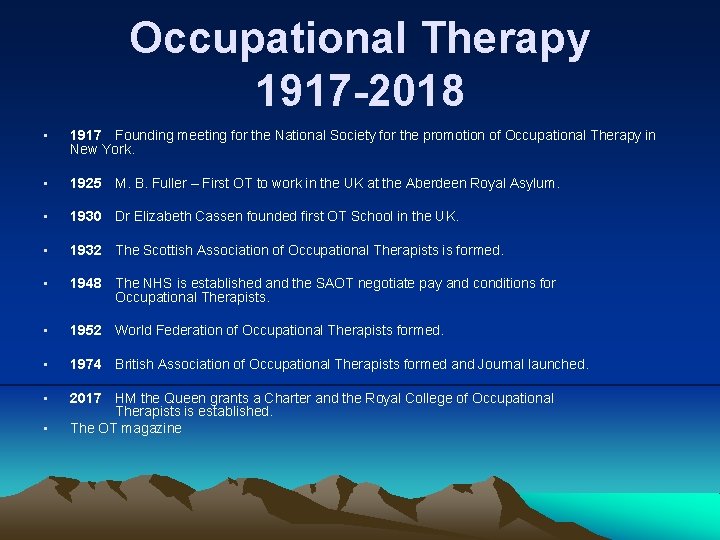
Occupational Therapy 1917 -2018 • 1917 Founding meeting for the National Society for the promotion of Occupational Therapy in New York. • 1925 M. B. Fuller – First OT to work in the UK at the Aberdeen Royal Asylum. • 1930 Dr Elizabeth Cassen founded first OT School in the UK. • 1932 The Scottish Association of Occupational Therapists is formed. • 1948 The NHS is established and the SAOT negotiate pay and conditions for Occupational Therapists. • 1952 World Federation of Occupational Therapists formed. • 1974 British Association of Occupational Therapists formed and Journal launched. • 2017 HM the Queen grants a Charter and the Royal College of Occupational Therapists is established. The OT magazine •
Professional Identity • Professional identity concerns group interaction in the workplace and relates to how people differentiate themselves from other professional groups. It develops over time and involves the attitudes, values, beliefs , knowledge and skills that are shared within a professional group. • Adams & Hean et al 2006
COT Website 2014 Tanock • As professional affairs officer: I often ask How do you explain Occupational Therapy to people? The response is usually an exasperated? “ Why should we have to explain our role? ”. “Why don’t the public know our role by now? ” followed by What is COT doing about this ? ”. • What can we do ?
Definition of OT • Due to the number of definitions that exist it can be argued that the profession may lack clarity about its practice and this could have considerable consequences in the current health and social care economic climate. Turner and Alsop BJOT 2015
Defining Occupational Therapy The professional Identity conundrum (Hooper and Wood 2002 ) • What are the beliefs and values that Occupational Therapists hold. • A reflective analysis of the profession is needed to challenge our identity, purpose and definition as at present it’s not clear both within the profession and extraneous to it. Whitty 2005 • Demands from management have contributed to a crisis of identity as therapists struggle to reconcile conflicting professional, managerial and service demands with day to day clinical practice. Lloyd et al 2010
Challenges and Opportunities 1976 • “Recent developments in Health and Social care having considerable influence on the structure and practice of the profession. As techniques and practices change and as the profession extends its spheres, the basic principles should remain the same “ OT in Rehabilitation 4 th Edition Macdonald 1976
Challenges and Opportunities 2017 • Occupational therapy practice is influenced by government drivers and organisational changes and constraints. • Professional practice is evolving in contemporary society in relation to patient choice, new working partnerships and the response and the need for socially reconstructed ways of delivering health care.
Professional Identity and Role Contextual influencing factors • Tension between the medical, psychological, social and occupational perspectives on health. • Dominant prevailing discourses. • Are theories and interventions of other professions more evidence based and accorded greater status. • Identity can be compromised by the expectation to learn skills from other professions and be supervised by them.
Professional Identity and Role Contextual influencing factors • Shift to working in inter professional teams that is associated with an expectation that team members work outside their professional domain. Rosen and Calley 2005 • Case management models that can cause blurring of roles. • Balancing generic and team tasks with discipline specific work. • Professional isolation in teams. • Pressure to adopt other forms of theoretical knowledge.
Core skills • Core indicates something that is central but not unique. • Skills are competencies and aptitudes appropriate for a particular job. • Historically seen as visible activities which may have been confused with techniques and personal attributes. Turner &Alsop 2015
Unique Occupational Therapy skills • Activity and task analysis. • Assessment of occupational performance and the use of selected activities to facilitate change. • Occupational therapy models have unique characteristics and share a common focus on occupation, occupational performance and the relationship of person to environment as a dynamic process. Brown 2014
Defining Occupational Therapy • Often seen as an activity focussed profession, it is essential that we articulate the high level of unseen reasoning processes that underpin the more visible application of practice skills. (Turner and Alsop 2015) • More focus on the occupational intent of the activity and less on the activity. • Ensure other disciplines understand the intrinsic goals and complexity of the interventions used and appreciate the “In vivo assessment” that takes place during these activities (Ashby Et Al 2012)
Discussion • Viewing practice as context dependant, client dependant or colleague dependant focussing on service need not met by other professions. Fortune (2000) • Ensuring that services, professional activity judgements are based upon the professions unique philosophy: without this practice can be determined by feel good factor, a desire for status or conforming to the agenda of others. Molineux (2011)
Jack of all trades • The problem with being competent in many skills and working in many areas is dilution: the more our profession spreads and grows in breadth, by definition the less depth it has. What skills are we giving up by constantly expanding our horizons. • Drummond 2010 • How do we decide what we pursue? Drummond BJOT 2010 • The true cost of something is what you give up to get it The Economist 2010
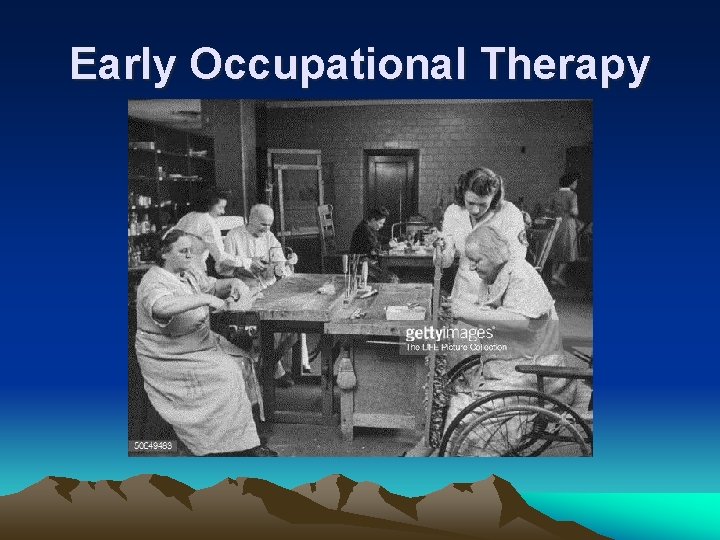
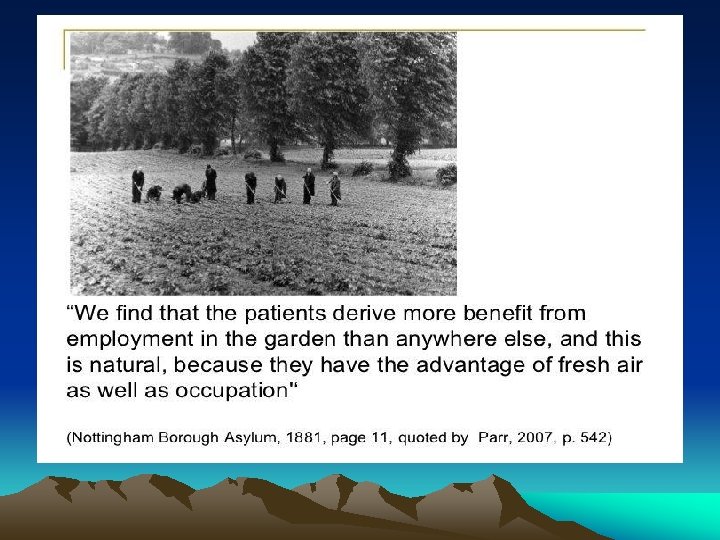
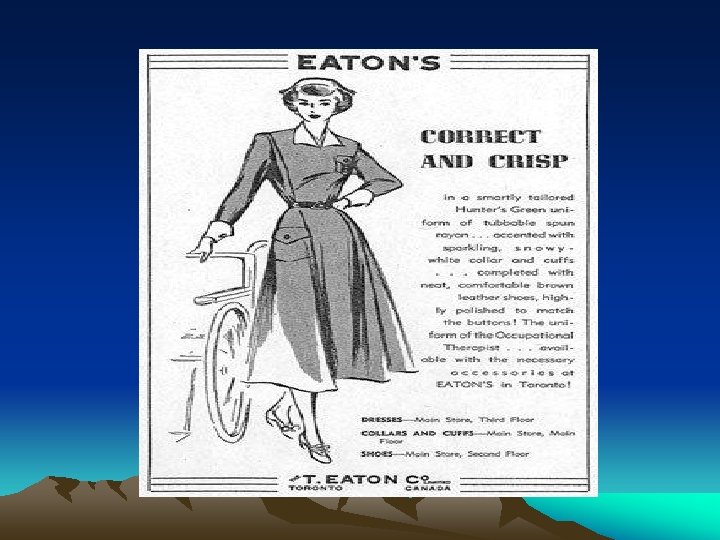
Early Occupational Therapy
Occupational Therapy 2017 I Laidlaw •
Occupational Therapy Activity. Garden group session What others see and understand • • Something to do Fun activity Distraction Meeting people Fresh air Gardening skills Try something new
An Occupational Perspective GARDENING GROUP • • • • Meaningful activity (developing personal interests) Observational assessment of motor/processing skills Activity analysis (concentration, problem solving, decision making, gross and fine motor skills) Social interaction skills Time management Positive routines Confidence building Anxiety management skills Community skills (public transport/community resources) Specific activity skills (gardening/cooking/nutrition) Learning from others/sharing own knowledge Developing self esteem/self worth Self management beyond therapy A sociological model supports practices by forging links with partners eg local farm shops I Laidlaw
Occupational Therapy • • Activity analysis/grading/sequencing/synthesis Understand group dynamics/processes Understand theories of group development Understand use frames of reference/models e. g. psychodynamic, behavioural, rehabilitative, Moho. • Forming the rationale for the use of any activity
The 4 Cs Model. • GROUP DISCUSSION • FORM AN ACTION PLAN Thistlewood BJOT 2014
Applying 4 words to Occupational Therapy. Emmanuel Gobillot (2013) • Conviction • Courage • Communication • Compassion
Conviction • The conviction to demonstrate the value of occupational therapy to the organisation in terms of demonstrable outcomes, cost effectiveness and in adding life to years • When you discuss occupational therapy, make every contact you have with clients, the public or other disciplines meaningful Make it count
Courage • Breakdown barriers to change and embrace opportunities for new ways of working • Build on innovative practice and make it evidence based and evaluated practice. • Believe that we have ability to manage and shape the perception of our unique discipline
Communication • Highlight the unique skills of occupational therapy • Make the invisible reasoning processes visible through the use of professionspecific language in discourses, assessments, reports, outcome measures. Sound evidence must be shown to underpin occupational therapists visible practice Turner and Alsop
Communication • Consistent reinforcement of occupational theory is needed to survive in a world where other agendas potentially distract or overwhelm professional sense of self
Maintaining resilience Professional resilience is linked to: • Positive dynamic relationship between professional identity, resilience and occupation based practice. Wilding and Whiteford 2008 • Strategies that encourage reflective practice on theoretical knowledge that underpins practice. Ashby Ryan, Gray And James (2013) • Robust reflective supervision • Confidence to explain and clearly articulate an occupational perspective
The Way Forward • Use of profession specific language to give clear messages and reframe practice around concepts of occupation. Wilding and Whiteford 2008 • Using a model elevates clinical practice from the application of techniques to a professional process of conceptual problem solving, planning and action Kielhofner 2009
The Way Forward • Adopt a consistent philosophy which guides research, education, practice and is the touchstone when considering change to practice. • (Wilcock 1999) • Proving our value in an economic trend of downsizing and competition D Ellenberg 1996 • Ensuring the use of other theories or techniques is congruent with occupational therapy conceptual foundations and does not become the focus of the intervention (Gustafsson et al ( 2014)
Realising Our Potential • The quiet revolution puts Occupational Therapy at the forefront of healthcare. Linda Jackson, 2016, The Guardian • Although no single group of professionals hold the key to the future of health and care systems, it is arguable that one has more influence. Not Nurses, not Doctors, not Social Workers but Occupational Therapists. David Brindle, The Guardian • Occupational Therapists punch above their weight but their profile needs to be raised. • D Brindle The Guardian
Early Occupational therapist