
Occupational Therapy Driving Assessment and Rehabilitation Centre Emily
Occupational Therapy Driving Assessment and Rehabilitation Centre Emily Hogan Clinical Operations Manager October 2014
Occupational Therapy Driving Assessment • Considerations for driving and medical guidelines • The ageing driver • Roles, responsibilities and reporting • Referral process • OT driving assessment process. • Evidence and outcomes of driving with Parkinson’s Disease
Driving • Why is it important? • Impact on driving performance in Parkinson's Disease • Muscle rigidity and bradykinesia • Tremors • Executive dysfunction and cognitive impairment • Lethargy • Medication • Decreased concentration • Reduced reaction time
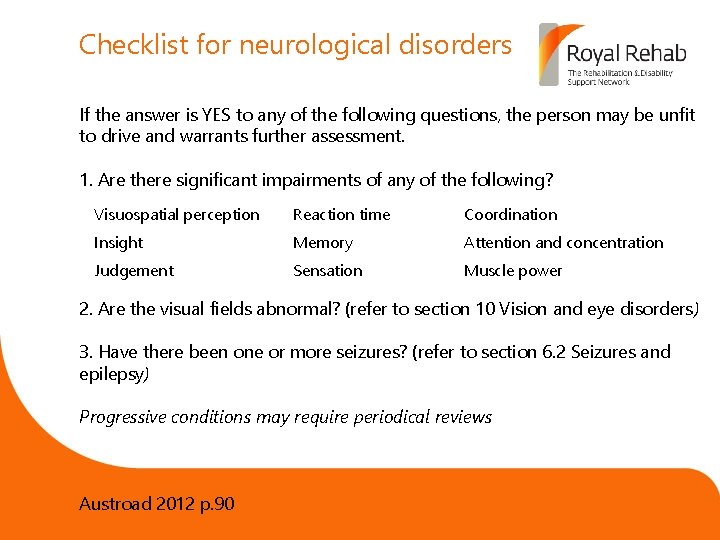
Checklist for neurological disorders If the answer is YES to any of the following questions, the person may be unfit to drive and warrants further assessment. 1. Are there significant impairments of any of the following? Visuospatial perception Reaction time Coordination Insight Memory Attention and concentration Judgement Sensation Muscle power 2. Are the visual fields abnormal? (refer to section 10 Vision and eye disorders) 3. Have there been one or more seizures? (refer to section 6. 2 Seizures and epilepsy) Progressive conditions may require periodical reviews Austroad 2012 p. 90
The aging driver “Advanced age, in itself, is not a barrier to driving. Functional ability rather than chronological age should be the criterion used in assessing the fitness to drive of older people. Age-related physical and mental changes vary greatly between individuals. Eventually they do affect the ability to drive safely” (Assessing Fitness to Drive, 2012)
The aging driver • At the age of 75, drivers are required to undergo annual medical examinations by their treating doctor. • The doctor must advise the RMS if the driver is medically fit to drive. • At this stage the doctor can elect to refer for an OT Driving Assessment.
The aging driver • At the age of 85, the rules change again. The driver has the following options: – Undergo an RMS Advanced Age Driver Test. – Elect to hold a kilometre restricted licence. – The doctor may recommend an Occupational Therapy Driving Assessment. • If the driver chooses to do an OT they still need to do RMS Test for an unrestricted licence. • The driver is reviewed medically annually and practically every two years if holding an unrestricted licence.
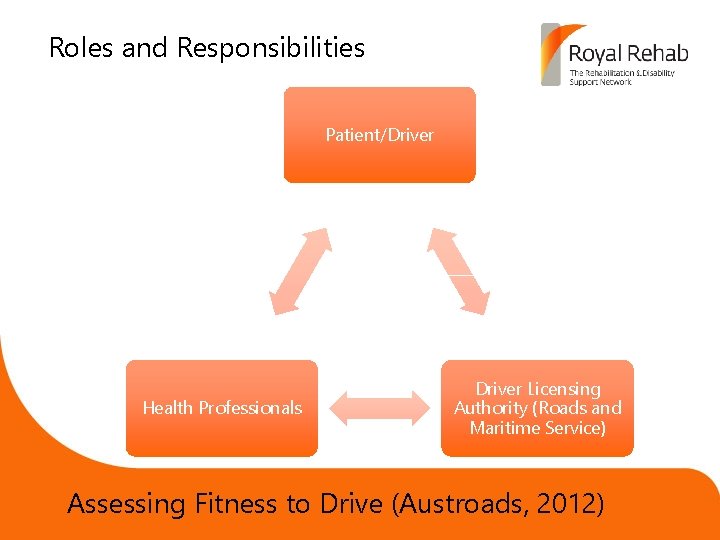
Roles and Responsibilities Place copy here Health Professionals Patient/Driver Licensing Authority (Roads and Maritime Service) Assessing Fitness to Drive (Austroads, 2012)
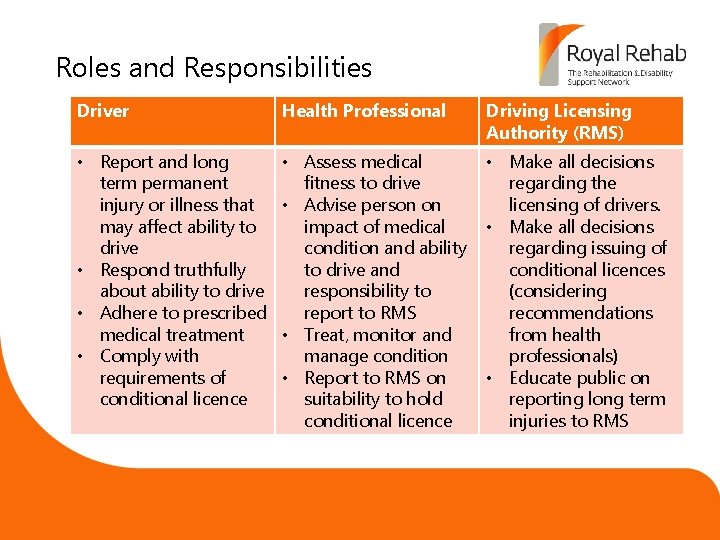
Roles and Responsibilities Driver Health Professional Driving Licensing Authority (RMS) • Report and long term permanent injury or illness that may affect ability to drive • Respond truthfully about ability to drive • Adhere to prescribed medical treatment • Comply with requirements of conditional licence • Assess medical fitness to drive • Advise person on impact of medical condition and ability to drive and responsibility to report to RMS • Treat, monitor and manage condition • Report to RMS on suitability to hold conditional licence • Make all decisions regarding the licensing of drivers. • Make all decisions regarding issuing of conditional licences (considering recommendations from health professionals) • Educate public on reporting long term injuries to RMS
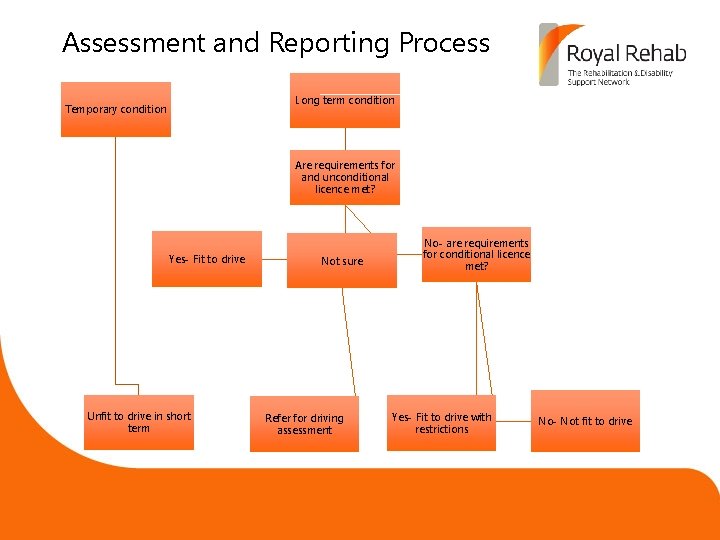
Assessment and Reporting Process Long term condition Temporary condition Are requirements for and unconditional licence met? Yes- Fit to drive Unfit to drive in short term Not sure Refer for driving assessment No- are requirements for conditional licence met? Yes- Fit to drive with restrictions No- Not fit to drive
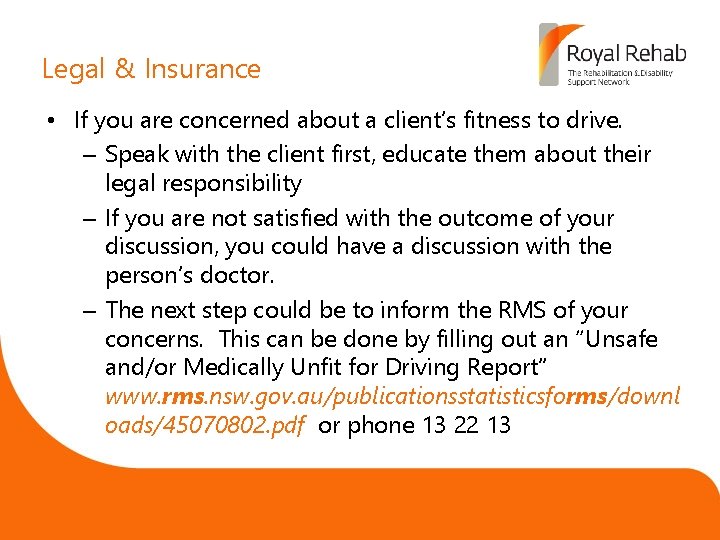
Legal & Insurance • If you are concerned about a client’s fitness to drive. – Speak with the client first, educate them about their legal responsibility – If you are not satisfied with the outcome of your discussion, you could have a discussion with the person’s doctor. – The next step could be to inform the RMS of your concerns. This can be done by filling out an “Unsafe and/or Medically Unfit for Driving Report” www. rms. nsw. gov. au/publicationsstatisticsforms/downl oads/45070802. pdf or phone 13 22 13
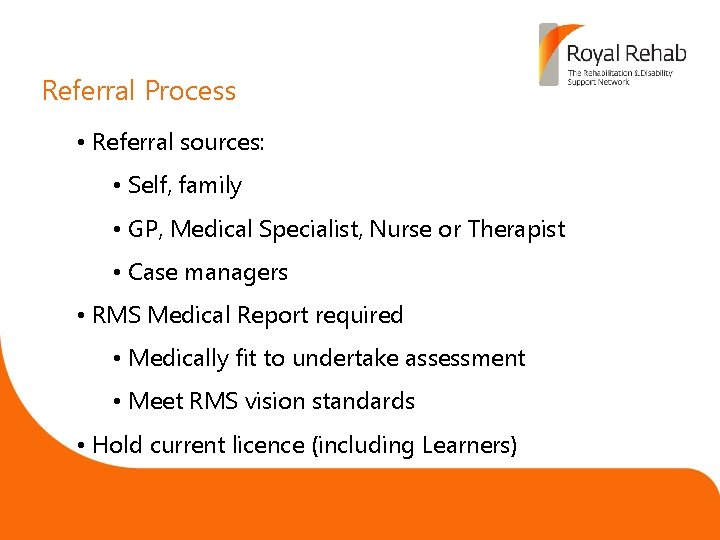
Referral Process • Referral sources: • Self, family • GP, Medical Specialist, Nurse or Therapist • Case managers • RMS Medical Report required • Medically fit to undertake assessment • Meet RMS vision standards • Hold current licence (including Learners)
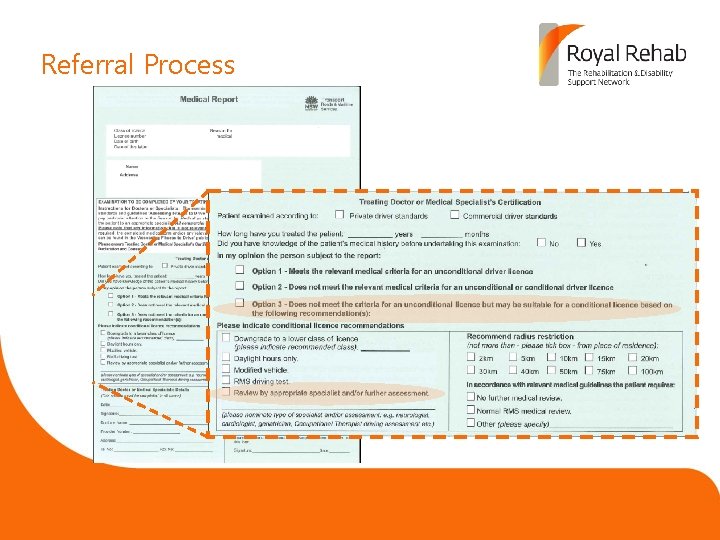
Referral Process
OT Driving Assessment Process • Off Road Assessment • Interview regarding medical & driving history • Vision screen • Physical screen • Cognitive screen • Road law knowledge screen • On Road Assessment
Interview • Medical history – Symptoms. – Medications and side effects. • Place here Drivingcopy history – How long has the person been driving? – Where does the person go? – Is the person driving currently? • Social situation – Work as a driver in the past. – Who else in the family drives?
Vision • History of eye treatment • Visual Acuity – Must be better than 6/12 in the better eye Visual symptoms • • Place copy here • Cover test • Slow & fast eye movements • Visual field confrontation test If there is anything unusual then the OT must refer to a vision specialist
Physical screen • • • Active range. Place of motion • Kinaesthesia copy here Strength – Oxford Rating Scale • Coordination § Copy here • Balance Tone Pain • Transfer ability Sensation Proprioception All physical screens (other than transfers) are completed whilst the client is sitting, as they would be whilst driving.
Cognitive Screen • Formal Tests – Drive. Safe – Intersection diagram test – Written road law test – Drive. Aware • The person’s ability to communicate, recall and concentrate provides information regarding cognitive ability.
Drive. Safe • Test Format – 11 images are projected on a screen – Each image has two to four objects. – Clients look at the image for three seconds. – After the image is removed the client is required to recall; object, location and direction of travel • Information gained – Tests areas such as memory and the ability to take in visual information quickly. – The Drive. Safe can be affected by NESB and communication difficulties. The OT will consider these factors when interpreting test scores.
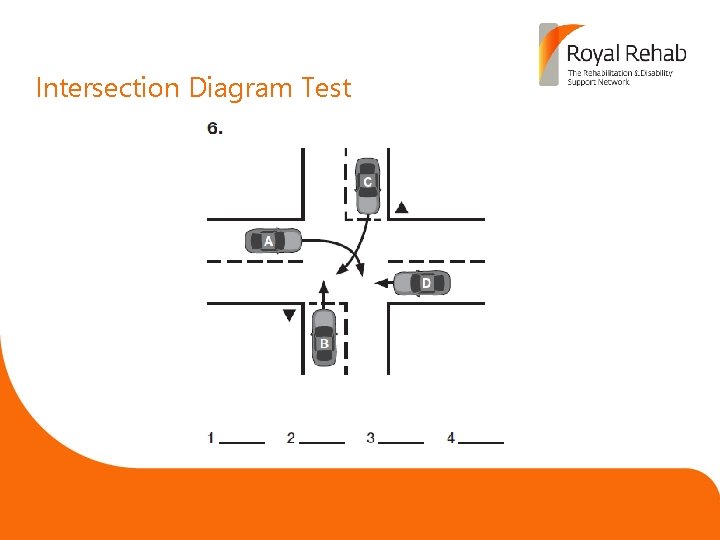
Intersection Diagram Test
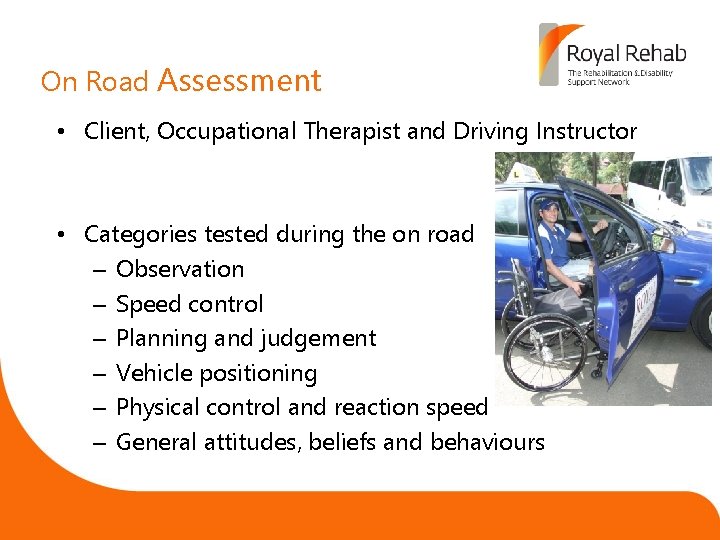
On Road Assessment • Client, Occupational Therapist and Driving Instructor • Categories tested during the on road – Observation – Speed control – Planning and judgement – Vehicle positioning – Physical control and reaction speed – General attitudes, beliefs and behaviours
Recommendations • Retain/Reinstate licence • Modifications and lessons followed by RMS Disability Test, an OT reassessment may be indicated. • Periodic OT reassessment for progressive conditions • Lessons followed by reassessment • Restrictions/conditions on licence • Not ready to return to driving yet, try again later. • Cancellation of licence
Evidence • Drivers with PD had significantly worse driving performance (p , 0. 05) than healthy controls. • Although most drivers with PD were considered safe to drive the deficits that may affect driving were apparent in the early stages of PD. Crizzle, A. M. , Classen, S. & Uc, E. Y. (2012). Parkinson disease and driving: An evidence-based review. Neurology, 79, p. 2067 -2074.
Evidence • In a cross sectional study of 104 participants with PD; 86 (65%) or participants passed and 36 (35%) failed a standardized on road driving test. • Poor performances on positioning at low speed, speed adaptations at high speed, and left turning maneuvers (on European roads) were most likely to indicate the pass/fail decision • Turning left (in Europe) is considered among the most complex driving skills and the main cause for car crashes in older drivers. This complex task is associated with visual scanning, working memory, cognitive inhibition, and selective attention. Devos, H. , Vandenberghe, W. , Tant, M. , Akinwuntan, A. E. De Weerdt, W. , Nieuwboer, A. & Uc, E. Y. (2013). Driving and Off-Road Impairments Underlying Failure on Road Testing in Parkinson’s Disease. Movement Disorders, 28 (14), p. 1949 -1956.
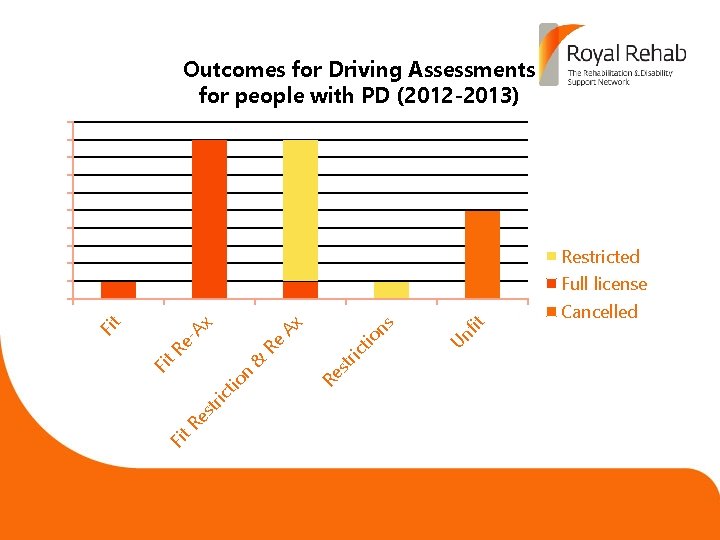
Outcomes for Driving Assessments for people with PD (2012 -2013) Restricted Full license fit Un ns tio ric Re & n io ct st ri Re Fi t Re st Ax x e. A t. R Fi Fi t Cancelled
Occupational Therapy Driving Assessment • A referral to an OT driving assessment DOES NOT mean the driver will lose their licence. • Driver Trained OT’s will look for every reason to maintain a person’s independence. • An OT assessment is an opportunity to clinically observe and provide feedback on someone’s driving. • An OT assessment may even result in improved driving performance.
DARC Contact • Phone: 9808 9328 • Fax: 8088 4783 • Email: emily. hogan@royalrehab. com. au leonie. eldridge@royalrehab. com. au Useful Links • http: //www. drivingassessment. com. au/ • http: //www. austroads. com. au/assessing-fitness-todrive/assessing-fitness-to-drive • www. pmeautoconversions. com. au • www. freedommotorsaustralia. com. au Questions? ? ?
- Slides: 28