
OCCUPATIONAL THERAPISTS USE OF COGNITIVE INTERVENTIONS FOR CLIENTS




- Slides: 15
OCCUPATIONAL THERAPISTS USE OF COGNITIVE INTERVENTIONS FOR CLIENTS WITH ALZHEIMER'S DISEASE HOLLY CROCKER & PAULA LIUCCI
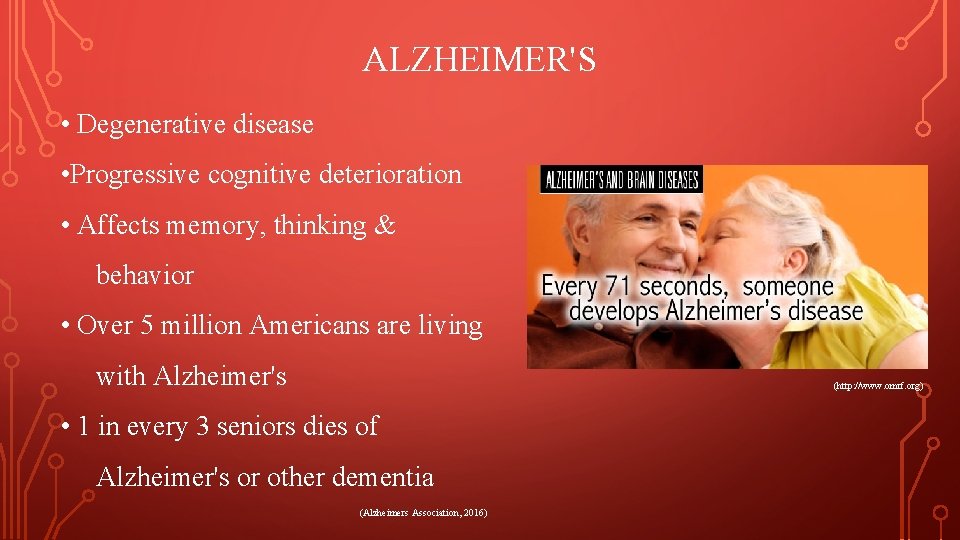
ALZHEIMER'S • Degenerative disease • Progressive cognitive deterioration • Affects memory, thinking & behavior • Over 5 million Americans are living with Alzheimer's (http: //www. omrf. org) • 1 in every 3 seniors dies of Alzheimer's or other dementia (Alzheimers Association, 2016)
GOAL • Establish profile of OT practice with provision of cognitive interventions • Involving AD clients in Montreal • Objectives were to determine methods of administration & types of cognitive interventions OTP use in different settings (http: //www. thecommissioningelf. net)
PARTICIPANTS • City of Montreal • OT eligibility • member of Ordre des Ergotherapeutes du Quebec • work in one setting only with AD patients • Settings • 14 in day centre • 15 in community health centre • 11 in rehabilitation centre • 15 in acute care • 19 in long term care • Total of 74 participants (http: //www. guardianly. com)
DATA COLLECTION • Self-Administered questionnaire • Developed based on evidence from literature • Reviewed by two expert OTs and two experts in survey methodology • Pilot test conducted with 4 OTs • Definitions for 3 types of cognitive interventions provided • Participants able to add in other types of cognitive interventions used • Cover letter mailed with stamped return envelope to selected OT participants • Reminder postcard mailed to non-responders 2 -3 weeks later • Study participants contacted to verify eligibility
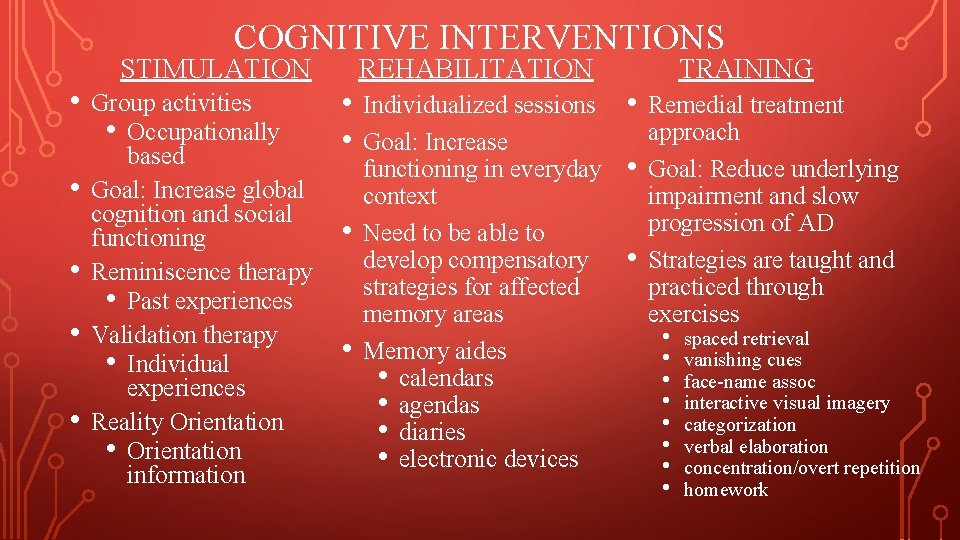
COGNITIVE INTERVENTIONS • • • Group activities • Occupationally based Goal: Increase global cognition and social functioning Reminiscence therapy • Past experiences Validation therapy • Individual experiences Reality Orientation • Orientation information TRAINING REHABILITATION STIMULATION • • Individualized sessions Goal: Increase functioning in everyday context Need to be able to develop compensatory strategies for affected memory areas Memory aides • calendars • agendas • diaries • electronic devices • • • Remedial treatment approach Goal: Reduce underlying impairment and slow progression of AD Strategies are taught and practiced through exercises • spaced retrieval • vanishing cues • face-name assoc • interactive visual imagery • categorization • verbal elaboration • concentration/overt repetition • homework
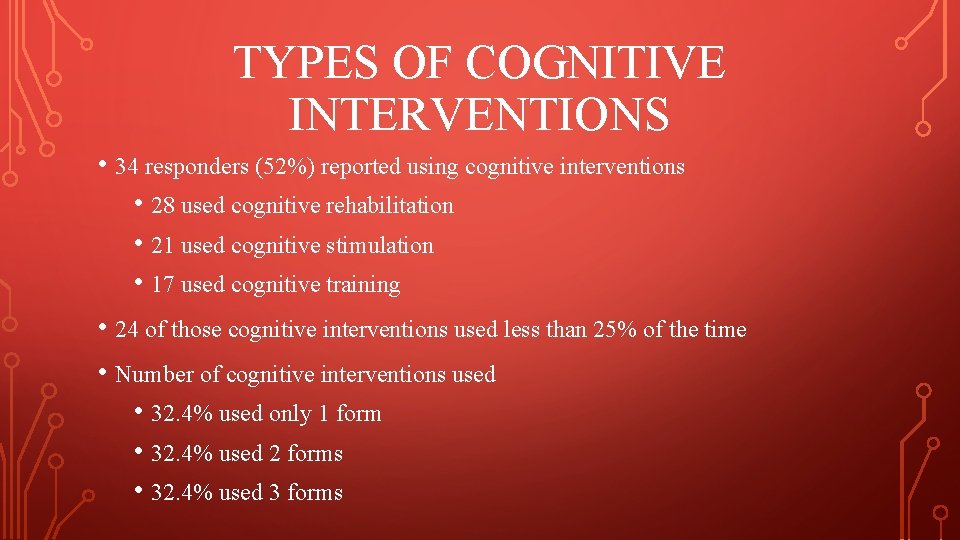
TYPES OF COGNITIVE INTERVENTIONS • 34 responders (52%) reported using cognitive interventions • 28 used cognitive rehabilitation • 21 used cognitive stimulation • 17 used cognitive training • 24 of those cognitive interventions used less than 25% of the time • Number of cognitive interventions used • 32. 4% used only 1 form • 32. 4% used 2 forms • 32. 4% used 3 forms
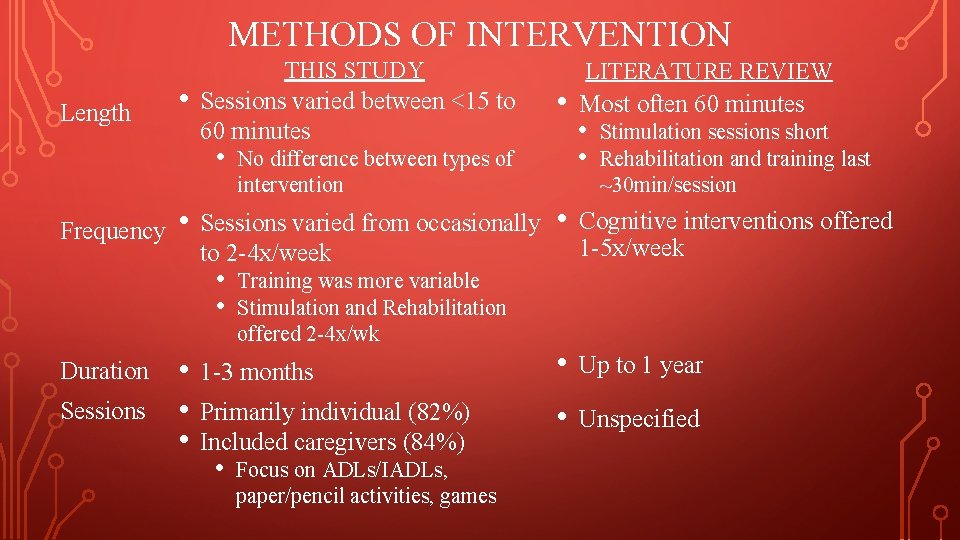
METHODS OF INTERVENTION Length • THIS STUDY Sessions varied between <15 to 60 minutes • Frequency • Sessions • • • No difference between types of intervention • • Stimulation sessions short Rehabilitation and training last ~30 min/session • Cognitive interventions offered 1 -5 x/week 1 -3 months • Up to 1 year Primarily individual (82%) Included caregivers (84%) • Unspecified Sessions varied from occasionally to 2 -4 x/week • • Duration • LITERATURE REVIEW Most often 60 minutes • Training was more variable Stimulation and Rehabilitation offered 2 -4 x/wk Focus on ADLs/IADLs, paper/pencil activities, games
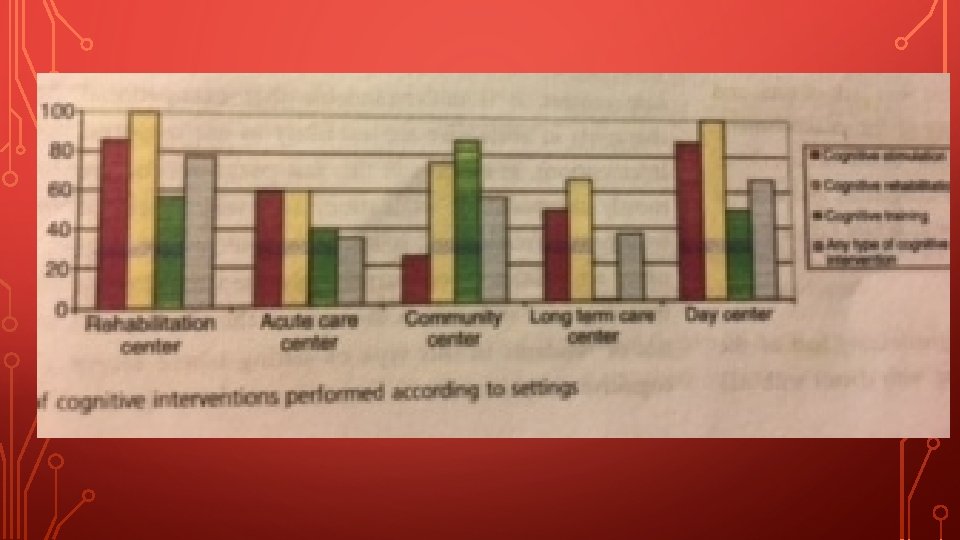
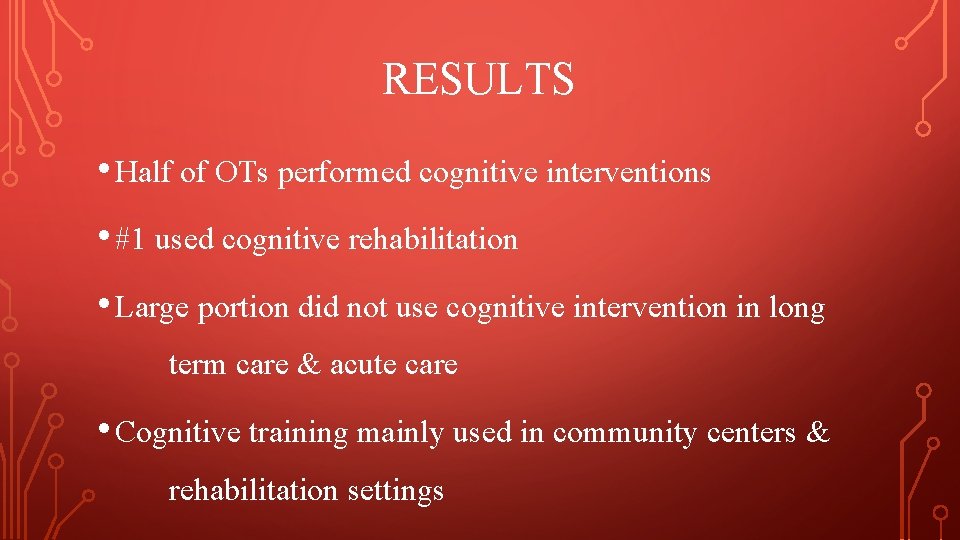
RESULTS • Half of OTs performed cognitive interventions • #1 used cognitive rehabilitation • Large portion did not use cognitive intervention in long term care & acute care • Cognitive training mainly used in community centers & rehabilitation settings
STRENGTHS • Variety of settings were represented • Varied demographic characteristics of study participants • Participant pool was random, but met pre-established professional criteria • Self-questionnaire was tested for validity and clarity prior to study
LIMITATIONS • Study represented only one urban area in Canada • Canadian health care system focuses on reduction in length of stay • Participants felt there was a lack of time to implement cognitive interventions • This study does not take into account interventions by professionals other than OTs • Shorter session length, frequency, and duration for this study impacts ability to compare to studies in literature review • Group intervention was infrequent so cognitive stimulation methods could not be implemented on a regular basis
FURTHER RESEARCH • Monitor clinical practice and development of evidence-based knowledge to be able to apply information across more types of settings • Urban versus rural • Internationally • More studies to determine effectiveness of cognitive intervention treatment • Cognitive stimulation • Cognitive rehabilitation • Cognitive training
“People with early Alzheimer’s Disease still have the potential to learn and retain information and skills through cognitive interventions. ” (http: //www. lethow. com)
REFERENCES Alzheimer’s Association. (2016). 2016 Alzheimer's disease facts and figures. Retrieved from http: //www. alz. org/facts/overview. asp [Photo of Alzheimer’s statistic]. Retrieved from http: // omrf. org/about-omrf/research-targets/alzheimers-and-brain-disease/alzheimers-frontpage / [Photo of interventions]. Retrieved from http: //r. search. yahoo. com/_ylt=Awr. B 8 ph. Xlw. FY 5 h 8 Ar 1 CQn. Il. Q; _ylu=X 3 o. DMTBtd. XBkb. HJy. BHNl. Yw. Nmc. C 1 hd. HRya. WIEc 2 xr. A 3 J 1 cmw/RV=2/RE=1476528087/RO=11/RU=http%3 a%2 f%2 fwww. thecommissioningelf. net%2 fa-strong-business-case-exists-for-investing-in-early-andcommunity-based-interventions-for-mental-health-says-report%2 f/RK=0/RS=xhsz. Kvt. Ji. NM 02 Is. H 5 Sl. Uti. Tlh 5 c[Photo of tree heads]. Retrieved from http: //r. search. yahoo. com/_ylt=Awr. B 8 pq 5 lw. FYsn. IA 0 ai. Qn. Il. Q; _ylu=X 3 o. DMTBtd. XBkb. HJy. BHNl. Yw. Nmc. C 1 hd. HRya. WIEc 2 xr. A 3 J 1 cmw/RV=2/RE=1476528185/RO=11/RU=http%3 a%2 f%2 flethow. com%2 fdisease%2 falzheimersstages%2 f/RK=0/RS=Iv. Jgq. Dn. Rv. P 5 pbwdfg 1 Tz. A 9 Rb. M 5 I[Photo of two women]. Retrieved from http: //r. search. yahoo. com/_ylt=Awr. B 8 pi. Ylw. FYx. Gs. A. 7 a. Qn. Il. Q; _ylu=X 3 o. DMTBtd. XBkb. HJy. BHNl. Yw. Nmc. C 1 hd. HRya. WIEc 2 xr. A 3 J 1 cmw/RV=2/RE=1476528153/RO=11/RU=http%3 a%2 f%2 fguardianlv. com%2 f 2014%2 f 07%2 falzheimers-disease-detected-with-eye-testvideo%2 f/RK=0/RS=uz. JIm 56 nf. CFRDo. FGli 407 i 4 f. LBYRobert, A. , Gélinas, I. , & Mazer, B. (2010). Occupational therapists use of cognitive interventions for clients with alzheimer's disease. Occupational Therapy International, 17(1), 10 -19. Doi: 10. 1002/Oti. 283