
Occupational License Tax Net Profits vs Gross Receipts

- Slides: 18
Occupational License Tax: Net Profits vs Gross Receipts EQUITABLE TAXATION
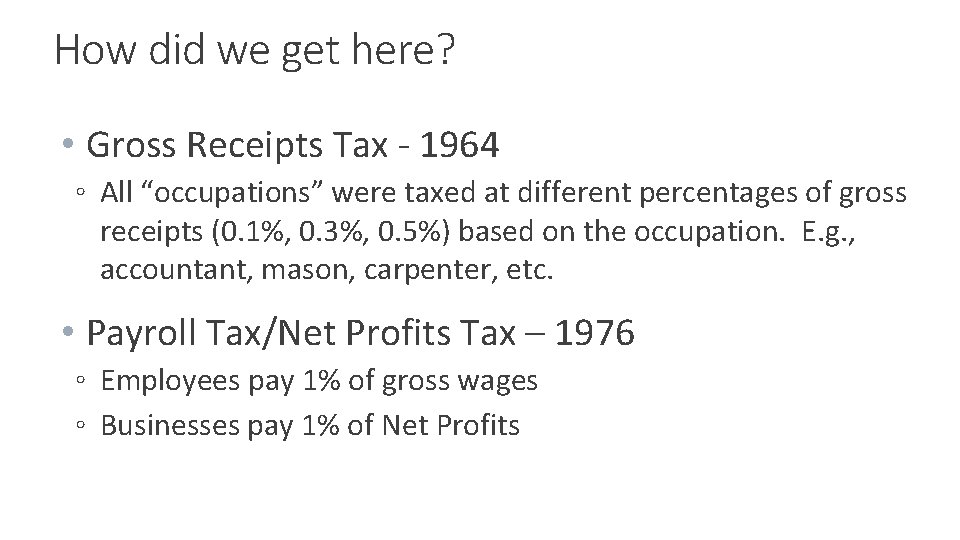
How did we get here? • Gross Receipts Tax - 1964 ◦ All “occupations” were taxed at different percentages of gross receipts (0. 1%, 0. 3%, 0. 5%) based on the occupation. E. g. , accountant, mason, carpenter, etc. • Payroll Tax/Net Profits Tax – 1976 ◦ Employees pay 1% of gross wages ◦ Businesses pay 1% of Net Profits
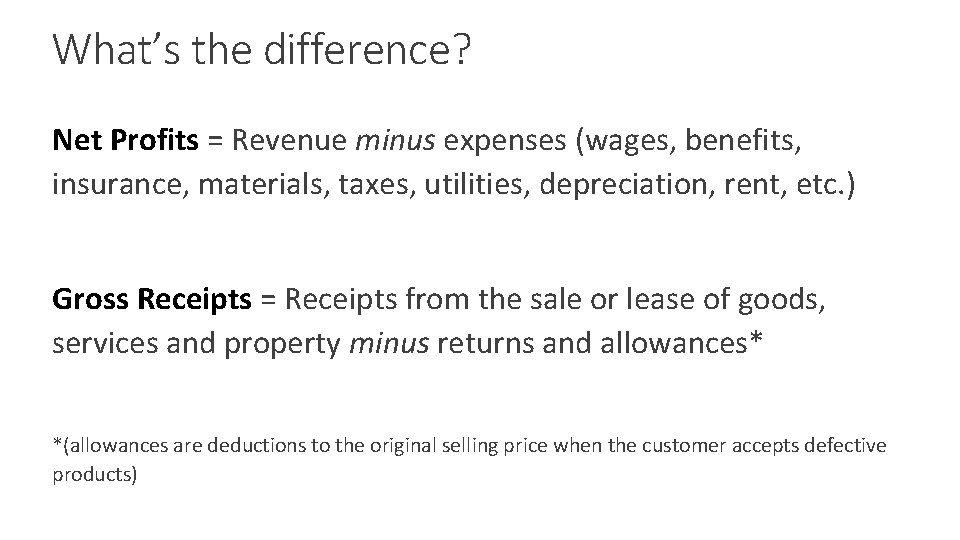
What’s the difference? Net Profits = Revenue minus expenses (wages, benefits, insurance, materials, taxes, utilities, depreciation, rent, etc. ) Gross Receipts = Receipts from the sale or lease of goods, services and property minus returns and allowances* *(allowances are deductions to the original selling price when the customer accepts defective products)
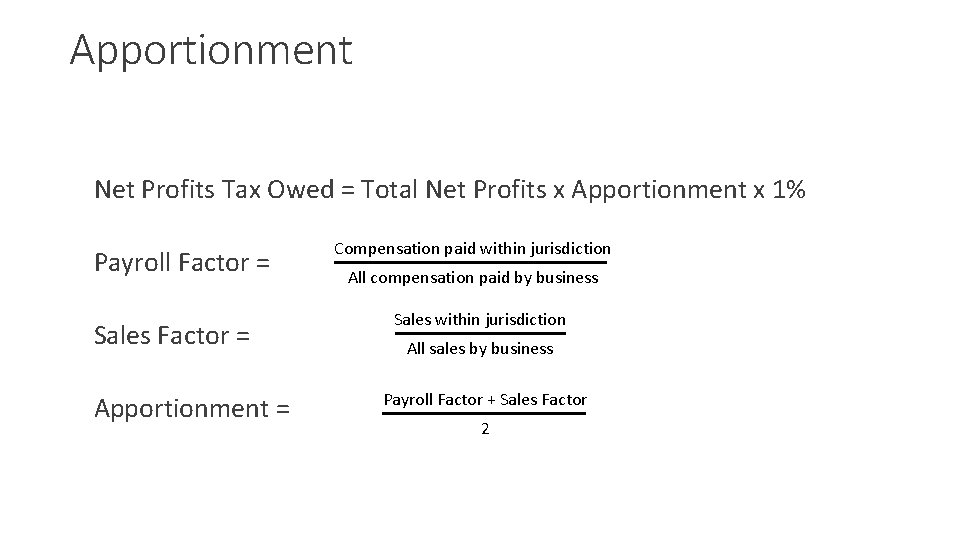
Apportionment Net Profits Tax Owed = Total Net Profits x Apportionment x 1% Payroll Factor = Sales Factor = Apportionment = Compensation paid within jurisdiction All compensation paid by business Sales within jurisdiction All sales by business Payroll Factor + Sales Factor 2
Key Concept: Net Profits are calculated based on global business operations. Hypothetical - Super. World. Mart 0. 05% business and payroll $0$150 Net Profits tax owed to Georgetown $100 Billion construction Worldwide Receipts expenses $0 Global Net Profits in Georgetown ($50 Million)
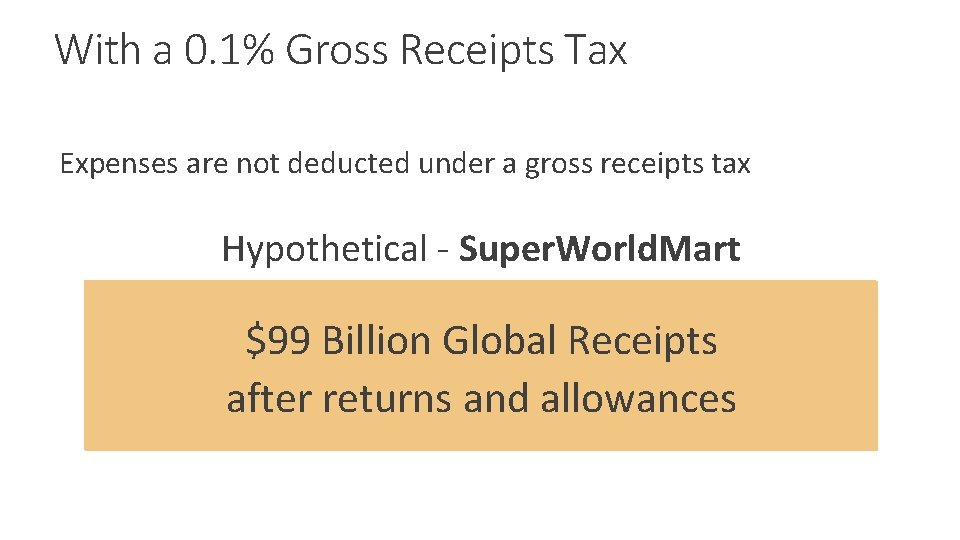
With a 0. 1% Gross Receipts Tax Expenses are not deducted under a gross receipts tax Hypothetical - Super. World. Mart $49, 500, 000 in apportioned gross receipts $49, 500 gross receipts tax owed to 0. 05% business and payroll $99 in. Billion Global Receipts in. Georgetown after returns and allowances
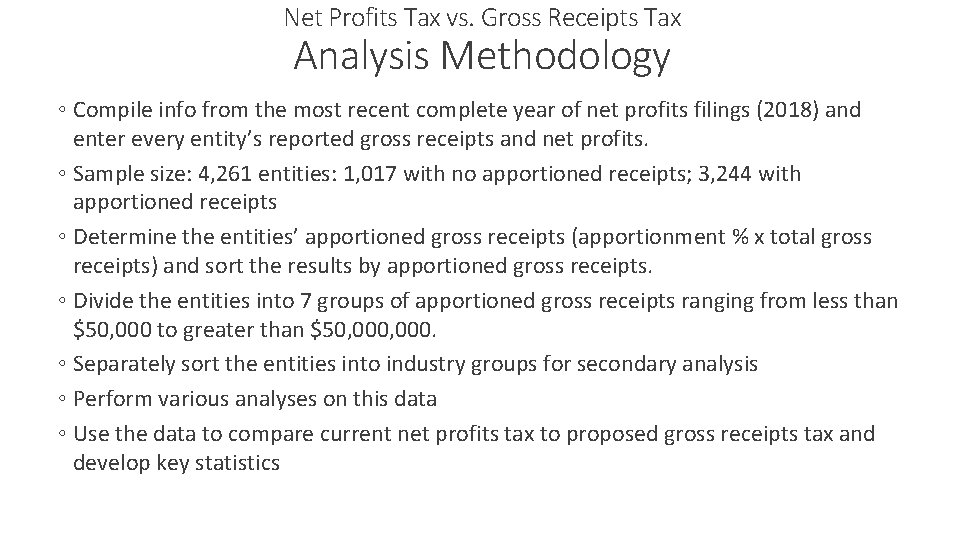
Net Profits Tax vs. Gross Receipts Tax Analysis Methodology ◦ Compile info from the most recent complete year of net profits filings (2018) and enter every entity’s reported gross receipts and net profits. ◦ Sample size: 4, 261 entities: 1, 017 with no apportioned receipts; 3, 244 with apportioned receipts ◦ Determine the entities’ apportioned gross receipts (apportionment % x total gross receipts) and sort the results by apportioned gross receipts. ◦ Divide the entities into 7 groups of apportioned gross receipts ranging from less than $50, 000 to greater than $50, 000. ◦ Separately sort the entities into industry groups for secondary analysis ◦ Perform various analyses on this data ◦ Use the data to compare current net profits tax to proposed gross receipts tax and develop key statistics
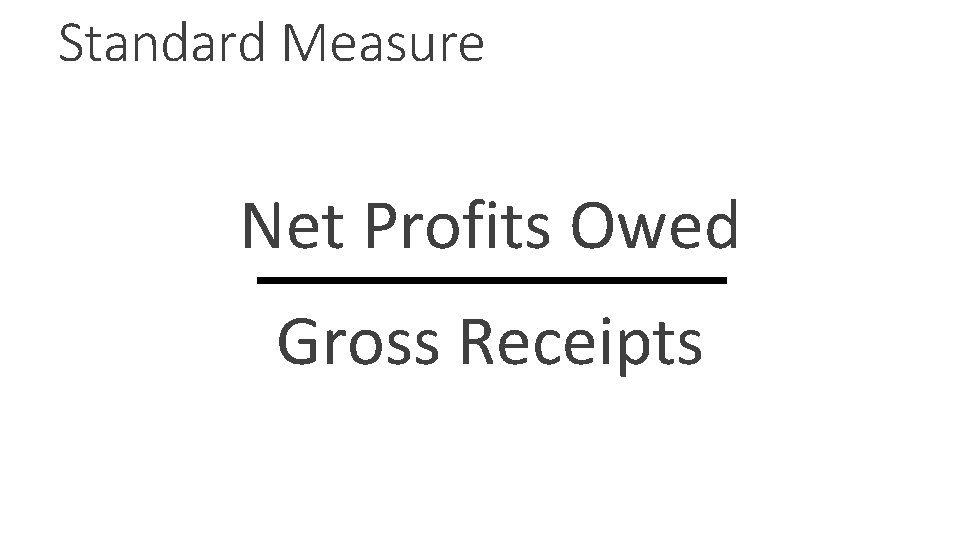
Standard Measure Net Profits Owed Gross Receipts
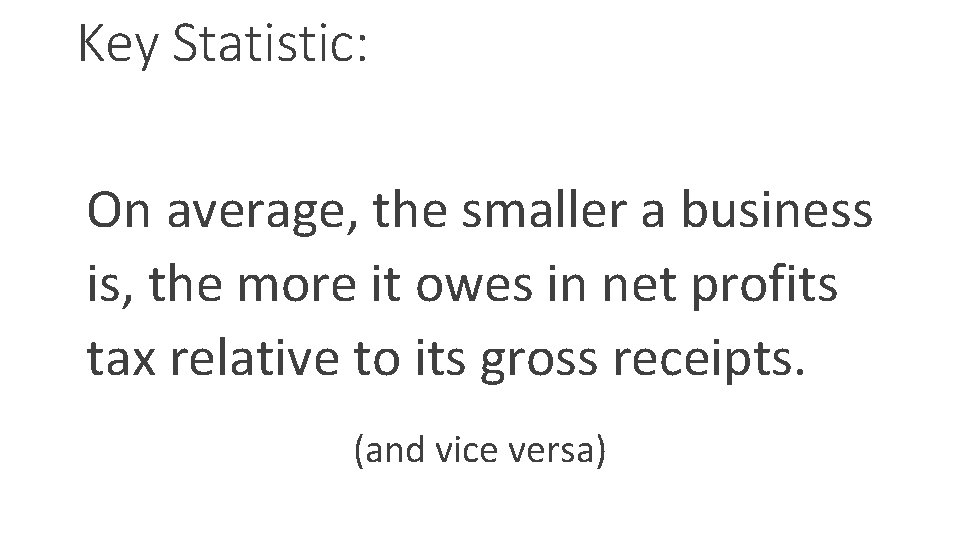
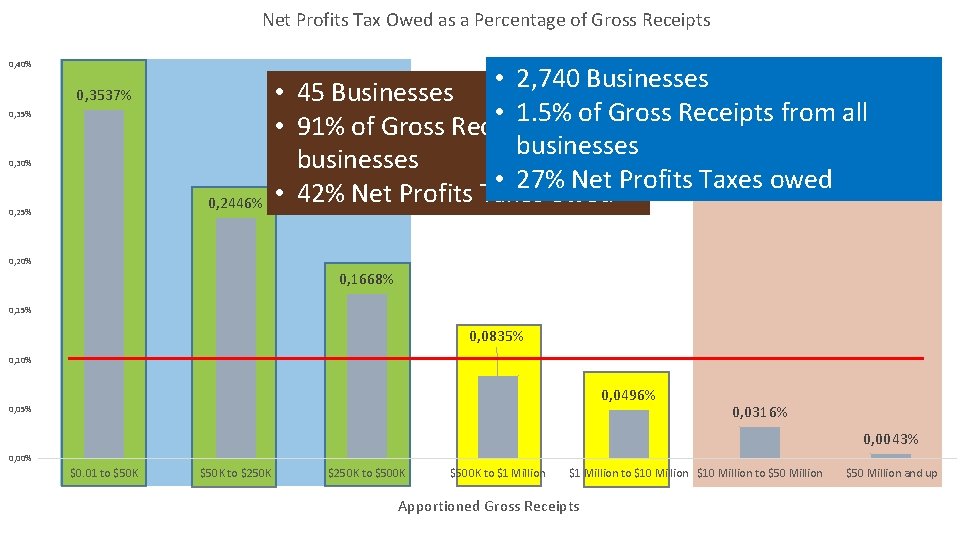
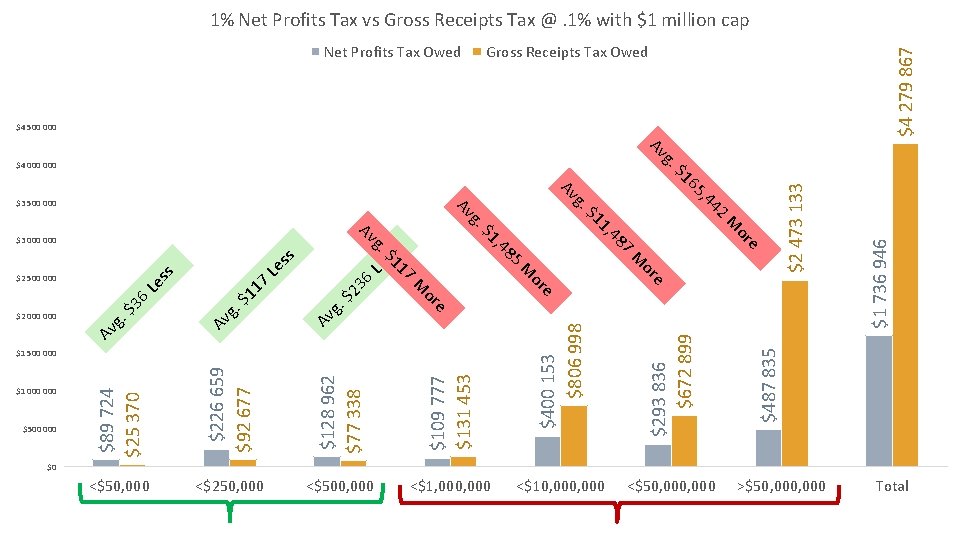
Key Statistic: On average, the smaller a business is, the more it owes in net profits tax relative to its gross receipts. (and vice versa)
Net Profits Tax Owed as a Percentage of Gross Receipts 0, 40% 0, 3537% 0, 35% 0, 30% 0, 2446% 0, 25% • 2, 740 Businesses • 45 Businesses • 1. 5% of Gross Receipts from all • 91% of Gross Receipts from all businesses • 27% Net Profits Taxes owed • 42% Net Profits Taxes owed 0, 20% 0, 1668% 0, 15% 0, 0835% 0, 10% 0, 0496% 0, 05% 0, 0316% 0, 0043% 0, 00% $0. 01 to $50 K to $250 K to $500 K to $1 Million to $10 Million to $50 Million Apportioned Gross Receipts $50 Million and up
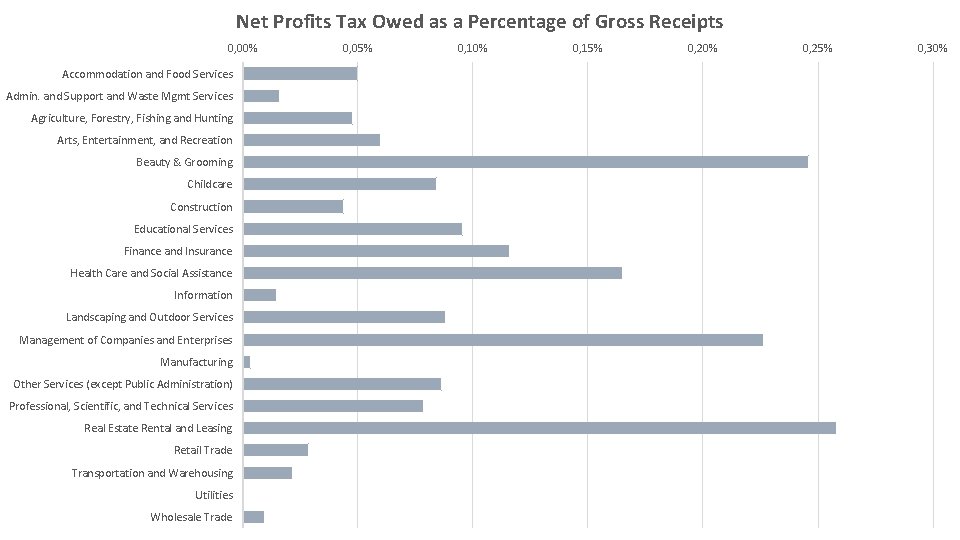
Net Profits Tax Owed as a Percentage of Gross Receipts 0, 00% Accommodation and Food Services Admin. and Support and Waste Mgmt Services Agriculture, Forestry, Fishing and Hunting Arts, Entertainment, and Recreation Beauty & Grooming Childcare Construction Educational Services Finance and Insurance Health Care and Social Assistance Information Landscaping and Outdoor Services Management of Companies and Enterprises Manufacturing Other Services (except Public Administration) Professional, Scientific, and Technical Services Real Estate Rental and Leasing Retail Trade Transportation and Warehousing Utilities Wholesale Trade 0, 05% 0, 10% 0, 15% 0, 20% 0, 25% 0, 30%
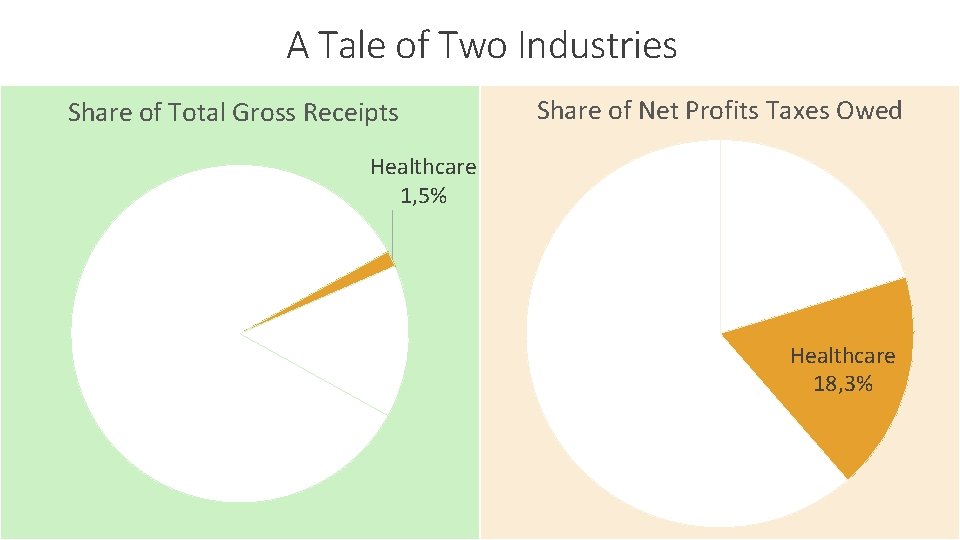
A Tale of Two Industries Share of Total Gross Receipts Share of Net Profits Taxes Owed Healthcare 1, 5% Manufacturing 83, 9% Manufacturing 20, 3% Healthcare 18, 3%
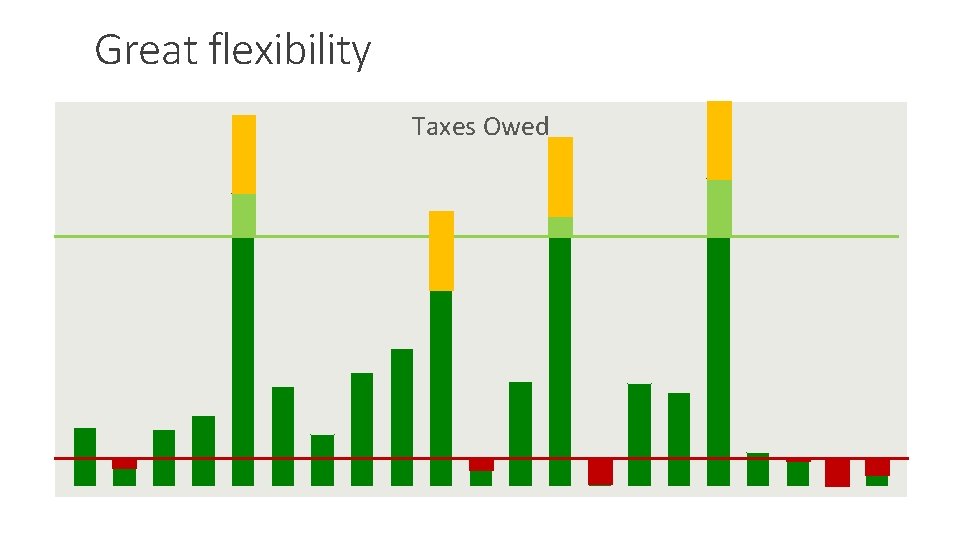
Great flexibility Taxes Owed
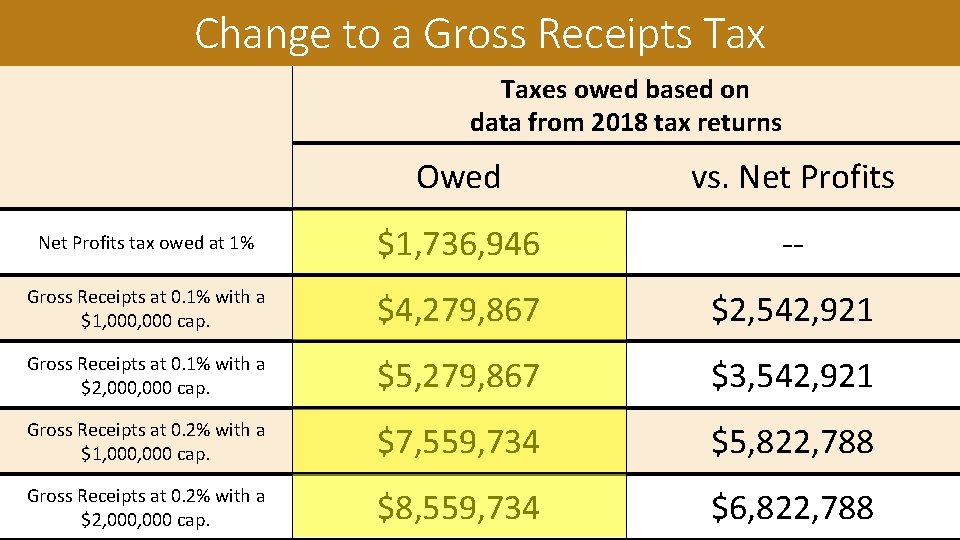
Change to a Gross Receipts Taxes owed based on data from 2018 tax returns Owed vs. Net Profits tax owed at 1% $1, 736, 946 -- Gross Receipts at 0. 1% with a $1, 000 cap. $4, 279, 867 $2, 542, 921 Gross Receipts at 0. 1% with a $2, 000 cap. $5, 279, 867 $3, 542, 921 Gross Receipts at 0. 2% with a $1, 000 cap. $7, 559, 734 $5, 822, 788 Gross Receipts at 0. 2% with a $2, 000 cap. $8, 559, 734 $6, 822, 788
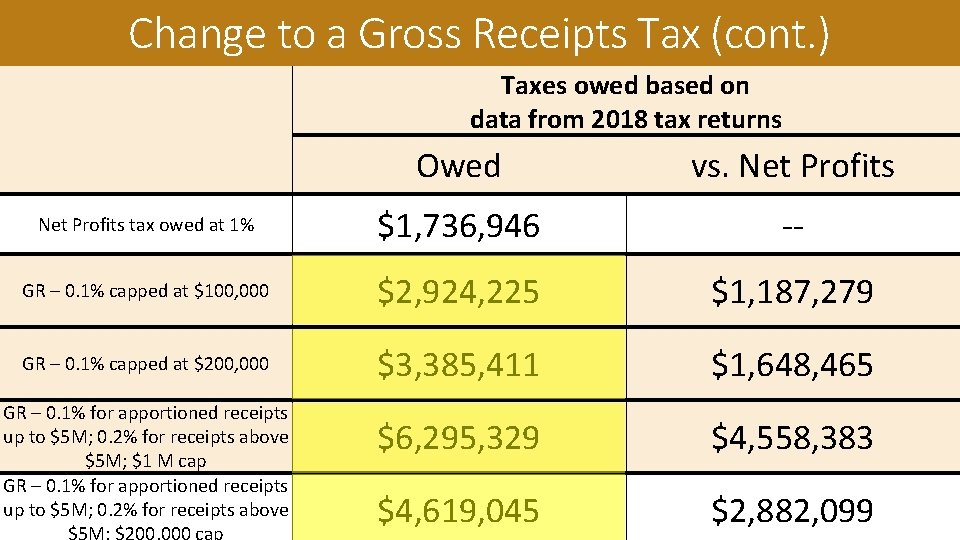
Change to a Gross Receipts Tax (cont. ) Taxes owed based on data from 2018 tax returns Owed vs. Net Profits tax owed at 1% $1, 736, 946 -- GR – 0. 1% capped at $100, 000 $2, 924, 225 $1, 187, 279 GR – 0. 1% capped at $200, 000 $3, 385, 411 $1, 648, 465 $6, 295, 329 $4, 558, 383 $4, 619, 045 $2, 882, 099 GR – 0. 1% for apportioned receipts up to $5 M; 0. 2% for receipts above $5 M; $1 M cap GR – 0. 1% for apportioned receipts up to $5 M; 0. 2% for receipts above
1% Net Profits Tax vs Gross Receipts Tax @. 1% with $1 million cap Gross Receipts Tax Owed $4 279 867 Net Profits Tax Owed $4 500 000 <$1, 000, 000 <$10, 000, 000 <$50, 000, 000 $487835 <$500, 000 $293 836 $672899 $109 777 $131 453 <$250, 000 $400 153 $806998 Le 36 $2 g. $128 962 $77 338 Av $226 659 $92 677 <$50, 000 $1 $1736 736946 ss ss Le $89 724 $25 370 Av g. $1 17 ss Le e 6 or M e $3 e or 7 or M g. M 48 1, 85 Av 42 $1 , 4 $0 e $0 or M $500 000 17 $500 000 $1 $1 500 000 $1 000 000 $1 g. $2 500 000 , 4 g. Av $3 000 000 $2 000 000 65 $1 Av Av $3 $3 500 000 $2 $2473 473133 g. Av $4 000 >$50, 000 > $50, 000 Total
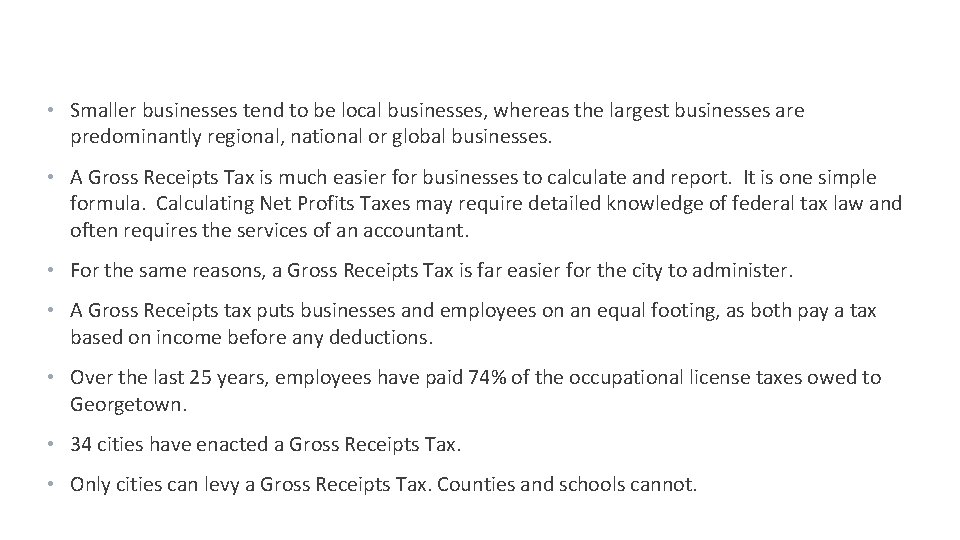
• Smaller businesses tend to be local businesses, whereas the largest businesses are predominantly regional, national or global businesses. • A Gross Receipts Tax is much easier for businesses to calculate and report. It is one simple formula. Calculating Net Profits Taxes may require detailed knowledge of federal tax law and often requires the services of an accountant. • For the same reasons, a Gross Receipts Tax is far easier for the city to administer. • A Gross Receipts tax puts businesses and employees on an equal footing, as both pay a tax based on income before any deductions. • Over the last 25 years, employees have paid 74% of the occupational license taxes owed to Georgetown. • 34 cities have enacted a Gross Receipts Tax. • Only cities can levy a Gross Receipts Tax. Counties and schools cannot.
Produced and Authored by: A production of the Special thanks to: Stacey Finance Director City of. Clark, Georgetown City of Georgetown Andrew S. Hartley Scott Hall, Director, Georgetown Scott County Revenue Commission Chief Administrative Officer Mayor Tom Prather Jessica Miller, Attorney, Georgetown Scott County Revenue Commission