
OCCUPATIONAL HEAT EXPOSURE CONTROL AND PREVENTION PRACTICES NEW

- Slides: 37
OCCUPATIONAL HEAT EXPOSURE CONTROL AND PREVENTION PRACTICES NEW MEXICO INSTITUTE OF MINING AND TECHNOLOGY
DISCLAIMER The training and educational materials were produced under grant SH-05048 -SH 8 from the Occupational Safety and Health Administration, U. S. Department of Labor. It does not necessarily reflect the views or policies of the U. S. Department of Labor, nor does mention of trade names, commercial products, or organizations imply endorsement by the U. S. Government. 2 TRAINING FOR WORKERS WHO ARE EXPOSED TO EXCESSIVE HEAT
PRE-TEST The purpose of the pre-test is to evaluate your knowledge about heat stress and heat exposure consequences It will help you know what will be covered during the training The pre-test will be compared to a post-test and helps us determine how we did during the training 3 TRAINING FOR WORKERS WHO ARE EXPOSED TO EXCESSIVE HEAT
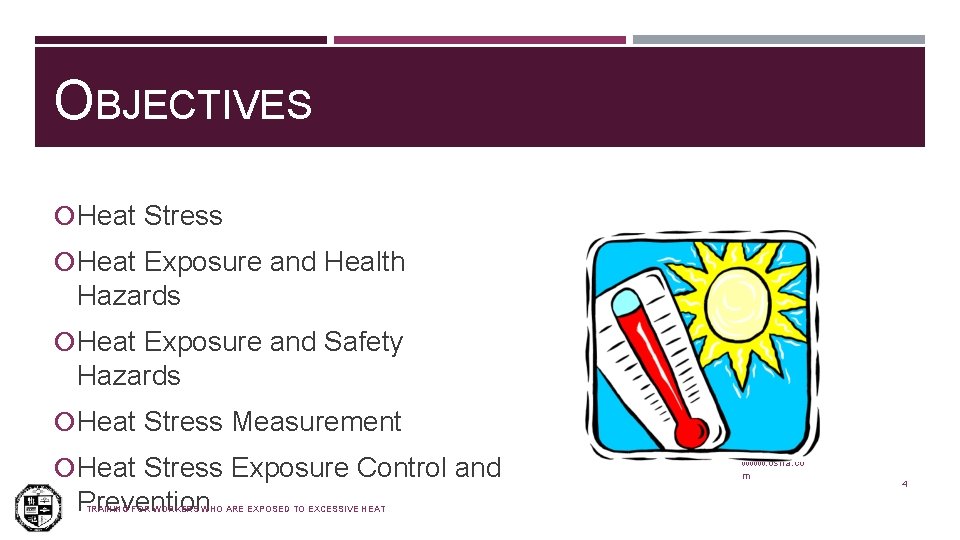
OBJECTIVES Heat Stress Heat Exposure and Health Hazards Heat Exposure and Safety Hazards Heat Stress Measurement Heat Stress Exposure Control and Prevention TRAINING FOR WORKERS WHO ARE EXPOSED TO EXCESSIVE HEAT www. osha. co m 4
PART 1 UNDERSTANDING HEAT What is heat? What is heat stress? Why is it important? 5 TRAINING FOR WORKERS WHO ARE EXPOSED TO EXCESSIVE HEAT
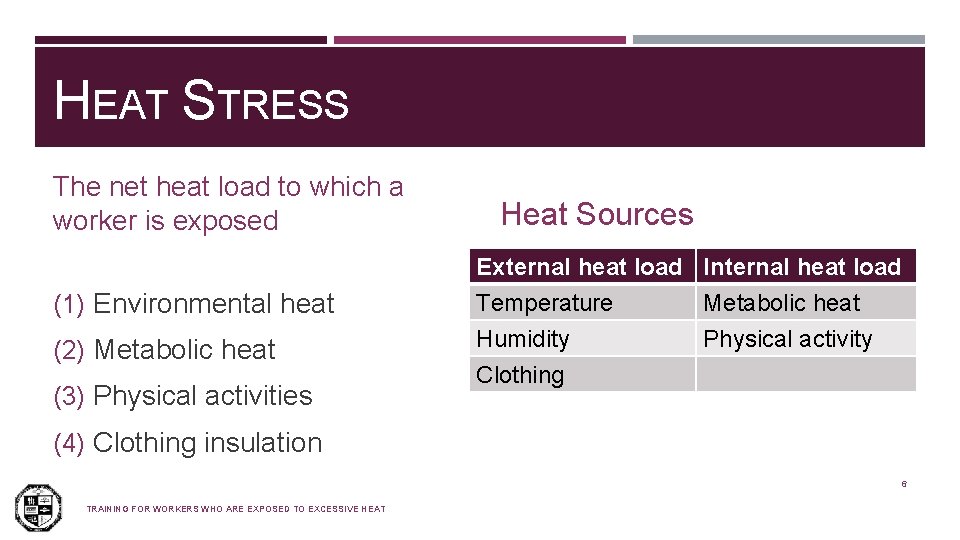
HEAT STRESS The net heat load to which a worker is exposed (1) Environmental heat (2) Metabolic heat (3) Physical activities Heat Sources External heat load Internal heat load Temperature Metabolic heat Humidity Physical activity Clothing (4) Clothing insulation 6 TRAINING FOR WORKERS WHO ARE EXPOSED TO EXCESSIVE HEAT
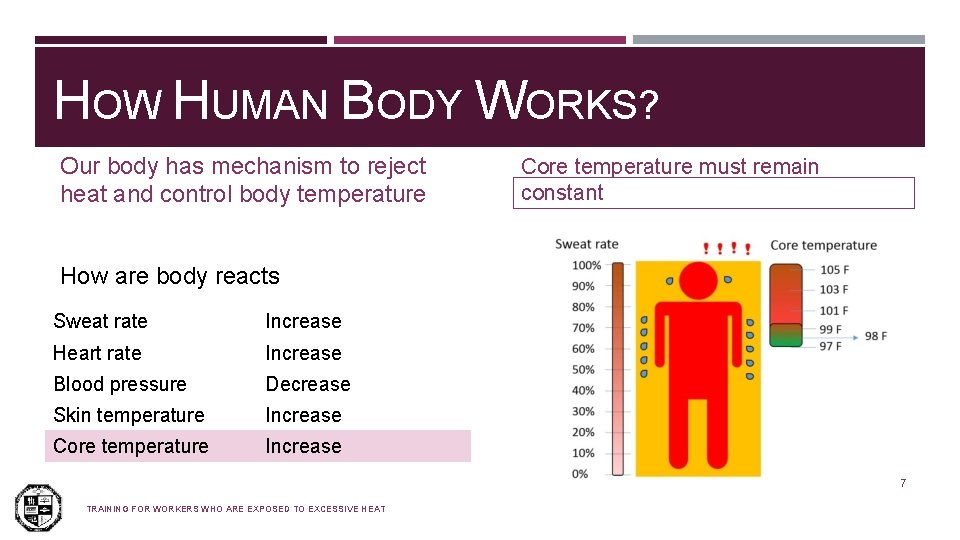
HOW HUMAN BODY WORKS? Our body has mechanism to reject heat and control body temperature Core temperature must remain constant How are body reacts Sweat rate Increase Heart rate Increase Blood pressure Decrease Skin temperature Increase Core temperature Increase 7 TRAINING FOR WORKERS WHO ARE EXPOSED TO EXCESSIVE HEAT
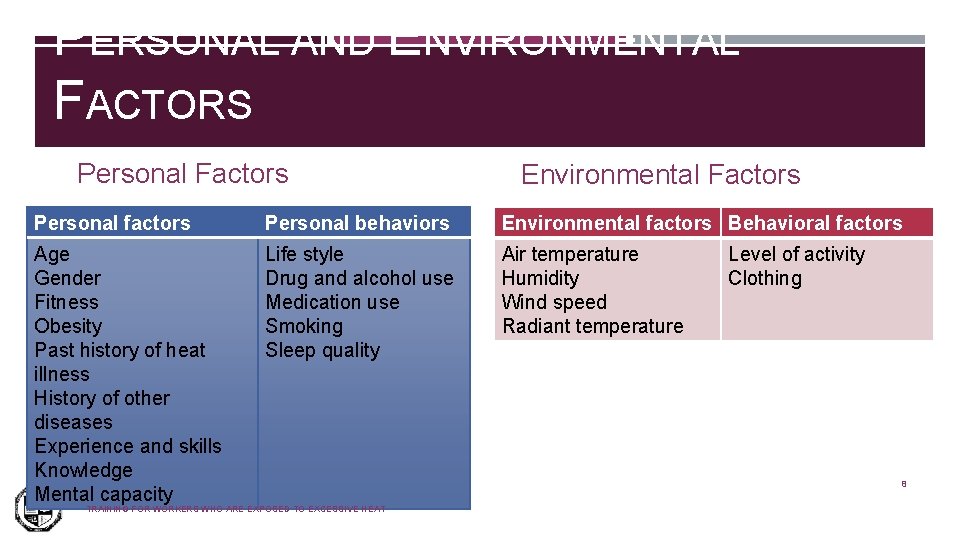
PERSONAL AND ENVIRONMENTAL FACTORS Personal Factors Environmental Factors Personal factors Personal behaviors Environmental factors Behavioral factors Age Gender Fitness Obesity Past history of heat illness History of other diseases Experience and skills Knowledge Mental capacity Life style Drug and alcohol use Medication use Smoking Sleep quality Air temperature Humidity Wind speed Radiant temperature TRAINING FOR WORKERS WHO ARE EXPOSED TO EXCESSIVE HEAT Level of activity Clothing 8
PART 11 HEAT IS A HEALTH HAZARD ARE YOU PROTECTED? 9 TRAINING FOR WORKERS WHO ARE EXPOSED TO EXCESSIVE HEAT
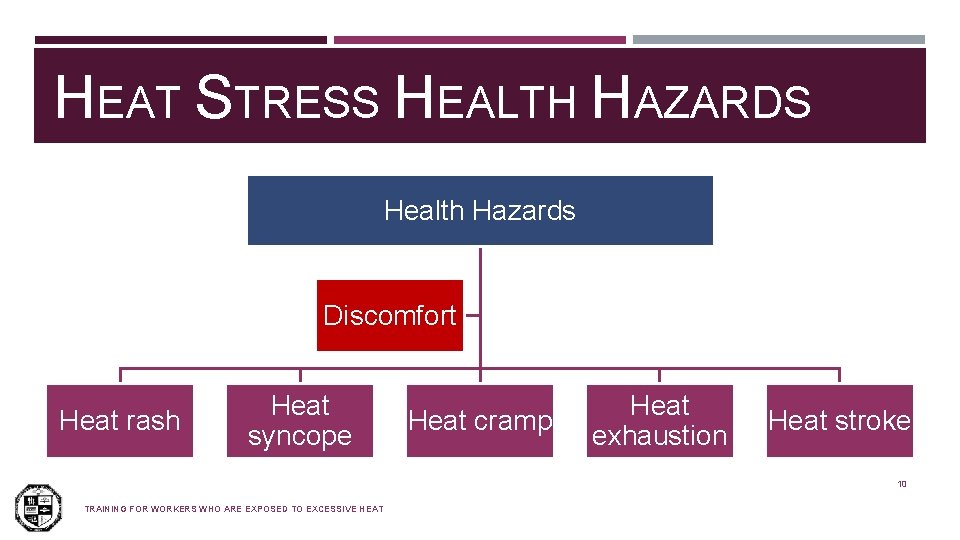
HEAT STRESS HEALTH HAZARDS Health Hazards Discomfort Heat rash Heat syncope Heat cramp Heat exhaustion Heat stroke 10 TRAINING FOR WORKERS WHO ARE EXPOSED TO EXCESSIVE HEAT
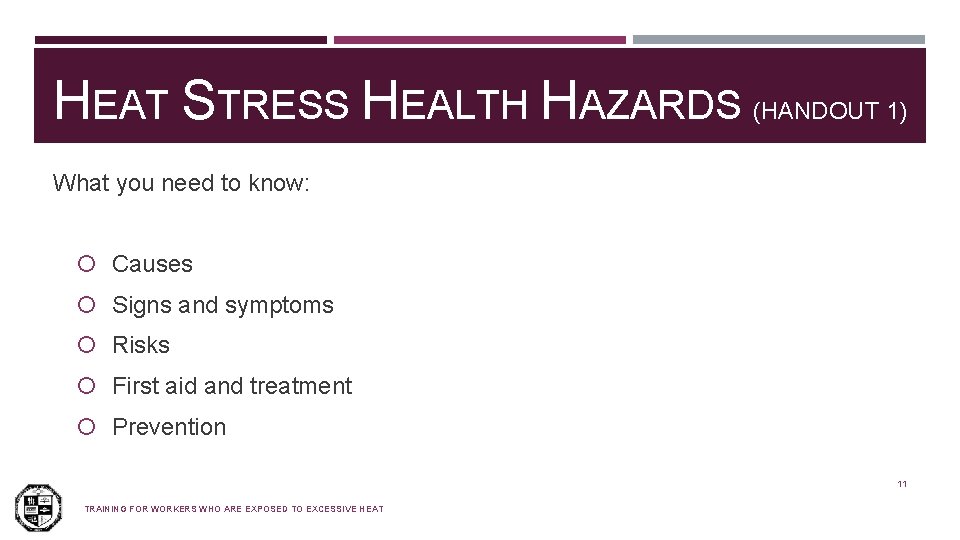
HEAT STRESS HEALTH HAZARDS (HANDOUT 1) What you need to know: Causes Signs and symptoms Risks First aid and treatment Prevention 11 TRAINING FOR WORKERS WHO ARE EXPOSED TO EXCESSIVE HEAT
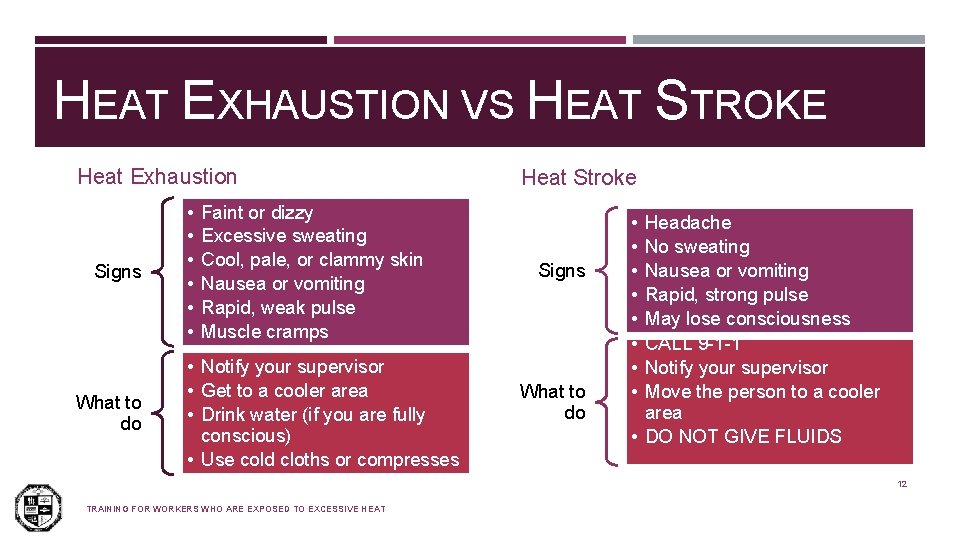
HEAT EXHAUSTION VS HEAT STROKE Heat Exhaustion Signs What to do • • • Faint or dizzy Excessive sweating Cool, pale, or clammy skin Nausea or vomiting Rapid, weak pulse Muscle cramps • Notify your supervisor • Get to a cooler area • Drink water (if you are fully conscious) • Use cold cloths or compresses Heat Stroke Signs What to do • • Headache No sweating Nausea or vomiting Rapid, strong pulse May lose consciousness CALL 9 -1 -1 Notify your supervisor Move the person to a cooler area • DO NOT GIVE FLUIDS 12 TRAINING FOR WORKERS WHO ARE EXPOSED TO EXCESSIVE HEAT
CLASS DISCUSSION – HEAT ILLNESSES How can we prevent heat stress illnesses? 1 11 111 111 TRAINING FOR WORKERS WHO ARE EXPOSED TO EXCESSIVE HEAT 13
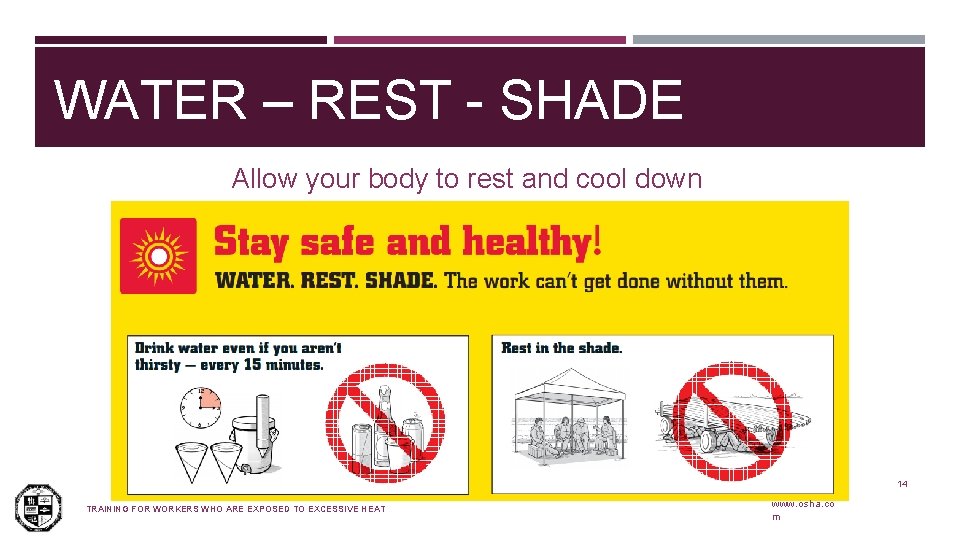
WATER – REST - SHADE Allow your body to rest and cool down 14 TRAINING FOR WORKERS WHO ARE EXPOSED TO EXCESSIVE HEAT www. osha. co m
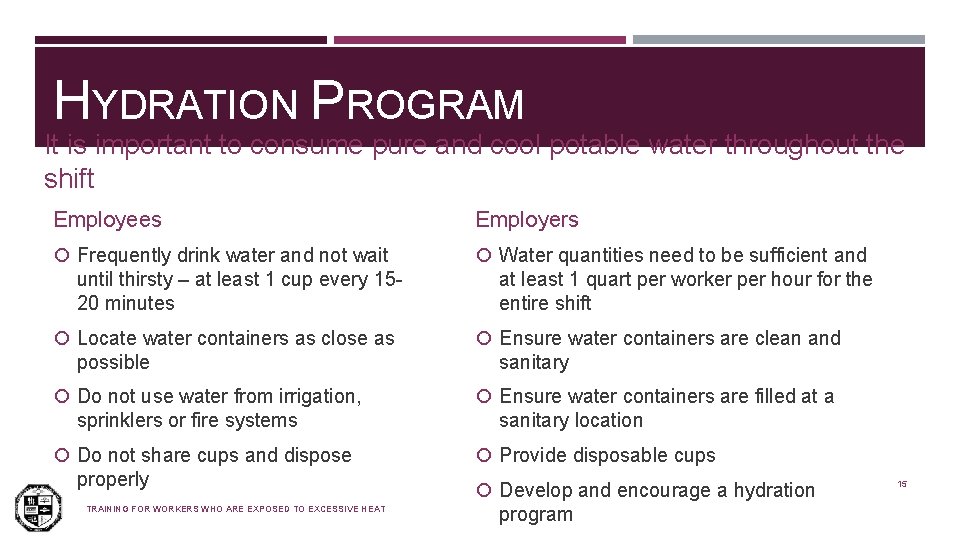
HYDRATION PROGRAM It is important to consume pure and cool potable water throughout the shift Employees Employers Frequently drink water and not wait Water quantities need to be sufficient and until thirsty – at least 1 cup every 1520 minutes Locate water containers as close as possible Do not use water from irrigation, sprinklers or fire systems Do not share cups and dispose properly TRAINING FOR WORKERS WHO ARE EXPOSED TO EXCESSIVE HEAT at least 1 quart per worker per hour for the entire shift Ensure water containers are clean and sanitary Ensure water containers are filled at a sanitary location Provide disposable cups Develop and encourage a hydration program 15
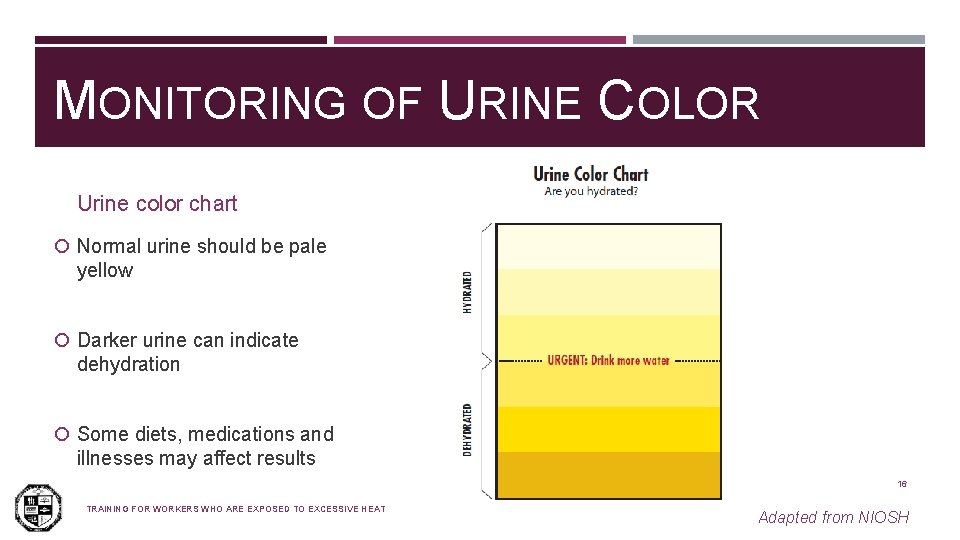
MONITORING OF URINE COLOR Urine color chart Normal urine should be pale yellow Darker urine can indicate dehydration Some diets, medications and illnesses may affect results 16 TRAINING FOR WORKERS WHO ARE EXPOSED TO EXCESSIVE HEAT Adapted from NIOSH
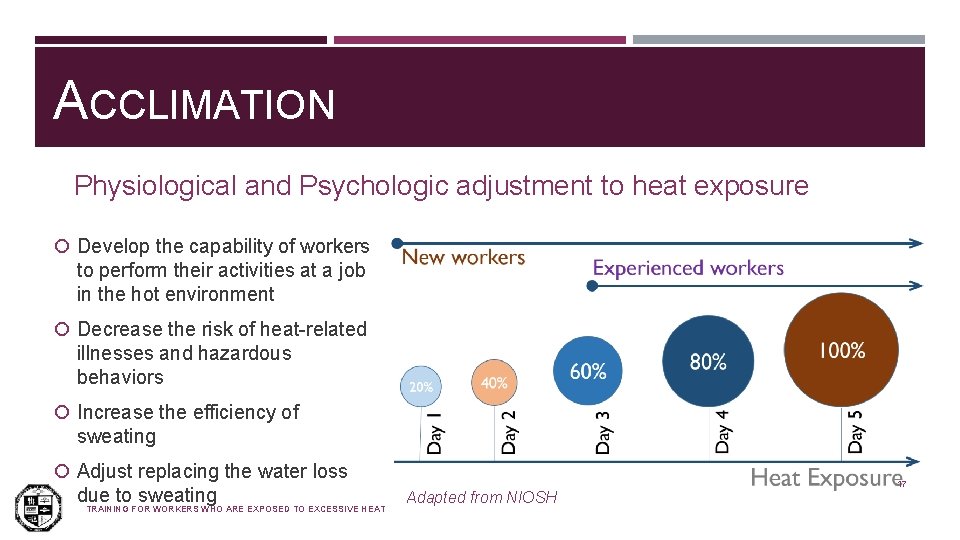
ACCLIMATION Physiological and Psychologic adjustment to heat exposure Develop the capability of workers to perform their activities at a job in the hot environment Decrease the risk of heat-related illnesses and hazardous behaviors Increase the efficiency of sweating Adjust replacing the water loss due to sweating TRAINING FOR WORKERS WHO ARE EXPOSED TO EXCESSIVE HEAT Adapted from NIOSH 17
PART 11 I HEAT IS A SAFETY HAZARD ARE YOU PROTECTED? 18 TRAINING FOR WORKERS WHO ARE EXPOSED TO EXCESSIVE HEAT
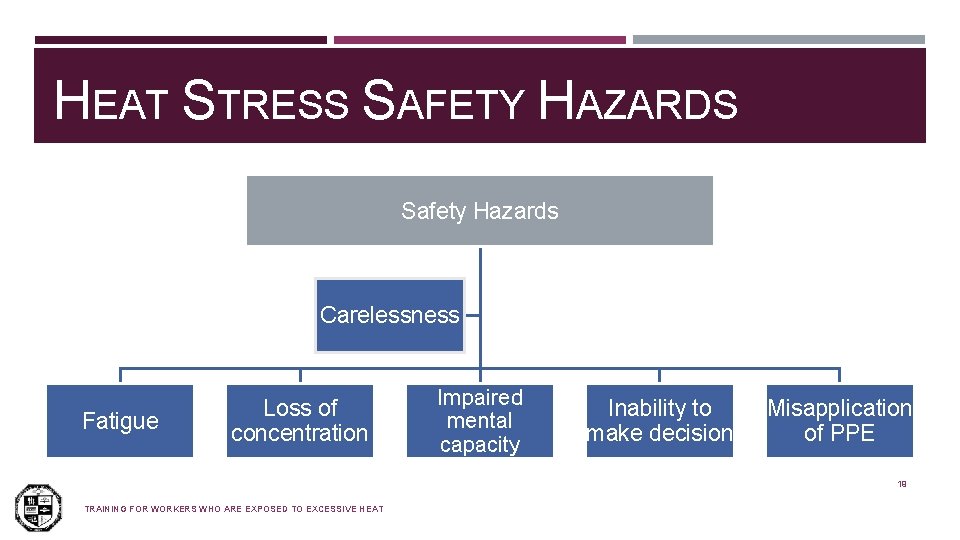
HEAT STRESS SAFETY HAZARDS Safety Hazards Carelessness Fatigue Loss of concentration Impaired mental capacity Inability to make decision Misapplication of PPE 19 TRAINING FOR WORKERS WHO ARE EXPOSED TO EXCESSIVE HEAT
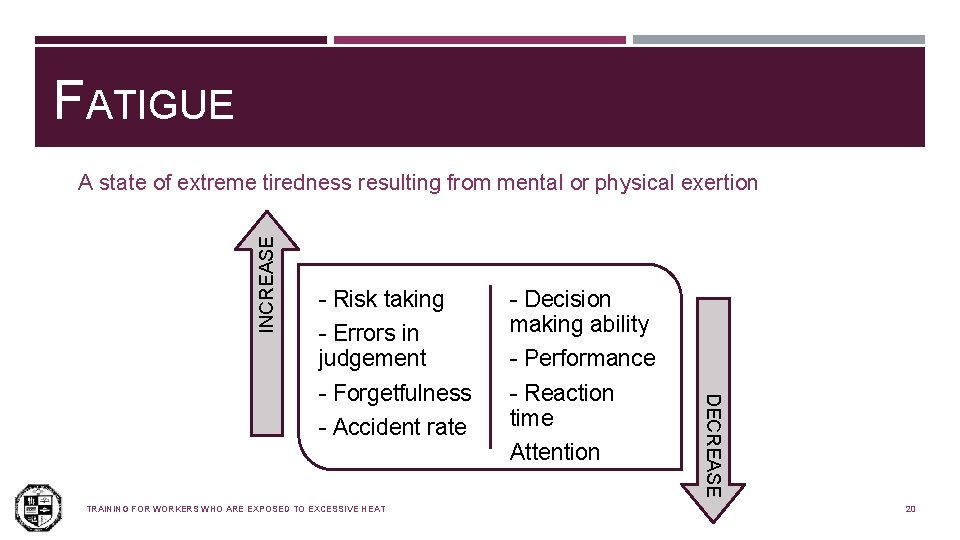
FATIGUE INCREASE A state of extreme tiredness resulting from mental or physical exertion TRAINING FOR WORKERS WHO ARE EXPOSED TO EXCESSIVE HEAT - Decision making ability - Performance - Reaction time Attention DECREASE - Risk taking - Errors in judgement - Forgetfulness - Accident rate 20
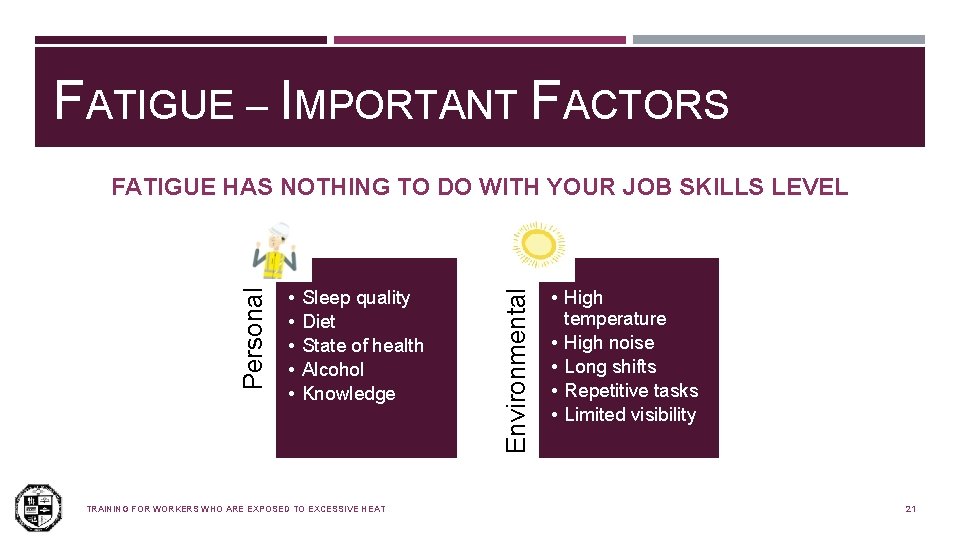
FATIGUE – IMPORTANT FACTORS • • • Sleep quality Diet State of health Alcohol Knowledge TRAINING FOR WORKERS WHO ARE EXPOSED TO EXCESSIVE HEAT Environmental Personal FATIGUE HAS NOTHING TO DO WITH YOUR JOB SKILLS LEVEL • High temperature • High noise • Long shifts • Repetitive tasks • Limited visibility 21
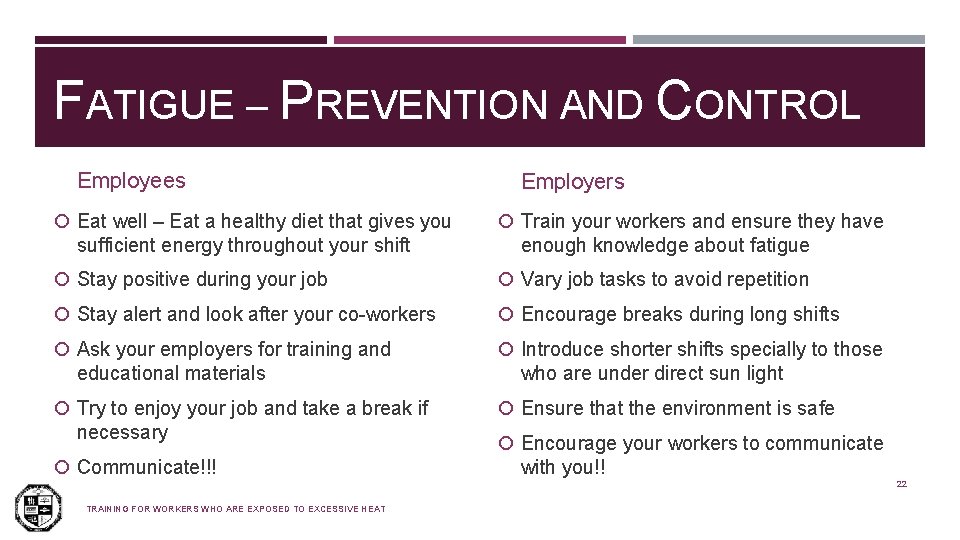
FATIGUE – PREVENTION AND CONTROL Employees Eat well – Eat a healthy diet that gives you sufficient energy throughout your shift Employers Train your workers and ensure they have enough knowledge about fatigue Stay positive during your job Vary job tasks to avoid repetition Stay alert and look after your co-workers Encourage breaks during long shifts Ask your employers for training and Introduce shorter shifts specially to those educational materials Try to enjoy your job and take a break if necessary Communicate!!! who are under direct sun light Ensure that the environment is safe Encourage your workers to communicate with you!! 22 TRAINING FOR WORKERS WHO ARE EXPOSED TO EXCESSIVE HEAT
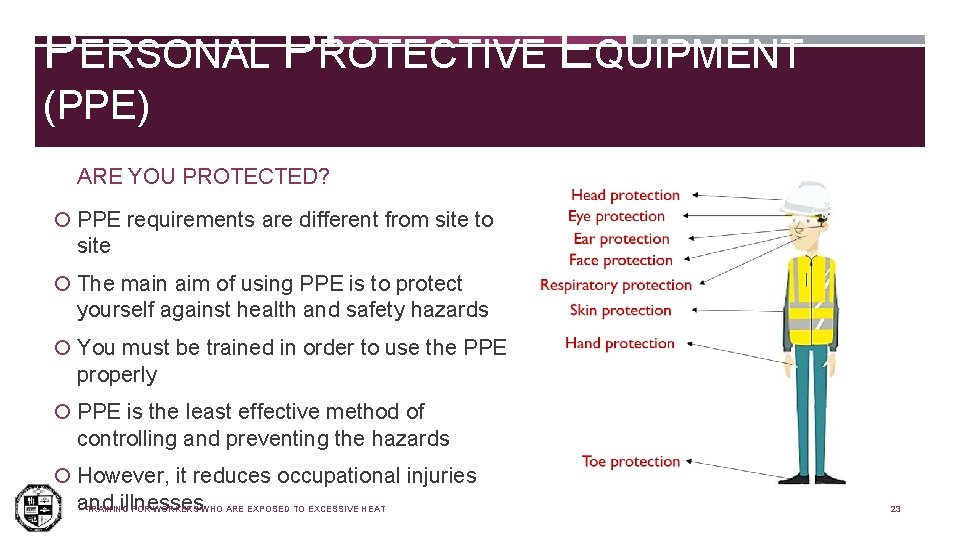
PERSONAL PROTECTIVE EQUIPMENT (PPE) ARE YOU PROTECTED? PPE requirements are different from site to site The main aim of using PPE is to protect yourself against health and safety hazards You must be trained in order to use the PPE properly PPE is the least effective method of controlling and preventing the hazards However, it reduces occupational injuries and illnesses TRAINING FOR WORKERS WHO ARE EXPOSED TO EXCESSIVE HEAT 23
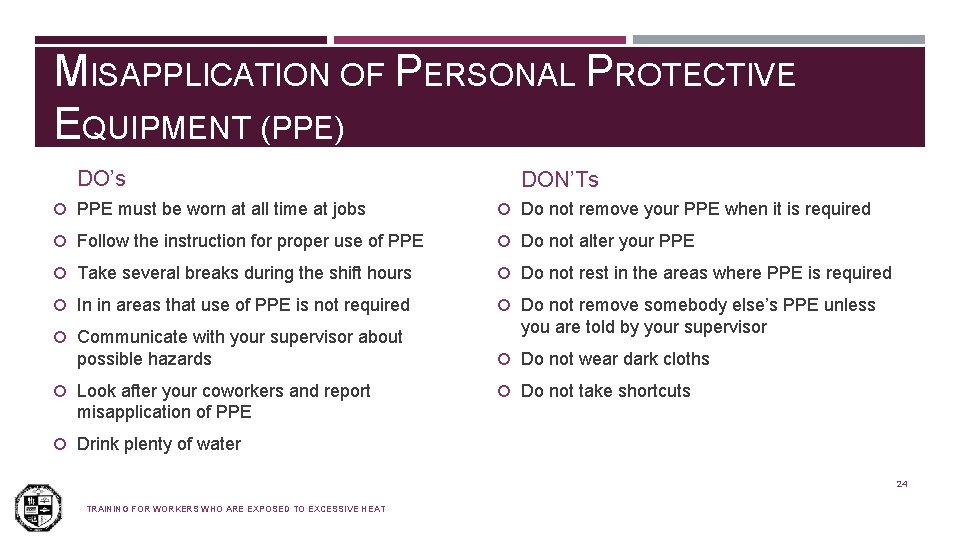
MISAPPLICATION OF PERSONAL PROTECTIVE EQUIPMENT (PPE) DO’s DON’Ts PPE must be worn at all time at jobs Do not remove your PPE when it is required Follow the instruction for proper use of PPE Do not alter your PPE Take several breaks during the shift hours Do not rest in the areas where PPE is required In in areas that use of PPE is not required Do not remove somebody else’s PPE unless Communicate with your supervisor about possible hazards Look after your coworkers and report you are told by your supervisor Do not wear dark cloths Do not take shortcuts misapplication of PPE Drink plenty of water 24 TRAINING FOR WORKERS WHO ARE EXPOSED TO EXCESSIVE HEAT
CLASS DISCUSSION PPE - Application and misapplication 1 11 111 111 TRAINING FOR WORKERS WHO ARE EXPOSED TO EXCESSIVE HEAT 25
PART IV Heat Stress Measurement HEAT STRESS INDEX 26 TRAINING FOR WORKERS WHO ARE EXPOSED TO EXCESSIVE HEAT
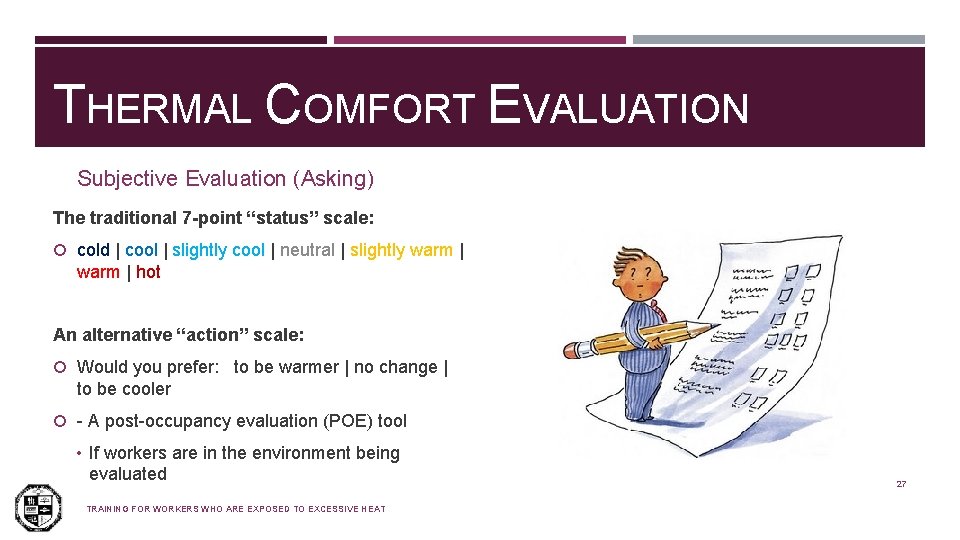
THERMAL COMFORT EVALUATION Subjective Evaluation (Asking) The traditional 7 -point “status” scale: cold | cool | slightly cool | neutral | slightly warm | hot An alternative “action” scale: Would you prefer: to be warmer | no change | to be cooler - A post-occupancy evaluation (POE) tool • If workers are in the environment being evaluated TRAINING FOR WORKERS WHO ARE EXPOSED TO EXCESSIVE HEAT 27
MEASUREMENT OF HEAT STRESS Heat Stress Index Heat stress index is an indicator Each heat stress index is developed for a specific application (there are over 160 heat indices) It takes into account some of the environmental and behavioral parameters Provides risk level and possibly work-rest cycles according to the level of danger It can be used as baseline for heat exposure safety measures 28 TRAINING FOR WORKERS WHO ARE EXPOSED TO EXCESSIVE HEAT
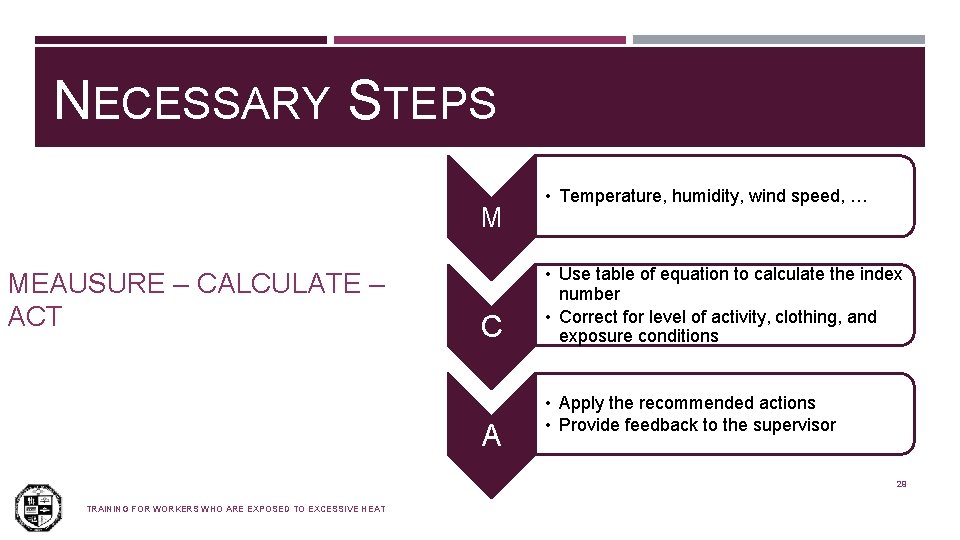
NECESSARY STEPS M MEAUSURE – CALCULATE – ACT C A • Temperature, humidity, wind speed, … • Use table of equation to calculate the index number • Correct for level of activity, clothing, and exposure conditions • Apply the recommended actions • Provide feedback to the supervisor 29 TRAINING FOR WORKERS WHO ARE EXPOSED TO EXCESSIVE HEAT
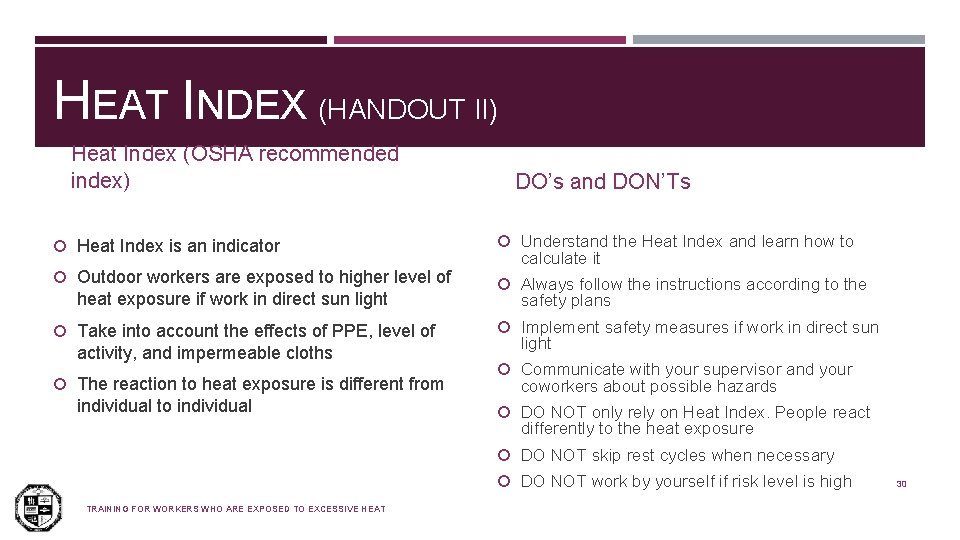
HEAT INDEX (HANDOUT II) Heat Index (OSHA recommended index) DO’s and DON’Ts Heat Index is an indicator Understand the Heat Index and learn how to Outdoor workers are exposed to higher level of Always follow the instructions according to the heat exposure if work in direct sun light Take into account the effects of PPE, level of activity, and impermeable cloths The reaction to heat exposure is different from individual to individual calculate it safety plans Implement safety measures if work in direct sun light Communicate with your supervisor and your coworkers about possible hazards DO NOT only rely on Heat Index. People react differently to the heat exposure DO NOT skip rest cycles when necessary DO NOT work by yourself if risk level is high TRAINING FOR WORKERS WHO ARE EXPOSED TO EXCESSIVE HEAT 30
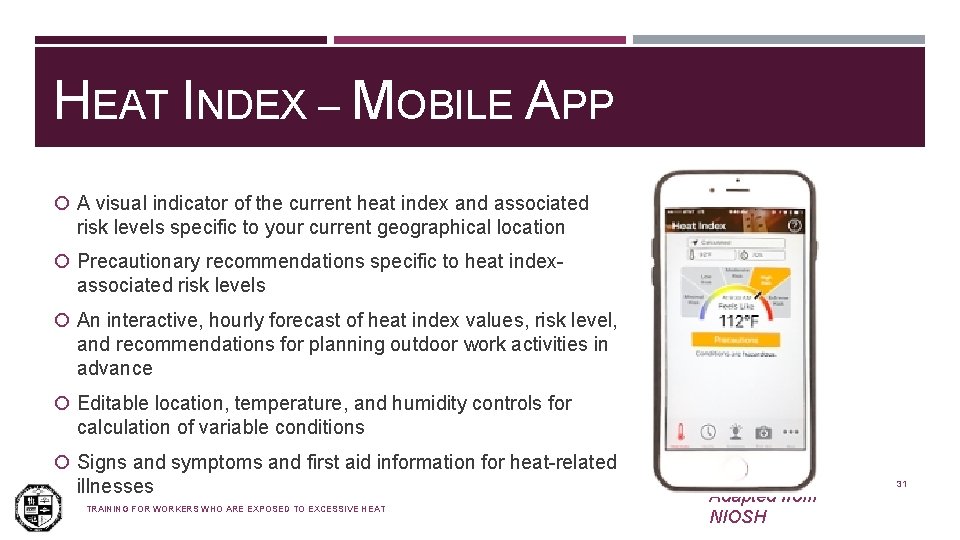
HEAT INDEX – MOBILE APP A visual indicator of the current heat index and associated risk levels specific to your current geographical location Precautionary recommendations specific to heat index- associated risk levels An interactive, hourly forecast of heat index values, risk level, and recommendations for planning outdoor work activities in advance Editable location, temperature, and humidity controls for calculation of variable conditions Signs and symptoms and first aid information for heat-related illnesses TRAINING FOR WORKERS WHO ARE EXPOSED TO EXCESSIVE HEAT Adapted from NIOSH 31
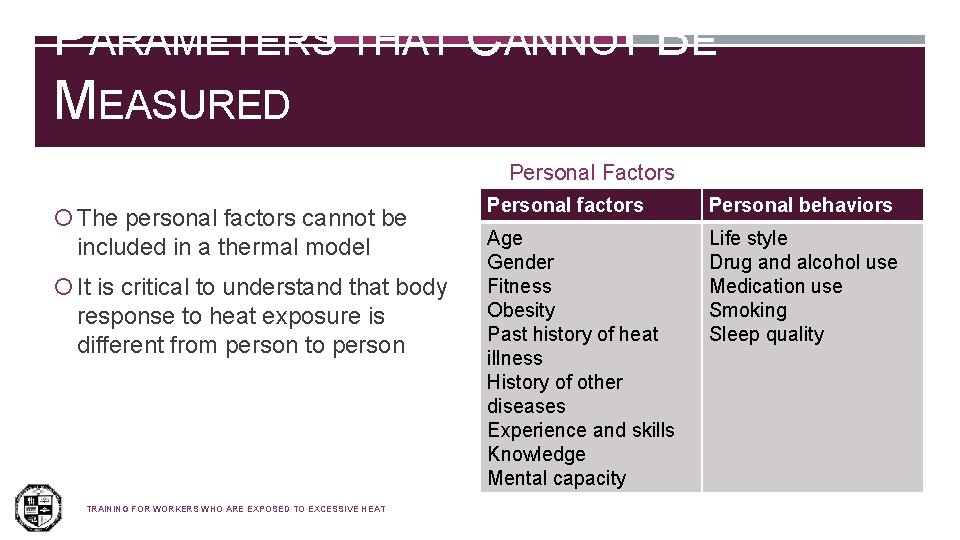
PARAMETERS THAT CANNOT BE MEASURED Personal Factors The personal factors cannot be included in a thermal model It is critical to understand that body response to heat exposure is different from person to person TRAINING FOR WORKERS WHO ARE EXPOSED TO EXCESSIVE HEAT Personal factors Personal behaviors Age Gender Fitness Obesity Past history of heat illness History of other diseases Experience and skills Knowledge Mental capacity Life style Drug and alcohol use Medication use Smoking Sleep quality 32
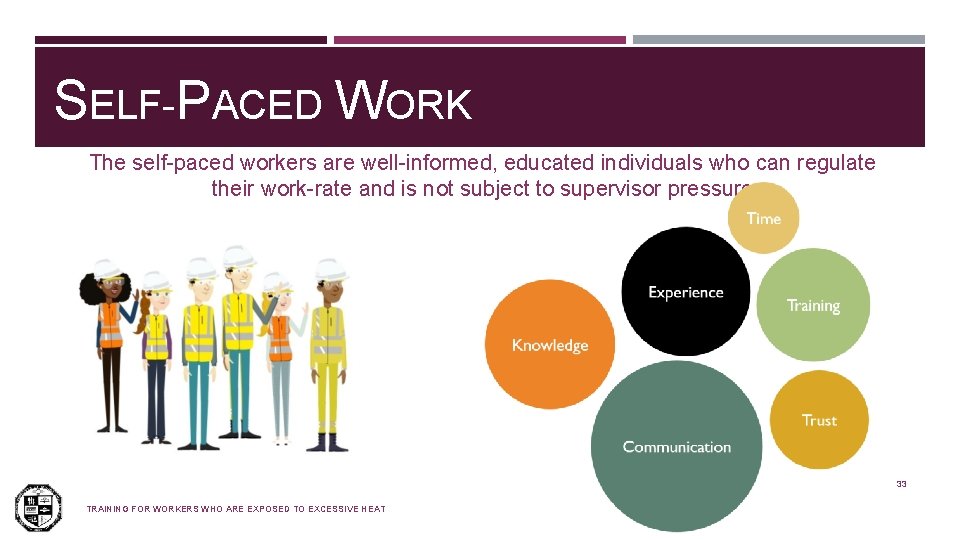
SELF-PACED WORK The self-paced workers are well-informed, educated individuals who can regulate their work-rate and is not subject to supervisor pressure 33 TRAINING FOR WORKERS WHO ARE EXPOSED TO EXCESSIVE HEAT
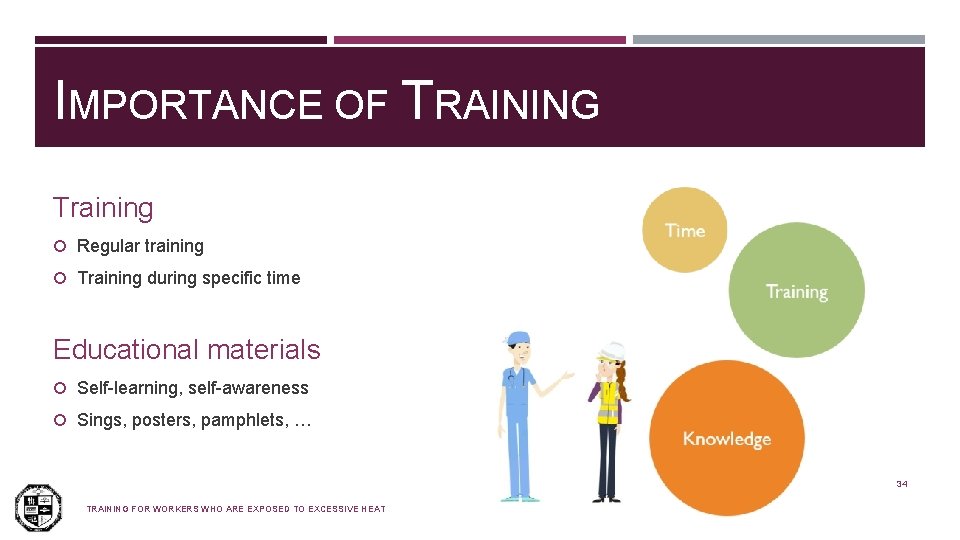
IMPORTANCE OF TRAINING Training Regular training Training during specific time Educational materials Self-learning, self-awareness Sings, posters, pamphlets, … 34 TRAINING FOR WORKERS WHO ARE EXPOSED TO EXCESSIVE HEAT
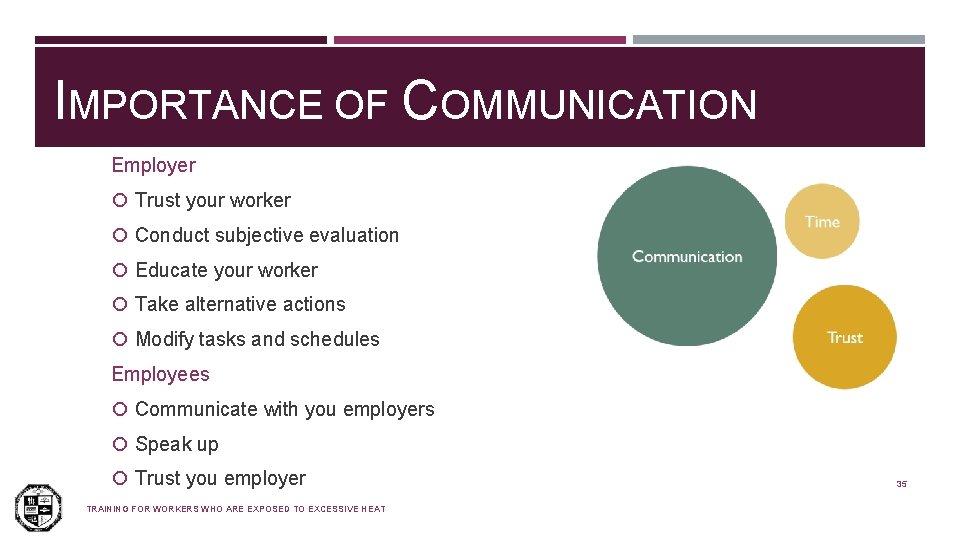
IMPORTANCE OF COMMUNICATION Employer Trust your worker Conduct subjective evaluation Educate your worker Take alternative actions Modify tasks and schedules Employees Communicate with you employers Speak up Trust you employer TRAINING FOR WORKERS WHO ARE EXPOSED TO EXCESSIVE HEAT 35
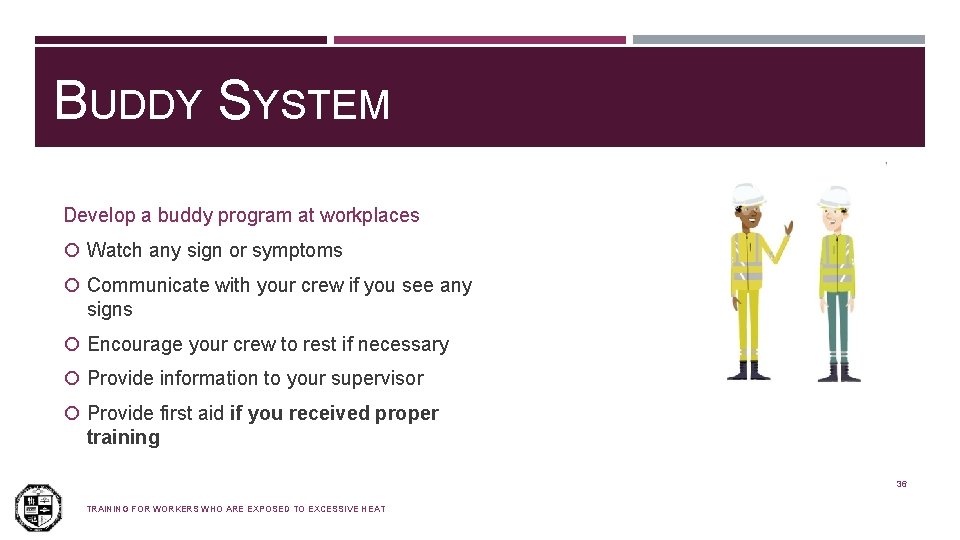
BUDDY SYSTEM Develop a buddy program at workplaces Watch any sign or symptoms Communicate with your crew if you see any signs Encourage your crew to rest if necessary Provide information to your supervisor Provide first aid if you received proper training 36 TRAINING FOR WORKERS WHO ARE EXPOSED TO EXCESSIVE HEAT
THANK YOU! Take Post-Test and Complete Survey The post-test and survey helps us determine if we did a good job or need to make improvements in certain areas 37 TRAINING FOR WORKERS WHO ARE EXPOSED TO EXCESSIVE HEAT