
Occupational Health Hazards Physical Agents Objectives 1 Understand
Occupational Health Hazards - Physical Agents 成大環醫所 林明彥
Objectives 1. Understand the elements of physical agents. 2. Understand the detection method and heath effects of physical agents. 3. Understand the control methods of the physical agents.
Physical Agents • Radiation – Ionizing radiation – Nonionizing radiation • • Noise Vibration Temperature Pressure
OCCUPATIONAL DISEASES Diseases due to Physical Agents • Radiation - Leukemia, Aplastic anaemia • Noise - NIHL, Hypertension, Irritability • Vibration - Neuromuscular diseases, Peripheral vascular diseases • Temperature - Injuries, Accidents • Pressure – Barotrauma, Acute Mountain Sickness
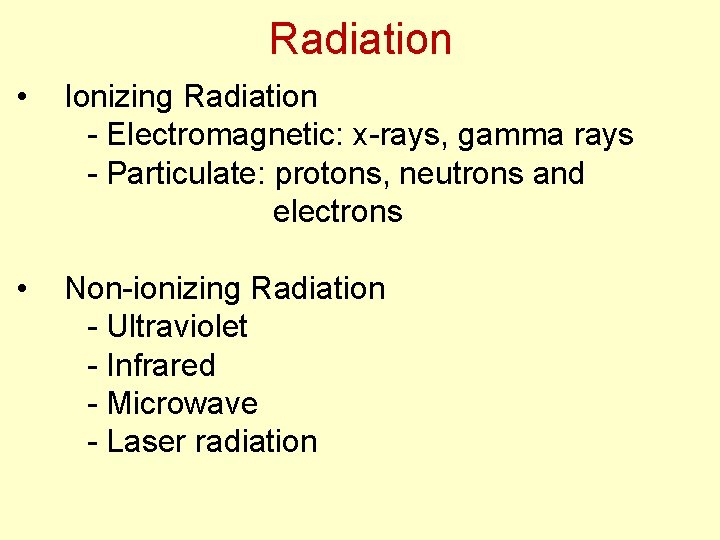
Radiation • Ionizing Radiation - Electromagnetic: x-rays, gamma rays - Particulate: protons, neutrons and electrons • Non-ionizing Radiation - Ultraviolet - Infrared - Microwave - Laser radiation
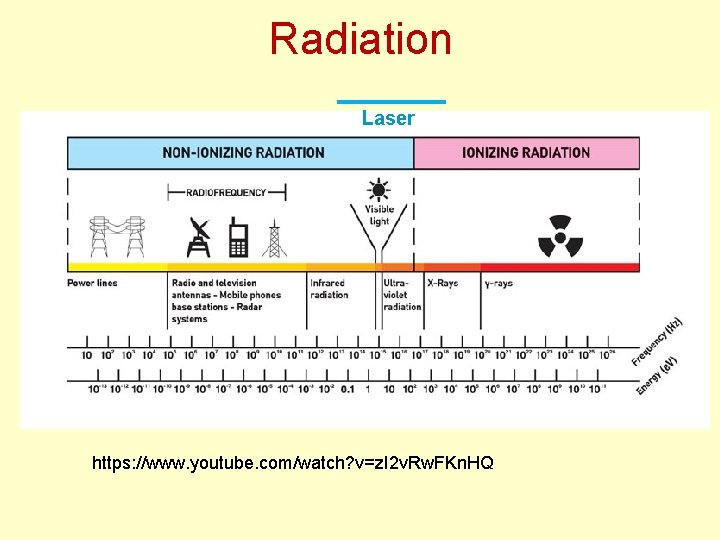
Radiation Laser https: //www. youtube. com/watch? v=z. I 2 v. Rw. FKn. HQ
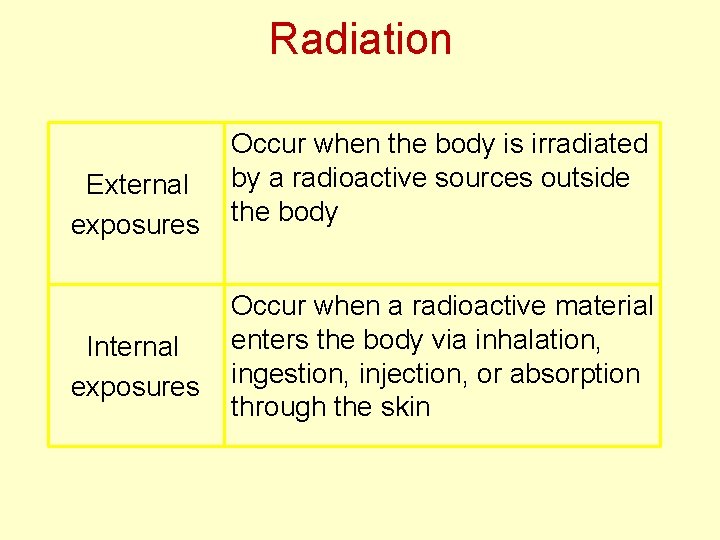
Radiation External exposures Internal exposures Occur when the body is irradiated by a radioactive sources outside the body Occur when a radioactive material enters the body via inhalation, ingestion, injection, or absorption through the skin
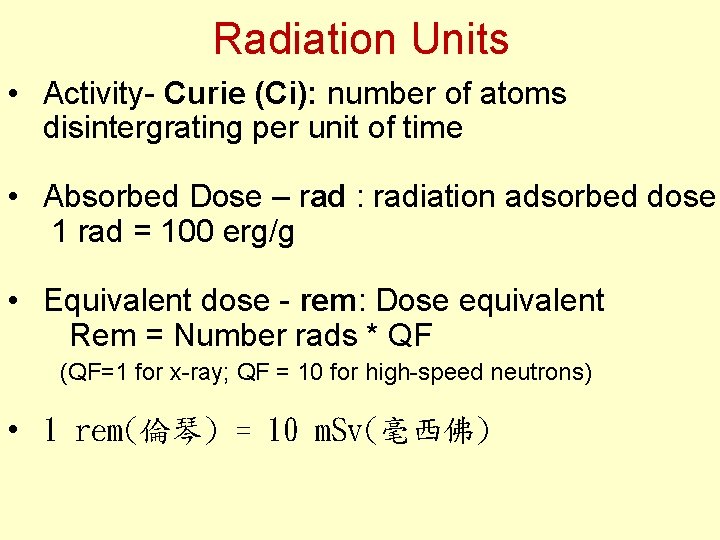
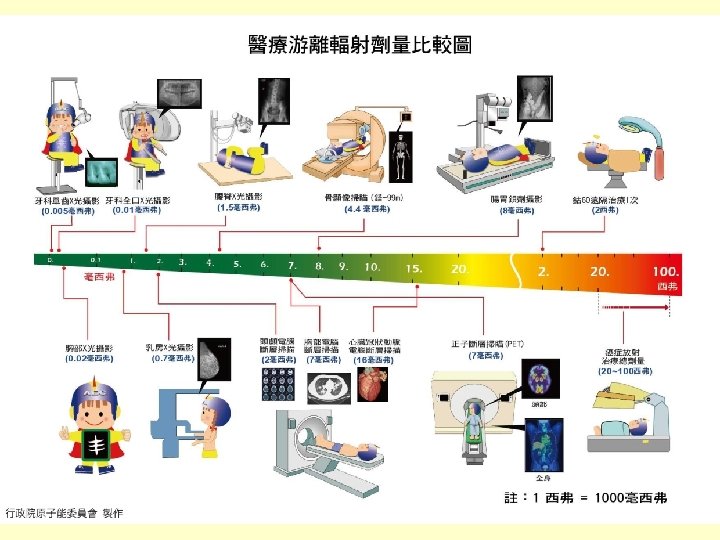
Radiation Units • Activity- Curie (Ci): number of atoms disintergrating per unit of time • Absorbed Dose – rad : radiation adsorbed dose 1 rad = 100 erg/g • Equivalent dose - rem: Dose equivalent Rem = Number rads * QF (QF=1 for x-ray; QF = 10 for high-speed neutrons) • 1 rem(倫琴) = 10 m. Sv(毫西佛)
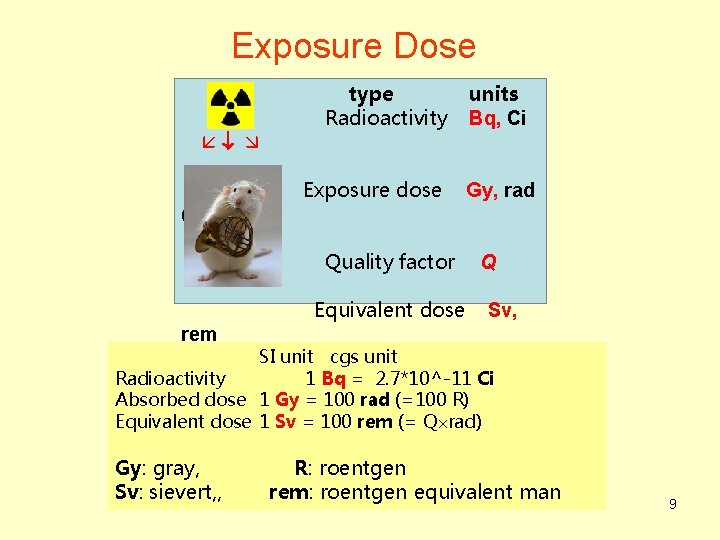
Exposure Dose type Radioactivity Exposure dose units Bq, Ci Gy, rad (R) Quality factor Equivalent dose Q Sv, rem SI unit cgs unit Radioactivity 1 Bq = 2. 7*10^-11 Ci Absorbed dose 1 Gy = 100 rad (=100 R) Equivalent dose 1 Sv = 100 rem (= Q rad) Gy: gray, Sv: sievert, , R: roentgen rem: roentgen equivalent man 9
![Exposure and Biological Dosage 1. 居里(Curie)是下列那一種游離輻射的單位? [102年國考] (A) absorbed dose (B) equivalent dose (C)](http://slidetodoc.com/presentation_image_h2/118e945ecdaa8e60310e171c041f73ac/image-10.jpg "Exposure and Biological Dosage 1. 居里(Curie)是下列那一種游離輻射的單位? [102年國考] (A) absorbed dose (B) equivalent dose (C)")
Exposure and Biological Dosage 1. 居里(Curie)是下列那一種游離輻射的單位? [102年國考] (A) absorbed dose (B) equivalent dose (C) radioactivity (D) collective dose (C) 10
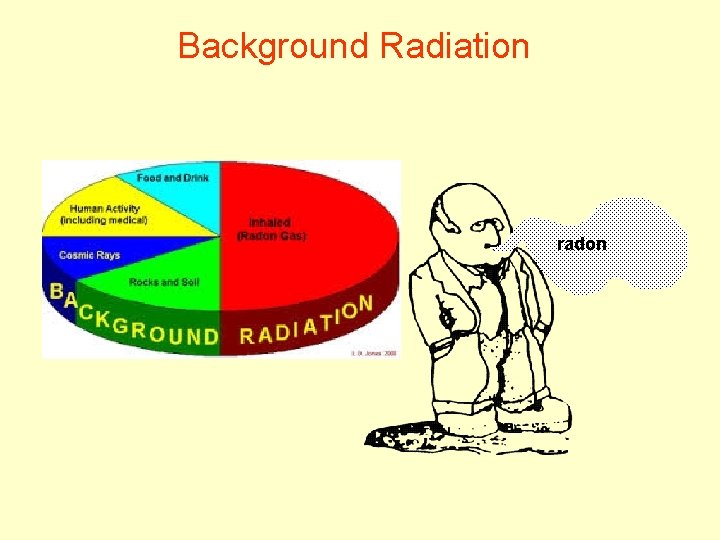
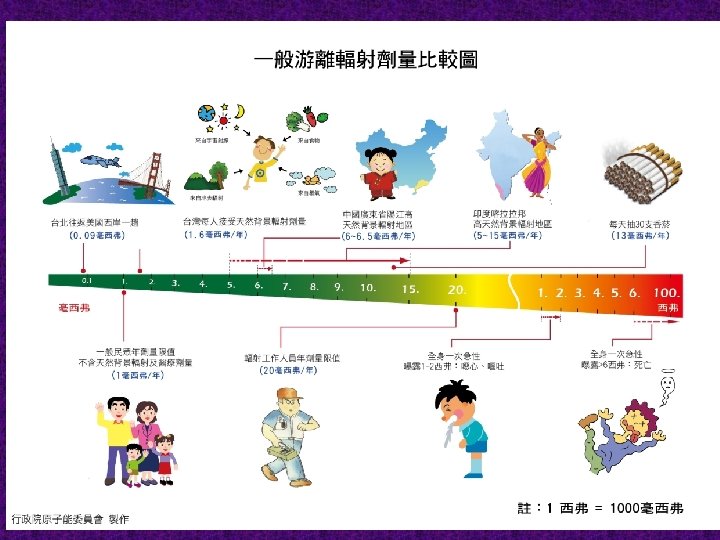
Background Radiation radon
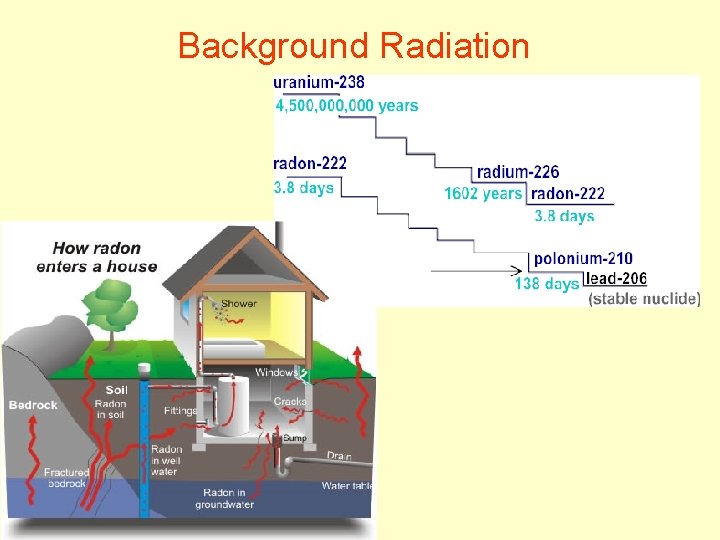
Background Radiation
Radiation Exposure Limit • The Threshold Limit Values (TLVs) published by the ACGIH (American Conference of Governmental Industrial Hygienists) are: – 20 m. Sv - average annual dose for radiation workers, over an average of five years – 1 m. Sv - annual dose limit recommended for general public (ICRP - International Commission on Radiological Protection) • The risk of radiation-induced diseases depends on the total radiation dose that a person receives over the time. • Legal framework: there are specific standards for each type of radiation.
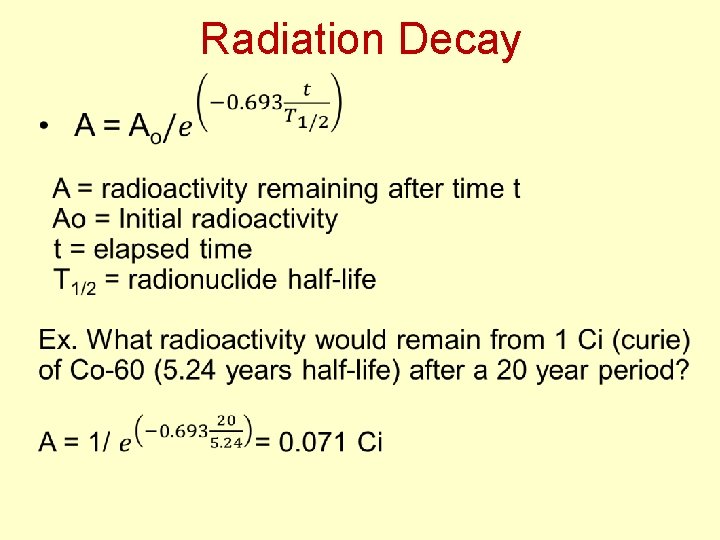
Radiation Decay
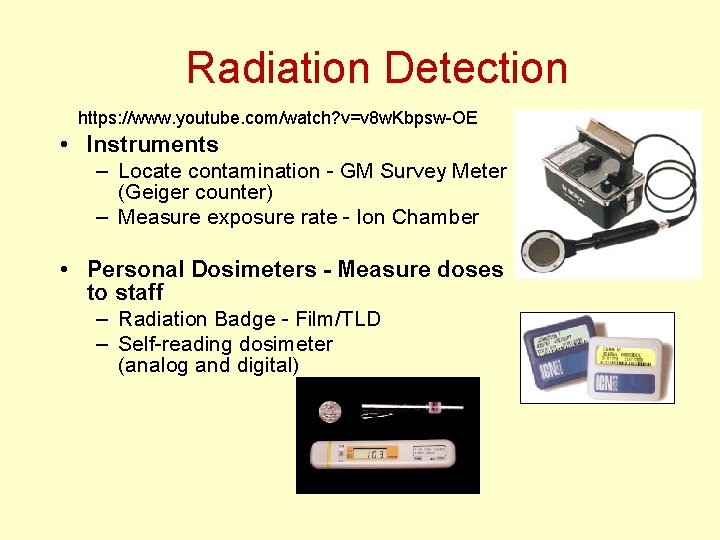
Radiation Detection https: //www. youtube. com/watch? v=v 8 w. Kbpsw-OE • Instruments – Locate contamination - GM Survey Meter (Geiger counter) – Measure exposure rate - Ion Chamber • Personal Dosimeters - Measure doses to staff – Radiation Badge - Film/TLD – Self-reading dosimeter (analog and digital)
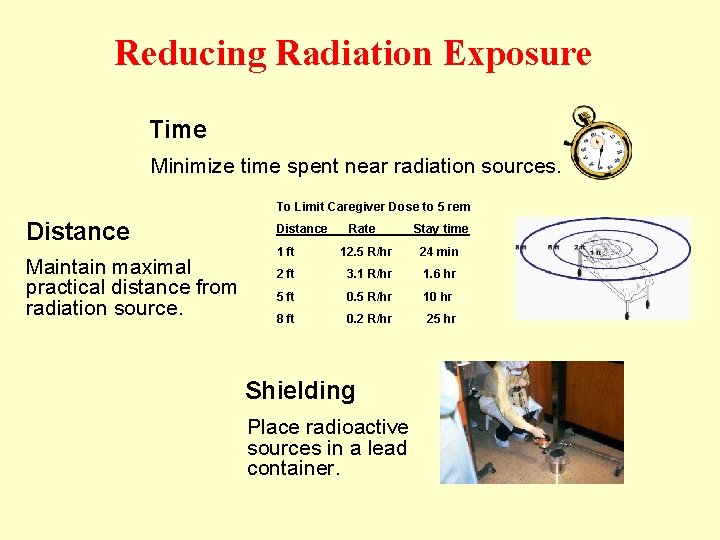
Reducing Radiation Exposure Time Minimize time spent near radiation sources. To Limit Caregiver Dose to 5 rem Distance Maintain maximal practical distance from radiation source. Distance Rate Stay time 1 ft 12. 5 R/hr 24 min 2 ft 3. 1 R/hr 1. 6 hr 5 ft 0. 5 R/hr 10 hr 8 ft 0. 2 R/hr 25 hr Shielding Place radioactive sources in a lead container.
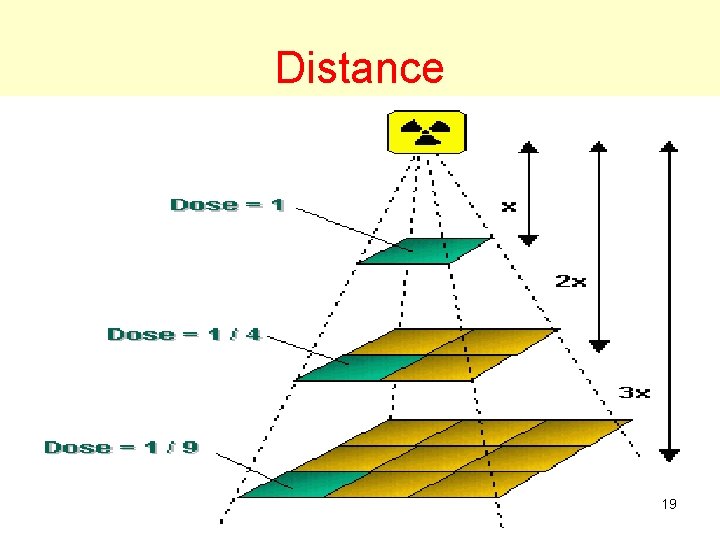
Distance 19
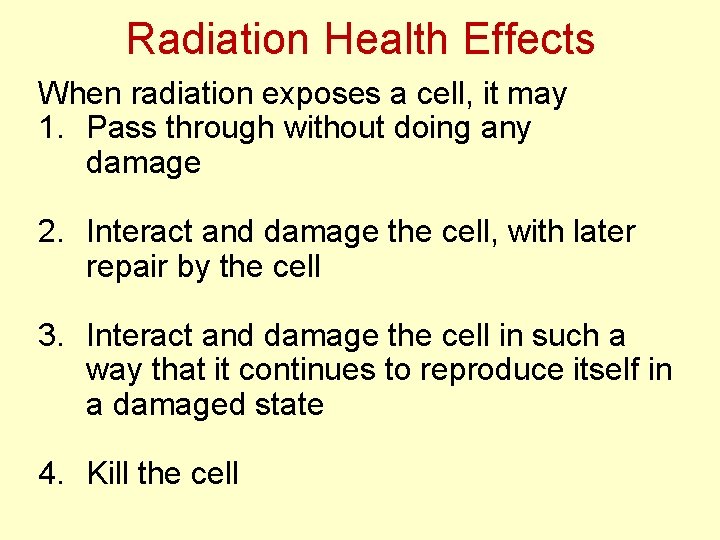
Radiation Health Effects When radiation exposes a cell, it may 1. Pass through without doing any damage 2. Interact and damage the cell, with later repair by the cell 3. Interact and damage the cell in such a way that it continues to reproduce itself in a damaged state 4. Kill the cell
Radiation Health Effects • Irradiation cause many types of effect on the human body, depending on the dose and the condition of exposure • Mutagenic effect • Carcinogenic effect • Teratogenic effect https: //www. youtube. com/watch? v=tq 6 FDy. Fe. CN 0
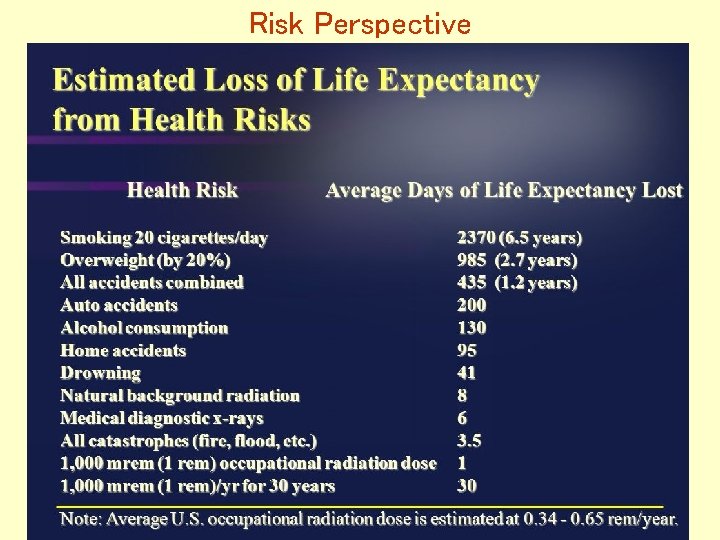
Risk Perspective
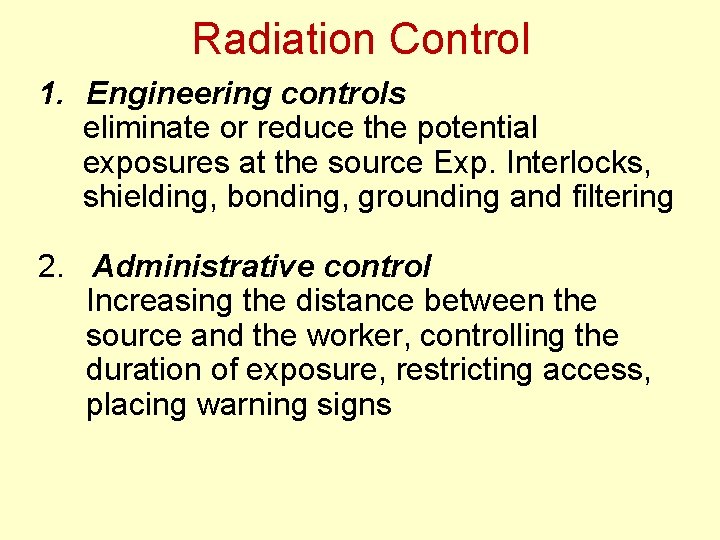
Radiation Control 1. Engineering controls eliminate or reduce the potential exposures at the source Exp. Interlocks, shielding, bonding, grounding and filtering 2. Administrative control Increasing the distance between the source and the worker, controlling the duration of exposure, restricting access, placing warning signs
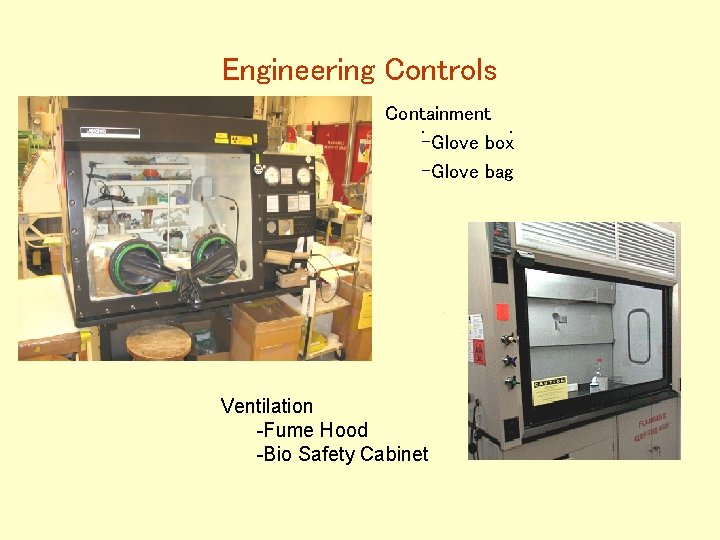
Engineering Controls Containment -Glove box -Glove bag Ventilation -Fume Hood -Bio Safety Cabinet
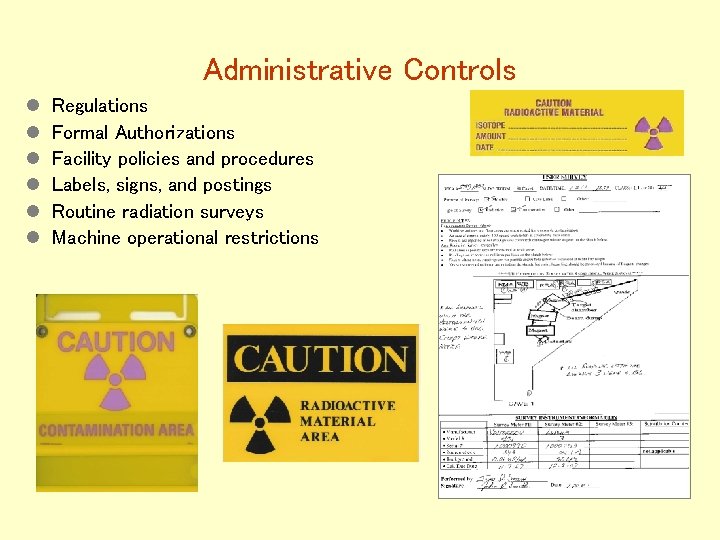
Administrative Controls l l l Regulations Formal Authorizations Facility policies and procedures Labels, signs, and postings Routine radiation surveys Machine operational restrictions
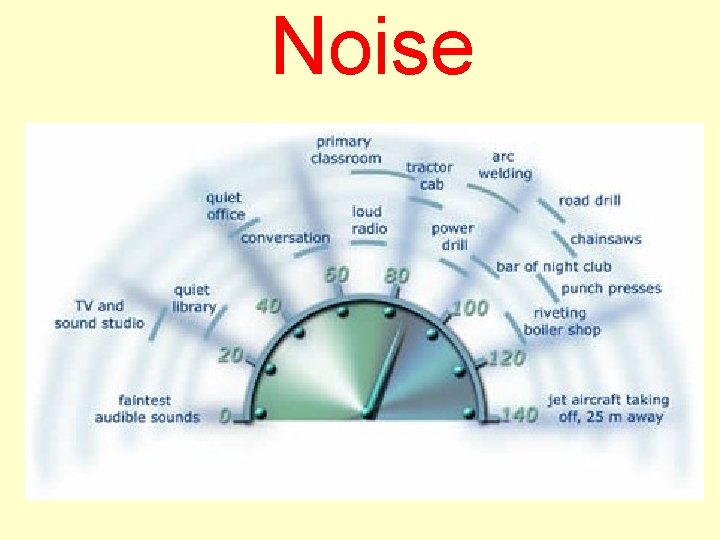
Noise
Noise Definition • Definition: Unwanted sound (the most simple). • Another definition is “Wrong Sound, in the wrong place, at the wrong time. ”
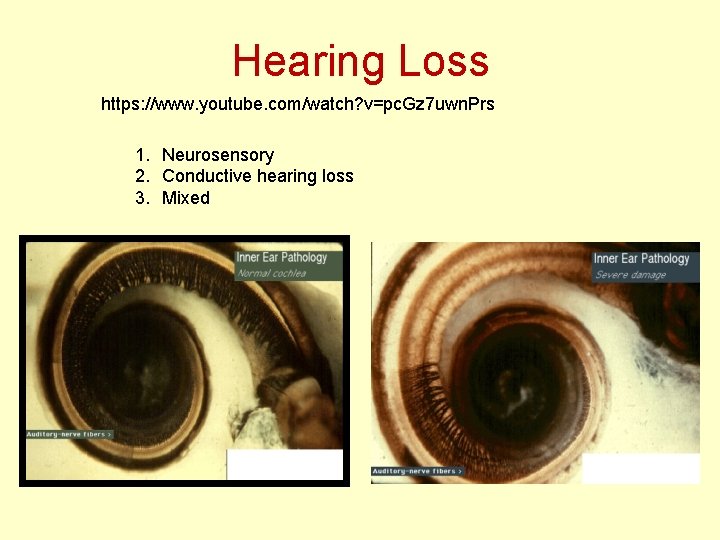
Hearing Loss https: //www. youtube. com/watch? v=pc. Gz 7 uwn. Prs 1. Neurosensory 2. Conductive hearing loss 3. Mixed
Occupational Hearing Loss • Approximately 30 million Americans are exposed to high intensity noise in their workplace. • One in 4 of these workers (or 7. 5 million Americans) will develop permanent hearing loss (National Institute of Deafness and Other Communicative Disorders: Noise Induced Hearing Loss) • In Taiwan, 74000 workers took hearing test. However, only 142 (0. 19%) were diagnosed of hearing loss! (Wu et al. , 2012) https: //www. youtube. com/watch? v=E 6 zl. OSVZe 5 U
Occupational Hearing Loss • Noise-Induced Permanent Threshold Shift (NIPTS) – Permanent sensor neural condition – Cannot be treated or corrected medically – Initially effects high frequencies • Industrial trough • Speech recognition – Progresses to lower frequencies
Occupational Hearing Loss • Temporary Threshold Shift (TTS)Temporary hearing loss (approx. 1 month) • Less than 80 d. BA -no hearing loss • 80 to 130 d. BA - TTS hearing loss is noticeable • 50 % of people exposed to 95 -d. BA will experience NIPTS (permanent hearing loss) • 150 d. BA or greater- can physically rupture the human eardrum. • (Note: 1 hr. of 100 d. BA can produce TTS whereas 8 hours of 95 d. BA over 10 years may cause NIPTS)
Other health problem from noise • • • Elevated blood pressure Irritability Fatigue Vasoconstriction of peripheral blood vessels Sore throat Headaches Allergic reactions Sleeping disorders Damage to the brain stem
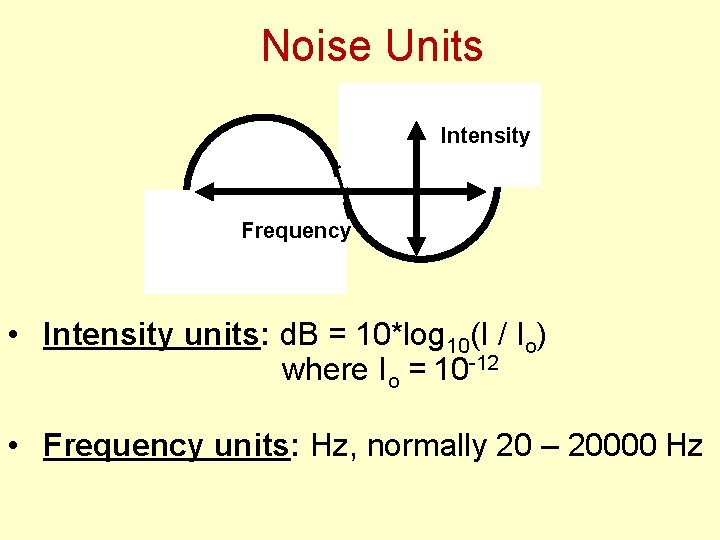
Noise Units Intensity Frequency • Intensity units: d. B = 10*log 10(I / Io) where Io = 10 -12 • Frequency units: Hz, normally 20 – 20000 Hz
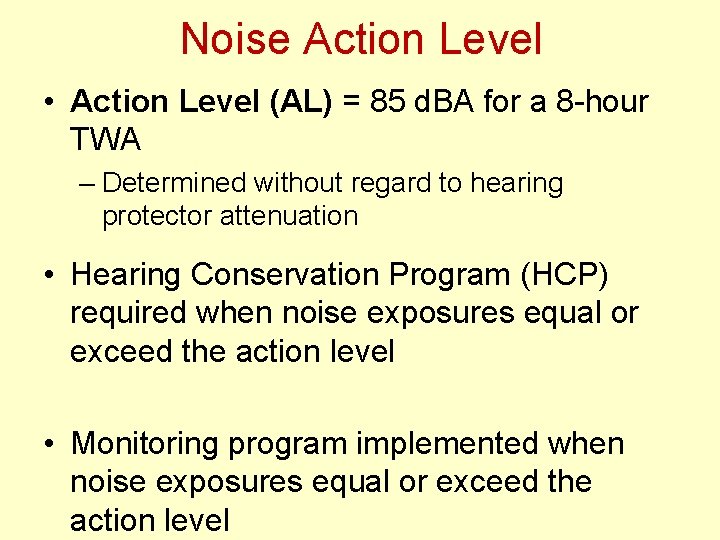
Noise Action Level • Action Level (AL) = 85 d. BA for a 8 -hour TWA – Determined without regard to hearing protector attenuation • Hearing Conservation Program (HCP) required when noise exposures equal or exceed the action level • Monitoring program implemented when noise exposures equal or exceed the action level
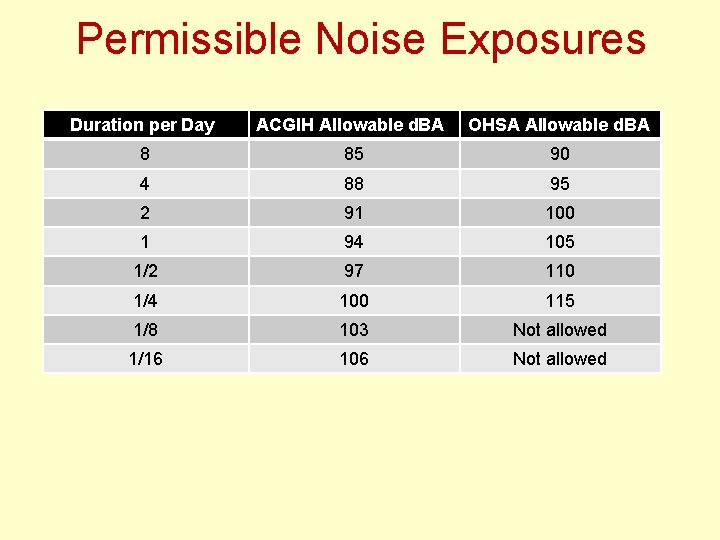
Permissible Noise Exposures Duration per Day ACGIH Allowable d. BA OHSA Allowable d. BA 8 85 90 4 88 95 2 91 100 1 94 105 1/2 97 110 1/4 100 115 1/8 103 Not allowed 1/16 106 Not allowed
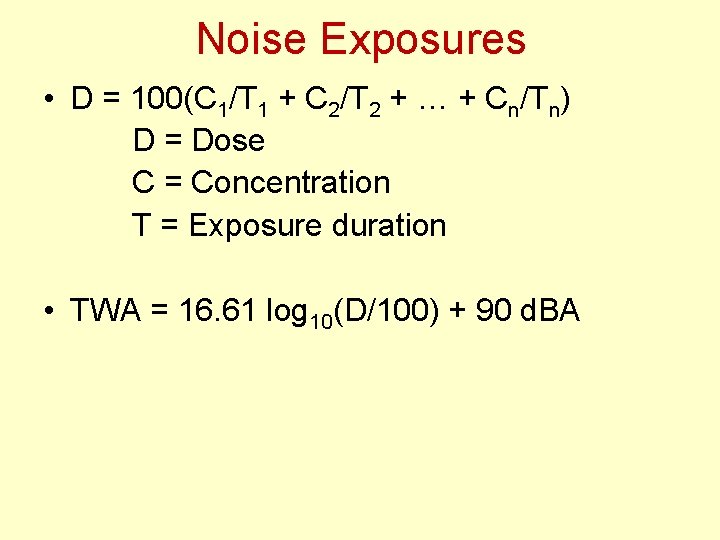
Noise Exposures • D = 100(C 1/T 1 + C 2/T 2 + … + Cn/Tn) D = Dose C = Concentration T = Exposure duration • TWA = 16. 61 log 10(D/100) + 90 d. BA
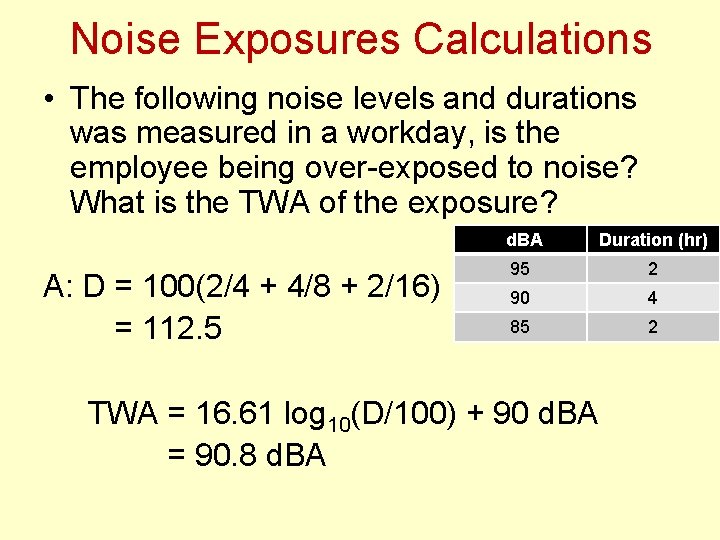
Noise Exposures Calculations • The following noise levels and durations was measured in a workday, is the employee being over-exposed to noise? What is the TWA of the exposure? A: D = 100(2/4 + 4/8 + 2/16) = 112. 5 d. BA Duration (hr) 95 2 90 4 85 2 TWA = 16. 61 log 10(D/100) + 90 d. BA = 90. 8 d. BA
Noise Measurements • Sound level meters • Noise dosimeter • Octave band analyzer
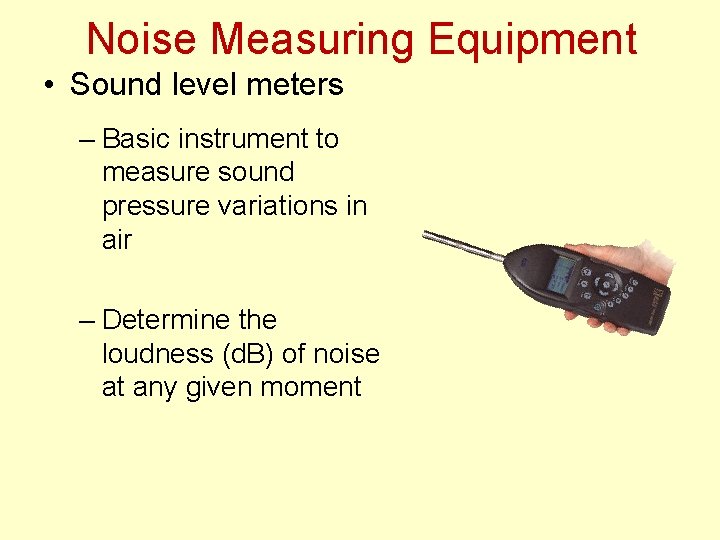
Noise Measuring Equipment • Sound level meters – Basic instrument to measure sound pressure variations in air – Determine the loudness (d. B) of noise at any given moment
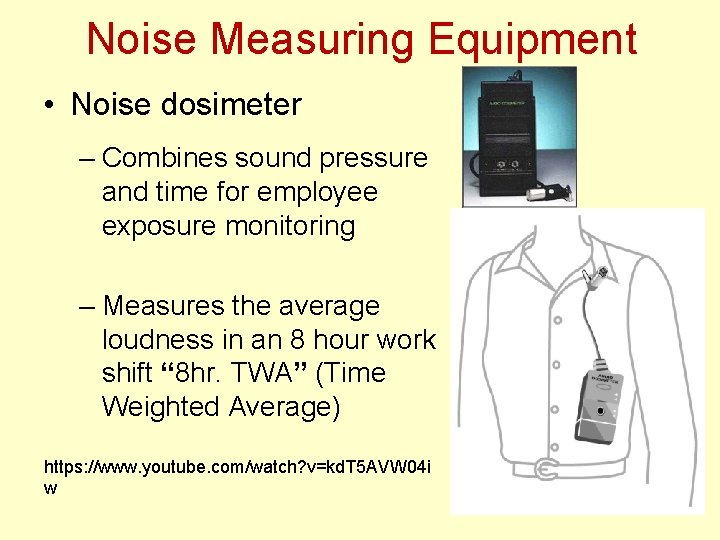
Noise Measuring Equipment • Noise dosimeter – Combines sound pressure and time for employee exposure monitoring – Measures the average loudness in an 8 hour work shift “ 8 hr. TWA” (Time Weighted Average) https: //www. youtube. com/watch? v=kd. T 5 AVW 04 i w
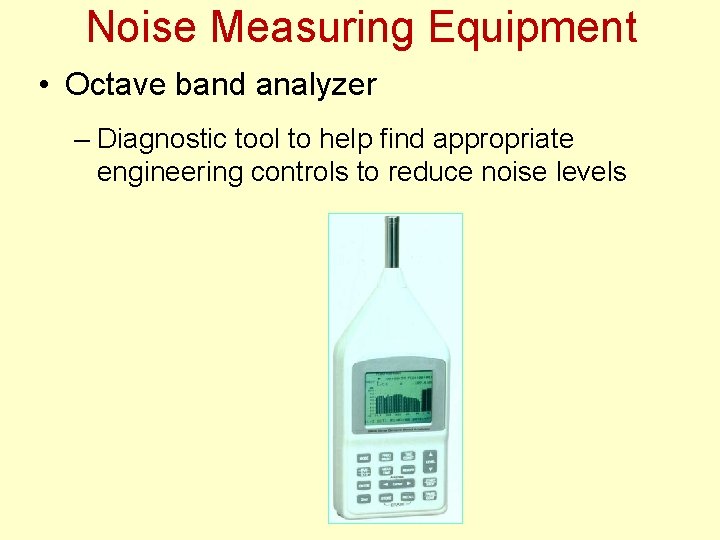
Noise Measuring Equipment • Octave band analyzer – Diagnostic tool to help find appropriate engineering controls to reduce noise levels
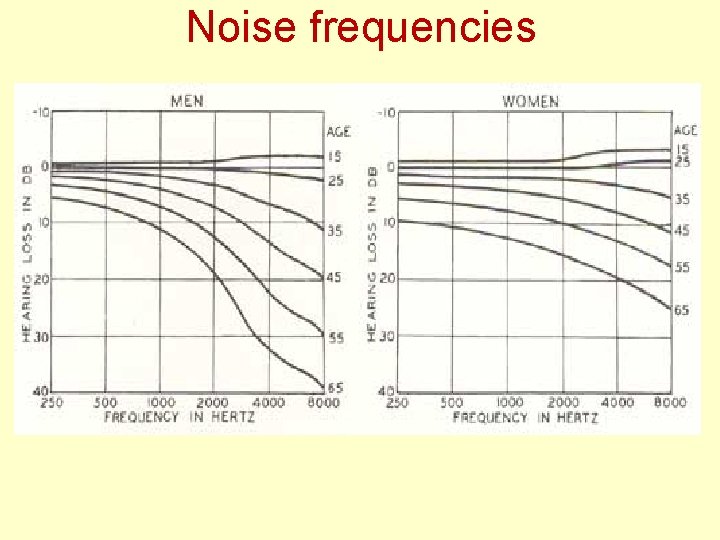
Noise frequencies
Noise Health Effects • Sound level meters - Microphones change energy from sound waves to mechanical energy • Noise dosimeter - Combines sound pressure and time for employee exposure monitoring
Noise Control • Use sound adsorbing materials • Pre-placement medical examination • Health education • Legislation
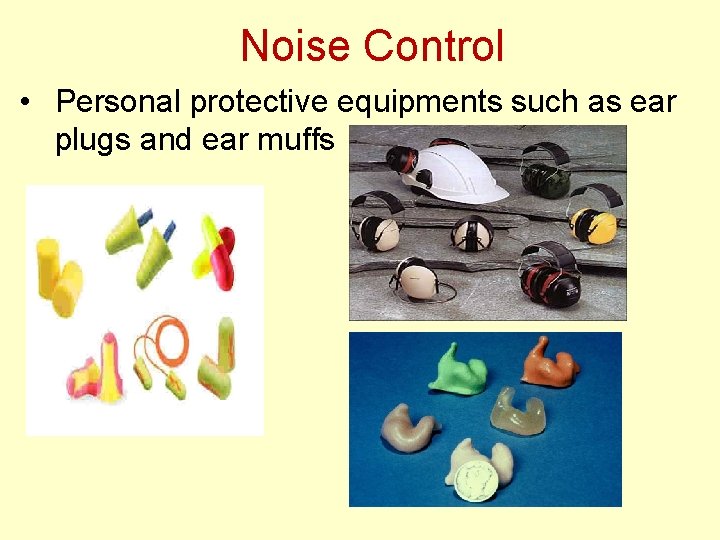
Noise Control • Personal protective equipments such as ear plugs and ear muffs
Selection of HPDs There is no such thing as a “best” hearing protector. • area noise levels, • worker noise exposures, • communication needs, • comfort, • hearing ability, • personal preference, and • interaction with other safety equipment
Individual Hearing Protector Fit Testing Analysis of laboratory evaluations indicates individual variability in HPD performance is large enough to make any population-based, statistical assessment of HPD performance inappropriate for individual workers. https: //www. youtube. com/watch? v=Ar. Ax-Wt 31 y. A
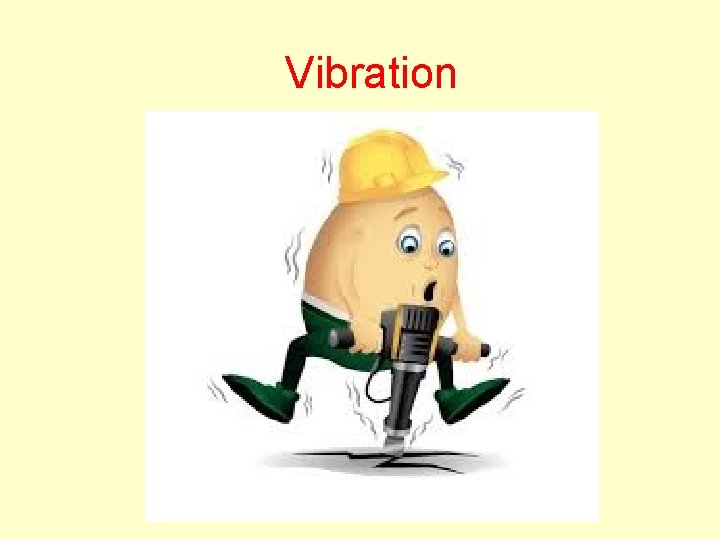
Vibration
Vibration • A complex physical exposure, which lends itself to electro-physical measurement • Two types of vibration: 1. Whole body vibration 2. Segmental vibration
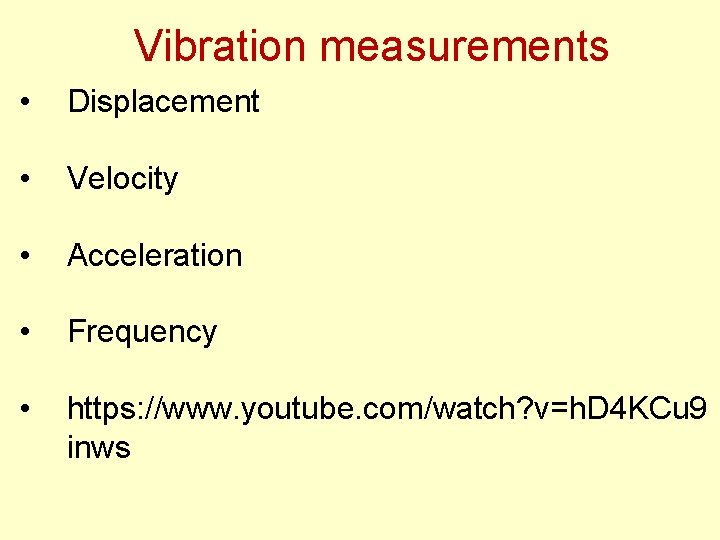
Vibration measurements • Displacement • Velocity • Acceleration • Frequency • https: //www. youtube. com/watch? v=h. D 4 KCu 9 inws
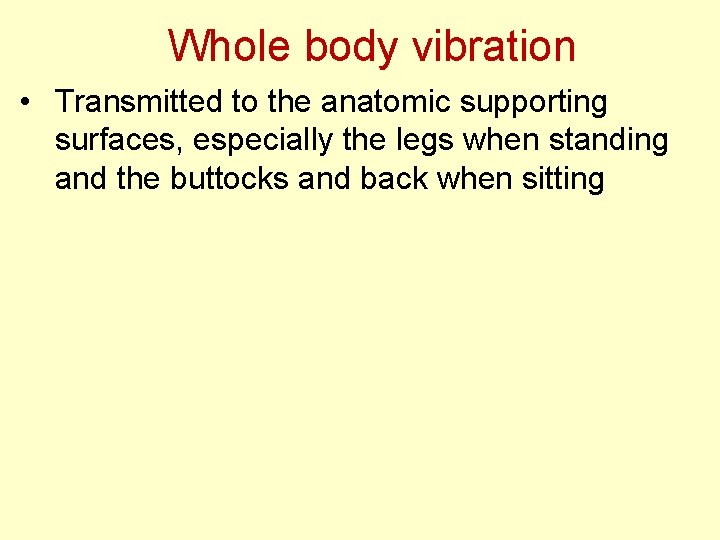
Whole body vibration • Transmitted to the anatomic supporting surfaces, especially the legs when standing and the buttocks and back when sitting
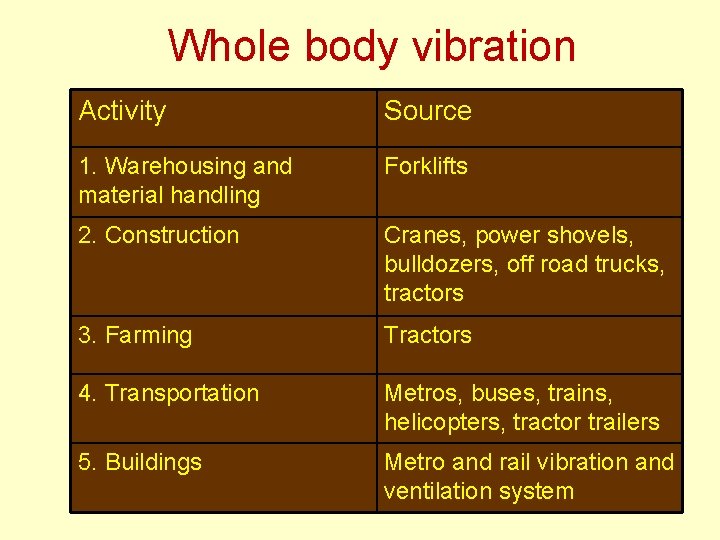
Whole body vibration Activity Source 1. Warehousing and material handling Forklifts 2. Construction Cranes, power shovels, bulldozers, off road trucks, tractors 3. Farming Tractors 4. Transportation Metros, buses, trains, helicopters, tractor trailers 5. Buildings Metro and rail vibration and ventilation system
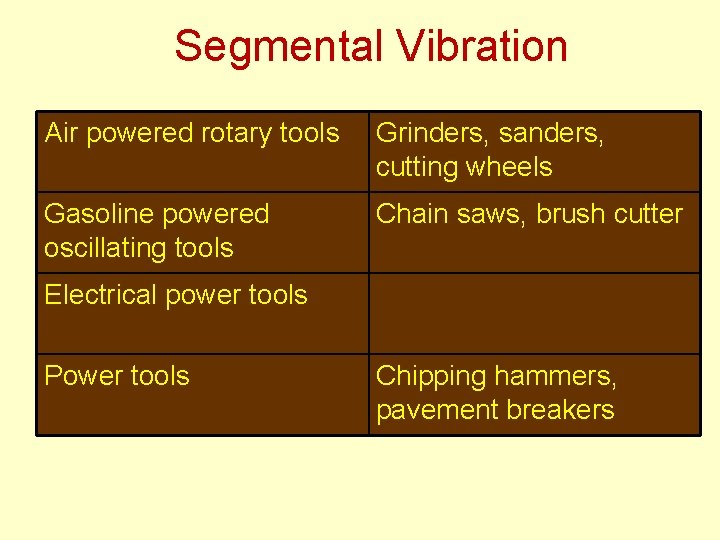
Segmental Vibration Air powered rotary tools Grinders, sanders, cutting wheels Gasoline powered oscillating tools Chain saws, brush cutter Electrical power tools Power tools Chipping hammers, pavement breakers
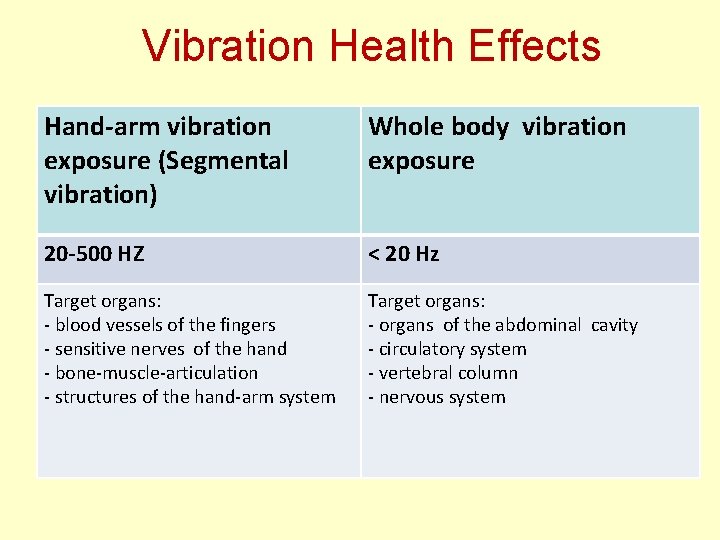
Vibration Health Effects Hand-arm vibration exposure (Segmental vibration) Whole body vibration exposure 20 -500 HZ < 20 Hz Target organs: - blood vessels of the fingers - sensitive nerves of the hand - bone-muscle-articulation - structures of the hand-arm system Target organs: - organs of the abdominal cavity - circulatory system - vertebral column - nervous system
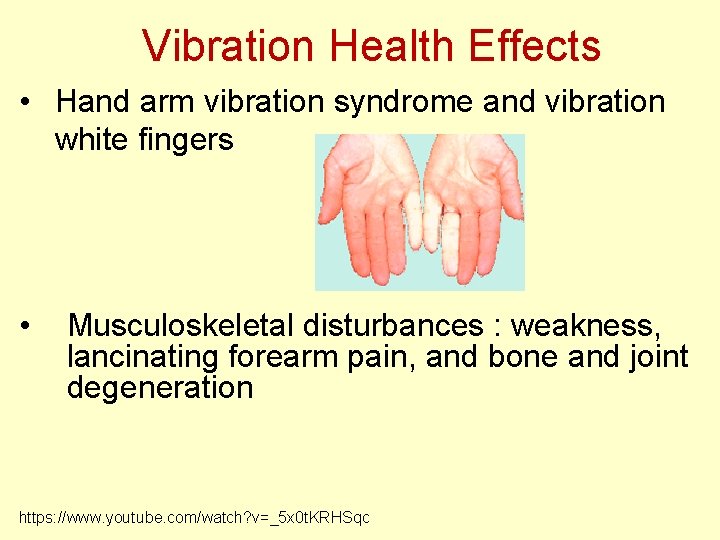
Vibration Health Effects • Hand arm vibration syndrome and vibration white fingers • Musculoskeletal disturbances : weakness, lancinating forearm pain, and bone and joint degeneration https: //www. youtube. com/watch? v=_5 x 0 t. KRHSqc
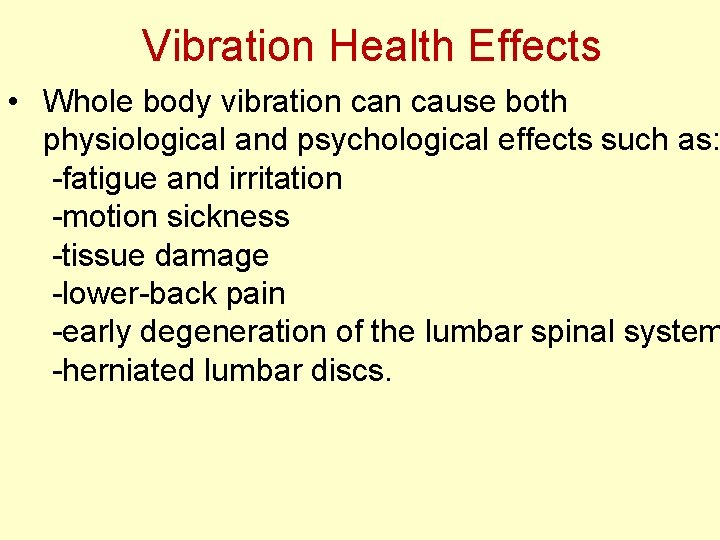
Vibration Health Effects • Whole body vibration cause both physiological and psychological effects such as: -fatigue and irritation -motion sickness -tissue damage -lower-back pain -early degeneration of the lumbar spinal system -herniated lumbar discs.
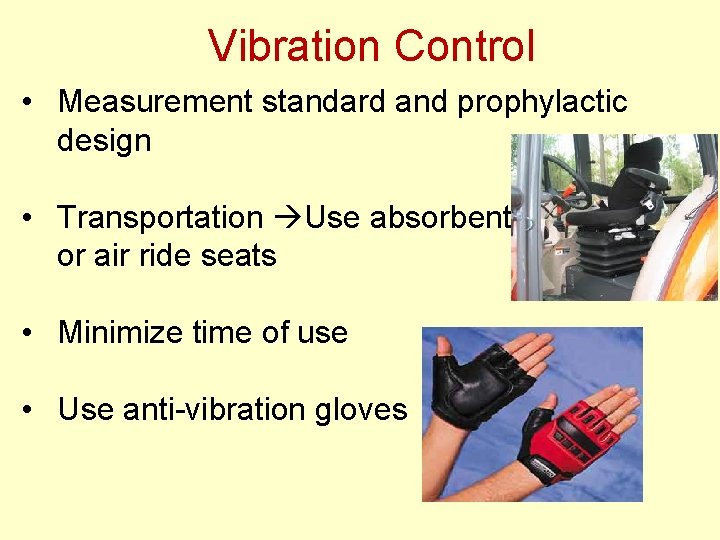
Vibration Control • Measurement standard and prophylactic design • Transportation Use absorbent or air ride seats • Minimize time of use • Use anti-vibration gloves
Temperature
Temperature • Comfortable thermal environment conditions are those under which a person can maintain normal balance between production and loss of heart at normal body temperature and without sweating. This comfort zone temperature has been evaluated to be between 25 - 28°C • Temperatures stress: Heat and Cold
Physically: heat rashes heat cramps heat exhaustion heat stroke Heat Mentally: lassitude, irritability, discomfort lowered work performance lack of concentration lack of judgment loss of critical thinking skills
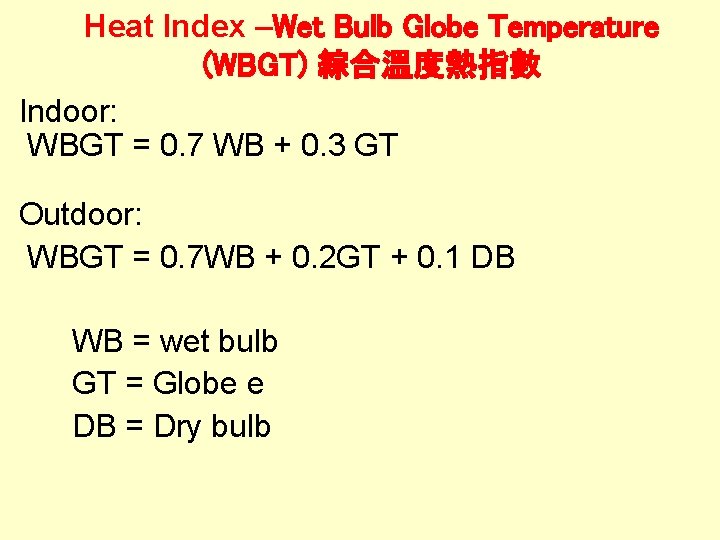
Heat Index –Wet Bulb Globe Temperature (WBGT) 綜合溫度熱指數 Indoor: WBGT = 0. 7 WB + 0. 3 GT Outdoor: WBGT = 0. 7 WB + 0. 2 GT + 0. 1 DB WB = wet bulb GT = Globe e DB = Dry bulb
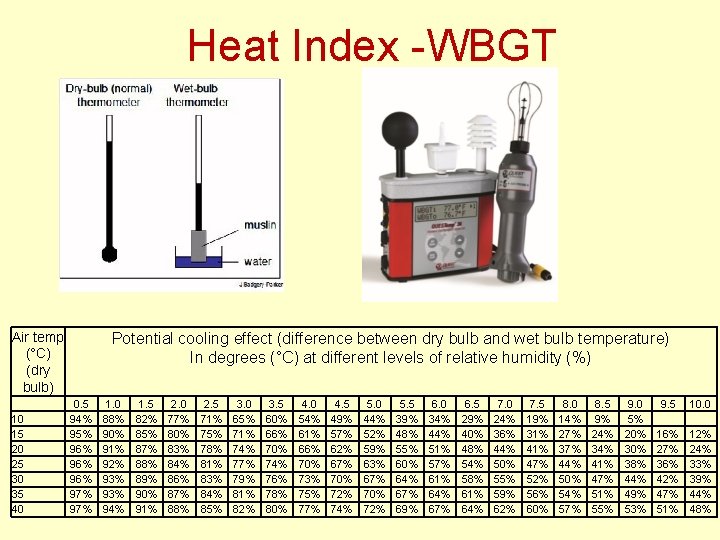
Heat Index -WBGT Air temp (°C) (dry bulb) 10 15 20 25 30 35 40 Potential cooling effect (difference between dry bulb and wet bulb temperature) In degrees (°C) at different levels of relative humidity (%) 0. 5 94% 95% 96% 96% 97% 1. 0 88% 90% 91% 92% 93% 94% 1. 5 82% 85% 87% 88% 89% 90% 91% 2. 0 77% 80% 83% 84% 86% 87% 88% 2. 5 71% 75% 78% 81% 83% 84% 85% 3. 0 65% 71% 74% 77% 79% 81% 82% 3. 5 60% 66% 70% 74% 76% 78% 80% 4. 0 54% 61% 66% 70% 73% 75% 77% 4. 5 49% 57% 62% 67% 70% 72% 74% 5. 0 44% 52% 59% 63% 67% 70% 72% 5. 5 39% 48% 55% 60% 64% 67% 69% 6. 0 34% 44% 51% 57% 61% 64% 67% 6. 5 29% 40% 48% 54% 58% 61% 64% 7. 0 24% 36% 44% 50% 55% 59% 62% 7. 5 19% 31% 47% 52% 56% 60% 8. 0 14% 27% 37% 44% 50% 54% 57% 8. 5 9% 24% 34% 41% 47% 51% 55% 9. 0 5% 20% 38% 44% 49% 53% 9. 5 10. 0 16% 27% 36% 42% 47% 51% 12% 24% 33% 39% 44% 48%
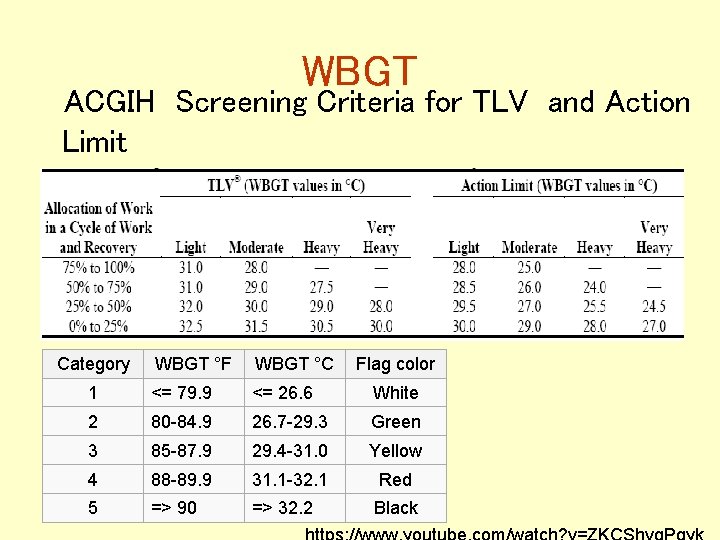
WBGT ACGIH Screening Criteria for TLV and Action Limit Category WBGT °F WBGT °C Flag color 1 <= 79. 9 <= 26. 6 White 2 80 -84. 9 26. 7 -29. 3 Green 3 85 -87. 9 29. 4 -31. 0 Yellow 4 88 -89. 9 31. 1 -32. 1 Red 5 => 90 => 32. 2 Black
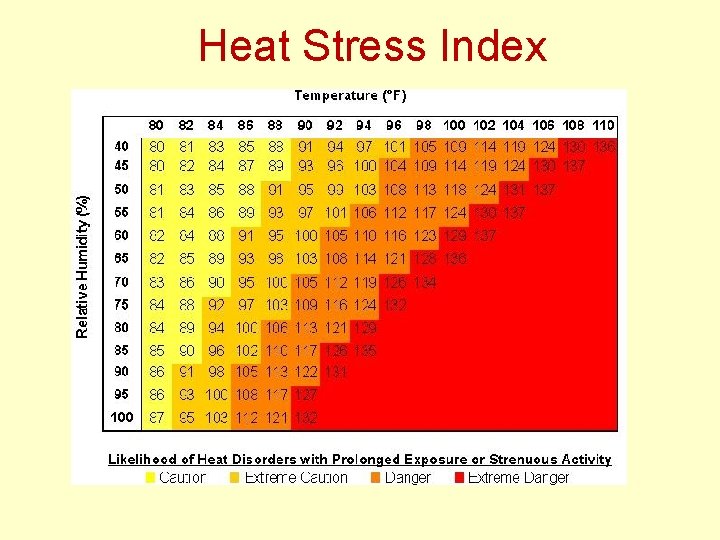
Heat Stress Index
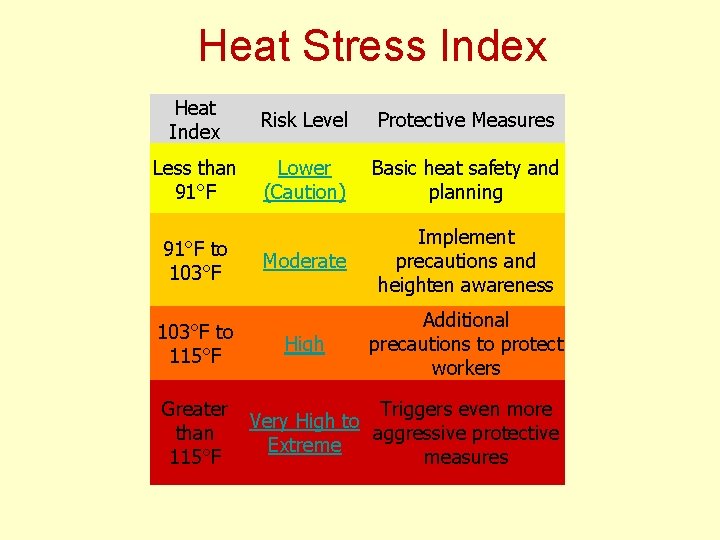
Heat Stress Index Heat Index Risk Level Protective Measures Less than 91°F Lower (Caution) Basic heat safety and planning Moderate Implement precautions and heighten awareness High Additional precautions to protect workers 91°F to 103°F to 115°F Greater than 115°F Triggers even more Very High to aggressive protective Extreme measures
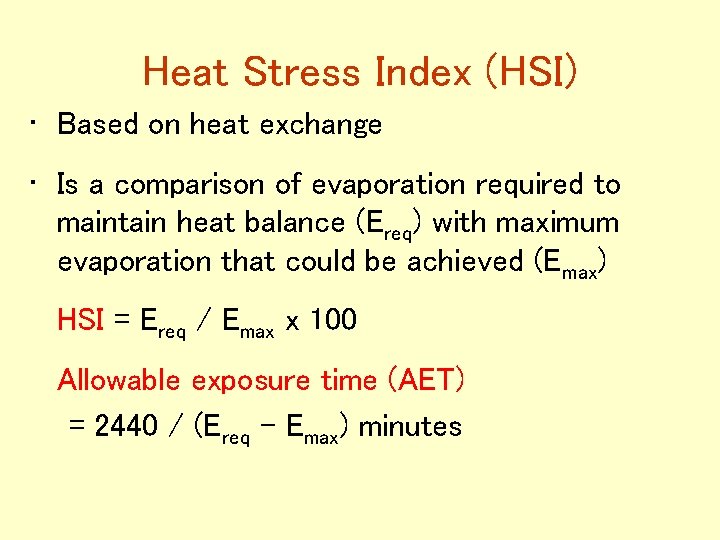
Heat Stress Index (HSI) • Based on heat exchange • Is a comparison of evaporation required to maintain heat balance (Ereq) with maximum evaporation that could be achieved (Emax) HSI = Ereq / Emax x 100 Allowable exposure time (AET) = 2440 / (Ereq – Emax) minutes
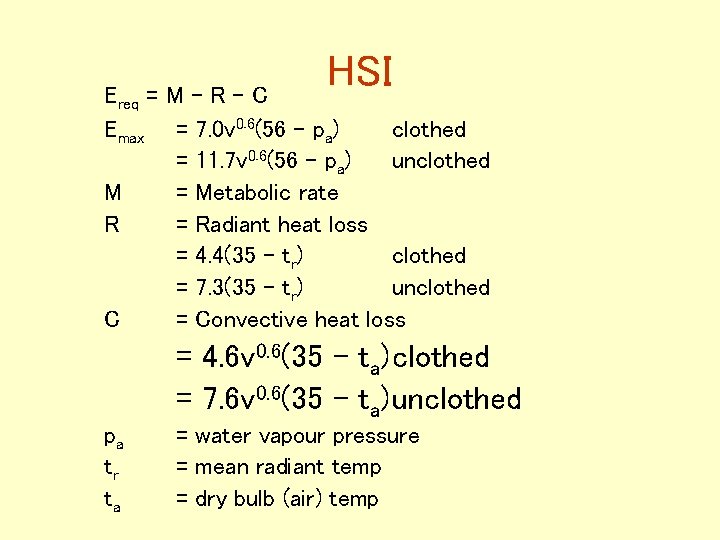
HSI Ereq = M – R – C Emax = 7. 0 v 0. 6(56 – pa) clothed = 11. 7 v 0. 6(56 – pa) unclothed M = Metabolic rate R = Radiant heat loss = 4. 4(35 – tr) clothed = 7. 3(35 – tr) unclothed C = Convective heat loss = 4. 6 v 0. 6(35 – ta)clothed = 7. 6 v 0. 6(35 – ta)unclothed pa tr ta = water vapour pressure = mean radiant temp = dry bulb (air) temp
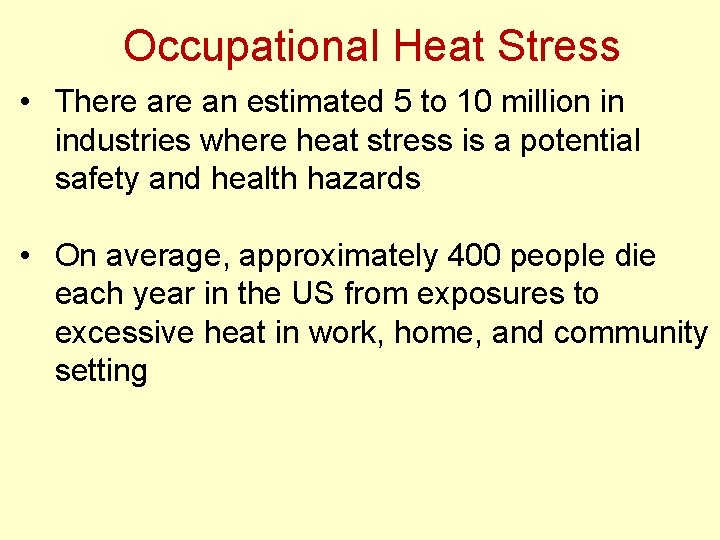
Occupational Heat Stress • There an estimated 5 to 10 million in industries where heat stress is a potential safety and health hazards • On average, approximately 400 people die each year in the US from exposures to excessive heat in work, home, and community setting
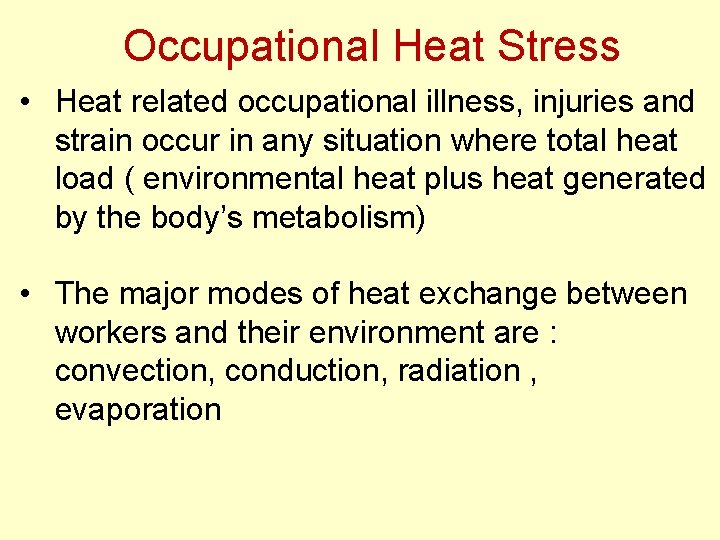
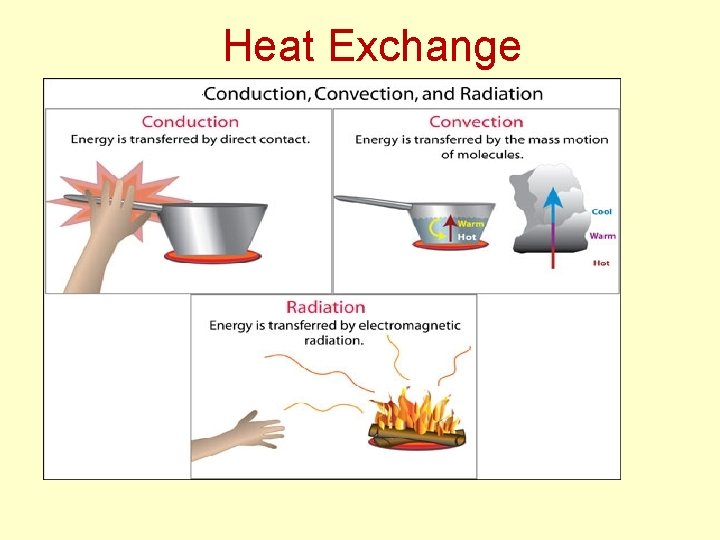
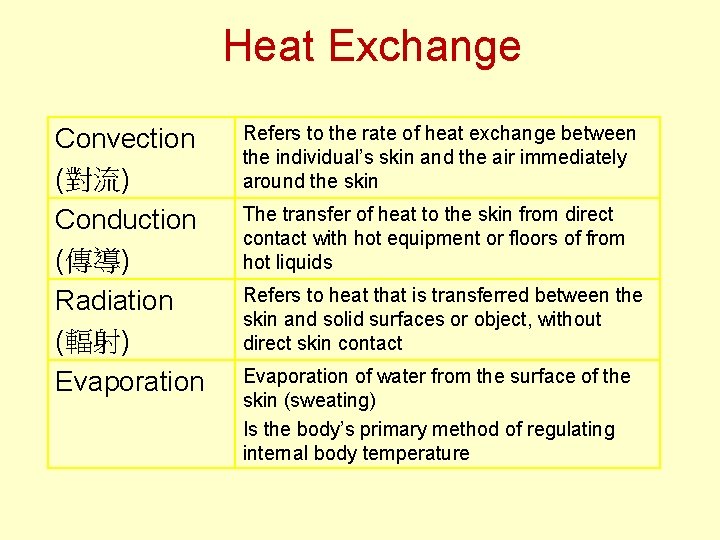
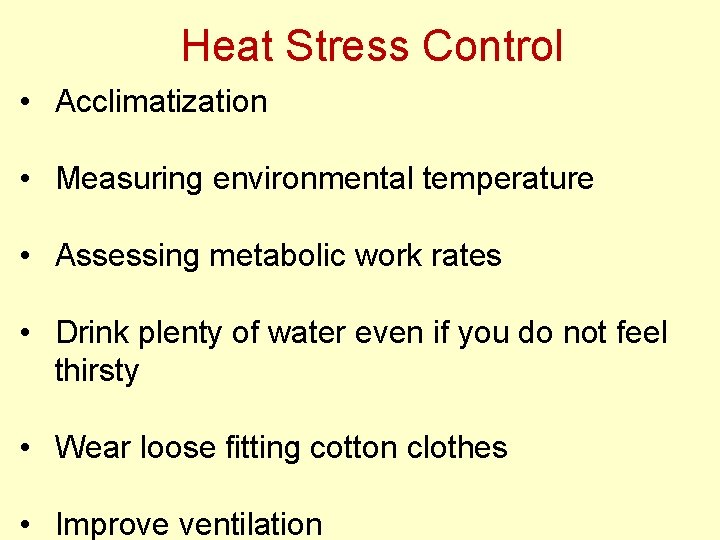
Occupational Heat Stress • Heat related occupational illness, injuries and strain occur in any situation where total heat load ( environmental heat plus heat generated by the body’s metabolism) • The major modes of heat exchange between workers and their environment are : convection, conduction, radiation , evaporation
Heat Exchange
Heat Exchange Convection (對流) Conduction (傳導) Radiation (輻射) Evaporation Refers to the rate of heat exchange between the individual’s skin and the air immediately around the skin The transfer of heat to the skin from direct contact with hot equipment or floors of from hot liquids Refers to heat that is transferred between the skin and solid surfaces or object, without direct skin contact Evaporation of water from the surface of the skin (sweating) Is the body’s primary method of regulating internal body temperature
Heat Stress Control • Acclimatization • Measuring environmental temperature • Assessing metabolic work rates • Drink plenty of water even if you do not feel thirsty • Wear loose fitting cotton clothes • Improve ventilation
Ventilation-Stack Effect where: Q= stack effect draft flow rate, m³/s A= flow area, m² C=discharge coefficient h=height m Ti=inside temp To=outside temp
Cold Stress Injury to cold may be general or local: - General cold injury (hypothermia) is characterized by numbness, blue lips, loss of sensation, muscular weakness, desire for sleep, coma and death. - Local cold injury: a) above freezing. Immersion or trench foot. After exposure for 12 hours. b) below freezing. Frostbite, tissues freeze and ice crystals form in between the cells.
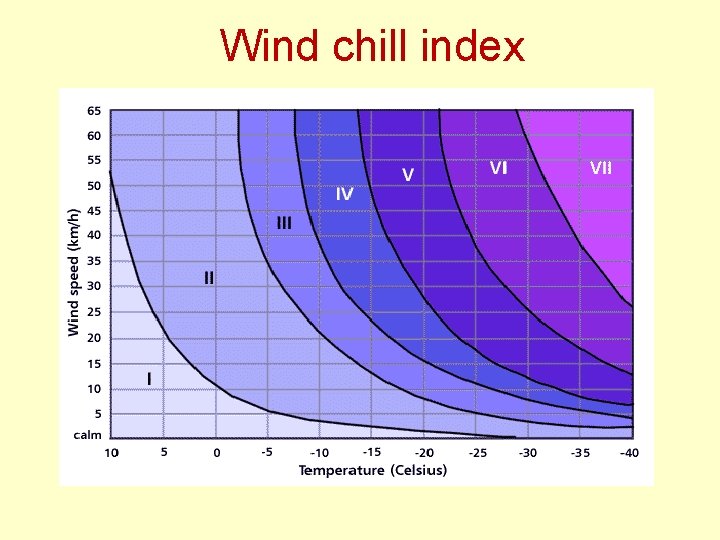
Wind chill index
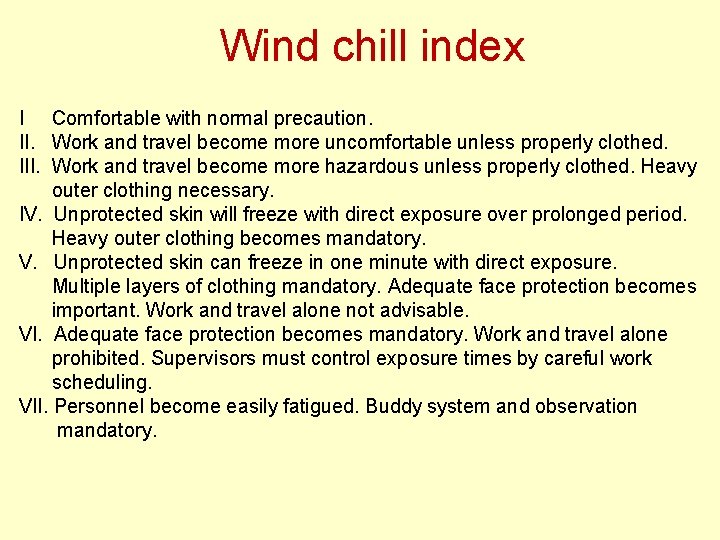
Wind chill index I Comfortable with normal precaution. II. Work and travel become more uncomfortable unless properly clothed. III. Work and travel become more hazardous unless properly clothed. Heavy outer clothing necessary. IV. Unprotected skin will freeze with direct exposure over prolonged period. Heavy outer clothing becomes mandatory. V. Unprotected skin can freeze in one minute with direct exposure. Multiple layers of clothing mandatory. Adequate face protection becomes important. Work and travel alone not advisable. VI. Adequate face protection becomes mandatory. Work and travel alone prohibited. Supervisors must control exposure times by careful work scheduling. VII. Personnel become easily fatigued. Buddy system and observation mandatory.
Cold Stress Control Work Practices 1. Drink plenty of liquids, avoiding caffeine and alcohol. It is easy to become dehydrated in cold weather. 2. If possible, heavy work should be scheduled during the warmer parts of the day. Take breaks out of the cold. 3. Buddy System: Try to work in pairs to keep an eye on each other and watch for signs of cold stress
Cold Stress Control Engineering Controls 1. Radiant heaters may be used to warm workers 2. Shield work areas from drafts or wind 3. Use insulating material on equipment handles when temperatures drop below 0°C
Pressure
Pressure 1. Hyperbaric - Pressure above 1 atm - Decompression Sickness 2. Hypobaric - Pressure below 1 atm - Acute Mountain Sickness - High Altitude Pulmonary Edema
Thank you
- Slides: 81