
Occupational health and safety training OHS Why should

- Slides: 14
Occupational health and safety training (OHS)
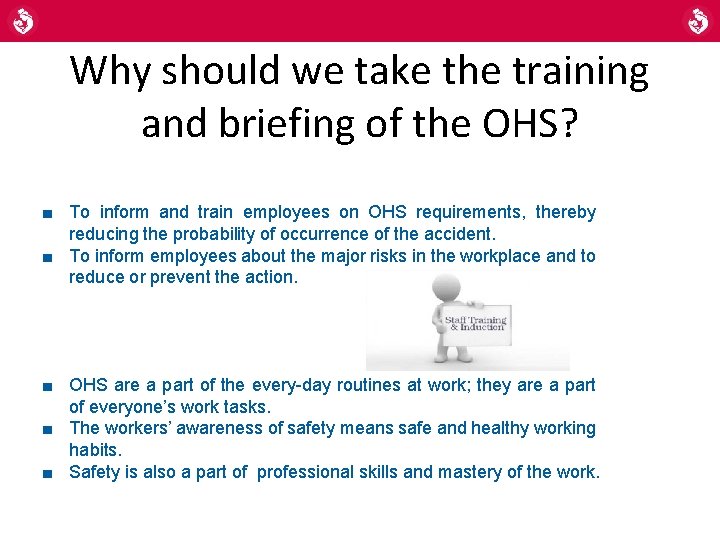
Why should we take the training and briefing of the OHS? ■ To inform and train employees on OHS requirements, thereby reducing the probability of occurrence of the accident. ■ To inform employees about the major risks in the workplace and to reduce or prevent the action. ■ OHS are a part of the every-day routines at work; they are a part of everyone’s work tasks. ■ The workers’ awareness of safety means safe and healthy working habits. ■ Safety is also a part of professional skills and mastery of the work.
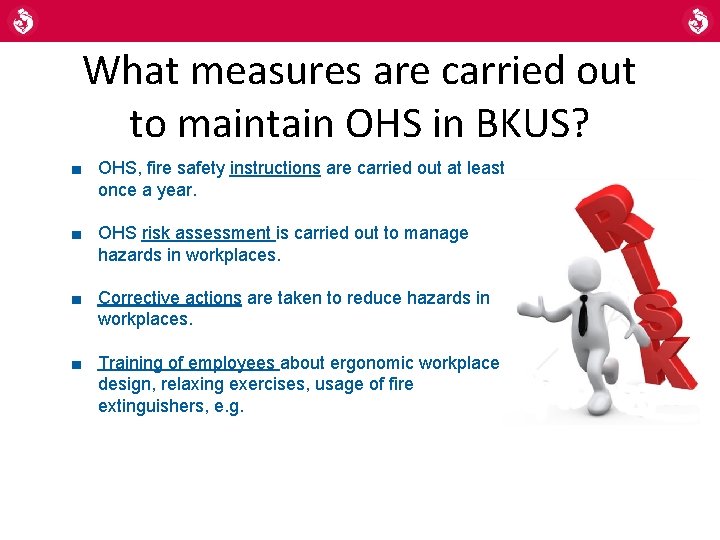
What measures are carried out to maintain OHS in BKUS? ■ OHS, fire safety instructions are carried out at least once a year. ■ OHS risk assessment is carried out to manage hazards in workplaces. ■ Corrective actions are taken to reduce hazards in workplaces. ■ Training of employees about ergonomic workplace design, relaxing exercises, usage of fire extinguishers, e. g.
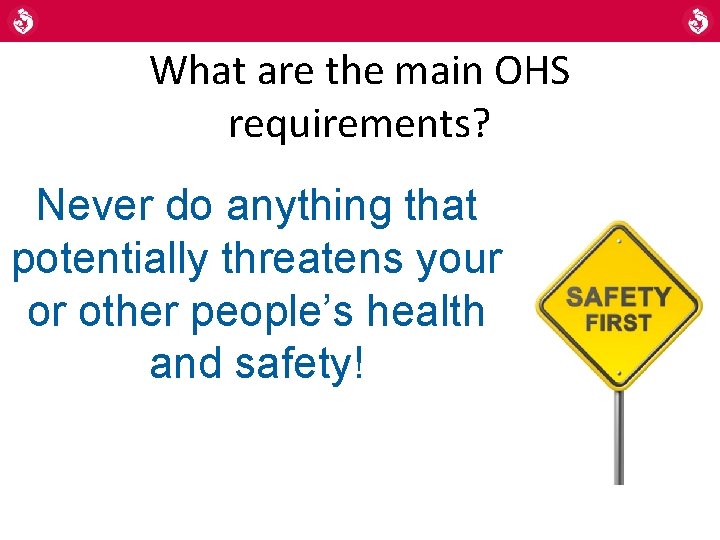
What are the main OHS requirements? Never do anything that potentially threatens your or other people’s health and safety!
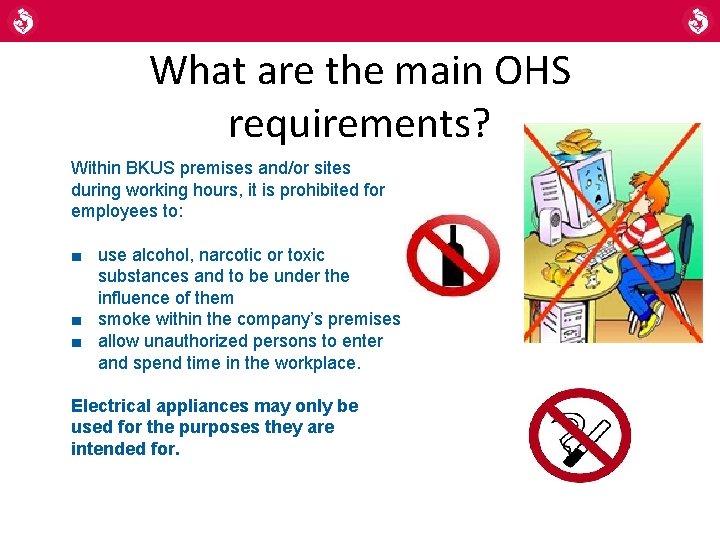
What are the main OHS requirements? Within BKUS premises and/or sites during working hours, it is prohibited for employees to: ■ use alcohol, narcotic or toxic substances and to be under the influence of them ■ smoke within the company’s premises ■ allow unauthorized persons to enter and spend time in the workplace. Electrical appliances may only be used for the purposes they are intended for.
What are the main OHS requirements? Employees are obliged to notify about: ■ any factors related to the working environment which pose or could pose a risk to people’s health and safety ■ all incidents that happened to employers, visitors and contractors Employees are obliged: ■ to participate in occupational health and safety instructions and training
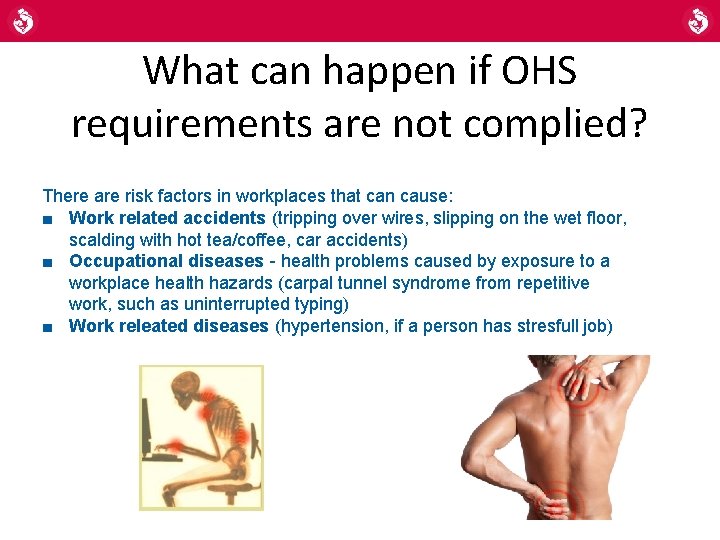
What can happen if OHS requirements are not complied? There are risk factors in workplaces that can cause: ■ Work related accidents (tripping over wires, slipping on the wet floor, scalding with hot tea/coffee, car accidents) ■ Occupational diseases - health problems caused by exposure to a workplace health hazards (carpal tunnel syndrome from repetitive work, such as uninterrupted typing) ■ Work releated diseases (hypertension, if a person has stresfull job)
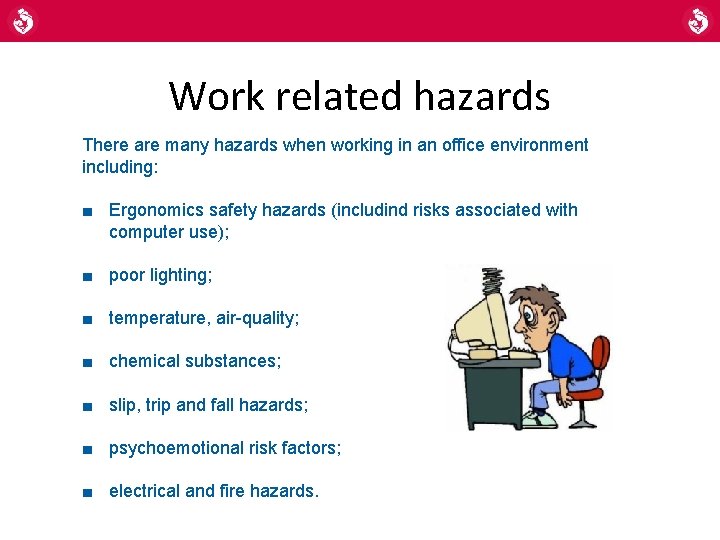
Work related hazards There are many hazards when working in an office environment including: ■ Ergonomics safety hazards (includind risks associated with computer use); ■ poor lighting; ■ temperature, air-quality; ■ chemical substances; ■ slip, trip and fall hazards; ■ psychoemotional risk factors; ■ electrical and fire hazards.
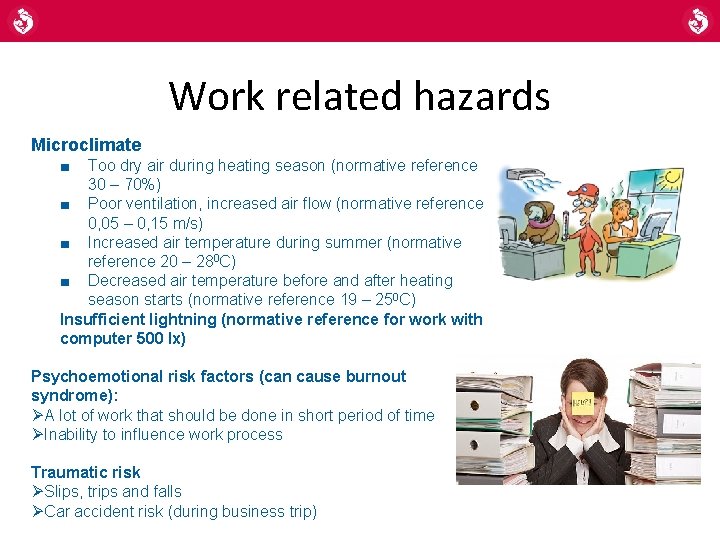
Work related hazards Microclimate ■ Too dry air during heating season (normative reference 30 – 70%) ■ Poor ventilation, increased air flow (normative reference 0, 05 – 0, 15 m/s) ■ Increased air temperature during summer (normative reference 20 – 280 C) ■ Decreased air temperature before and after heating season starts (normative reference 19 – 250 C) Insufficient lightning (normative reference for work with computer 500 lx) Psychoemotional risk factors (can cause burnout syndrome): ØA lot of work that should be done in short period of time ØInability to influence work process Traumatic risk ØSlips, trips and falls ØCar accident risk (during business trip)
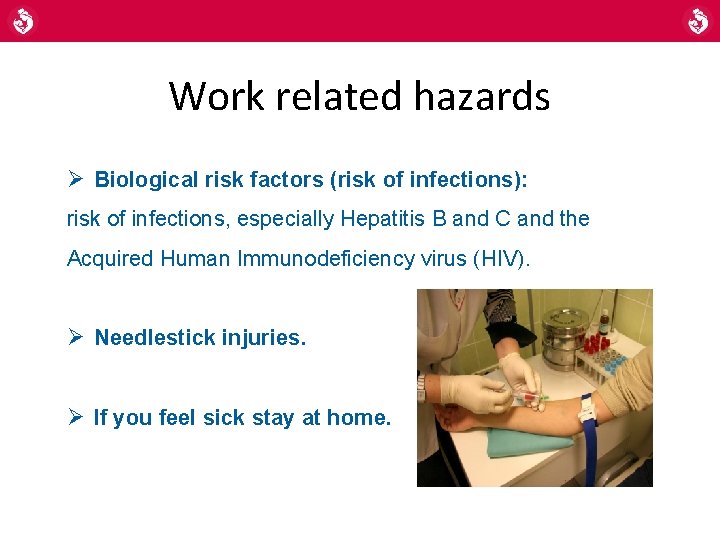
Work related hazards Ø Biological risk factors (risk of infections): risk of infections, especially Hepatitis B and C and the Acquired Human Immunodeficiency virus (HIV). Ø Needlestick injuries. Ø If you feel sick stay at home.
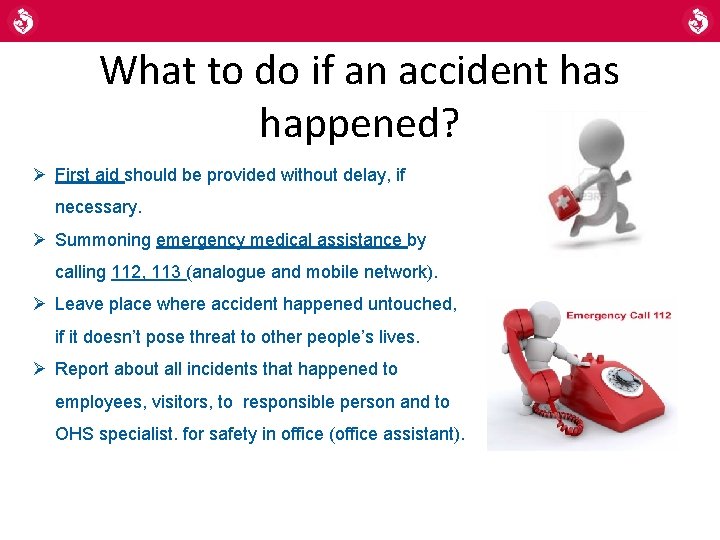
What to do if an accident has happened? Ø First aid should be provided without delay, if necessary. Ø Summoning emergency medical assistance by calling 112, 113 (analogue and mobile network). Ø Leave place where accident happened untouched, if it doesn’t pose threat to other people’s lives. Ø Report about all incidents that happened to employees, visitors, to responsible person and to OHS specialist. for safety in office (office assistant).
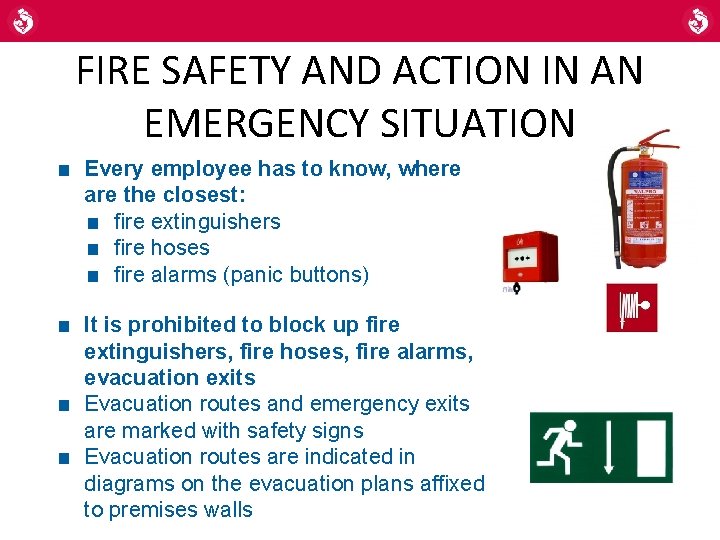
FIRE SAFETY AND ACTION IN AN EMERGENCY SITUATION ■ Every employee has to know, where are the closest: ■ fire extinguishers ■ fire hoses ■ fire alarms (panic buttons) ■ It is prohibited to block up fire extinguishers, fire hoses, fire alarms, evacuation exits ■ Evacuation routes and emergency exits are marked with safety signs ■ Evacuation routes are indicated in diagrams on the evacuation plans affixed to premises walls
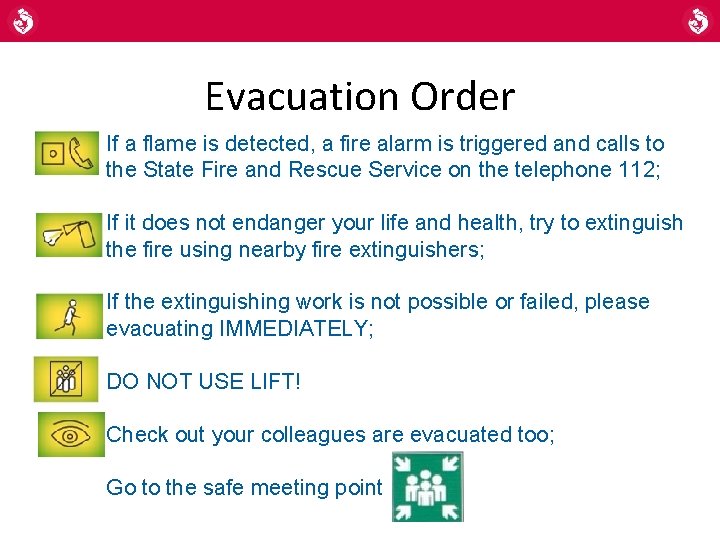
Evacuation Order If a flame is detected, a fire alarm is triggered and calls to the State Fire and Rescue Service on the telephone 112; If it does not endanger your life and health, try to extinguish the fire using nearby fire extinguishers; If the extinguishing work is not possible or failed, please evacuating IMMEDIATELY; DO NOT USE LIFT! Check out your colleagues are evacuated too; Go to the safe meeting point
Thank You for your attention ! Documents you were introduce with: DI-19/00 “Entry instructions for job protection”, DI-4/03 “PLLC „CCUH” Tornakalns Vienības gatve 45, Riga, LV-1004 fire safety instructions”, DI-45/02 “Emergency action plan”, DI-5/05 Evacuation plan in the holding of Tornakalns (Vienības gatvē 45), DI-10/02 “Emergency reporting scheme in a holding in Tornaklans, Gailezers, ”, DI-17/00 “Electrical safety instructions”, DI-11/01 “General Work Protection Instructions”, DI-46/00 “Working protection instructions for handling sharp objects. Action in cases of exposure to potentially hazardous human organism secretions and fluids”,