
Occam Jason Miller Justin Doll Chantelle Erasmus Preview
![Protocol types Simple/Sequential Examples: PROTOCOL ADDR IS INT: PROTOCOL PACKET IS INT: : []BYTE:](https://slidetodoc.com/presentation_image_h2/7bc0d4bc9d7fb0605c14d3d7a5a85ff0/image-25.jpg "Protocol types Simple/Sequential Examples: PROTOCOL ADDR IS INT: PROTOCOL PACKET IS INT: : []BYTE:")
![Expressions Examples: 42 5+7 array[i/32][i32] [array FROM j] foo (32) + ((bar (i) +](https://slidetodoc.com/presentation_image_h2/7bc0d4bc9d7fb0605c14d3d7a5a85ff0/image-26.jpg "Expressions Examples: 42 5+7 array[i/32][i32] [array FROM j] foo (32) + ((bar (i) +")
- Slides: 30
Occam Jason Miller Justin Doll Chantelle Erasmus
Preview History Design. Occam 1 through Occam-∏ Pi-Calculus Communicating Sequential Process (CSP) Introduction Notation Producer/Consumer Problem Syntax Processes Data Types Functions
History
Design Created by David May and others at INMOS. Advised by Tony Hoare. Designed to work with INMOS’ Transputer Microprocessors designed for concurrent processing. Concurrent Sequential Processing language.
Occam’s Razor. attributed to 14 th-century English logician and Franciscan friar, William of Ockham. Principle that the language was based off of, states “entities should not be multiplied unnecessarily. ” the explanation of any phenomenon should make as few assumptions as possible, eliminating those that make no difference in the observable predictions of the explanatory hypothesis or theory.
Design Overview Used Channels to communicate between Processes. Adhered to the Off-Side Rule. Indentation is necessary for proper compilation. Commands are ended by a new line.
Occam 1 Released in 1983. Only recognized the VAR data type. Only allowed arrays of 1 dimension.
Occam 2 The most popular version of the language. Released in 1987 by INMOS. Added support for: Floating-Point. Functions. Multi-dimensional arrays. Other Variable Types: INT 16 Bytes. and INT 32.
Occam 2. 1 Last variant created by INMOS. Developed by Geoff Barrett and released in 1994. Based off a design for Occam 3 that was never implemented. Added new features, including: Relaxation of some data type conversion. Arrays of channels. Ability to return fixed-length array from function.
Occam-∏ Implemented in later versions of the Kent Retargetable occam Compiler. (KRo. C) Implements ideas inspired by Pi-Calculus. New features include: Nested Protocols. Recursion. Array constructors.
Pi-Calculus Developed by Robin Milner, Joachim Parrow, and David Walker. Extension to the process calculus, CCS (Calculus of Communicating Systems). Attempts to describe concurrent computations whose configuration may change during computation.
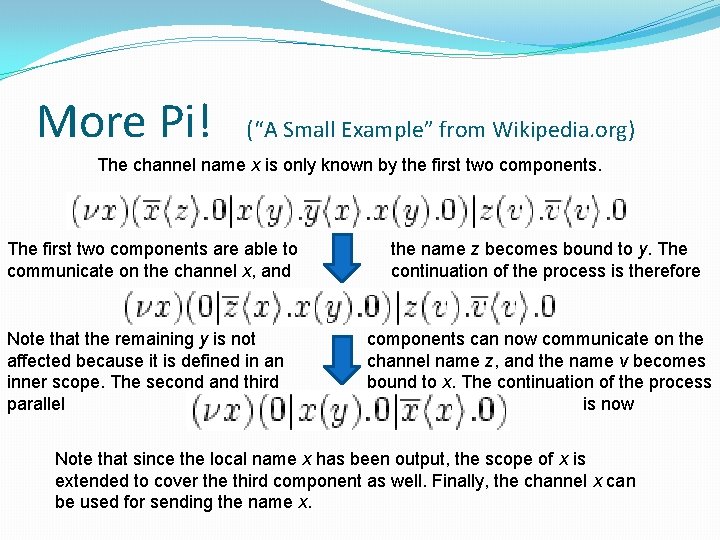
More Pi! (“A Small Example” from Wikipedia. org) The channel name x is only known by the first two components. The first two components are able to communicate on the channel x, and Note that the remaining y is not affected because it is defined in an inner scope. The second and third parallel the name z becomes bound to y. The continuation of the process is therefore components can now communicate on the channel name z, and the name v becomes bound to x. The continuation of the process is now Note that since the local name x has been output, the scope of x is extended to cover the third component as well. Finally, the channel x can be used for sending the name x.
CSP and the Producer/Consumer Problem
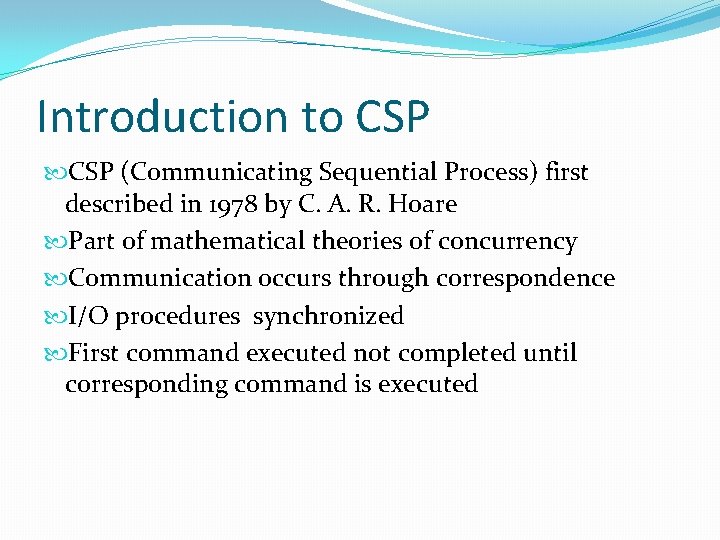
Introduction to CSP (Communicating Sequential Process) first described in 1978 by C. A. R. Hoare Part of mathematical theories of concurrency Communication occurs through correspondence I/O procedures synchronized First command executed not completed until corresponding command is executed
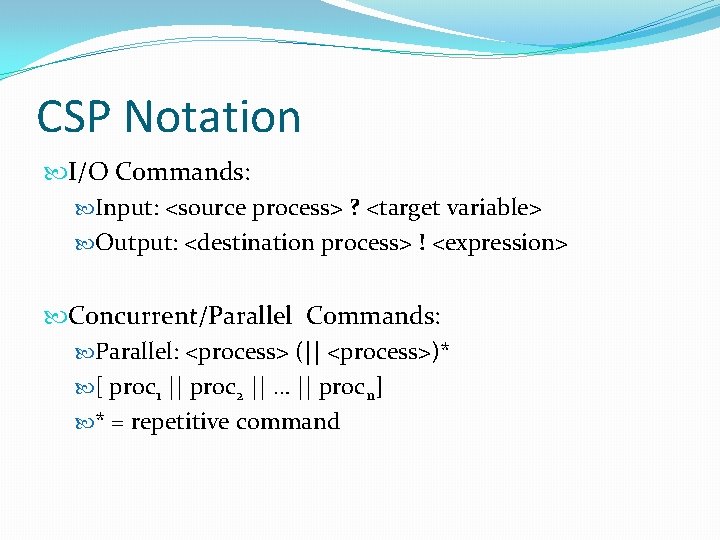
CSP Notation I/O Commands: Input: <source process> ? <target variable> Output: <destination process> ! <expression> Concurrent/Parallel Commands: Parallel: <process> (|| <process>)* [ proc 1 || proc 2 || … || procn] * = repetitive command
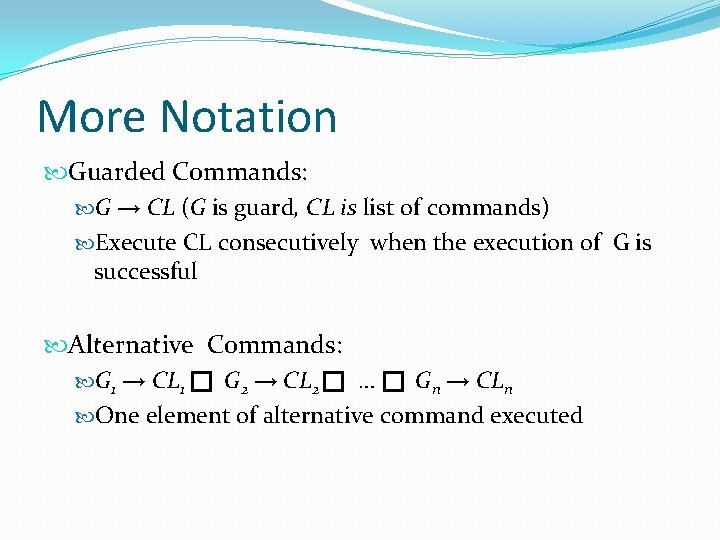
More Notation Guarded Commands: G → CL (G is guard, CL is list of commands) Execute CL consecutively when the execution of G is successful Alternative Commands: G 1 → CL 1 G 2 → CL 2 … Gn → CLn One element of alternative command executed
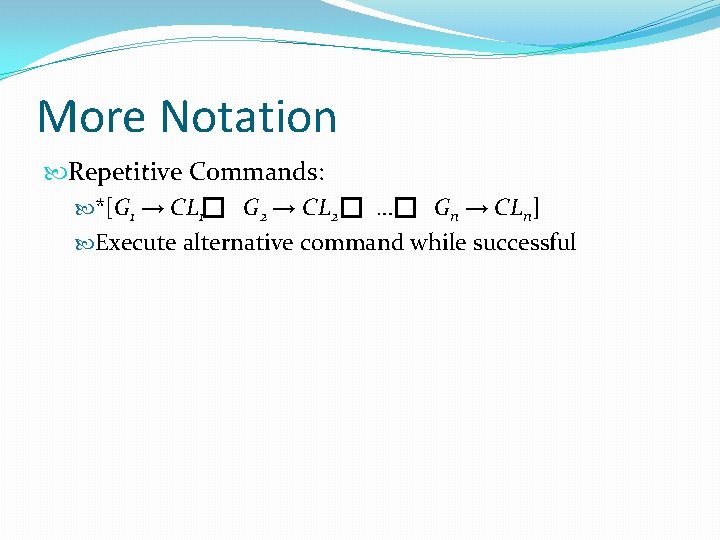
More Notation Repetitive Commands: *[G 1 → CL 1 G 2 → CL 2 … Gn → CLn] Execute alternative command while successful
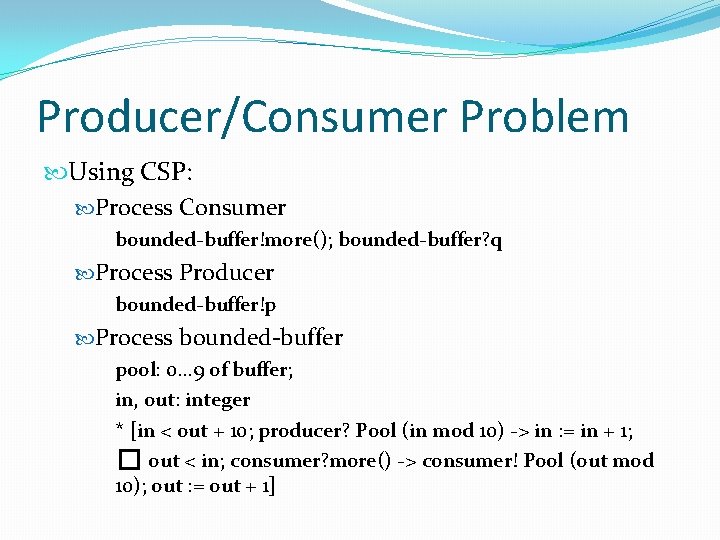
Producer/Consumer Problem Using CSP: Process Consumer bounded-buffer!more(); bounded-buffer? q Process Producer bounded-buffer!p Process bounded-buffer pool: 0… 9 of buffer; in, out: integer * [in < out + 10; producer? Pool (in mod 10) -> in : = in + 1; out < in; consumer? more() -> consumer! Pool (out mod 10); out : = out + 1]
Syntax
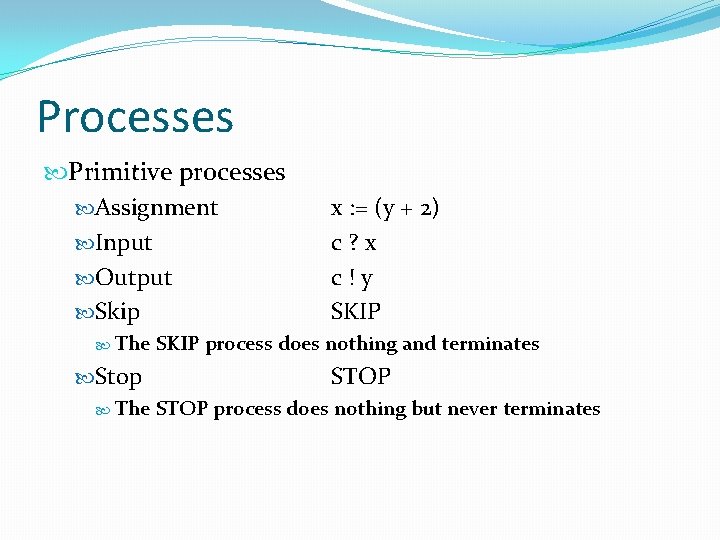
Processes Primitive processes Assignment Input Output Skip The x : = (y + 2) c? x c!y SKIP process does nothing and terminates Stop STOP The STOP process does nothing but never terminates
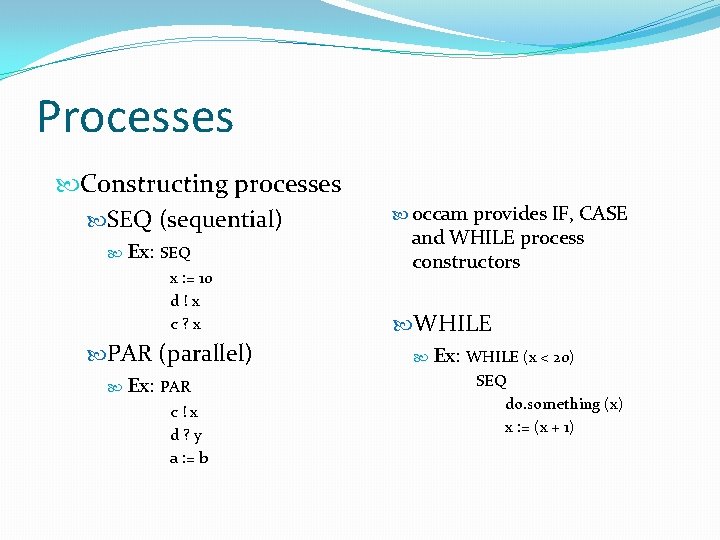
Processes Constructing processes SEQ (sequential) Ex: SEQ x : = 10 d!x c? x PAR (parallel) Ex: PAR c!x d? y a : = b occam provides IF, CASE and WHILE process constructors WHILE Ex: WHILE (x < 20) SEQ do. something (x) x : = (x + 1)
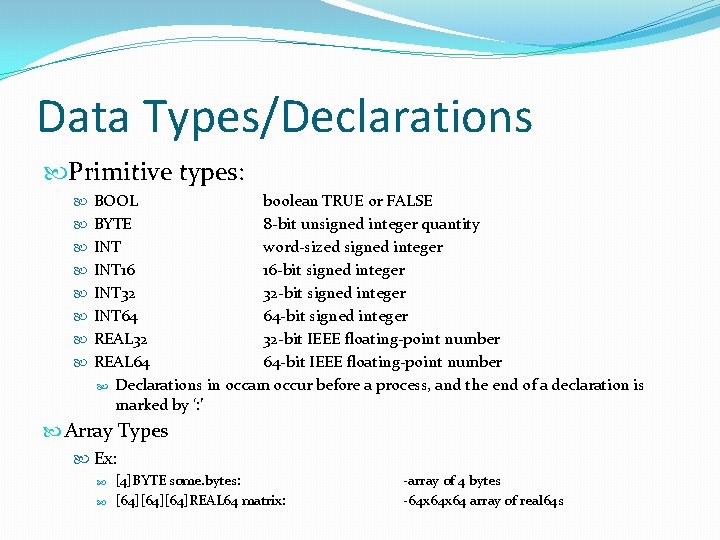
Data Types/Declarations Primitive types: BOOL boolean TRUE or FALSE BYTE 8 -bit unsigned integer quantity INT word-sized signed integer INT 16 16 -bit signed integer INT 32 32 -bit signed integer INT 64 64 -bit signed integer REAL 32 32 -bit IEEE floating-point number REAL 64 64 -bit IEEE floating-point number Declarations in occam occur before a process, and the end of a declaration is marked by ‘: ’ Array Types Ex: [4]BYTE some. bytes: [64][64]REAL 64 matrix: -array of 4 bytes -64 x 64 array of real 64 s
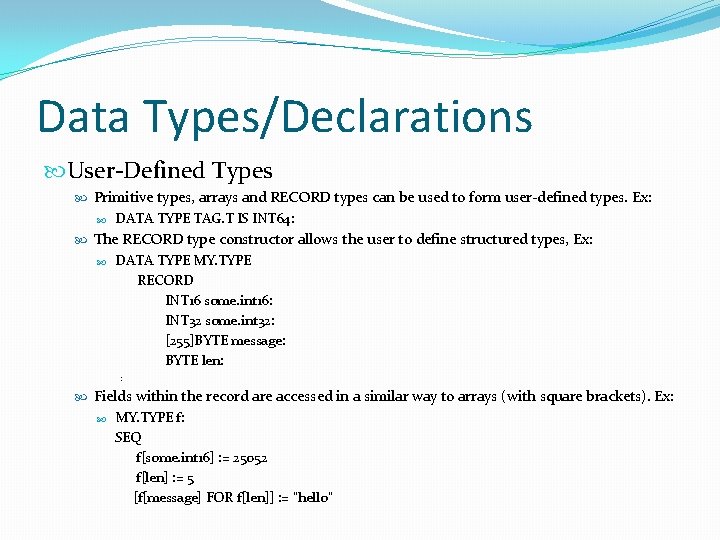
Data Types/Declarations User-Defined Types Primitive types, arrays and RECORD types can be used to form user-defined types. Ex: DATA TYPE TAG. T IS INT 64: The RECORD type constructor allows the user to define structured types, Ex: DATA TYPE MY. TYPE RECORD INT 16 some. int 16: INT 32 some. int 32: [255]BYTE message: BYTE len: : Fields within the record are accessed in a similar way to arrays (with square brackets). Ex: MY. TYPE f: SEQ f[some. int 16] : = 25052 f[len] : = 5 [f[message] FOR f[len]] : = "hello"
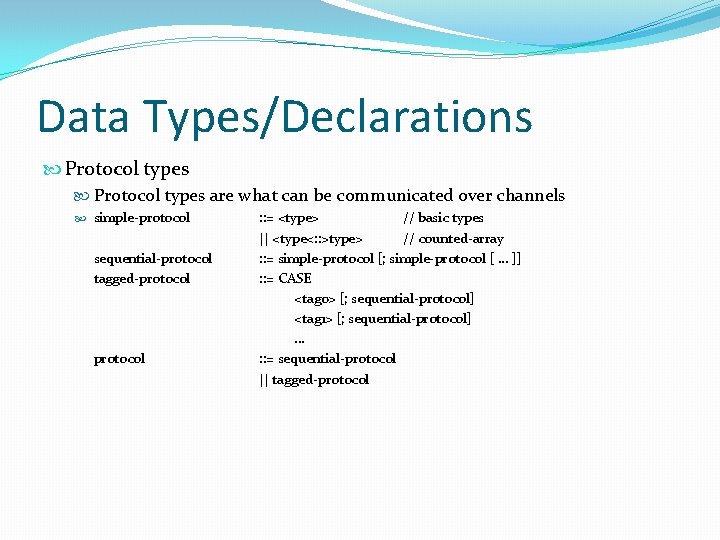
Data Types/Declarations Protocol types are what can be communicated over channels simple-protocol sequential-protocol tagged-protocol : : = <type> // basic types || <type<: : >type> // counted-array : : = simple-protocol [; simple-protocol [. . . ]] : : = CASE <tag 0> [; sequential-protocol] <tag 1> [; sequential-protocol]. . . : : = sequential-protocol || tagged-protocol
Protocol types Simple/Sequential Examples: PROTOCOL ADDR IS INT: PROTOCOL PACKET IS INT: : []BYTE: PROTOCOL COORD. 3 D IS REAL 64; REAL 64: PROTOCOL TAGGED. PACKET IS BYTE; INT: : []BYTE: Tagged Examples: PROTOCOL DISPLAY CASE clear. screen int. x. y; BYTE; INT string. x. y; BYTE; BYTE: : []BYTE : -- simple protocol ADDR -- INT counted array of BYTEs -- 3 REAL 64 values -- BYTE followed by INT counted array of BYTEs
Expressions Examples: 42 5+7 array[i/32][i32] [array FROM j] foo (32) + ((bar (i) + thing (j)) * 42) [array FROM foo(i) FOR bar(i+32)] [1, 2, foo (3), 4, bar(5)] -- simple value -- addition -- array element -- array slice -- function calls -- mixed -- constant array with function calls occam expressions have no concept of operator precedence
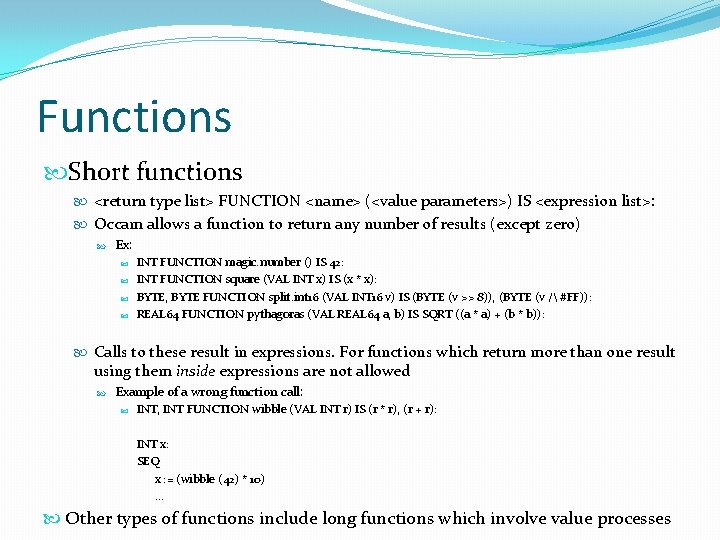
Functions Short functions <return type list> FUNCTION <name> (<value parameters>) IS <expression list>: Occam allows a function to return any number of results (except zero) Ex: INT FUNCTION magic. number () IS 42: INT FUNCTION square (VAL INT x) IS (x * x): BYTE, BYTE FUNCTION split. int 16 (VAL INT 16 v) IS (BYTE (v >> 8)), (BYTE (v / #FF)): REAL 64 FUNCTION pythagoras (VAL REAL 64 a, b) IS SQRT ((a * a) + (b * b)): Calls to these result in expressions. For functions which return more than one result using them inside expressions are not allowed Example of a wrong function call: INT, INT FUNCTION wibble (VAL INT r) IS (r * r), (r + r): INT x: SEQ x : = (wibble (42) * 10). . . Other types of functions include long functions which involve value processes
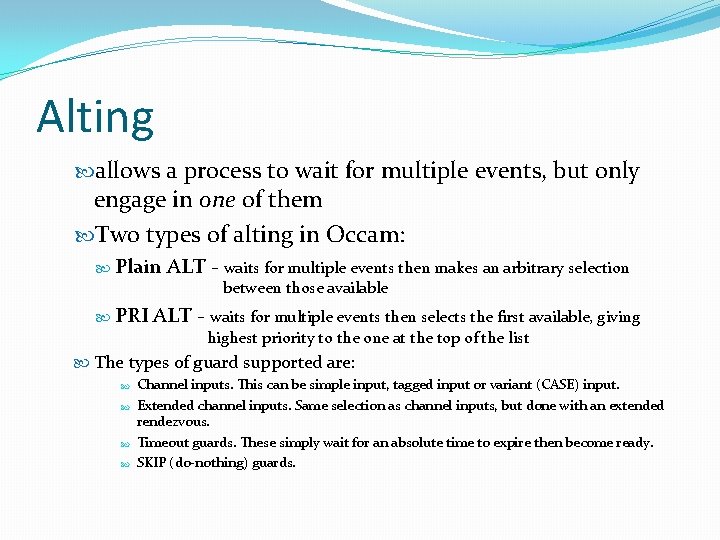
Alting allows a process to wait for multiple events, but only engage in one of them Two types of alting in Occam: Plain PRI ALT - waits for multiple events then makes an arbitrary selection between those available ALT - waits for multiple events then selects the first available, giving highest priority to the one at the top of the list The types of guard supported are: Channel inputs. This can be simple input, tagged input or variant (CASE) input. Extended channel inputs. Same selection as channel inputs, but done with an extended rendezvous. Timeout guards. These simply wait for an absolute time to expire then become ready. SKIP (do-nothing) guards.
Conclusion Created with the intention to make problems solvable with the fewest amount of steps. Uses sequential execution and unique data types to achieve this. Unfortunately the compiler for a Windows system isn’t as simple.
Occam Jason Miller Justin Doll Chantelle Erasmus