
OCB A BockCipher Mode of Operation for Efficient
OCB: A Bock-Cipher Mode of Operation for Efficient Authenticated Encryption Phillip Rogaway UC Davis This work done at Chiang Mai University rogaway@cs. ucdavis. edu http: //www. cs. ucdavis. edu/~rogaway Mihir Bellare John Black Ted Krovetz UC San Diego University of Nevada UC Davis CCS-8 — Philadelphia, USA — November 8, 2001 1
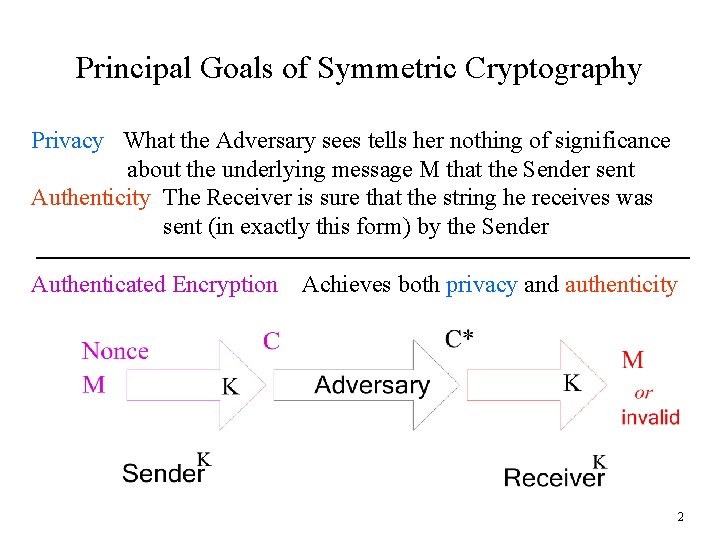
Principal Goals of Symmetric Cryptography Privacy What the Adversary sees tells her nothing of significance about the underlying message M that the Sender sent Authenticity The Receiver is sure that the string he receives was sent (in exactly this form) by the Sender Authenticated Encryption Achieves both privacy and authenticity 2
Why Authenticated Encryption? • Efficiency By merging privacy and authenticity one can achieve efficiency difficult to achieve if handling them separately. • Easier-to-correctly-use abstraction By delivering strong security properties one may minimize encryption-scheme misuse. 3
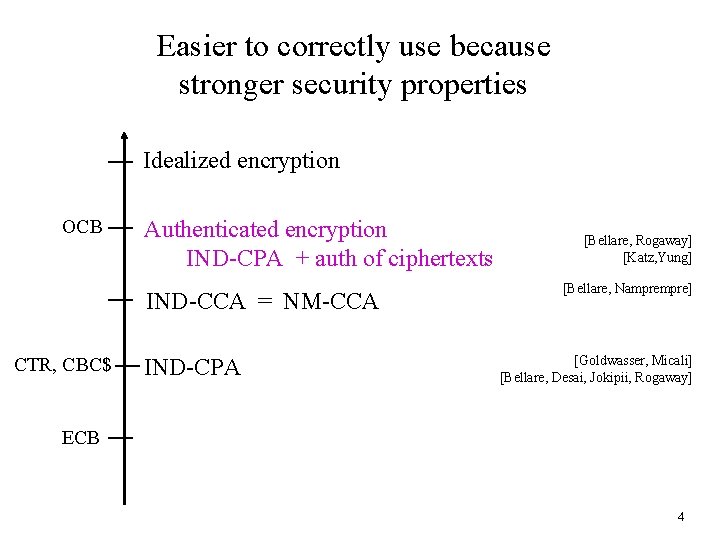
Easier to correctly use because stronger security properties Idealized encryption OCB Authenticated encryption IND-CPA + auth of ciphertexts IND-CCA = NM-CCA CTR, CBC$ IND-CPA [Bellare, Rogaway] [Katz, Yung] [Bellare, Nampre] [Goldwasser, Micali] [Bellare, Desai, Jokipii, Rogaway] ECB 4
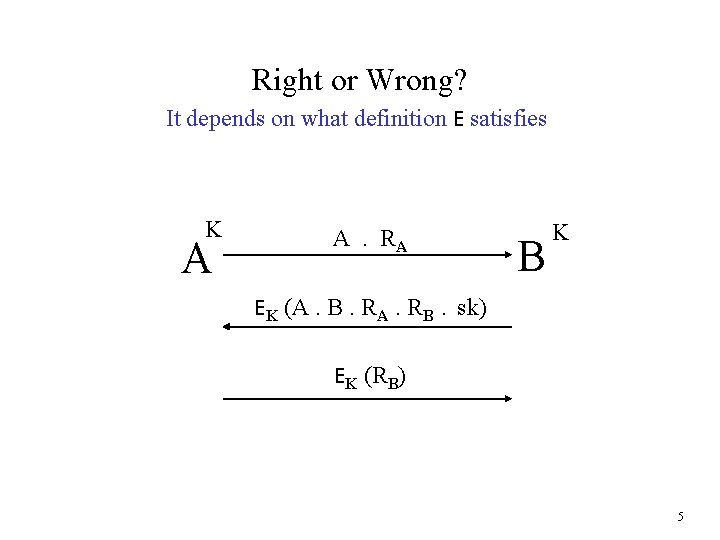
Right or Wrong? It depends on what definition E satisfies K A A. RA B K EK (A. B. RA. RB. sk) EK (RB) 5
![Folklore approach. See [Bellare, Nampre] and [Krawczyk] encryption for analysis. Generic Composition Traditional approach](http://slidetodoc.com/presentation_image_h/012a7365a014417e964d9e3902a5c63d/image-6.jpg "Folklore approach. See [Bellare, Nampre] and [Krawczyk] encryption for analysis. Generic Composition Traditional approach")
Folklore approach. See [Bellare, Nampre] and [Krawczyk] encryption for analysis. Generic Composition Traditional approach to authenticated Glue together an encryption scheme ( E ) and a message authentication code (MAC) Preferred way to do generic composition: 6
Generic Composition + Versatile, clean approach + Reduces design work + Quick rejection of forged messages if use optimized MAC (eg. , UMAC) + Inherits the characteristics of the modes one builds from - Cost » (cost to encrypt) + (cost to MAC) For CBC Enc + CBC MAC, cost » 2 ´ (cost to CBC Enc) - Often done wrong - Two keys - Inherits characteristics of the modes one builds from 7
Trying to do Better • Numerous attempts to make privacy + authenticity cheaper. • One approach: stick with generic composition, but find cheaper. encryption schemes or MACs. • Make authenticity an “incidental” adjunct to privacy within a conventional-looking mode: • CBC-with-various-checksums (wrong) • PCBC in Kerberos (wrong) • PCBC of [Gligor, Donescu 99] (wrong) • [Jutla 00] First correct solution • Jutla described two modes, IACBC and IAPM. • A lovely start, but many improvements possible. • OCB: inspired by IAPM, but many new characteristics. 8
![Additional Related Work • [Halevi]—improved on Jutla’s IAPM proof and helped to clarify what](http://slidetodoc.com/presentation_image_h/012a7365a014417e964d9e3902a5c63d/image-9.jpg "Additional Related Work • [Halevi]—improved on Jutla’s IAPM proof and helped to clarify what")
Additional Related Work • [Halevi]—improved on Jutla’s IAPM proof and helped to clarify what was going on in the scheme. • [Gligor, Donescu]—Proposed IACBC-like scheme, using mod 2 n addition. 9
What is OCB? • Authenticated-encryption scheme • Uses any block cipher (eg. AES) • Computational cost » cost of CBC • OCB-AES good in SW or HW • Lots of nice characteristics designed in: • Uses é |M| / n ù + 2 block-cipher calls • Uses any nonce (needn’t be unpredictable) • Works on messages of any length • Creates minimum-length ciphertext • Uses a single block-cipher key, each block-cipher keyed with it • Quick key setup – suitable for single-message sessions • Essentially endian-neutral • Fully parallelizable • No n-bit additions • Provably secure: if you break OCB-AES you’ve broken AES • In IEEE 802. 11 draft standard (wireless LANs) 10
![Checksum = M[1] Å M[2] Å … Å M[m-1] Å C[m]0* Å Pad L](http://slidetodoc.com/presentation_image_h/012a7365a014417e964d9e3902a5c63d/image-11.jpg "Checksum = M[1] Å M[2] Å … Å M[m-1] Å C[m]0* Å Pad L")
Checksum = M[1] Å M[2] Å … Å M[m-1] Å C[m]0* Å Pad L = EK(0) 11
![Pseudocode of OCB[E, t] algorithm OCB-Encrypt K) Nonce, M( L(0) = EK(0) L(-1) =](http://slidetodoc.com/presentation_image_h/012a7365a014417e964d9e3902a5c63d/image-12.jpg "Pseudocode of OCB[E, t] algorithm OCB-Encrypt K) Nonce, M( L(0) = EK(0) L(-1) =")
Pseudocode of OCB[E, t] algorithm OCB-Encrypt K) Nonce, M( L(0) = EK(0) L(-1) = lsb(L(0))? (L(0) >> 1) Å Const 43 : (L(0) >>1) for i = 1, 2, … do L(i) = msb(L(i-1))? (L(i-1) << 1) Å Const 87 : (L(i-1) <<1) Partition M into M[1]. . . M[m] // each n bits, except M[m] may be shorter Offset = EK) Nonce Å L(0(( for i=1 to m-1 do Offset = Offset Å L(ntz(i)) C[i] = EK )M[i] Å Offset (Å Offset = Offset Å L(ntz(m)) Pad = EK )len(M[m]) Å Offset Å L(-1)( C[m] = M[m] Å (first |M[m] | bits of Pad( Checksum = M[1] Å. . . Å M[m-1] Å C[m]0* Å Pad Tag = first t bits of EK)Checksum Å Offset) return C[1]. . . C[m] || Tag 12
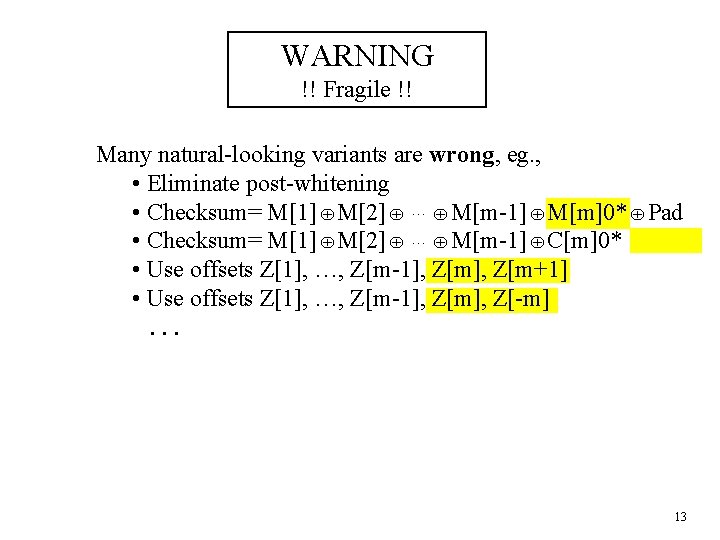
WARNING !! Fragile !! Many natural-looking variants are wrong, eg. , • Eliminate post-whitening • Checksum= M[1] Å M[2] Å … Å M[m-1] Å M[m]0* Å Pad • Checksum= M[1] Å M[2] Å … Å M[m-1] Å C[m]0* • Use offsets Z[1], …, Z[m-1], Z[m+1] • Use offsets Z[1], …, Z[m-1], Z[m], Z[-m]. . . 13
![Assurance via Provable Security • Provable security begins with [Goldwasser, Micali 82] • Despite](http://slidetodoc.com/presentation_image_h/012a7365a014417e964d9e3902a5c63d/image-14.jpg "Assurance via Provable Security • Provable security begins with [Goldwasser, Micali 82] • Despite")
Assurance via Provable Security • Provable security begins with [Goldwasser, Micali 82] • Despite the name, one doesn’t really prove security • Instead, one gives reductions: theorems of the form If a certain primitive is secure then the scheme based on it is secure. Eg: If AES is a secure block cipher then OCB-AES is a secure authenticated-encryption scheme. Equivalently: If some adversary A does a good job at breaking OCB-AES then some comparably efficient B does a good job to break AES. • Actual theorems quantitative: they measure how much security is “lost” across the reduction. 14
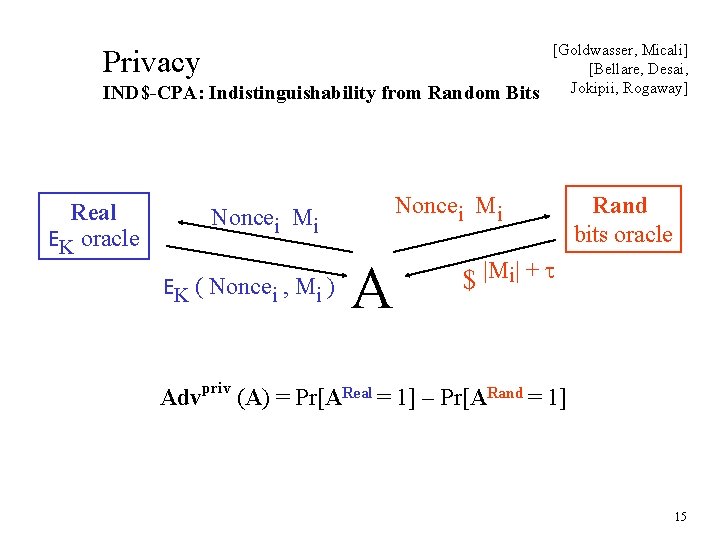
Privacy IND$-CPA: Indistinguishability from Random Bits Real EK oracle Noncei Mi EK ( Noncei , Mi ) [Goldwasser, Micali] [Bellare, Desai, Jokipii, Rogaway] A Rand bits oracle $ |Mi| + t Advpriv (A) = Pr[AReal = 1] – Pr[ARand = 1] 15
![Authenticity [Bellare, Rogaway] [Katz, Yung] this paper Authenticty of Ciphertexts Real EK oracle Noncei](http://slidetodoc.com/presentation_image_h/012a7365a014417e964d9e3902a5c63d/image-16.jpg "Authenticity [Bellare, Rogaway] [Katz, Yung] this paper Authenticty of Ciphertexts Real EK oracle Noncei")
Authenticity [Bellare, Rogaway] [Katz, Yung] this paper Authenticty of Ciphertexts Real EK oracle Noncei Mi EK (Noncei , Mi ) Nonce C A Adversary A forges if she outputs Nonce C s. t. • C is valid (it decrypts to a message, not to invalid) • there was no earlier query Nonce Mi that returned C Advauth (A) = Pr[A forges] 16
![[Goldreich, Goldwasser, Micali] [Luby, Rackoff] [Bellare, Kilian, Rogaway] Block-Cipher Security PRP and Strong PRP](http://slidetodoc.com/presentation_image_h/012a7365a014417e964d9e3902a5c63d/image-17.jpg "[Goldreich, Goldwasser, Micali] [Luby, Rackoff] [Bellare, Kilian, Rogaway] Block-Cipher Security PRP and Strong PRP")
[Goldreich, Goldwasser, Micali] [Luby, Rackoff] [Bellare, Kilian, Rogaway] Block-Cipher Security PRP and Strong PRP Real EK oracle xi xi EK (xi) B Rand perm oracle p p (xi) Advprp (B) = Pr[BEK = 1] – Pr[Bp = 1] -1 Advsprp (B)= Pr[BEK EK-1 = 1] – Pr[Bp p = 1] 17
![OCB Theorems Privacy theorem: Suppose $ an adversary A that distinguishes OCB[E, t] in:](http://slidetodoc.com/presentation_image_h/012a7365a014417e964d9e3902a5c63d/image-18.jpg "OCB Theorems Privacy theorem: Suppose $ an adversary A that distinguishes OCB[E, t] in:")
OCB Theorems Privacy theorem: Suppose $ an adversary A that distinguishes OCB[E, t] in: time = t total-num-of-blocks = s adv = Advpriv (A) Then $ an adversary B that breaks block cipher E with: time » t num-of-queries » s Advprp (B) » Advpriv(A) – 1. 5 s 2 / 2 n Authenticity theorem: Suppose $ an adversary A that forges OCB[E, t] with: time = t total-num-of-blocks = s adv = Advauth (A) Then $ an adversary B that breaks block cipher E with: time » t num-of-queries » s Advsprp (B) » Advauth(A) – 1. 5 s 2/2 n – 2 -t 18
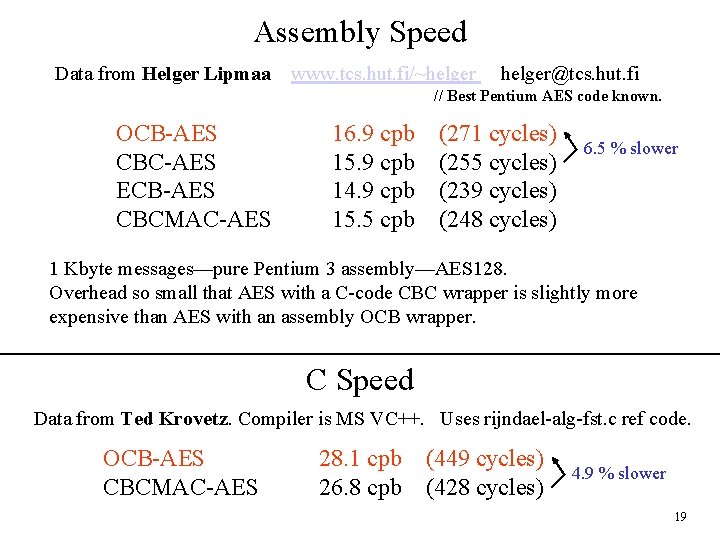
Assembly Speed Data from Helger Lipmaa www. tcs. hut. fi/~helger@tcs. hut. fi // Best Pentium AES code known. OCB-AES CBC-AES ECB-AES CBCMAC-AES 16. 9 cpb 15. 9 cpb 14. 9 cpb 15. 5 cpb (271 cycles) (255 cycles) (239 cycles) (248 cycles) 6. 5 % slower 1 Kbyte messages—pure Pentium 3 assembly—AES 128. Overhead so small that AES with a C-code CBC wrapper is slightly more expensive than AES with an assembly OCB wrapper. C Speed Data from Ted Krovetz. Compiler is MS VC++. Uses rijndael-alg-fst. c ref code. OCB-AES CBCMAC-AES 28. 1 cpb 26. 8 cpb (449 cycles) (428 cycles) 4. 9 % slower 19
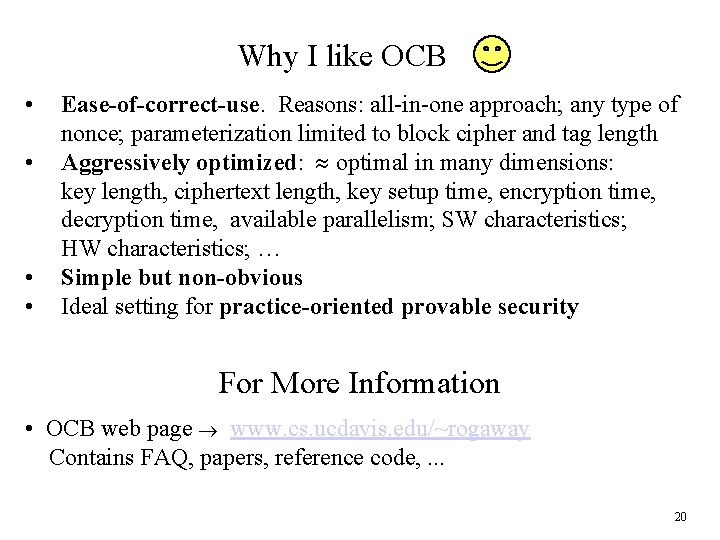
Why I like OCB • • Ease-of-correct-use. Reasons: all-in-one approach; any type of nonce; parameterization limited to block cipher and tag length Aggressively optimized: » optimal in many dimensions: key length, ciphertext length, key setup time, encryption time, decryption time, available parallelism; SW characteristics; HW characteristics; … Simple but non-obvious Ideal setting for practice-oriented provable security For More Information • OCB web page ® www. cs. ucdavis. edu/~rogaway Contains FAQ, papers, reference code, . . . 20
- Slides: 20