
OCAs Capacity Assessment Tools CAT 1 Purpose 2
![QUOTE Even for organizations that have long [done this work], it’s a very noble](https://slidetodoc.com/presentation_image_h2/1279fc1127226b6d65cf774ce9d00dab/image-17.jpg "QUOTE Even for organizations that have long [done this work], it’s a very noble")


- Slides: 25
OCA’s Capacity Assessment Tools (CAT)
1. Purpose 2. Background 3. Independent Evaluation 4. CAT Learning 5. Advice
PURPOSE
1. Understanding what the CAT platform is now and what it can be for you 2. Understanding the context of the CAT within the International Program Department, Oxfam Canada, Oxfam International and the Development sector 3. Review the CAT evaluation and recommendations 4. Practical considerations Page 4
BACKGROUND
OCA’s Approach to Capacity. Strengthening • Stems from OCA’s history of working in solidarity with, and accompanying, partner organizations in their respective areas of work • Intends to place women’s rights organizations (WROs) in the driver’s seat in determining the type of capacity strengthening they require and that will allow them to carry out their critical work in ways they deem appropriate and relevant • WROs are themselves best suited to assess their own capacities Page 6
Origins of Oxfam’s Capacity Assessment Tool (CAT)… • Engendering Change Project (2009 -2014) – focused on women’s rights & gender equality • 44 partner organizations (various sizes, makeup, budgets, and missions), working across Central America and Cuba, the Horn and East Africa, southern Africa, and Asia • shared commitment to working to support women to further gender equality and secure their rights • Objective of EC Project: provide partner organizations with organizational capacity-building to support their path to becoming stronger, gender-just organizations Page 7
Reasoning Behind CAT Approach. . • Inherent link between programming & organizational capacities • Organizations can do better gender justice work with their communities when their own internal structures, processes, and work are more sustainable, democratic, and gender-just. • Strong gender just organizations Sustainable programming Long lasting change • CAT process goes beyond any one project • Intended to support wider organizational development conversations • particularly relevant in the development of the resulting Action Plan Page 8
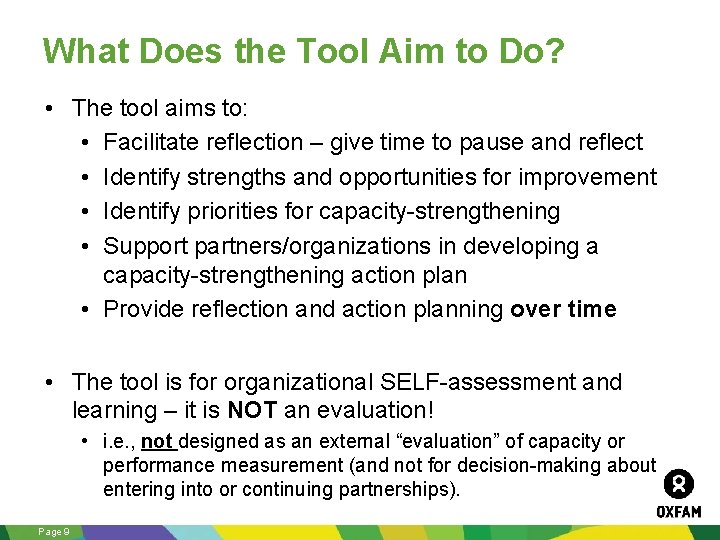
What Does the Tool Aim to Do? • The tool aims to: • Facilitate reflection – give time to pause and reflect • Identify strengths and opportunities for improvement • Identify priorities for capacity-strengthening • Support partners/organizations in developing a capacity-strengthening action plan • Provide reflection and action planning over time • The tool is for organizational SELF-assessment and learning – it is NOT an evaluation! • i. e. , not designed as an external “evaluation” of capacity or performance measurement (and not for decision-making about entering into or continuing partnerships). Page 9
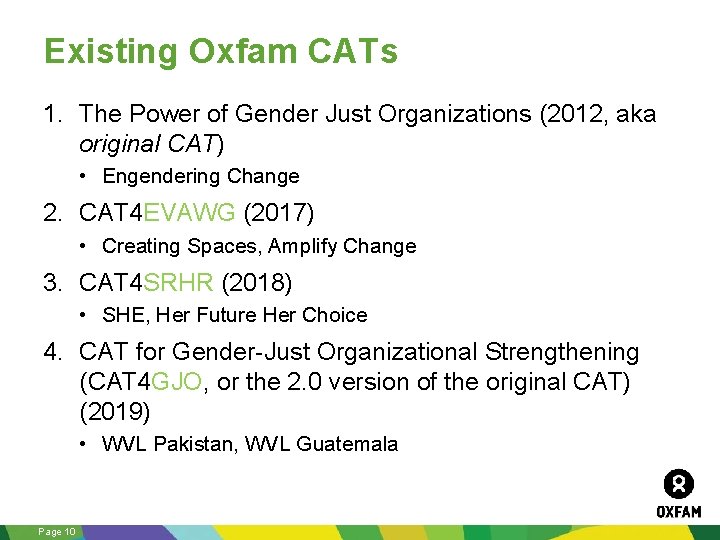
Existing Oxfam CATs 1. The Power of Gender Just Organizations (2012, aka original CAT) • Engendering Change 2. CAT 4 EVAWG (2017) • Creating Spaces, Amplify Change 3. CAT 4 SRHR (2018) • SHE, Her Future Her Choice 4. CAT for Gender-Just Organizational Strengthening (CAT 4 GJO, or the 2. 0 version of the original CAT) (2019) • WVL Pakistan, WVL Guatemala Page 10
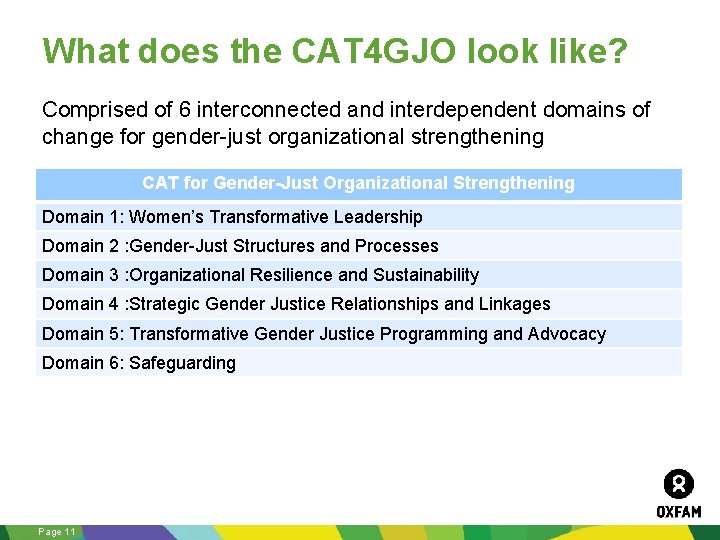
What does the CAT 4 GJO look like? Comprised of 6 interconnected and interdependent domains of change for gender-just organizational strengthening CAT for Gender-Just Organizational Strengthening Domain 1: Women’s Transformative Leadership Domain 2 : Gender-Just Structures and Processes Domain 3 : Organizational Resilience and Sustainability Domain 4 : Strategic Gender Justice Relationships and Linkages Domain 5: Transformative Gender Justice Programming and Advocacy Domain 6: Safeguarding Page 11
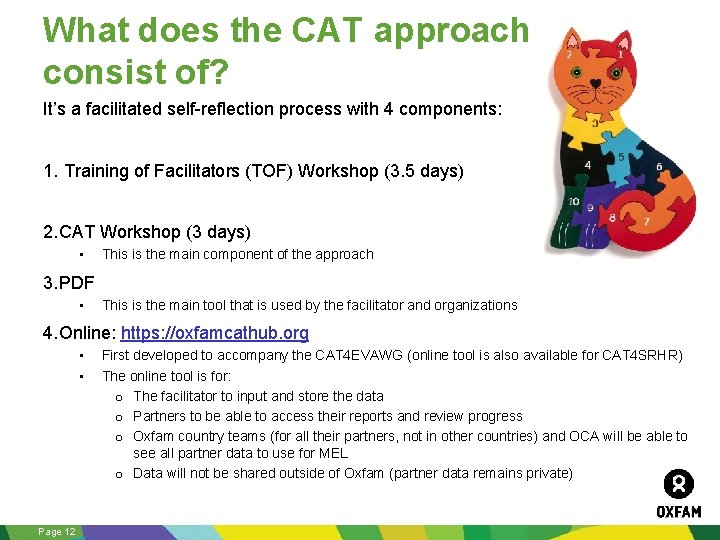
What does the CAT approach consist of? It’s a facilitated self-reflection process with 4 components: 1. Training of Facilitators (TOF) Workshop (3. 5 days) 2. CAT Workshop (3 days) • This is the main component of the approach 3. PDF • This is the main tool that is used by the facilitator and organizations 4. Online: https: //oxfamcathub. org • • Page 12 First developed to accompany the CAT 4 EVAWG (online tool is also available for CAT 4 SRHR) The online tool is for: o The facilitator to input and store the data o Partners to be able to access their reports and review progress o Oxfam country teams (for all their partners, not in other countries) and OCA will be able to see all partner data to use for MEL o Data will not be shared outside of Oxfam (partner data remains private)
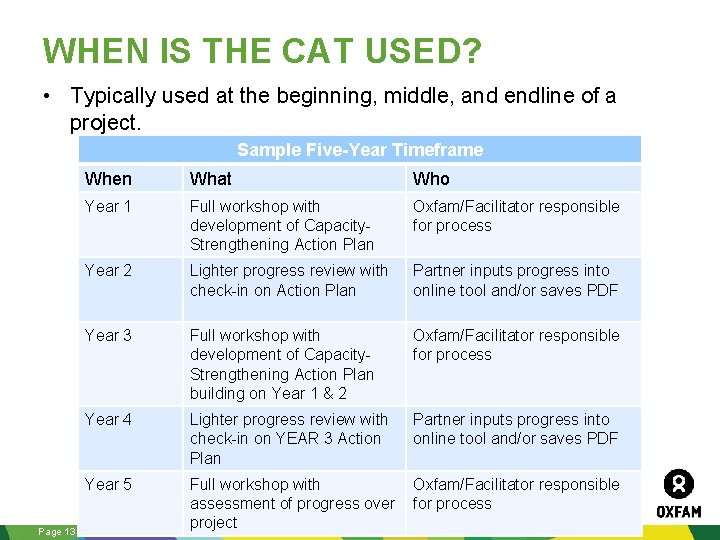
WHEN IS THE CAT USED? • Typically used at the beginning, middle, and endline of a project. Sample Five-Year Timeframe Page 13 When What Who Year 1 Full workshop with development of Capacity. Strengthening Action Plan Oxfam/Facilitator responsible for process Year 2 Lighter progress review with check-in on Action Plan Partner inputs progress into online tool and/or saves PDF Year 3 Full workshop with development of Capacity. Strengthening Action Plan building on Year 1 & 2 Oxfam/Facilitator responsible for process Year 4 Lighter progress review with check-in on YEAR 3 Action Plan Partner inputs progress into online tool and/or saves PDF Year 5 Full workshop with assessment of progress over project Oxfam/Facilitator responsible for process
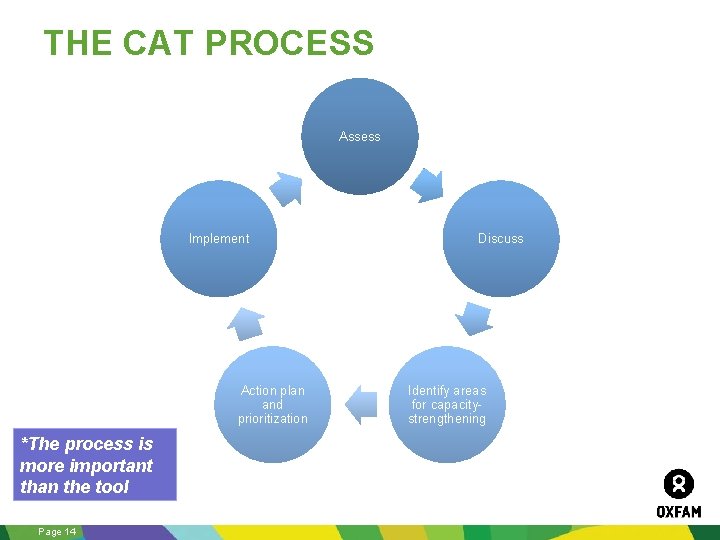
THE CAT PROCESS Assess Implement Action plan and prioritization *The process is more important than the tool Page 14 Discuss Identify areas for capacitystrengthening
INDEPENDENT EVALUATION
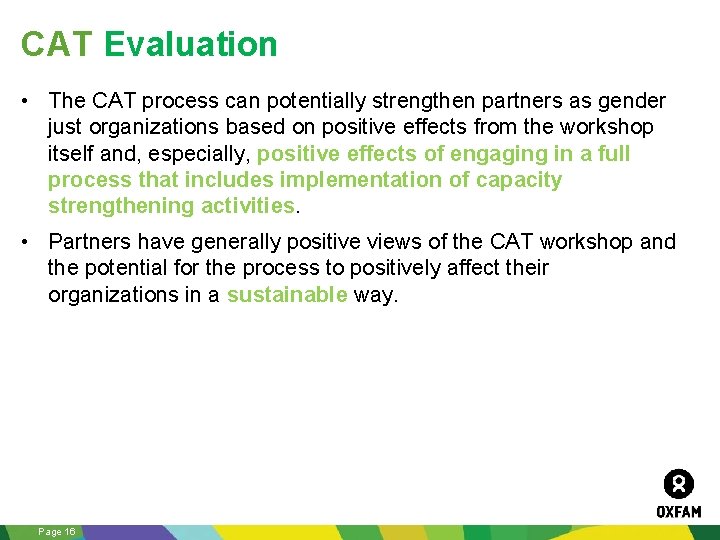
CAT Evaluation • The CAT process can potentially strengthen partners as gender just organizations based on positive effects from the workshop itself and, especially, positive effects of engaging in a full process that includes implementation of capacity strengthening activities. • Partners have generally positive views of the CAT workshop and the potential for the process to positively affect their organizations in a sustainable way. Page 16
QUOTE Even for organizations that have long [done this work], it’s a very noble tool because it’s both programmatic and institutional. It actually generated immense unity in terms of the manager and the technical personnel for support for doing something - for the first time they were able to see they were able to re-imagine their [program] capacity. Page 17
CAT Evaluation • Informants familiar with other capacity self-assessment tools cited the overall gender justice focus and/or the specific technical content (EVAWG, SRHR) as unique. • Facilitator feedback to Oxfam after the workshops in one case encouraged peer learning related to capacity strengthening needs, in which partners in a cohort teach and learn from each other • Importance of strong facilitators: Training of Trainers (TOT) • Budget considerations for… • Emphasizing action plan Page 18
Advice
Institutional knowledge and leadership • Assign an individual within OCA and country project teams with specific responsibility to track, oversee, and support capacity strengthening throughout the full process, ensuring they have dedicated time for relevant responsibilities. (This is likely not a MEAL Officer function. ) • Ensure country office project teams possess or have access to advisers with locally-specific knowledge of capacity strengthening and civil society. Working with local civil society strengthening institutions is advised when possible. Page 20
Partner ownership • Give partners the option not to use a self-assessment, to use another tool, or to use the CAT in a semi-autonomous unit within the organization/network. • While using existing materials as standard templates to aid in the process, support partners (individually or in a cohort) to tailor the CAT with capacity areas and statements relevant to their needs, context, size, scope, and maturity. Support facilitators to conduct pilot testing. • Work with each partner to design a CAT workshop experience that aligns with their needs and preferences. In addition to timing aligned with planning cycles, other factors include venue, pacing/schedule, and a participant list responsive to organizational structure and governance models. Page 21
Facilitation • Training facilitators • Spending time on Values Clarification and Attitude Transformation (VCAT) activities before diving into organizational assessments • Facilitation in national languages is essential. In some contexts, there was also a need or preference for facilitators with relevant regional language skills…facilitators’ ability to explain concepts in regional languages aided participants’ comprehension and discussion. • Facilitators and Oxfam personnel emphasized the importance of documentation to capture the rich workshop discussions. Page 22
Resources • No resources = no self-assessment. • Incorporate into preparation for the workshop and the workshop itself transparent messaging about limitations on budget and cost items, the reasons behind them, and alternative ideas, resources, etc. • Support partners in identifying alternative resources to meet capacity strengthening priorities that the Oxfam project will not cover. Page 23
Accessibility • Translations/Interpretations • Different materials for participants and facilitators • Discuss core concepts in advance Page 24
Capacity strengthening • Introduce peer learning methodologies, coaching, and other forms of partner-centred capacity strengthening support. Page 25