
OCAN Education Core Self OCAN Objectives Upon completion
OCAN Education Core + Self OCAN
Objectives Upon completion of this OCAN training session, you will: • Know the components of Core + Self OCAN • Know the benefits of the self-assessment • Know how to introduce the self-assessment to a consumer • Know how to engage a consumer in conversation prompted by hisher responses in the self-assessment
OCAN Training Agenda • • Welcome & Introductions Objectives Agenda Icebreaker Orientation to materials Review Core OCAN Core + Self OCAN – – Introduce to consumer Self-Assessment Conversation Next steps • Wrap-up
Icebreaker
Review of Core OCAN Training
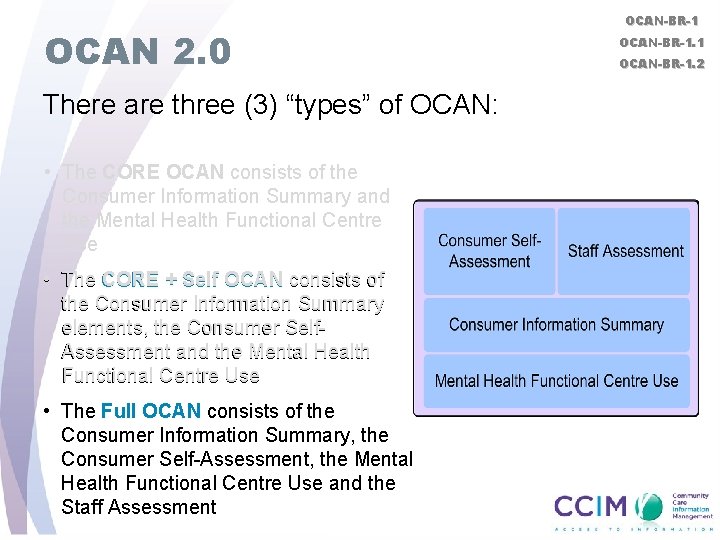
OCAN 2. 0 There are three (3) “types” of OCAN: • The CORE OCAN consists of the Consumer Information Summary and the Mental Health Functional Centre Use • The CORE + Self OCAN consists of the Consumer Information Summary elements, the Consumer Self. Assessment and the Mental Health Functional Centre Use • The Full OCAN consists of the Consumer Information Summary, the Consumer Self-Assessment, the Mental Health Functional Centre Use and the Staff Assessment OCAN-BR-1. 1 OCAN-BR-1. 2
Core OCAN Elements - Overview ü ü ü Consumer Demographic Information Mental Health Functional Centre Use Contacts Consumer Capacity Culture and Citizenship Current Legal Status Accommodation Employment Status Education Level Psychiatric History Income Presenting Issues
POP QUIZ Who is the OCAN Lead?
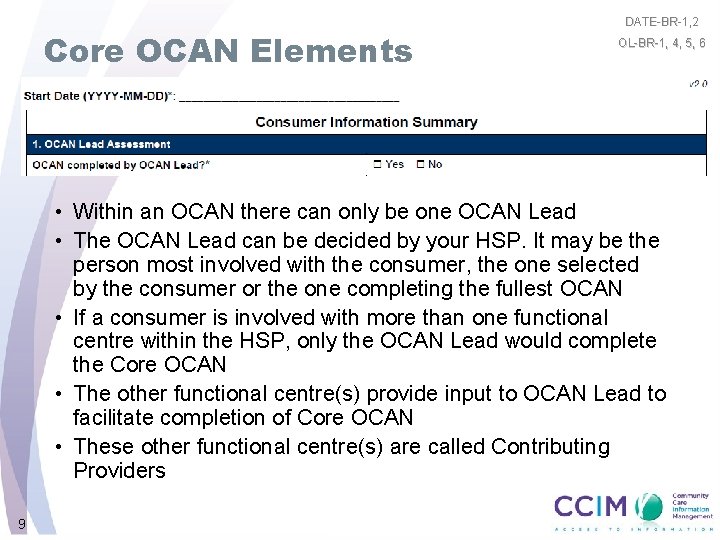
Core OCAN Elements DATE-BR-1, 2 OL-BR-1, 4, 5, 6 • Within an OCAN there can only be one OCAN Lead • The OCAN Lead can be decided by your HSP. It may be the person most involved with the consumer, the one selected by the consumer or the one completing the fullest OCAN • If a consumer is involved with more than one functional centre within the HSP, only the OCAN Lead would complete the Core OCAN • The other functional centre(s) provide input to OCAN Lead to facilitate completion of Core OCAN • These other functional centre(s) are called Contributing Providers 9
0 POP QUIZ What are the reasons for OCAN?
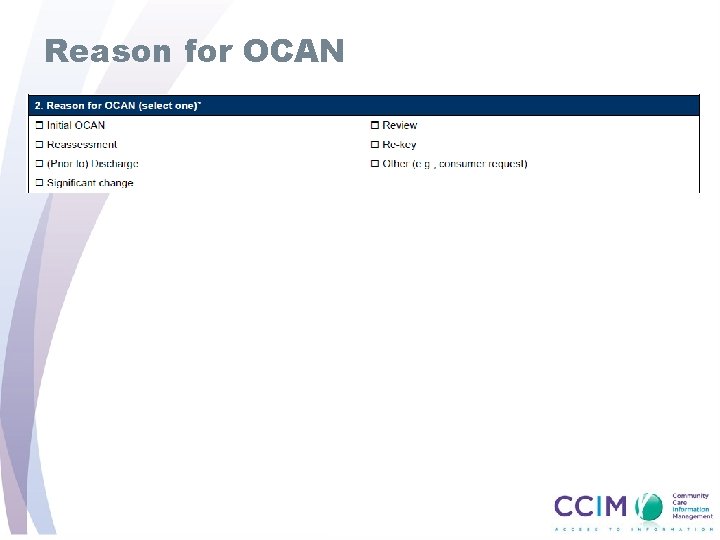
1 Reason for OCAN
2 POP QUIZ Why is it important to record all functional centres involved with each consumer in your HSP? Where would you find the information to fill in the Mental Health Functional Centre Use?
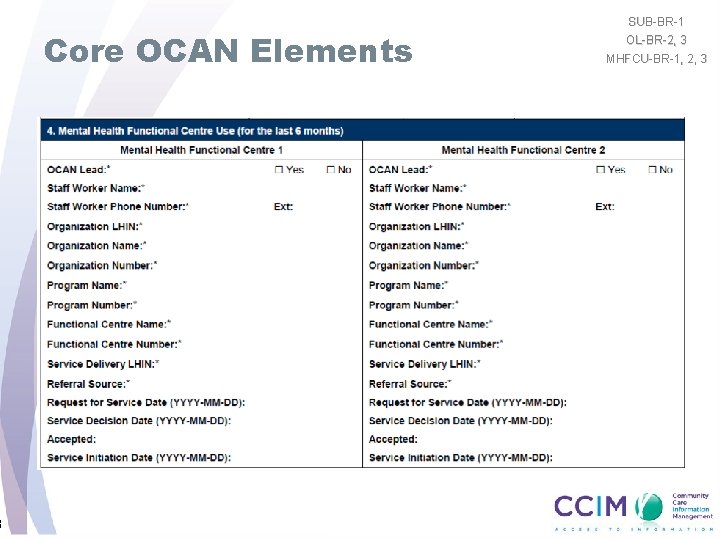
3 Core OCAN Elements SUB-BR-1 OL-BR-2, 3 MHFCU-BR-1, 2, 3
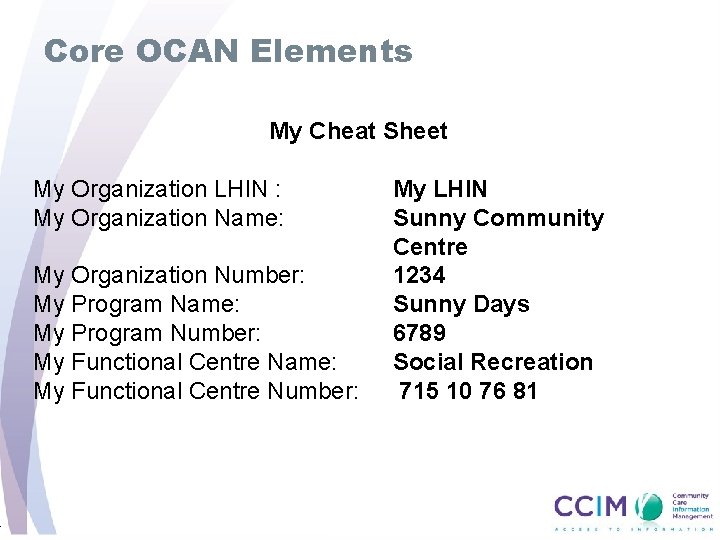
4 Core OCAN Elements My Cheat Sheet My Organization LHIN : My Organization Name: My Organization Number: My Program Name: My Program Number: My Functional Centre Name: My Functional Centre Number: My LHIN Sunny Community Centre 1234 Sunny Days 6789 Social Recreation 715 10 76 81
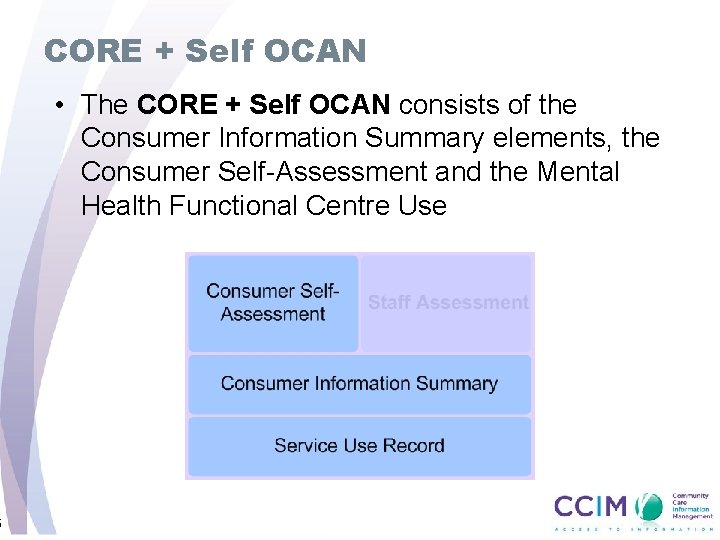
5 CORE + Self OCAN • The CORE + Self OCAN consists of the Consumer Information Summary elements, the Consumer Self-Assessment and the Mental Health Functional Centre Use
6 Benefits of Core + Self OCAN • Provides an opportunity for consumers to participate in determining their own needs. • Can potentially link consumers to the most appropriate services based on their needs • May reduce duplication of assessments in your HSP
Using an evidence-based tool CANSAS-P Backed by research: * • Meeting consumer-identified unmet need improves outcomes in these areas: • Well-being • Relationship - Therapeutic alliance • Satisfaction with services • Equivalent research into staff-rated unmet need does not show the same benefits • Reassessment improves mental health outcomes • Source: Mike Slade, Made in Ontario conference and The Power of Shared Information conference (2009) 17
8 Recovery and Assessment
9 What is Recovery? • Mental health recovery has many definitions. William A. Anthony defines it as: “A deeply personal, unique process of changing one’s attitudes, values, feelings, goals, skills and roles. It is a way of living a satisfying, hopeful and contributing life even with limitations caused by the illness” Anthony WA (1993) Recovery from mental illness: the guiding vision of the mental health service system in the 1990 s Psychosocial Rehabilitation Journal, 16, 11 -23
0 OCAN and Recovery Principles Values Empowerment Consumer perspective and input is central to information gathered in OCAN and the determination of priority areas to work on. Values and Elicits Hope The OCAN tool includes open ended questions where consumers share and later discuss hopes and dreams. Values Self Determination OCAN focuses heavily on consumer-voiced needs, through the assessment of 24 concrete life domains. Works Toward the Elimination of Prejudice and Discrimination The OCAN approach views a consumer as a whole person and an active participant in the assessment process, not as a diagnosis (“patient”) Values Meaningful Choice Consumers engage with their workers to focus on their perspective in preparation for action and service planning. Based on recovery principles from the Self Help Alliance of Waterloo Wellington Dufferin
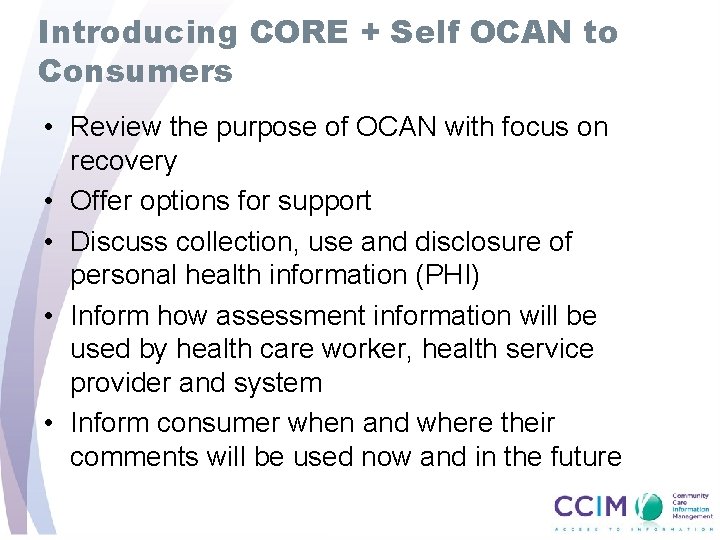
1 Introducing CORE + Self OCAN to Consumers • Review the purpose of OCAN with focus on recovery • Offer options for support • Discuss collection, use and disclosure of personal health information (PHI) • Inform how assessment information will be used by health care worker, health service provider and system • Inform consumer when and where their comments will be used now and in the future
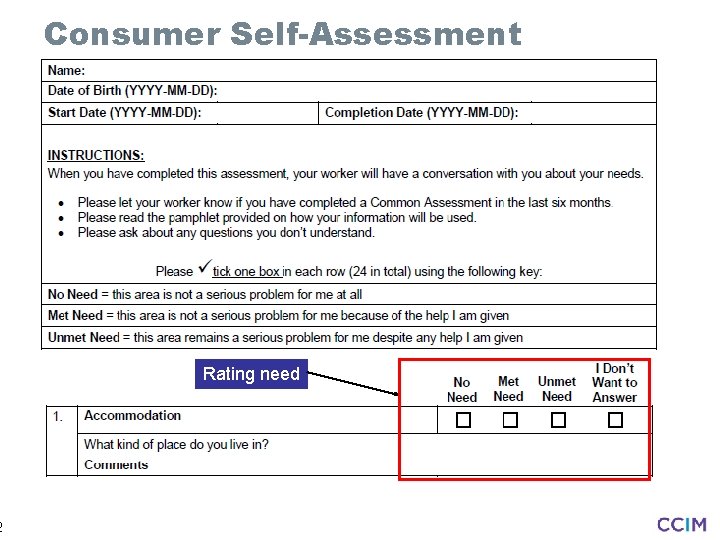
2 Consumer Self-Assessment Rating need
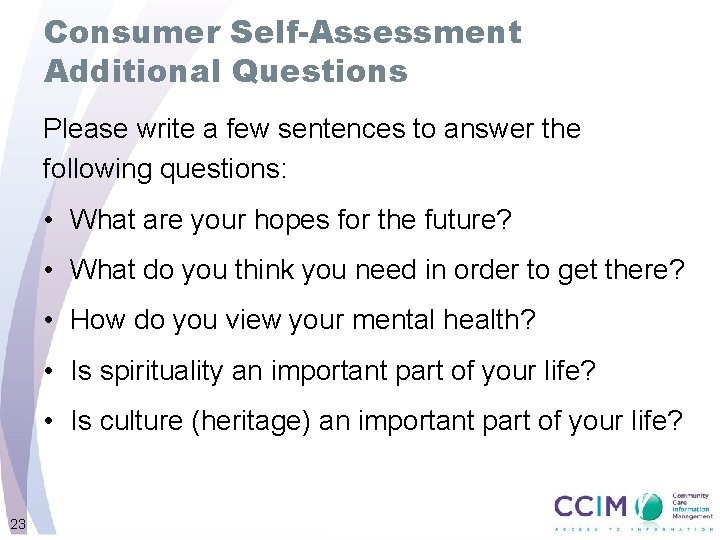
Consumer Self-Assessment Additional Questions Please write a few sentences to answer the following questions: • What are your hopes for the future? • What do you think you need in order to get there? • How do you view your mental health? • Is spirituality an important part of your life? • Is culture (heritage) an important part of your life? 23
4 Introducing CORE + Self OCAN to Consumers As a group, brainstorm… • What are some of the considerations when introducing Core + Self OCAN to people you are working with?
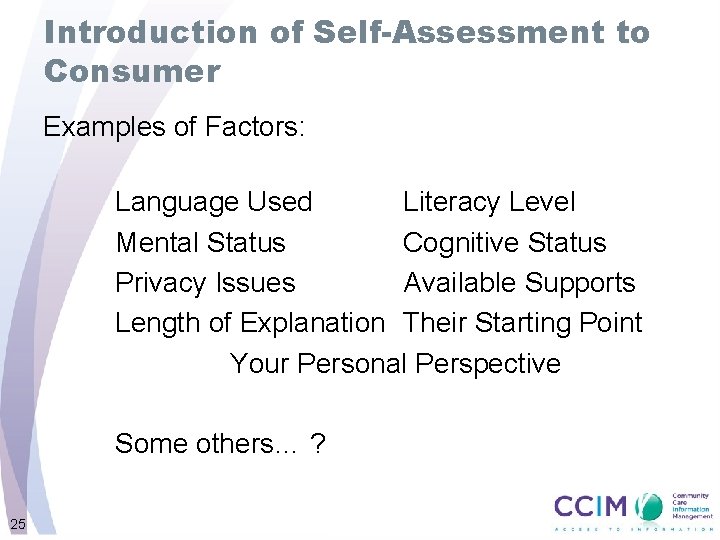
Introduction of Self-Assessment to Consumer Examples of Factors: Language Used Literacy Level Mental Status Cognitive Status Privacy Issues Available Supports Length of Explanation Their Starting Point Your Personal Perspective Some others… ? 25
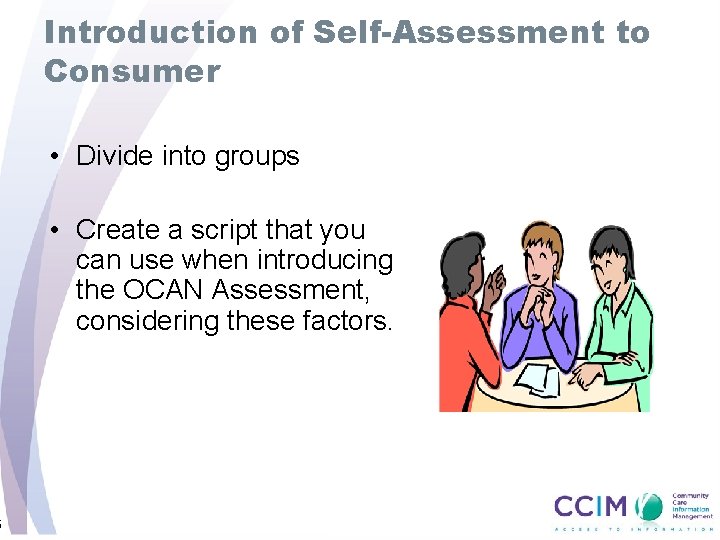
6 Introduction of Self-Assessment to Consumer • Divide into groups • Create a script that you can use when introducing the OCAN Assessment, considering these factors.
7
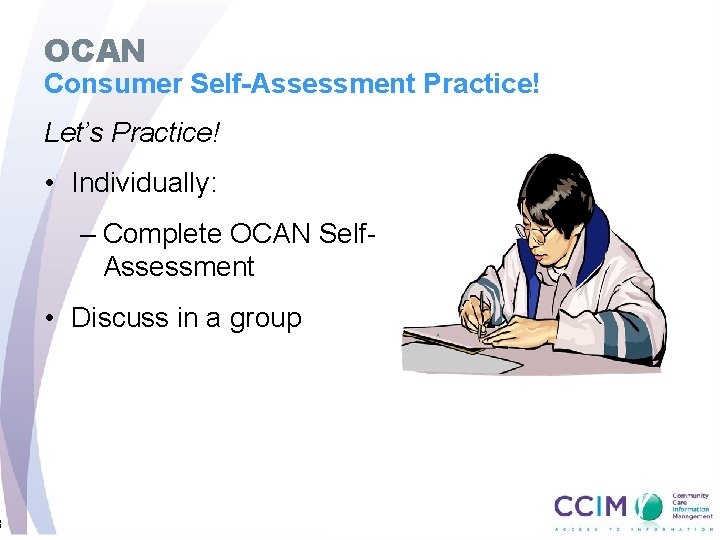
8 OCAN Consumer Self-Assessment Practice! Let’s Practice! • Individually: – Complete OCAN Self. Assessment • Discuss in a group
9 Assessment Conversation Engages the person with lived experience and the person with assessment knowledge in a conversation focused on the consumer’s strengths, challenges and goals for recovery.
The Assessment Conversation Introduction OCAN Consumer Self-Assessment Conversation Tips for a successful assessment conversation: OCAN Staff Assessment • Provide a safe space • Allow the conversation to unfold naturally • Explore variances • Summarize key points 30 I have a voice I hear you loud and clear
The Conversation: Clarity of Content Take the time to clarify what the conversation is about and ensure clarity of the content Introduction OCAN Consumer Self-Assessment Conversation OCAN Staff Assessment • Example: Be aware of how the consumer identifies unmet need, met need and no need. At every step clarify what the consumer means by their choice. Do not encourage the consumer to change responses. • Example: Avoid the term ‘navigate the system’. • Example: Hearing voices may not always be a sign of psychotic symptoms. • Example: Consumer may have a different view of homelessness than staff. 31
2 Conversation Activity • Divide into pairs • Decide on roles: consumer and staff • Have a conversation using the completed Self– Assessment in your workbook as a prompt for the conversation focused on needs • Discuss with larger group
3 Next Steps As a group, brainstorm what the next steps are following your conversations with consumers
4 Wrap-up • Supported training sign-up • Evaluations

5
- Slides: 35