
Obtaining diversity and abundance from OBIS database the
Obtaining diversity and abundance from OBIS database – the way forward Simon Claus & Klaas Deneudt Flanders Marine Institute (VLIZ) 1
Outline Presentation 1. Introduction – Common biodiversity measurements & indices – How to model biodiversity 2. Eur. OBIS and OBIS (Ocean Biogeographic Information System) – Data scheme – Data content – Quality control 3. Applications OBIS data – Global patterns of marine biodiversity (Tittensor et al, 2010 – Nature) 4. EMODnet data products – Outcomes products from Biological data product workshop – Visualisation abundance CPR data on EMODnet portal 5. Conclusions & way forward 2
Biodiversity measurements (1) • Occurrence or presence/absence (or not detected) – When is a species absent? • Absolute abundance or counts – Total number of animals sampled, seen or counted Positive: sample size is known Negative: not “as is” comparable between different sites or samples • Relative abundance or density – Number of animals per surface, volume – Derived from absolute abundance Negative: Size of sample is unknown => limits possibilities for correct application of statistics and indices Positive: comparable between different sites • Biomass – Productivity 3
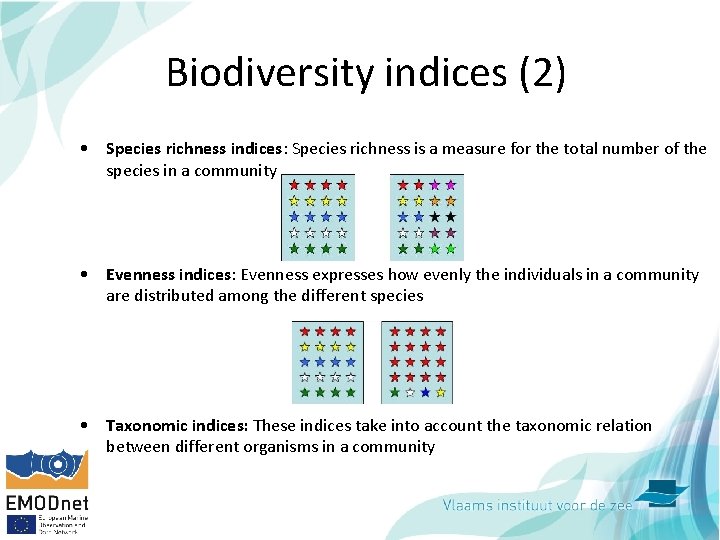
Biodiversity indices (2) • Species richness indices: Species richness is a measure for the total number of the species in a community • Evenness indices: Evenness expresses how evenly the individuals in a community are distributed among the different species • Taxonomic indices: These indices take into account the taxonomic relation between different organisms in a community 4
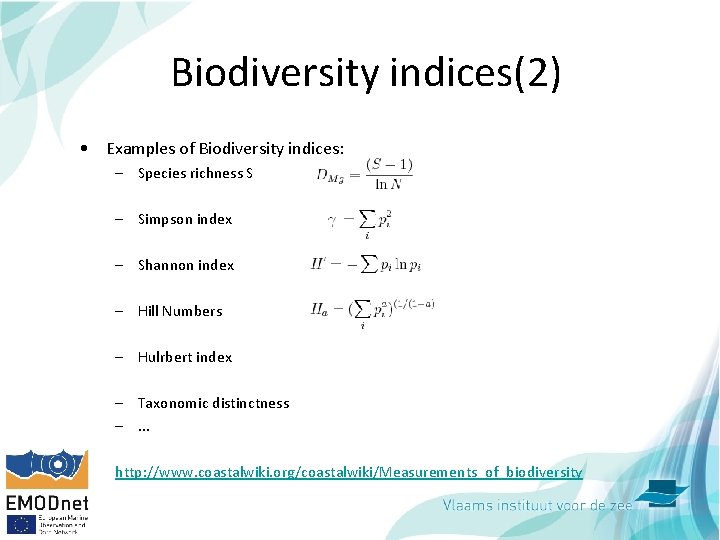
Biodiversity indices(2) • Examples of Biodiversity indices: – Species richness S – Simpson index – Shannon index – Hill Numbers – Hulrbert index – Taxonomic distinctness –. . . http: //www. coastalwiki. org/coastalwiki/Measurements_of_biodiversity 5
Modelling biodiversity • Habitat suitability modelling Delineating suitable area’s (likeliness of occurrence/absence) for certain species or communities based on the environmental requirements of these species or communities • Predictions: environmental envelope modelling Based on describing the environment encompassing the current distribution of a species or ecosystem (the environmental envelope), then mapping the location of this same envelope under a climate change scenario. • Predicting biodiversity indices – – Predictability of marine nematode biodiversity (Merckx et al, 2009 - Ecological Modelling) Predict biodiversity indices using Artifical Neural Networks ( a data driven modeling technique used in ecological sciences as a tool for uncovering complex patterns in data) 6
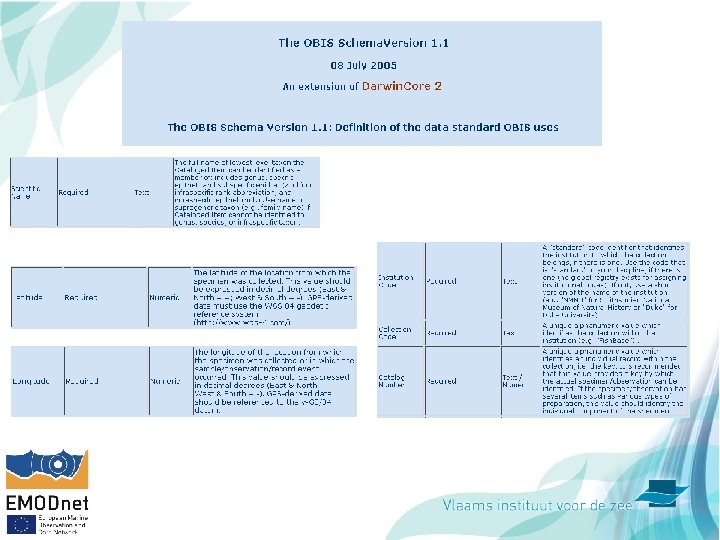
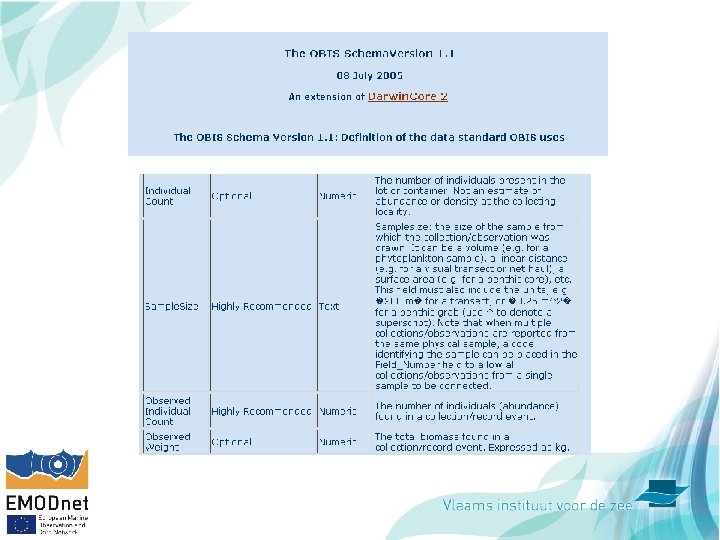
Eur. OBIS and OBIS – data scheme • OBIS is a distributed system to integrate marine biogeographic information • The OBIS schema is an extension to the Darwin Core Version 2 standard • 74 fields of which 6 requiered • Four fields to describe abundance/biomass • Link to metadata record which ISO 19115 Compliant • Link to World Register of Marine Species for taxonomy 7
8
9
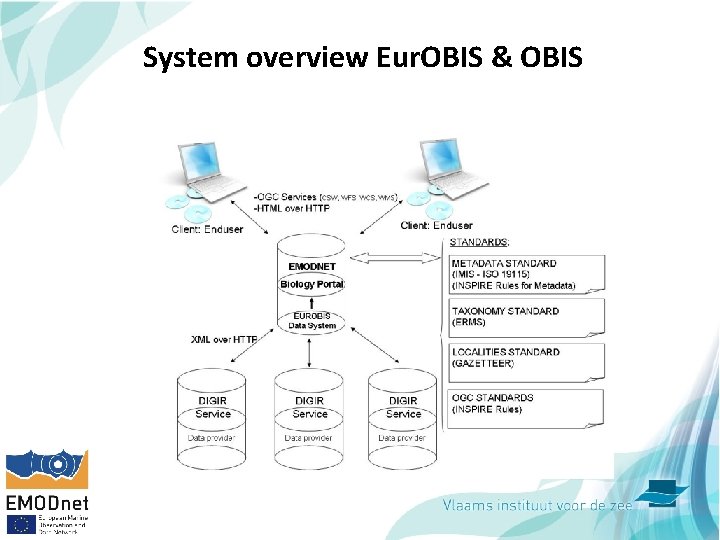
System overview Eur. OBIS & OBIS 10
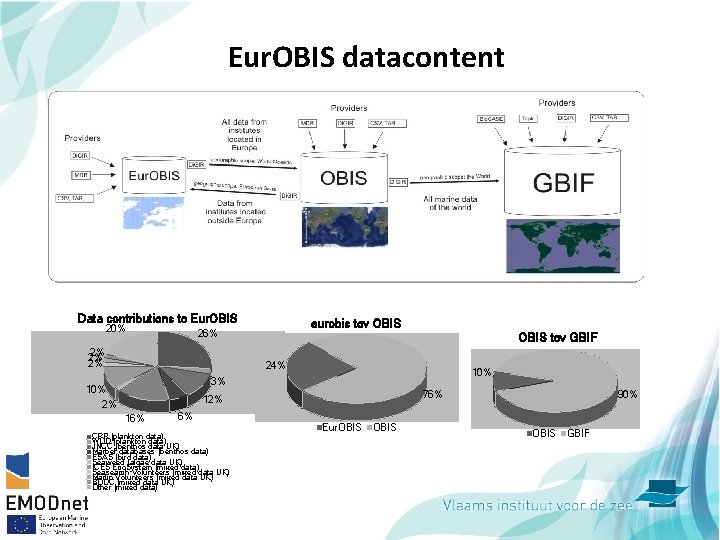
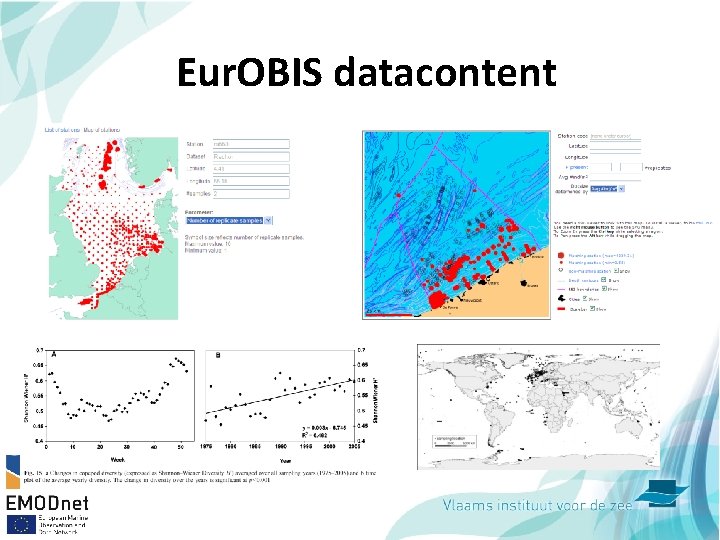
Eur. OBIS datacontent Data contributions to Eur. OBIS 20% eurobis tov OBIS 26% 2% 2% 2% OBIS tov GBIF 24% 10% 3% 10% 2% 76% 12% 16% 90% 6% CPR (plankton data) WOD (plankton data) JNCC (benthos data UK) Marbef databases (benthos data) ESAS (bird data) Seaweed (algae data UK) ICES Eco. System (mixed data) Seasearch Volunteers (mixed data UK) Marlin Volunteers (mixed data UK) BODC (mixed data UK) Other (mixed data) Eur. OBIS GBIF 11
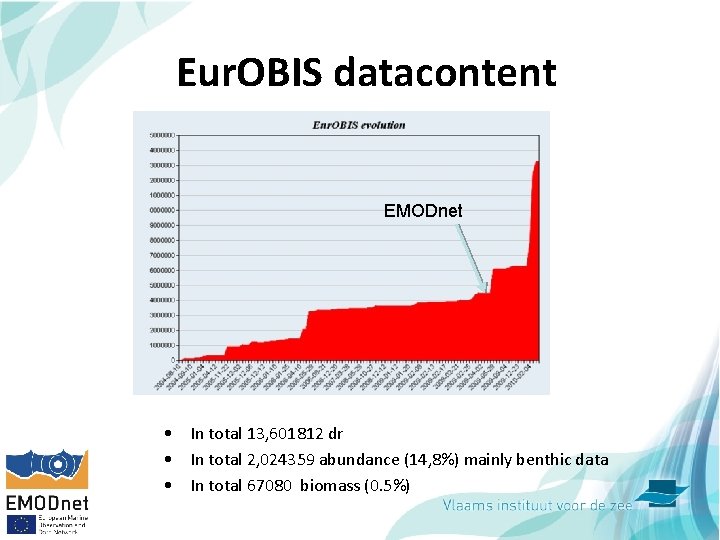
Eur. OBIS datacontent EMODnet • In total 13, 601812 dr • In total 2, 024359 abundance (14, 8%) mainly benthic data • In total 67080 biomass (0. 5%) 12
Eur. OBIS datacontent 13
Eur. OBIS quality control • Taxonomy important, even crucial (Wor. MS) – Integrate datasets – correct estimates of biodiversity -> (Vandepitte et al, 2009 - Hydrobiology) …In total, 6, 172 unique taxon names were submitted to Large. Net. After a thorough quality control, however, this number was reduced to 4, 525, mostly due to spelling variations and synonymy. Such quality control is highly needed, since a misspelled or obsolete name could be compared to the introduction of a rare species, with adverse effects on further (biodiversity) calculations. • Quality flags completeness of records • Quality procedures for biological data (sampling methods) 14
Eur. OBIS data scheme & content: issues • Eur. OBIS can store abundance/biomass data • However number of fields rather limited to capture these data – – – How to store information on fractions (meiobenthos, phytoplankton. . . ) – not linked to Wo. RMS ID Link to additional metadata is important (with ISO 19115 compliant) Link to Wo. RMS is key in order to compare datasets • Number of abundance/biomass data very limited – – – Not requiered (find the good trade off) Not willing to provide the data (data protection)? Not aware of possibilities to store the data in Eur. OBIS format More labour intensive to provide absence/biomass data More difficult to provide absence/biomass data 15
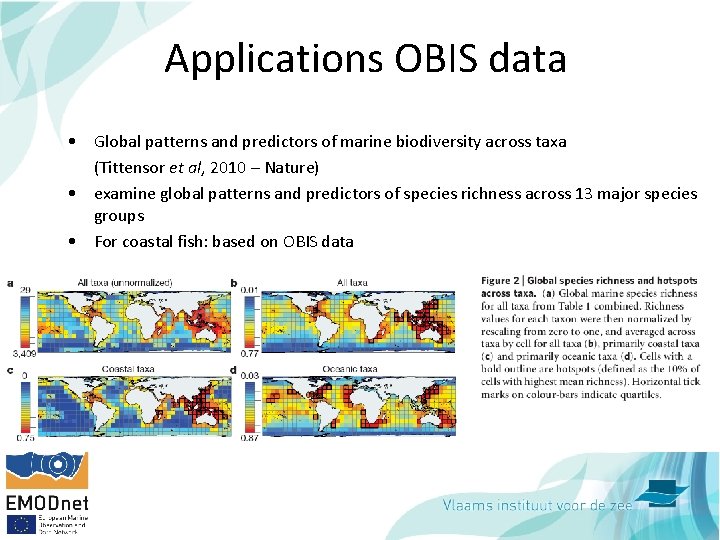
Applications OBIS data • Global patterns and predictors of marine biodiversity across taxa (Tittensor et al, 2010 – Nature) • examine global patterns and predictors of species richness across 13 major species groups • For coastal fish: based on OBIS data 16
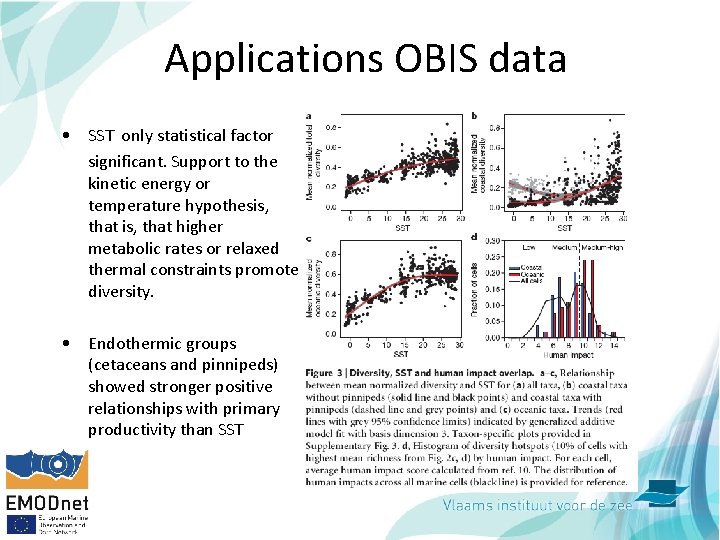
Applications OBIS data • SST only statistical factor significant. Support to the kinetic energy or temperature hypothesis, that higher metabolic rates or relaxed thermal constraints promote diversity. • Endothermic groups (cetaceans and pinnipeds) showed stronger positive relationships with primary productivity than SST 17
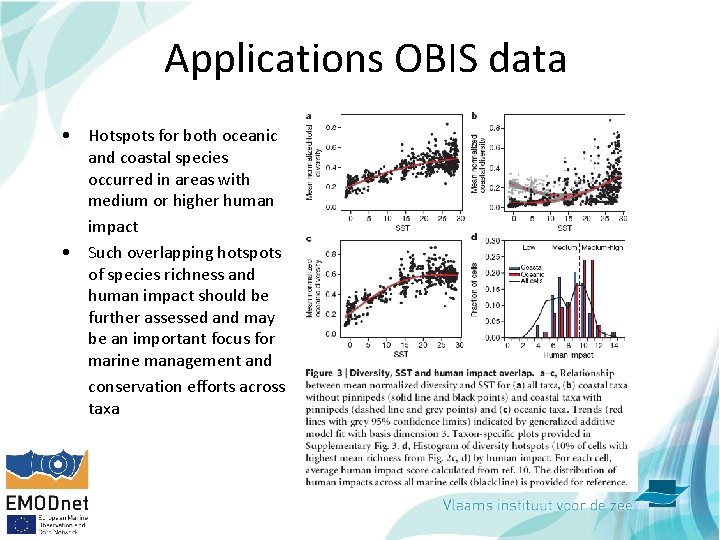
Applications OBIS data • Hotspots for both oceanic and coastal species occurred in areas with medium or higher human impact • Such overlapping hotspots of species richness and human impact should be further assessed and may be an important focus for marine management and conservation efforts across taxa 18
Applications OBIS data Gaps • Limited to taxa for which sufficient records were accessible to determine global distribution (cells with less then 10 years of sampling removed) • Distribution of deep-sea diversity, where data remain scarce • Limited marine invertebrate data • Microbes or viruses not considered 19
EMODnet data products Outcomes products from Biological data product workshop • Biological Data Products Workshop (25 -26/02/2010) Aim: – To define a set of derived data products relevant for private bodies, public authorities and researchers – Discuss the marine biological (monitoring) data availability in Europe and gaps – Present protoype portal to wide(r) community of European Biological Experts and capture feedback 20
EMODnet data products Outcomes products from Biological data product workshop • Biological Data Products Workshop (Participants) – MARE, DG Research, OSPAR, ICES, HELCOM, Black Sea Commission, coordinators of the other lots, project partners and advisory board – Greece, France, UK, Italy, Belgium, Netherlands, Germany, Sweden, Ireland, Russia, Ukraine, US, New Zealand EMODnet 21
EMODnet data products Outcomes products from Biological data product workshop – Workshop report available – Data products: – Species attributes (labelling) (functional groups, HAB’s, invasive species, red list or protected species, BD and HD) – Species distribution maps and trends – Species sensitivity and vulnerability map – Biodiversity indices 22
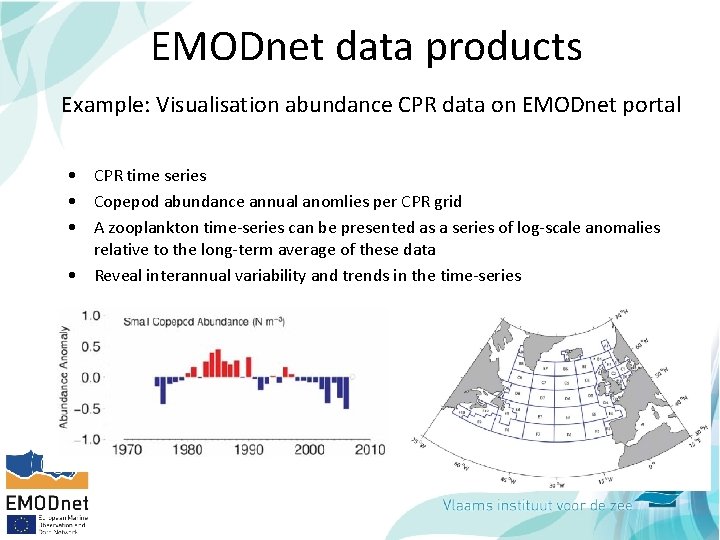
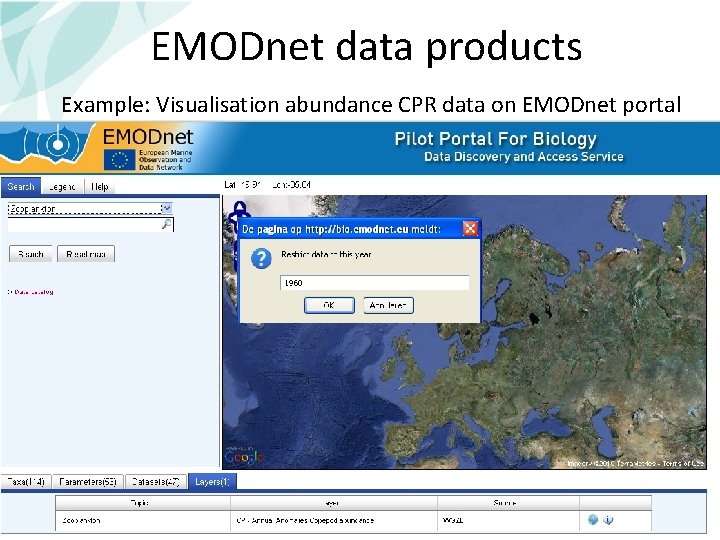
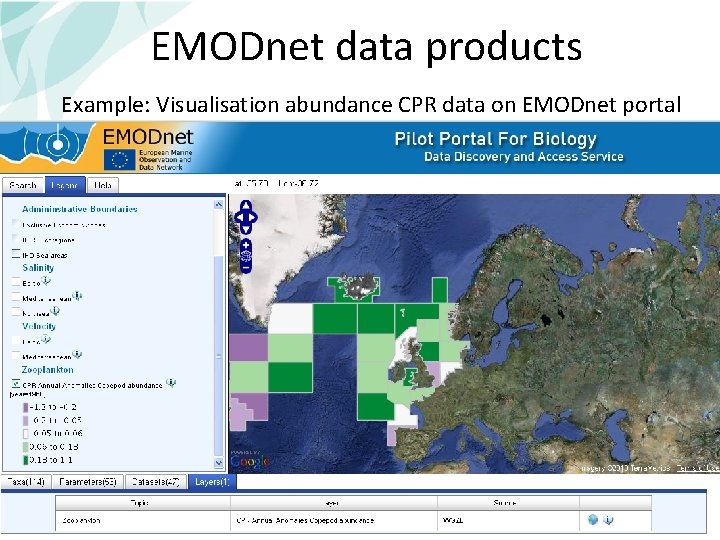
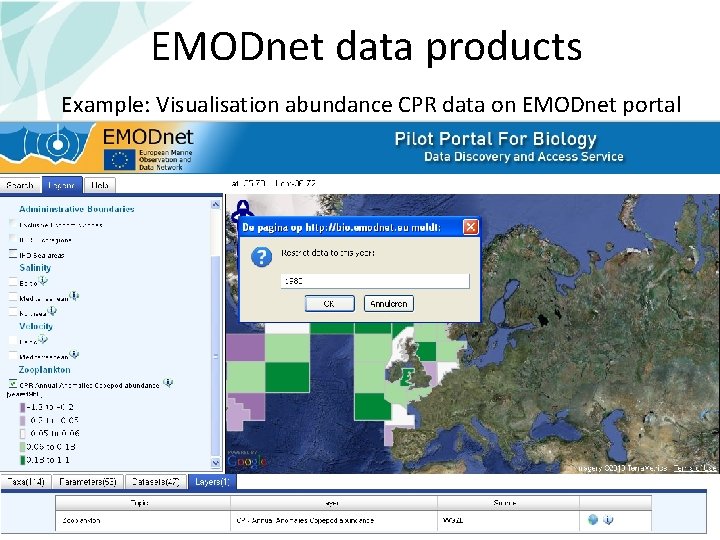
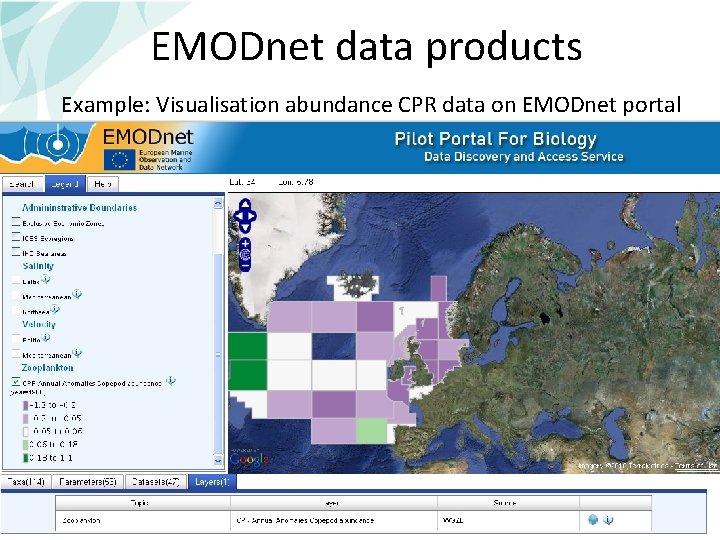
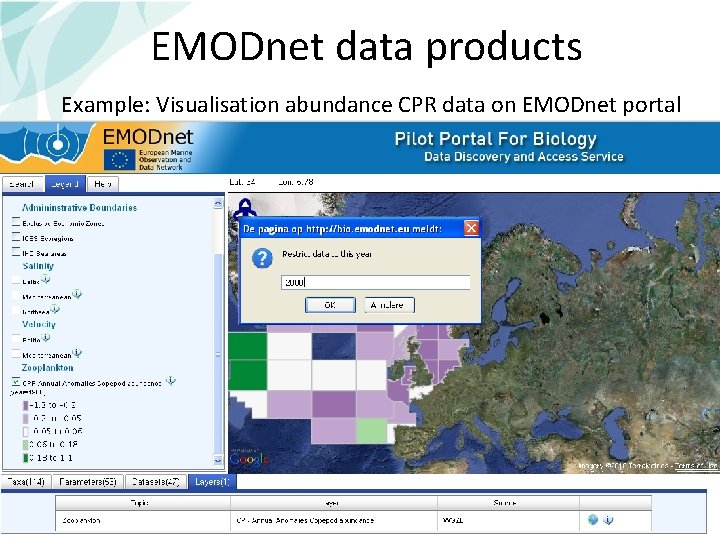
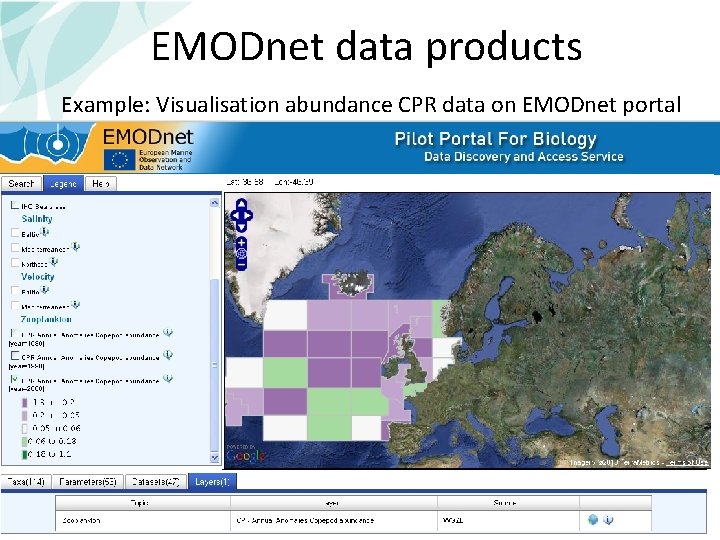
EMODnet data products Example: Visualisation abundance CPR data on EMODnet portal • CPR time series • Copepod abundance annual anomlies per CPR grid • A zooplankton time-series can be presented as a series of log-scale anomalies relative to the long-term average of these data • Reveal interannual variability and trends in the time-series 23
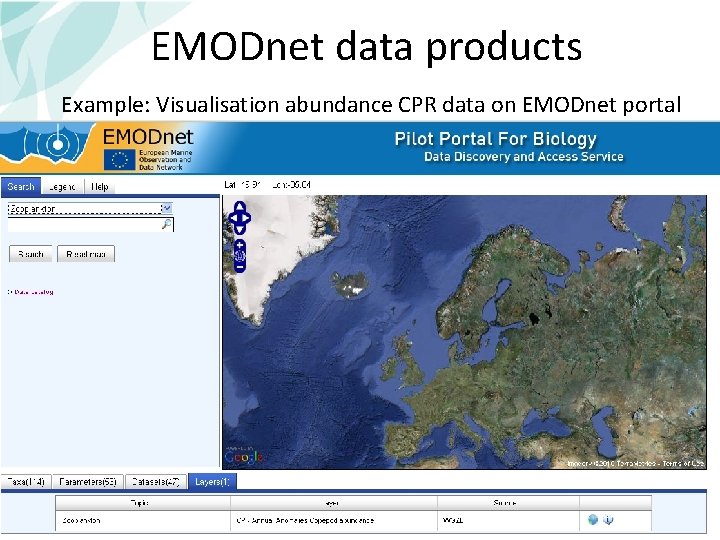
EMODnet data products Example: Visualisation abundance CPR data on EMODnet portal 24
EMODnet data products Example: Visualisation abundance CPR data on EMODnet portal 25
EMODnet data products Example: Visualisation abundance CPR data on EMODnet portal 26
EMODnet data products Example: Visualisation abundance CPR data on EMODnet portal 27
EMODnet data products Example: Visualisation abundance CPR data on EMODnet portal 28
EMODnet data products Example: Visualisation abundance CPR data on EMODnet portal 29
EMODnet data products Example: Visualisation abundance CPR data on EMODnet portal 30
Conclusions & way forward • Model & predict distributions & biodiversity: emerging area • OBIS scheme can handle most biodiversity measurment data but could be improved • Abundance data at the moment underrepresented • Quality control is key aspect – especially taxonomic qc • EMODet Biological project making first steps on identification and visualisation of biological dataproducts (indices, anomalies. . . ) • Other types of biological data: biometry, stomach analyses, genes (growing importance, possibly future projects with that focus) 31
Thank you References Derek P. Tittensor, Camilo Mora, Walter Jetz, Heike K. Lotze, Daniel Ricard, Edward Vanden Berghe & Boris Worm Global patterns and predictors of marine biodiversity across taxa, Nature 2010 doi: 10. 1038/nature 09329 Merckx Bea , Peter Goethals, Maaike Steyaert, Ann Vanreusel, Magda Vincx, Jan Vanaverbeke Predictability of marine nematode biodiversity, Ecological Modelling 220 (2009) 1449– 1458 O’Brien, T. D. , López-Urrutia, A. , Wiebe, P. H. , and Hay, S. (Eds). 2008. ICES Zooplankton Status Report 2006/2007 http: //www. coastalwiki. org/coastalwiki/Measurements_of_biodiversity 32
- Slides: 32