
Obstructive hypopnea Figure S 1 Respiratory polygraphy 2
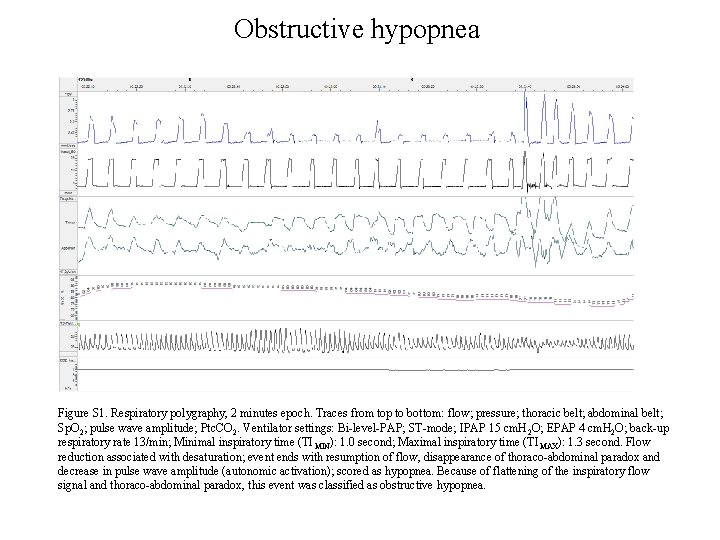
Obstructive hypopnea Figure S 1. Respiratory polygraphy, 2 minutes epoch. Traces from top to bottom: flow; pressure; thoracic belt; abdominal belt; Sp. O 2; pulse wave amplitude; Ptc. CO 2. Ventilator settings: Bi-level-PAP; ST-mode; IPAP 15 cm. H 2 O; EPAP 4 cm. H 2 O; back-up respiratory rate 13/min; Minimal inspiratory time (TI MIN): 1. 0 second; Maximal inspiratory time (TI MAX): 1. 3 second. Flow reduction associated with desaturation; event ends with resumption of flow, disappearance of thoraco-abdominal paradox and decrease in pulse wave amplitude (autonomic activation); scored as hypopnea. Because of flattening of the inspiratory flow signal and thoraco-abdominal paradox, this event was classified as obstructive hypopnea.
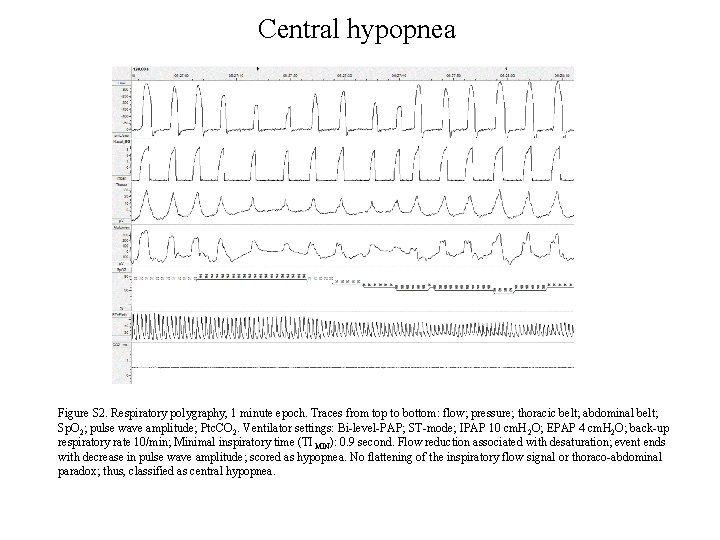
Central hypopnea Figure S 2. Respiratory polygraphy, 1 minute epoch. Traces from top to bottom: flow; pressure; thoracic belt; abdominal belt; Sp. O 2; pulse wave amplitude; Ptc. CO 2. Ventilator settings: Bi-level-PAP; ST-mode; IPAP 10 cm. H 2 O; EPAP 4 cm. H 2 O; back-up respiratory rate 10/min; Minimal inspiratory time (TI MIN): 0. 9 second. Flow reduction associated with desaturation; event ends with decrease in pulse wave amplitude; scored as hypopnea. No flattening of the inspiratory flow signal or thoraco-abdominal paradox; thus, classified as central hypopnea.

Obstructive hypopnea Figure S 3. Respiratory polygraphy, 2 minutes epoch. Traces from top to bottom: flow; pressure; thoracic belt; abdominal belt; Sp. O 2; pulse wave amplitude; Ptc. CO 2. Ventilator settings: Bi-level-PAP; ST-mode; IPAP 18 cm. H 2 O; EPAP 6 cm. H 2 O; back-up respiratory rate 12/min; Minimal inspiratory time (TI MIN): 1. 1 second; Maximal inspiratory time (TI MAX): 1. 6 second. Two events with flow reduction and desaturation, scored as hypopnea. Flattening of the inspiratory flow signal in both events. No thoraco-abdominal paradox in the first event, phase opposition during second event. Both events were classified as obstructive hypopnea.

Obstructive hypopnea Figure S 4. Respiratory polygraphy, 2 minutes epoch. Traces from top to bottom: flow; pressure; thoracic belt; abdominal belt; Sp. O 2; pulse wave amplitude; Ptc. CO 2. Ventilator settings: Bi-level-PAP; ST-mode; IPAP 15 cm. H 2 O; EPAP 4 cm. H 2 O; back-up respiratory rate 13/min; Minimal inspiratory time (TI MIN): 1. 0 second; Maximal inspiratory time (TI MAX): 1. 3 second. Flow reduction with desaturation; event ends with decrease in pulse wave amplitude (autonomic activation) and resumption of normal flow; event is scored as hypopnea. No flattening of the inspiratory flow signal, but thoraco-abdominal paradox during the event, absent pre-event; thus, event classified as obstructive hypopnea.
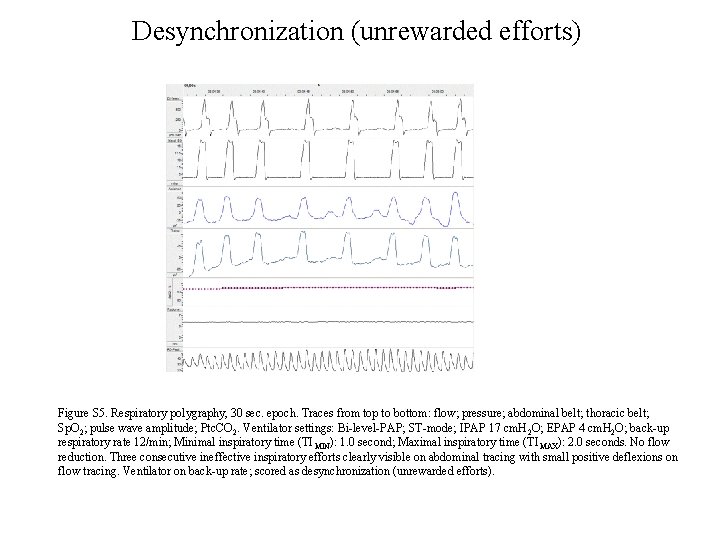
Desynchronization (unrewarded efforts) Figure S 5. Respiratory polygraphy, 30 sec. epoch. Traces from top to bottom: flow; pressure; abdominal belt; thoracic belt; Sp. O 2; pulse wave amplitude; Ptc. CO 2. Ventilator settings: Bi-level-PAP; ST-mode; IPAP 17 cm. H 2 O; EPAP 4 cm. H 2 O; back-up respiratory rate 12/min; Minimal inspiratory time (TI MIN): 1. 0 second; Maximal inspiratory time (TI MAX): 2. 0 seconds. No flow reduction. Three consecutive ineffective inspiratory efforts clearly visible on abdominal tracing with small positive deflexions on flow tracing. Ventilator on back-up rate; scored as desynchronization (unrewarded efforts).
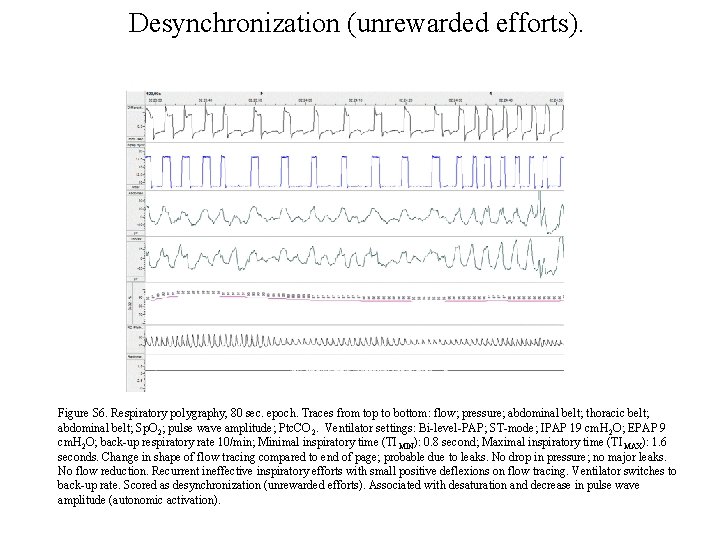
Desynchronization (unrewarded efforts). Figure S 6. Respiratory polygraphy, 80 sec. epoch. Traces from top to bottom: flow; pressure; abdominal belt; thoracic belt; abdominal belt; Sp. O 2; pulse wave amplitude; Ptc. CO 2. Ventilator settings: Bi-level-PAP; ST-mode; IPAP 19 cm. H 2 O; EPAP 9 cm. H 2 O; back-up respiratory rate 10/min; Minimal inspiratory time (TI MIN): 0. 8 second; Maximal inspiratory time (TI MAX): 1. 6 seconds. Change in shape of flow tracing compared to end of page; probable due to leaks. No drop in pressure; no major leaks. No flow reduction. Recurrent ineffective inspiratory efforts with small positive deflexions on flow tracing. Ventilator switches to back-up rate. Scored as desynchronization (unrewarded efforts). Associated with desaturation and decrease in pulse wave amplitude (autonomic activation).
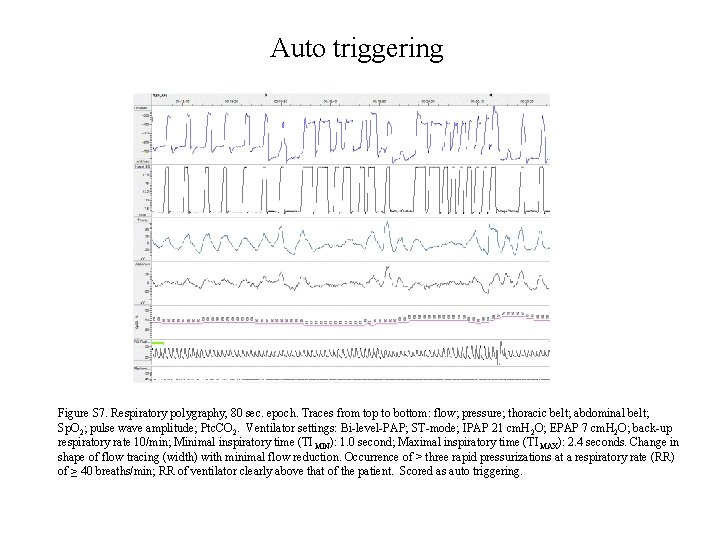
Auto triggering Figure S 7. Respiratory polygraphy, 80 sec. epoch. Traces from top to bottom: flow; pressure; thoracic belt; abdominal belt; Sp. O 2; pulse wave amplitude; Ptc. CO 2. Ventilator settings: Bi-level-PAP; ST-mode; IPAP 21 cm. H 2 O; EPAP 7 cm. H 2 O; back-up respiratory rate 10/min; Minimal inspiratory time (TI MIN): 1. 0 second; Maximal inspiratory time (TI MAX): 2. 4 seconds. Change in shape of flow tracing (width) with minimal flow reduction. Occurrence of > three rapid pressurizations at a respiratory rate (RR) of ≥ 40 breaths/min; RR of ventilator clearly above that of the patient. Scored as auto triggering.
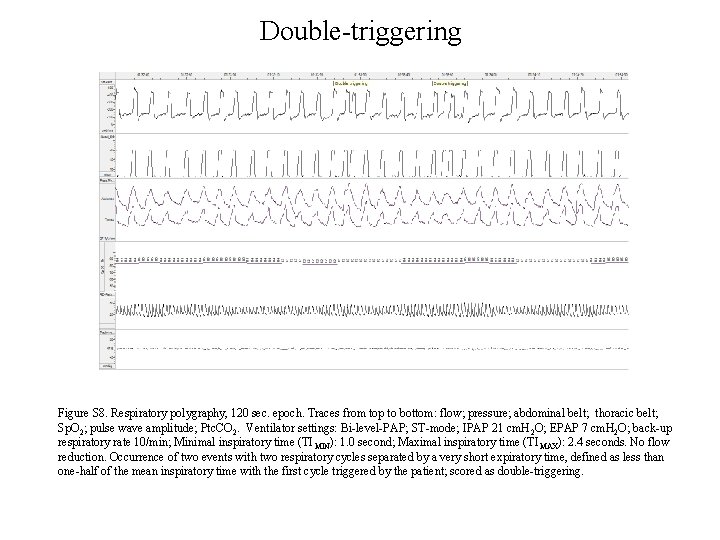
Double-triggering Figure S 8. Respiratory polygraphy, 120 sec. epoch. Traces from top to bottom: flow; pressure; abdominal belt; thoracic belt; Sp. O 2; pulse wave amplitude; Ptc. CO 2. Ventilator settings: Bi-level-PAP; ST-mode; IPAP 21 cm. H 2 O; EPAP 7 cm. H 2 O; back-up respiratory rate 10/min; Minimal inspiratory time (TI MIN): 1. 0 second; Maximal inspiratory time (TI MAX): 2. 4 seconds. No flow reduction. Occurrence of two events with two respiratory cycles separated by a very short expiratory time, defined as less than one-half of the mean inspiratory time with the first cycle triggered by the patient; scored as double-triggering.
- Slides: 8