
Obstetric Violence Disrespect and Abuse in Childbirth Simone
Obstetric Violence Disrespect and Abuse in Childbirth Simone Snyder Rutgers University VAWC Consortium Center on Violence Against Women and Children
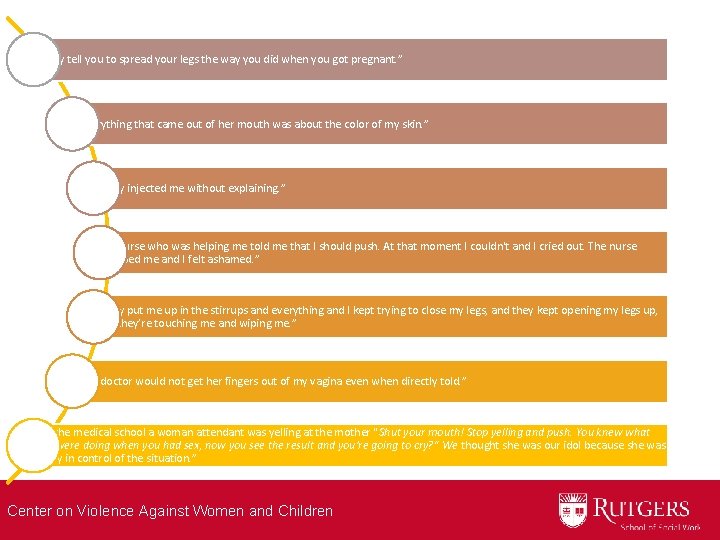
“They tell you to spread your legs the way you did when you got pregnant. ” “Everything that came out of her mouth was about the color of my skin. ” “They injected me without explaining. ” “A nurse who was helping me told me that I should push. At that moment I couldn't and I cried out. The nurse slapped me and I felt ashamed. ” “They put me up in the stirrups and everything and I kept trying to close my legs, and they kept opening my legs up, and they’re touching me and wiping me. ” “The doctor would not get her fingers out of my vagina even when directly told. ” “At the medical school a woman attendant was yelling at the mother "Shut your mouth! Stop yelling and push. You knew what you were doing when you had sex, now you see the result and you’re going to cry? " We thought she was our idol because she was really in control of the situation. ” Center on Violence Against Women and Children
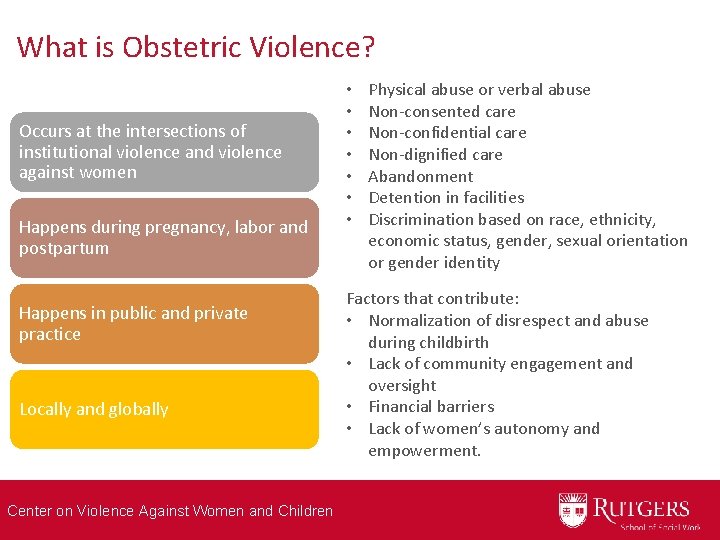
What is Obstetric Violence? Occurs at the intersections of institutional violence and violence against women Happens during pregnancy, labor and postpartum Happens in public and private practice Locally and globally Center on Violence Against Women and Children • • Physical abuse or verbal abuse Non‐consented care Non‐confidential care Non‐dignified care Abandonment Detention in facilities Discrimination based on race, ethnicity, economic status, gender, sexual orientation or gender identity Factors that contribute: • Normalization of disrespect and abuse during childbirth • Lack of community engagement and oversight • Financial barriers • Lack of women’s autonomy and empowerment.
Obstetric Violence recognized as a legal term in Venezuela 2007 Similar definitions were introduced in Argentina and certain Mexican states following the Venezuelan model “The appropriation of the body and reproductive processes of women by health personnel, which is expressed as dehumanized treatment, an abuse of medication, and to convert the natural processes into pathological ones, bringing with it loss of autonomy and the ability to decide freely about their bodies and sexuality, negatively impacting the quality of life of women. ” Center on Violence Against Women and Children
Human Rights In 2014, the World Health Organization addressed the issue in a statement on mistreatment during childbirth, the statement was endorsed by more than 90 international, civil society, and health professional organizations. In 2015, the UN and other human rights experts issued a joint statement calling on states to address acts of obstetric and institutional violence. Respectful maternity care is a universal human right that is due to every childbearing woman/person in every health system around the world. Center on Violence Against Women and Children Rights Violations • • Right to informed consent Right to refuse medical treatment Right to health Right to equal treatment Right to privacy Right to life Right to bodily autonomy Right to live free from violence
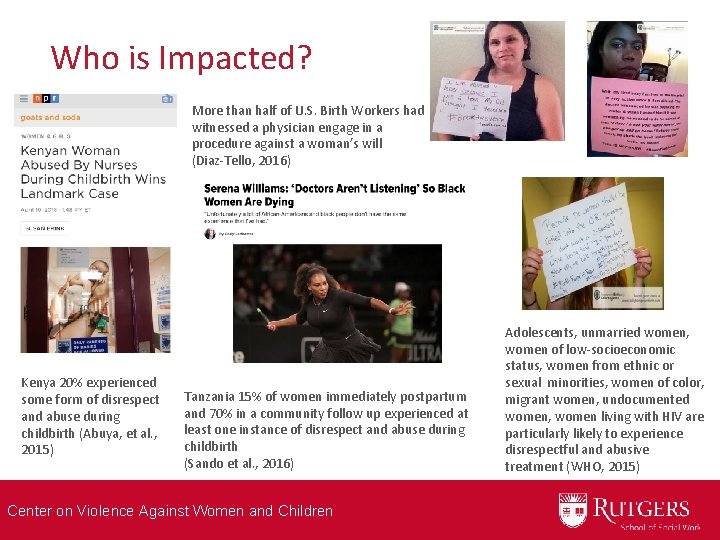
Who is Impacted? More than half of U. S. Birth Workers had witnessed a physician engage in a procedure against a woman’s will (Diaz‐Tello, 2016) Kenya 20% experienced some form of disrespect and abuse during childbirth (Abuya, et al. , 2015) Tanzania 15% of women immediately postpartum and 70% in a community follow up experienced at least one instance of disrespect and abuse during childbirth (Sando et al. , 2016) Center on Violence Against Women and Children Adolescents, unmarried women, women of low‐socioeconomic status, women from ethnic or sexual minorities, women of color, migrant women, undocumented women, women living with HIV are particularly likely to experience disrespectful and abusive treatment (WHO, 2015)
What are the Consequences? Poor outcomes for mothers and babies Mother‐baby bonding impacted Impact maternal mental health i. e. depression and anxiety Distrust in the medical system Triggering for survivors of sexual assault Birth Trauma and PTSD • 35% of women experienced some degree of PTSD symptoms postpartum • 26% of obstetric nurses met all diagnostic criteria for PTSD due to exposure to patients who were traumatized (Kitzinger, 2006; Fernandez, 2013; Reed et al. , 2017) Center on Violence Against Women and Children
Maternal Mortality Issues of gender equity and gender‐based violence are at the core of maternity care – the notion of “safe motherhood” must be expanded beyond the prevention of morbidity or mortality to encompass respect for women’s basic human rights. (White Ribbon Alliance) Disrespect and abuse of women during maternity care problems that have been obscured by a “veil of silence, ” and they can significantly impact women’s willingness to seek out life‐saving maternity care. In fact, disrespect and abuse in facilities are among the biggest barriers to women seeking maternal health services. (Bowser and Hill, 2010) "Women are not dying because of untreatable diseases. They are dying because societies have yet to make the decision that their lives are worth saving. We have not yet valued women's lives and health highly enough. " ‐Professor Mahmoud Fathalla Center on Violence Against Women and Children
Implications for Social Work Micro • Understand the issue ‐ scope, consequences, treatment • Give clients opportunity to talk about experience • Research counseling interventions and support Macro • • • Need more interdisciplinary research Education human rights in childbirth Address structural, social, and political roots of the problem Raise awareness and demand respectful maternity care rights Advocate for legislation that addresses obstetric violence and maternal mortality (i. e. NJ S 3452 Maternal Mortality Review Commission) Center on Violence Against Women and Children
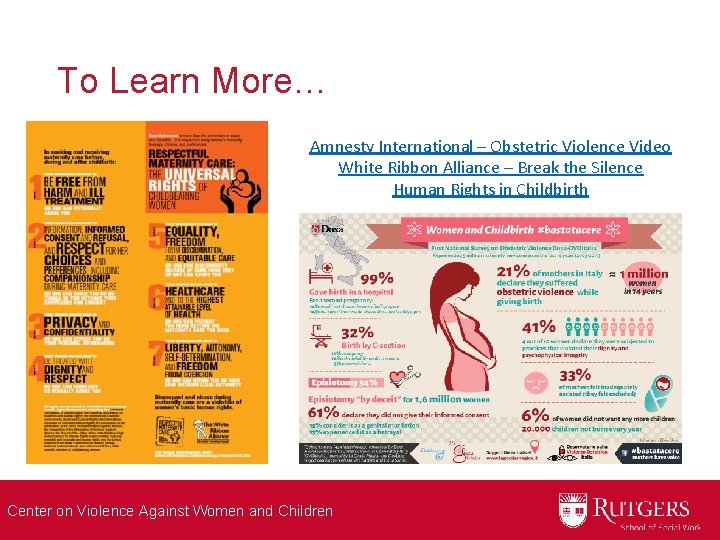
To Learn More… Amnesty International – Obstetric Violence Video White Ribbon Alliance – Break the Silence Human Rights in Childbirth Center on Violence Against Women and Children
Thank You! Questions? Center on Violence Against Women and Children
References • Abuya, T. , Warren, C. E. , Miller, N. , Njuki, R. , Ndwiga, C. , Maranga, A. , . . . & Bellows, B. (2015). Exploring the prevalence of disrespect and abuse during childbirth in Kenya. Plo. S one, 10(4), e 0123606. • Borges, M. T. (2017). A violent birth: reframing coerced procedures during childbirth as obstetric violence. Duke LJ, 67, 827. • d'Oliveira, A. F. P. L. , Diniz, S. G. , & Schraiber, L. B. (2002). Violence against women in health‐care institutions: an emerging problem. The Lancet, 359(9318), 1681‐ 1685. • Elmir, R. , Schmied, V. , Wilkes, L. , & Jackson, D. (2010). Women’s perceptions and experiences of a traumatic birth: a meta‐ethnography. Journal of advanced nursing, 66(10), 2142‐ 2153. • Diaz‐Tello (2016) Invisible wounds: obstetric violence in the United. States, Reproductive Health Matters, 24: 47, 56‐ 64, • Freedman, L. P. , Ramsey, K. , Abuya, T. , Bellows, B. , Ndwiga, C. , Warren, C. E. , . . . & Mbaruku, G. (2014). Defining disrespect and abuse of women in childbirth: a research, policy and rights agenda. Bulletin of the World Health Organization, 92, 915‐ 917. • Hodges, S. (2009). Abuse in hospital‐based birth settings? . The Journal of perinatal education, 18(4), 8. • Khosla, R. , Zampas, C. , Vogel, J. , Bohren, M. , Roseman, M. , & Erdman, J. (2016). International Human Rights and the Mistreatment of Women During Childbirth. Health and Human Rights Journal. 18 (2). Center on Violence Against Women and Children
References • Kitzinger, S. (2006). Birth as rape: There must be an end tojust in case'obstetrics. British Journal of Midwifery, 14(9), 544‐ 545. • Lowe, N. K. (2014). Dignity in childbirth. Journal of Obstetric, Gynecologic, & Neonatal Nursing, 43(2), 137‐ 138. • Sadler, M. , Santos, M. J. , Ruiz‐Berdún, D. , Rojas, G. L. , Skoko, E. , Gillen, P. , & Clausen, J. A. (2016). Moving beyond disrespect and abuse: addressing the structural dimensions of obstetric violence. Reproductive health matters, 24(47), 47‐ 55. • Sando, D. , Ratcliffe, H. , Mc. Donald, K. , Spiegelman, D. , Lyatuu, G. , Mwanyika‐Sando, M. , . . . & Langer, A. (2016). The prevalence of disrespect and abuse during facility‐based childbirth in urban Tanzania. BMC pregnancy and childbirth, 16(1), 236. • Shabot, S. C. (2016). Making loud bodies “Feminine”: A feminist‐phenomenological analysis of obstetric violence. Human Studies, 39(2), 231‐ 247. • Reed, R. , Sharman, R. , & Inglis, C. (2017). Women’s descriptions of childbirth trauma relating to care provider actions and interactions. BMC pregnancy and childbirth, 17(1), 21. • Pereira Rodrigues, D. , Herdy Alves, V. , Santana Vieira, R. , Morett Romano Leão, D. C. , de Paula, E. , & Machado • Pimentel, M. (2018). OBSTETRIC VIOLENCE IN THE CONTEXT OF LABOR AND CHILDBIRTH. Journal of Nursing UFPE/Revista de Enfermagem UFPE, 12(1). • Wright, R. L. , Bird, M. , & Frost, C. J. (2015). Reproductive health in the United States: A review of the recent social work literature. Social work, 60(4), 295‐ 304. Center on Violence Against Women and Children
- Slides: 13