
Obstetric outcome following cervical treatment for CIN By
Obstetric outcome following cervical treatment for CIN By M Lokman, M De. Lange
Aims and Objectives Aim: ¡ To determine whether cervical conisation increases risk of preterm delivery and adverse obstetric outcome ¡ To develop critical appraisal skills Objective: ¡ To review current evidence in published studies, meta-analysis ¡ To review RCOG advisory opinion ¡ To critically appraise most current study ¡ To discuss impact on clinical practice
The Clinical Question Does cervical conisation increase risk of preterm delivery and adverse obstetric outcomes? P(women of fertile age who have had cervical treatment) I (excisional cervical treatment) C (Cx conisation vs none) O (risk of preterm delivery and adverse obstetric outcome)
Literature search ¡ ¡ ¡ Databases searched: RCOG, Cochrane, Pub. Med Search terms: Cervical (MESH selecting subheadings treatment, surgery, complications) AND (obstetric morbidity OR perinatal mortality) Results: 1 x RCOG advisory group opinion. 1 x cochrane protocol. 2 x current cohort studies. 2 x meta-analysis.

Guidelines (RCOG) Background – evidence show both ablative and excisional technique have equal efficacy and similar risk of invasive disease. 2 meta-analysis similar conclusion – excisional method increase risk of adverse pregnancy outcomes but not with laser ablation. biological mechanism – uncertain and confounding factors (age, smoking, socio-economic class) clinical practice: proportionally large excision/high grade lesion/multiple excision -> high risk pregnancy (serial TV scan/ffn). Intervention – cx cerclage, progesterone, steroids

Paper selected Pregnancy outcome after cervical conisation: a retrospective cohort study in the Leuven University Hospital. van de Vijver A, Poppe W, Verguts J, Arbyn M. BJOG. 2010 Feb; 117(3): 268 -73. Epub 2009 Nov 26. PMID: 19943824 [Pub. Med - indexed for MEDLINE] ¡ reason: the most relevant paper, up to date, good methodology.
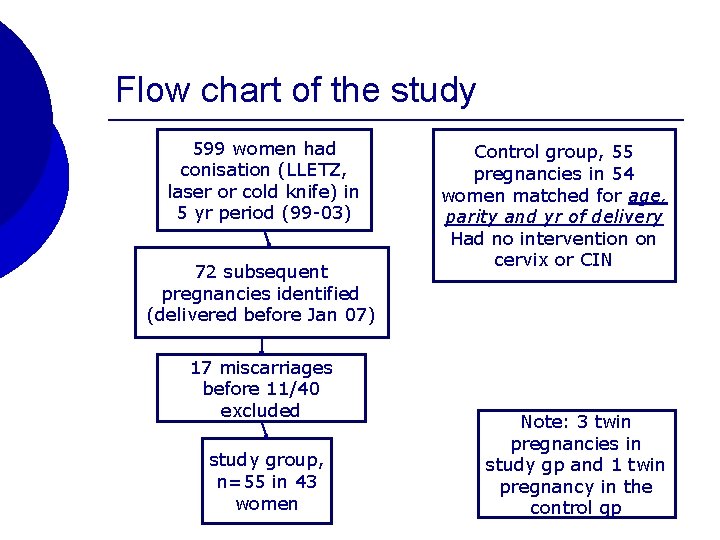
Flow chart of the study 599 women had conisation (LLETZ, laser or cold knife) in 5 yr period (99 -03) 72 subsequent pregnancies identified (delivered before Jan 07) 17 miscarriages before 11/40 excluded study group, n=55 in 43 women Control group, 55 pregnancies in 54 women matched for age, parity and yr of delivery Had no intervention on cervix or CIN Note: 3 twin pregnancies in study gp and 1 twin pregnancy in the control gp
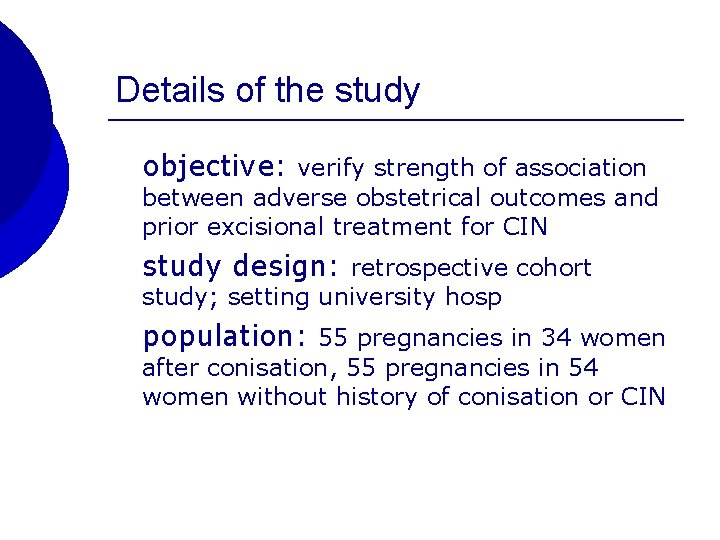
Details of the study objective: verify strength of association between adverse obstetrical outcomes and prior excisional treatment for CIN study design: retrospective cohort study; setting university hosp population: 55 pregnancies in 34 women after conisation, 55 pregnancies in 54 women without history of conisation or CIN
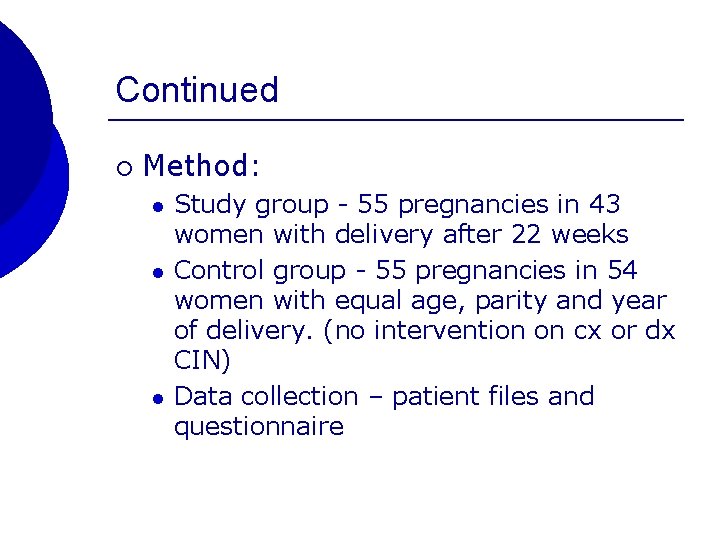
Continued ¡ Method: l l l Study group - 55 pregnancies in 43 women with delivery after 22 weeks Control group - 55 pregnancies in 54 women with equal age, parity and year of delivery. (no intervention on cx or dx CIN) Data collection – patient files and questionnaire
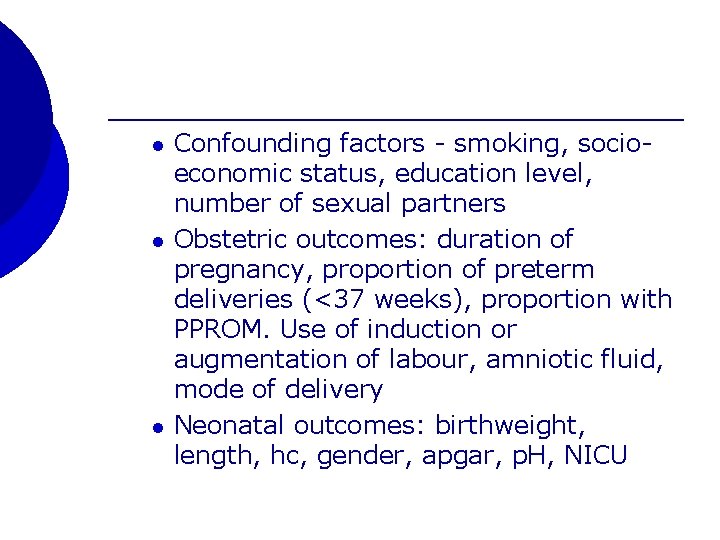
l l l Confounding factors - smoking, socioeconomic status, education level, number of sexual partners Obstetric outcomes: duration of pregnancy, proportion of preterm deliveries (<37 weeks), proportion with PPROM. Use of induction or augmentation of labour, amniotic fluid, mode of delivery Neonatal outcomes: birthweight, length, hc, gender, apgar, p. H, NICU
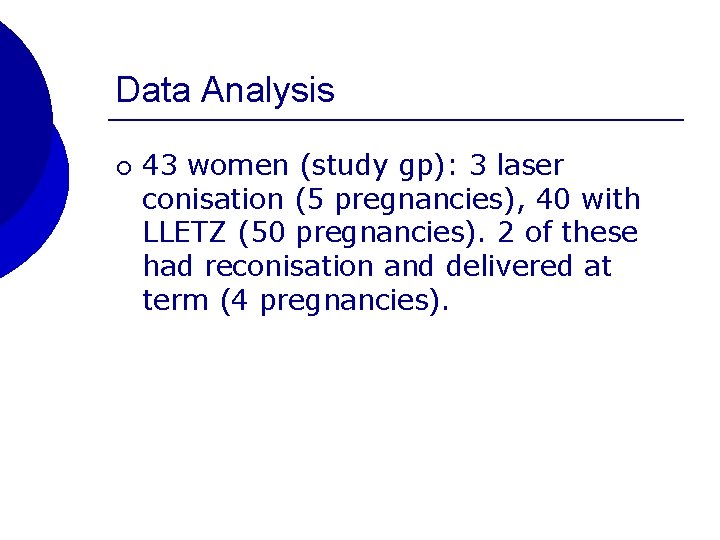
Data Analysis ¡ 43 women (study gp): 3 laser conisation (5 pregnancies), 40 with LLETZ (50 pregnancies). 2 of these had reconisation and delivered at term (4 pregnancies).
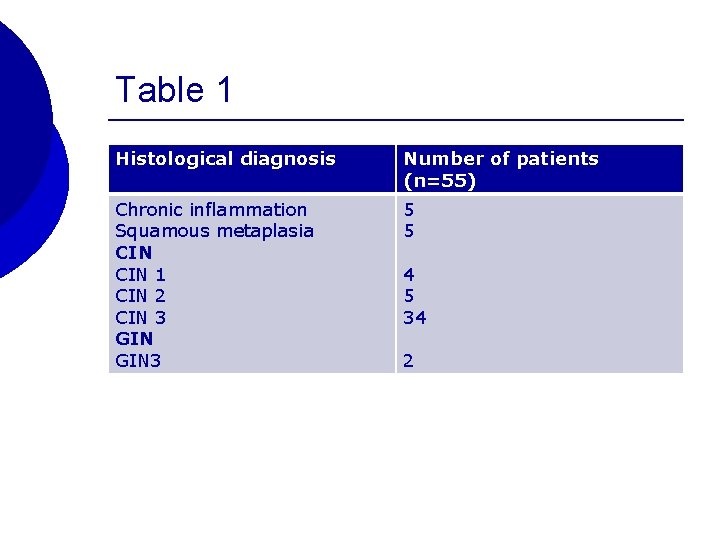
Table 1 Histological diagnosis Number of patients (n=55) Chronic inflammation Squamous metaplasia CIN 1 CIN 2 CIN 3 GIN 3 5 5 4 5 34 2
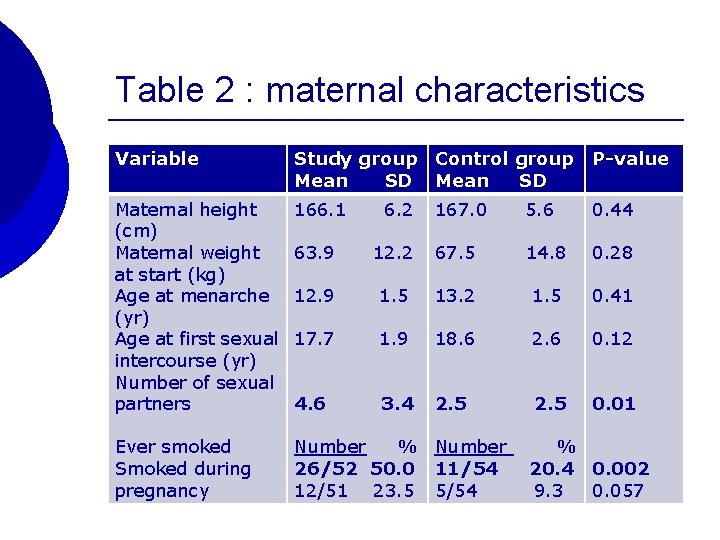
Table 2 : maternal characteristics Variable Study group Control group Mean SD P-value Maternal height (cm) Maternal weight at start (kg) Age at menarche (yr) Age at first sexual intercourse (yr) Number of sexual partners 166. 1 Ever smoked Smoked during pregnancy Number % Number 26/52 50. 0 11/54 12/51 23. 5 5/54 6. 2 167. 0 5. 6 0. 44 63. 9 12. 2 67. 5 14. 8 0. 28 12. 9 1. 5 13. 2 1. 5 0. 41 17. 7 1. 9 18. 6 2. 6 0. 12 4. 6 3. 4 2. 5 0. 01 % 20. 4 0. 002 9. 3 0. 057
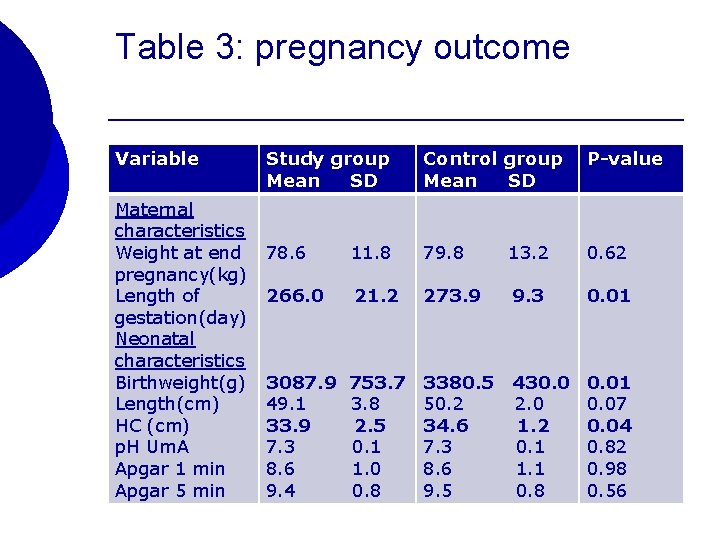
Table 3: pregnancy outcome Variable Maternal characteristics Weight at end pregnancy(kg) Length of gestation(day) Neonatal characteristics Birthweight(g) Length(cm) HC (cm) p. H Um. A Apgar 1 min Apgar 5 min Study group Mean SD Control group Mean SD P-value 78. 6 11. 8 79. 8 13. 2 0. 62 266. 0 21. 2 273. 9 9. 3 0. 01 3380. 5 50. 2 34. 6 7. 3 8. 6 9. 5 430. 0 2. 0 1. 2 0. 1 1. 1 0. 8 0. 01 0. 07 0. 04 0. 82 0. 98 0. 56 3087. 9 49. 1 33. 9 7. 3 8. 6 9. 4 753. 7 3. 8 2. 5 0. 1 1. 0 0. 8
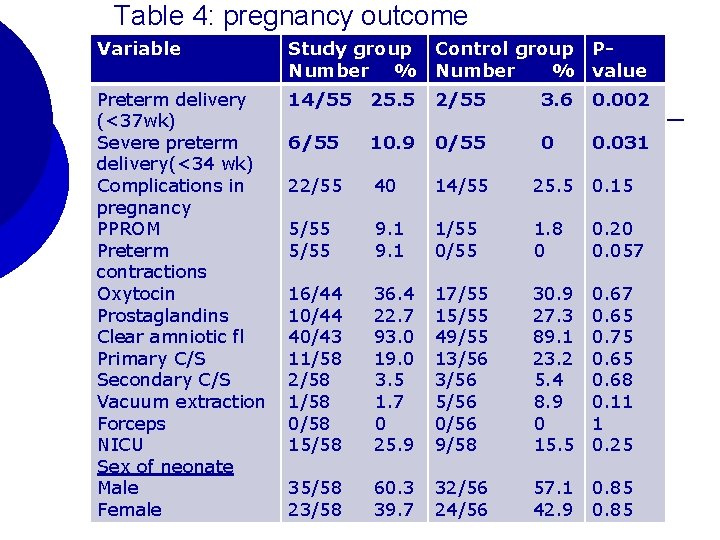
Table 4: pregnancy outcome Variable Study group Number % Control group PNumber % value Preterm delivery (<37 wk) Severe preterm delivery(<34 wk) Complications in pregnancy PPROM Preterm contractions Oxytocin Prostaglandins Clear amniotic fl Primary C/S Secondary C/S Vacuum extraction Forceps NICU Sex of neonate Male Female 14/55 25. 5 2/55 3. 6 0. 002 6/55 10. 9 0/55 0 0. 031 22/55 40 14/55 25. 5 0. 15 5/55 9. 1 1/55 0/55 1. 8 0 0. 20 0. 057 16/44 10/44 40/43 11/58 2/58 1/58 0/58 15/58 36. 4 22. 7 93. 0 19. 0 3. 5 1. 7 0 25. 9 17/55 15/55 49/55 13/56 5/56 0/56 9/58 30. 9 27. 3 89. 1 23. 2 5. 4 8. 9 0 15. 5 0. 67 0. 65 0. 75 0. 68 0. 11 1 0. 25 35/58 23/58 60. 3 39. 7 32/56 24/56 57. 1 42. 9 0. 85
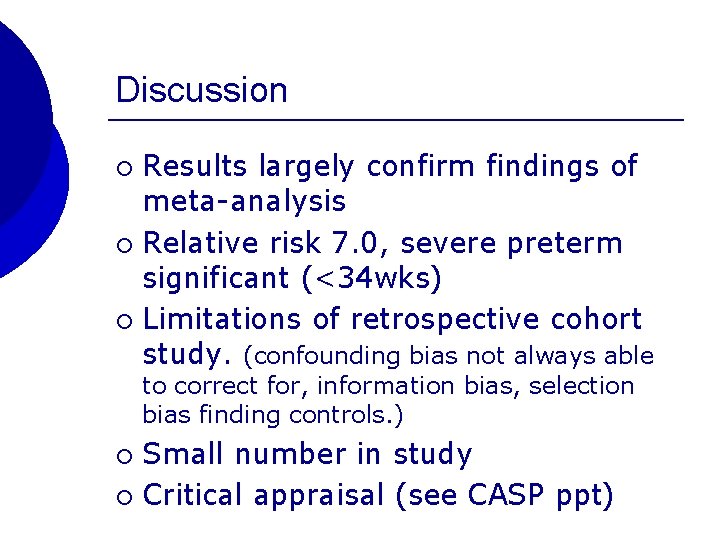
Discussion Results largely confirm findings of meta-analysis ¡ Relative risk 7. 0, severe preterm significant (<34 wks) ¡ Limitations of retrospective cohort study. (confounding bias not always able ¡ to correct for, information bias, selection bias finding controls. ) Small number in study ¡ Critical appraisal (see CASP ppt) ¡
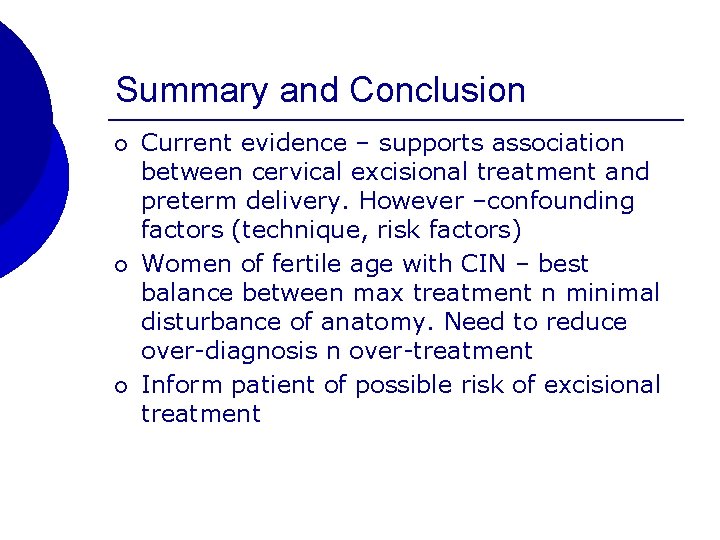
Summary and Conclusion ¡ ¡ ¡ Current evidence – supports association between cervical excisional treatment and preterm delivery. However –confounding factors (technique, risk factors) Women of fertile age with CIN – best balance between max treatment n minimal disturbance of anatomy. Need to reduce over-diagnosis n over-treatment Inform patient of possible risk of excisional treatment
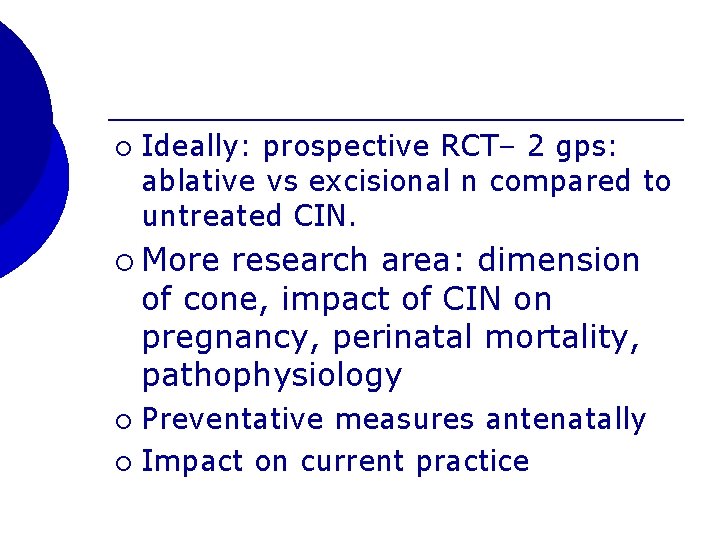
¡ Ideally: prospective RCT– 2 gps: ablative vs excisional n compared to untreated CIN. ¡ More research area: dimension of cone, impact of CIN on pregnancy, perinatal mortality, pathophysiology Preventative measures antenatally ¡ Impact on current practice ¡
- Slides: 18