
Obstacles in the Visual Segment 20 1 Background
Obstacles in the Visual Segment 20: 1 Background, Policies and Action Presented to: 2016 Maryland Aviation Conference By: Gerard G Lebar Eastern Flight Procedures Team Date: June 17, 2016 Federal Aviation Administration
Overview • Background • 2 -Year Plan • Assessment Phase Background 20: 1 Background, Policies, and Action Plan 2 -Year Plan Assessment Phase Federal Aviation Administration 2

Background – 20: 1 Visual Area The purpose of the surface is to protect aircraft during the last stages of approach procedures when pilots transition from instruments to visual guidance Picture of SWA landing in San Diego Background 20: 1 Background, Policies, and Action Plan 2 -Year Plan Assessment Phase Federal Aviation Administration 3
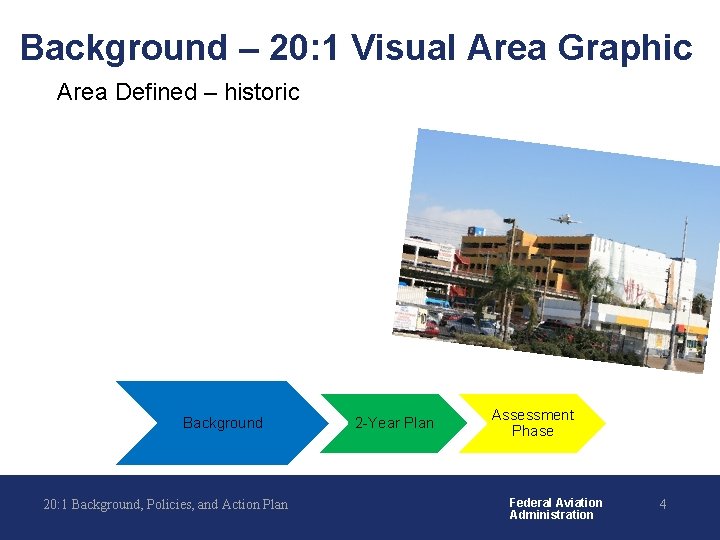
Background – 20: 1 Visual Area Graphic Area Defined – historic Background 20: 1 Background, Policies, and Action Plan 2 -Year Plan Assessment Phase Federal Aviation Administration 4
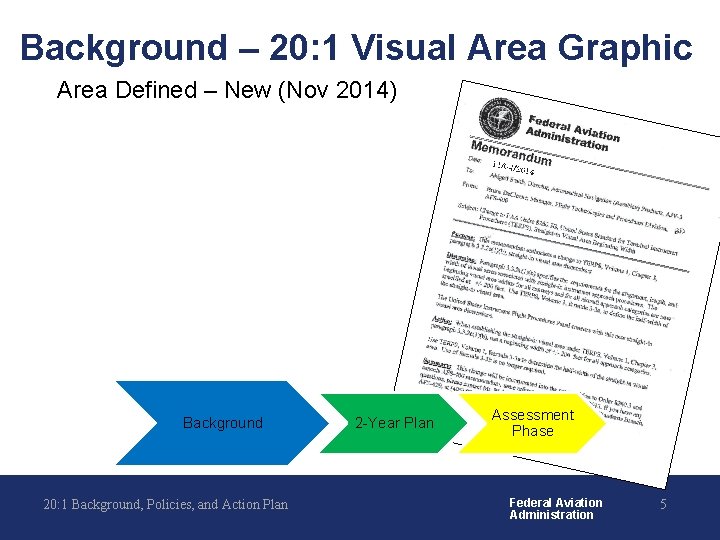
Background – 20: 1 Visual Area Graphic Area Defined – New (Nov 2014) Background 20: 1 Background, Policies, and Action Plan 2 -Year Plan Assessment Phase Federal Aviation Administration 5
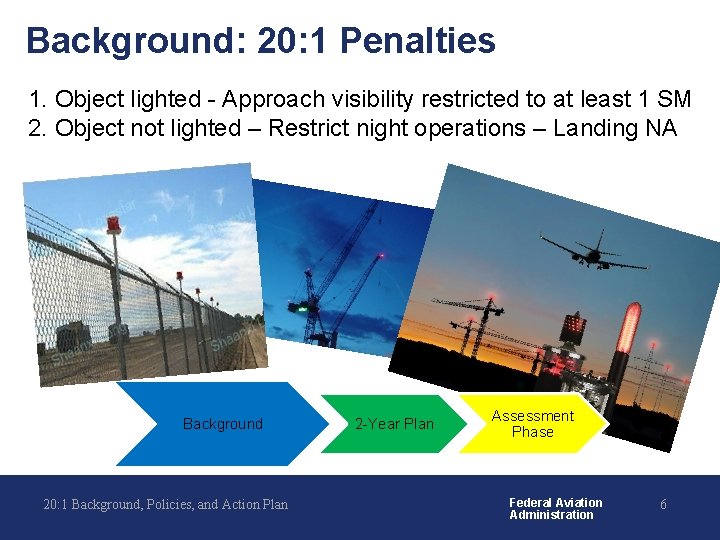
Background: 20: 1 Penalties 1. Object lighted - Approach visibility restricted to at least 1 SM 2. Object not lighted – Restrict night operations – Landing NA Background 20: 1 Background, Policies, and Action Plan 2 -Year Plan Assessment Phase Federal Aviation Administration 6
Background – Problem Identified • Due to improvements in how we identify and track obstacles, the FAA began enforcing a clear 20: 1 surface in April, 2013 • Subsequently, penetrations of airport approach surfaces were discovered at several high visibility airports (e. g. , LGA, SAN) • Enforcement of requirements caught airport and operator community by surprise, affecting access on some procedures where operations have occurred for years Background 20: 1 Background, Policies, and Action Plan 2 -Year Plan Assessment Phase Federal Aviation Administration 7

Interim Policy • Effective January 6, 2014 • Long term goal Achieve and sustain compliance to required obstacle surfaces by January 2016 Background 20: 1 Background, Policies, and Action Plan 2 -Year Plan Assessment Phase Federal Aviation Administration 8
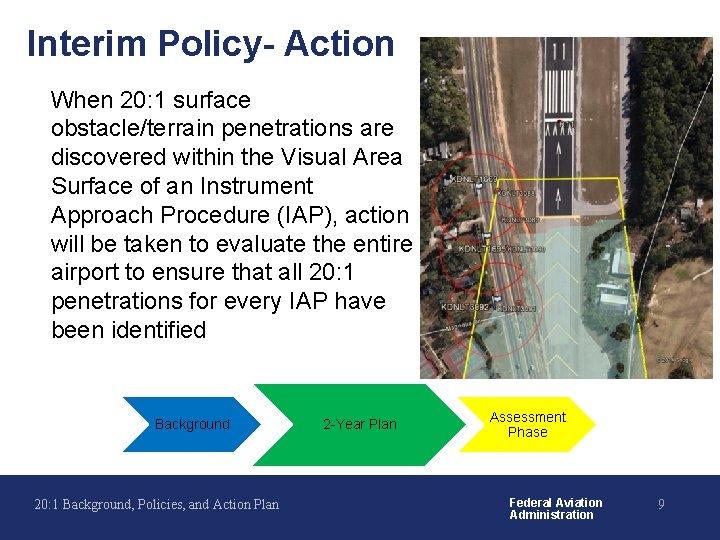
Interim Policy- Action When 20: 1 surface obstacle/terrain penetrations are discovered within the Visual Area Surface of an Instrument Approach Procedure (IAP), action will be taken to evaluate the entire airport to ensure that all 20: 1 penetrations for every IAP have been identified Background 20: 1 Background, Policies, and Action Plan 2 -Year Plan Assessment Phase Federal Aviation Administration 9
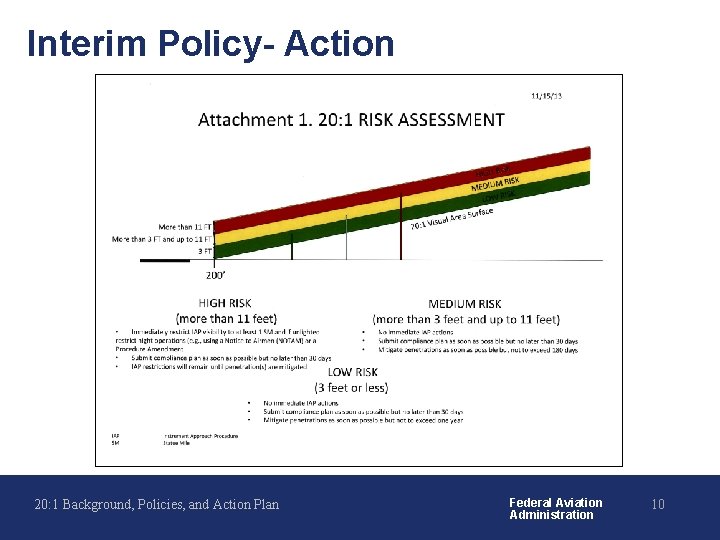
Interim Policy- Action Background 20: 1 Background, Policies, and Action Plan 2 -Year Plan Assessment Phase Federal Aviation Administration 10
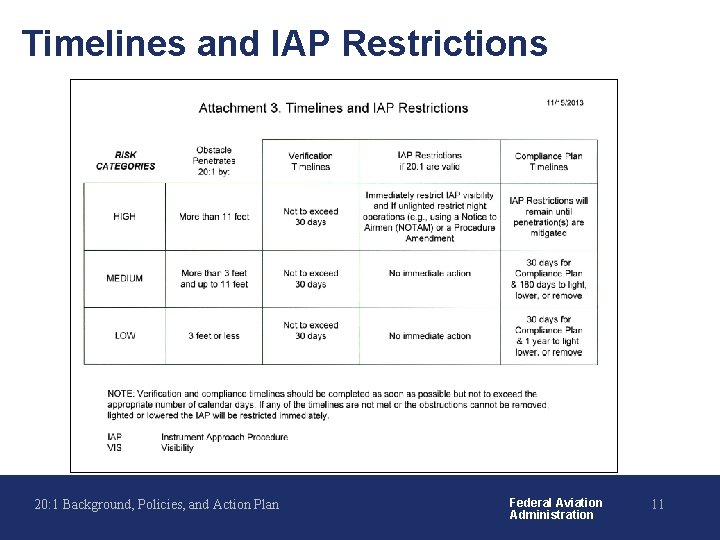
Timelines and IAP Restrictions Background 20: 1 Background, Policies, and Action Plan 2 -Year Plan Assessment Phase Federal Aviation Administration 11
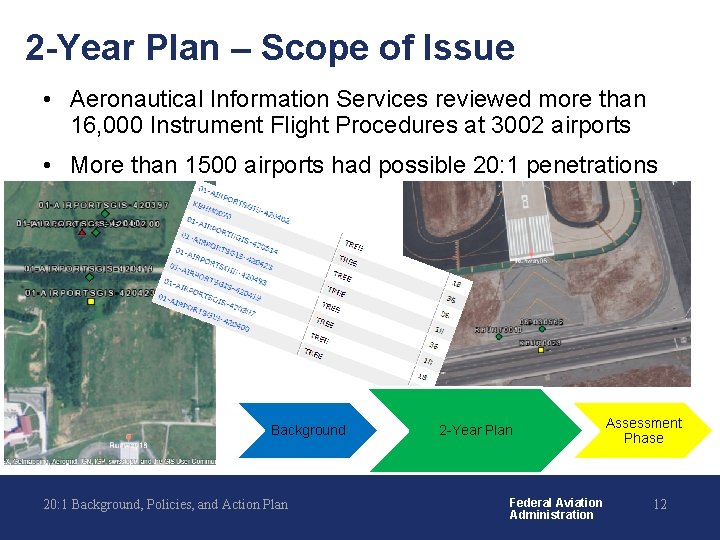
2 -Year Plan – Scope of Issue • Aeronautical Information Services reviewed more than 16, 000 Instrument Flight Procedures at 3002 airports • More than 1500 airports had possible 20: 1 penetrations Background 20: 1 Background, Policies, and Action Plan 2 -Year Plan Federal Aviation Administration Assessment Phase 12
2 -Year Plan Report Card (Ending Jan 2016) • FAA restricted IFPs at 913 airports • More than 800 procedures amended • More than 500 airports have either removed or mitigated obstacles to address safety risks • More than 100 airports remain in the notification, validation and/or mitigation phase Background 20: 1 Background, Policies, and Action Plan 2 -Year Plan Assessment Phase Federal Aviation Administration 13
Assessment Phase - Objective: Determine if the 2 -year plan was successful in obtaining compliance throughout the NAS - If successful, there should be very few noncompliances - If not successful, a new strategy to achieve compliance will be needed - Began with initial procedure reviews of procedures which had been addressed under the 2 -year plan Background 20: 1 Background, Policies, and Action Plan 2 -Year Plan Assessment Phase Federal Aviation Administration 14
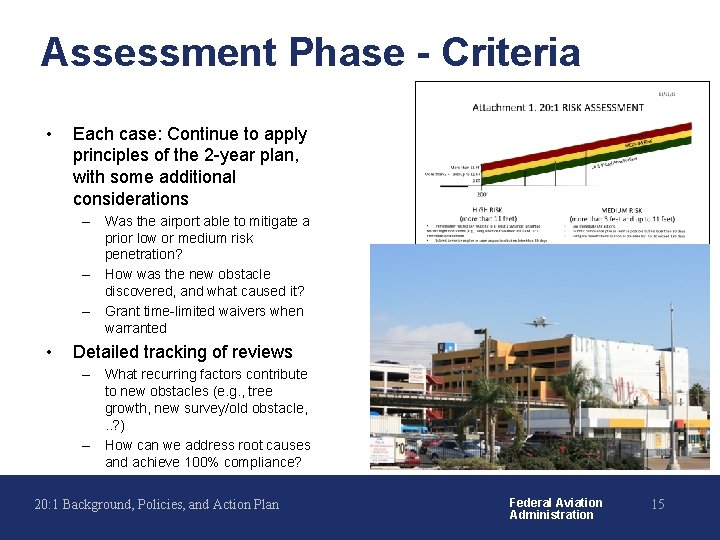
Assessment Phase - Criteria • Each case: Continue to apply principles of the 2 -year plan, with some additional considerations – Was the airport able to mitigate a prior low or medium risk penetration? – How was the new obstacle discovered, and what caused it? – Grant time-limited waivers when warranted • Detailed tracking of reviews – What recurring factors contribute to new obstacles (e. g. , tree growth, new survey/old obstacle, . . ? ) – How can we address root causes and achieve 100% compliance? 20: 1 Background, Policies, and Action Plan Federal Aviation Administration 15
Next Steps • Share Insights from Assessment • Potential for new root-cause actions • Goal is 100% Compliance • Anticipate penetrations before FAA review and take corrective action • Use of the SAV tool to monitor obstructions around airport 20: 1 Background, Policies, and Action Plan Federal Aviation Administration 16
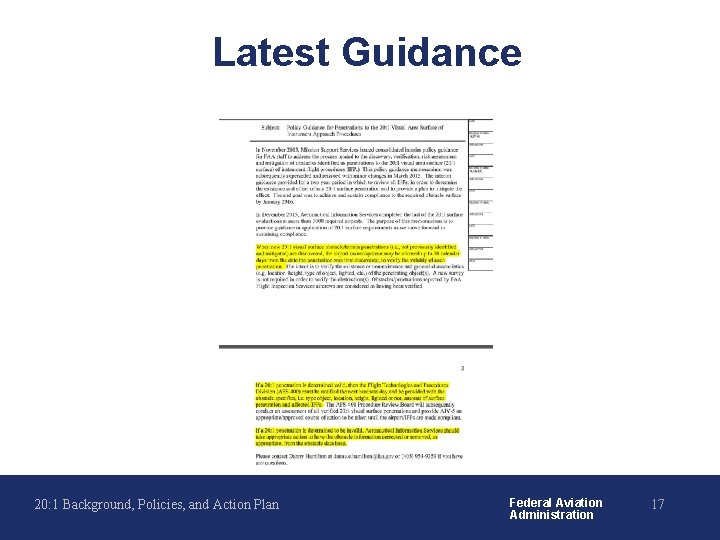
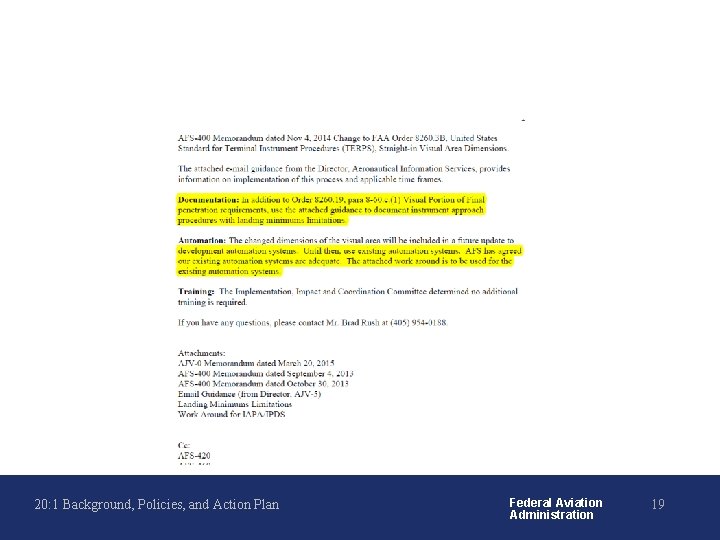
Latest Guidance 20: 1 Background, Policies, and Action Plan Federal Aviation Administration 17
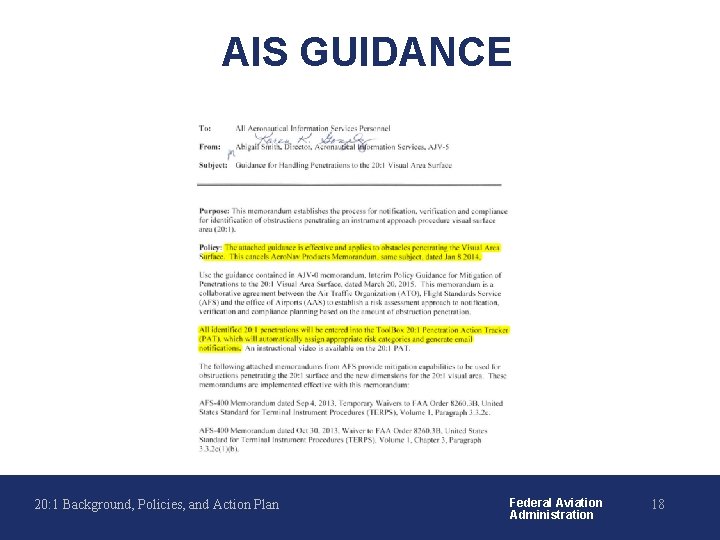
AIS GUIDANCE 20: 1 Background, Policies, and Action Plan Federal Aviation Administration 18
20: 1 Background, Policies, and Action Plan Federal Aviation Administration 19
QUESTIONS • • Gerard Lebar Eastern Flight Procedures Team 404 -305 -5953 Gerard. G. Lebar@faa. gov 20: 1 Background, Policies, and Action Plan Federal Aviation Administration 20
- Slides: 20