
OBSERVING SYSTEM SIMULATION EXPERIMENTS FOR A US WIND
OBSERVING SYSTEM SIMULATION EXPERIMENTS FOR A US WIND LIDAR SPACE MISSION Lars Peter Riishojgaard 1, 2, Zaizhong Ma 1, 2, Michiko Masutani 3, Jack Woollen 3, Dave Emmitt 4, Sid Wood 4, Steve Greco 4 1 Joint Center for Satellite Data Assimilation of Maryland Baltimore County 3 NCEP Environmental Modeling Center 4 Simpson Weather Associates 2 University AMS Annual Meeting, Seattle, January 23 -27 2011 1
Overview n n n NWP and wind observations GWOS mission concept OSSE setup Initial results Future work Summary and conclusions AMS Annual Meeting, Seattle, January 23 -27 2011 2
Upper-air observation requirements for NWP ØNumerical weather prediction requires independent and global observations of the mass (temperature) and wind fields ØThe global three-dimensional mass field is well observed from space ØNo existing space-based observing system provides vertically resolved wind information => horizontal coverage of wind profiles is sparse ØThe lack of wind measurements is widely believed to be one of the main limiting factors for progress in NWP skill at all temporal ranges Especially critical as we progress to smaller and smaller scales where wind/mass balance assumptions break down 3
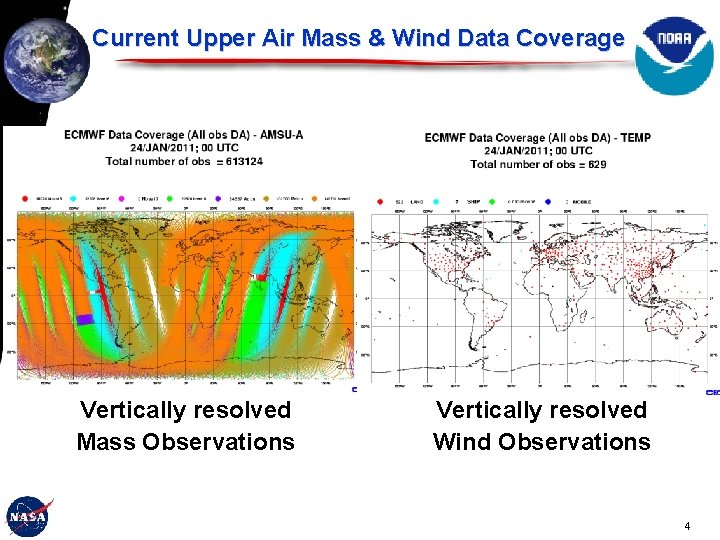
Current Upper Air Mass & Wind Data Coverage Vertically resolved Mass Observations Vertically resolved Wind Observations 4
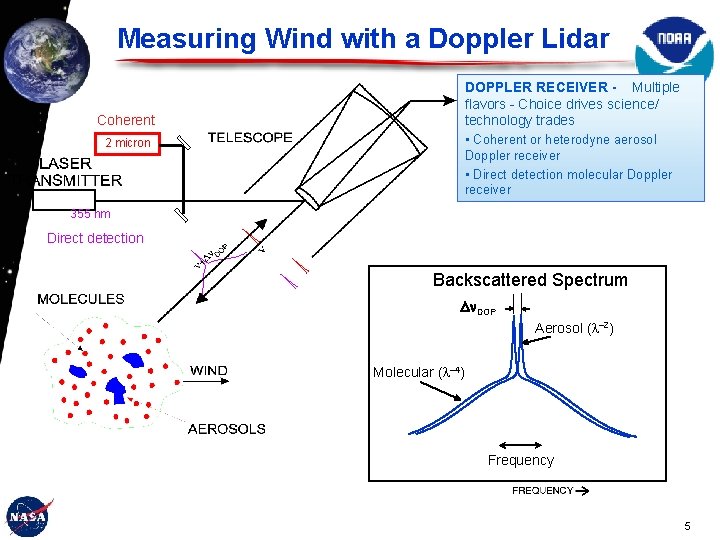
Measuring Wind with a Doppler Lidar DOPPLER RECEIVER - Multiple flavors - Choice drives science/ technology trades • Coherent or heterodyne aerosol Coherent 2 micron Doppler receiver • Direct detection molecular Doppler receiver 355 nm Direct detection Backscattered Spectrum DOP Aerosol (l-2) Molecular (l-4) Frequency 5
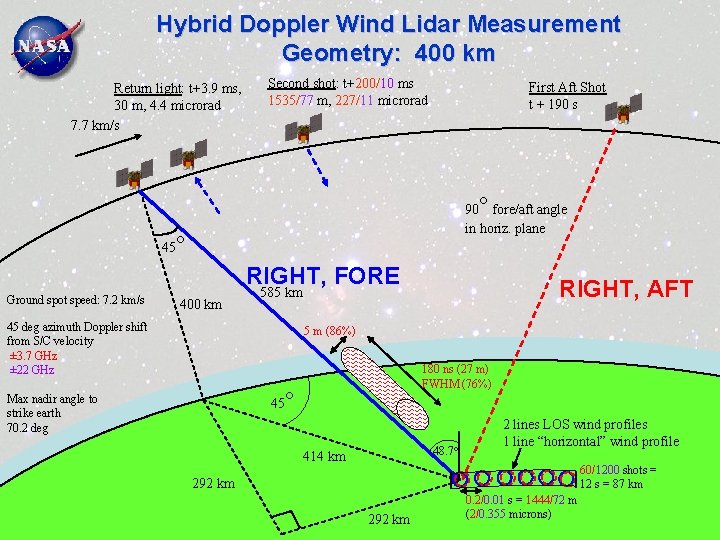
Hybrid Doppler Wind Lidar Measurement Geometry: 400 km Return light: t+3. 9 ms, 30 m, 4. 4 microrad 7. 7 km/s Second shot: t+200/10 ms 1535/77 m, 227/11 microrad First Aft Shot t + 190 s ° 90 fore/aft angle in horiz. plane ° 45 RIGHT, FORE Ground spot speed: 7. 2 km/s 400 km RIGHT, AFT 585 km 45 deg azimuth Doppler shift from S/C velocity ± 3. 7 GHz ± 22 GHz 5 m (86%) 180 ns (27 m) FWHM (76%) ° Max nadir angle to strike earth 70. 2 deg 45 48. 7° 414 km 2 lines LOS wind profiles 1 line “horizontal” wind profile 60/1200 shots = 12 s = 87 km 292 km 6 292 km 0. 2/0. 01 s = 1444/72 m (2/0. 355 microns)

Wind Lidar OSSEs • Impact experiments carried out as part of NASANOAA Joint OSSE collaboration – Common Nature Run supplied by ECMWF • (comprehensive validation presented at past AMS meetings) – Shared simulation of reference observations; contributions by NESDIS, GMAO, NCEP, et al. – See poster by Masutani et al. (PS 1, no. 199) • Wind Lidar OSSE project funded by NASA (Kakar and Lee) under ROSES 2007 AMS Annual Meeting, Seattle, January 23 -27 2011 7
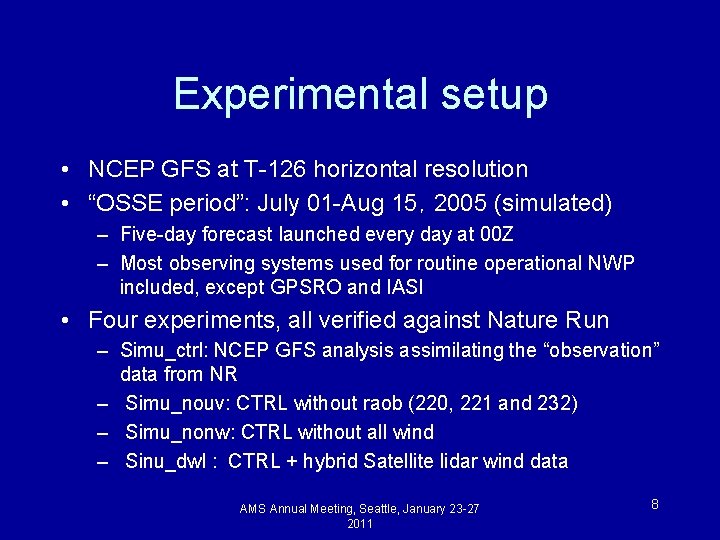
Experimental setup • NCEP GFS at T-126 horizontal resolution • “OSSE period”: July 01 -Aug 15,2005 (simulated) – Five-day forecast launched every day at 00 Z – Most observing systems used for routine operational NWP included, except GPSRO and IASI • Four experiments, all verified against Nature Run – Simu_ctrl: NCEP GFS analysis assimilating the “observation” data from NR – Simu_nouv: CTRL without raob (220, 221 and 232) – Simu_nonw: CTRL without all wind – Sinu_dwl : CTRL + hybrid Satellite lidar wind data AMS Annual Meeting, Seattle, January 23 -27 2011 8
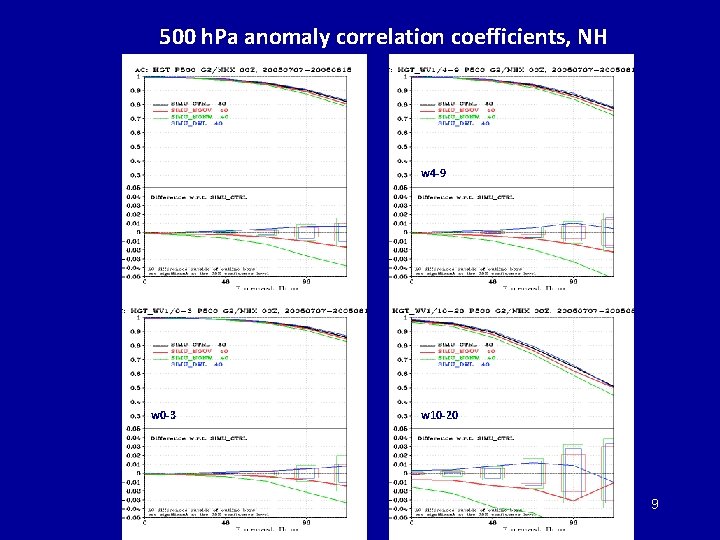
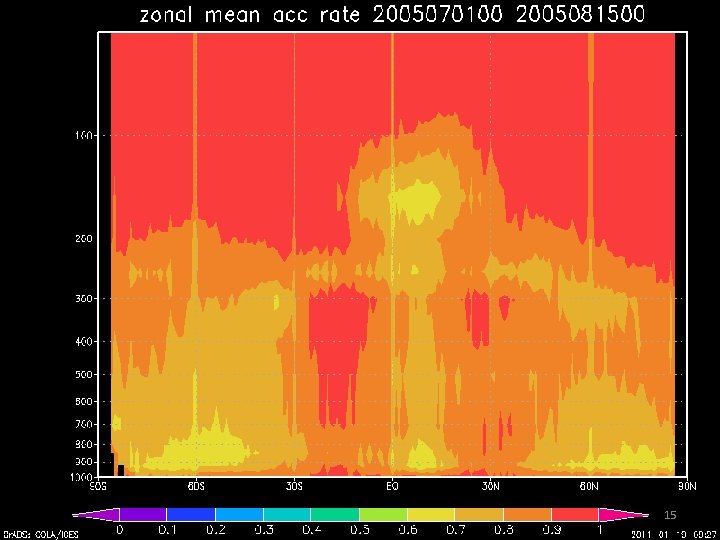
500 h. Pa anomaly correlation coefficients, NH w 4 -9 w 0 -3 w 10 -20 9
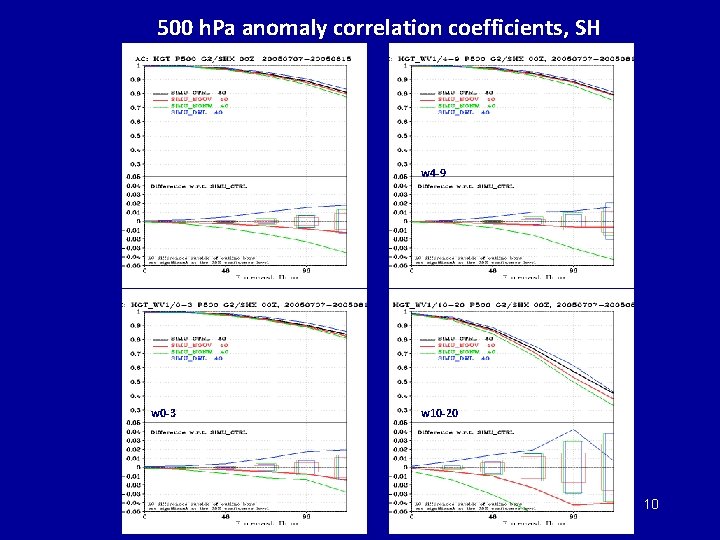
500 h. Pa anomaly correlation coefficients, SH w 4 -9 w 0 -3 w 10 -20 10
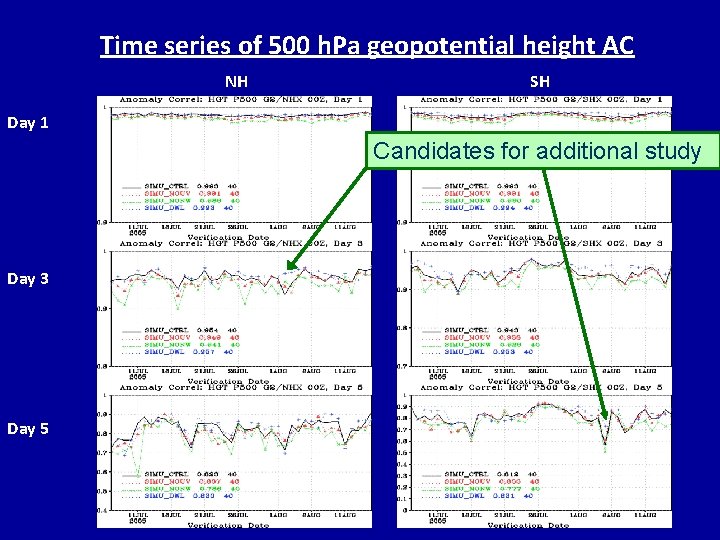
Time series of 500 h. Pa geopotential height AC NH SH Day 1 Candidates for additional study Day 3 Day 5 11
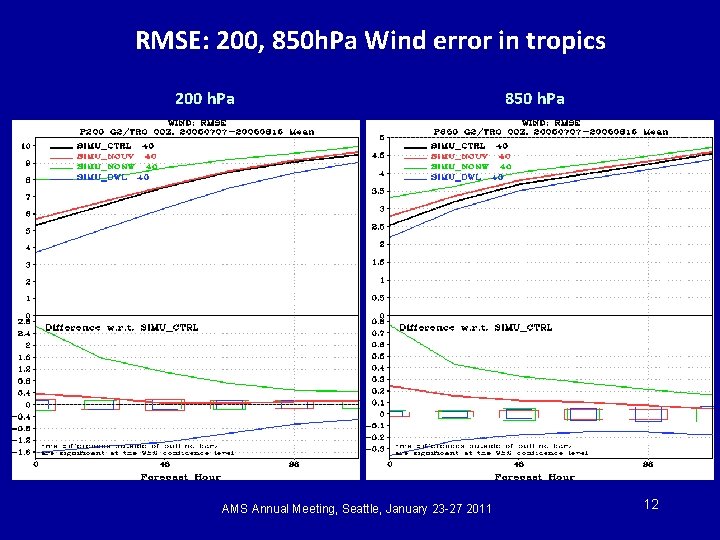
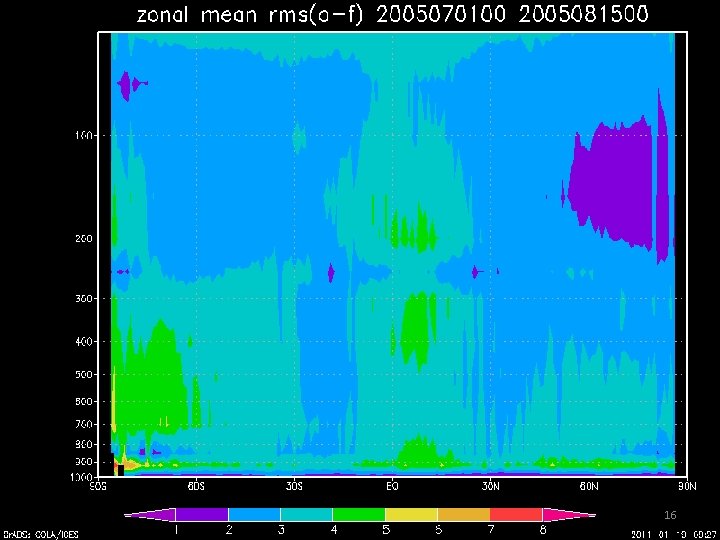
RMSE: 200, 850 h. Pa Wind error in tropics 200 h. Pa AMS Annual Meeting, Seattle, January 23 -27 2011 850 h. Pa 12
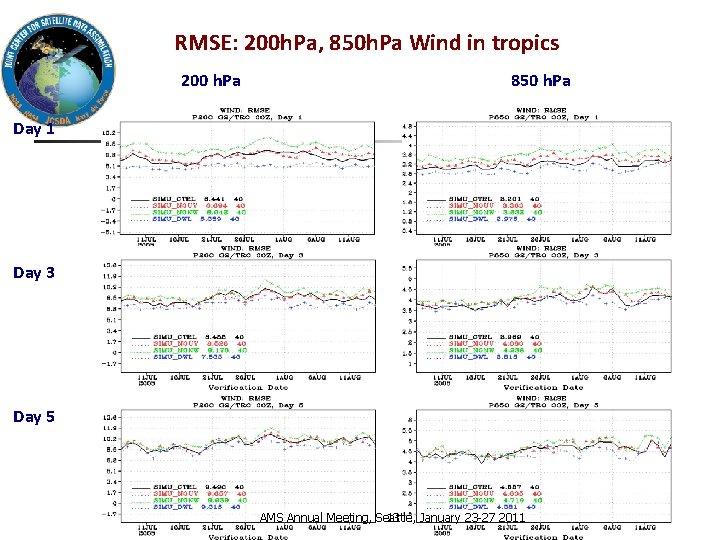
RMSE: 200 h. Pa, 850 h. Pa Wind in tropics 200 h. Pa 850 h. Pa Day 1 Day 3 Day 5 AMS Annual Meeting, Seattle, 13 January 23 -27 2011
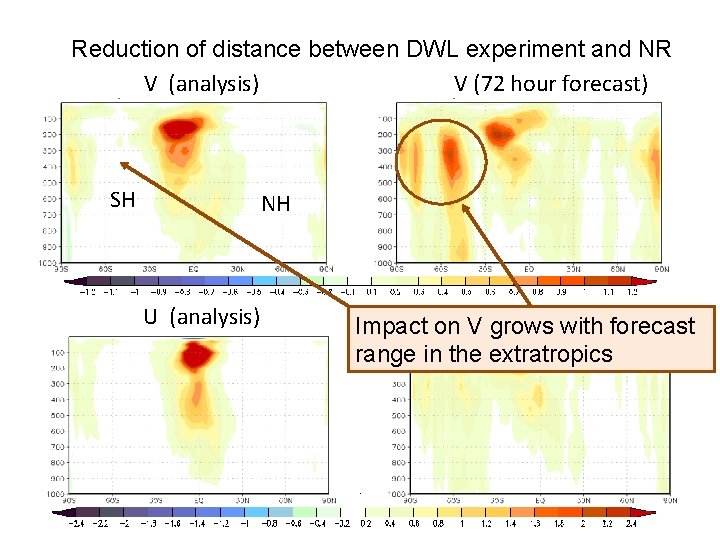
Reduction of distance between DWL experiment and NR V (analysis) V (72 hour forecast) SH NH U (analysis) hour with forecast) Impact on. UV(72 grows forecast range in the extratropics
15
16
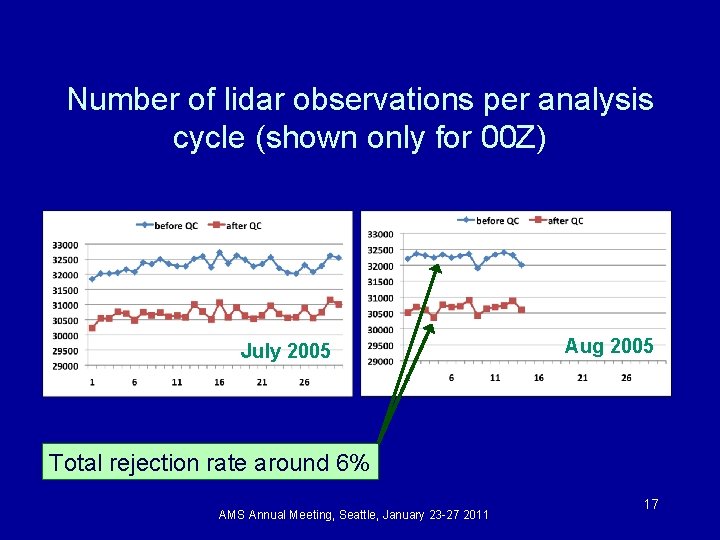
Number of lidar observations per analysis cycle (shown only for 00 Z) July 2005 Aug 2005 Total rejection rate around 6% AMS Annual Meeting, Seattle, January 23 -27 2011 17
Summary and conclusions n The lack of vertically resolved wind observations continue to be a major shortcoming of the Global Observing System n n n Space-borne wind lidar is the best option to meet this need A comprehensive OSSE system has been developed under the Joint OSSE collaboration Initial results simulating expected impact of GWOS observations on NCEP GFS system are very encouraging n n n Small positive impact in NH extratropics (summer) Larger positive impact in SH extratropics (winter) Very large positive impact in tropics; implications for hurricane forecasting AMS Annual Meeting, Seattle, January 23 -27 2011 18
Outlook n n n n Extend simulation into hurricane season (several Atlantic hurricanes in Nature Run “Oct 2005”) Experiment in opposite season (NH winter/SH summer) Increased horizontal resolution (T-382 and higher) Detailed case studies Separate assessments of the impacts of Direct Detection and Coherent Detection Impact of one, two or four telescopes on spacecraft Other orbits, e. g. different altitude, lower inclination Impact on applications other than NWP, e. g. chemical transport models Acknowledgments: Study funded primarily through Wind Lidar Science Element of NASA ROSES 2007 (Kakar). Additional resources including computing made available by NCEP/EMC. AMS Annual Meeting, Seattle, January 23 -27 2011 19
- Slides: 19