
Observing Children Child Development Mrs Mc Ginnis How
Observing Children Child Development Mrs. Mc. Ginnis
How is observing children different from reading about child development?

READING – Learn from experts and comprehend their theories. OBSERVING information. – You gain direct

What is the difference between watching and observing? To observe is to watch closely

Why are observation skills important for teachers & childcare workers? (record your ideas in your notebook-left side) They must keep children safe To understand individual children well enough to meet their needs.

Why observe children? The chance to see children as individuals. Important skill for teachers, parents, & caregivers. If observer is familiar with the stages of development, they can encourage children as they progress. Can get to know the child & adapt activities to their needs. Can identify disabilities or the need for extra care. Provide useful feedback. Stick to what works more effectively at earning children’s trust & cooperation.

Types of Observations RUNNING RECORDS Everything that you observe in a set time. Good for getting to know a child. When you need to concentrate on a certain area of development.
FREQUENCY COUNT A tally of how often a certain behavior occurs. Can be helpful to change unwanted behavior. Must find a baseline. (a count made before any steps to change a behavior are made). Can continue to utilize after changes are made to see if a child’s behavior changes.

ANECDOTAL RECORDS Concentrates on a child’s specific behavior or area of development. Usually no time limits.
DEVELOPMENTAL CHECKLIST A list of skills or behaviors that are to be developed by a certain age. Used for the observer to check off what they see.
HOW TO OBSERVE Follow the steps so observations are useful. ALWAYS separate fact from fiction; should be objective not subjective.
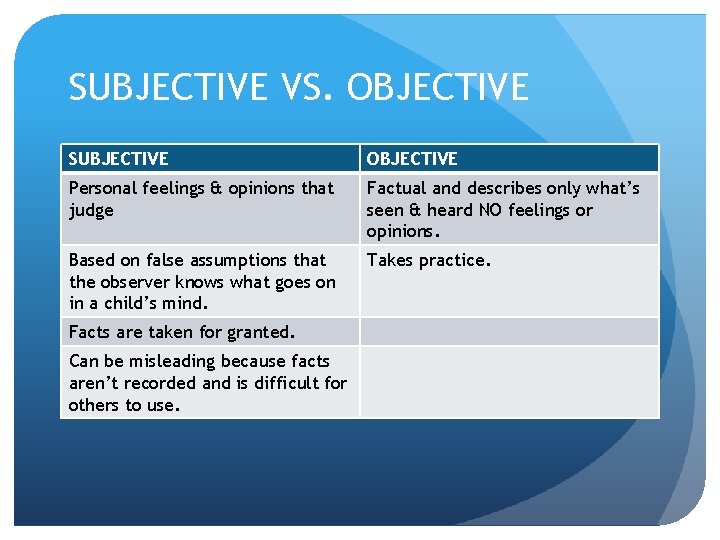
SUBJECTIVE VS. OBJECTIVE SUBJECTIVE OBJECTIVE Personal feelings & opinions that judge Factual and describes only what’s seen & heard NO feelings or opinions. Based on false assumptions that the observer knows what goes on in a child’s mind. Takes practice. Facts are taken for granted. Can be misleading because facts aren’t recorded and is difficult for others to use.
HOW TO ACT WHEN OBSERVING Try not to be noticed; blend into the environment. Understand the purpose of your observation before you start. Note basic information immediately, things happen fast. Be respectful of others. Be on time and follow check in procedures. Follow the rules of the center or school. Answer children’s questions honestly & briefly.
If you observe a child in danger…. Get a childcare worker immediately or prevent the accident.
GUIDELINES FOR OBSERVING Determine the place. Schedule a time. Know your objective. Be familiar with the development of the age group. Be respectful. Keep a low profile. Try not to interact with the children.
Start quickly with basic information, # of children & adults, ages of children, setting, time, date. Record exact observations-be objective. Notice specific details. Be patient. Be descriptive-make a picture of what you see. Make comparisons. Review and clarify what you saw. Complete the observation and write it up formally. KEEP IT CONFIDENTIAL!!!!!!
INTERPRET OBSERVATIONS Review your notes and rewrite or type if necessary. Type or re-write on assigned forms. Remain objective. Most observations are short and yours won’t match a professionals. KEEP ALL INFORMATION CONFIDENTIAL-----NO GOSSIP! Must turn in your notes to me with your observation.
- Slides: 17