
OBSERVING AND ASSESSING Activating StrategyWarm Up What is
OBSERVING AND ASSESSING
Activating Strategy-Warm Up What is an assessment? In your own words, explain what you believe is the purpose of an assessment. How can we use them in the early childhood classroom?

Discuss What do you note about the observation taking place in The picture?
Vocabulary: Page 53 Define in your notes the following terms: � Assessment � Developmental milestones � Anecdotal record � Checklist � Participation chart � Rating scale � Visual documentation � portfolio

Why Assess? We assess children to better understand their developmental needs Information should be collected over time and in all developmental areas
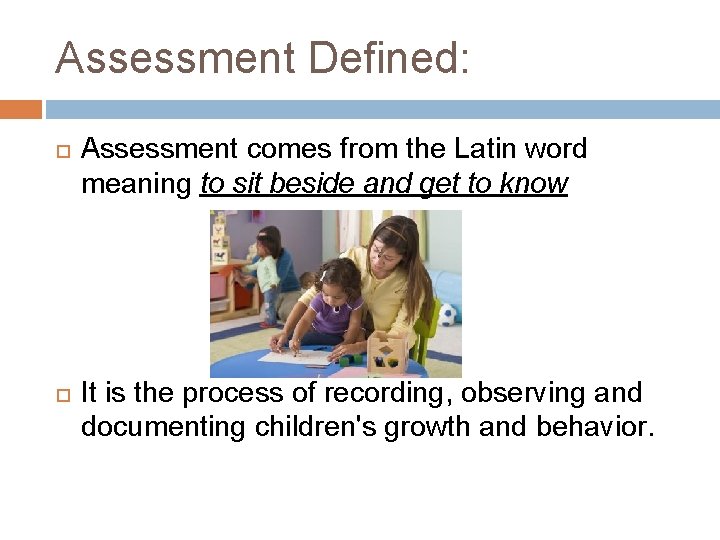
Assessment Defined: Assessment comes from the Latin word meaning to sit beside and get to know It is the process of recording, observing and documenting children's growth and behavior.
Purpose of Assessment During the assessment process, you, as teacher, gain insights into children’s learning styles and needs. � What are their strengths and weaknesses? � What does the group know? � What are they able to do ? � What are their interests and dispositions? � What are their needs?
Assessment When we create lessons, measurable objectives must be present. � Why am I creating this lesson? � What am I hoping students will learn? � What growth am I measuring?
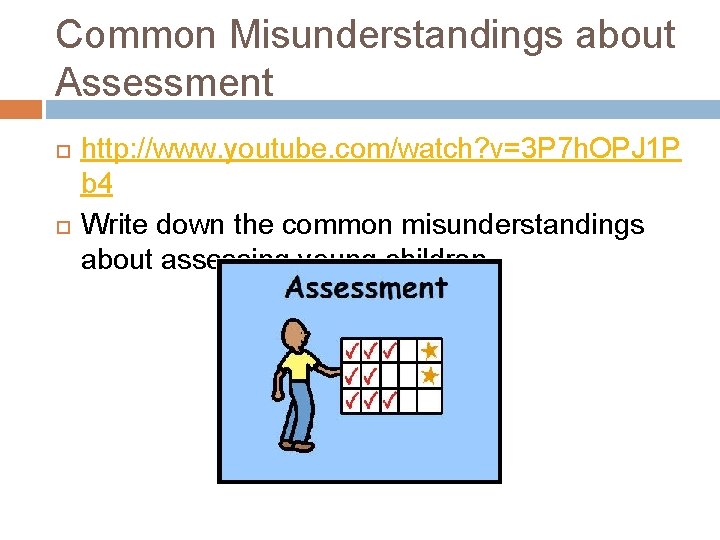
Common Misunderstandings about Assessment http: //www. youtube. com/watch? v=3 P 7 h. OPJ 1 P b 4 Write down the common misunderstandings about assessing young children
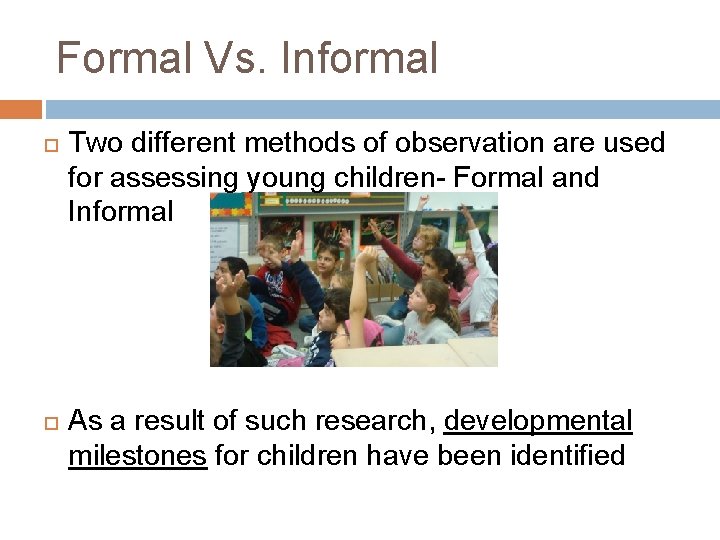
Formal Vs. Informal Two different methods of observation are used for assessing young children- Formal and Informal As a result of such research, developmental milestones for children have been identified
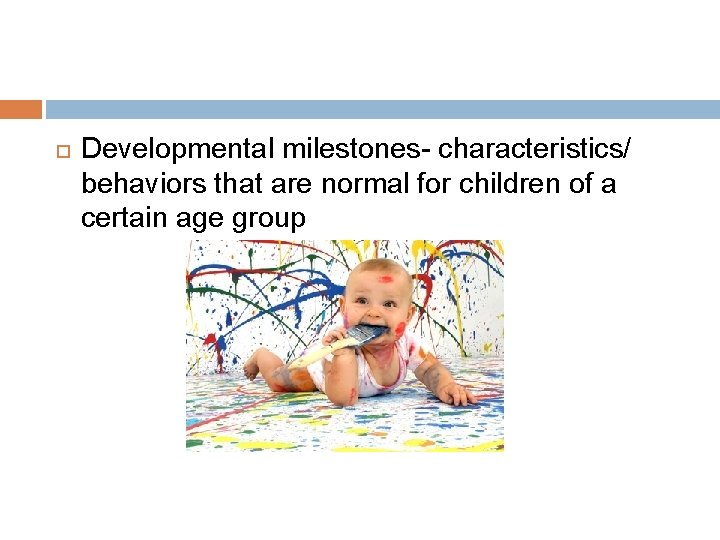
Developmental milestones- characteristics/ behaviors that are normal for children of a certain age group
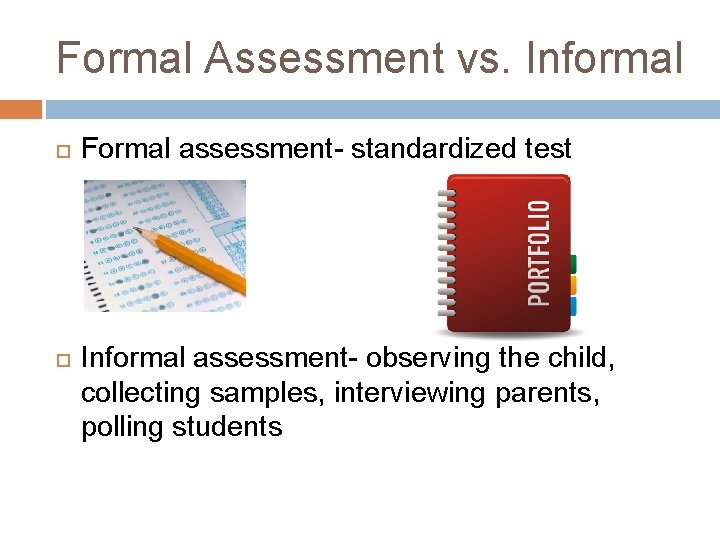
Formal Assessment vs. Informal Formal assessment- standardized test Informal assessment- observing the child, collecting samples, interviewing parents, polling students
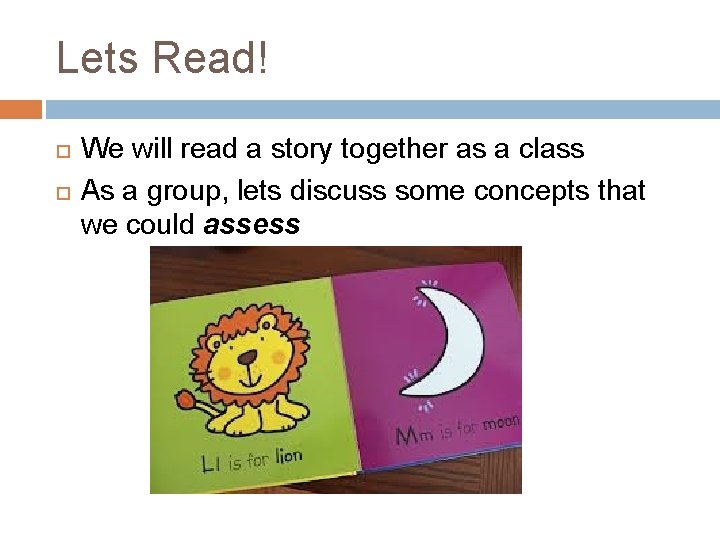
Lets Read! We will read a story together as a class As a group, lets discuss some concepts that we could assess
Example: Formal and Informal 1. Select two books from our Reading Center 2. READ your selection and become familiar with the story. For both of these books, you will determine two methods of assessment. One must be formal and the other will be informal � Students are three years old. They can talk in full sentences and express thoughts to adults � They are beginning to write their names � They are familiar with the letters A-Z � They are familiar with the letters 1 -10
Agenda Warm Up: Observation and Anecdotal Record Activities

Why Observe? An observation is watching children with the clear goal of studying a specific behavior or ability � develop realistic curriculum and goals � in order to challenge and support the children
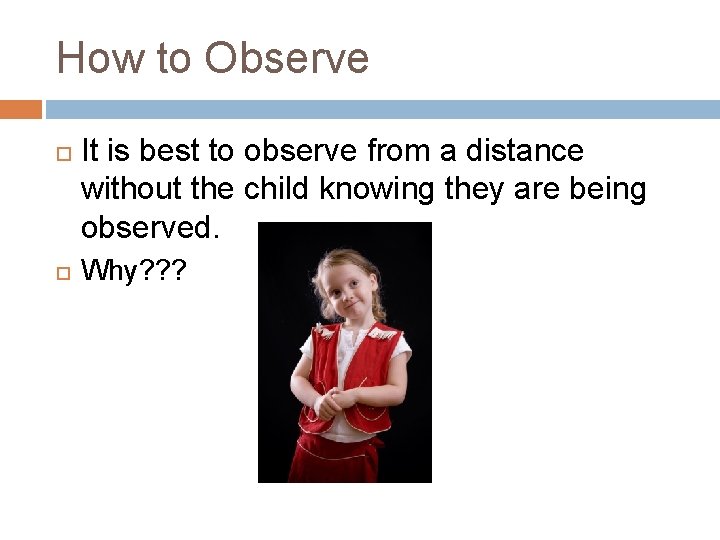
How to Observe It is best to observe from a distance without the child knowing they are being observed. Why? ? ?
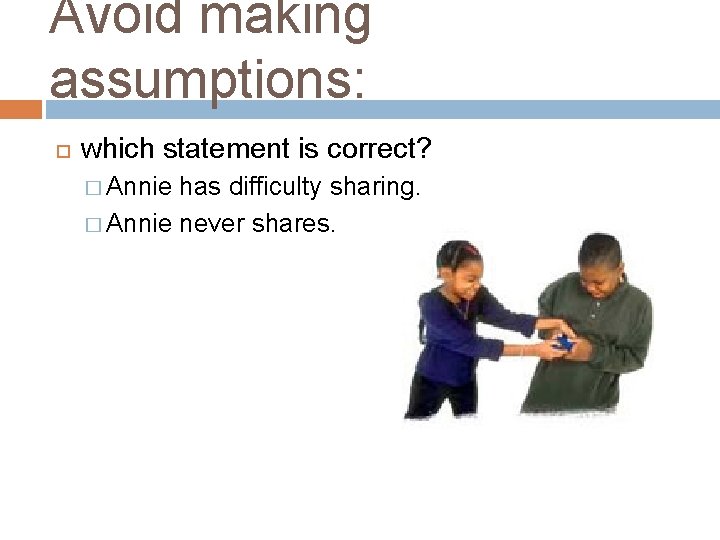
Avoid making assumptions: which statement is correct? � Annie has difficulty sharing. � Annie never shares.
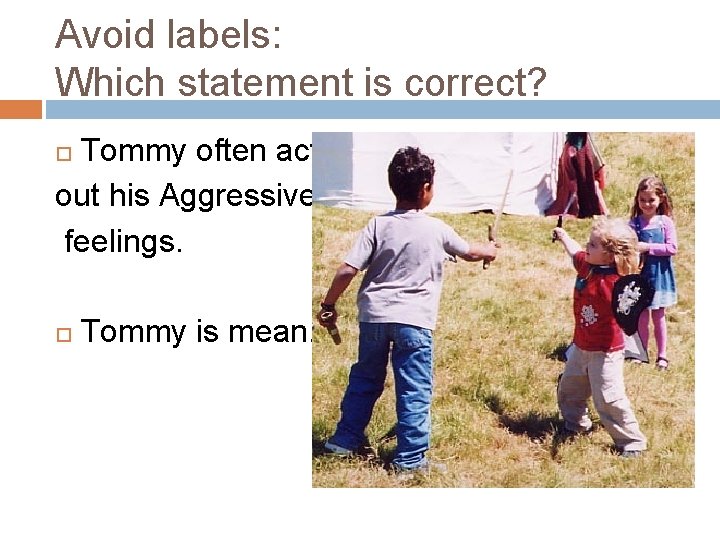
Avoid labels: Which statement is correct? Tommy often acts out his Aggressive feelings. Tommy is mean.
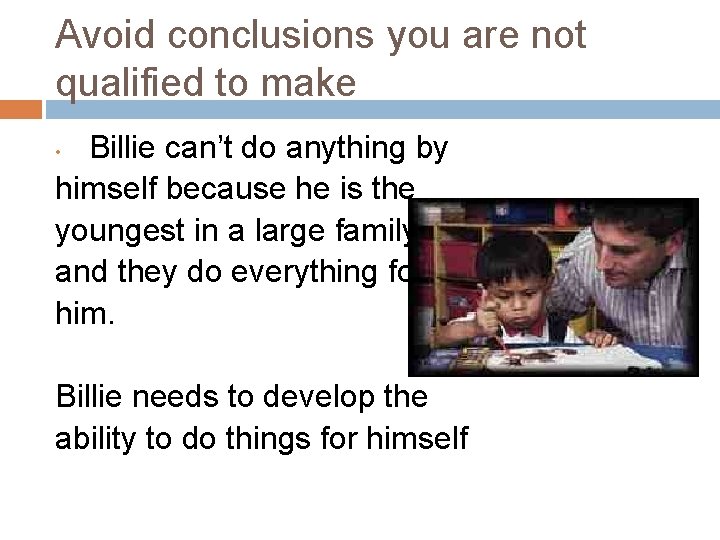
Avoid conclusions you are not qualified to make Billie can’t do anything by himself because he is the youngest in a large family and they do everything for him. • Billie needs to develop the ability to do things for himself
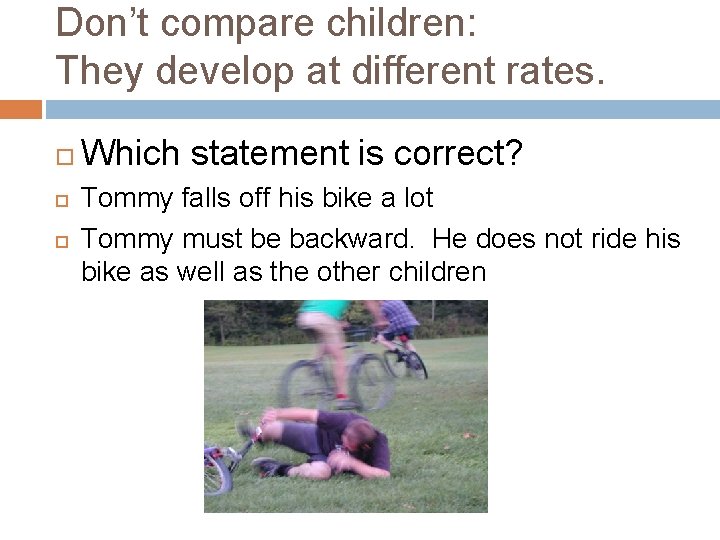
Don’t compare children: They develop at different rates. Which statement is correct? Tommy falls off his bike a lot Tommy must be backward. He does not ride his bike as well as the other children
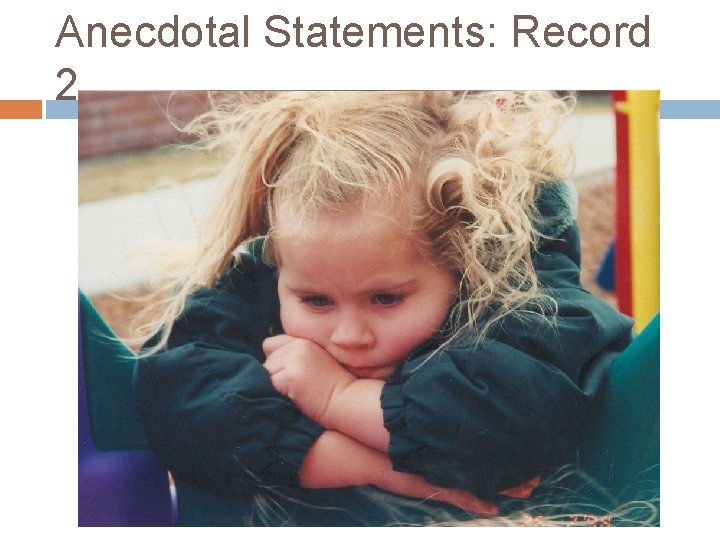
Anecdotal Statements: Record 2
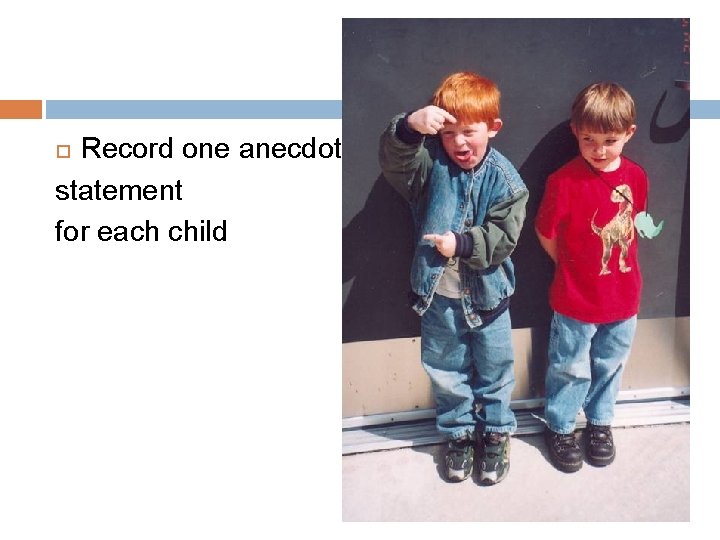
Record one anecdotal statement for each child
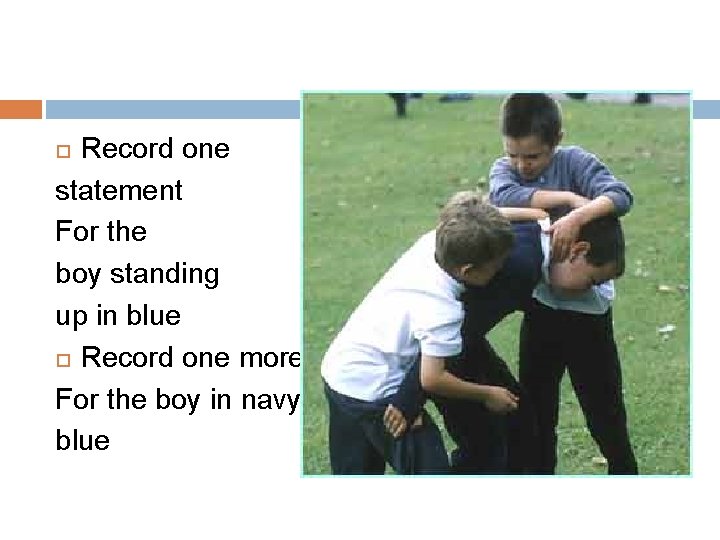
Record one statement For the boy standing up in blue Record one more For the boy in navy blue
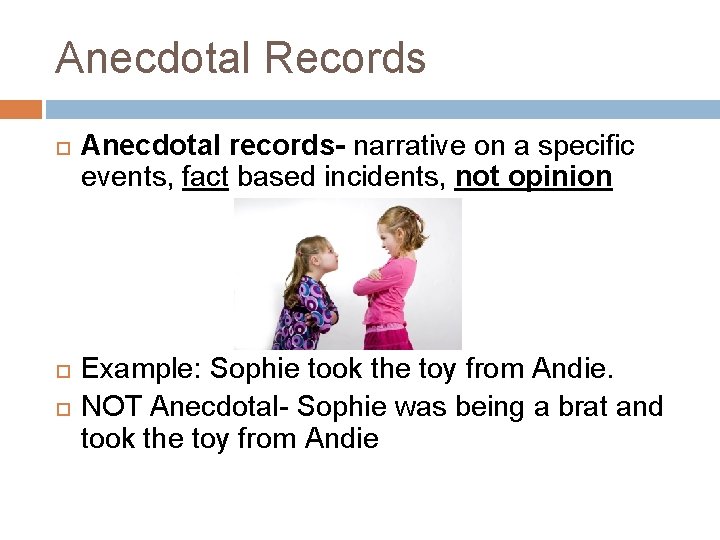
Anecdotal Records Anecdotal records- narrative on a specific events, fact based incidents, not opinion Example: Sophie took the toy from Andie. NOT Anecdotal- Sophie was being a brat and took the toy from Andie
Anecdotal Record Lets do some observations! � Toddler Video � http: //www. youtube. com/watch? v=7 n. Qx. WCn_d. Bg � Kindergarten Circle Time � http: //www. youtube. com/watch? v=Zsgoz 9_c 21 w
BE OBJECTIVE Objective observations simply state the facts. It is important but difficult to remain objective at all time. The first thing to record when observing is an objective list of behavior patterns
Checklists designed to record the presence or absence of specific traits or behaviors They are easy to use and are especially helpful when many different items need to be observed Checklists can be used in any developmental domain: Physical, Intellectual, Emotional or Social
Checklists can be used to survey one child or a group of children. The targeted behaviors are listed in logical order with similar items grouped together � This way, you can quickly record the presence or absence of a behavior.
Using Checklists Review Checklist http: //www. youtube. com/watch? v=0 Egr 2 Xxr 95 k
Compare and Contrast Write a paragraph comparing and contrasting the use of Anecdotal Records and Checklists. Make sure to include the strengths and weaknesses of anecdotal records versus checklists Which method do you prefer and why?
Participation Charts A participation chart can be developed to gain information on specific aspects of children’s behavior � Examples include children’s activity preferences during self-selected play or recording the time each child falls asleep at nap time.
Why use Participation charts? Sometimes teachers realize that children’s preferences do not match their needs � Example: Jimmy has weak hand-eye coordination skills. A chart would show he spends most of his time listening to stories and music and watching other children play. To meet Jimmy’s needs, the teacher could introduce him to interesting art activities, puzzles and other small manipulative learning aids.
Participation charts- can help determine what the child enjoys doing, can gain specific info on behavior http: //www. youtube. com/watch? v=sg. Kkfz. MPp a. E
Rating scale- similar to checklists, but determine how frequently something occurs
- Slides: 35