
Observing and Asking Questions Scientists observe a situation

Observing and Asking Questions • Scientists observe a situation and ask questions about it. • Why? • How much? • In which circumstances? • et cetera (etc. )
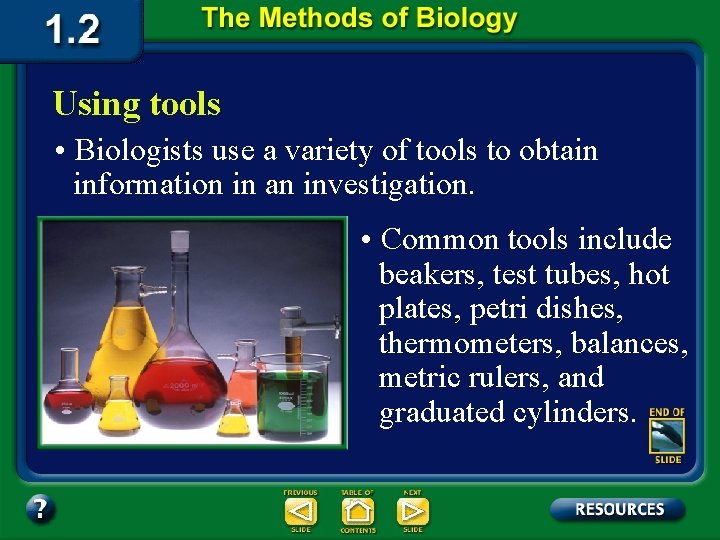
Using tools • Biologists use a variety of tools to obtain information in an investigation. • Common tools include beakers, test tubes, hot plates, petri dishes, thermometers, balances, metric rulers, and graduated cylinders.
The methods biologists use • A hypothesis is an explanation for a question or a problem that can be formally tested. • A hypothesis is not a random guess.
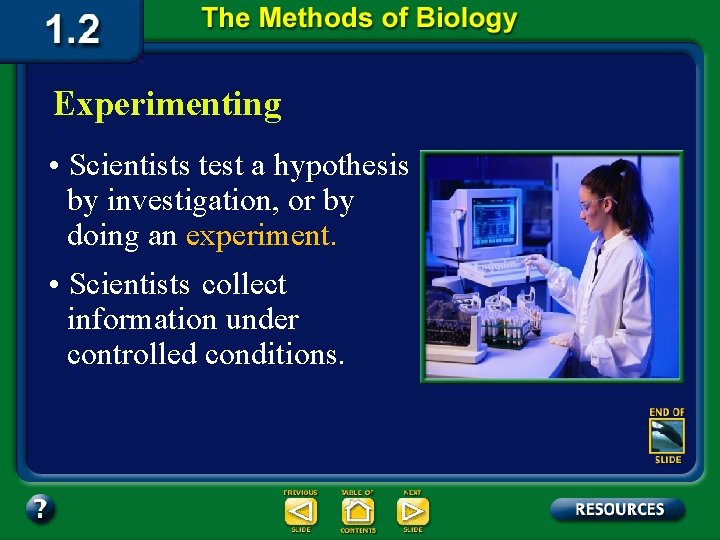
Experimenting • Scientists test a hypothesis by investigation, or by doing an experiment. • Scientists collect information under controlled conditions.
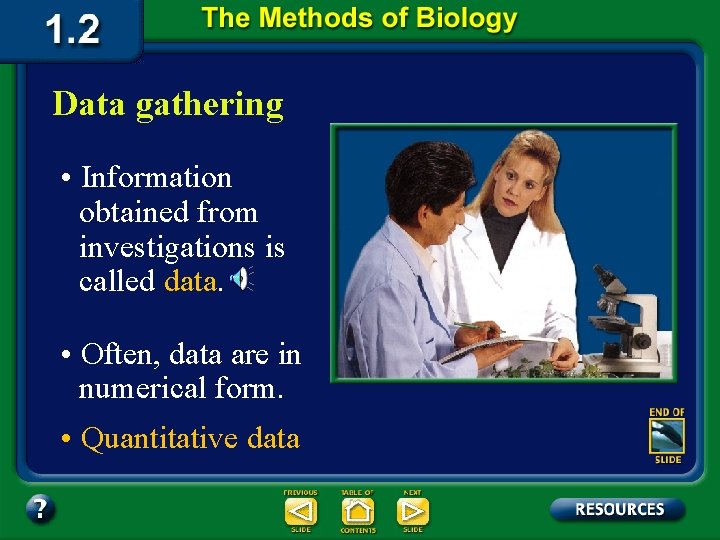
Data gathering • Information obtained from investigations is called data. • Often, data are in numerical form. • Quantitative data
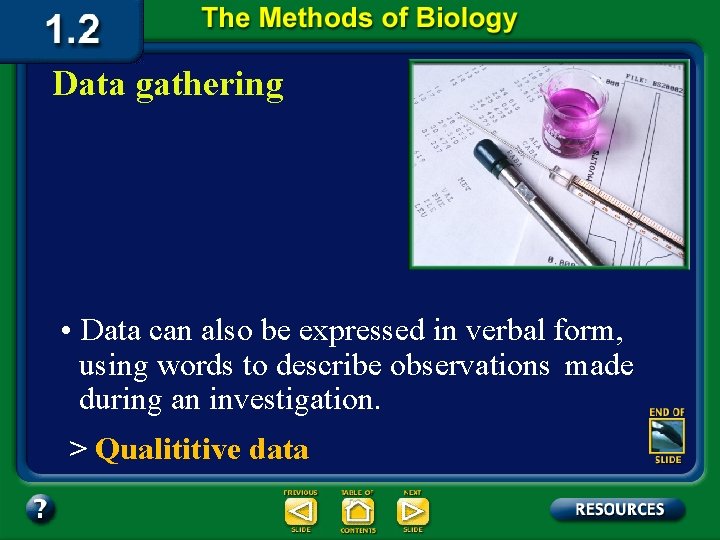
Data gathering • Data can also be expressed in verbal form, using words to describe observations made during an investigation. > Qualititive data
Thinking about what happened After careful review of the results, the scientist must come to a conclusion: • Was the hypothesis supported by the data? • Are more data needed? • If the data did not support the hypothesis, a new hypothesis is developed, and another experiment is done to test it.
Mystery Tube Activity
Verifying results • After results of an investigation have been published, other scientists can try to verify the results by repeating the procedure. • When a hypothesis is supported by data from additional investigations, it is considered valid and is generally accepted by the scientific community.
The methods biologists use • Scientists may test a hypothesis by conducting an experiment. • The results of the experiment will help the scientist draw a conclusion about whether or not the hypothesis is correct.
Theories and laws • In science, a hypothesis that is supported by many separate observations and investigations, usually over a long period of time, becomes a theory. • A theory is an explanation of a natural phenomenon that is supported by a large body of scientific evidence obtained from many different investigations and observations.
Section Summary
The Methods of Biology • Scientific methods are used by scientists to answer questions or solve problems. Scientific methods include observing, making a hypothesis, collecting data, publishing results, forming a theory, developing new hypotheses, and revising theory.
The Methods of Biology • Biologists use controlled experiments to obtain data that either do or do not support a hypothesis. By publishing the results and conclusions of an experiment, a scientist allows others to try to verify the results. Repeated verification over time leads to the development of a theory.
Tools & Safety
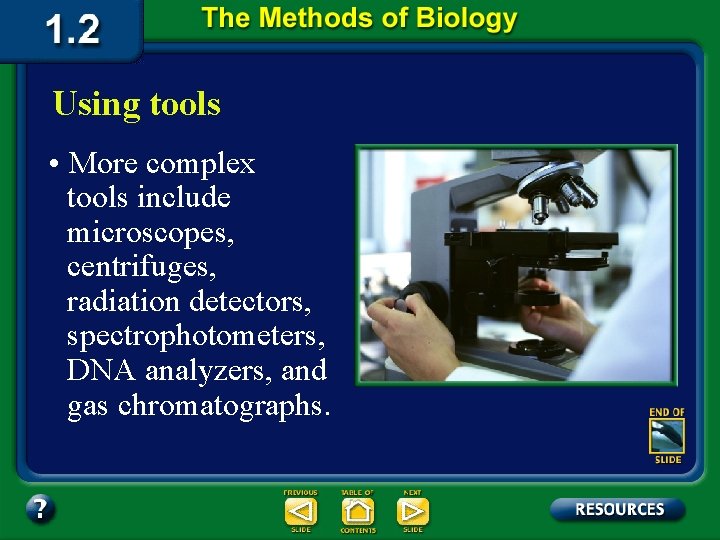
Using tools • More complex tools include microscopes, centrifuges, radiation detectors, spectrophotometers, DNA analyzers, and gas chromatographs.
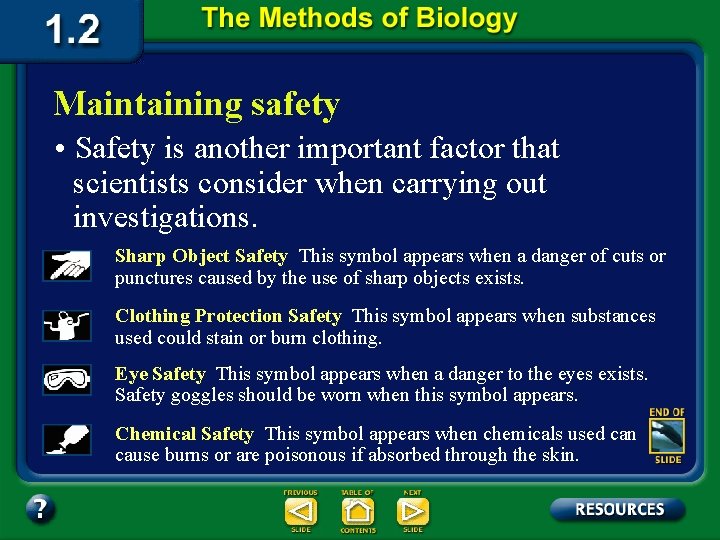
Maintaining safety • Safety is another important factor that scientists consider when carrying out investigations. Sharp Object Safety This symbol appears when a danger of cuts or punctures caused by the use of sharp objects exists. Clothing Protection Safety This symbol appears when substances used could stain or burn clothing. Eye Safety This symbol appears when a danger to the eyes exists. Safety goggles should be worn when this symbol appears. Chemical Safety This symbol appears when chemicals used can cause burns or are poisonous if absorbed through the skin.
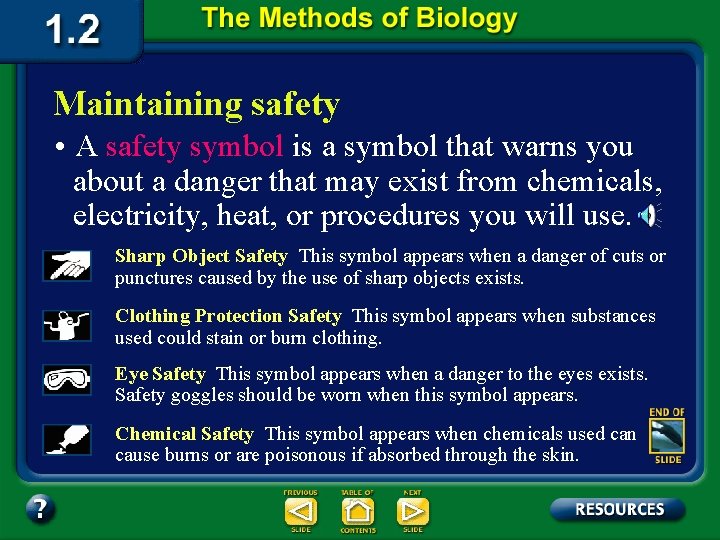
Maintaining safety • A safety symbol is a symbol that warns you about a danger that may exist from chemicals, electricity, heat, or procedures you will use. Sharp Object Safety This symbol appears when a danger of cuts or punctures caused by the use of sharp objects exists. Clothing Protection Safety This symbol appears when substances used could stain or burn clothing. Eye Safety This symbol appears when a danger to the eyes exists. Safety goggles should be worn when this symbol appears. Chemical Safety This symbol appears when chemicals used can cause burns or are poisonous if absorbed through the skin.
Section Check
Question 1 What is the difference between a hypothesis and an observation? CA: Inv. & Exp. 1 f, 1 n
A hypothesis is an explanation for a question or problem and can be formally tested. An observation is something that has been noticed, often generating questions that lead to the formation of a hypothesis. CA: Inv. & Exp. 1 f, 1 n
Question 2 A scientist conducts an experiment to test the effect of light on plant growth. In each experiment, three plants of the same variety are each given 10 m. L of water. One plant is exposed to full sunlight for 8 hours, one is exposed to full sunlight for 4 hours, and one plant is kept in a dark room. Plant height is measured after two weeks. What is the independent variable in this experiment? CA: Inv. & Exp. 1 j
Question 2 What is the independent variable in this experiment? A. soil volume B. amount of sunlight C. plant height D. amount of water CA: Inv. & Exp. 1 j
The answer is B. The independent variable is the condition that is changed. In this case, the amount of sunlight is changed for each plant. Plant heights are measured results of the experiment, so plant height is the dependent variable. CA: Inv. & Exp. 1 j
Question 3 Which of the following is the group in an experiment in which all conditions are kept the same? A. standard B. independent variable C. experimental D. control CA: Inv. & Exp. 1 j
The answer is D. Conditions are kept the same in the control group. The experimental group is the test group. CA: Inv. & Exp. 1 j
Question 4 Compare the terms "theory" and "principle". CA: Inv. & Exp. 1 f, 1 n
A theory is an explanation of a natural phenomenon that is supported by a large body of scientific evidence. A principle is a fact of nature, generally known to be true, such as the law of gravity. CA: Inv. & Exp. 1 f, 1 n
- Slides: 29