
Observing a Lunar Impact Karen J Meech Astronomer
Observing a Lunar Impact Karen J. Meech, Astronomer Institute for Astronomy University of Hawaii, NASA Astrobiology Institute AAVSO Conference May 4 -6, 2006
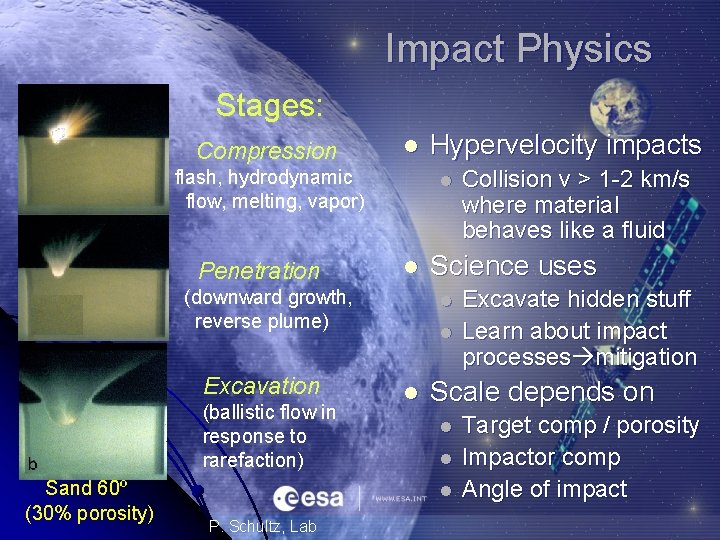
Impact Physics Stages: Compression l flash, hydrodynamic flow, melting, vapor) Penetration l l (downward growth, reverse plume) Excavation (ballistic flow in response to rarefaction) Sand 60º (30% porosity) Hypervelocity impacts Science uses l l l Excavate hidden stuff Learn about impact processes mitigation Scale depends on l l l P. Schultz, Lab Collision v > 1 -2 km/s where material behaves like a fluid Target comp / porosity Impactor comp Angle of impact
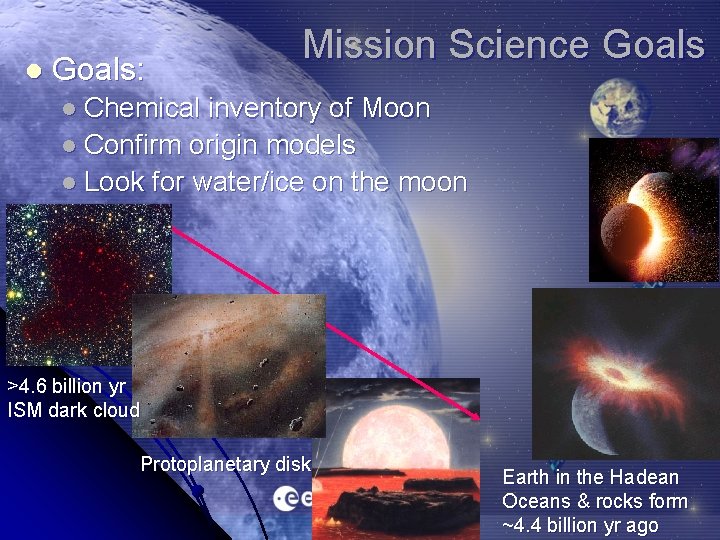
l Goals: Mission Science Goals l Chemical inventory of Moon l Confirm origin models l Look for water/ice on the moon >4. 6 billion yr ISM dark cloud Protoplanetary disk Earth in the Hadean Oceans & rocks form ~4. 4 billion yr ago
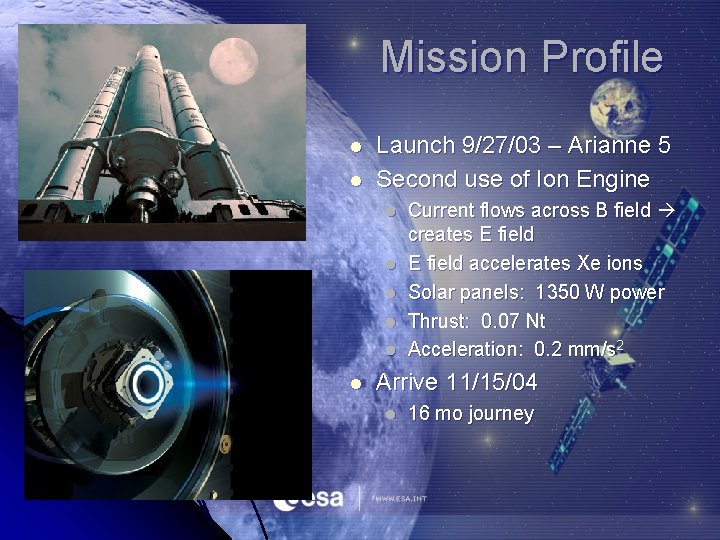
Mission Profile l l Launch 9/27/03 – Arianne 5 Second use of Ion Engine l l l Current flows across B field creates E field accelerates Xe ions Solar panels: 1350 W power Thrust: 0. 07 Nt Acceleration: 0. 2 mm/s 2 Arrive 11/15/04 l 16 mo journey
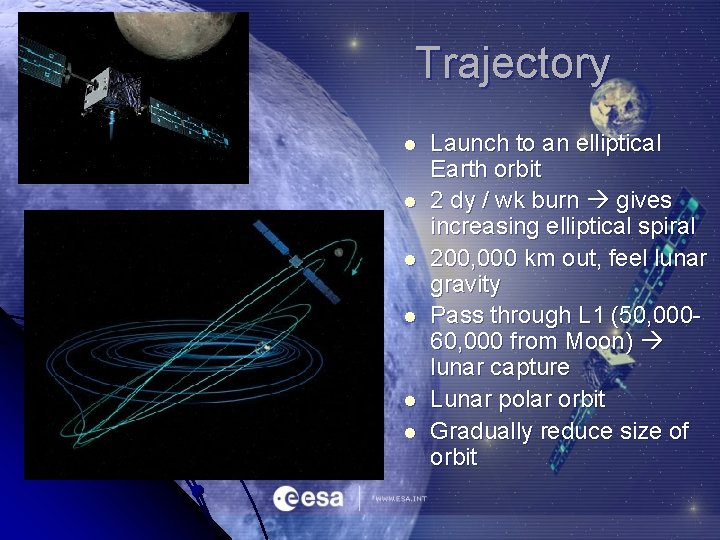
Trajectory l l l Launch to an elliptical Earth orbit 2 dy / wk burn gives increasing elliptical spiral 200, 000 km out, feel lunar gravity Pass through L 1 (50, 00060, 000 from Moon) lunar capture Lunar polar orbit Gradually reduce size of orbit
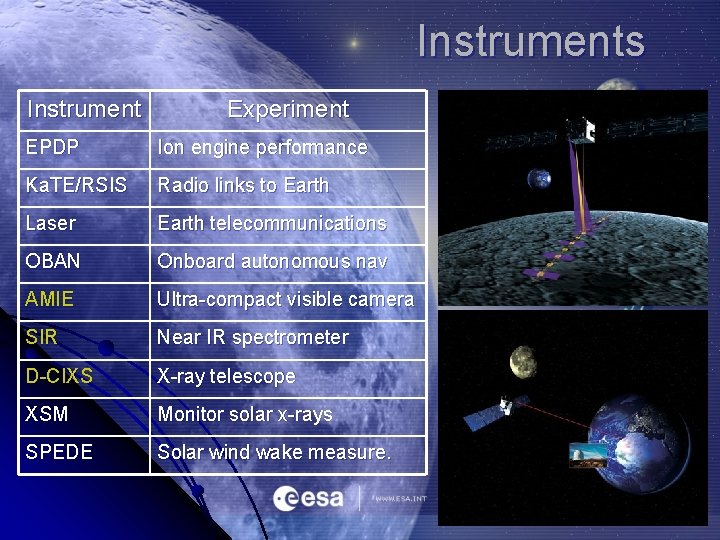
Instruments Instrument Experiment EPDP Ion engine performance Ka. TE/RSIS Radio links to Earth Laser Earth telecommunications OBAN Onboard autonomous nav AMIE Ultra-compact visible camera SIR Near IR spectrometer D-CIXS X-ray telescope XSM Monitor solar x-rays SPEDE Solar wind wake measure.
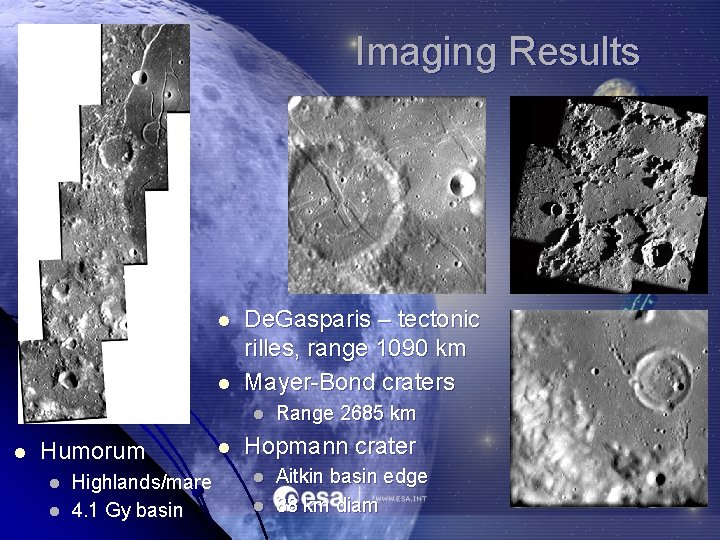
Imaging Results l l De. Gasparis – tectonic rilles, range 1090 km Mayer-Bond craters l l Humorum l l Highlands/mare 4. 1 Gy basin l Range 2685 km Hopmann crater l l Aitkin basin edge 88 km diam
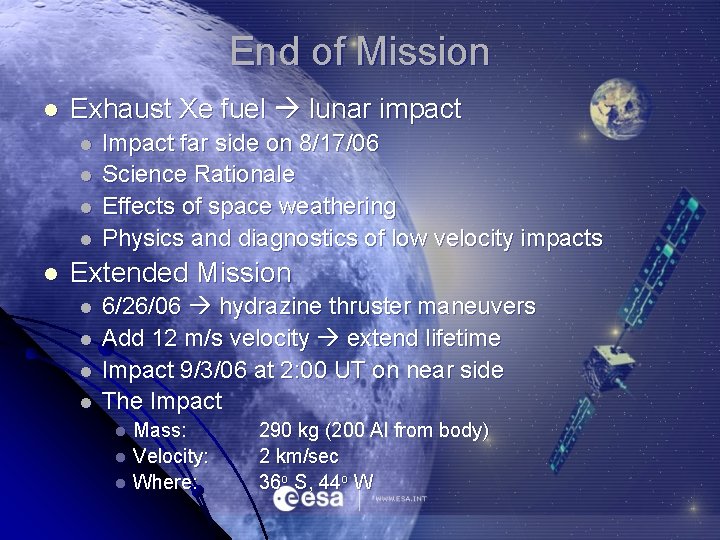
End of Mission l Exhaust Xe fuel lunar impact l l l Impact far side on 8/17/06 Science Rationale Effects of space weathering Physics and diagnostics of low velocity impacts Extended Mission l l 6/26/06 hydrazine thruster maneuvers Add 12 m/s velocity extend lifetime Impact 9/3/06 at 2: 00 UT on near side The Impact Mass: l Velocity: l Where: l 290 kg (200 Al from body) 2 km/sec 36 o S, 44 o W
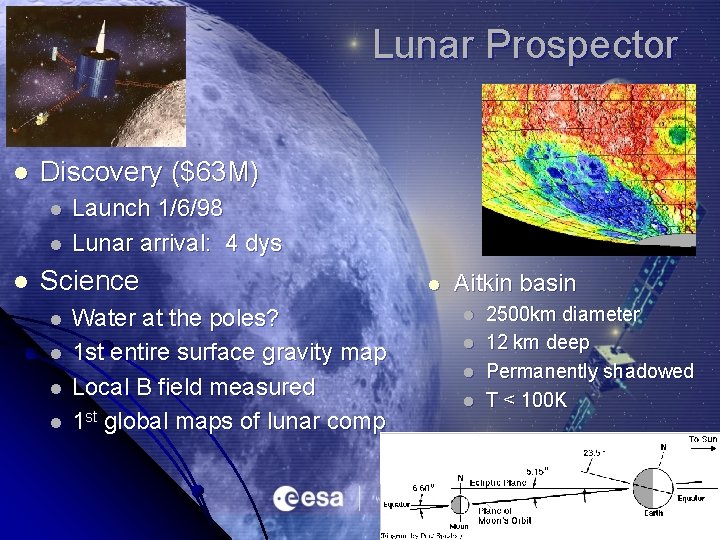
Lunar Prospector l Discovery ($63 M) l l l Launch 1/6/98 Lunar arrival: 4 dys Science l l Water at the poles? 1 st entire surface gravity map Local B field measured 1 st global maps of lunar comp l Aitkin basin l l 2500 km diameter 12 km deep Permanently shadowed T < 100 K
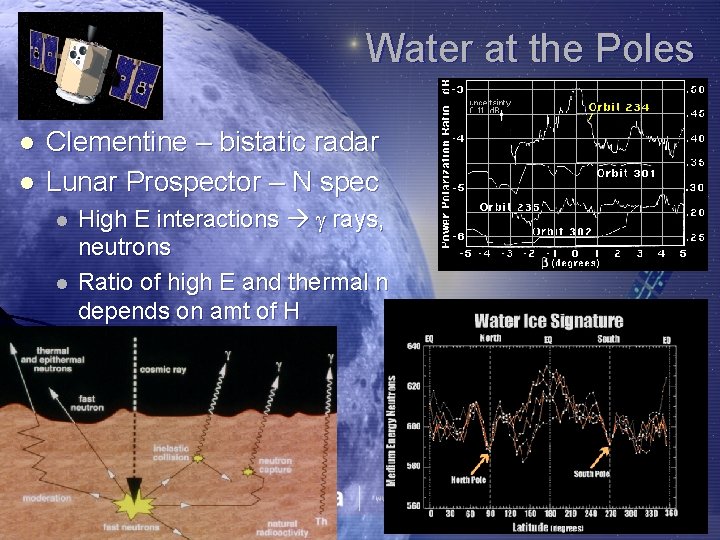
Water at the Poles l l Clementine – bistatic radar Lunar Prospector – N spec l l High E interactions g rays, neutrons Ratio of high E and thermal n depends on amt of H
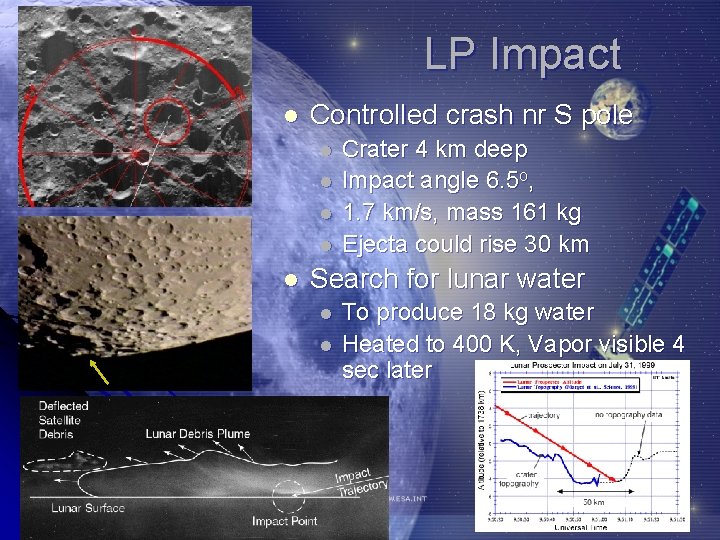
LP Impact l Controlled crash nr S pole l l l Crater 4 km deep Impact angle 6. 5 o, 1. 7 km/s, mass 161 kg Ejecta could rise 30 km Search for lunar water l l To produce 18 kg water Heated to 400 K, Vapor visible 4 sec later
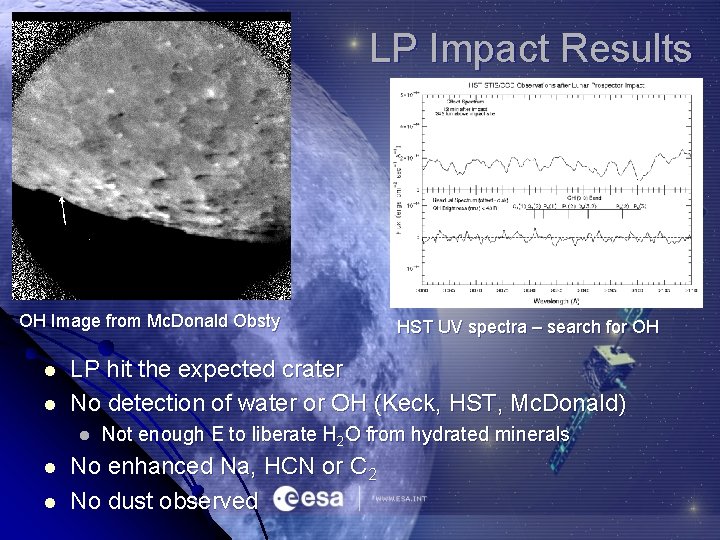
LP Impact Results OH Image from Mc. Donald Obsty l l LP hit the expected crater No detection of water or OH (Keck, HST, Mc. Donald) l l l HST UV spectra – search for OH Not enough E to liberate H 2 O from hydrated minerals No enhanced Na, HCN or C 2 No dust observed
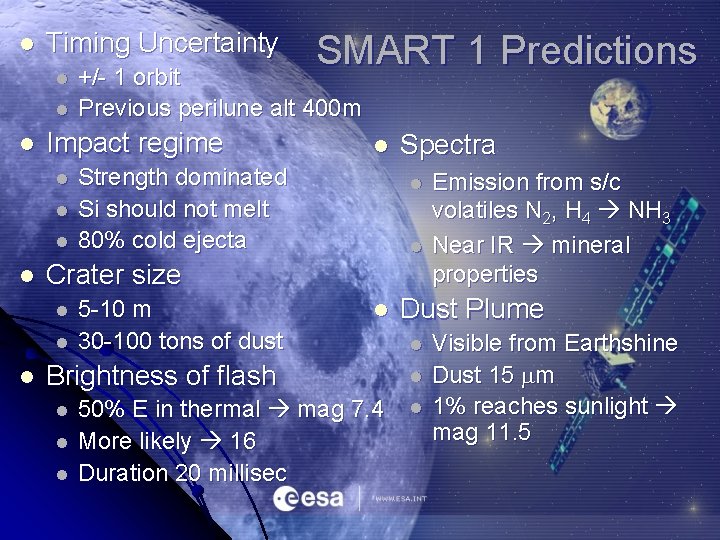
l Timing Uncertainty l l l l Strength dominated Si should not melt 80% cold ejecta Spectra l l Crater size l l l +/- 1 orbit Previous perilune alt 400 m Impact regime l SMART 1 Predictions 5 -10 m 30 -100 tons of dust l Brightness of flash l l l 50% E in thermal mag 7. 4 More likely 16 Duration 20 millisec Emission from s/c volatiles N 2, H 4 NH 3 Near IR mineral properties Dust Plume l l l Visible from Earthshine Dust 15 mm 1% reaches sunlight mag 11. 5
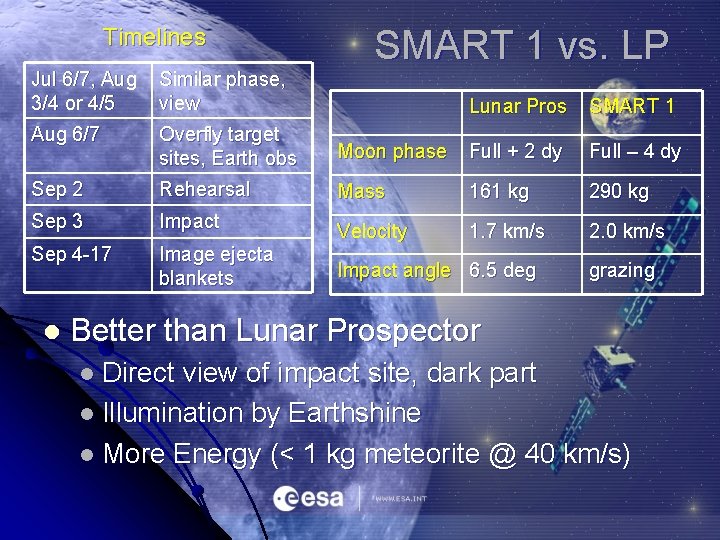
Timelines Jul 6/7, Aug 3/4 or 4/5 Similar phase, view Aug 6/7 Overfly target sites, Earth obs Sep 2 SMART 1 vs. LP Lunar Pros SMART 1 Moon phase Full + 2 dy Full – 4 dy Rehearsal Mass 161 kg 290 kg Sep 3 Impact Velocity 1. 7 km/s 2. 0 km/s Sep 4 -17 Image ejecta blankets Impact angle 6. 5 deg l grazing Better than Lunar Prospector l Direct view of impact site, dark part l Illumination by Earthshine l More Energy (< 1 kg meteorite @ 40 km/s)
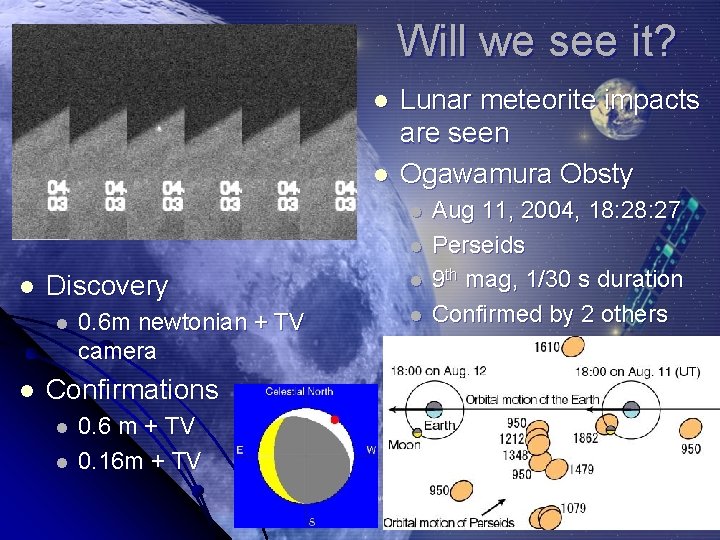
Will we see it? l l Lunar meteorite impacts are seen Ogawamura Obsty l l l Discovery l l 0. 6 m newtonian + TV camera Confirmations l l 0. 6 m + TV 0. 16 m + TV l l Aug 11, 2004, 18: 27 Perseids 9 th mag, 1/30 s duration Confirmed by 2 others
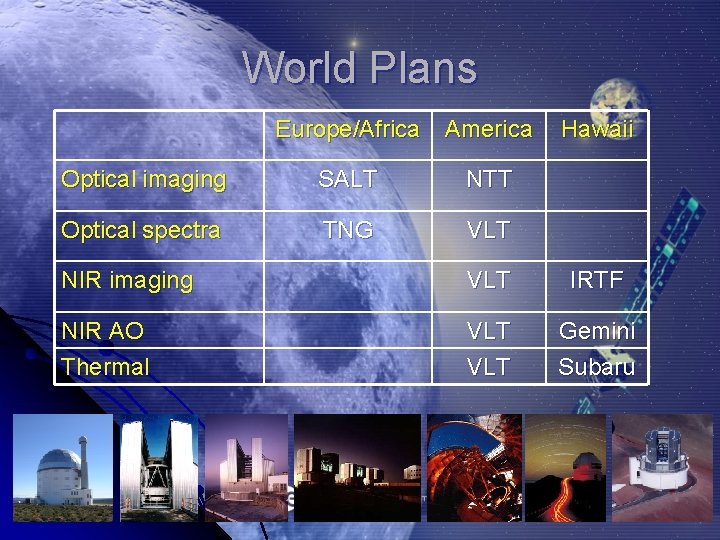
World Plans Europe/Africa America Optical imaging SALT NTT Optical spectra TNG VLT Hawaii NIR imaging VLT IRTF NIR AO Thermal VLT Gemini Subaru
- Slides: 16