
Observations on Observational Research Observational Research Casual every
Observations on Observational Research
Observational Research • Casual every day observations – Interesting – informative - important • Scientific Observation – “. . is made under precisely defined conditions, in a systematic and objective manner, and with careful record-keeping. ” p. 93 SZZ – Use of constructs, avoid bias and have organized records • Part of “descriptive methods” approach – Describe behavior fully and accurately – Which is difficult to do 2
Observational Research • Researchers cannot observe – All of a person’s behavior – All people’s behavior • Behavior is influenced by the situation • However, Researchers can observe – Samples of individuals – Samples of behavior at particular times – Samples of different settings and conditions 3
Sampling Behavior • Goal of samples – Representative of • Behaviors • People • Settings and conditions • Example: – How many hours of television did you watch last week? • Is this number representative of how much you typically watch tv? • Is the average for the class representative of the number of hours of tv watched by – all students on campus? – all college students? – all people? 4

Sampling Behavior • Use data from a sample to represent the population – “Generalize” the findings from sample to population – Sample must be representative of the population • External validity – “Validity” refers to “truthfulness. ” – Extent to which a study’s findings may be used to describe people, settings, conditions beyond those used in the study. – Allows generalization from sample to population 5
Sampling Behavior • External validity depends on how behavior is sampled. • Two methods are – time sampling – situation sampling • Researchers typically use a combination of both methods. • The goal of both methods is to obtain a representative sample of behavior. 6
Sampling Behavior • Time Sampling: Researchers choose time intervals for making observations to get representative samples – Systematic: Schedule observations to occur at a regular time (day of the week, time of day, etc. ). – Random: Use some random means for identifying times for observations (set intervals, randomly distributed across the day, week, etc. ). – Use of electronics • Automated recording device “EAR” Box 4. 1 • Apps on a smart phone • “Smart TV” internet connected TV 7
Sampling Behavior • Time Sampling: – Time sampling is not used when researchers wish to observe rare events (e. g. , behavior following a hurricane). – Event sampling is used for rare events (for example, the researcher travels to the site of a recent hurricane). – See: “Seared in our memories” memory of terrorist attacks of September 11 8
Sampling Behavior • Situation Sampling: Researchers choose different – – Settings (locations) Quad, Parking Lot, Library, Office Circumstances; alone, group, taking a test, hanging out Conditions; hot, cold, time pressure, chilling & grilling In situations with large numbers of people, researchers may use subject sampling to observe some people in the setting (e. g. , choose every 5 th person to enter a store). • Demonstrate external validity of findings when – Similar behavior across situations i. e. helping behavior – However, some behavior is situation specific 9
Box 4. 2 Observation: taking another look • Observing behavior in natural settings is common in ethology • Ethology Movement focused on instinctive behavior such as nest building and imprinting • Also used in ethnography studies – for example Eibl-Eibesfeldt (more on this next time) • Objective observation forms the basis for theory construction – For example observation of same-sex parenting in nonhuman animals such as penguins 10
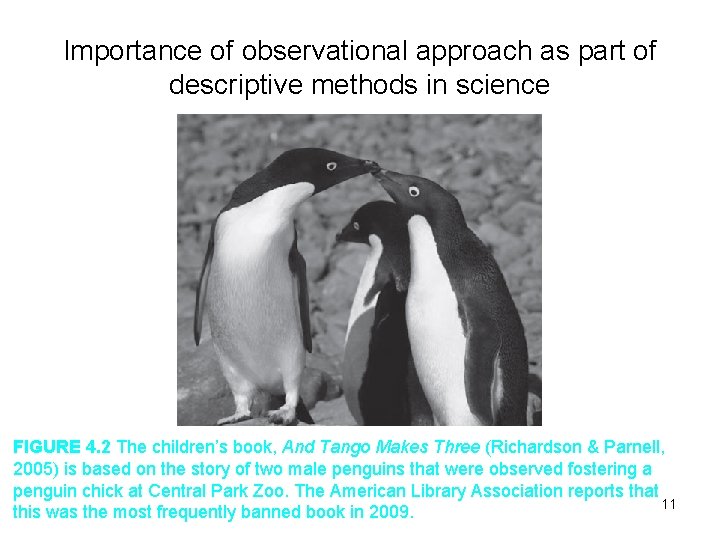
Importance of observational approach as part of descriptive methods in science FIGURE 4. 2 The children’s book, And Tango Makes Three (Richardson & Parnell, 2005) is based on the story of two male penguins that were observed fostering a penguin chick at Central Park Zoo. The American Library Association reports that 11 this was the most frequently banned book in 2009.

Classification of Observational Methods • Direct Observational – Observation without Intervention – Observation with Intervention • Participant • Structured • Field • Indirect Observational “Unobtrusive” – Physical Traces – Archival 12

Observational Methods Direct Observation without Intervention Observation with Intervention Participant Observation Structured Observation Indirect (Unobtrusive) Observation Physical Traces Archival Records Classification of Observational Methods Field Experiment
Direct Observation without Intervention • Naturalistic Observation: – Observation in natural setting – No attempt to intervene or change situation • Jane Goodall observing chimpanzees in the jungle • College students in the quad • Goals: – Describe behavior as it normally occurs such as aggression of children on the school playground – examine relationships among naturally occurring variables. – to establish the external validity of laboratory findings – As an alternative because of ethical and moral considerations • Aggressive behavior of children playing at school • Use of internet chat rooms – Just observation with no intervention – Issues of privacy 14
Direct Observation with Intervention • Most psychological research involves observation with intervention. – Increased control over observations • Three methods in natural settings: – Participant observation • Disguised • Undisguised – Structured observation – Field experiment 15
Direct Observation with Intervention • Participant Observation: Observer is an active participant in the natural setting he or she observes. – undisguised: people in the setting know they are being observed which can produce reactivity • Reactivity occurs when people change their usual behavior because they know they are being observed. • Anthropologists doing ethnographies • What can be done to reduce reactivity? – disguised: people don’t know they are being observed • Will reduce reactivity but not make it go away – Will still be interacting with the group • What are the ethical concerns? – Poising as fake patients for example 16
Direct Observation with Intervention • Disguised participant observation helps control for reactivity, one of the main problems associated with observation. • Participant observers may sometimes lose their objectivity by becoming too involved in the situation – Police academy training as an undisguised participant • Participant observers may influence the behavior of people they are observing. 17
Direct Observation with Intervention • Structured Observation: Researcher sets up a specific situation in order to observe people’s behavior. – Less intervention “control” then a field experiment” – Structured observation is useful when behavior is difficult to observe as it naturally occurs. – Examples: • natural setting “inattentional blindness” • laboratory setting “parent-child interaction” – Observe a child’s response to a stranger • Problems can occur – when observers don’t follow the same procedures across observations – when important variables are not controlled. 18
Direct Observation with Intervention • Field Experiment: Researcher manipulates an independent variable in a natural setting and observes behavior (dependent variable). – There must be two or more conditions to compare (independent variable). • For example confederates cutting into a waiting line or not • OR, type of image on a charity bucket, eye vs stars – Researchers often use confederates to create these different conditions. – Researchers attempt to have control in field experiments. 19
Indirect (Unobtrusive) Observational Methods • Researchers can learn about people’s behavior by looking at evidence of their past behavior. • These methods are called nonreactive, because people can not react to being observed because: • The researcher is looking at their past behavior using – Physical traces – Archival Records 20
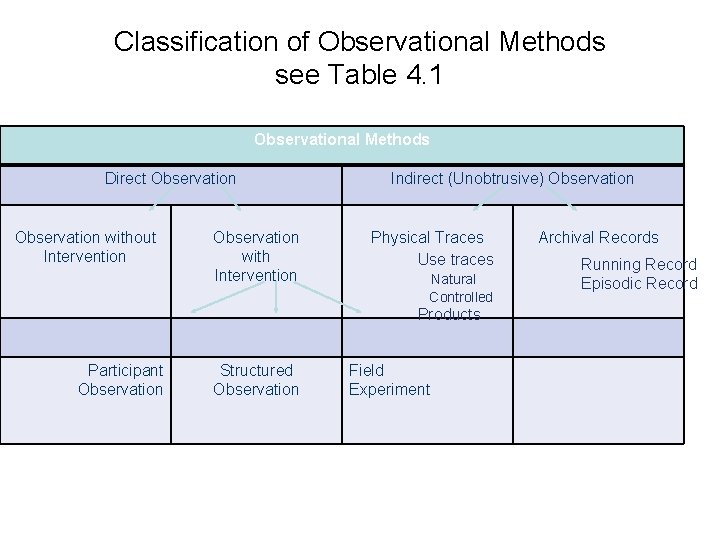
Classification of Observational Methods see Table 4. 1 Observational Methods Direct Observation without Intervention Observation with Intervention Indirect (Unobtrusive) Observation Physical Traces Use traces Natural Controlled Products Participant Observation Structured Observation Field Experiment Archival Records Running Record Episodic Record
Two Unobtrusive Observational Methods • Physical traces are the remnants, fragments, and products of past behavior – Use Traces • Natural • Controlled – Products • Archival records are the public and private documents that describe the activities of individuals, institutions, governments, and other groups. • See table 4. 1 22
Physical Traces • Physical trace measures are obtained indirectly — people are not present when the data are collected • Two types of physical traces: – Use Traces • Evidence of use or nonuse • Measured in controlled or natural conditions – Products • owned by individuals • produced by culture 23
Physical Traces: Use Traces • Use traces: Evidence that remains from the use or nonuse of an item. – Example of use: beverage containers in campus recycling bins (soda, juice, water) • What do these containers tell us about the health habits of college students? – Example of nonuse: books unopened • What does this tell us about study habits? – Example: accuracy of clock settings • What does it tell us about punctuality? 24
Physical Traces : Use Traces – Physical-use traces are also classified as either natural or controlled (planned) • Natural-use traces are produced without any intervention by the investigator. • Example: analyze the amount of highlighting in students’ textbooks to investigate which material is read. • What does this analysis tell us about students’ studying habits? About how much they learned from the material? 25
Physical Traces : Use Traces – Physical-use traces • Controlled-use traces are produced with some degree of intervention or manipulation by the investigator. • Example: Place tiny glue seals between pages of texts prior to their purchase. Analyze the textbooks at the end of the semester to determine which pages have been opened (i. e. , unsealed). • What does this analysis tell us about students’ studying habits? 26
Physical Traces : Products • Products: Is the other category of physical trace – Creations, constructions, or other artifacts of earlier behavior • Example: Television programs such as Howdy Doody, Sesame Street, Mister Roger’s Neighborhood, Power Rangers • Example: Food related products to compare US vs French eating related health problems • Example: Cross cultural comparison of tattoos – Important and abundant sources of information about human behavior 27
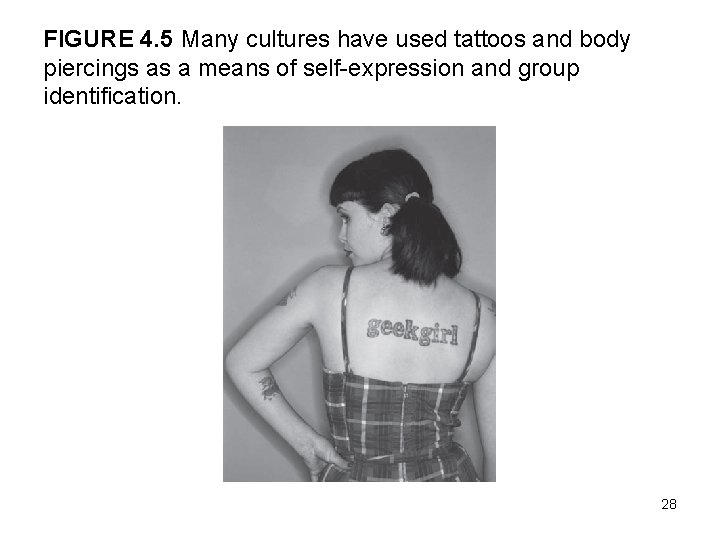
FIGURE 4. 5 Many cultures have used tattoos and body piercings as a means of self-expression and group identification. 28
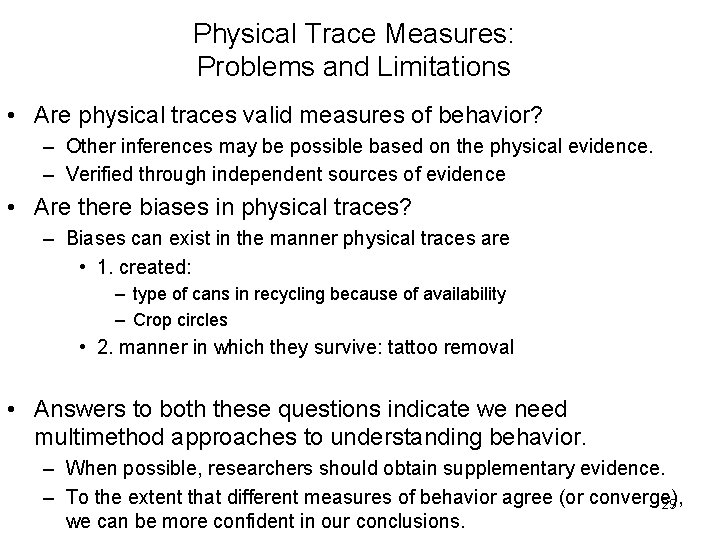
Physical Trace Measures: Problems and Limitations • Are physical traces valid measures of behavior? – Other inferences may be possible based on the physical evidence. – Verified through independent sources of evidence • Are there biases in physical traces? – Biases can exist in the manner physical traces are • 1. created: – type of cans in recycling because of availability – Crop circles • 2. manner in which they survive: tattoo removal • Answers to both these questions indicate we need multimethod approaches to understanding behavior. – When possible, researchers should obtain supplementary evidence. – To the extent that different measures of behavior agree (or converge), 29 we can be more confident in our conclusions.

Crop Circles 30
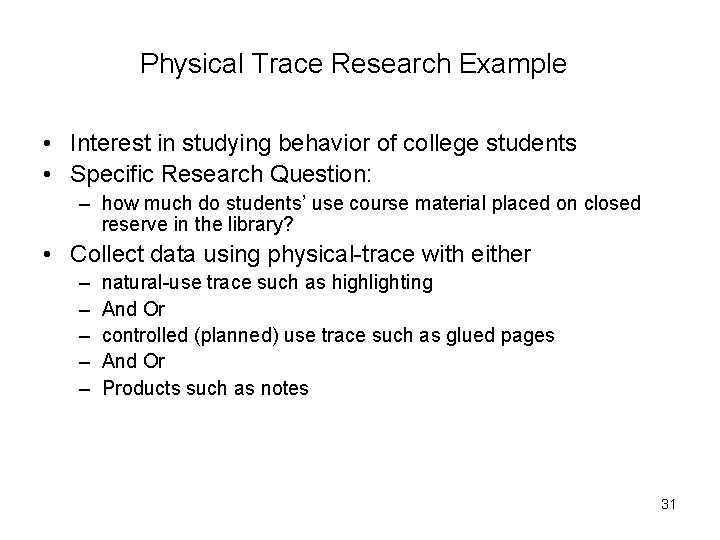
Physical Trace Research Example • Interest in studying behavior of college students • Specific Research Question: – how much do students’ use course material placed on closed reserve in the library? • Collect data using physical-trace with either – – – natural-use trace such as highlighting And Or controlled (planned) use trace such as glued pages And Or Products such as notes 31
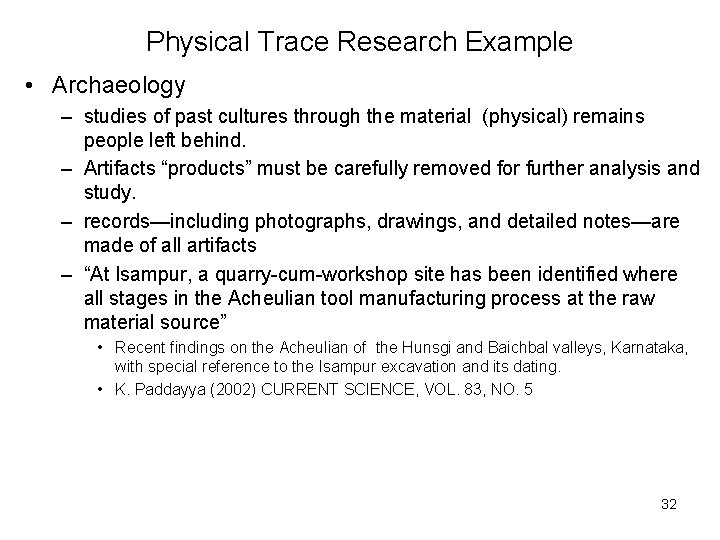
Physical Trace Research Example • Archaeology – studies of past cultures through the material (physical) remains people left behind. – Artifacts “products” must be carefully removed for further analysis and study. – records—including photographs, drawings, and detailed notes—are made of all artifacts – “At Isampur, a quarry-cum-workshop site has been identified where all stages in the Acheulian tool manufacturing process at the raw material source” • Recent findings on the Acheulian of the Hunsgi and Baichbal valleys, Karnataka, with special reference to the Isampur excavation and its dating. • K. Paddayya (2002) CURRENT SCIENCE, VOL. 83, NO. 5 32
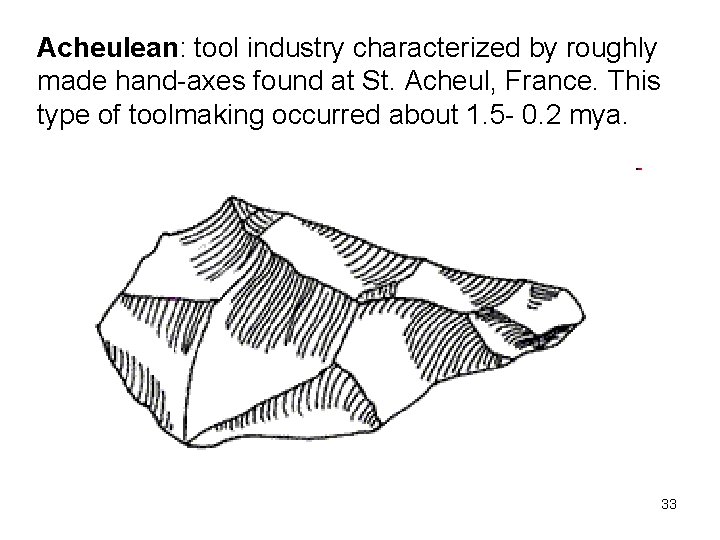
Acheulean: tool industry characterized by roughly made hand-axes found at St. Acheul, France. This type of toolmaking occurred about 1. 5 - 0. 2 mya. 33

Archival Records • Archival records are the public and private documents of individuals, institutions, governments, and other groups. – Running records (e. g. , your transcript) are continuously kept and updated – Episodic records of specific events (e. g. , your graduation) describe a specific event. – An enormous amount of information – For example: government, school, financial, criminal, social media etc. see box 4. 3 • Data obtained from these records are nonreactive because people’s behavior is observed indirectly. 34
BOX 4. 3 THE SCIENCE OF FREAKONOMICS • • • Do school teachers cheat on tests so that they and their students will look good? Do police really lower crime rates? Why does capital punishment not deter criminals? Which is more dangerous to your child: the family owning a swimming pool or a gun? Why are doctors so bad at washing their hands? What’s the best way to catch a terrorist? Are people hard-wired for altruism or selfishness? Why is chemotherapy prescribed so often if it’s so ineffective? These questions, and others, were asked by the maverick social scientist, Steven D. Levitt, in his best-selling books, Freakonomics and Super- Freakonomics (Levitt & Dubner, 2005; 2009). The answers he gives come from archival analyses of student test scores, sports records, crime statistics, birth and death statistics, and much more. We won’t give away all the answers based on this clever researcher’s mining of society’s archives, but we will say that in this era of highstakes testing, public school teachers sometimes cheat, and if you own both a gun and a swimming pool, your child is 100 times more likely to die by drowning than by gunplay. 35
Archival Records • Archival data are used to: – test hypotheses as part of a multimethod approach, – test the external validity of laboratory findings (i. e. , whether findings generalize to real-world settings), – test hypotheses about past behavior, and – assess the effect of a natural treatment. 36
Archival Records • Natural treatments are naturally occurring events that impact society and individuals. Examples: – drastic changes in the stock market, acts of terrorism, election of a new president (society level) – death of a parent, divorce, graduation (individual level). • Analysis of archival data can reveal effects of natural treatments on people’s behavior. 37

Archival Records Problems • Possible problems in archival records – Selective deposit • Only some information is recorded – High school yearbook – Public statements by politicians – Social media profiles – Selective survival • Some records are lost, damaged or removed – Example: When students drop a course within a certain time period, the record of their ever being in the class is removed from the transcript. • Serious when it is selective – Fire in the vice president’s office – Spurious relationships • Coincidental occurrence of event – New laws and reduced crime rates • Seek converging evidence using multimethod approach. 38
The Multimethod Approach • Unobtrusive measures contribute to a multimethod approach to understanding behavior and mental processes. • A multimethod approach means that researchers use a variety of measures to examine a research question: – Direct observation – Surveys – Unobtrusive measures 39
The Multimethod Approach • Research findings based on a single method for making observations may be biased because of characteristics of the measurement process. • Because direct observation and survey methods can be reactive (i. e. , people react to being observed), unobtrusive measures provide an important alternative for gaining information about people. 40
- Slides: 40