
Observations on Determination of Capacity to Pay Computation
Observations on Determination of Capacity to Pay Computation Preparation of “Household Income and Expenditures Form” A Presentation by the AMPC Credit Committee 2017 -2018 1
Borrower's Capacity to Pay • CRECOM in its review of loan applications and outstanding loan accounts is dismayed by the lack of documents or reports on the borrower's capacity to pay, especially on loans to AMPC employees. • There are several forms to support this aspect of credit investigation (as emphasized in the Credit Policy Manual) but these are either left out unaccomplished or other formats done which are grossly not informative. • one such form is the “Household Income and Expenditure Form” which we will discuss in the following minutes. 2
Function of the Household Income & Expenditure Form • Shows the declaration of the loan applicant of his/her sources of income such as salaries and wages, from business, investments and other sources • Reveals how much are his/her expenditures for basic needs such as food, shelter, and clothing; medical and dental expenses, utilities, transportation, salary for helper, cooking gas, lifestyle expenses (such as family or personal gathering or outings), etc • Shows also the cash outlays including payment of other debts or amortizations such as loans to other financial institutions; housing, vehicle, appliance amortizations, premiums or credit card payments. 3
Function of Household Income and Expenditures Form -2 • Determine his/net cash outflow from the reported total income less expenditures and cash outlays as a basis for his/her capacity to pay • Determine the amount he/she can borrow by multiplying his/her computed net cash outflow (also known as disposable income or cash available for investment) by the number of months the loan will be paid; • Analysis of this form (when filled up accurately) will show where the borrower get his/her income; reveals also his/her spending habits and how he/she saves part of his/her income, and ultimately his/her capacity to pay. 4

Household Income and Expenditure Form. First Part - the Sources of Income SOURCES OF INCOME BORROWER MONTHLY INCOME SPOUSE MONTHLY INCOME 1. Salaries and Wages (net) 2. Income from Business (net) 3. Income from Investments/ Dividends 4. Other Income TOTAL INCOME 5
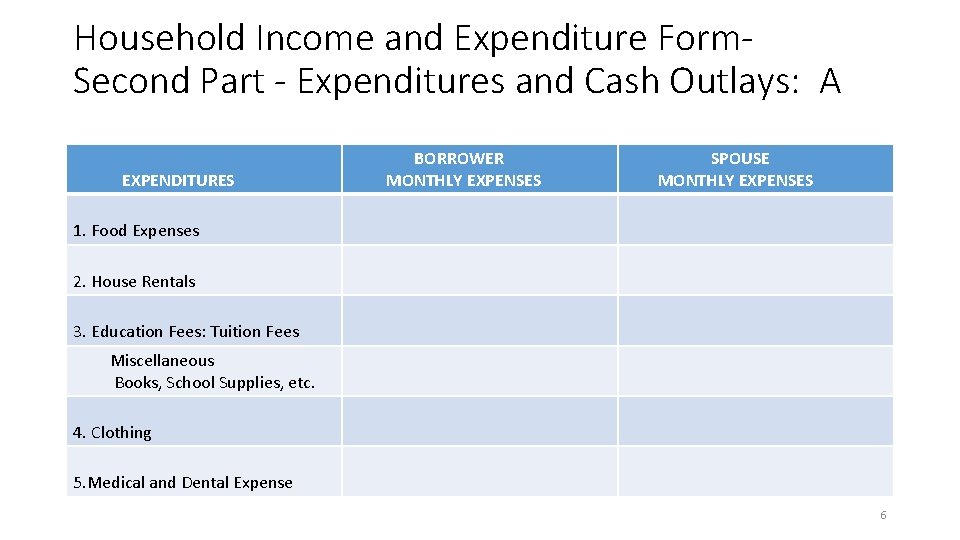
Household Income and Expenditure Form. Second Part - Expenditures and Cash Outlays: A EXPENDITURES BORROWER MONTHLY EXPENSES SPOUSE MONTHLY EXPENSES 1. Food Expenses 2. House Rentals 3. Education Fees: Tuition Fees Miscellaneous Books, School Supplies, etc. 4. Clothing 5. Medical and Dental Expense 6
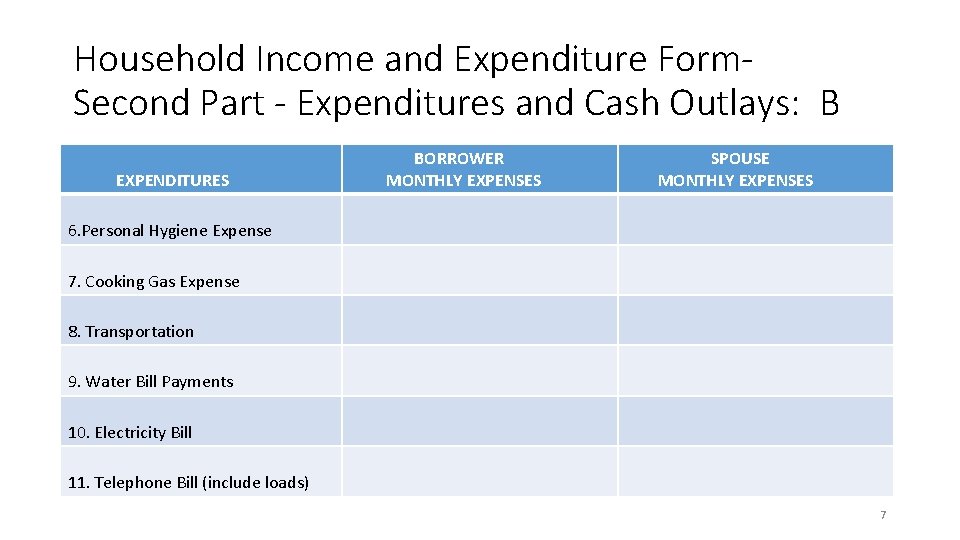
Household Income and Expenditure Form. Second Part - Expenditures and Cash Outlays: B EXPENDITURES BORROWER MONTHLY EXPENSES SPOUSE MONTHLY EXPENSES 6. Personal Hygiene Expense 7. Cooking Gas Expense 8. Transportation 9. Water Bill Payments 10. Electricity Bill 11. Telephone Bill (include loads) 7
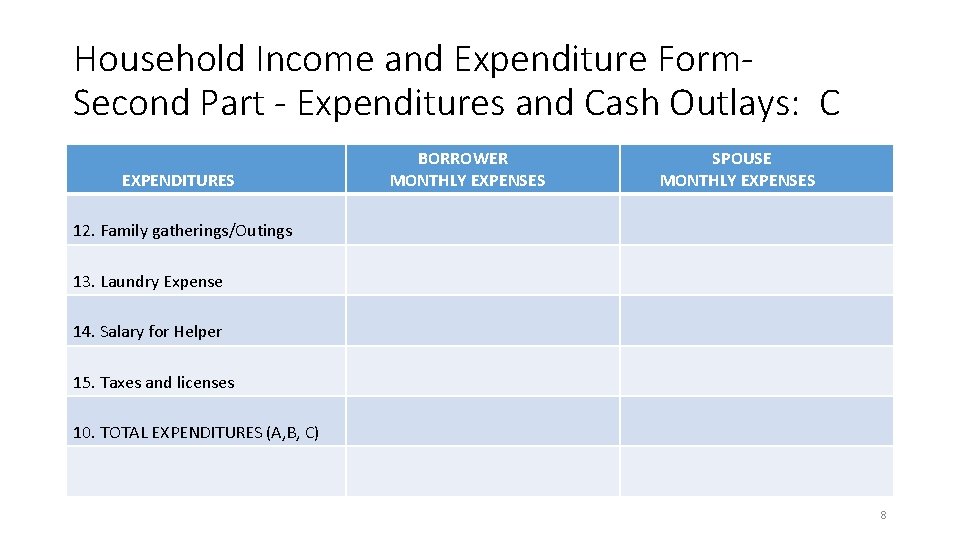
Household Income and Expenditure Form. Second Part - Expenditures and Cash Outlays: C EXPENDITURES BORROWER MONTHLY EXPENSES SPOUSE MONTHLY EXPENSES 12. Family gatherings/Outings 13. Laundry Expense 14. Salary for Helper 15. Taxes and licenses 10. TOTAL EXPENDITURES (A, B, C) 8
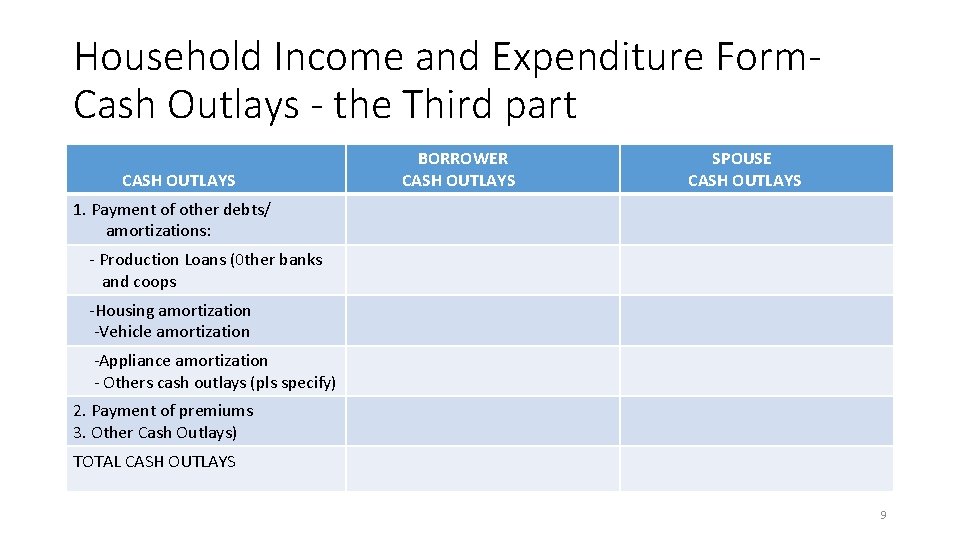
Household Income and Expenditure Form. Cash Outlays - the Third part CASH OUTLAYS BORROWER CASH OUTLAYS SPOUSE CASH OUTLAYS 1. Payment of other debts/ amortizations: - Production Loans (0 ther banks and coops -Housing amortization -Vehicle amortization -Appliance amortization - Others cash outlays (pls specify) 2. Payment of premiums 3. Other Cash Outlays) TOTAL CASH OUTLAYS 9
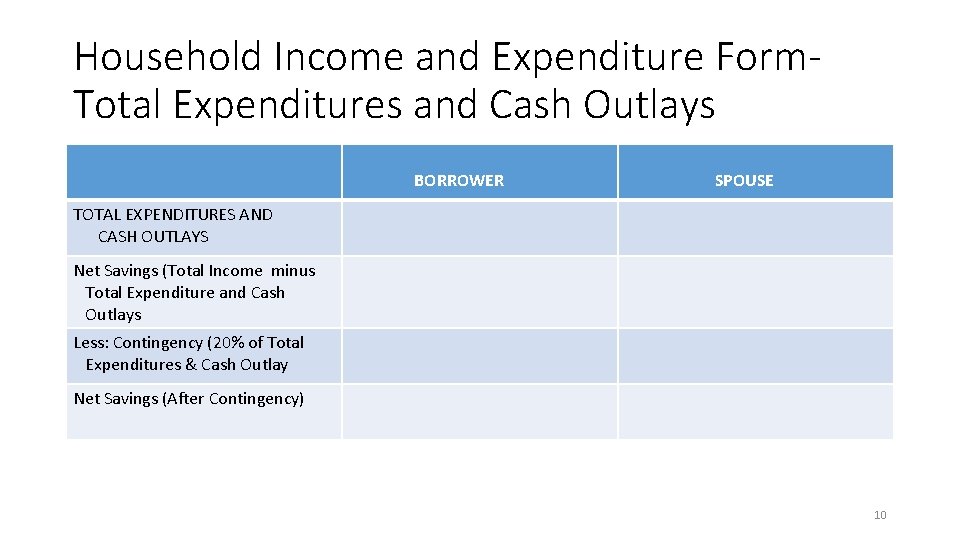
Household Income and Expenditure Form. Total Expenditures and Cash Outlays BORROWER SPOUSE TOTAL EXPENDITURES AND CASH OUTLAYS Net Savings (Total Income minus Total Expenditure and Cash Outlays Less: Contingency (20% of Total Expenditures & Cash Outlay Net Savings (After Contingency) 10
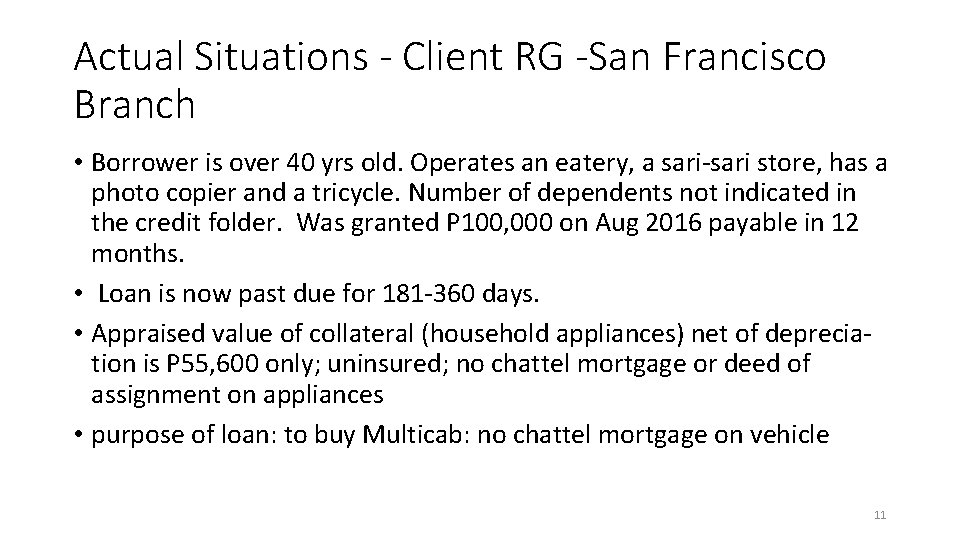
Actual Situations - Client RG -San Francisco Branch • Borrower is over 40 yrs old. Operates an eatery, a sari-sari store, has a photo copier and a tricycle. Number of dependents not indicated in the credit folder. Was granted P 100, 000 on Aug 2016 payable in 12 months. • Loan is now past due for 181 -360 days. • Appraised value of collateral (household appliances) net of depreciation is P 55, 600 only; uninsured; no chattel mortgage or deed of assignment on appliances • purpose of loan: to buy Multicab: no chattel mortgage on vehicle 11
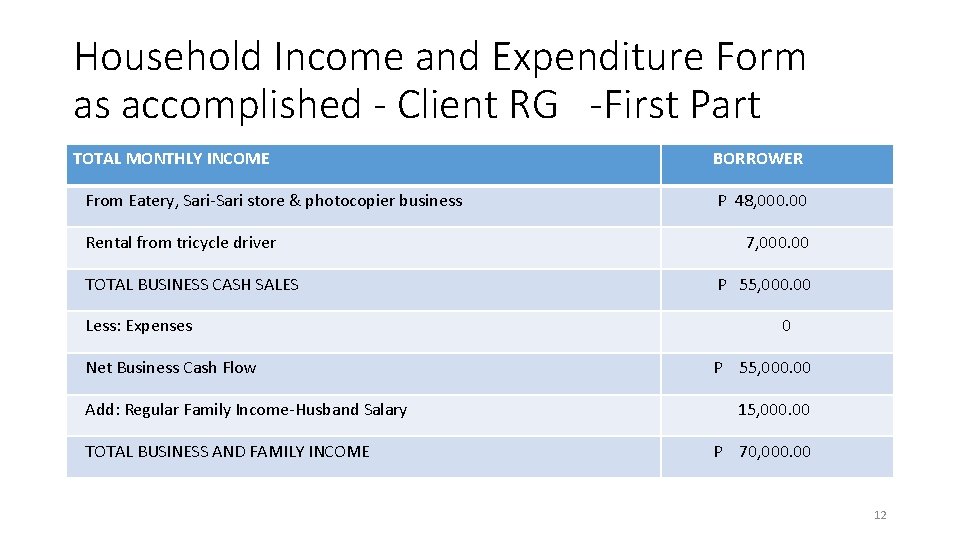
Household Income and Expenditure Form as accomplished - Client RG -First Part TOTAL MONTHLY INCOME From Eatery, Sari-Sari store & photocopier business Rental from tricycle driver TOTAL BUSINESS CASH SALES Less: Expenses Net Business Cash Flow Add: Regular Family Income-Husband Salary TOTAL BUSINESS AND FAMILY INCOME BORROWER P 48, 000. 00 7, 000. 00 P 55, 000. 00 15, 000. 00 P 70, 000. 00 12
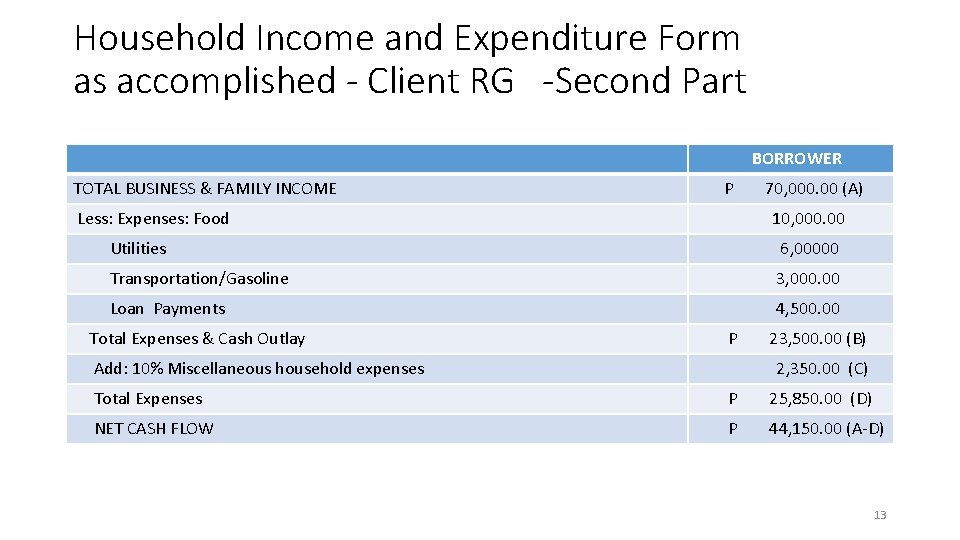
Household Income and Expenditure Form as accomplished - Client RG -Second Part BORROWER TOTAL BUSINESS & FAMILY INCOME P Less: Expenses: Food 70, 000. 00 (A) 10, 000. 00 Utilities 6, 00000 Transportation/Gasoline 3, 000. 00 Loan Payments 4, 500. 00 Total Expenses & Cash Outlay P Add: 10% Miscellaneous household expenses 23, 500. 00 (B) 2, 350. 00 (C) Total Expenses P 25, 850. 00 (D) NET CASH FLOW P 44, 150. 00 (A-D) 13
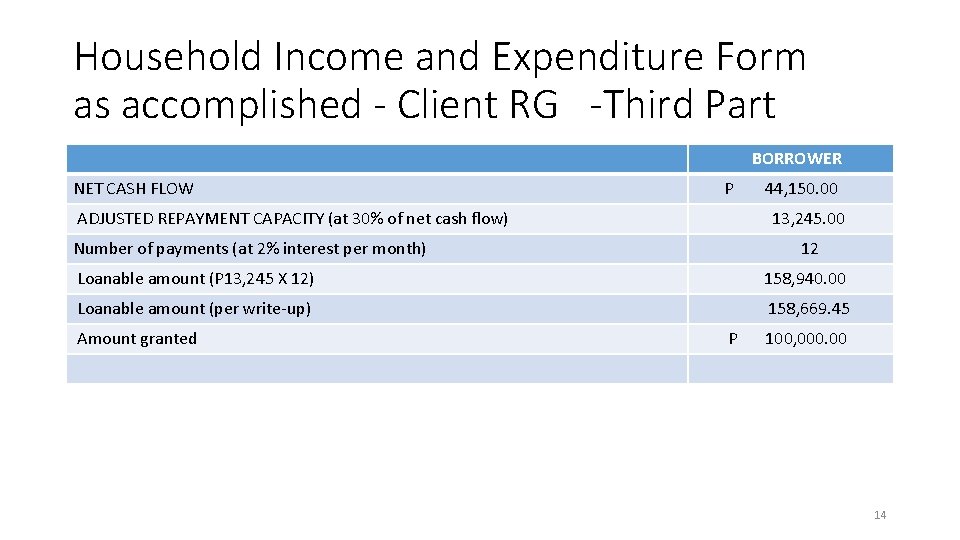
Household Income and Expenditure Form as accomplished - Client RG -Third Part BORROWER NET CASH FLOW P ADJUSTED REPAYMENT CAPACITY (at 30% of net cash flow) 44, 150. 00 13, 245. 00 Number of payments (at 2% interest per month) 12 Loanable amount (P 13, 245 X 12) 158, 940. 00 Loanable amount (per write-up) 158, 669. 45 Amount granted P 100, 000. 00 14
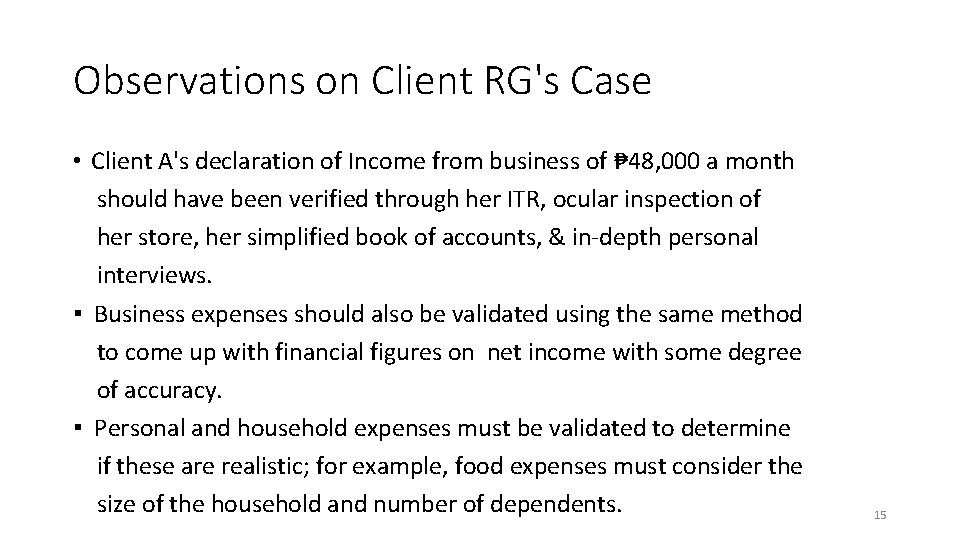
Observations on Client RG's Case • Client A's declaration of Income from business of ₱ 48, 000 a month should have been verified through her ITR, ocular inspection of her store, her simplified book of accounts, & in-depth personal interviews. ▪ Business expenses should also be validated using the same method to come up with financial figures on net income with some degree of accuracy. ▪ Personal and household expenses must be validated to determine if these are realistic; for example, food expenses must consider the size of the household and number of dependents. 15
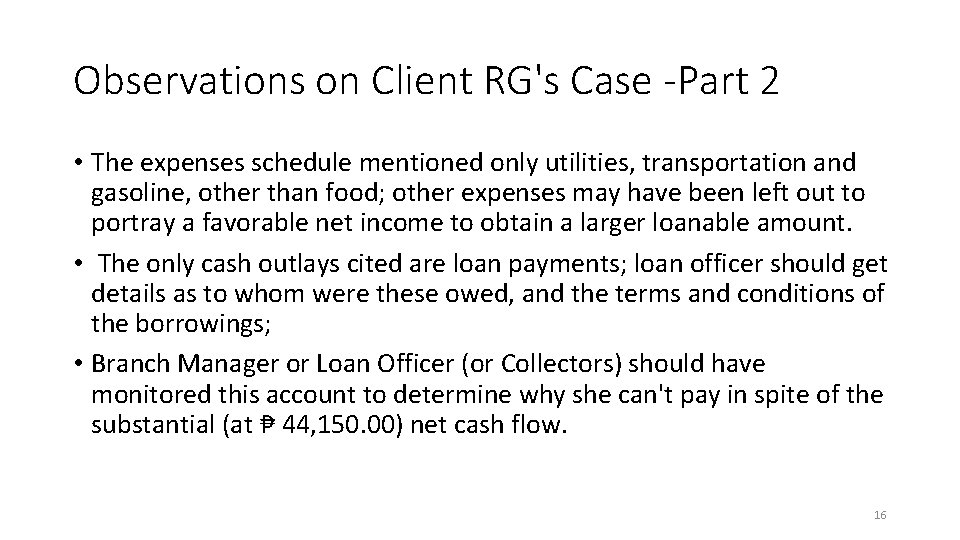
Observations on Client RG's Case -Part 2 • The expenses schedule mentioned only utilities, transportation and gasoline, other than food; other expenses may have been left out to portray a favorable net income to obtain a larger loanable amount. • The only cash outlays cited are loan payments; loan officer should get details as to whom were these owed, and the terms and conditions of the borrowings; • Branch Manager or Loan Officer (or Collectors) should have monitored this account to determine why she can't pay in spite of the substantial (at ₱ 44, 150. 00) net cash flow. 16
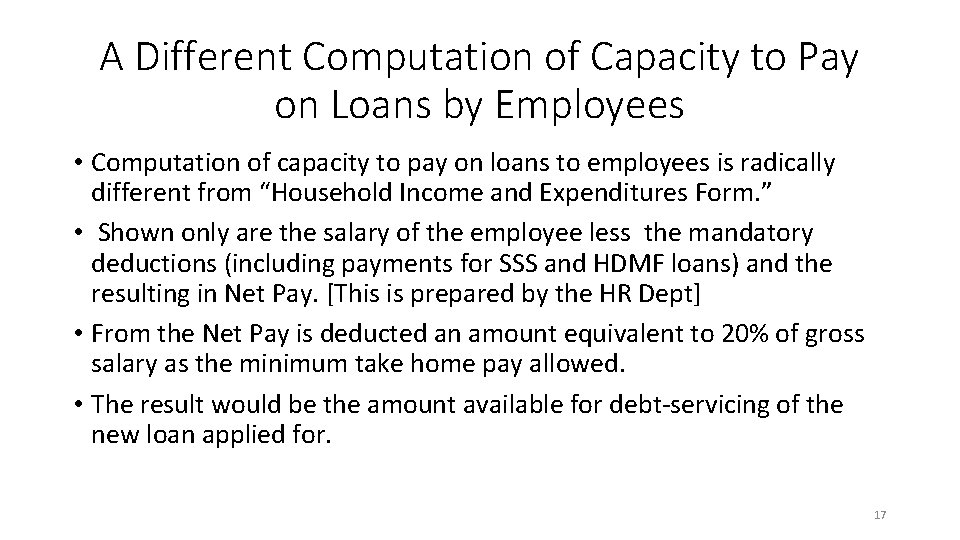
A Different Computation of Capacity to Pay on Loans by Employees • Computation of capacity to pay on loans to employees is radically different from “Household Income and Expenditures Form. ” • Shown only are the salary of the employee less the mandatory deductions (including payments for SSS and HDMF loans) and the resulting in Net Pay. [This is prepared by the HR Dept] • From the Net Pay is deducted an amount equivalent to 20% of gross salary as the minimum take home pay allowed. • The result would be the amount available for debt-servicing of the new loan applied for. 17
A Different Computation of Capacity to Pay on Loans by Employees - continuation • The computation does not show the details of household or personal expenses as outlined in the form • The accompanying computation as support for application for additional loan does not also show the amounts for payment of existing loans; if such would be included, applicant's capacity to pay would be very low or in the negative. • The Credit Committee believe that this is the practice in the grant of employee loans in the past. 18
Illustration - Capacity to Pay Computation. Employee A - Head Office • Employee A applied for a ₱ 230, 000 loan payable in 48 months. • He has existing Prov Loan with a ₱ 33, 333. 34 balance and a vehicle loan with a balance of ₱ 33, 963. 77. • Salary is ₱ 10, 963. 62, possibly excluding RATA and cost of living allowances amounting to an estimated ₱ 10, 500 • Mandatory deductions (SSS, HDMF, Philhealth, etc) totaled ₱ 1, 971. 08 including SSS or HDMF loans. 19
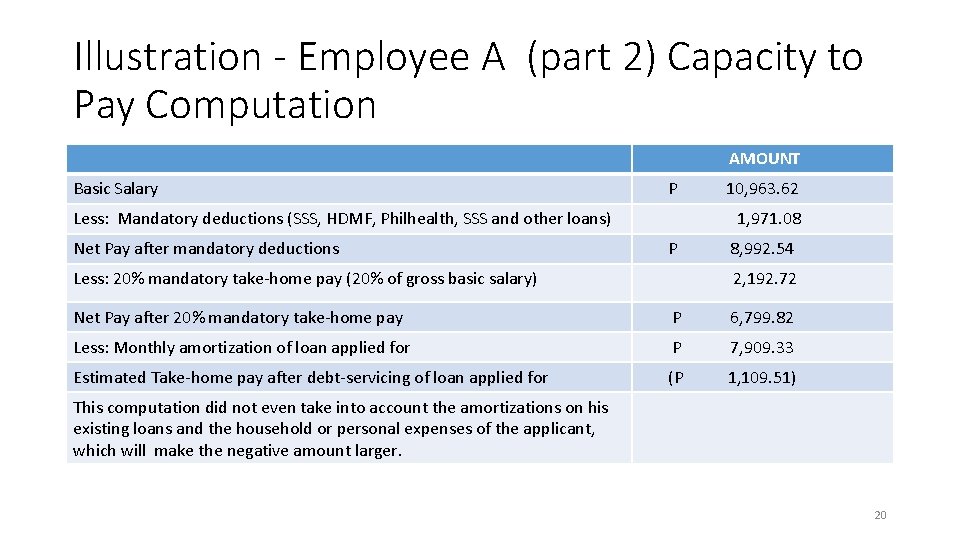
Illustration - Employee A (part 2) Capacity to Pay Computation AMOUNT Basic Salary P Less: Mandatory deductions (SSS, HDMF, Philhealth, SSS and other loans) Net Pay after mandatory deductions 10, 963. 62 1, 971. 08 P Less: 20% mandatory take-home pay (20% of gross basic salary) 8, 992. 54 2, 192. 72 Net Pay after 20% mandatory take-home pay P 6, 799. 82 Less: Monthly amortization of loan applied for P 7, 909. 33 Estimated Take-home pay after debt-servicing of loan applied for (P 1, 109. 51) This computation did not even take into account the amortizations on his existing loans and the household or personal expenses of the applicant, which will make the negative amount larger. 20
Illustration - Capacity to Pay Computation Employee A (part 3) • Loans to employees should also follow the same rules and requirements as in accommodations to other members. • The “Household Income and Expenditures Form” should also be accomplished to find out his/her individual capacity to pay. Details on salaries and other income/s should be shown in the form. • Details of personal and household expenses should also be shown. • Amortizations on existing loans should be included on cash outlays in the form. • Amounts written on the form should be accurate to a degree of certainty and verifiable. 21
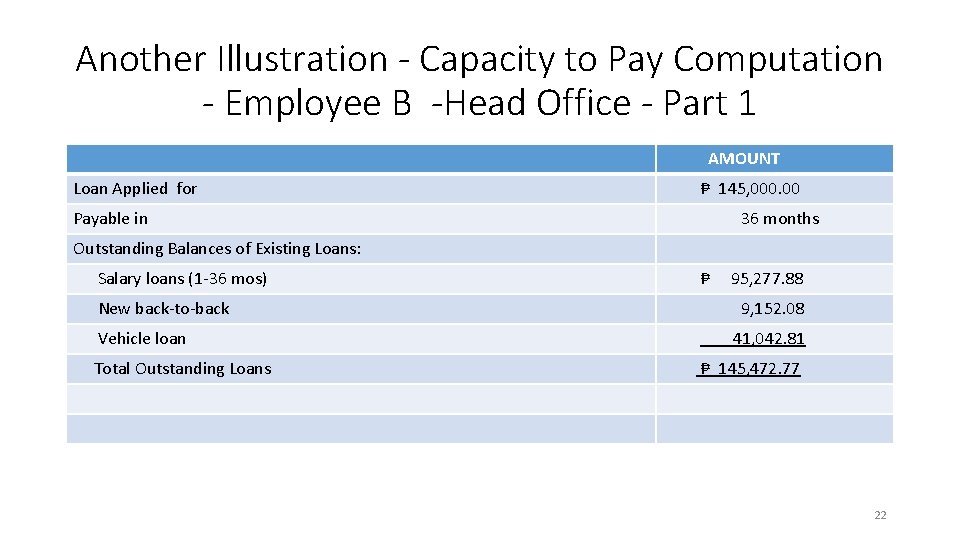
Another Illustration - Capacity to Pay Computation - Employee B -Head Office - Part 1 AMOUNT Loan Applied for ₱ 145, 000. 00 Payable in 36 months Outstanding Balances of Existing Loans: Salary loans (1 -36 mos) New back-to-back Vehicle loan Total Outstanding Loans ₱ 95, 277. 88 9, 152. 08 41, 042. 81 ₱ 145, 472. 77 22
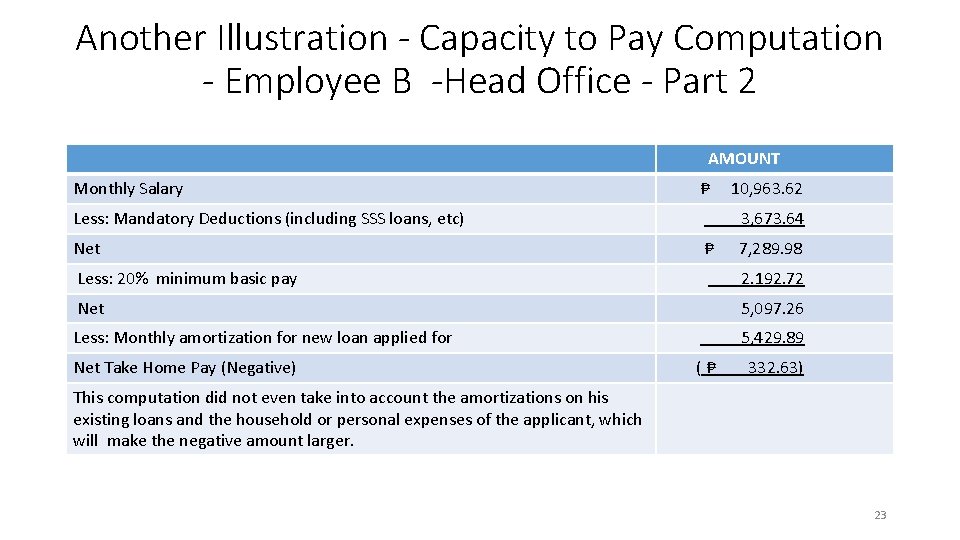
Another Illustration - Capacity to Pay Computation - Employee B -Head Office - Part 2 AMOUNT Monthly Salary ₱ Less: Mandatory Deductions (including SSS loans, etc) Net 10, 963. 62 3, 673. 64 ₱ 7, 289. 98 Less: 20% minimum basic pay 2. 192. 72 Net 5, 097. 26 Less: Monthly amortization for new loan applied for 5, 429. 89 Net Take Home Pay (Negative) (₱ 332. 63) This computation did not even take into account the amortizations on his existing loans and the household or personal expenses of the applicant, which will make the negative amount larger. 23
Another Illustration - Capacity to Pay Computation - Employee B -Head Office - Part 3 Conclusion: -obviously, based on his discernible income, he has not the capacity to pay for the amortization for the loan he's applying for -if granted even if he has negative capacity to pay, his total loans to the coop would be double his total obligations now 24
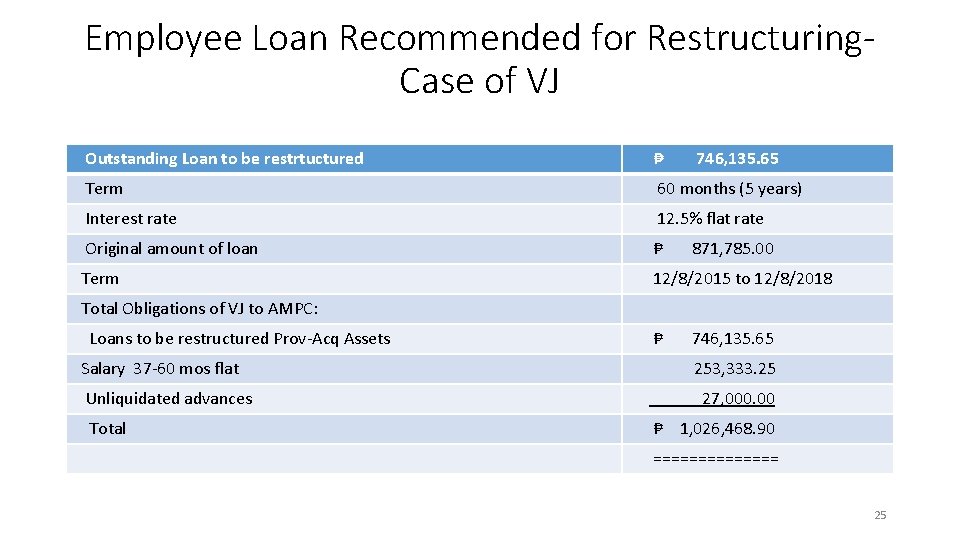
Employee Loan Recommended for Restructuring. Case of VJ Outstanding Loan to be restrtuctured ₱ 746, 135. 65 Term 60 months (5 years) Interest rate 12. 5% flat rate Original amount of loan ₱ Term 12/8/2015 to 12/8/2018 871, 785. 00 Total Obligations of VJ to AMPC: Loans to be restructured Prov-Acq Assets Salary 37 -60 mos flat Unliquidated advances Total ₱ 746, 135. 65 253, 333. 25 27, 000. 00 ₱ 1, 026, 468. 90 ======= 25
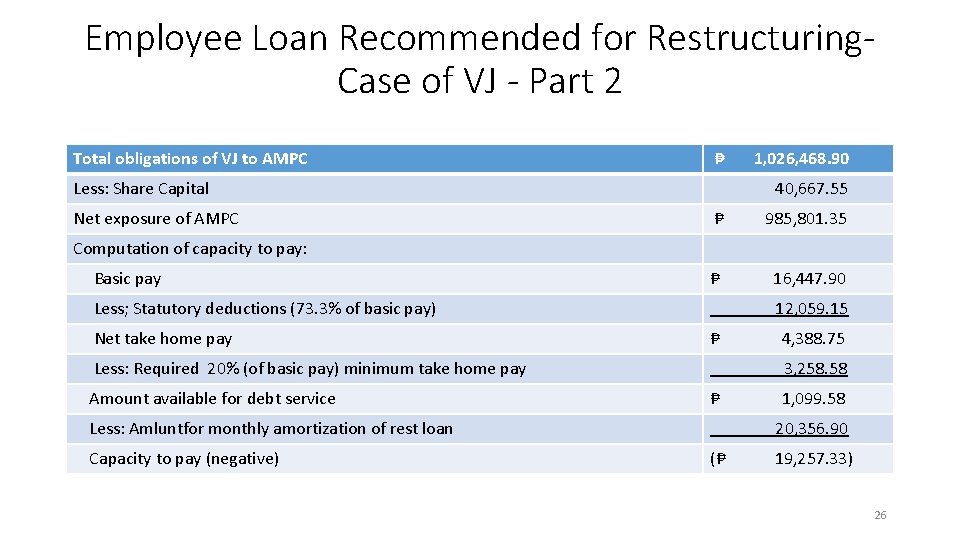
Employee Loan Recommended for Restructuring. Case of VJ - Part 2 Total obligations of VJ to AMPC ₱ Less: Share Capital Net exposure of AMPC 1, 026, 468. 90 40, 667. 55 ₱ 985, 801. 35 ₱ 16, 447. 90 Computation of capacity to pay: Basic pay Less; Statutory deductions (73. 3% of basic pay) Net take home pay 12, 059. 15 ₱ Less: Required 20% (of basic pay) minimum take home pay Amount available for debt service 3, 258. 58 ₱ Less: Amluntfor monthly amortization of rest loan Capacity to pay (negative) 4, 388. 75 1, 099. 58 20, 356. 90 (₱ 19, 257. 33) 26
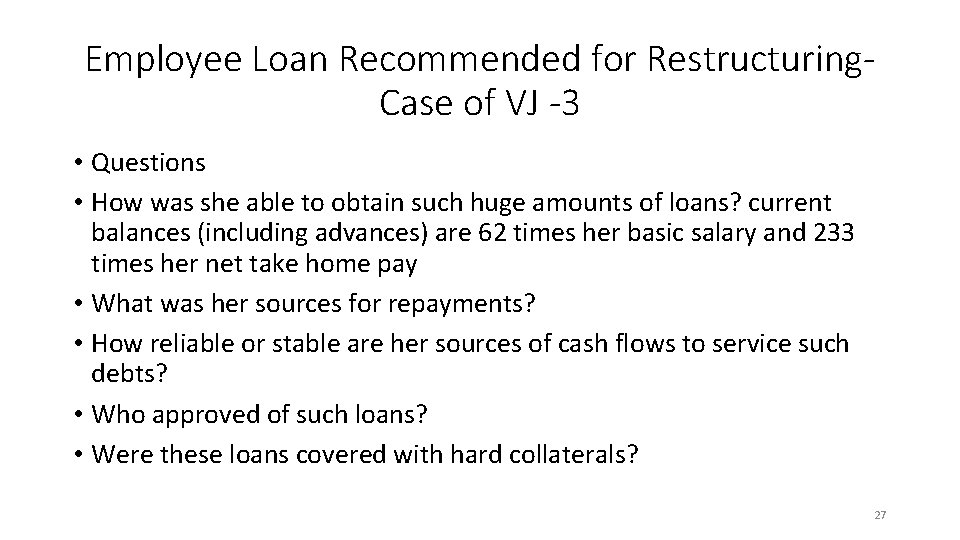
Employee Loan Recommended for Restructuring. Case of VJ -3 • Questions • How was she able to obtain such huge amounts of loans? current balances (including advances) are 62 times her basic salary and 233 times her net take home pay • What was her sources for repayments? • How reliable or stable are her sources of cash flows to service such debts? • Who approved of such loans? • Were these loans covered with hard collaterals? 27
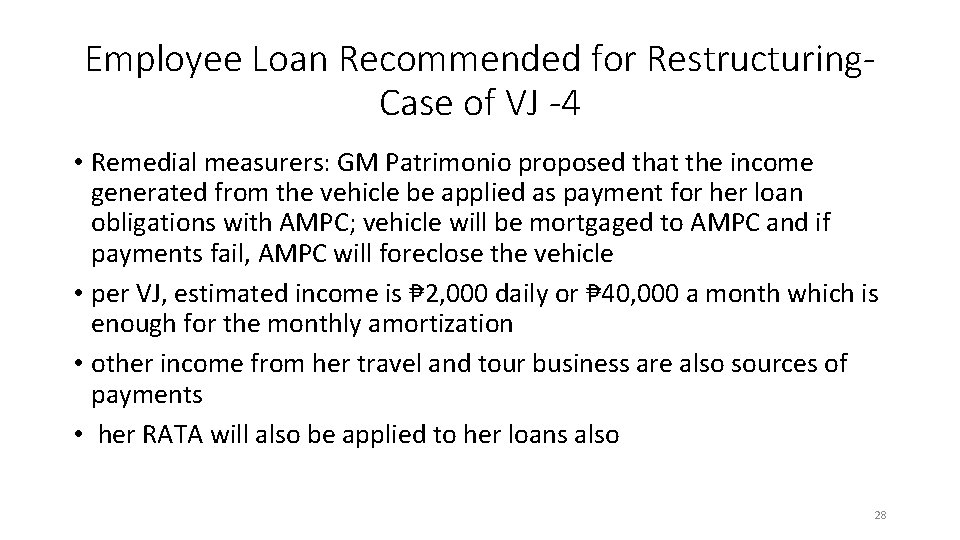
Employee Loan Recommended for Restructuring. Case of VJ -4 • Remedial measurers: GM Patrimonio proposed that the income generated from the vehicle be applied as payment for her loan obligations with AMPC; vehicle will be mortgaged to AMPC and if payments fail, AMPC will foreclose the vehicle • per VJ, estimated income is ₱ 2, 000 daily or ₱ 40, 000 a month which is enough for the monthly amortization • other income from her travel and tour business are also sources of payments • her RATA will also be applied to her loans also 28
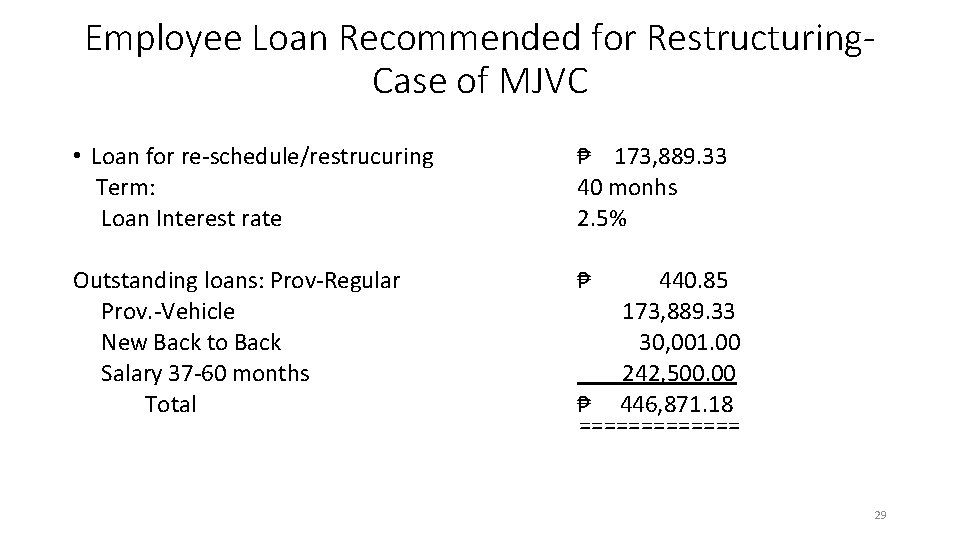
Employee Loan Recommended for Restructuring. Case of MJVC • Loan for re-schedule/restrucuring Term: Loan Interest rate ₱ 173, 889. 33 40 monhs 2. 5% Outstanding loans: Prov-Regular Prov. -Vehicle New Back to Back Salary 37 -60 months Total ₱ 440. 85 173, 889. 33 30, 001. 00 242, 500. 00 ₱ 446, 871. 18 ======= 29
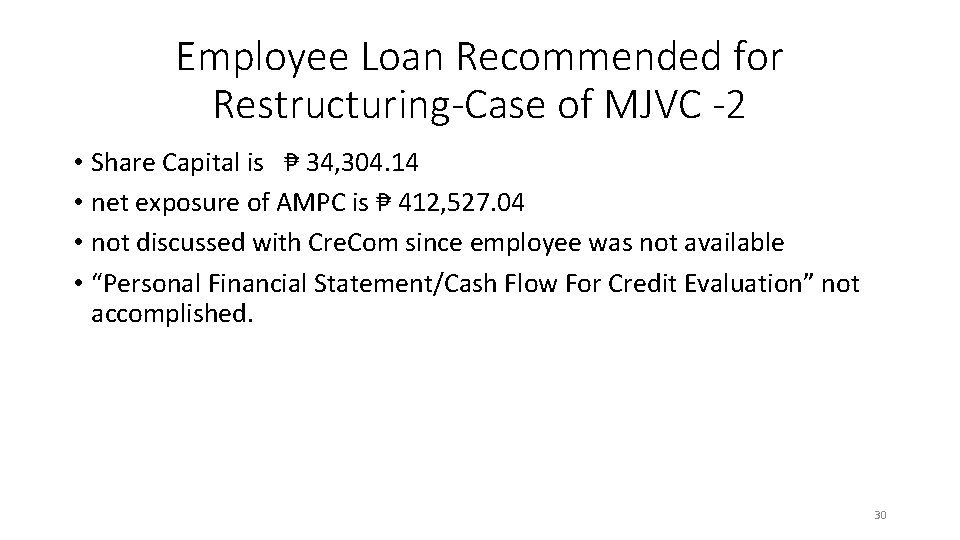
Employee Loan Recommended for Restructuring-Case of MJVC -2 • Share Capital is ₱ 34, 304. 14 • net exposure of AMPC is ₱ 412, 527. 04 • not discussed with Cre. Com since employee was not available • “Personal Financial Statement/Cash Flow For Credit Evaluation” not accomplished. 30
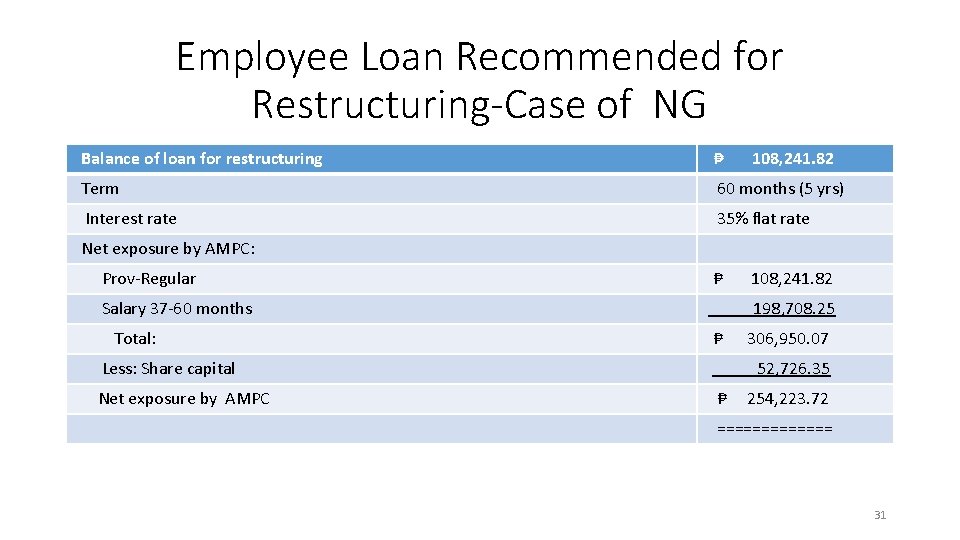
Employee Loan Recommended for Restructuring-Case of NG Balance of loan for restructuring ₱ 108, 241. 82 Term 60 months (5 yrs) Interest rate 35% flat rate Net exposure by AMPC: Prov-Regular ₱ Salary 37 -60 months Total: 198, 708. 25 ₱ Less: Share capital Net exposure by AMPC 108, 241. 82 306, 950. 07 52, 726. 35 ₱ 254, 223. 72 ======= 31
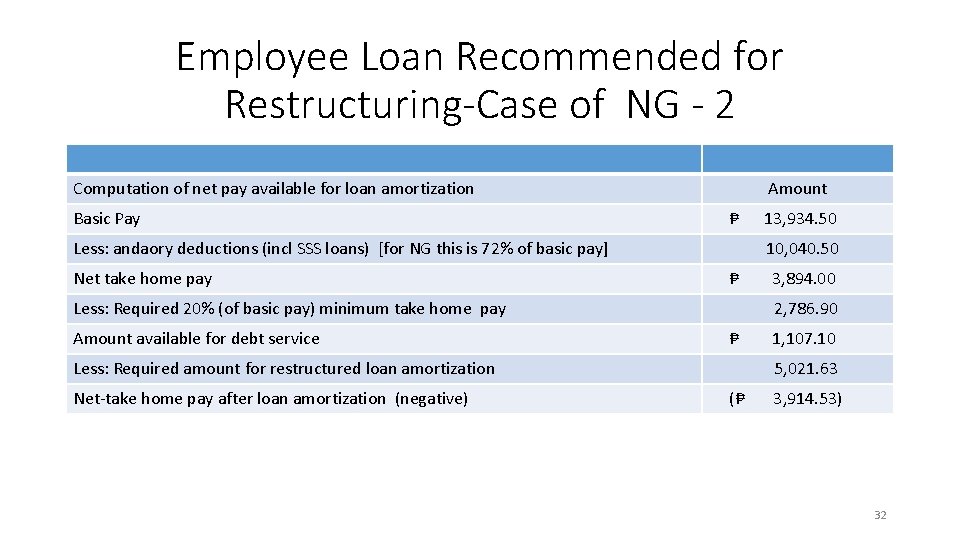
Employee Loan Recommended for Restructuring-Case of NG - 2 Computation of net pay available for loan amortization Basic Pay Amount ₱ Less: andaory deductions (incl SSS loans) [for NG this is 72% of basic pay] Net take home pay 10, 040. 50 ₱ Less: Required 20% (of basic pay) minimum take home pay Amount available for debt service 3, 894. 00 2, 786. 90 ₱ Less: Required amount for restructured loan amortization Net-take home pay after loan amortization (negative) 13, 934. 50 1, 107. 10 5, 021. 63 (₱ 3, 914. 53) 32
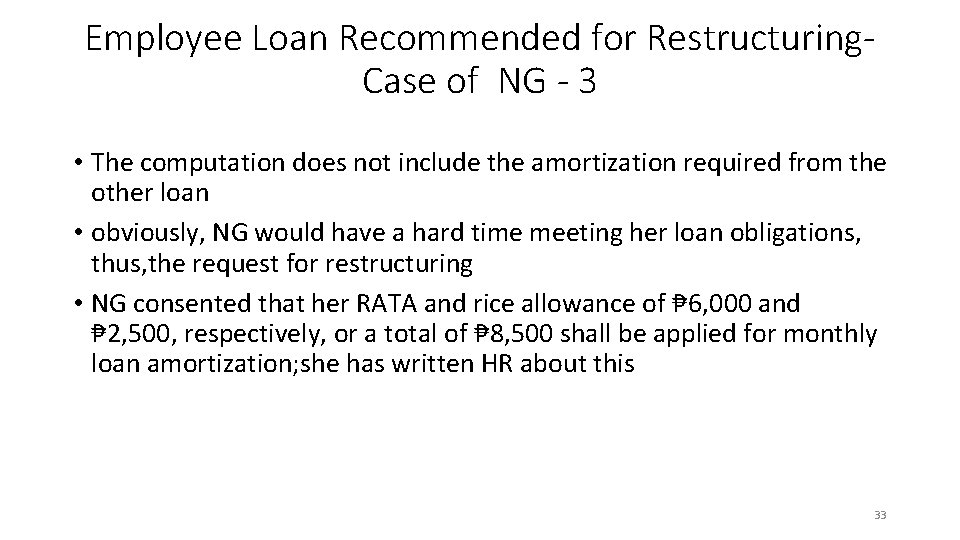
Employee Loan Recommended for Restructuring. Case of NG - 3 • The computation does not include the amortization required from the other loan • obviously, NG would have a hard time meeting her loan obligations, thus, the request for restructuring • NG consented that her RATA and rice allowance of ₱ 6, 000 and ₱ 2, 500, respectively, or a total of ₱ 8, 500 shall be applied for monthly loan amortization; she has written HR about this 33
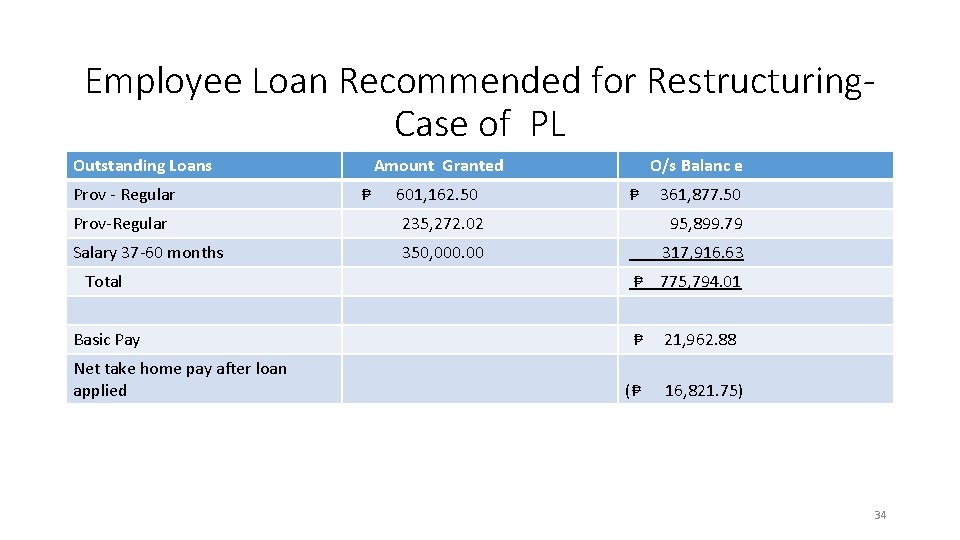
Employee Loan Recommended for Restructuring. Case of PL Outstanding Loans Prov - Regular Amount Granted ₱ 601, 162. 50 O/s Balanc e ₱ 361, 877. 50 Prov-Regular 235, 272. 02 95, 899. 79 Salary 37 -60 months 350, 000. 00 317, 916. 63 Total Basic Pay Net take home pay after loan applied ₱ 775, 794. 01 ₱ (₱ 21, 962. 88 16, 821. 75) 34
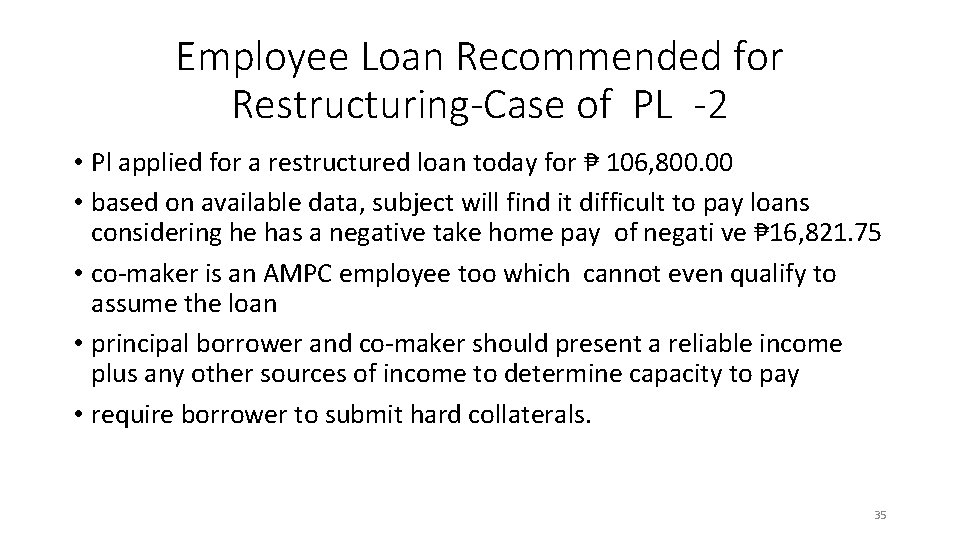
Employee Loan Recommended for Restructuring-Case of PL -2 • Pl applied for a restructured loan today for ₱ 106, 800. 00 • based on available data, subject will find it difficult to pay loans considering he has a negative take home pay of negati ve ₱ 16, 821. 75 • co-maker is an AMPC employee too which cannot even qualify to assume the loan • principal borrower and co-maker should present a reliable income plus any other sources of income to determine capacity to pay • require borrower to submit hard collaterals. 35

36

37

38
- Slides: 38