
Observations of Three Dimensional Neutral Composition Changes in
Observations of Three Dimensional Neutral Composition Changes in the Thermosphere During Geomagnetic Storms. John B. Sigwarth 1 — NASA/GSFC Larry J. Paxton 2 — JHU/APL Yongliang Zhang 2 — JHU/APL 1 NASA Goddard Space Flight Center, Greenbelt, MD 20771 (301286 -0166; john. b. sigwarth@nasa. gov) 2 The Johns Hopkins University Applied Physics Lab. , 11100 Johns Hopkins Road, Laurel, MD 20723 -6099
Overview • • Instrumentation Methodology May 2003 event Discussion
Instrumentation • Visible Imaging System (VIS) on the Polar Spacecraft – VIS Earth Camera sensitive at far-ultraviolet (FUV) wavelengths 124 -149 nm predominantly OI 130. 4 and 135. 6 nm with a smaller contribution from N 2 LBH 138 -149 nm, 20° × 20° – Image cadence 54 s. • Global Ultraviolet Imager (GUVI) on the TIMED spacecraft – GUVI is an FUV scanning imaging spectrograph that provides horizon-to-horizon images and limb scans in five selectable wavelength intervals covering HI 121. 6 nm, OI 130. 4 nm, OI 135. 6 nm, and N 2 Lyman-Birge-Hopfield bands 140 to 150 nm and 165 to 180 nm.
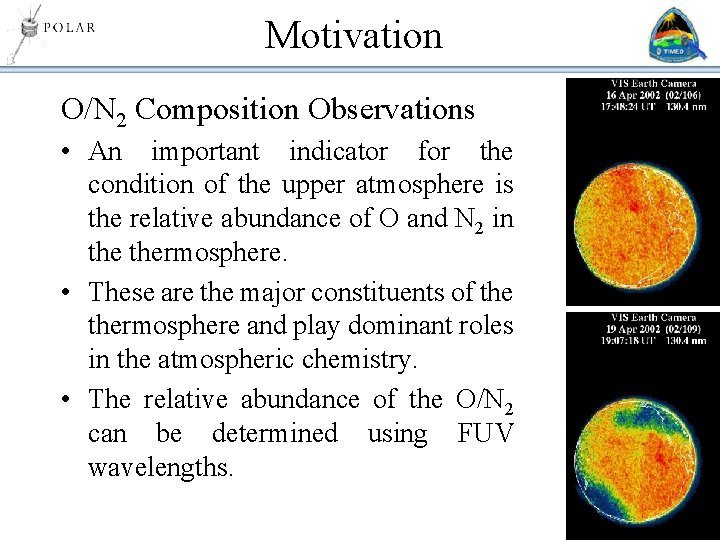
Motivation O/N 2 Composition Observations • An important indicator for the condition of the upper atmosphere is the relative abundance of O and N 2 in thermosphere. • These are the major constituents of thermosphere and play dominant roles in the atmospheric chemistry. • The relative abundance of the O/N 2 can be determined using FUV wavelengths.
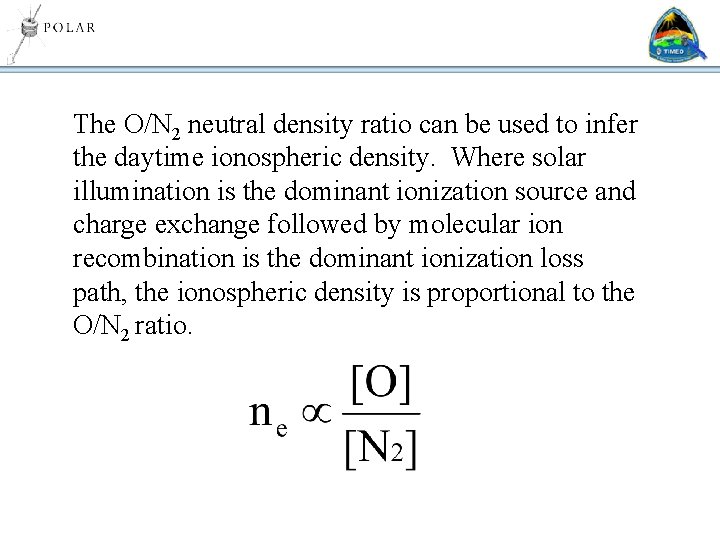
The O/N 2 neutral density ratio can be used to infer the daytime ionospheric density. Where solar illumination is the dominant ionization source and charge exchange followed by molecular ion recombination is the dominant ionization loss path, the ionospheric density is proportional to the O/N 2 ratio.
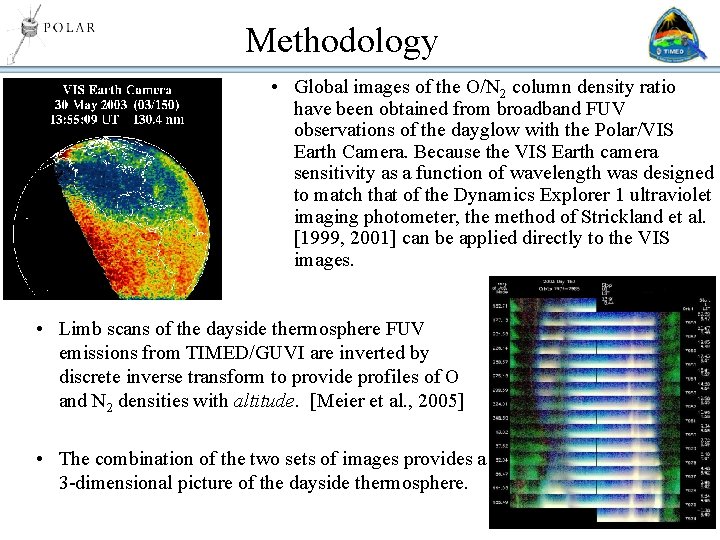
Methodology • Global images of the O/N 2 column density ratio have been obtained from broadband FUV observations of the dayglow with the Polar/VIS Earth Camera. Because the VIS Earth camera sensitivity as a function of wavelength was designed to match that of the Dynamics Explorer 1 ultraviolet imaging photometer, the method of Strickland et al. [1999, 2001] can be applied directly to the VIS images. • Limb scans of the dayside thermosphere FUV emissions from TIMED/GUVI are inverted by discrete inverse transform to provide profiles of O and N 2 densities with altitude. [Meier et al. , 2005] • The combination of the two sets of images provides a 3 -dimensional picture of the dayside thermosphere.

Methodology TIMED/GUVI limb scans observations of thermospheric radiance are inverted to derive the altitude density profiles for N 2 and O and the O/N 2 density ratios at each altitude.
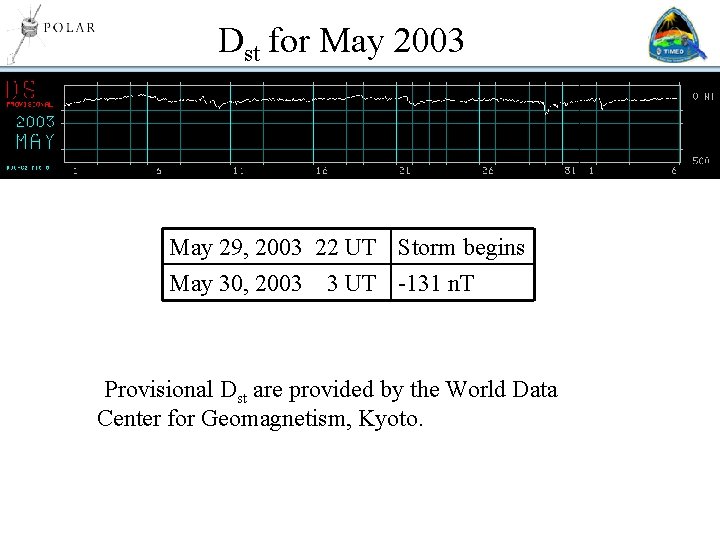
Dst for May 2003 May 29, 2003 22 UT Storm begins May 30, 2003 3 UT -131 n. T Provisional Dst are provided by the World Data Center for Geomagnetism, Kyoto.
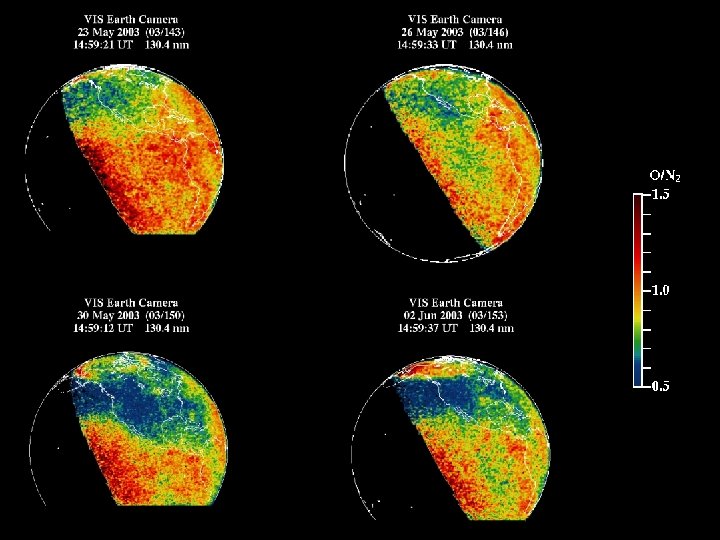
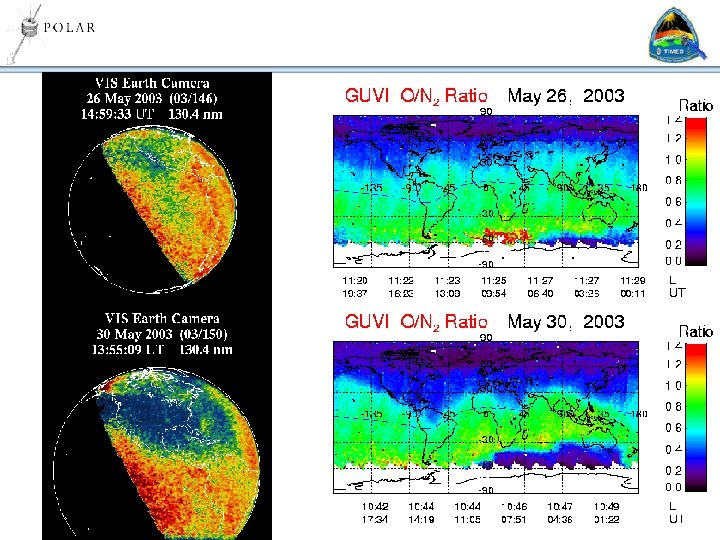
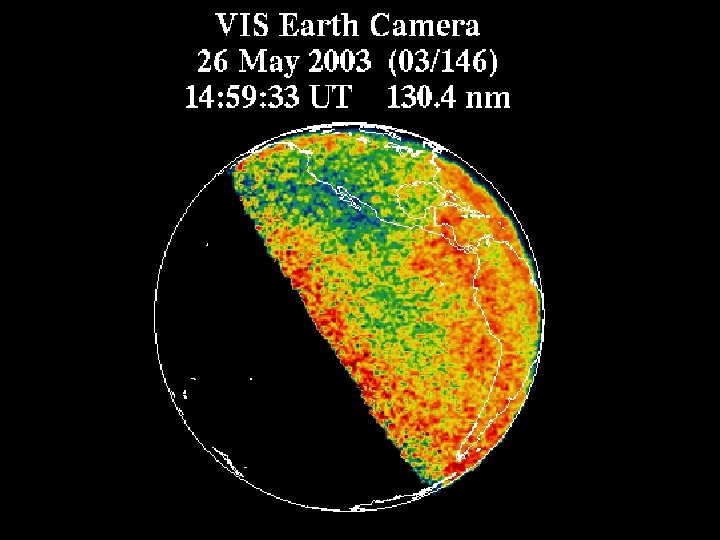
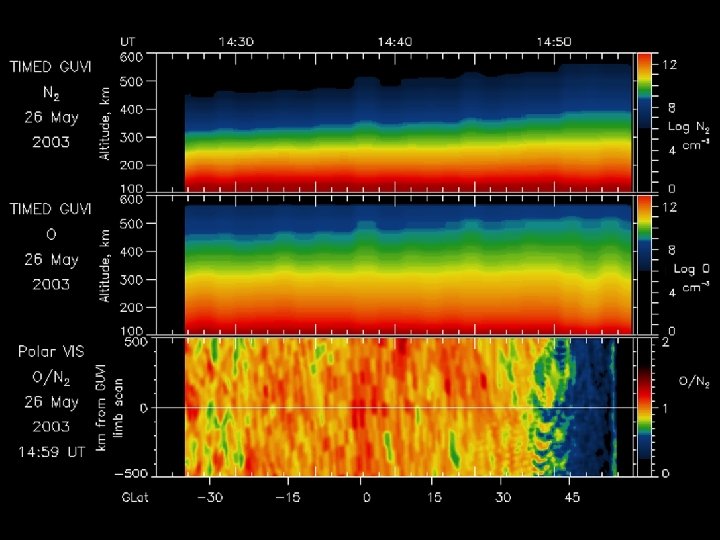
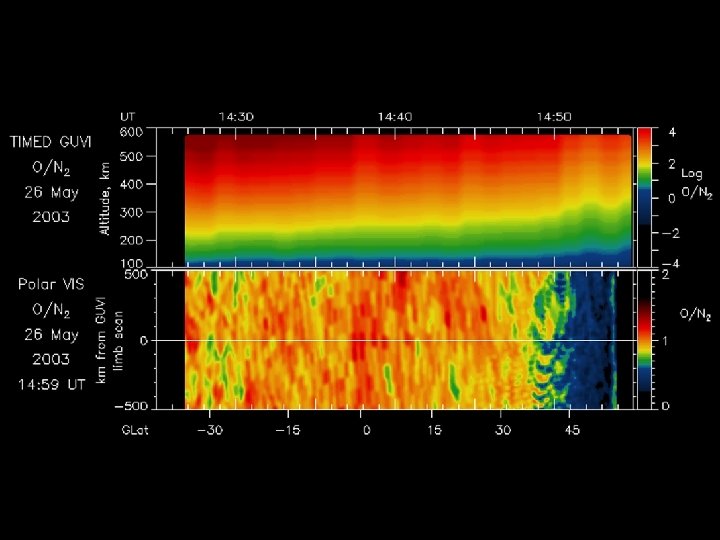
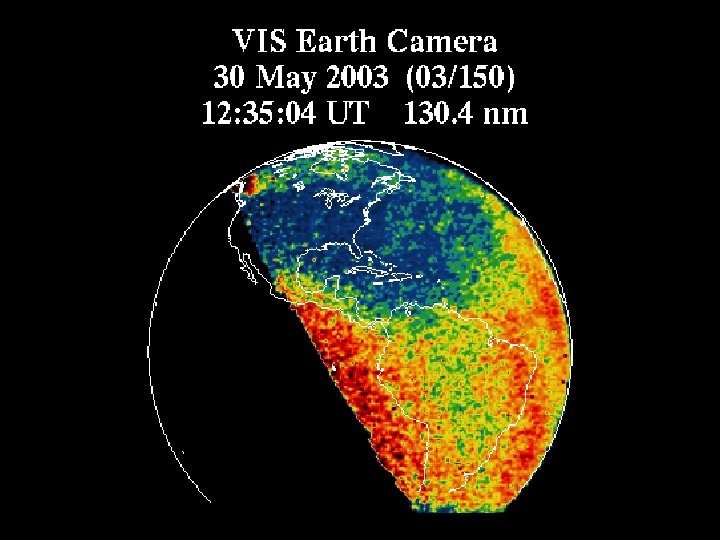


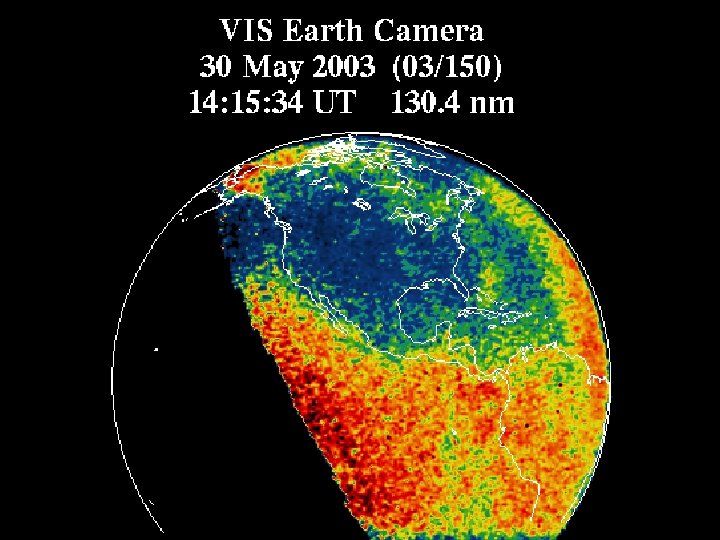


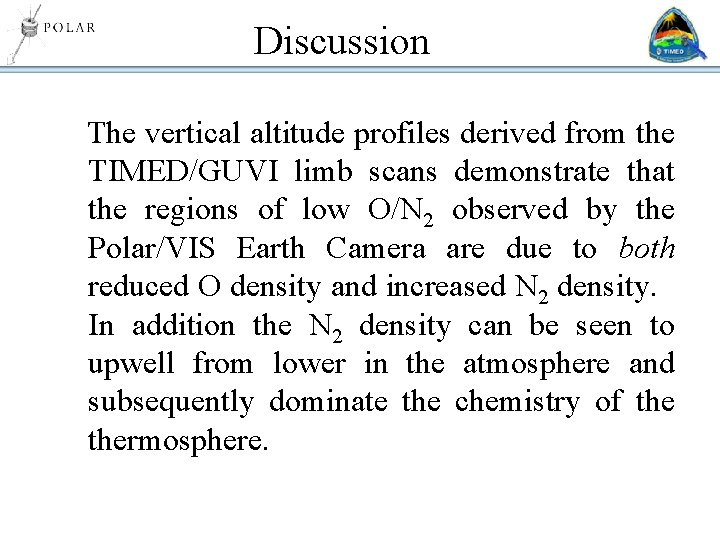
Discussion The vertical altitude profiles derived from the TIMED/GUVI limb scans demonstrate that the regions of low O/N 2 observed by the Polar/VIS Earth Camera are due to both reduced O density and increased N 2 density. In addition the N 2 density can be seen to upwell from lower in the atmosphere and subsequently dominate the chemistry of thermosphere.
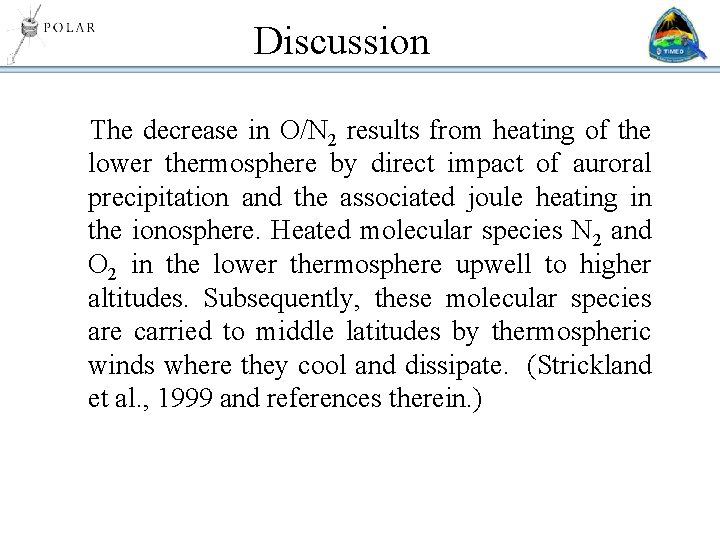
Discussion The decrease in O/N 2 results from heating of the lower thermosphere by direct impact of auroral precipitation and the associated joule heating in the ionosphere. Heated molecular species N 2 and O 2 in the lower thermosphere upwell to higher altitudes. Subsequently, these molecular species are carried to middle latitudes by thermospheric winds where they cool and dissipate. (Strickland et al. , 1999 and references therein. )
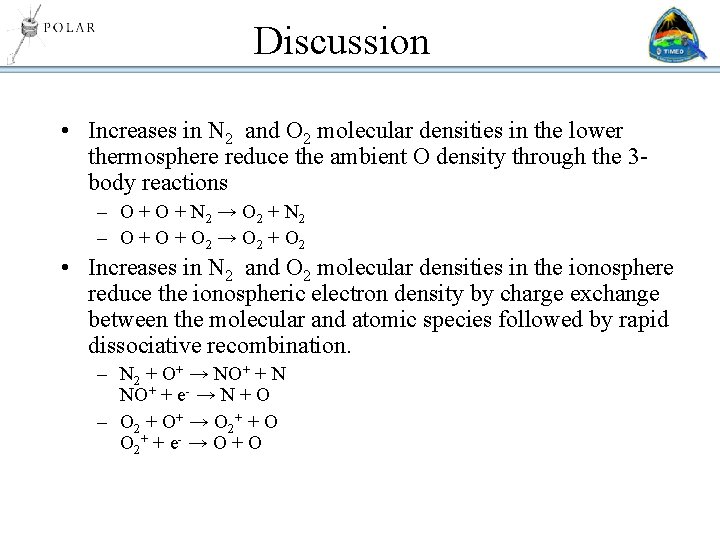
Discussion • Increases in N 2 and O 2 molecular densities in the lower thermosphere reduce the ambient O density through the 3 body reactions – O + N 2 → O 2 + N 2 – O + O 2 → O 2 + O 2 • Increases in N 2 and O 2 molecular densities in the ionosphere reduce the ionospheric electron density by charge exchange between the molecular and atomic species followed by rapid dissociative recombination. – N 2 + O+ → NO+ + N NO+ + e- → N + O – O 2 + O + → O 2 + + O O 2 + + e - → O + O
- Slides: 22