
Observations and Variables What is Science Science has
Observations and Variables
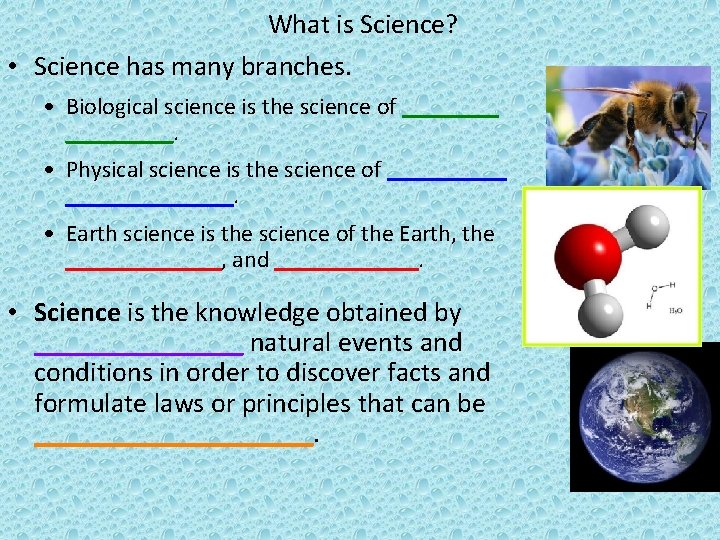
What is Science? • Science has many branches. • Biological science is the science of _________. • Physical science is the science of ______________. • Earth science is the science of the Earth, the _______, and ______. • Science is the knowledge obtained by ________ natural events and conditions in order to discover facts and formulate laws or principles that can be __________.
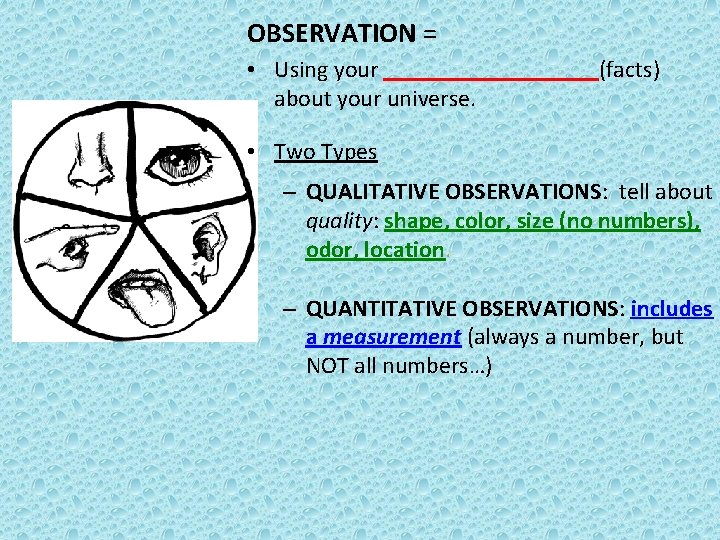
OBSERVATION = • Using your _________(facts) about your universe. • Two Types – QUALITATIVE OBSERVATIONS: tell about quality: shape, color, size (no numbers), odor, location. – QUANTITATIVE OBSERVATIONS: includes a measurement (always a number, but NOT all numbers…)
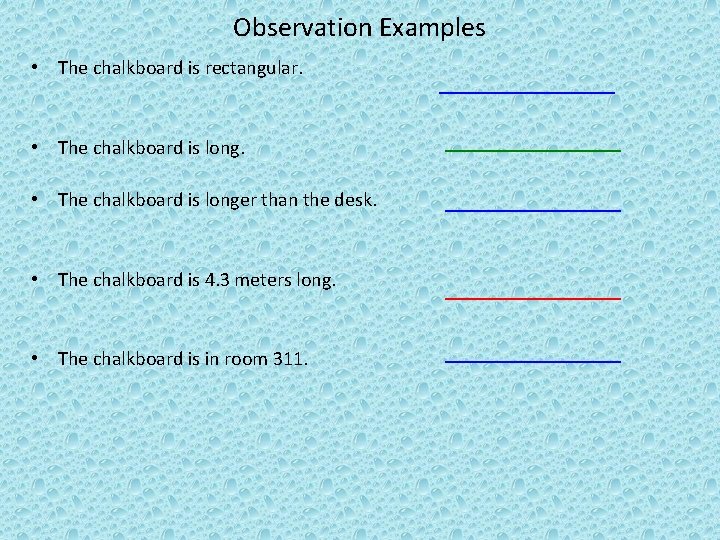
Observation Examples • The chalkboard is rectangular. ___________ • The chalkboard is longer than the desk. ______ • The chalkboard is 4. 3 meters long. ______ • The chalkboard is in room 311. ______
Forming a Hypothesis • HYPOTHESIS: _________ l A hypothesis is a possible answer to a question based on observations that can be tested. l ***Uses the information researched to help form the hypothesis****

Testing the Hypothesis EXPERIMENT: Doing something to test the hypothesis. Must be repeatable and have… _________: things that a scientist wants to remain constant _______: the one that is changed by the scientist. In an experiment there is only one independent variable. _______: the one that changes because of the change in the independent variable.
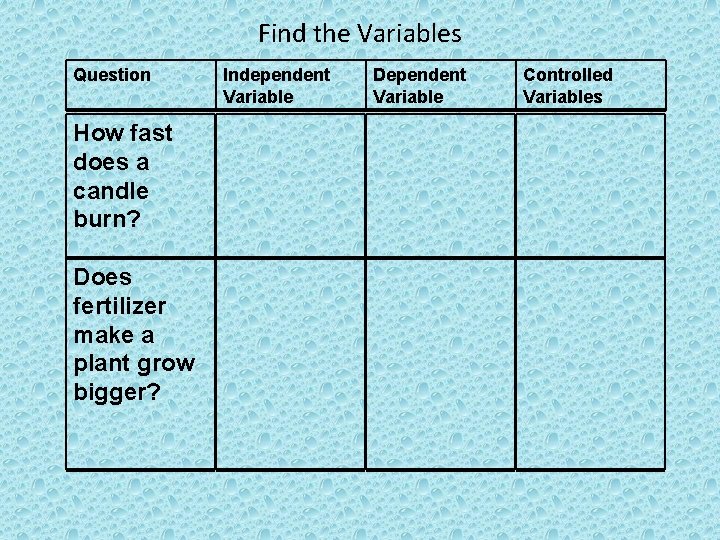
Find the Variables Question How fast does a candle burn? Does fertilizer make a plant grow bigger? Independent Variable Dependent Variable Controlled Variables
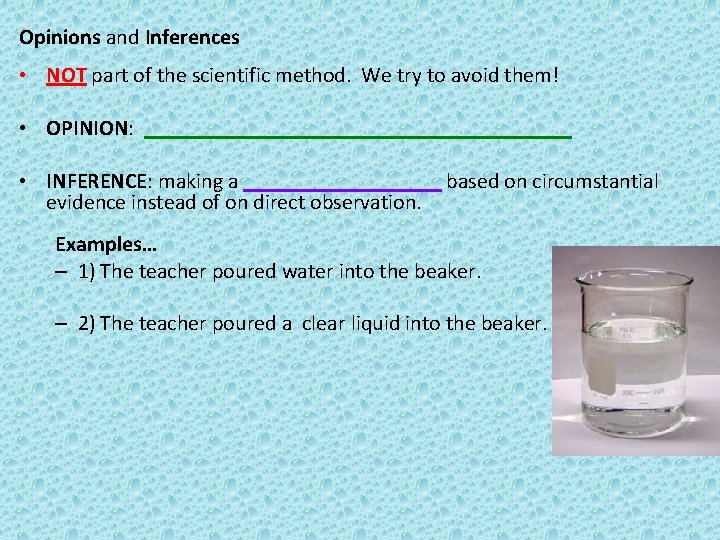
Opinions and Inferences • NOT part of the scientific method. We try to avoid them! • OPINION: ____________________ • INFERENCE: making a _________ based on circumstantial evidence instead of on direct observation. Examples… – 1) The teacher poured water into the beaker. – 2) The teacher poured a clear liquid into the beaker.
- Slides: 8