
Observations and Instrumentations for NWS Operations Presented at
Observations and Instrumentations for NWS Operations Presented at: Building a Weather-Ready Nation by Transitioning Academic Research to NOAA Operations Workshop November 1, 2017 Joseph A. Pica Director, NWS Office of Observations
What NWS Does MISSION Provide weather, water, and climate data, forecasts and warnings for the protection of life and property and the enhancement of the national economy. VISION A Weather-Ready Nation where Society is prepared for and responds to Weather-Dependent Events. “First, it should be understood that forecasts possess no intrinsic value. They acquire value through their ability to influence the decisions made by users of the forecasts. ” What is a Good Forecast? An Essay on the Nature of Goodness in Weather Forecasting” By Allan H. Murphy; Weather and Forecasting (June 1993) 2
NWS Strategic Outcome: A Weather- and Water-Ready Nation “Ready, Responsive, Resilient” Becoming a Weather-Ready Nation is about building community resiliency in the face of increasing vulnerability to extreme weather, water and climate events Better forecasts and warnings Consistent products and services Actionable environmental intelligence Connecting forecasts to decisions Involves the entire US Weather, Water and Climate Enterprise WORKING TOGETHER We have 6000+ WRN Ambassadors 3 3
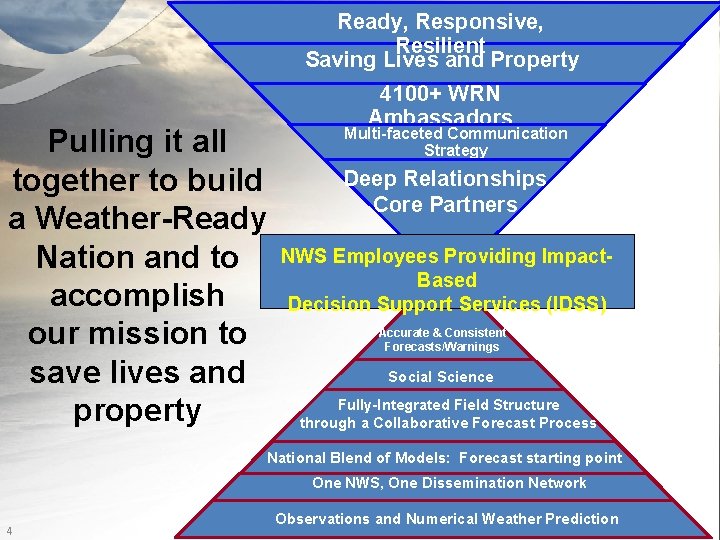
Ready, Responsive, Resilient Saving Lives and Property Pulling it all together to build a Weather-Ready Nation and to accomplish our mission to save lives and property 4100+ WRN Ambassadors Multi-faceted Communication Strategy Deep Relationships Core Partners NWS Employees Providing Impact. Based Decision Support Services (IDSS) Accurate & Consistent Forecasts/Warnings Social Science Fully-Integrated Field Structure through a Collaborative Forecast Process National Blend of Models: Forecast starting point One NWS, One Dissemination Network 4 Observations and Numerical Weather Prediction 4
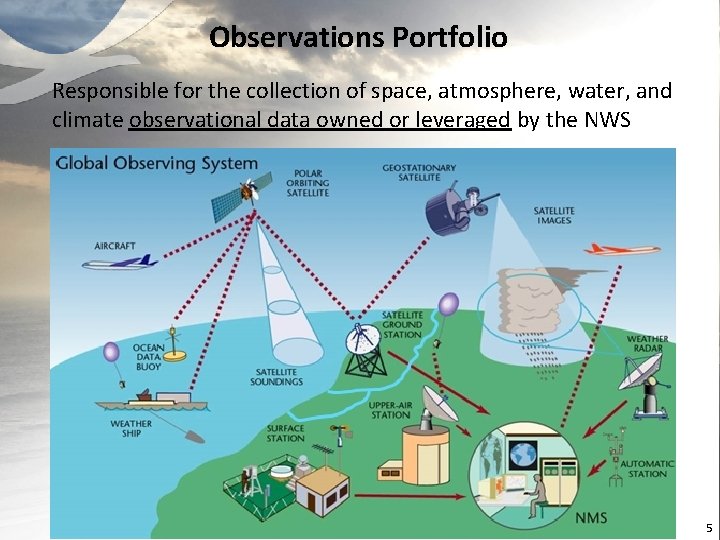
Observations Portfolio Responsible for the collection of space, atmosphere, water, and climate observational data owned or leveraged by the NWS 2 5
Observation Portfolio Management in NOAA As our portfolio management matures, the following are guiding principles towards which we are striving: • Mission-Effective • Superior Service and Reputation • Adaptable • Cost-Effective, Affordable, and Sustainable • Integrated • Global Context and Commitments • In-House Expertise • Well-Governed, Understood, and Trusted 6
NOAA’s Second Emerging Technologies for Observations Workshop - 2017 Theme: “Technology toward a mission-effective, integrated, adaptable and affordable observation portfolio” When: August 22 -23, 2017 Where: NOAA Center for Weather and Climate Prediction (NCWCP), College Park, MD Why: The NOAA Observing Systems Council is seeking to identify emerging technologies for Earth and space observation, and develop recommendations to help NOAA infuse new technology into the observing systems portfolio. How: 5 Internal Sessions – Space, Atmosphere, Terrestrial, Oceans, and Data Management/Analytics 2 External Requests for Information that was open to all Inter-governmental / Partner Panel as the last session Info: https: //nosc. noaa. gov/emerging-tech-workshop. php 7
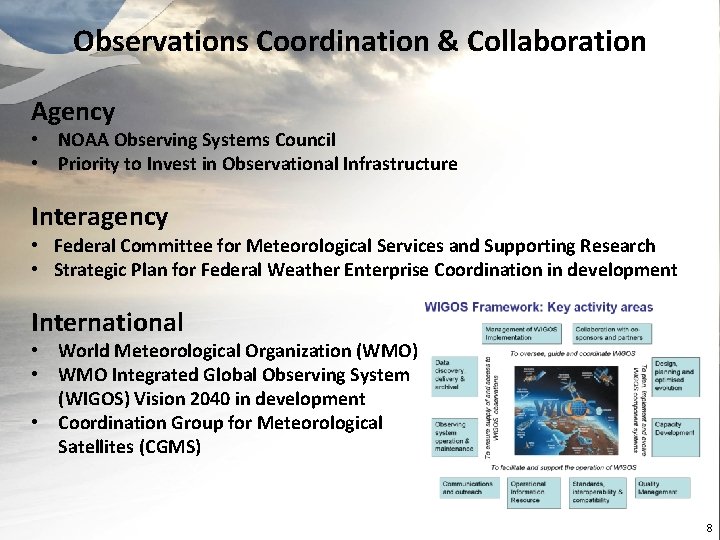
Observations Coordination & Collaboration Agency • NOAA Observing Systems Council • Priority to Invest in Observational Infrastructure Interagency • Federal Committee for Meteorological Services and Supporting Research • Strategic Plan for Federal Weather Enterprise Coordination in development International • World Meteorological Organization (WMO) • WMO Integrated Global Observing System (WIGOS) Vision 2040 in development • Coordination Group for Meteorological Satellites (CGMS) 8
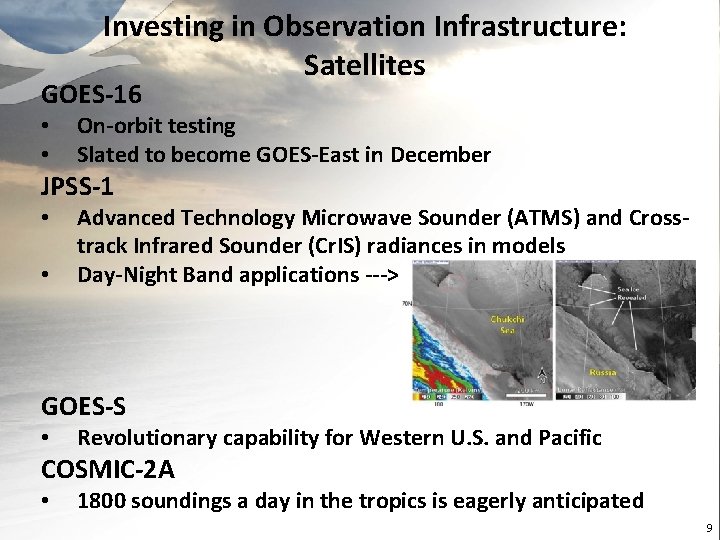
Investing in Observation Infrastructure: Satellites GOES-16 • • On-orbit testing Slated to become GOES-East in December JPSS-1 • • Advanced Technology Microwave Sounder (ATMS) and Crosstrack Infrared Sounder (Cr. IS) radiances in models Day-Night Band applications ---> GOES-S • Revolutionary capability for Western U. S. and Pacific COSMIC-2 A • 1800 soundings a day in the tropics is eagerly anticipated 9
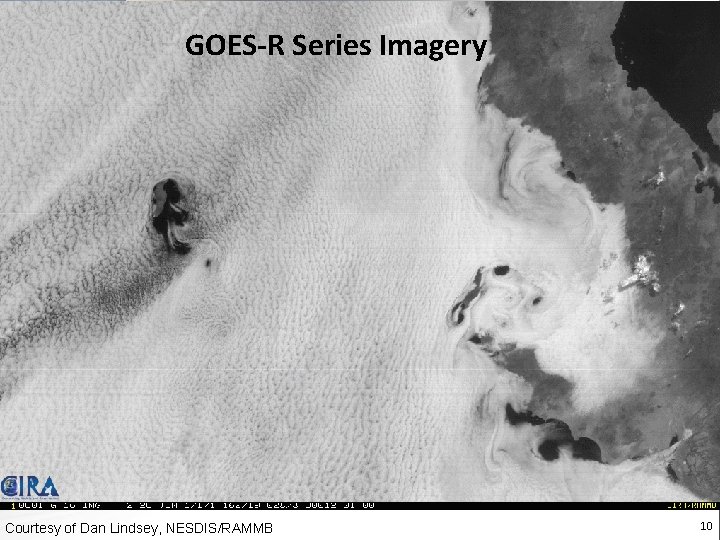
GOES-R Series Imagery Courtesy of Dan Lindsey, NESDIS/RAMMB 10
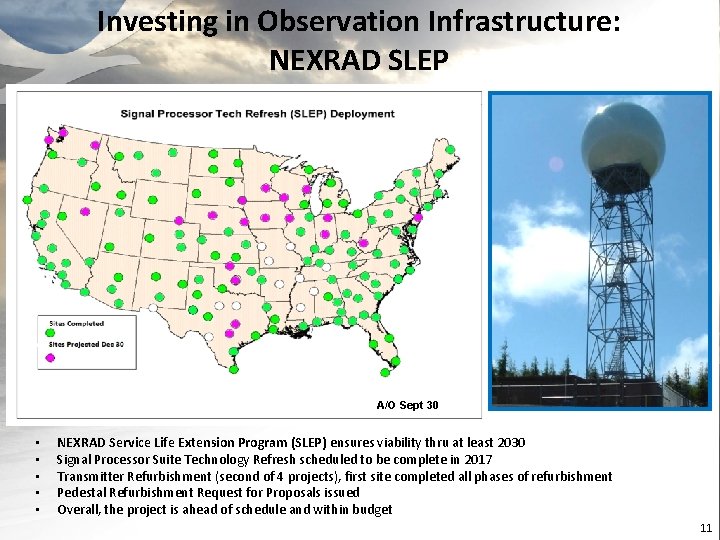
Investing in Observation Infrastructure: NEXRAD SLEP A/O Jan 6, 2017 A/O Sept 30 • • • NEXRAD Service Life Extension Program (SLEP) ensures viability thru at least 2030 Signal Processor Suite Technology Refresh scheduled to be complete in 2017 Transmitter Refurbishment (second of 4 projects), first site completed all phases of refurbishment Pedestal Refurbishment Request for Proposals issued Overall, the project is ahead of schedule and within budget 11
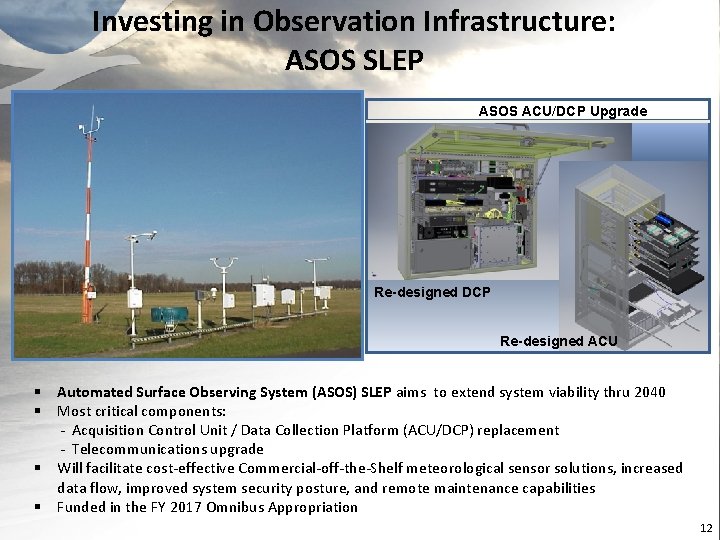
Investing in Observation Infrastructure: ASOS SLEP ASOS ACU/DCP Upgrade Re-designed DCP Re-designed ACU § Automated Surface Observing System (ASOS) SLEP aims to extend system viability thru 2040 § Most critical components: - Acquisition Control Unit / Data Collection Platform (ACU/DCP) replacement - Telecommunications upgrade § Will facilitate cost-effective Commercial-off-the-Shelf meteorological sensor solutions, increased data flow, improved system security posture, and remote maintenance capabilities § Funded in the FY 2017 Omnibus Appropriation 12
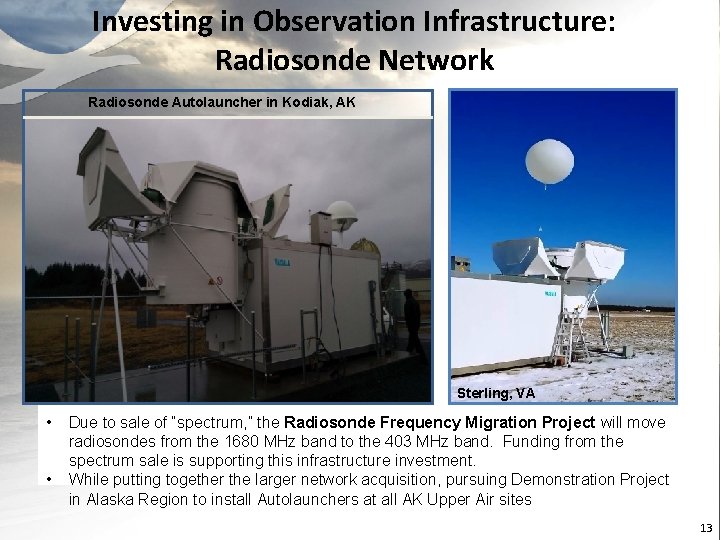
Investing in Observation Infrastructure: Radiosonde Network Radiosonde Autolauncher in Kodiak, AK Sterling, VA • • Due to sale of “spectrum, ” the Radiosonde Frequency Migration Project will move radiosondes from the 1680 MHz band to the 403 MHz band. Funding from the spectrum sale is supporting this infrastructure investment. While putting together the larger network acquisition, pursuing Demonstration Project in Alaska Region to install Autolaunchers at all AK Upper Air sites 13
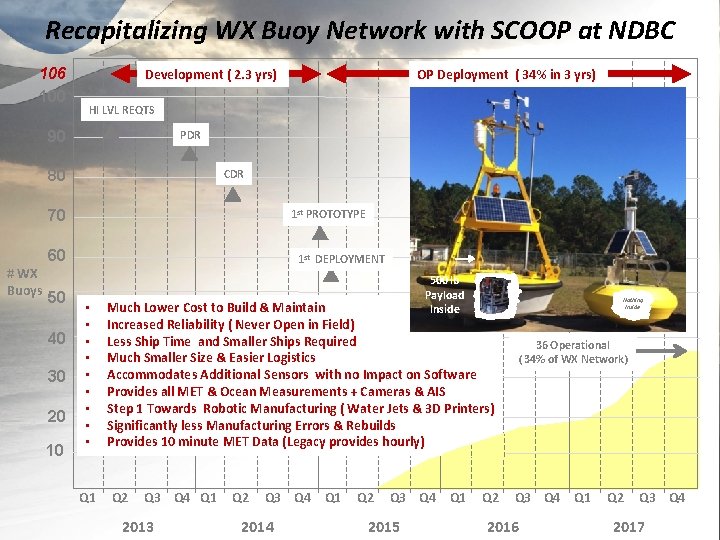
Recapitalizing WX Buoy Network with SCOOP at NDBC 106 100 Development ( 2. 3 yrs) HI LVL REQTS 90 PDR CDR 1 st PROTOTYPE 70 60 50 40 30 20 10 SCOOP Legacy 80 # WX Buoys OP Deployment ( 34% in 3 yrs) 1 st DEPLOYMENT • • • Q 1 500 lb Payload Inside Much Lower Cost to Build & Maintain Increased Reliability ( Never Open in Field) Less Ship Time and Smaller Ships Required Much Smaller Size & Easier Logistics Accommodates Additional Sensors with no Impact on Software Provides all MET & Ocean Measurements + Cameras & AIS Step 1 Towards Robotic Manufacturing ( Water Jets & 3 D Printers) Significantly less Manufacturing Errors & Rebuilds Provides 10 minute MET Data (Legacy provides hourly) Q 2 Q 3 Q 4 Q 1 2013 Q 2 Q 3 Q 4 Q 1 2014 Q 2 Q 3 Q 4 Q 1 2015 Q 2 Nothing Inside 36 Operational ( 34% of WX Network) Q 3 Q 4 Q 1 2016 Q 2 Q 3 Q 4 2017
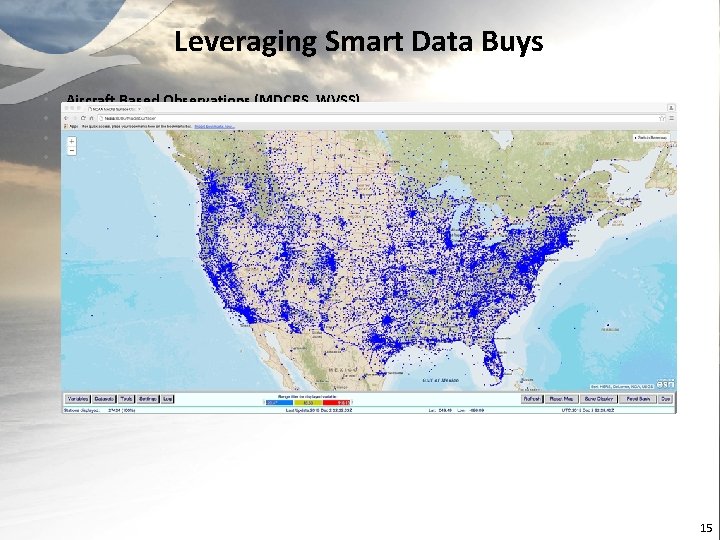
Leveraging Smart Data Buys • • Aircraft Based Observations (MDCRS, WVSS) Lightning Data GPS-Met Commercial Weather Data Pilot – evaluating Radio Occultation data from commercial satellite providers 15
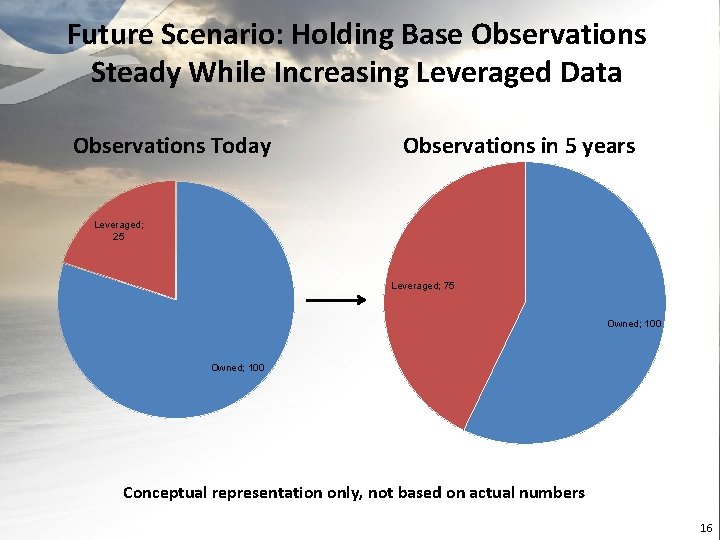
Future Scenario: Holding Base Observations Steady While Increasing Leveraged Data Observations Today Observations in 5 years Leveraged; 25 Leveraged; 75 Owned; 100 Conceptual representation only, not based on actual numbers 16
Discussion Given the scarce resources available, how do we determine the highest “value” observing capabilities to transition from research to operations? Identify the most significant gaps or opportunities to improve the mission Utilize tools to show actual or estimated impact of an observation on the mission When determining costs, include consideration of the resources needed through the entire value chain To the extent possible, represent the results in a consistent manner among observing capabilities 17
Thank You! Contact: Joseph. A. Pica@noaa. gov 301 -427 -9778 18
- Slides: 18