
Observational Learning by observing and watching others the
Observational Learning by observing and watching others (the model) 1
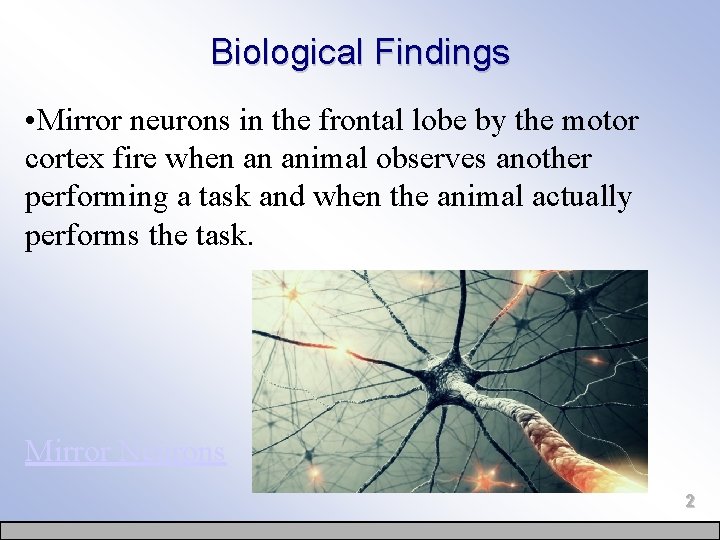
Biological Findings • Mirror neurons in the frontal lobe by the motor cortex fire when an animal observes another performing a task and when the animal actually performs the task. Mirror Neurons 2
Observational Learning • The Model - the person whose behavior the subject watches and imitates • Modeling - The process of observing and imitating a specific behavior 3
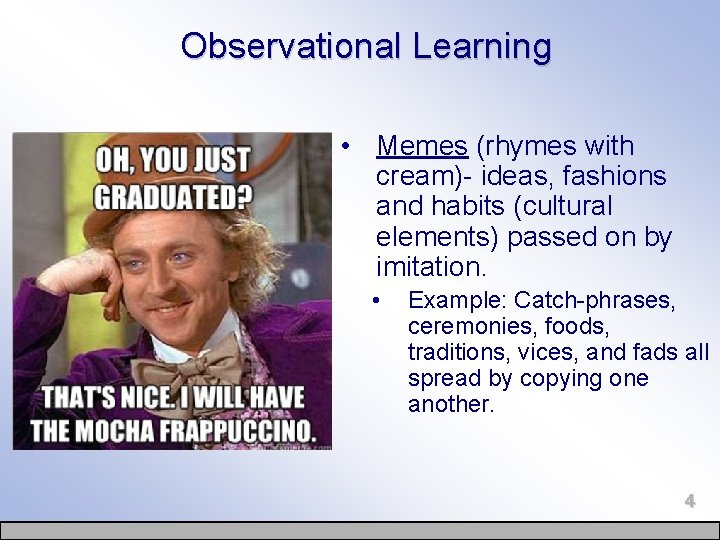
Observational Learning • Memes (rhymes with cream)- ideas, fashions and habits (cultural elements) passed on by imitation. • Example: Catch-phrases, ceremonies, foods, traditions, vices, and fads all spread by copying one another. 4
Modeled Behavior What behaviors do your parents do that you do now? 5
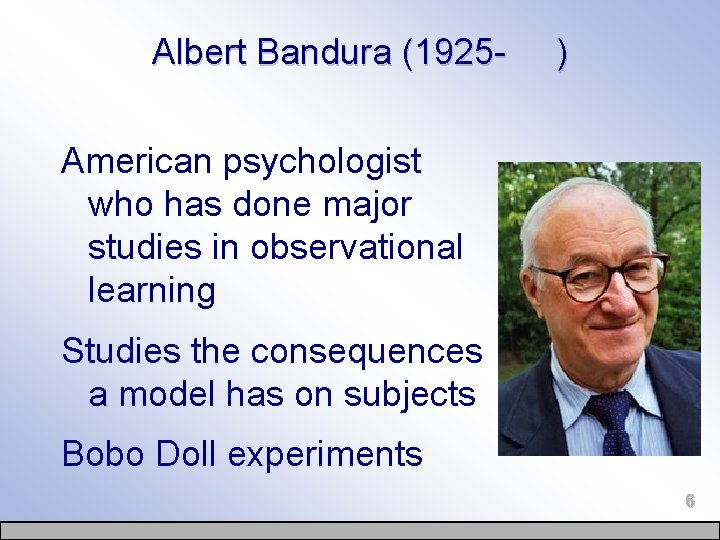
Albert Bandura (1925 - ) American psychologist who has done major studies in observational learning Studies the consequences a model has on subjects Bobo Doll experiments 6
Bobo Doll Experiments Children watched an adult model show aggressive behavior toward a Bobo doll Three experimental conditions: • The model was praised. • The model was punished. • The model received no consequences for the aggressive behavior. 7
Vicarious Learning by seeing the consequence of another’s behavior Bandura said that reinforcement is not essential for learning to occur but the expectation of reinforcement affects the performance of what has been learned. 8

Bobo Doll Experiment 9
Bandura’s Bobo Dolls Let’s watch the clip! 10
Factors that make us more likely to imitate: Bandura said 4 cognitive processes are used in observational learning • Must pay attention to the other person’s behavior. • Must remember the other person’s behavior. • Must transform the memory into actions that you are capable of reproducing. • Must have some motivation for you to imitate behavior. 11
Antisocial/Prosocial Behavior Antisocial behavior - negative, destructive, abusive, unhelpful behavior Prosocial behavior – positive, constructive, helpful behavior Both types of behavior can be modeled effectively. How might TV programs effect the way we behave? 12
• Modeling 4 Monkey see, monkey do! • Disinhibition 4 Get away with or are rewarded for violence öThey always “get the girl/guy/money/car - etc. • Increased arousal 4 Works the audience up öWatch the fans at a sporting event öWatch your friends watch the WWF • Habituation 4 We become used to - desensitization
- Slides: 13