
Observation Systems and Advanced Technology OSAT Overview Steve
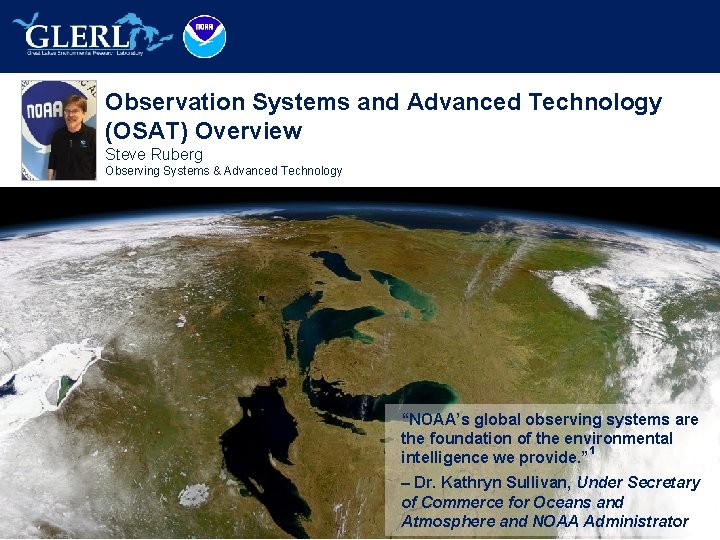
Observation Systems and Advanced Technology (OSAT) Overview Steve Ruberg Observing Systems & Advanced Technology Place Photo Here “NOAA’s global observing systems are the foundation of the environmental 1 intelligence we provide. ” – Dr. Kathryn Sullivan, Under Secretary of Commerce for Oceans and Atmosphere and NOAA Administrator 1/10
OSAT | Overview OSAT Teams Remote Sensing George Leshkevich 1 Songzhi Liu 2 Andrea Vander. Woude 2 Vessel Operations Dennis Donahue 1 Steve Bawks 5 Beau Braymer 5 Dan Burlingame 5 Bob Harvey 5 Jack Workman 1 Andrew Yagiela 1 Marine Instrumentation Lab (MIL) Ron Muzzi 1 Kyle Beadle 1 Steve Constant 1 Russ Miller 2 Terry Miller 1 Synthesis Observations and Response (SOAR) Steve Ruberg 1, Tom Johengen 2 Dan Obenour 3 Eric Anderson 1 Danna Palladino 2 Ashley Burtner 2 Heidi Purcell 2 Jim Churnside 6 Mike Sayers 4 Tim Davis 1 Bob Shuchman 4 Sonia Joseph-Joshi 2 Craig Stow 1 George Leshkevich 1 Dack Stuart 2 Brandi Mc. Carty 5 Andrea Vander Woude 2 Russ Miller 2 2/5
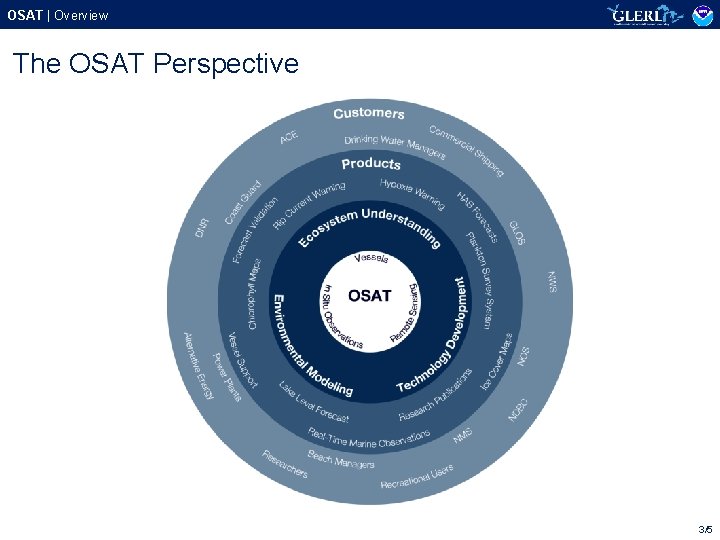
OSAT | Overview The OSAT Perspective 3/5
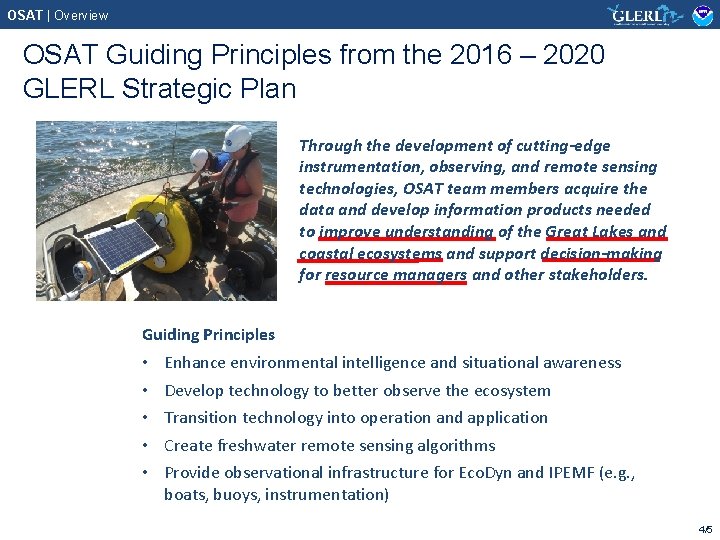
OSAT | Overview OSAT Guiding Principles from the 2016 – 2020 GLERL Strategic Plan Through the development of cutting-edge instrumentation, observing, and remote sensing technologies, OSAT team members acquire the data and develop information products needed to improve understanding of the Great Lakes and coastal ecosystems and support decision-making for resource managers and other stakeholders. Guiding Principles • • • Enhance environmental intelligence and situational awareness Develop technology to better observe the ecosystem Transition technology into operation and application Create freshwater remote sensing algorithms Provide observational infrastructure for Eco. Dyn and IPEMF (e. g. , boats, buoys, instrumentation) 4/5
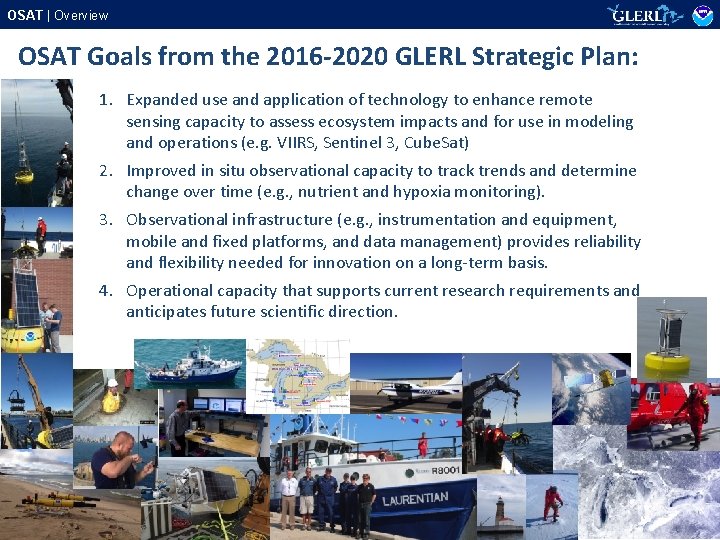
OSAT | Overview OSAT Goals from the 2016 -2020 GLERL Strategic Plan: 1. Expanded use and application of technology to enhance remote sensing capacity to assess ecosystem impacts and for use in modeling and operations (e. g. VIIRS, Sentinel 3, Cube. Sat) 2. Improved in situ observational capacity to track trends and determine change over time (e. g. , nutrient and hypoxia monitoring). 3. Observational infrastructure (e. g. , instrumentation and equipment, mobile and fixed platforms, and data management) provides reliability and flexibility needed for innovation on a long-term basis. 4. Operational capacity that supports current research requirements and anticipates future scientific direction. 2/10
- Slides: 5