
Observation of the inception and movement of cavitation
Observation of the inception and movement of cavitation bubbles in liquid whistle C. Li , J. J. Deng, L. X. Bai Institute of acoustics, Chinese Academy of Sciences, Beijing, China 1
Outline 1. Background 2. Experimental setup 3. The pressure of the liquid whistle 4. The observation of the bubbles induced by the liquid whistle 5. Result 2

1. Background Cavitation is a phenomena of formation, growth and collapse of microbubbles within a liquid. It can release large magnitudes of energy locally and induce mechanical, physical and chemical effect. These effects can be used in many field, such as cleaning, emulsification and chemistry etc. . The application of cavitation become an exciting field. Acoustical cavitation and Hydrodynamic cavitation are two main types of cavitation. Hydrodynamic cavitation has been widely studied due to high energy efficiency, large-scale using and its presence in many industrial applications. 3
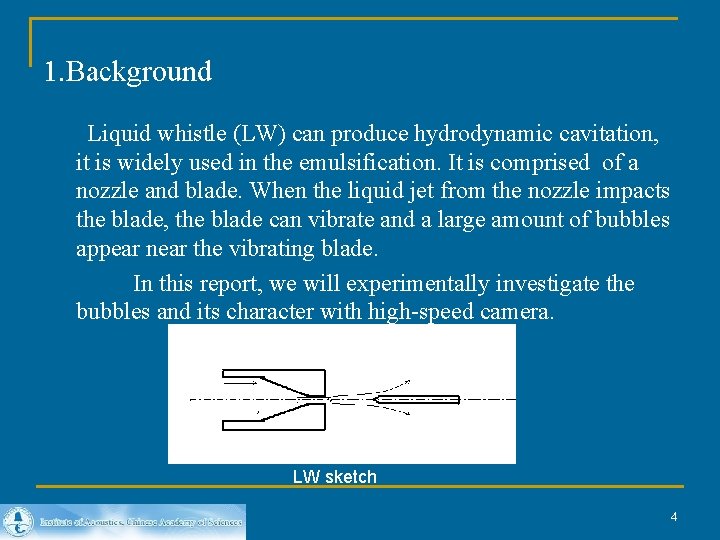
1. Background Liquid whistle (LW) can produce hydrodynamic cavitation, it is widely used in the emulsification. It is comprised of a nozzle and blade. When the liquid jet from the nozzle impacts the blade, the blade can vibrate and a large amount of bubbles appear near the vibrating blade. In this report, we will experimentally investigate the bubbles and its character with high-speed camera. LW sketch 4
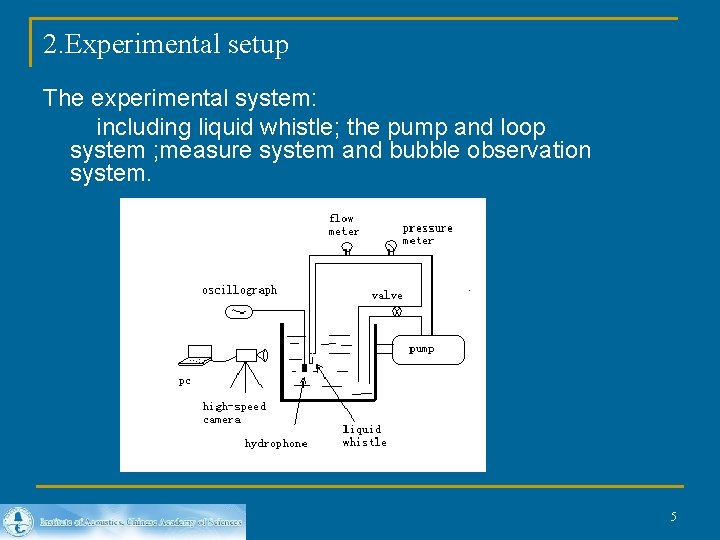
2. Experimental setup The experimental system: including liquid whistle; the pump and loop system ; measure system and bubble observation system. 5
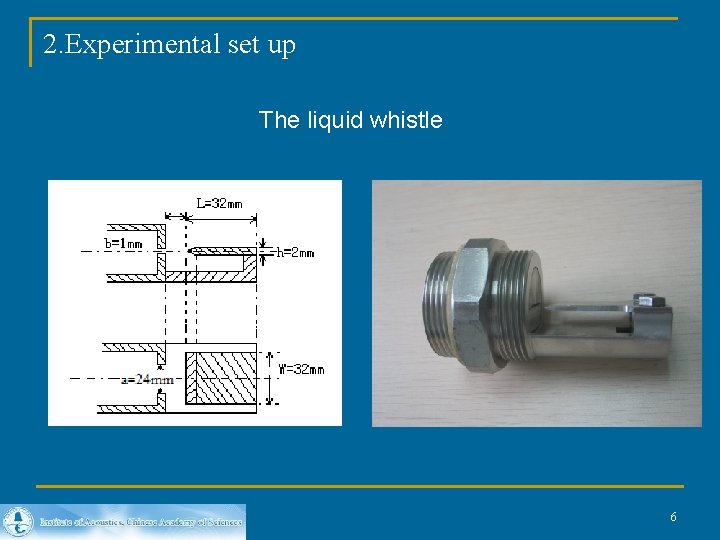
2. Experimental set up The liquid whistle 6
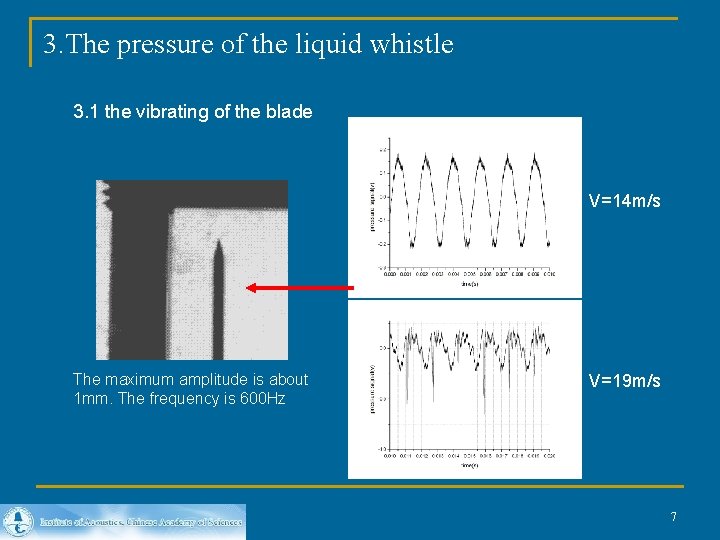
3. The pressure of the liquid whistle 3. 1 the vibrating of the blade V=14 m/s The maximum amplitude is about 1 mm. The frequency is 600 Hz V=19 m/s 7
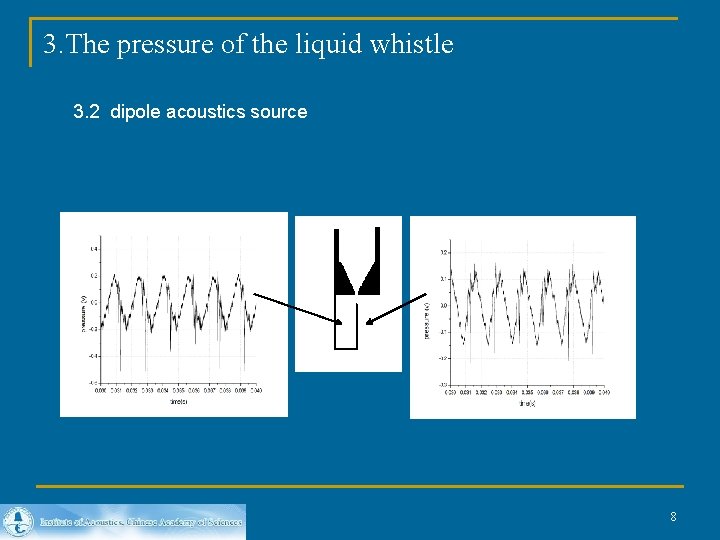
3. The pressure of the liquid whistle 3. 2 dipole acoustics source 8
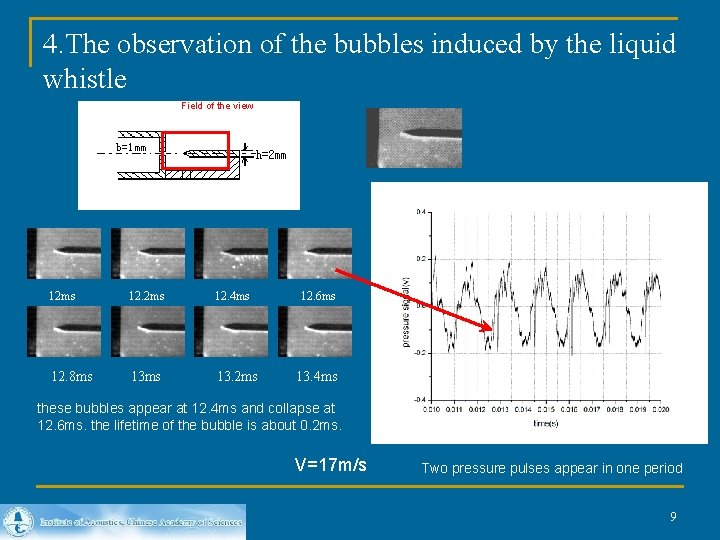
4. The observation of the bubbles induced by the liquid whistle Field of the view 12 ms 12. 4 ms 12. 8 ms 13. 2 ms 12. 6 ms 13. 4 ms these bubbles appear at 12. 4 ms and collapse at 12. 6 ms. the lifetime of the bubble is about 0. 2 ms. V=17 m/s Two pressure pulses appear in one period 9
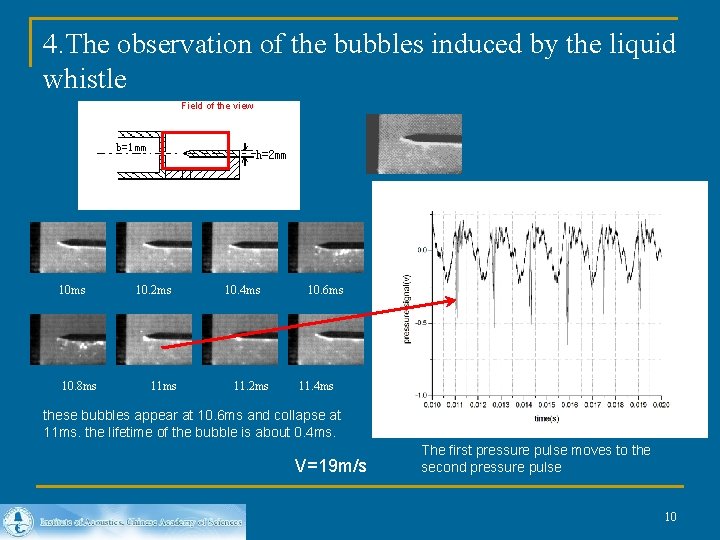
4. The observation of the bubbles induced by the liquid whistle Field of the view 10 ms 10. 8 ms 10. 2 ms 11 ms 10. 4 ms 11. 2 ms 10. 6 ms 11. 4 ms these bubbles appear at 10. 6 ms and collapse at 11 ms. the lifetime of the bubble is about 0. 4 ms. V=19 m/s The first pressure pulse moves to the second pressure pulse 10
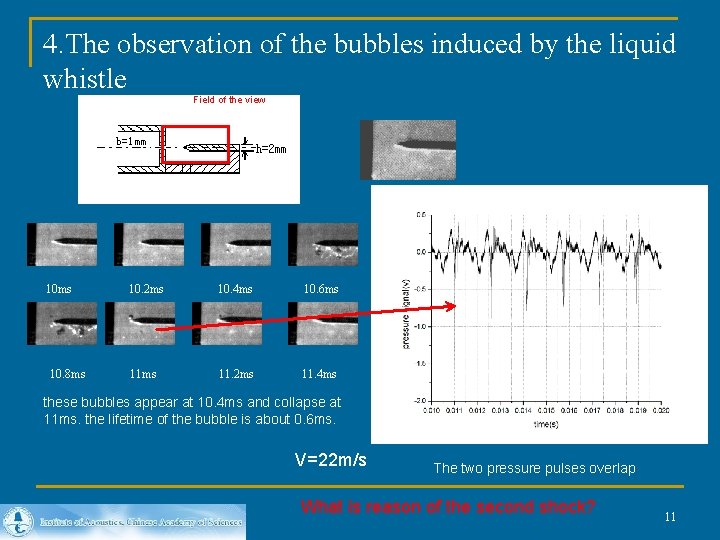
4. The observation of the bubbles induced by the liquid whistle Field of the view 10 ms 10. 8 ms 10. 2 ms 10. 4 ms 10. 6 ms 11. 2 ms 11. 4 ms these bubbles appear at 10. 4 ms and collapse at 11 ms. the lifetime of the bubble is about 0. 6 ms. V=22 m/s The two pressure pulses overlap What is reason of the second shock? 11
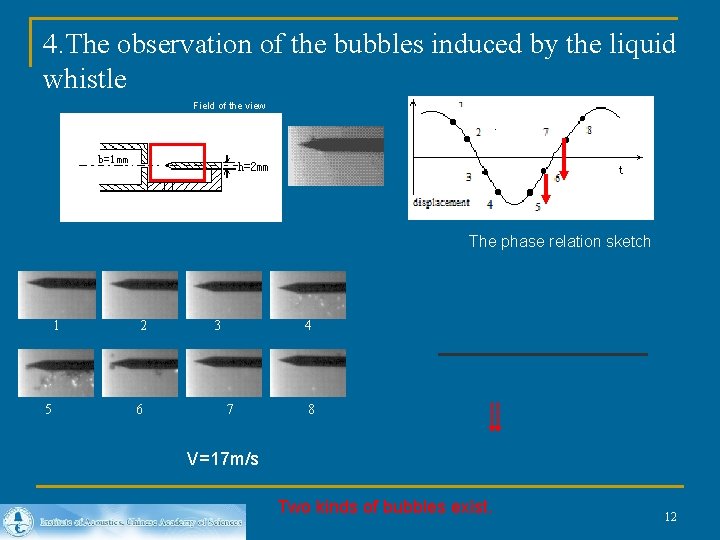
4. The observation of the bubbles induced by the liquid whistle Field of the view The phase relation sketch 1 5 2 6 3 4 7 8 V=17 m/s Two kinds of bubbles exist. 12
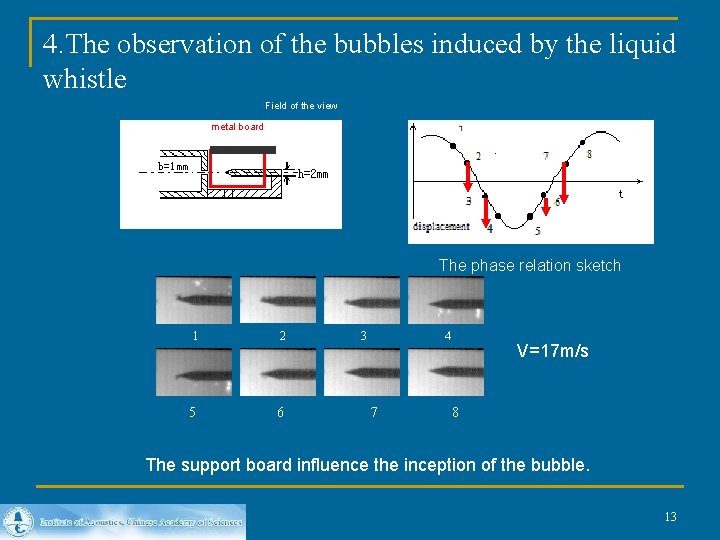
4. The observation of the bubbles induced by the liquid whistle Field of the view metal board The phase relation sketch 1 2 5 6 3 4 7 V=17 m/s 8 The support board influence the inception of the bubble. 13
5. Result 1. Two kinds of bubbles were observed near the vibrating blade of the liquid whistle in each period. The first kind occurs on the side of the blade. The second kind occurs on the tip of the blade. Both of these bubbles can transmit shock wave. With the increase of the flow speed, the two shocks overlap. 2. The bubble is only appear at the space where is between the blade and support board. The board can influences the inception of these bubbles. 14
Thanks for your attention ! 15
- Slides: 15