
OBSERVATION OF KELVINHELMHOLTZLIKE INSTABILITY AT THE PLASMALIQUID INTERFACE
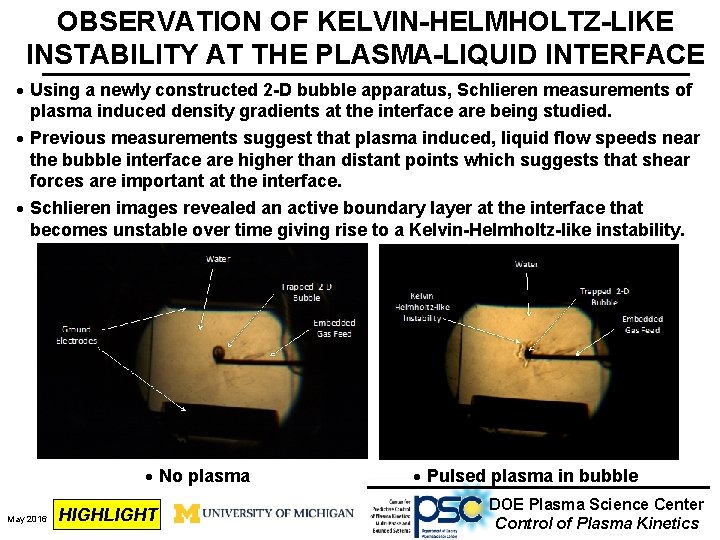
OBSERVATION OF KELVIN-HELMHOLTZ-LIKE INSTABILITY AT THE PLASMA-LIQUID INTERFACE · Using a newly constructed 2 -D bubble apparatus, Schlieren measurements of plasma induced density gradients at the interface are being studied. · Previous measurements suggest that plasma induced, liquid flow speeds near the bubble interface are higher than distant points which suggests that shear forces are important at the interface. · Schlieren images revealed an active boundary layer at the interface that becomes unstable over time giving rise to a Kelvin-Helmholtz-like instability. · No plasma May 2016 HIGHLIGHT · Pulsed plasma in bubble DOE Plasma Science Center Control of Plasma Kinetics
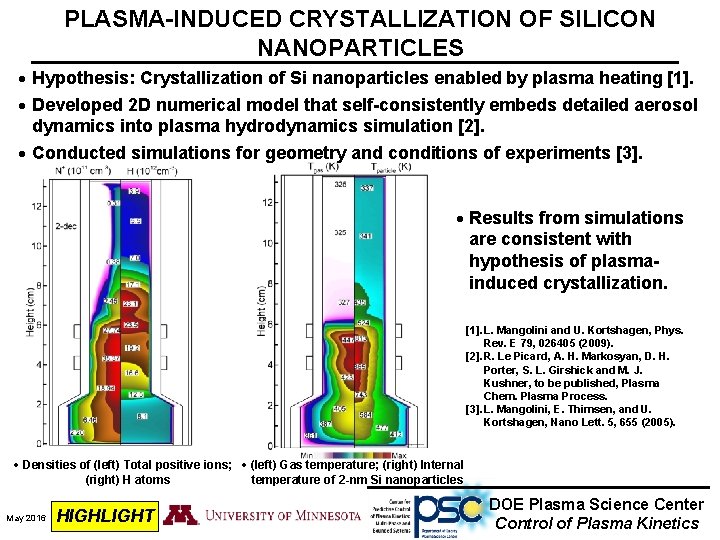
PLASMA-INDUCED CRYSTALLIZATION OF SILICON NANOPARTICLES · Hypothesis: Crystallization of Si nanoparticles enabled by plasma heating [1]. · Developed 2 D numerical model that self-consistently embeds detailed aerosol dynamics into plasma hydrodynamics simulation [2]. · Conducted simulations for geometry and conditions of experiments [3]. · Results from simulations are consistent with hypothesis of plasmainduced crystallization. [1]. L. Mangolini and U. Kortshagen, Phys. Rev. E 79, 026405 (2009). [2]. R. Le Picard, A. H. Markosyan, D. H. Porter, S. L. Girshick and M. J. Kushner, to be published, Plasma Chem. Plasma Process. [3]. L. Mangolini, E. Thimsen, and U. Kortshagen, Nano Lett. 5, 655 (2005). · Densities of (left) Total positive ions; · (left) Gas temperature; (right) Internal (right) H atoms temperature of 2 -nm Si nanoparticles May 2016 HIGHLIGHT DOE Plasma Science Center Control of Plasma Kinetics
- Slides: 2