
Observation of CP Violation in Kaon Decays Igor
Observation of CP Violation in Kaon Decays Igor Senderovich
Outline 1. Theory i. iii. Review of discrete symmetries Violation of symmetries and the CPT Theorem The Kaon System a. b. 2. Mixing and eigenstates of CP Decay modes and regeneration Experiment: Cronin, Fitch et. al. i. iii. June 11, 2007 Setup Analysis Results Igor Senderovich, Observation of CP Violation in Kaon Decays 2

Discrete Symmetries The discrete transformations discussed here have eigenvalues where the operator stands in for Charge Conjugation (C), Parity (P), and Time Reversal (T) What are their eigenstates? If [Ô, Ĥ] = 0, that is if Ô has the same eigenstates as the Hamiltonian, then these energy eigenstates are said to have definite states of symmetry. June 11, 2007 Igor Senderovich, Observation of CP Violation in Kaon Decays 3
CPT Theorem A local, Lorentz invariant quantum field theory with a Hermitian Hamiltonian must respect CPT symmetry. • first appeared in the work of Julian Schwinger, then proven more explicitly by Lüders, Pauli and Bell. • stands on solid ground theoretically and experimentally Implications: individual violations of permutations of C, P and T must cancel. Thus, violation of CP would require violation of T, which would mean that • time has a preferred direction on the fundamental scale. • there is a clue to the matter-antimatter imbalance (the two are otherwise CP-symmetric) June 11, 2007 Igor Senderovich, Observation of CP Violation in Kaon Decays 4

The Kaon System Neutral Kaon Particles: • Neutral particle with a distinct (opposite strangeness) antiparticle • Common decay products (e. g. 2π) Consequence: A neutral Kaon can oscillate into its antiparticle! Example: These must not be eigenstates of the full Hamiltonian! June 11, 2007 Igor Senderovich, Observation of CP Violation in Kaon Decays 5
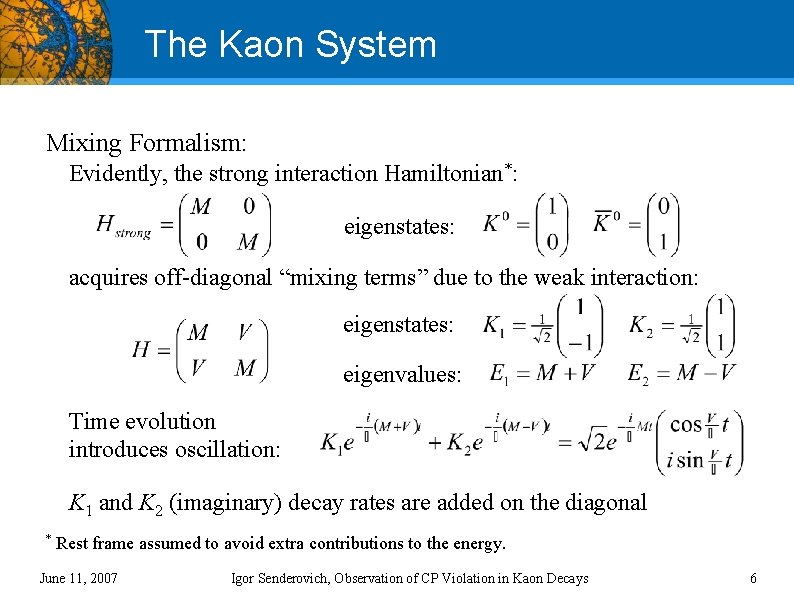
The Kaon System Mixing Formalism: Evidently, the strong interaction Hamiltonian*: eigenstates: acquires off-diagonal “mixing terms” due to the weak interaction: eigenstates: eigenvalues: Time evolution introduces oscillation: K 1 and K 2 (imaginary) decay rates are added on the diagonal * Rest frame assumed to avoid extra contributions to the energy. June 11, 2007 Igor Senderovich, Observation of CP Violation in Kaon Decays 6
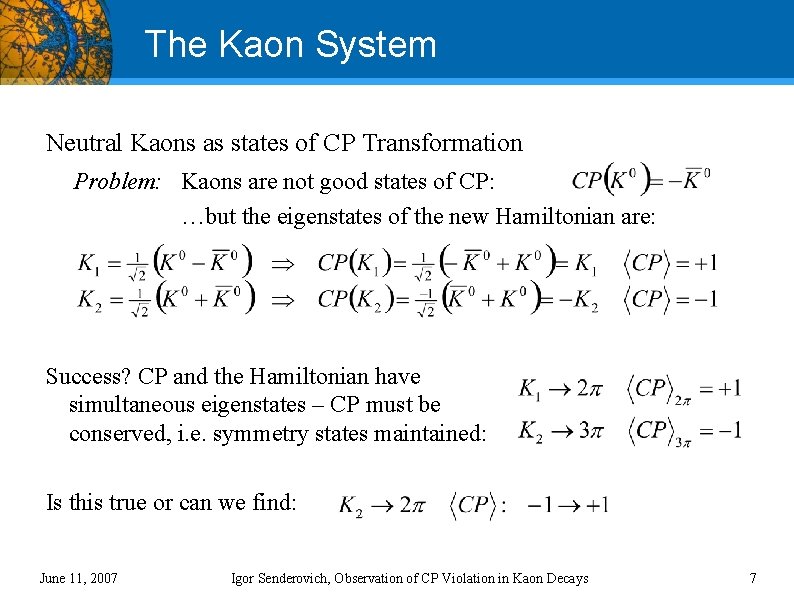
The Kaon System Neutral Kaons as states of CP Transformation Problem: Kaons are not good states of CP: …but the eigenstates of the new Hamiltonian are: Success? CP and the Hamiltonian have simultaneous eigenstates – CP must be conserved, i. e. symmetry states maintained: Is this true or can we find: June 11, 2007 Igor Senderovich, Observation of CP Violation in Kaon Decays 7
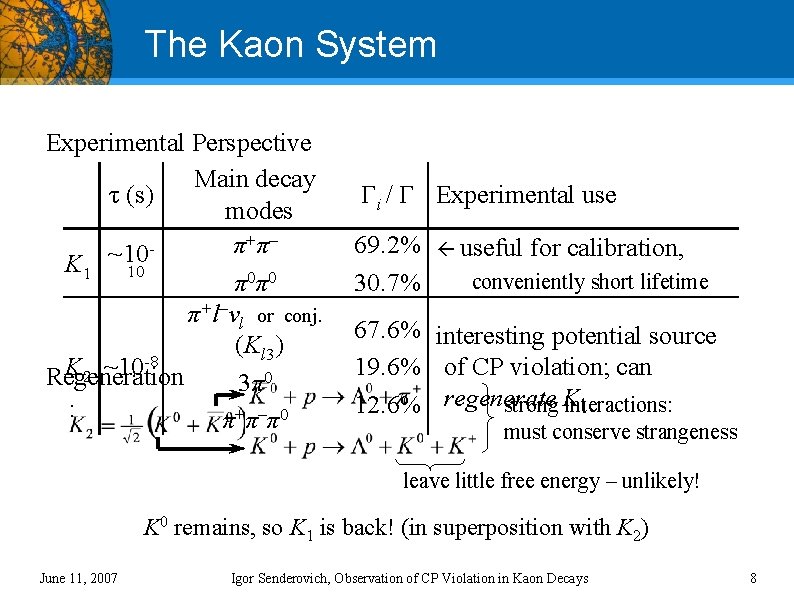
The Kaon System Experimental Perspective Main decay τ (s) modes +π – π K 1 ~10 10 π 0π 0 π+l–νl or conj. (Kl 3) -8 K 2 ~10 Regeneration 3π0 : π + π –π 0 Γi / Γ Experimental use 69. 2% 30. 7% useful for calibration, conveniently short lifetime 67. 6% interesting potential source 19. 6% of CP violation; can strong K interactions: 12. 6% regenerate 1 must conserve strangeness leave little free energy – unlikely! K 0 remains, so K 1 is back! (in superposition with K 2) June 11, 2007 Igor Senderovich, Observation of CP Violation in Kaon Decays 8
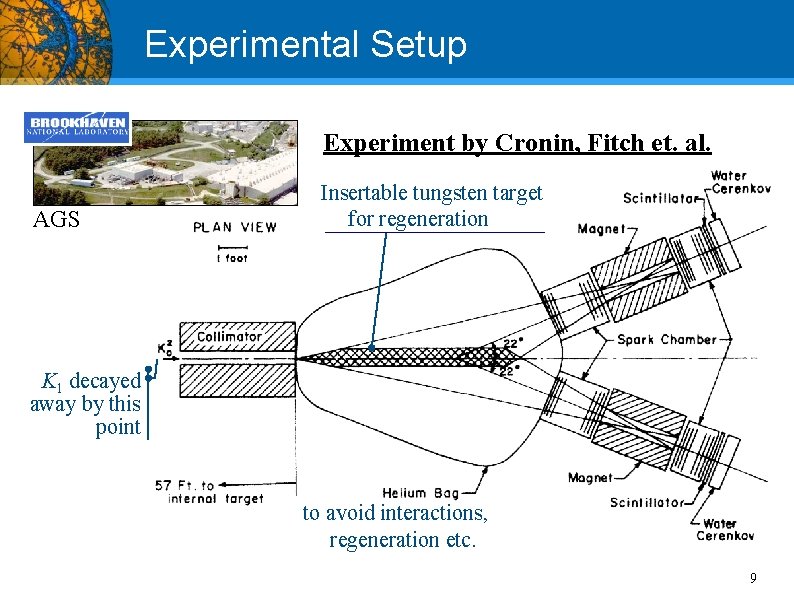
Experimental Setup Experiment by Cronin, Fitch et. al. AGS Insertable tungsten target for regeneration K 1 decayed away by this point to avoid interactions, regeneration etc. 9
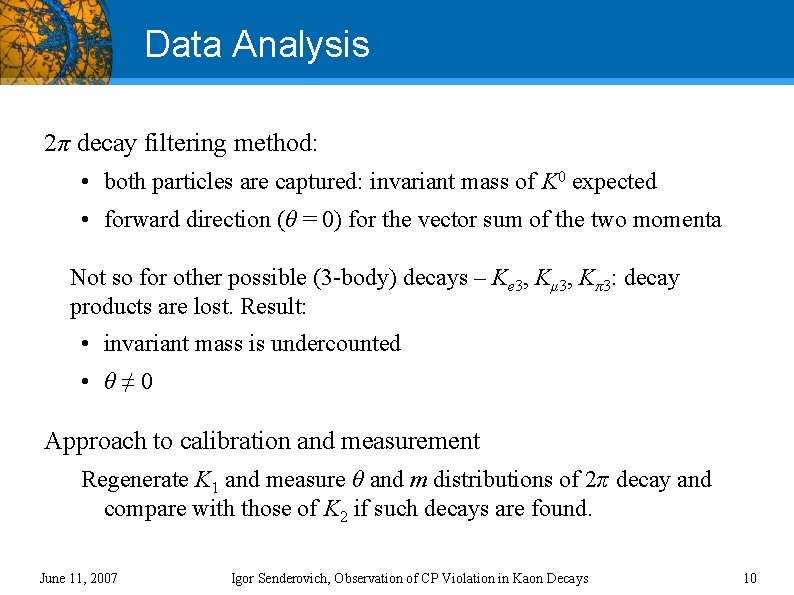
Data Analysis 2π decay filtering method: • both particles are captured: invariant mass of K 0 expected • forward direction (θ = 0) for the vector sum of the two momenta Not so for other possible (3 -body) decays – Ke 3, Kμ 3, Kπ3: decay products are lost. Result: • invariant mass is undercounted • θ≠ 0 Approach to calibration and measurement Regenerate K 1 and measure θ and m distributions of 2π decay and compare with those of K 2 if such decays are found. June 11, 2007 Igor Senderovich, Observation of CP Violation in Kaon Decays 10
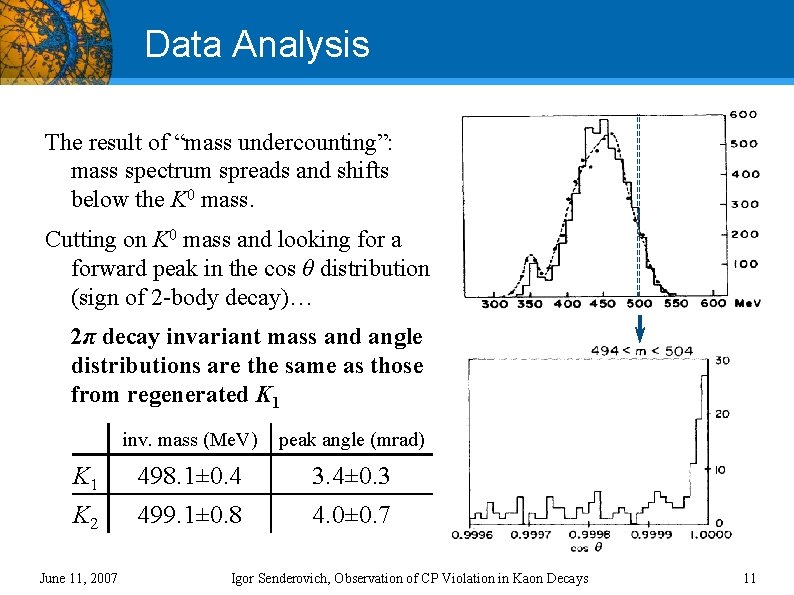
Data Analysis The result of “mass undercounting”: mass spectrum spreads and shifts below the K 0 mass. Cutting on K 0 mass and looking for a forward peak in the cos θ distribution (sign of 2 -body decay)… 2π decay invariant mass and angle distributions are the same as those from regenerated K 1 K 2 June 11, 2007 inv. mass (Me. V) peak angle (mrad) 498. 1± 0. 4 499. 1± 0. 8 3. 4± 0. 3 4. 0± 0. 7 Igor Senderovich, Observation of CP Violation in Kaon Decays 11
Results So, having subtracted the background as shown and taken into account relative detection efficiencies, there were found 45 ± 9 CP-violating π+π– decays out of a total of 22700 events. This corresponds to a branching ratio of 0. 20 ± 0. 04 %. Reported: 12
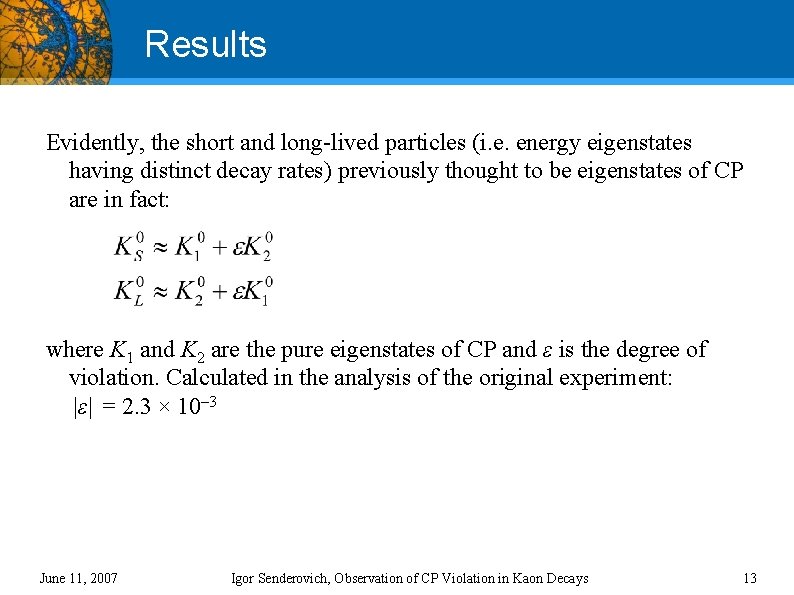
Results Evidently, the short and long-lived particles (i. e. energy eigenstates having distinct decay rates) previously thought to be eigenstates of CP are in fact: where K 1 and K 2 are the pure eigenstates of CP and ε is the degree of violation. Calculated in the analysis of the original experiment: |ε| = 2. 3 × 10– 3 June 11, 2007 Igor Senderovich, Observation of CP Violation in Kaon Decays 13
Summary The presented results lead to the following conclusions: • the Weak interaction slightly violates CP symmetry • by the CPT theorem, it violates T symmetry as well – a preferred direction on the elementary particle scale! • a small (and not yet satisfactory) degree of CP violation has been verified in theory of matter-antimatter imbalance. June 11, 2007 Igor Senderovich, Observation of CP Violation in Kaon Decays 14
- Slides: 14