
Observation and Experience as Research Books teach us
Observation and Experience as Research

Books teach us many things, but much of what we need to know in life, we learn by watching and doing. You can learn about food science and cooking techniques by reading, but you learn to cook by cooking and eating. We know implicitly that experience is a great teacher. It’s also important to understand how our own experiences and observations help us in research-based writing.

Science is Observation Scientific studies are large-scale exercises in observation. Scientists set up controls and observe what happens when the parameters of those controls change. They observe how their results are repeatable when observed again, at what scale they are repeatable, and under what parameters they are repeatable.
Personal Experience vs. Scientific Observation We tend to mimic scientific observations in life instinctively, but because we don’t keep scientific measurements and records, we aren’t always right. • “I can drive another ten miles on this empty tank because I know my car. ” • “I’ll be fine for a couple of days without enough sleep before I crash because I know my body. ” Experience teaches us a lot, but science is a mathematical study of patterns. If we don’t keep written records over time and actively study those records, our instincts can betray us.
Anecdotal Evidence in Science Personal experiences are called anecdotal evidence in scientific studies. Anecdotal evidence might seem true, but if it isn’t repeatable on a large scale in a controlled study, there is no real evidence that it is true. For example, many people take herbal remedies for aches and pains that they swear by as cures. When one person shares an anecdotal experience, that doesn’t mean much. When a lot of people share the same anecdotal experience, a pattern starts to emerge, but without a series of large-scale controlled studies showing repeatable results, we don’t yet know the true effectiveness of the treatment.
Anecdotal Evidence in Personal Writing Although anecdotal evidence is not scientific, it can be very persuasive. In personal essays, we often use anecdotal evidence through personal experience examples. Anecdotal evidence has an emotional appeal, and we can show some personal authority through anecdotes just by having lived through an experience. That’s okay as long as we recognize that our own experience might not apply to others, and we might not always be right about why something works or doesn’t work for us.
Anecdotal Evidence in Research Writing Generally, personal anecdotal evidence is not used in formal academic research writing. The purpose of research writing is to find the best evidence from experts. Your personal experiences do inform your research, though. They form the basis for how well you understand process your research. They motivate your interest in your research. They help you formulate ideas for further research. Personal experience and library research form a symbiotic process that leads you to your evidence-based conclusions.
Personal Observation as Field Research Field research is research that takes place outside of traditional academic realms like the library and the laboratory. It is a type of research conducted by going out into the field and simply observing. If you had an ant farm as a child, you probably spent some time observing ant behavior. Entomologists go into nature and observe insect behavior. Sociologists go into public places and observe human behavior.
Traditional research papers might not call for much field research, but there are times when student writers need to conduct field research. Field Research and the Student Writer Examples: • • • Proposals Problem Solving Essays Review Essays Behavioral Analysis Essays Research-Based Personal Essays Instructions
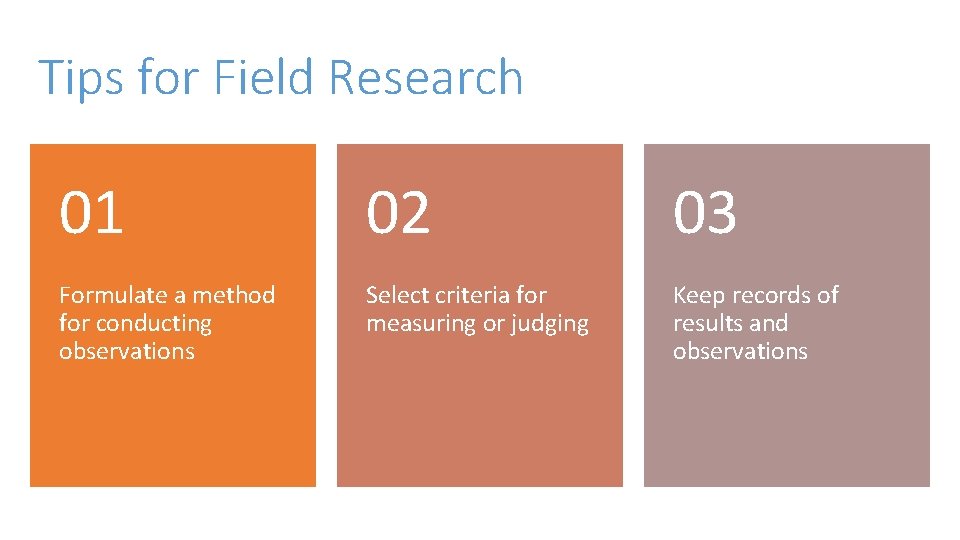
Tips for Field Research 01 02 03 Formulate a method for conducting observations Select criteria for measuring or judging Keep records of results and observations
Methods of Field Research Your method depends on your topic and purpose. Formulate a plan accordingly. • Are you supposed to review a restaurant? Then you need to eat in the restaurant. • Are you supposed to propose a solution to a problem? Then you need to document the problem itself through personal observation (and perhaps through surveys or other methods). • Are you supposed to write instructions for getting the most out of a yoga class? Then you need to go to some yoga classes.
Criteria for Judging Observations Your topic and purpose also determine your criteria for making judgments. • Are you reviewing a movie or TV show? If so, your criteria might include entertainment value, historical accuracy, acting skills, visual appeal, plot complexity and/or believability, social relevance, or other criteria. • Are you trying to define a problem with lack of student parking spaces on a college campus for a problem-solving essay? If so, your criteria might include accessibility of spaces in convenient locations, distance between available spaces and the busiest classroom buildings, impediments to walking across campus like crossing busy streets or flooded sidewalks on rainy days, and so forth.
Record Keeping One of the most important aspects of field research is accurate and meticulous record keeping. Take notes on everything. Put dates and times on your notes. Organize your notes into lists, graphs, and charts where necessary. Don’t rely on yourself to remember details later. Write them down so that there will be no question later. Tip: Carry a notepad with you for taking notes, but if you are caught without one, use the Notes app on your phone, or use your phone to send notes to yourself in an email.
On Being Objective Remember that what’s true for you may not be true for everyone, and you may not always be right about why things happen the way they do for you. That’s why it is important to be as objective and methodical as possible in making observations. Recognize that your experience on its own, while perfectly valid, is still only anecdotal evidence that may not apply to others in the same way it applies to you. Also, be aware of when you are making judgments that are simply a matter of personal preference. Maybe you are reviewing a recipe, and you don’t like it because you don’t like bell peppers. The fact that the recipe calls for bell peppers doesn’t make it a bad recipe. It just makes it a bad recipe for you as an individual to follow precisely without making your own substitutions to suit your own preferences.
On Recognizing Limited Point of View No matter how carefully you observe, there will be things you don’t know. Recognize and accept that you don’t know everything about your topic. Sometimes that means you need to find out through research. For example, if you are writing about problems with student parking, but you don’t know the budget constraints of the school, you can’t propose a viable solution. Other times you just won’t know what you don’t know. If you are reviewing a restaurant you’ve heard great things about, but the service is slow when you experience it, you don’t have any way of knowing whether something has happened that has only temporarily slowed down service or if it is always tortoise-like. You can ask others. You can ask your server. You can go back several times to find out if there are patterns of bad service. There might still be something eluding you, though. If your server is going through a divorce and having trouble focusing but doesn’t want to talk about it with customers, you are just not going to know what you don’t know. That’s okay. Good researchers recognize that while they can draw solid conclusions based on solid evidence, those conclusions are always subject to change as more evidence comes to light.
Do Your Best Do your best to be logical. Do your best to be fair. Do your best to be thorough. Do your best apply your own observations appropriately for your topic, purpose, and audience. If you follow the guidelines provided here and in your assignment instructions, and you do your best, you should be able to construct a well-written essay using your own observations as at least part of your research.
- Slides: 16