
Observability and Identifiability of Jump Linear Systems Ren

Observability and Identifiability of Jump Linear Systems René Vidal Alessandro Chiuso Stefano Soatto EECS UC Berkeley Università di Padova CS UCLA
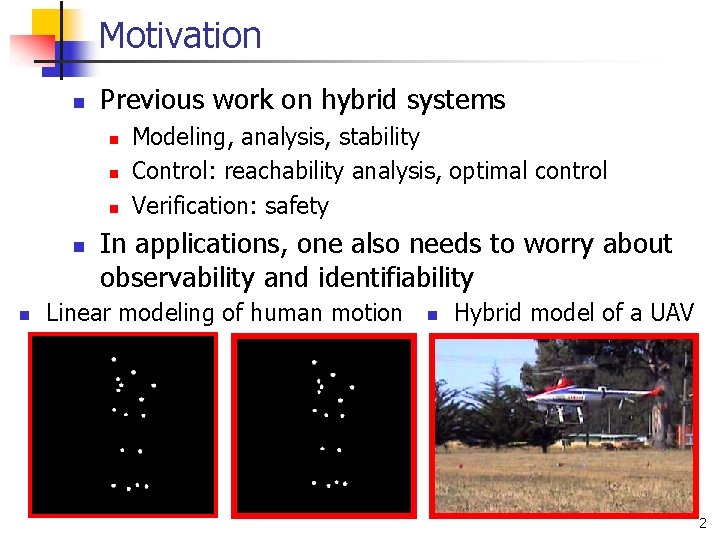
Motivation n Previous work on hybrid systems n n n Modeling, analysis, stability Control: reachability analysis, optimal control Verification: safety In applications, one also needs to worry about observability and identifiability Linear modeling of human motion n Hybrid model of a UAV 2
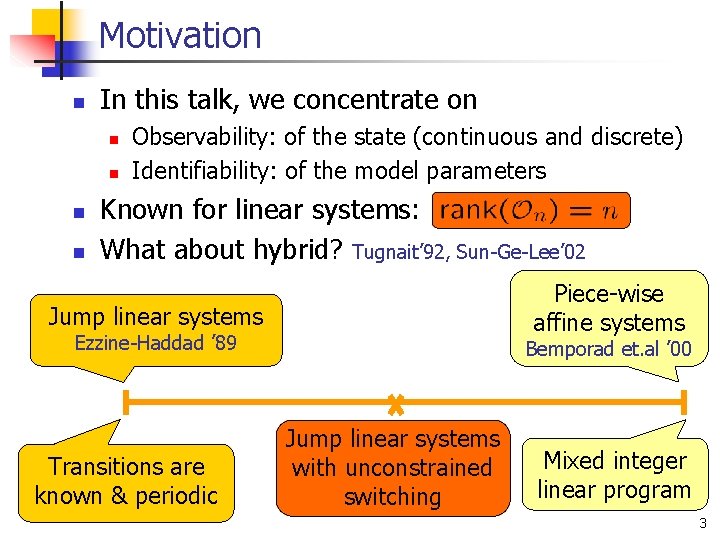
Motivation n In this talk, we concentrate on n n Observability: of the state (continuous and discrete) Identifiability: of the model parameters Known for linear systems: What about hybrid? Tugnait’ 92, Sun-Ge-Lee’ 02 Piece-wise affine systems Jump linear systems Ezzine-Haddad ’ 89 Transitions are known & periodic Bemporad et. al ’ 00 Jump linear systems with unconstrained switching Mixed integer linear program 3
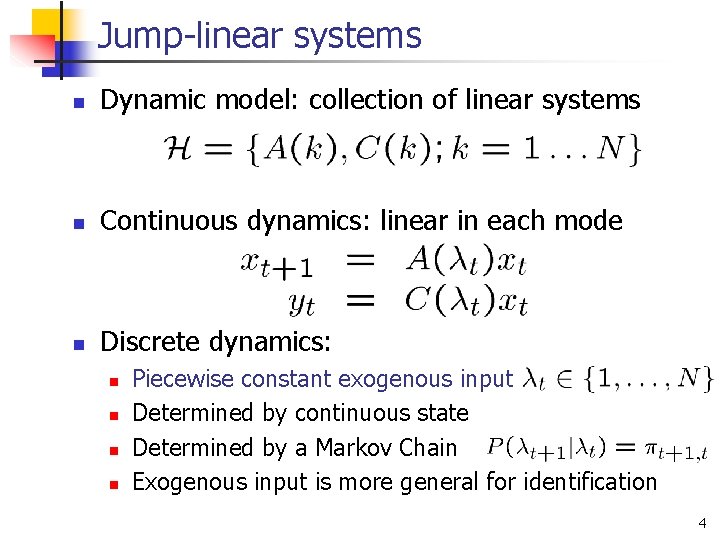
Jump-linear systems n Dynamic model: collection of linear systems n Continuous dynamics: linear in each mode n Discrete dynamics: n n Piecewise constant exogenous input Determined by continuous state Determined by a Markov Chain Exogenous input is more general for identification 4
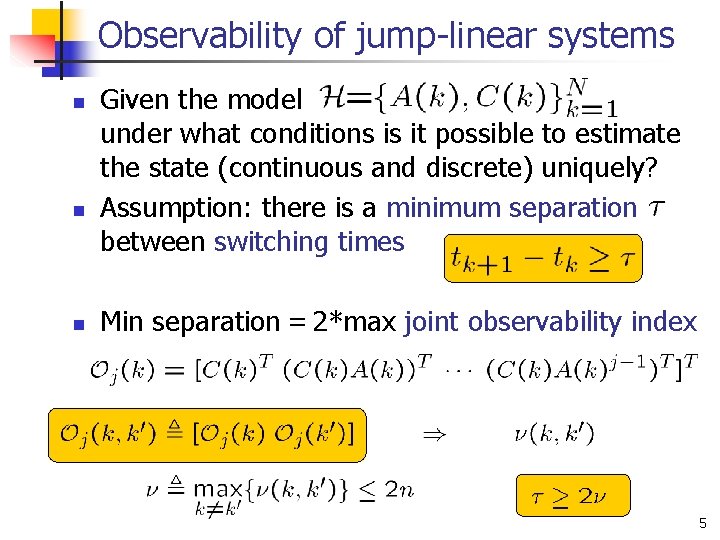
Observability of jump-linear systems n n n Given the model under what conditions is it possible to estimate the state (continuous and discrete) uniquely? Assumption: there is a minimum separation between switching times Min separation = 2*max joint observability index 5
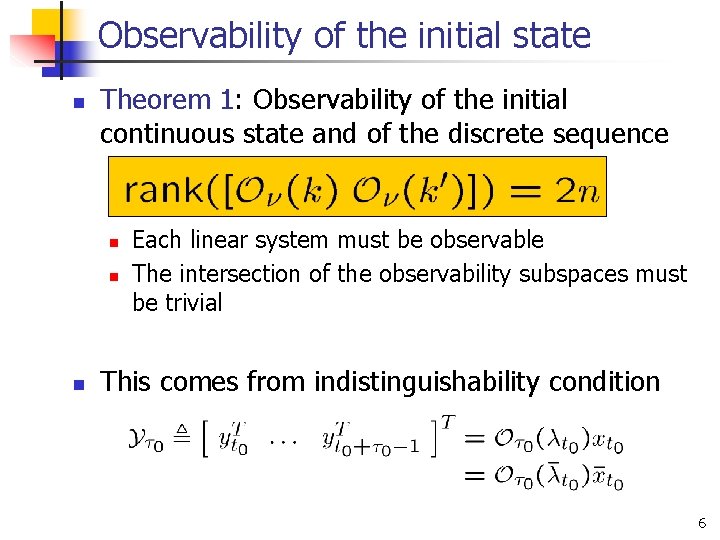
Observability of the initial state n Theorem 1: Observability of the initial continuous state and of the discrete sequence n n n Each linear system must be observable The intersection of the observability subspaces must be trivial This comes from indistinguishability condition 6
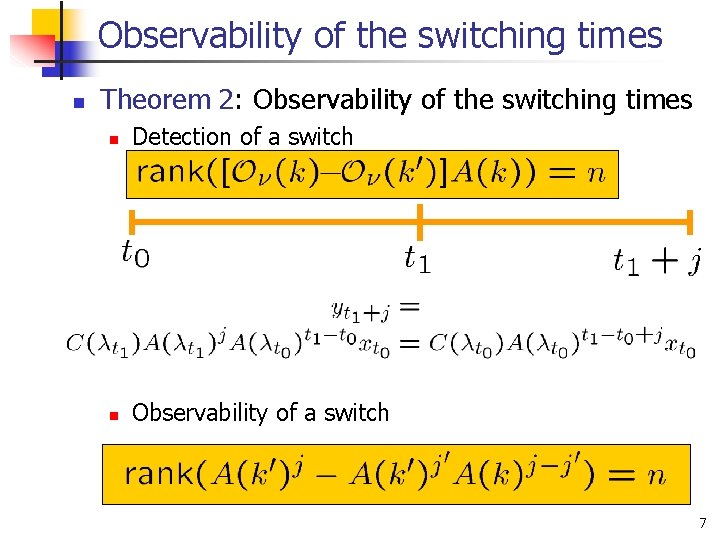
Observability of the switching times n Theorem 2: Observability of the switching times n Detection of a switch n Observability of a switch 7
Identifiability of jump-linear systems n Identification of jump-linear systems n Tugnait ’ 82, Murphy’ 98, Doucet’ 00, Bemporad’ 01 n n n None of them enforces uniqueness of the model parameters Realizability: Given the output, what is the set of models that can reproduce the output? n n Alternating minimization, Viterbi approximations, mixture densities, particle filtering, Expectation Maximization If this set is not understood, each algorithm can compute a different model from the same data Identifiability: Given the output, under what conditions can we identify the model uniquely? 8
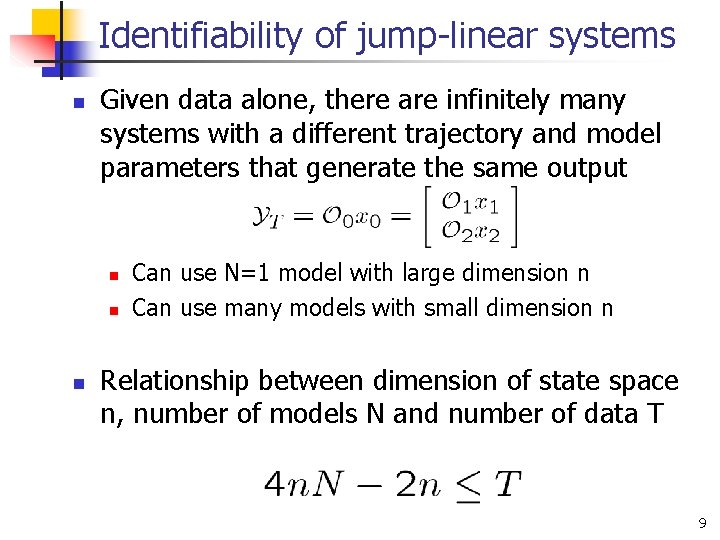
Identifiability of jump-linear systems n Given data alone, there are infinitely many systems with a different trajectory and model parameters that generate the same output n n n Can use N=1 model with large dimension n Can use many models with small dimension n Relationship between dimension of state space n, number of models N and number of data T 9
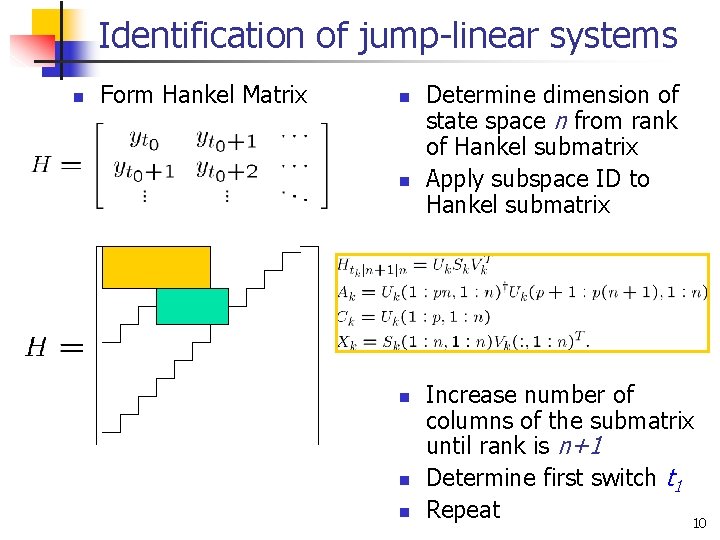
Identification of jump-linear systems n Form Hankel Matrix n n n Determine dimension of state space n from rank of Hankel submatrix Apply subspace ID to Hankel submatrix Increase number of columns of the submatrix until rank is n+1 Determine first switch t 1 Repeat 10

Conclusions and Future Work n n n We have characterized the observability of jump -linear systems in terms of simple rank tests on the model paramaters We have studied the identifiability of the model parameters and characterized models that produce the same output Can we eliminate minimum separation? How to apply this condition to piecewise affine systems? How to use this condition to improve/develop identification algorithms in the stochastic case? 11
- Slides: 11