
Oblivious Equilibrium for Stochastic Games with Concave Utility
Oblivious Equilibrium for Stochastic Games with Concave Utility • Sachin Adlakha, Ramesh Johari, Gabriel Weintraub and Andrea Goldsmith • DARPA ITMANET Meeting • March 5 -6, 2009
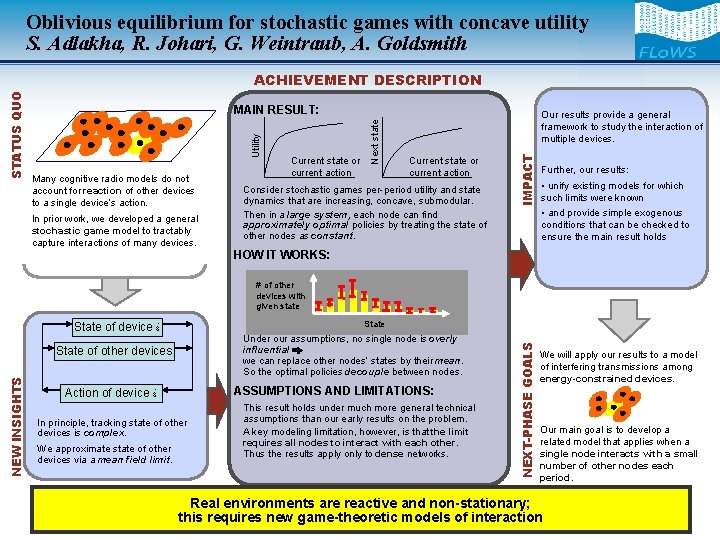
Oblivious equilibrium for stochastic games with concave utility S. Adlakha, R. Johari, G. Weintraub, A. Goldsmith In prior work, we developed a general stochastic game model to tractably capture interactions of many devices. Our results provide a general framework to study the interaction of multiple devices. Current state or current action Consider stochastic games per-period utility and state dynamics that are increasing, concave, submodular. Then in a large system, each node can find approximately optimal policies by treating the state of other nodes as constant. IMPACT Many cognitive radio models do not account for reaction of other devices to a single device’s action. Current state or current action Next state MAIN RESULT: Utility STATUS QUO ACHIEVEMENT DESCRIPTION Further, our results: • unify existing models for which such limits were known • and provide simple exogenous conditions that can be checked to ensure the main result holds HOW IT WORKS: # of other devices with given state Under our assumptions, no single node is overly influential ) we can replace other nodes’ states by their mean. So the optimal policies decouple between nodes. NEW INSIGHTS State of other devices ASSUMPTIONS AND LIMITATIONS: Action of device i In principle, tracking state of other devices is complex. We approximate state of other devices via a mean field limit. This result holds under much more general technical assumptions than our early results on the problem. A key modeling limitation, however, is that the limit requires all nodes to interact with each other. Thus the results apply only to dense networks. NEXT-PHASE GOALS State of device i We will apply our results to a model of interfering transmissions among energy-constrained devices. Our main goal is to develop a related model that applies when a single node interacts with a small number of other nodes each period. Real environments are reactive and non-stationary; this requires new game-theoretic models of interaction
Wireless environments are reactive • Scenario: Wireless devices sharing same spectrum. • Typical Approach: Assume that the environment is non -reactive. • Flawed assumption at best: – In cognitive radio networks, the environment consists of other cognitive radios – hence is highly reactive Questions: 1. How do we design policies for such networks? 2. What is the performance loss if we assume non-reactive environments?

Foundational theory – Markov Perfect Equilibrium • Model such reactive environments as stochastic dynamic games. • Key solution concept is that of Markov perfect equilibrium (MPE). • The action of each player depends on the state of everyone. State of player i State of other players Action of player i Problems: 1. Tracking state of everyone else is hard. 2. MPE is hard to compute.
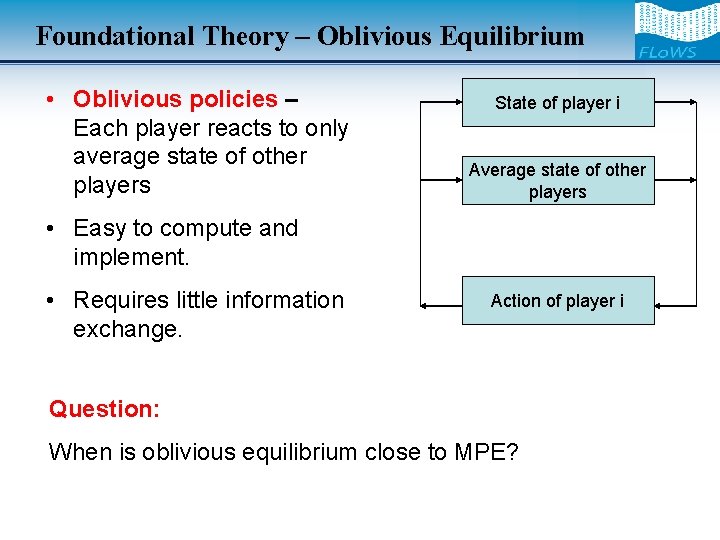
Foundational Theory – Oblivious Equilibrium • Oblivious policies – Each player reacts to only average state of other players State of player i Average state of other players • Easy to compute and implement. • Requires little information exchange. Action of player i Question: When is oblivious equilibrium close to MPE?
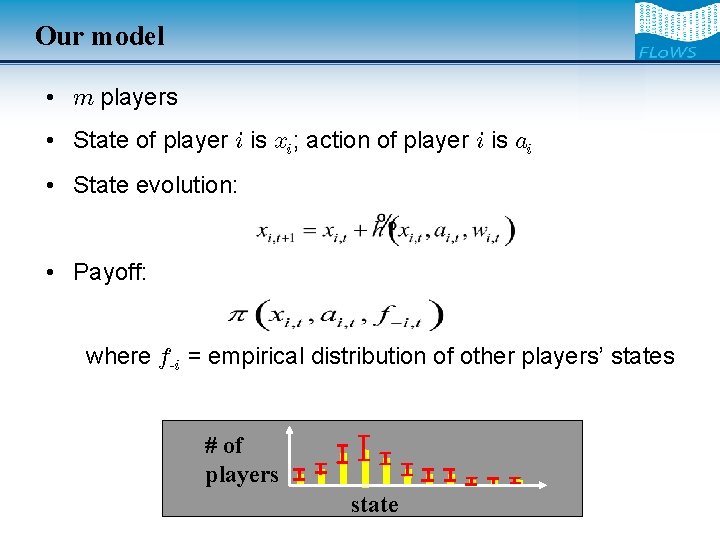
Our model • m players • State of player i is xi; action of player i is ai • State evolution: • Payoff: where f-i = empirical distribution of other players’ states # of players state
MPE and OE • A Markov policy is a decision rule based on the current state and the empirical distribution: ai, t = ¹(xi, t, f-i, t(m)) • A Markov perfect equilibrium is a vector of Markov policies, where each player has maximized present discounted payoff, given policies of other players. • In an oblivious policy, a player responds instead to x-i, t and only the long run average f-i(m). • In an oblivious equilibrium each player has maximized present discounted payoff using an oblivious policy, given long run average state induced by other players’ policies.
Prior Work • Generalized the idea of OE to general stochastic games [Allerton 07]. • Unified existing models, such as LQG games, via our framework [CDC 08]. • Exogenous conditions for approximating MPE using OE for linear dynamics and separable payoffs [Allerton 08]. Current Results: We have a general set of exogenous conditions (including nonlinear dynamics and nonseparable payoffs) under which OE is a good approximation to MPE. These conditions also unify our previous results and existing models.
Assumptions [A 1] The state transition function is concave in state and action and has decreasing differences in state and action. [A 2] For any action, is a non-increasing function of state and eventually becomes negative. [A 3] The payoff function is jointly concave in state and action and has decreasing differences in state and action. [A 4] The logarithm of the payoff is Gateaux differentiable w. r. t. f-i. [A 5] MPE and OE exist. [A 6] We restrict attention to policies that make the individual state Markov chain recurrent and keep the discounted sum of the square of the payoff finite.
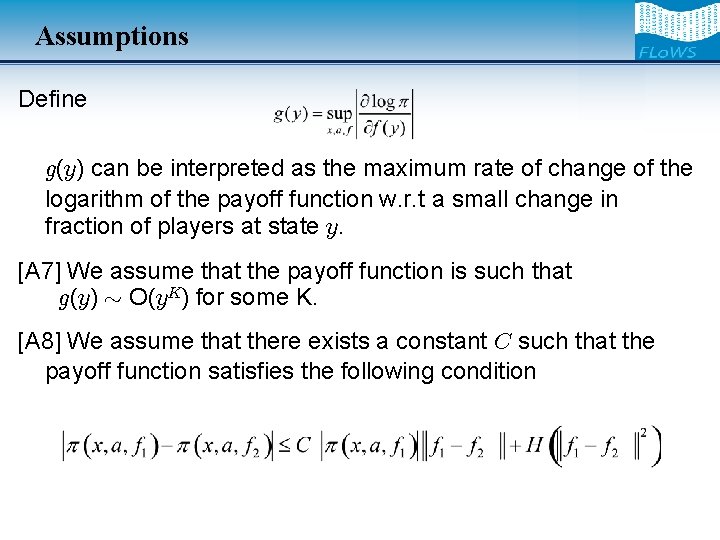
Assumptions Define g(y) can be interpreted as the maximum rate of change of the logarithm of the payoff function w. r. t a small change in fraction of players at state y. [A 7] We assume that the payoff function is such that g(y) » O(y. K) for some K. [A 8] We assume that there exists a constant C such that the payoff function satisfies the following condition
Main Result Under [A 1]-[A 8], oblivious equilibrium payoff is approximately optimal over Markov policies, as m 1. In other words, OE is approximately an MPE. The key point here is that no single player is overly influential and the true state distribution is close to the time average—so knowledge of other player’s policies does not significantly improve payoff. Advantage: Each player can use oblivious policy without loss in performance.
Main Contributions and Future Work • Provides a general framework to study the interaction of multiple devices. • Provides exogenous conditions which can be easily checked to ensure the main result holds. • Unifies existing models for which such limits are known. Future Work: • Apply this model to interfering transmissions between energy constrained nodes. • Develop similar models where a single node interacts with a small set of nodes at each time period.
- Slides: 12