
Oblivious Data Structures Xiao Shaun Wang Kartik Nayak

Oblivious Data Structures Xiao Shaun Wang, Kartik Nayak , Chang Liu, T-H. Hubert Chan, Elaine Shi, Emil Stefanov, Yan Huang 1

Sensitive Data in the Cloud • • • Emails Photos Videos Financial data Medical records Genome data Encrypt your data! …… 2
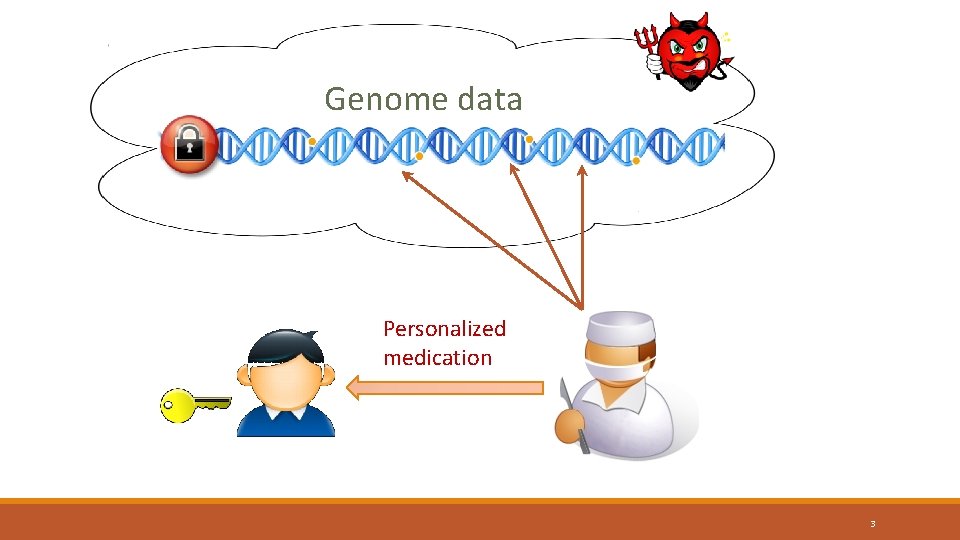
Genome data Personalized medication 3

Genome data Kidney problem 4

Access patterns leak sensitive information 5
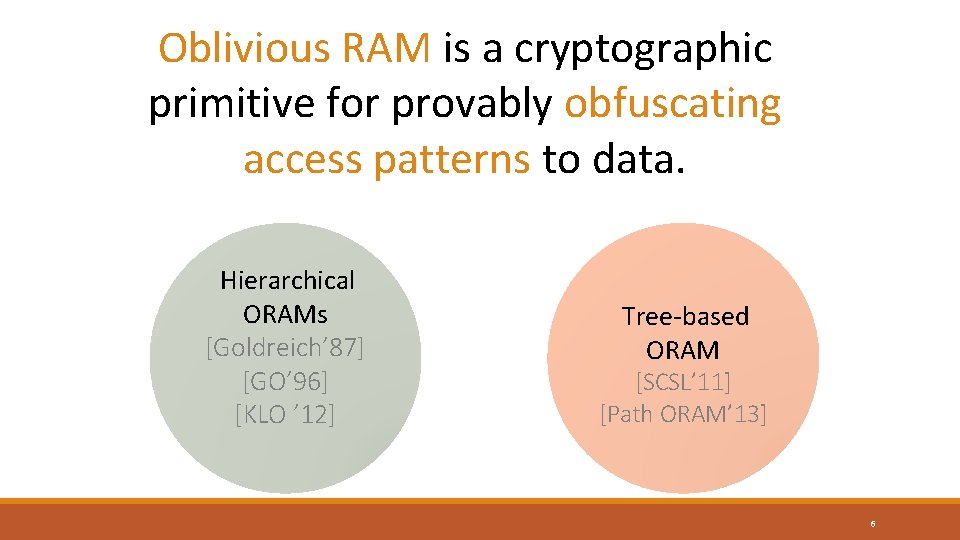
Oblivious RAM is a cryptographic primitive for provably obfuscating access patterns to data. Hierarchical ORAMs [Goldreich’ 87] [GO’ 96] [KLO ’ 12] Tree-based ORAM [SCSL’ 11] [Path ORAM’ 13] 6
How do ORAMs obfuscate access patterns to data? Intuition: 1. Move blocks around 2. For every single access to memory block, access many blocks. 7
Path ORAM achieves O(log 2 N) blowup for small blocks [SDSCFRYD’ 13] N = 230 (1 Giga) c=8 c log 2 N = 7200 N: Number of memory blocks, c: constant for Path ORAM Access about 7200 memory blocks per block i. Schemes with better asymptotics [KLO’ 12] ii. Path ORAM with larger block size performs better 8

Can we do better Can we do for limited access better? patterns? 9
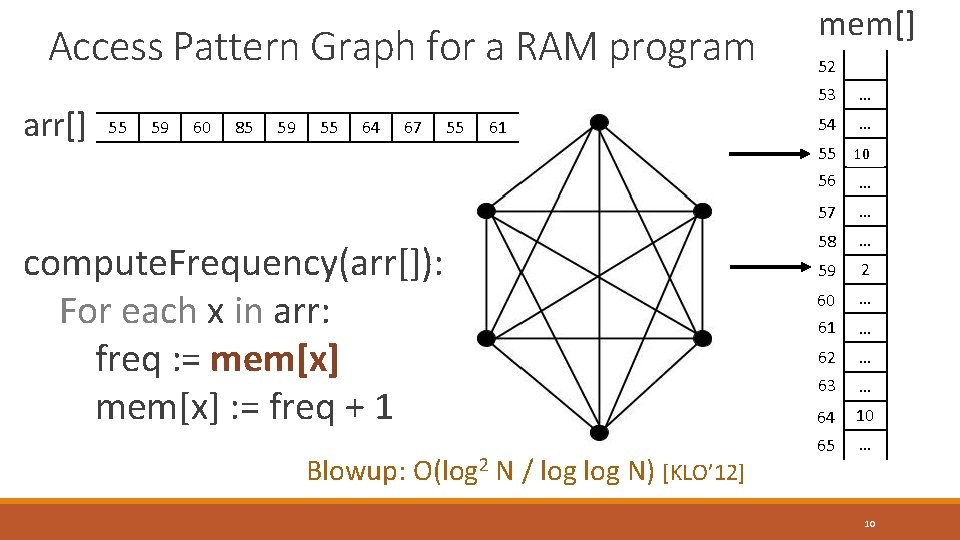
Access Pattern Graph for a RAM program arr[] 55 59 60 85 59 55 64 67 55 61 compute. Frequency(arr[]): For each x in arr: freq : = mem[x] : = freq + 1 Blowup: O(log 2 N / log N) [KLO’ 12] mem[] 52 53 … 54 … 55 56 9 10 57 … 58 … 59 2 60 … 61 … 62 … 63 … 64 10 65 … … 10
Some real world programs may have limited access patterns due to: 1. Inherent structure in the data or 2. Locality of accesses 11
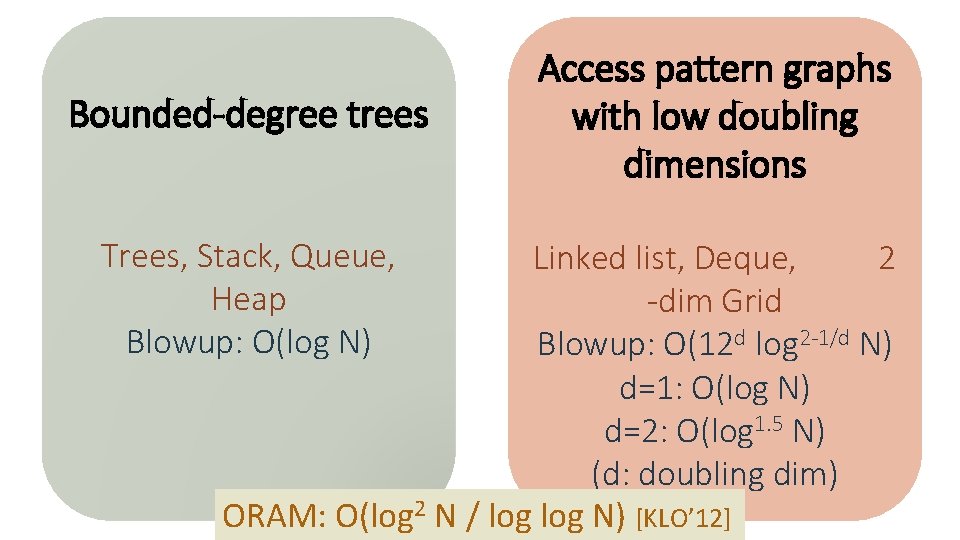
Bounded-degree trees Access pattern graphs with low doubling dimensions Trees, Stack, Queue, Heap Blowup: O(log N) Linked list, Deque, 2 -dim Grid Blowup: O(12 d log 2 -1/d N) d=1: O(log N) d=2: O(log 1. 5 N) (d: doubling dim) ORAM: O(log 2 N / log N) [KLO’ 12] 12
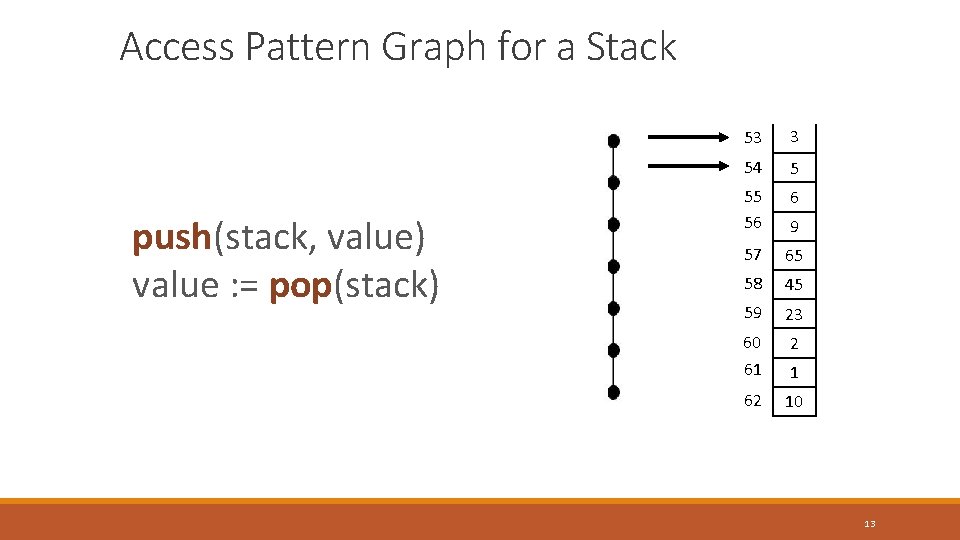
Access Pattern Graph for a Stack push(stack, value) value : = pop(stack) 53 3 54 5 55 56 6 57 65 58 45 59 23 60 2 61 1 62 10 9 13
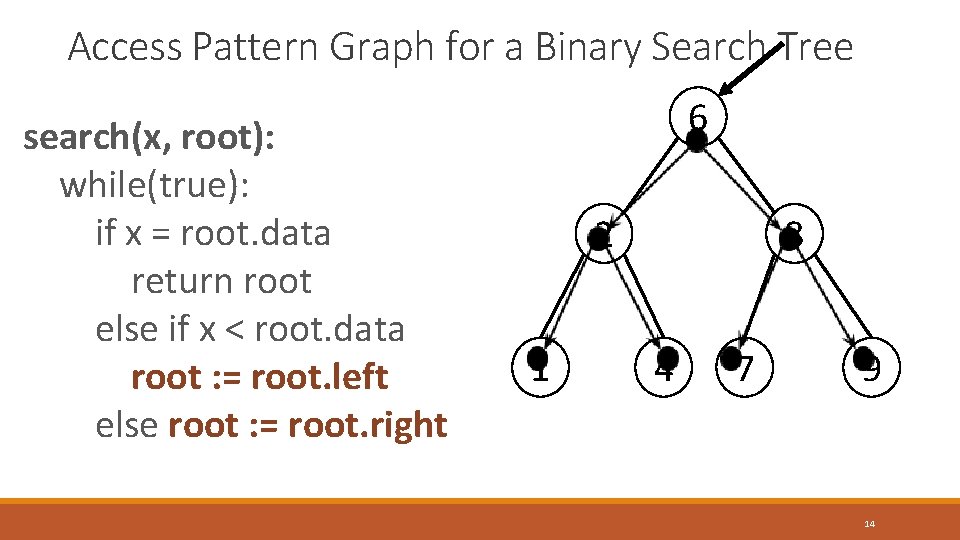
Access Pattern Graph for a Binary Search Tree search(x, root): while(true): if x = root. data return root else if x < root. data root : = root. left else root : = root. right 6 2 1 8 4 7 9 14
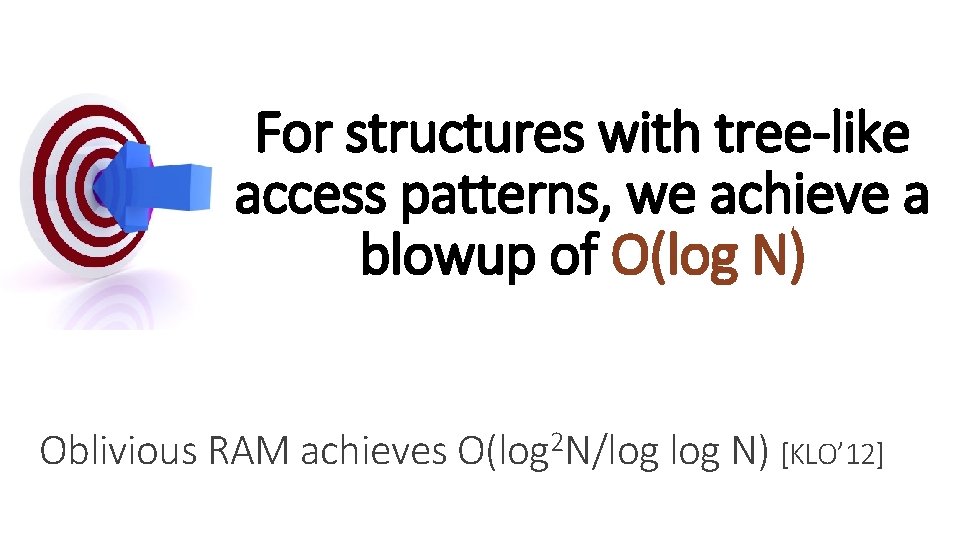
For structures with tree-like access patterns, we achieve a blowup of O(log N) Oblivious RAM achieves O(log 2 N/log N) [KLO’ 12] 15
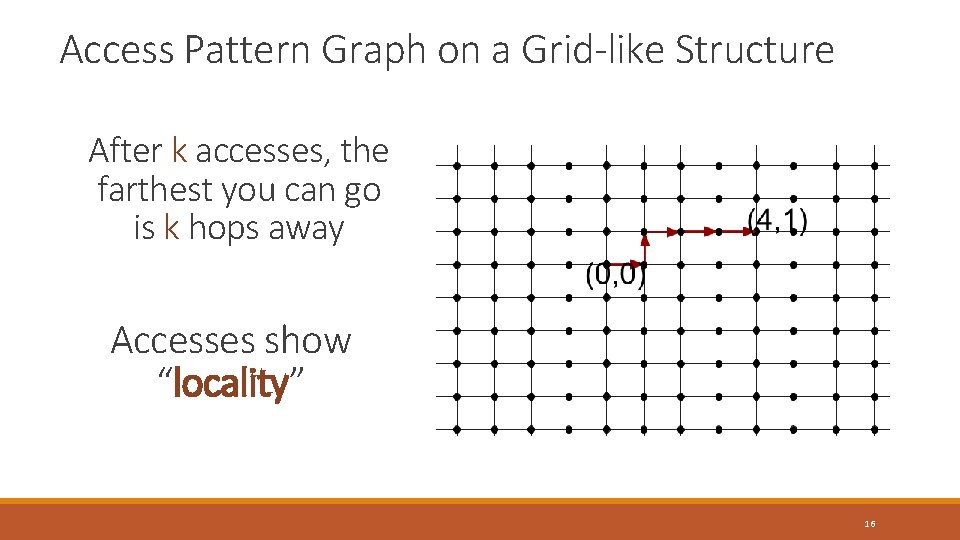
Access Pattern Graph on a Grid-like Structure After k accesses, the farthest you can go is k hops away Accesses show “locality” 16
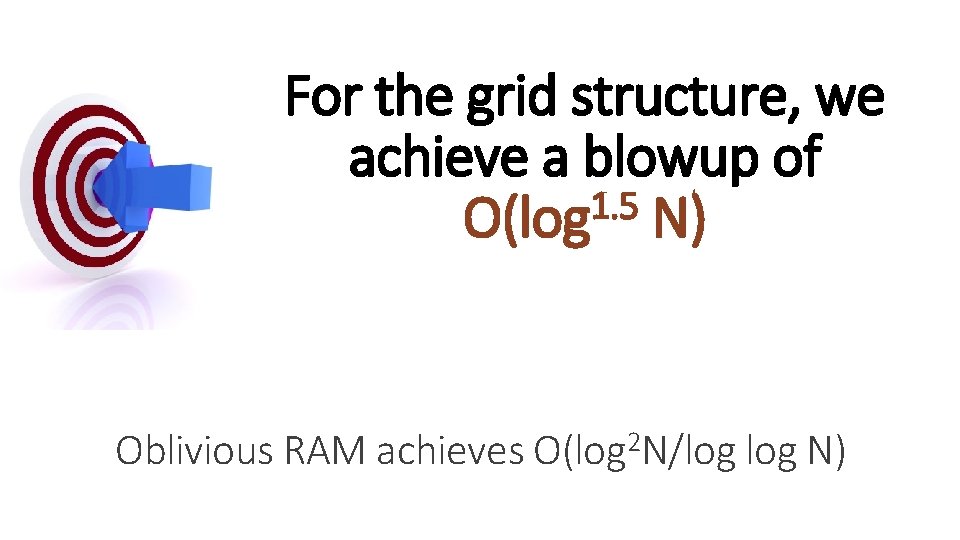
For the grid structure, we achieve a blowup of 1. 5 O(log N) Oblivious RAM achieves O(log 2 N/log N) 17
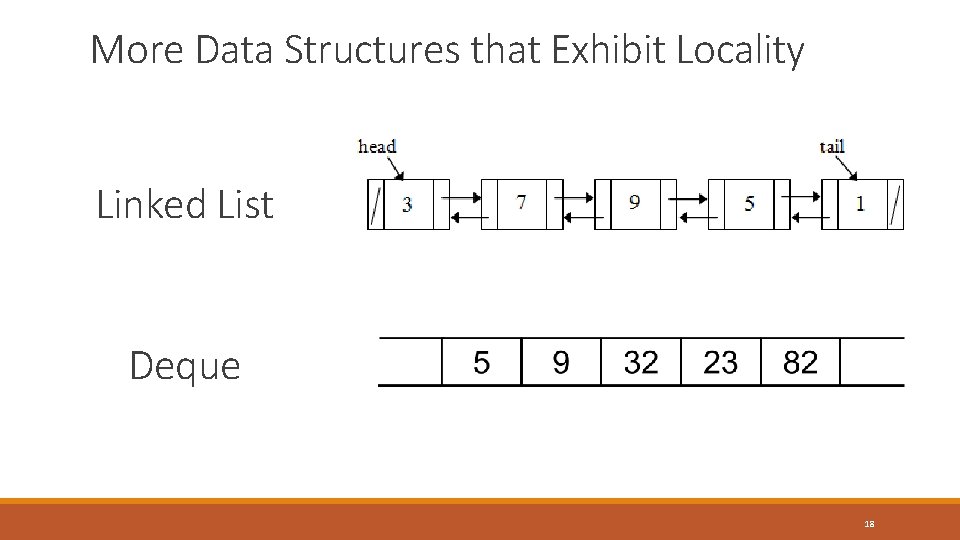
More Data Structures that Exhibit Locality Linked List Deque 18
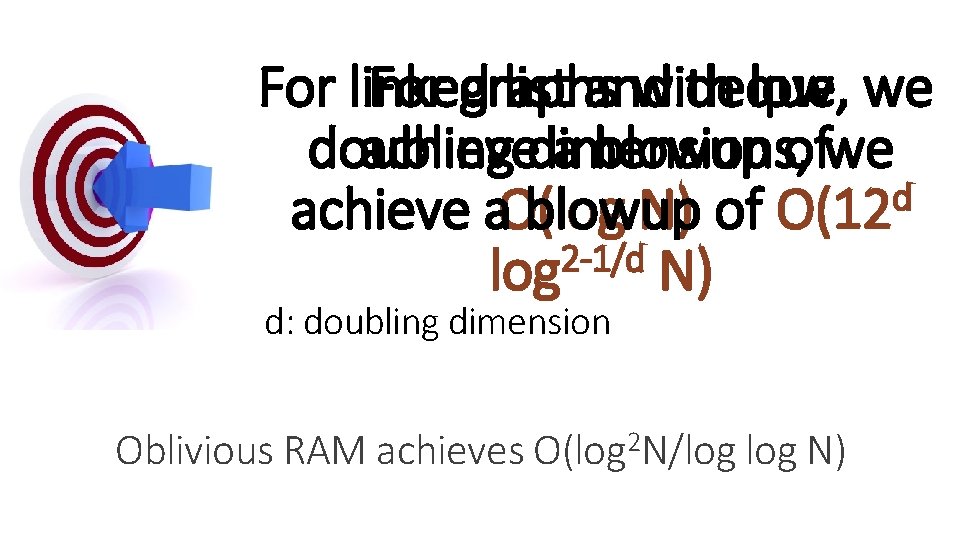
For graphs with low we For linked list and deque, doubling achievedimensions, a blowup ofwe d achieve a. O(log blowup N) of O(12 2 -1/d log N) d: doubling dimension Oblivious RAM achieves O(log 2 N/log N) 19
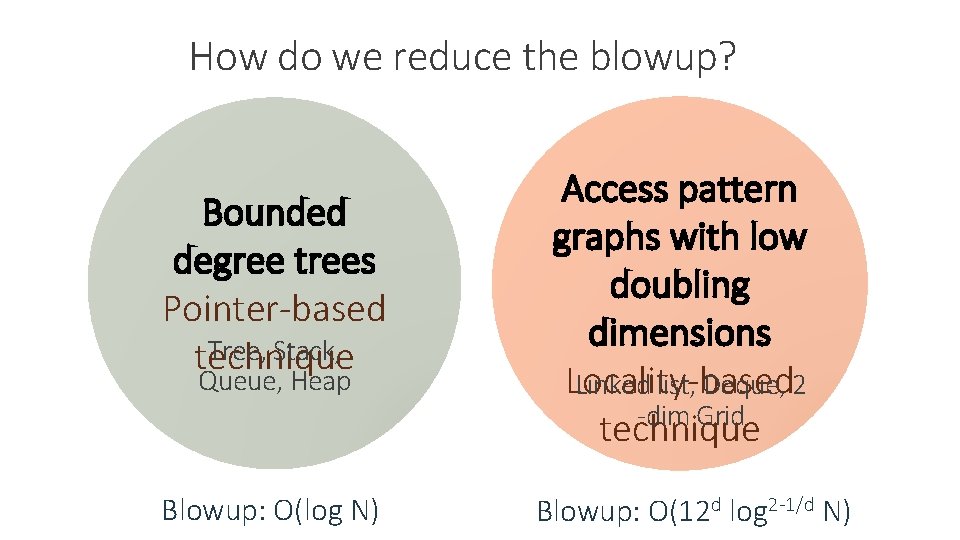
How do we reduce the blowup? Bounded degree trees Pointer-based Tree, Stack, technique Queue, Heap Blowup: O(log N) Access pattern graphs with low doubling dimensions Locality-based Linked list, Deque, 2 -dim Grid technique Blowup: O(12 d log 2 -1/d N) 20
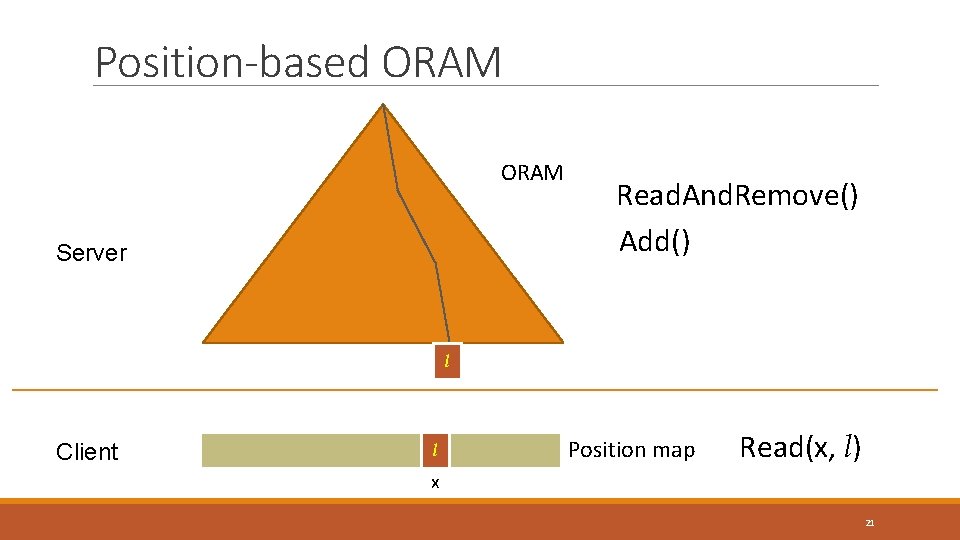
Position-based ORAM Server Read. And. Remove() Add() l Client l Position map Read(x, l) x 21
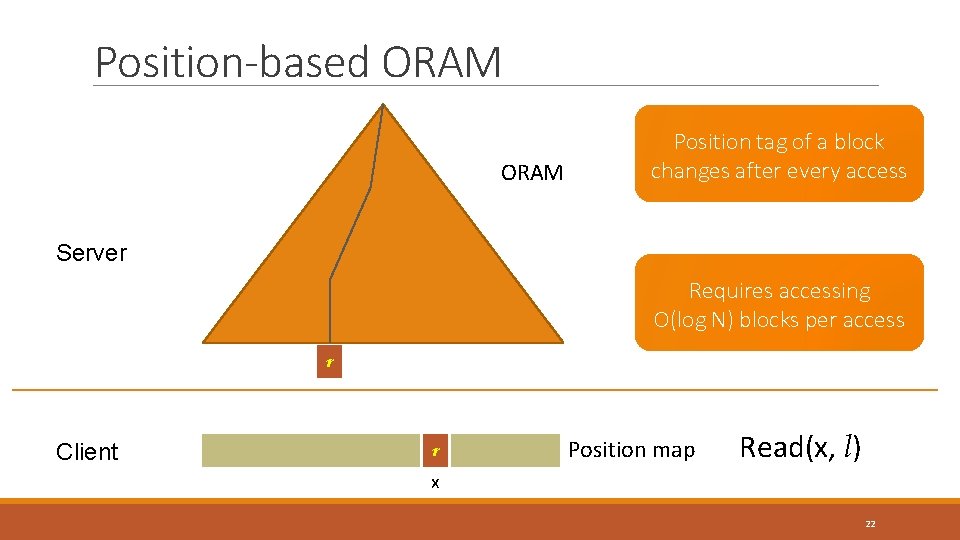
Position-based ORAM Position tag of a block changes after every access Server Requires accessing O(log N) blocks per access r Client r Position map Read(x, l) x 22
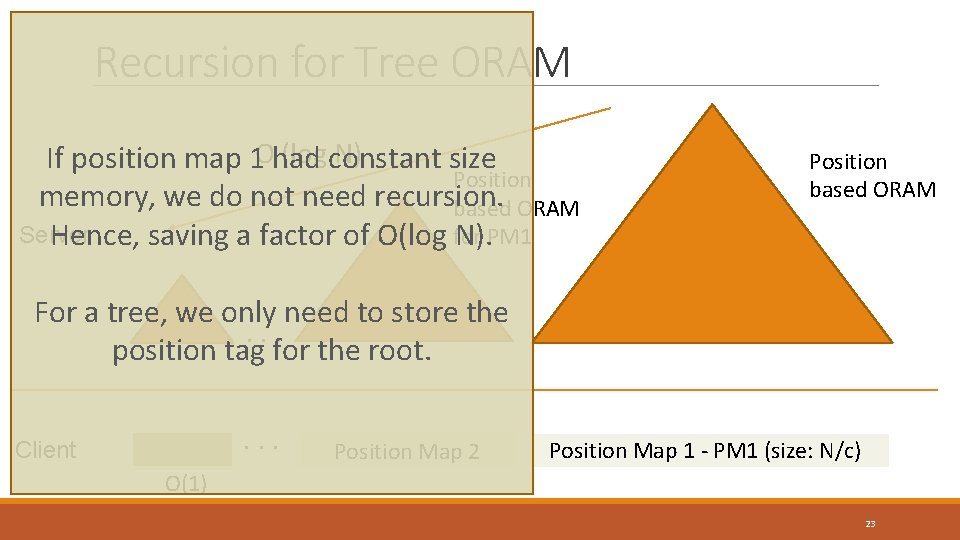
Recursion for Tree ORAM (log constant N) If position map 1 Ohad size Position memory, we do not need recursion. based ORAM Server Hence, saving a factor of O(log for N). PM 1 Position based ORAM For a tree, we only need to store the. . . position tag for the root. . Client Position Map 2 Position Map 1 - PM 1 (size: N/c) O(1) 23
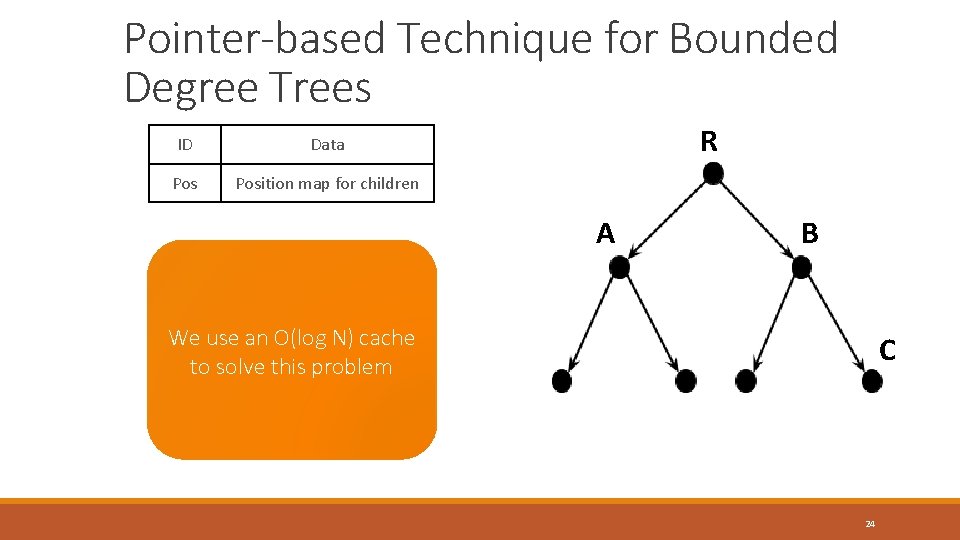
Pointer-based Technique for Bounded Degree Trees ID Data Position map for children R A B Storing position tags of We use an O(log N) cache children nodes is an to solve this problem added responsibility. C 24
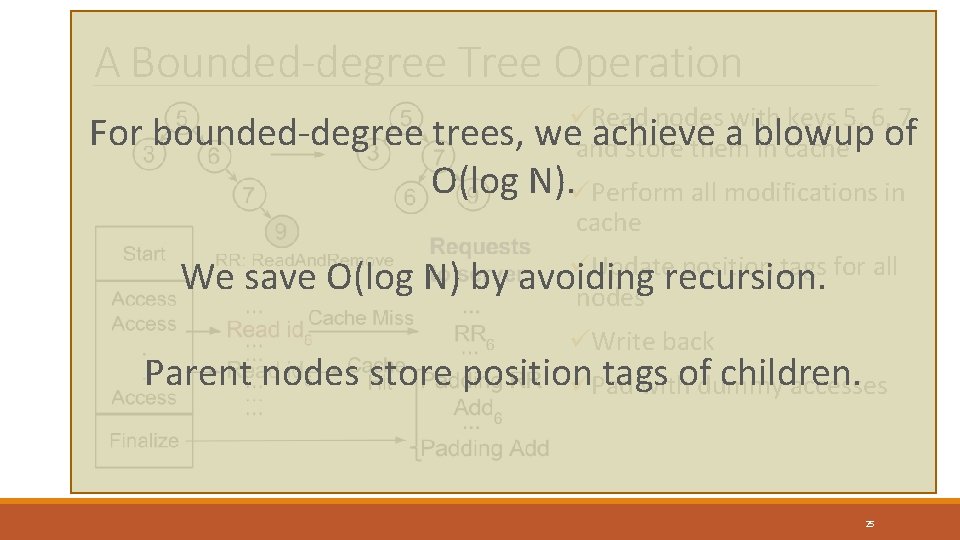
A Bounded-degree Tree Operation üRead nodes with keys 5, 6, 7 weand achieve a blowup store them in cache of For bounded-degree trees, O(log N). üPerform all modifications in cache We save O(log N) by ü Update position tags for all avoiding recursion. nodes üWrite back Parent nodes store position tags children. üPad withof dummy accesses 25
Locality-based Technique - Intuition Key Idea: Path ORAM achieves O(log N) overhead for block size ≥ O(log 2 N) bits Can we leverage this to group smaller data nodes into larger blocks? 26
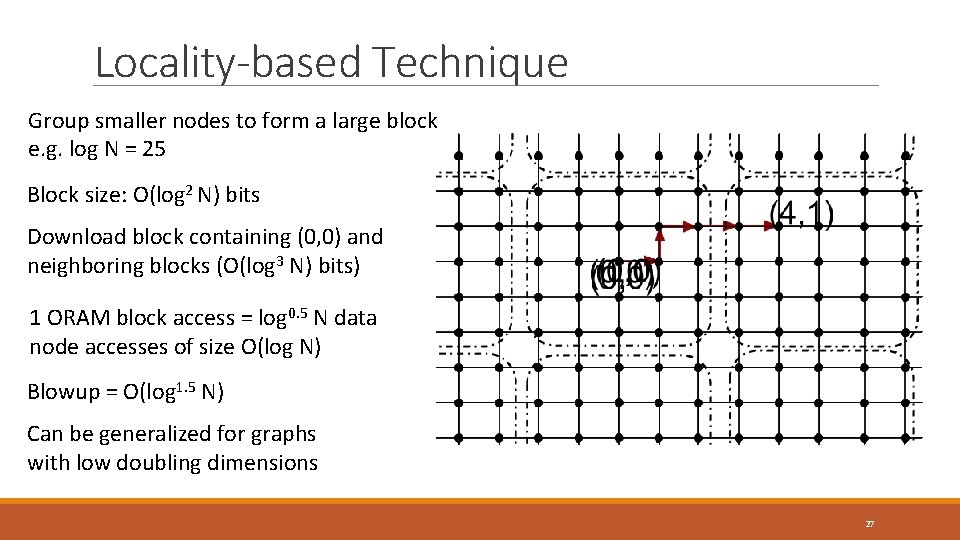
Locality-based Technique Group smaller nodes to form a large block e. g. log N = 25 Block size: O(log 2 N) bits Download block containing (0, 0) and neighboring blocks (O(log 3 N) bits) 1 ORAM block access = log 0. 5 N data node accesses of size O(log N) Blowup = O(log 1. 5 N) Can be generalized for graphs with low doubling dimensions 27
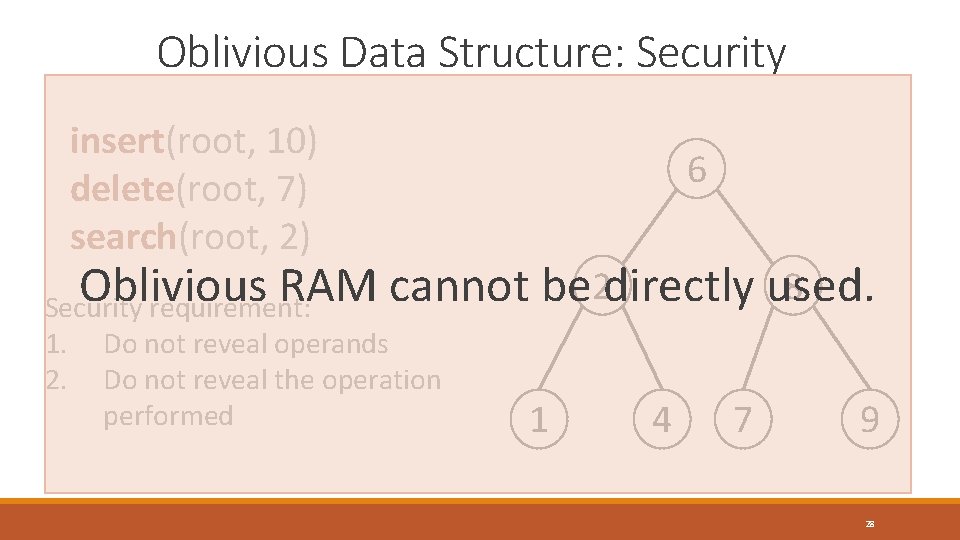
Oblivious Data Structure: Security insert(root, 10) delete(root, 7) search(root, 2) 6 2 8 Oblivious RAM cannot be directly used. Security requirement: 1. 2. Do not reveal operands Do not reveal the operation performed 1 4 7 9 28

Related Work üEfficient, Oblivious Data Structures for MPC [KS’ 14] üDesign oblivious priority queue üSecure Data Structures based on Multiparty Computation [T’ 11] üDesign oblivious priority queue but reveals the type of operation performed üData-oblivious Data Structures [MZ’ 14] üDesign oblivious stack, queue and priority queue 29
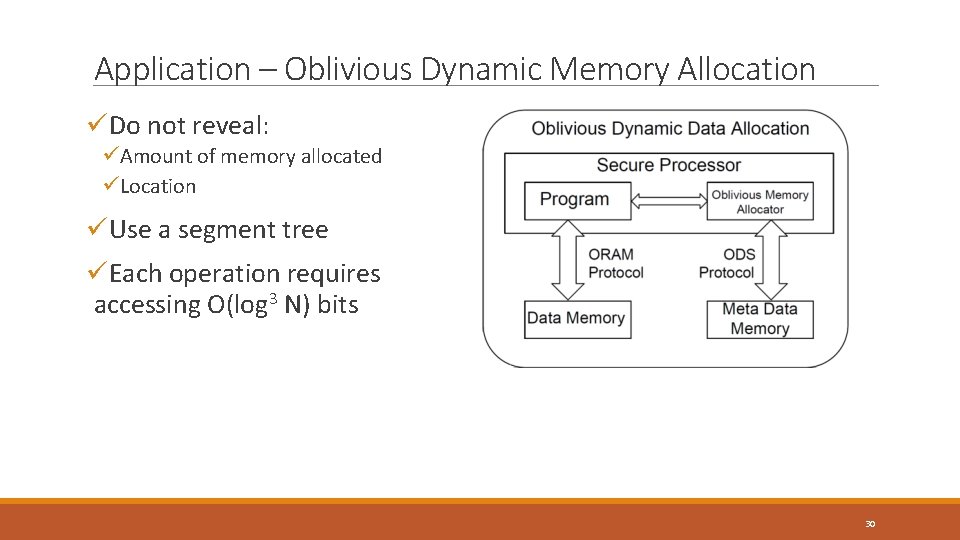
Application – Oblivious Dynamic Memory Allocation üDo not reveal: üAmount of memory allocated üLocation üUse a segment tree üEach operation requires accessing O(log 3 N) bits 30
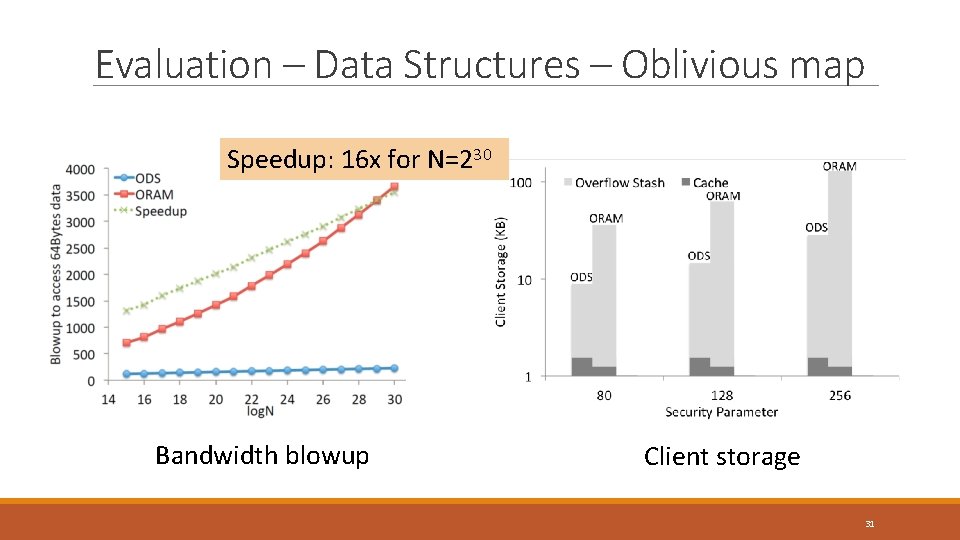
Evaluation – Data Structures – Oblivious map Speedup: 16 x for N=230 Bandwidth blowup Client storage 31
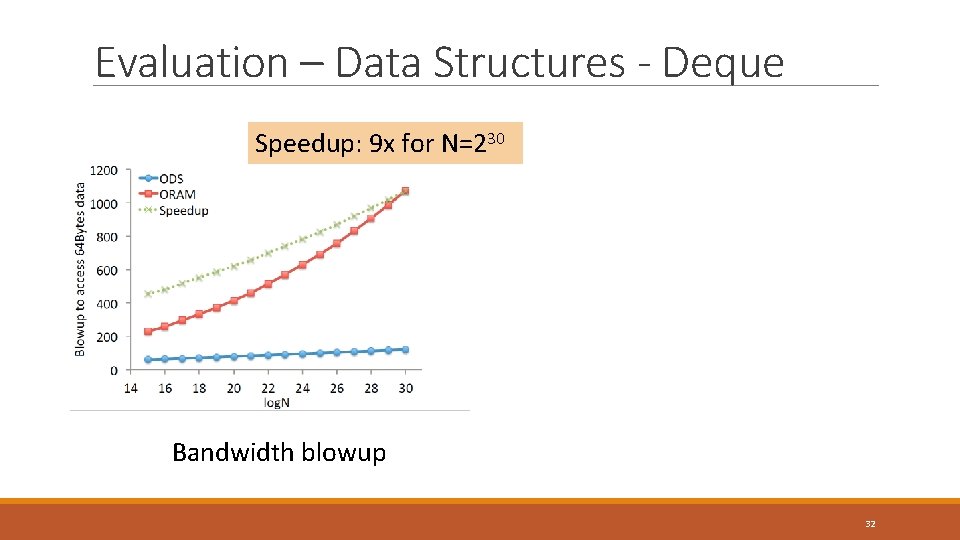
Evaluation – Data Structures - Deque Speedup: 9 x for N=230 Bandwidth blowup 32
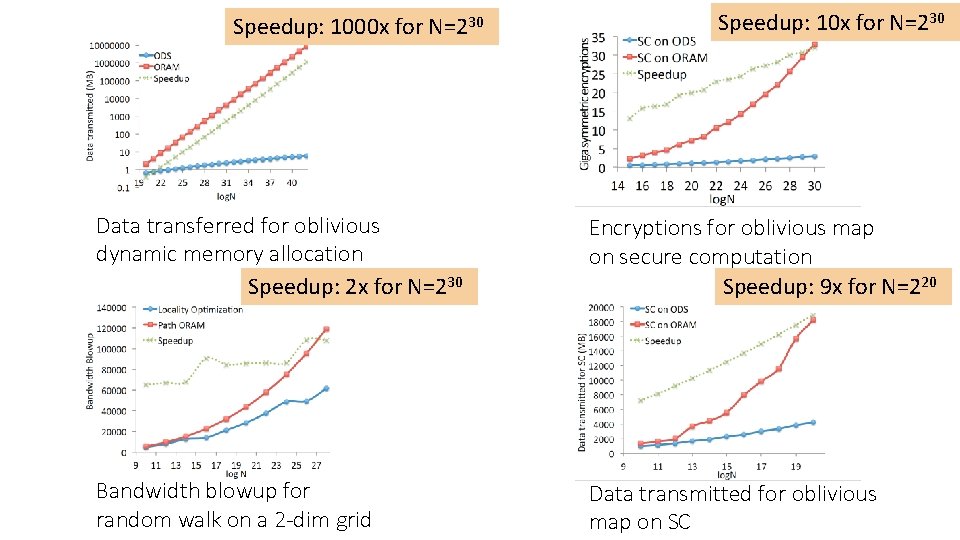
Speedup: 1000 x for N=230 Speedup: 10 x for N=230 Data transferred for oblivious dynamic memory allocation Speedup: 2 x for N=230 33 Encryptions for oblivious map on secure computation Speedup: 9 x for N=220 Bandwidth blowup for random walk on a 2 -dim grid Data transmitted for oblivious map on SC
Conclusion üOblivious RAMs can provably hide data access patterns but have a high bandwidth blowup üWe design oblivious data structures that reduce the bandwidth blowup for limited access patterns üFor bounded-degree trees, we achieve a blowup of O(log N) üFor graphs with low doubling dimensions, we achieve a blowup of O(12 d log 2 -1/d N) 34
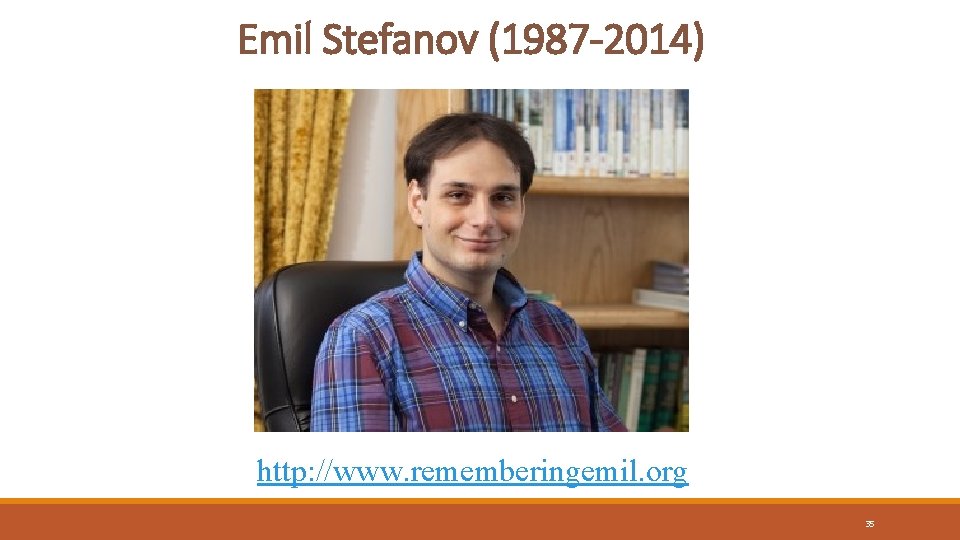
Emil Stefanov (1987 -2014) http: //www. rememberingemil. org 35
Stack / Queue Map (AVL tree) Heap Open source implementation on a garbled circuit backend coming soon Deque Doubly linked list http: //www. oblivm. com/ Thank You! kartik@cs. umd. edu 36
- Slides: 36