
Oblique Shock and Expansion Waves Introduction Supersonic flow
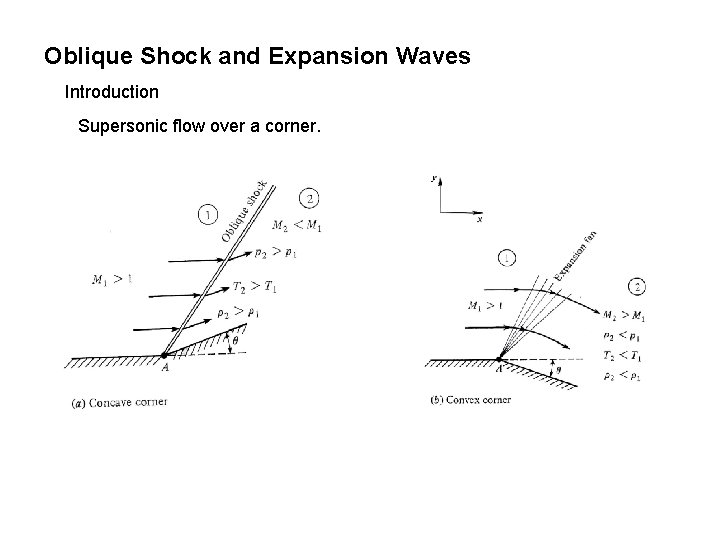
Oblique Shock and Expansion Waves Introduction Supersonic flow over a corner.
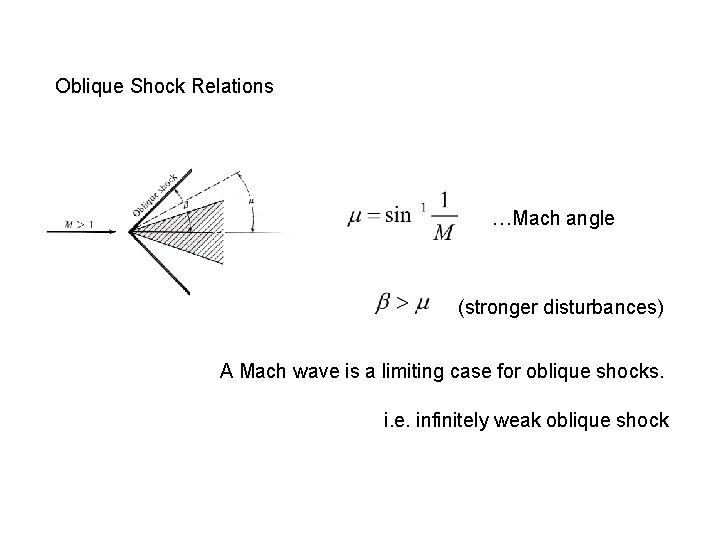
Oblique Shock Relations …Mach angle (stronger disturbances) A Mach wave is a limiting case for oblique shocks. i. e. infinitely weak oblique shock
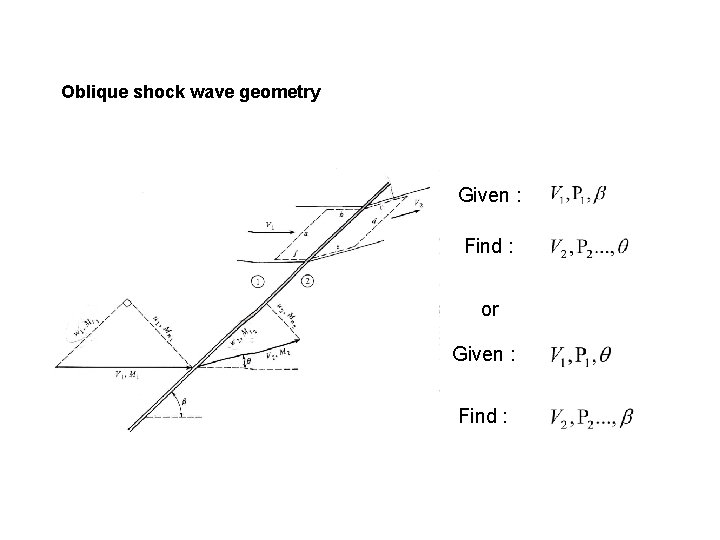
Oblique shock wave geometry Given : Find : or Given : Find :
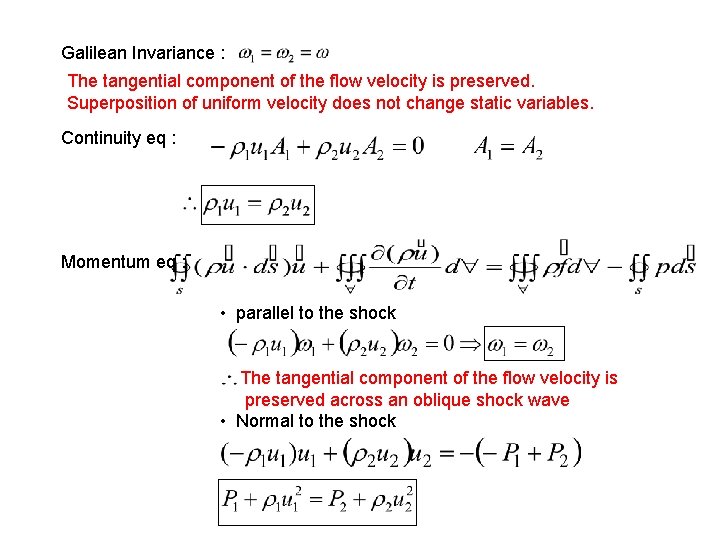
Galilean Invariance : The tangential component of the flow velocity is preserved. Superposition of uniform velocity does not change static variables. Continuity eq : Momentum eq : • parallel to the shock The tangential component of the flow velocity is preserved across an oblique shock wave • Normal to the shock
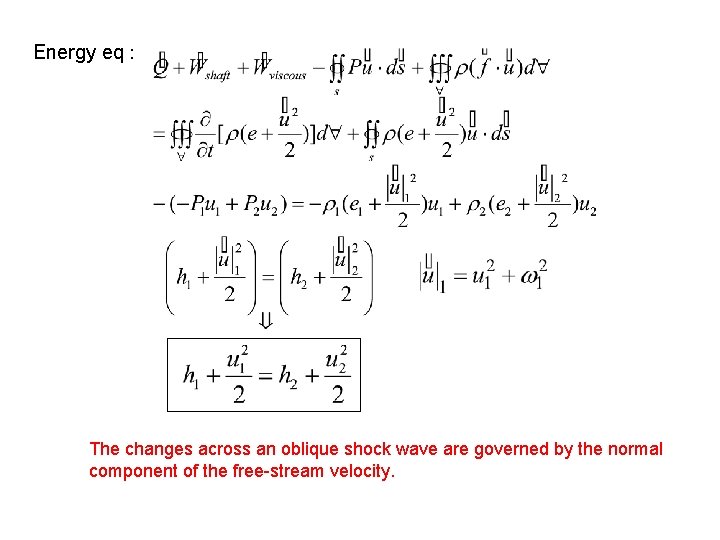
Energy eq : The changes across an oblique shock wave are governed by the normal component of the free-stream velocity.
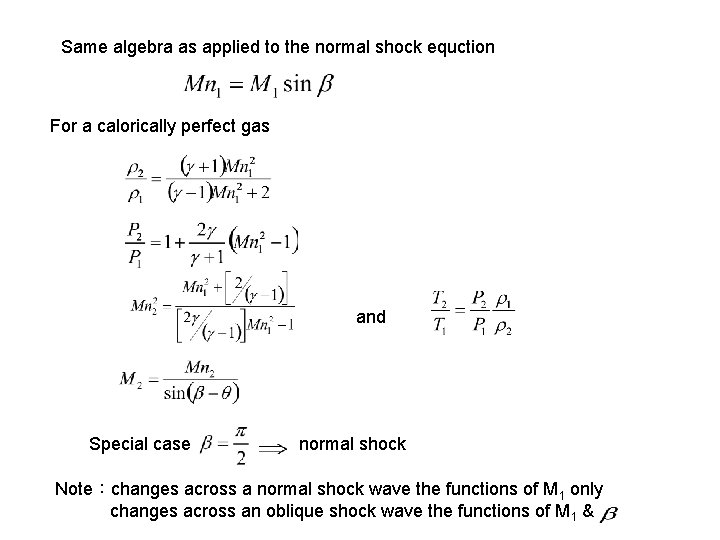
Same algebra as applied to the normal shock equction For a calorically perfect gas and Special case normal shock Note:changes across a normal shock wave the functions of M 1 only changes across an oblique shock wave the functions of M 1 &
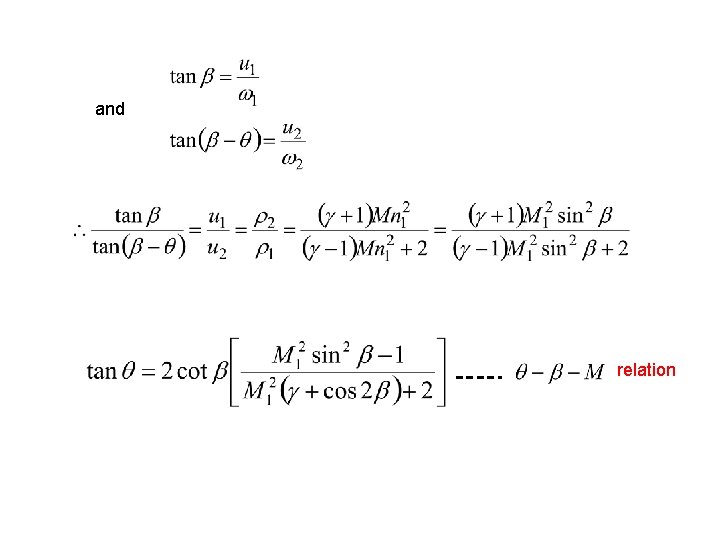
and relation
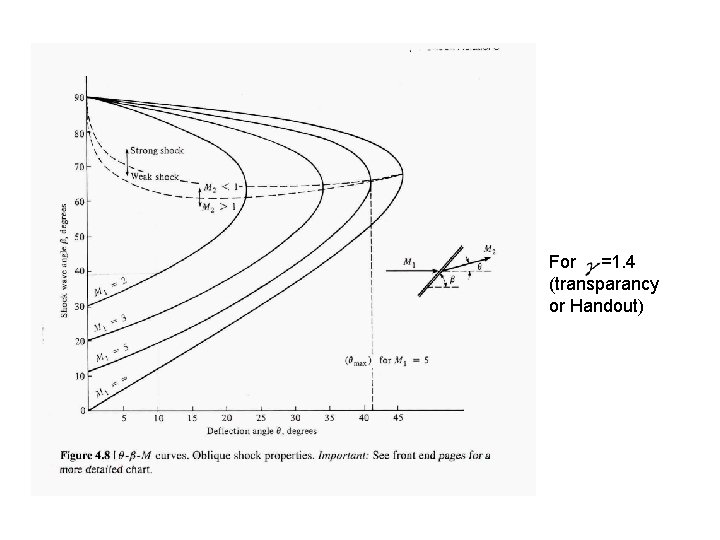
For =1. 4 (transparancy or Handout)
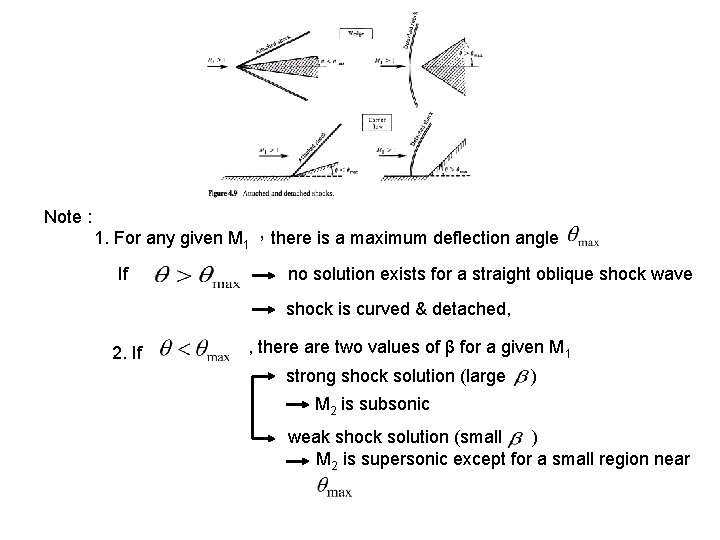
Note : 1. For any given M 1 ,there is a maximum deflection angle If no solution exists for a straight oblique shock wave shock is curved & detached, 2. If , there are two values of β for a given M 1 strong shock solution (large ) M 2 is subsonic weak shock solution (small ) M 2 is supersonic except for a small region near
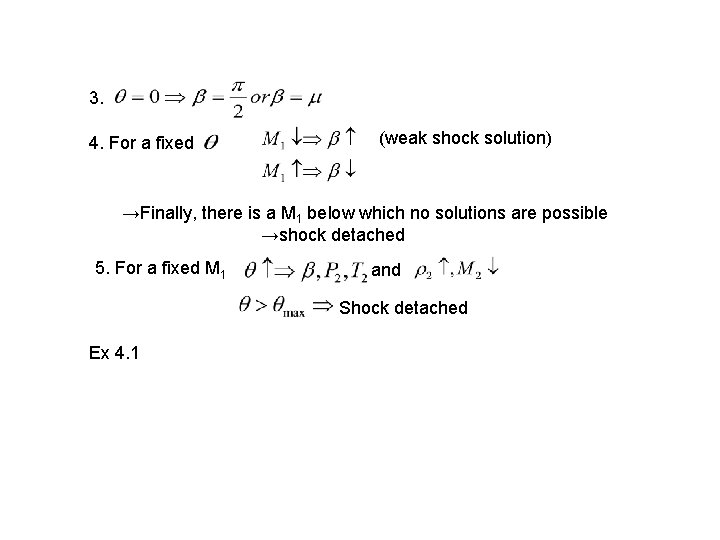
3. 4. For a fixed (weak shock solution) →Finally, there is a M 1 below which no solutions are possible →shock detached 5. For a fixed M 1 and Shock detached Ex 4. 1
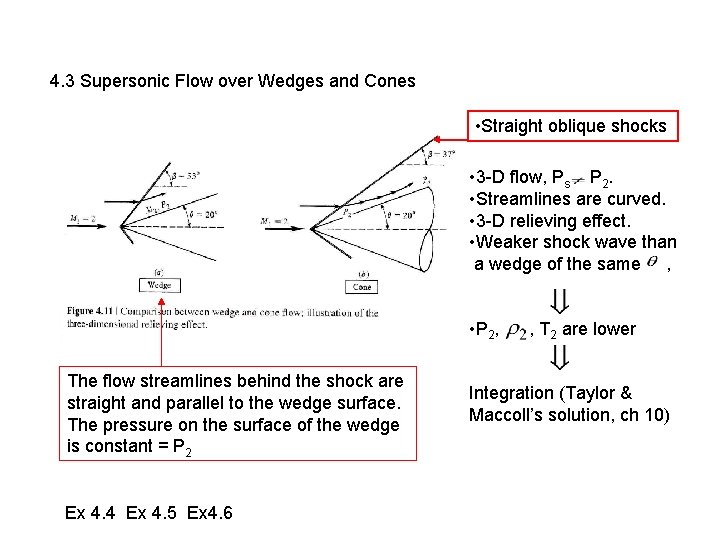
4. 3 Supersonic Flow over Wedges and Cones • Straight oblique shocks • 3 -D flow, Ps P 2. • Streamlines are curved. • 3 -D relieving effect. • Weaker shock wave than a wedge of the same , • P 2 , The flow streamlines behind the shock are straight and parallel to the wedge surface. The pressure on the surface of the wedge is constant = P 2 Ex 4. 4 Ex 4. 5 Ex 4. 6 , T 2 are lower Integration (Taylor & Maccoll’s solution, ch 10)
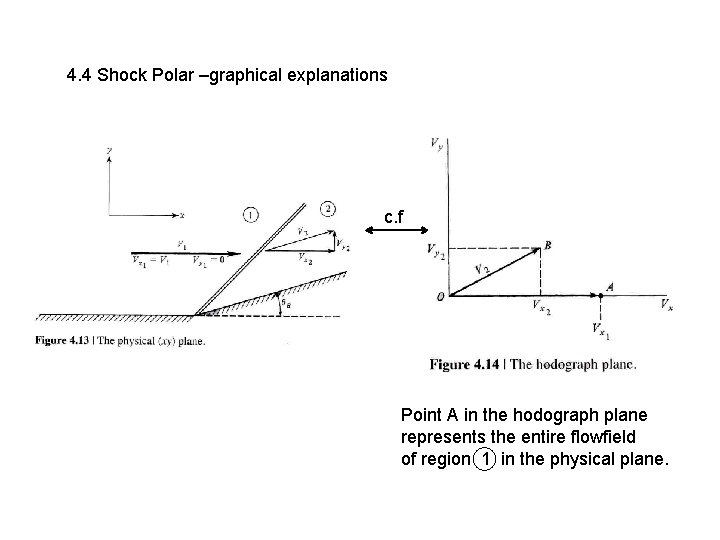
4. 4 Shock Polar –graphical explanations c. f Point A in the hodograph plane represents the entire flowfield of region 1 in the physical plane.
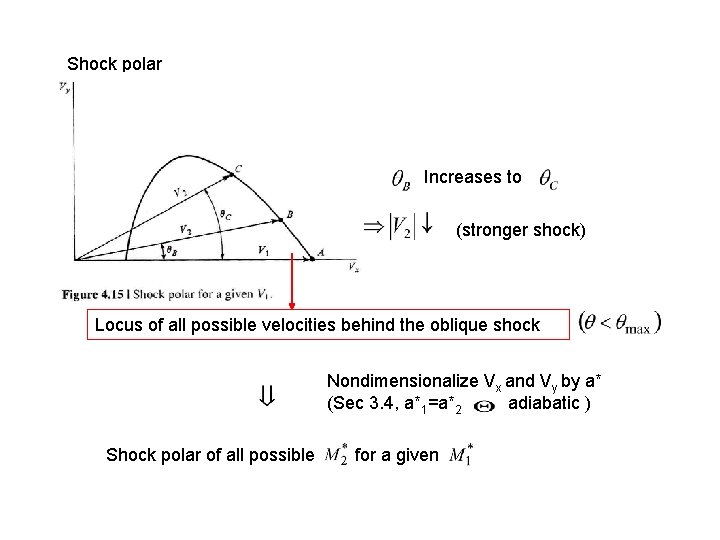
Shock polar Increases to (stronger shock) Locus of all possible velocities behind the oblique shock Nondimensionalize Vx and Vy by a* (Sec 3. 4, a*1=a*2 adiabatic ) Shock polar of all possible for a given
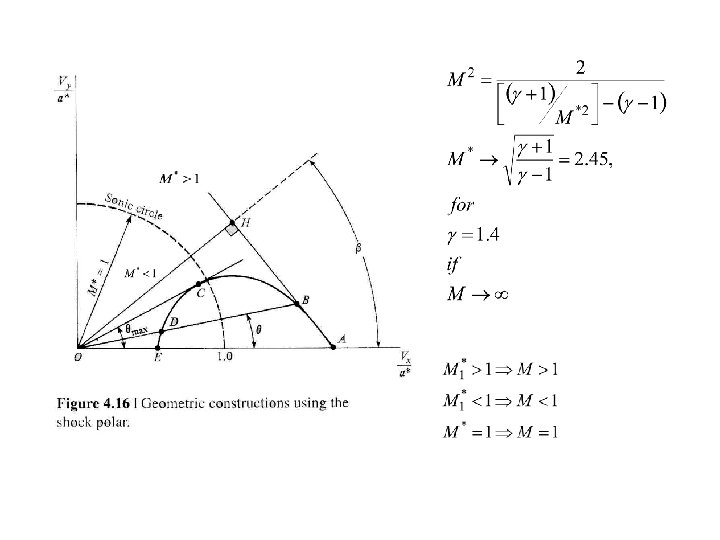
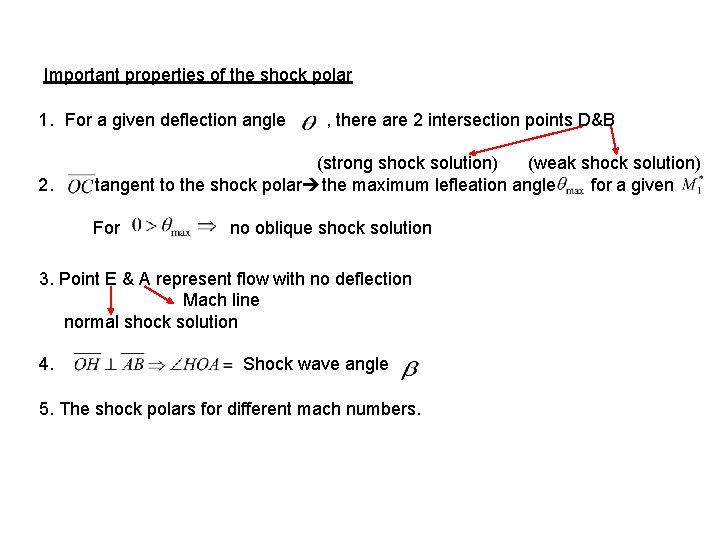
Important properties of the shock polar 1. For a given deflection angle 2. , there are 2 intersection points D&B (strong shock solution) (weak shock solution) tangent to the shock polar the maximum lefleation angle for a given For no oblique shock solution 3. Point E & A represent flow with no deflection Mach line normal shock solution 4. Shock wave angle 5. The shock polars for different mach numbers.
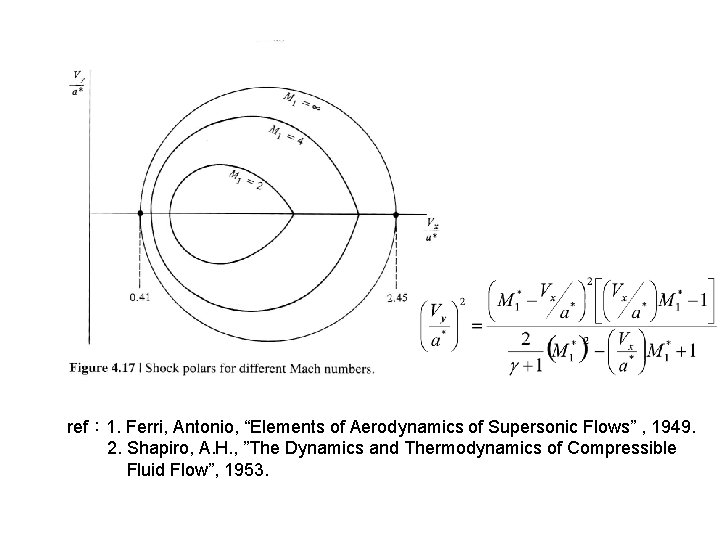
ref: 1. Ferri, Antonio, “Elements of Aerodynamics of Supersonic Flows” , 1949. 2. Shapiro, A. H. , ”The Dynamics and Thermodynamics of Compressible Fluid Flow”, 1953.
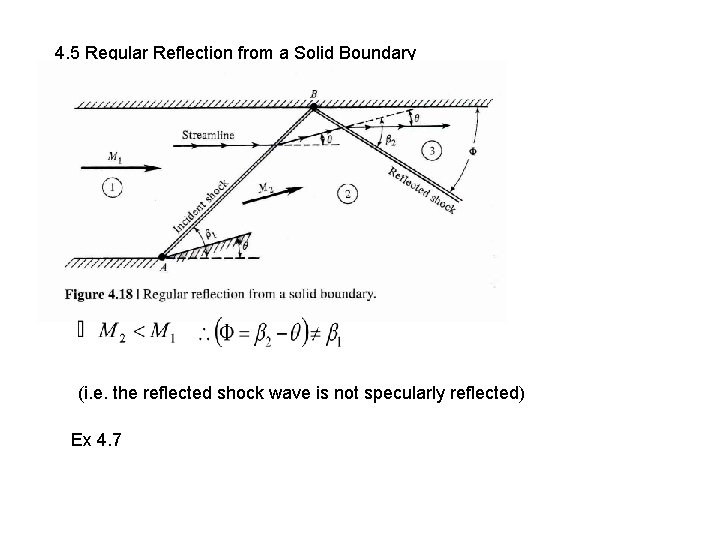
4. 5 Regular Reflection from a Solid Boundary (i. e. the reflected shock wave is not specularly reflected) Ex 4. 7
4. 6 Pressure – Deflection Diagrams Wave interaction -locus of all possible static pressure behind an oblique shock wave as a function deflection angle for given upstream conditions. Shock wave – a solid boundary Shock – shock Shock – expansion Shock – free boundaries Expansion – expansion
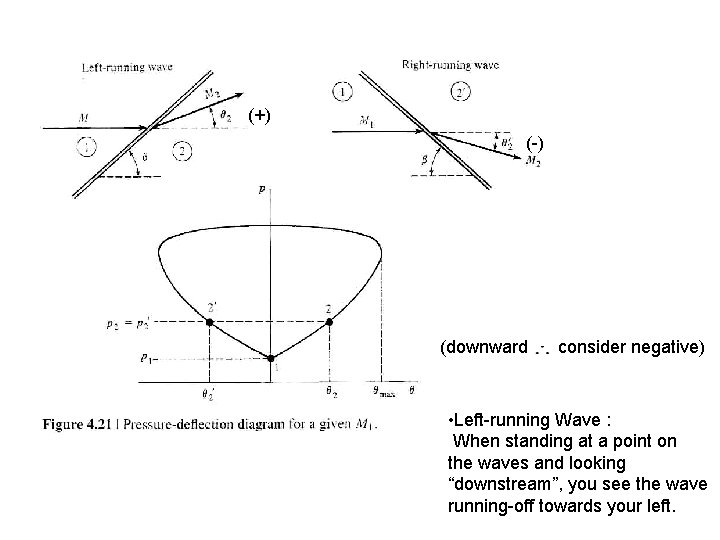
(+) (-) (downward consider negative) • Left-running Wave : When standing at a point on the waves and looking “downstream”, you see the wave running-off towards your left.
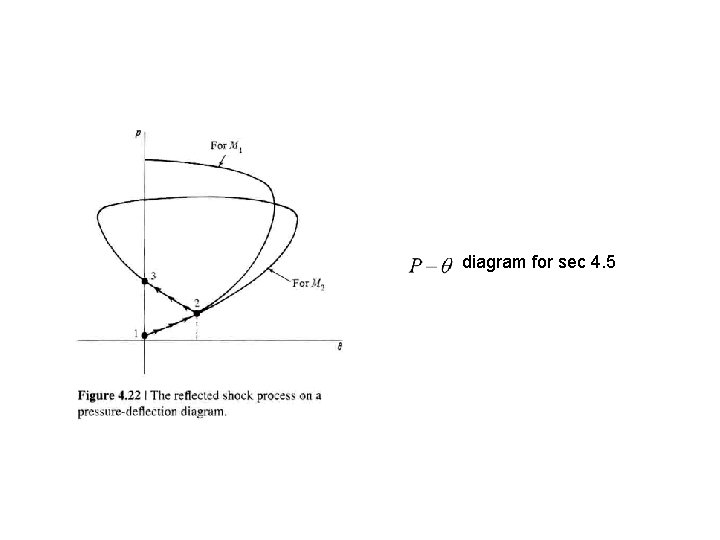
diagram for sec 4. 5
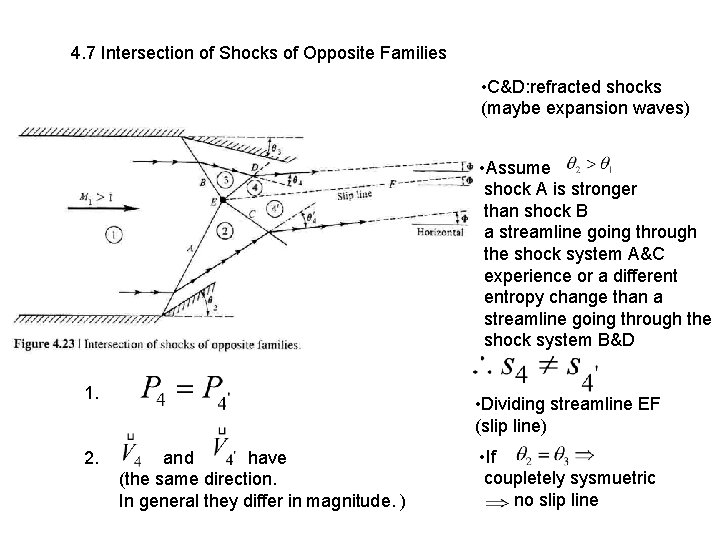
4. 7 Intersection of Shocks of Opposite Families • C&D: refracted shocks (maybe expansion waves) • Assume shock A is stronger than shock B a streamline going through the shock system A&C experience or a different entropy change than a streamline going through the shock system B&D 1. 2. • Dividing streamline EF (slip line) and have (the same direction. In general they differ in magnitude. ) • If coupletely sysmuetric no slip line
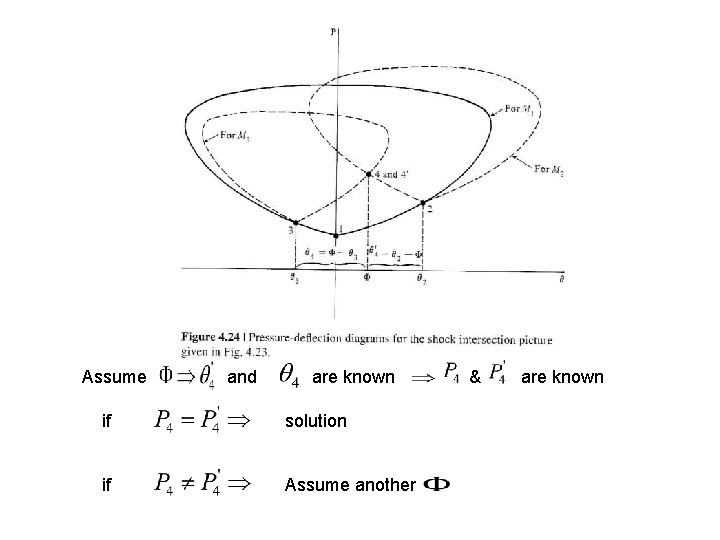
Assume and are known if solution if Assume another & are known
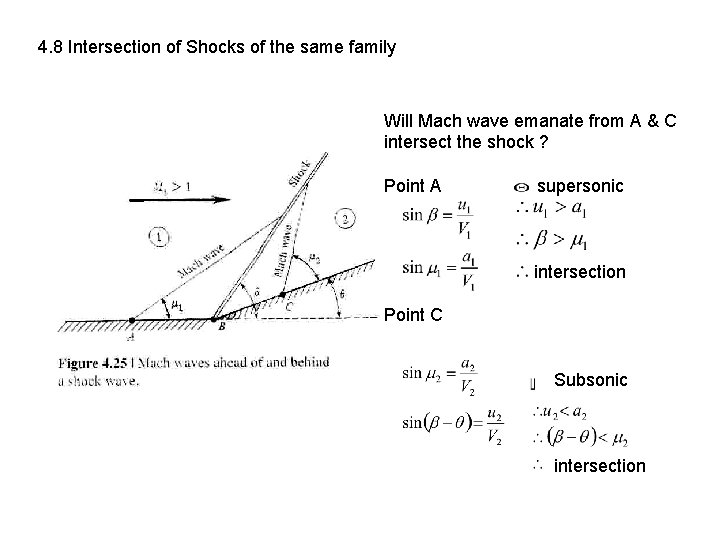
4. 8 Intersection of Shocks of the same family Will Mach wave emanate from A & C intersect the shock ? Point A supersonic intersection Point C Subsonic intersection
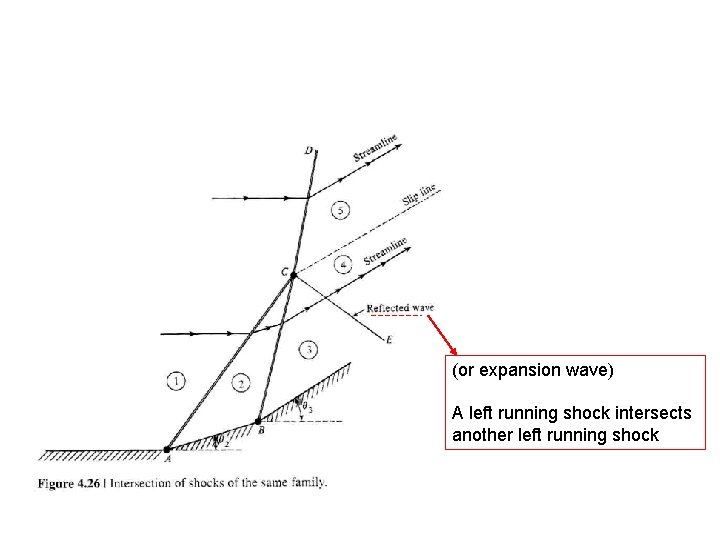
(or expansion wave) A left running shock intersects another left running shock
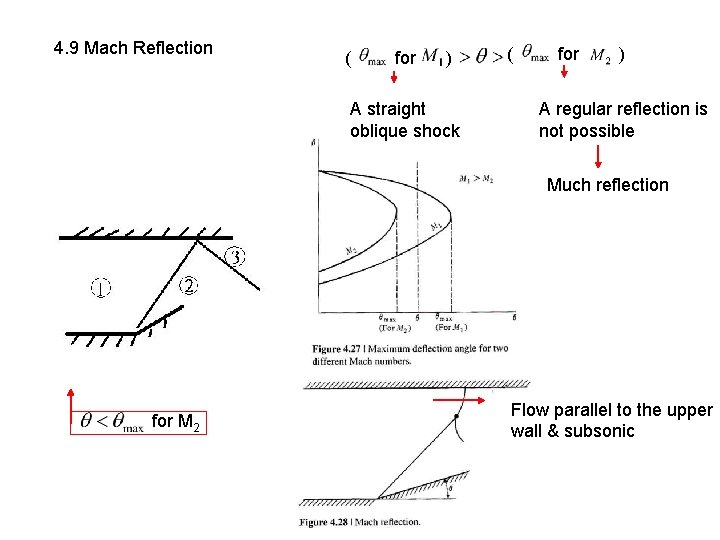
4. 9 Mach Reflection ( for ) A straight oblique shock ( for ) A regular reflection is not possible Much reflection for M 2 Flow parallel to the upper wall & subsonic
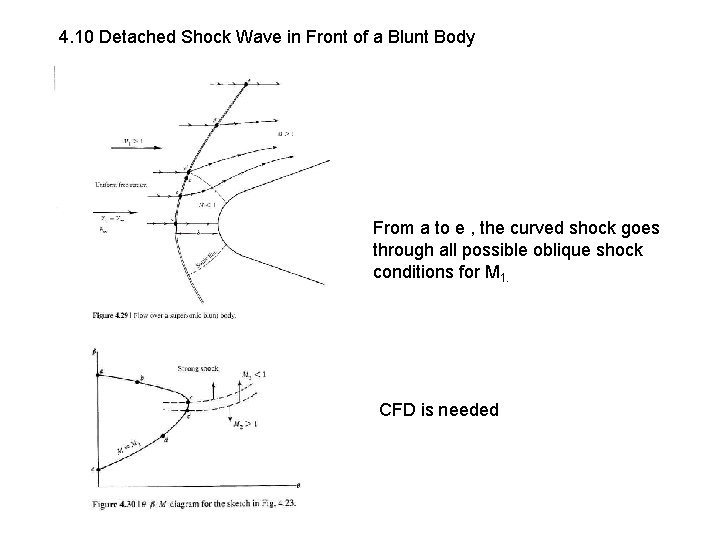
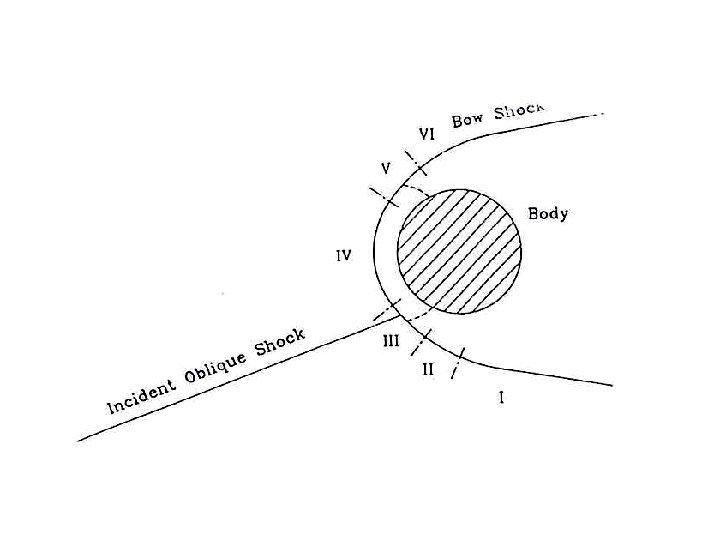
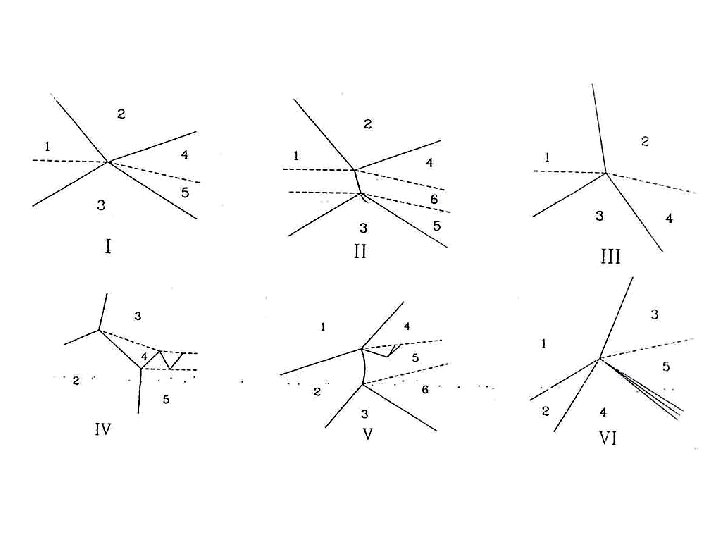
4. 10 Detached Shock Wave in Front of a Blunt Body From a to e , the curved shock goes through all possible oblique shock conditions for M 1. CFD is needed
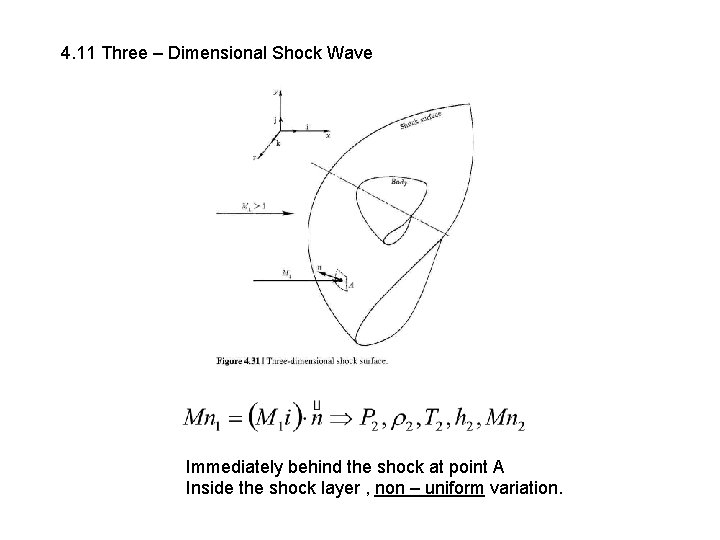
4. 11 Three – Dimensional Shock Wave Immediately behind the shock at point A Inside the shock layer , non – uniform variation.
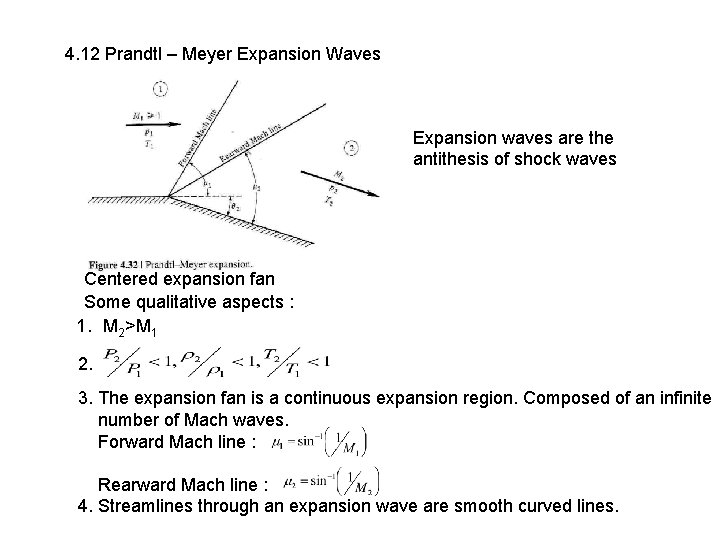
4. 12 Prandtl – Meyer Expansion Waves Expansion waves are the antithesis of shock waves Centered expansion fan Some qualitative aspects : 1. M 2>M 1 2. 3. The expansion fan is a continuous expansion region. Composed of an infinite number of Mach waves. Forward Mach line : Rearward Mach line : 4. Streamlines through an expansion wave are smooth curved lines.
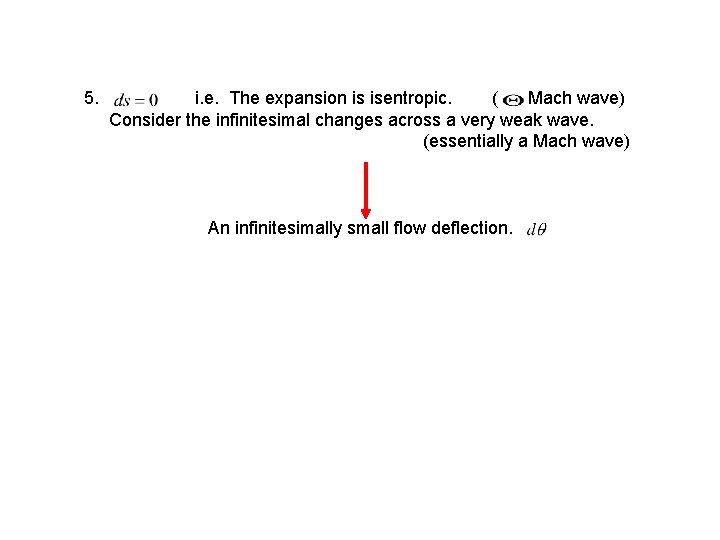
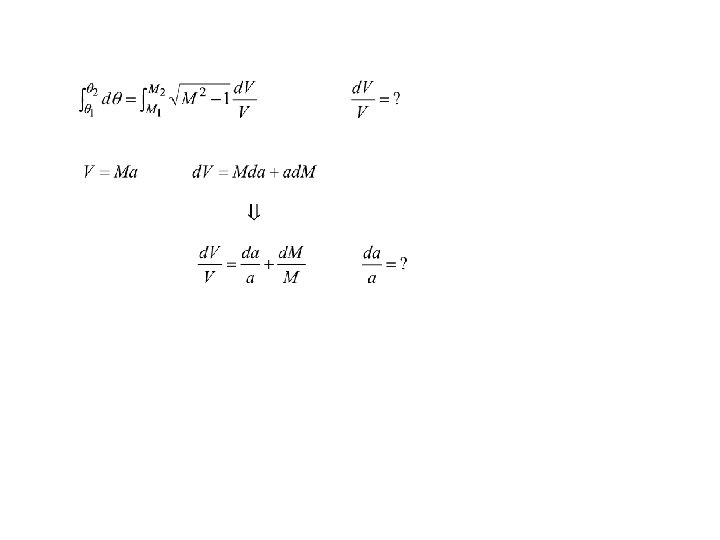
5. i. e. The expansion is isentropic. ( Mach wave) Consider the infinitesimal changes across a very weak wave. (essentially a Mach wave) An infinitesimally small flow deflection.
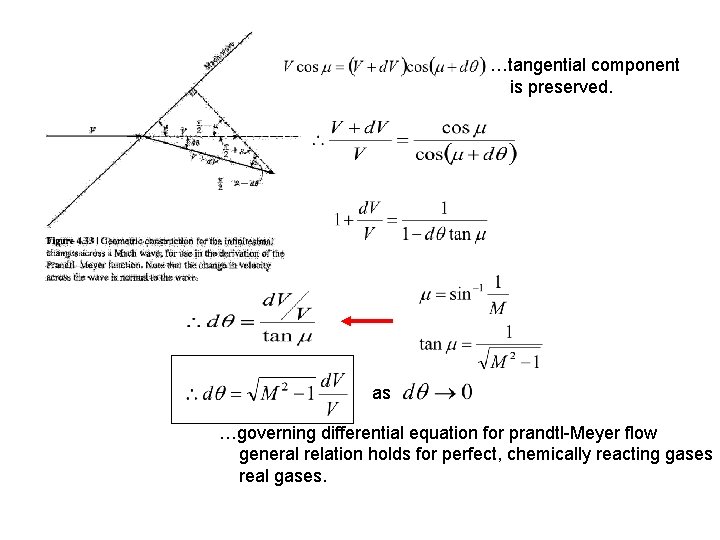
…tangential component is preserved. as …governing differential equation for prandtl-Meyer flow general relation holds for perfect, chemically reacting gases real gases.
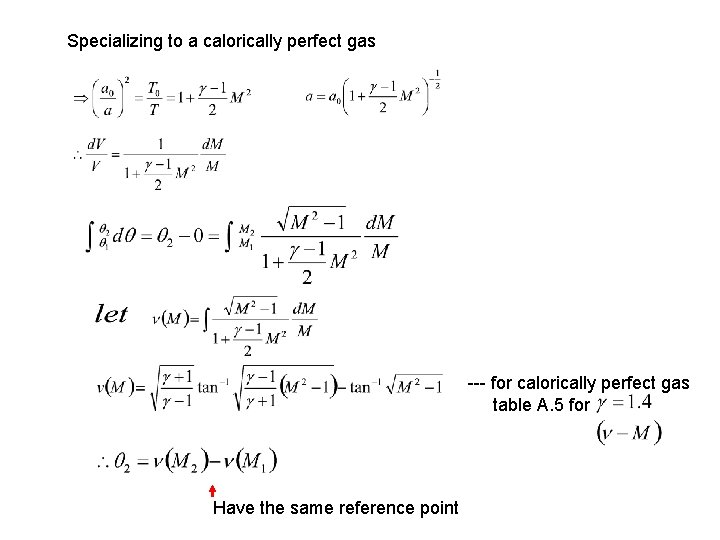
Specializing to a calorically perfect gas --- for calorically perfect gas table A. 5 for Have the same reference point
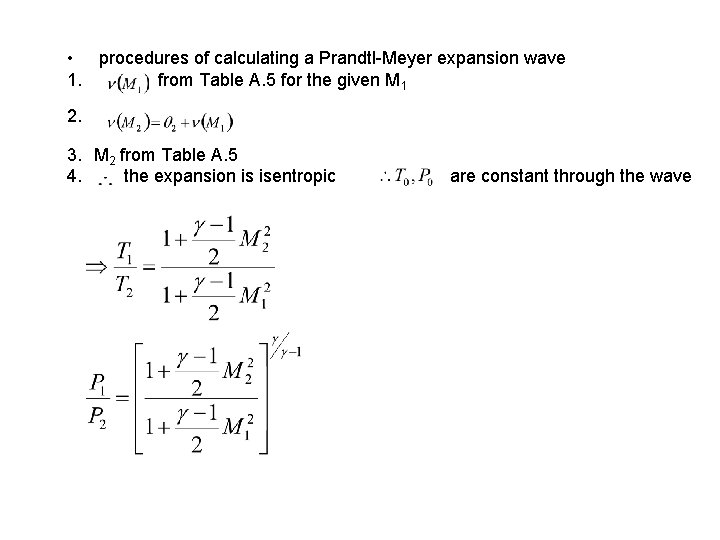
• procedures of calculating a Prandtl-Meyer expansion wave 1. from Table A. 5 for the given M 1 2. 3. M 2 from Table A. 5 4. the expansion is isentropic are constant through the wave
- Slides: 35