
ObjectRelational Mapping 2008 Hibernate and the Entity Data
Object/Relational Mapping 2008: Hibernate and the Entity Data Model (EDM) Elizabeth (Betty) O’Neil Dept. of Computer Science University of Massachusetts Boston
Love of Objects Programmers love objects Objects are normally ephemeral Programming languages provide object persistence, but it is fragile Databases provide robust data persistence. So… need way to persist object data in the database Or think bigger: use data model across object-DB boundaries. 2
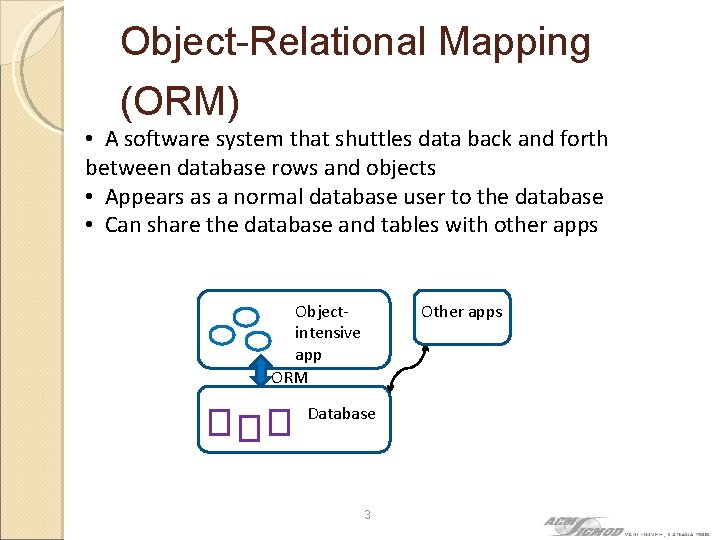
Object-Relational Mapping (ORM) • A software system that shuttles data back and forth between database rows and objects • Appears as a normal database user to the database • Can share the database and tables with other apps Objectintensive app ORM Other apps Database 3

Object-Relational Mapping Has a history, but widely adopted only since open-source Hibernate project started, 20012002. The Hibernate project [7] was founded and led by Gavin King, a Java/J 2 EE software developer, now part of Jboss. King wrote an excellent book [3]. Microsoft has adopted a comparable approach with EDM, Entity Data Model and its Entity Framework, for release this year. [1, 10] Both Hibernate and EDM support (or will 4 support) multiple databases: Oracle, DB 2, SQL
Java Persistence Architecture (JPA) JPA is part of current JEE (previously J 2 EE), Sun’s Java Enterprise Edition JPA is a standardized version of the Hibernate architecture EJB 3 (current Entity Java Beans) uses JPA for EJB persistence, i. e. , persistence of “managed” objects JPA and EJB 3 are now available in major application servers: Oracle Top. Link 11 g, Open. JPA for Web. Sphere and Web. Logic, Hibernate JPA for JBoss JPA can be used outside EJB 3 for persistence 5
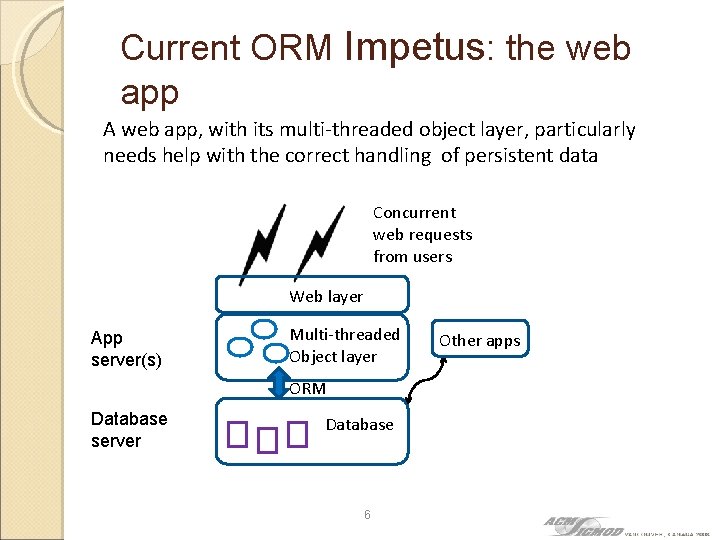
Current ORM Impetus: the web app A web app, with its multi-threaded object layer, particularly needs help with the correct handling of persistent data Concurrent web requests from users Web layer App server(s) Multi-threaded Object layer ORM Database server Database 6 Other apps
Our Universe of Discourse Object-oriented web apps with database backed data Let’s consider sites with ◦ Possibly many application servers, where the objects live ◦ A single database server with plenty of CPUs and disks Given today’s fast machines and databases, this configuration scales up to many 100 s of transactions/second (over 1 M Tx/hour) We will concentrate on common characteristics of Hibernate and EDM 7
Outline of Presentation -------Ask questions any time Schema mapping Entities and their identity Relationships Inheritance The Pizza Shop Example ------Short Break------ Sample code using entity objects Development tools, artifacts The ORM runtime system Transactions, performance -------Summary, final questions------8
Data Modeling Three modeling methodologies: ◦ We all know the venerable Chen E-R models for database schemas; the extended E-R models (EER) incorporate inheritance ◦ The object modeling approach uses UML class diagrams, somewhat similar to EER ◦ The tables of the database define the “physical” schema, itself a model of underlying resources The relationship between these models involves schema mapping, covered in last SIGMOD’s keynote talk by Phil Bernstein[9] 9
Even simple cases need help In the simplest case, a program object of class A has fields x, y, z and a table B has columns x, y, z ◦ Each instance of A has a row in B and vice versa, via ORM ◦ Are we done? ◦ If x is a unique id, and x, y, and z are simple types, yes. ◦ --Or some unique id in (x, y, z), possibly composite If no unique id in (x, y, z), the object still has its innate identity, but corresponding rows involve duplicate rows, against relational model rules So in practice, we add a unique id in this case: Class A 1 has id, x, y, z and table B 1 has id, x, y, z 10
Persistent Objects & Identity A “persistent object” is an ordinary program object tied via ORM to database data for its longterm state The program objects come and go as needed Don’t confuse this with language-provided persistence (Java/C#), a less robust mechanism Persistent objects have field-materialized identity It makes sense—Innate object identity depends on memory addresses, a short-lived phenomenon So long-lived objects (could be years…) have to be identified this way, it’s not the database’s fault 11
Persistent Objects need tracking We want only one copy of each unique object in use by an app, a basic idea of OO programming Each persistent object has a unique id We can no longer can depend on object location in memory to ensure non-duplication So we have a harder problem than before—need an active agent tracking objects This agent is part of ORM’s runtime system The ORM uses hashing to keep track of ids, detect duplicates 12
ORM Entities Like E/R entities, ORM entities model collections of realworld objects of interest to the app Entities have properties/attributes of database datatypes Entities participate in relationships—see soon (but relationships are not “first class” objects, have no attributes) Entities have unique ids consisting of one or more properties Entity instances (AKA entities) are persistent objects of persistent classes Entity instances correspond to database rows of 13 matching unique id
Value Objects In fact, persistent objects can be entities or value objects Value objects can represent E/R composite attributes and multi -valued attributes Example: one address consisting of several address attributes for a customer. Programmers want an object for the whole address, hanging off the customer object Value objects provide details about some entity, have lifetime tied to their entity, don’t need own unique id Value objects are called Hibernate “components”, EDM “complex types” We’ll only discuss entities for persistent objects For this presentation, persistent object = entity object 14
Creating Unique IDs A new entity object needs a new id, and the database is holding all the old rows, so it is the proper agent to assign it Note this can’t be done with standard SQL insert, which needs predetermined values for all columns Every production database has a SQL extension to do this ◦ Oracle’s sequences ◦ SQL Server’s auto-increment datatype ◦ … The ORM system coordinates with the database to assign the id, in effect standardizing an extension of SQL Keys obtained this way have no meaning, are called “surrogate keys” Natural keys can be used instead if they are available. 15
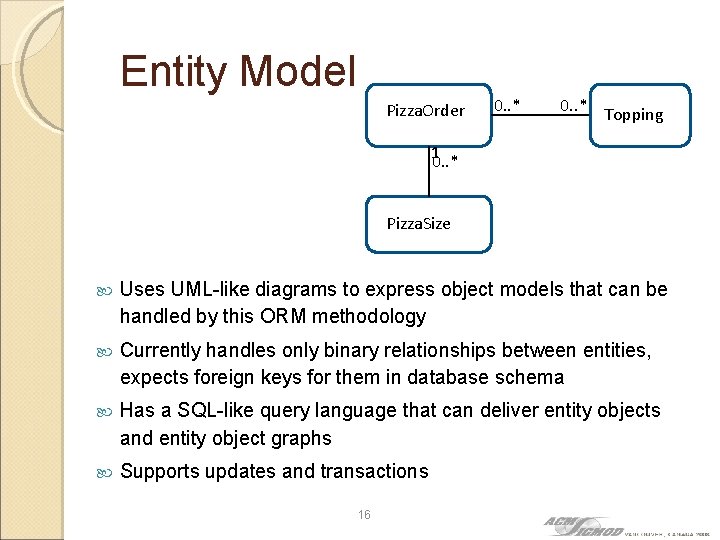
Entity Model Pizza. Order 0. . * Topping 10. . * Pizza. Size Uses UML-like diagrams to express object models that can be handled by this ORM methodology Currently handles only binary relationships between entities, expects foreign keys for them in database schema Has a SQL-like query language that can deliver entity objects and entity object graphs Supports updates and transactions 16
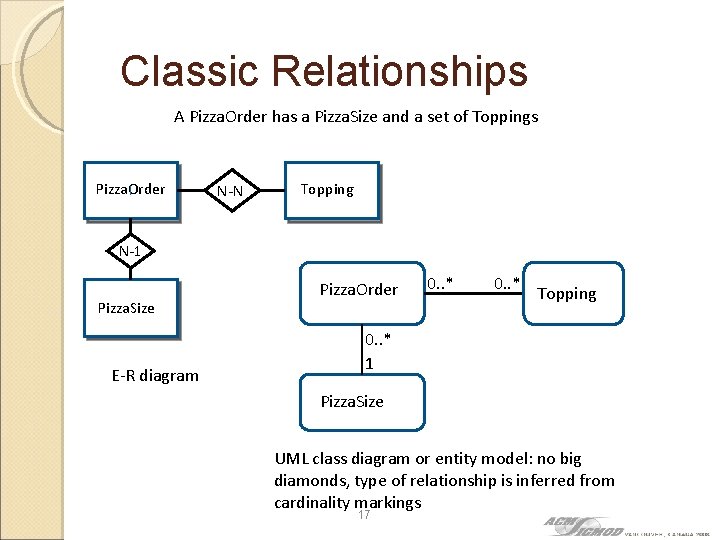
Classic Relationships A Pizza. Order has a Pizza. Size and a set of Toppings Pizza. Order N-N Topping N-1 Pizza. Size E-R diagram Pizza. Order 0. . * Topping 0. . * 1 Pizza. Size UML class diagram or entity model: no big diamonds, type of relationship is inferred from cardinality markings 17
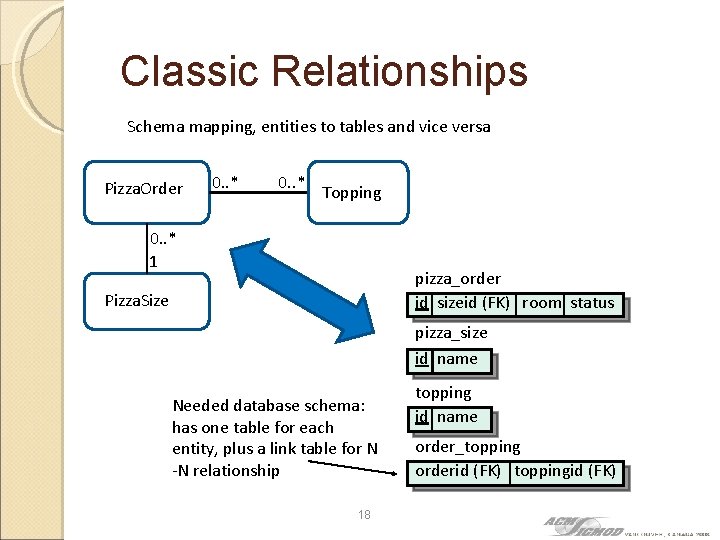
Classic Relationships Schema mapping, entities to tables and vice versa Pizza. Order 0. . * Topping 0. . * 1 pizza_order id sizeid (FK) room status Pizza. Size pizza_size id name Needed database schema: has one table for each entity, plus a link table for N -N relationship 18 topping id name order_topping orderid (FK) toppingid (FK)
Inheritance Example: generalize Topping to Pizza. Option, to allow other options in the future: ◦ Topping ISA Pizza. Option ◦ Shape ISA Pizza. Option, … Then a Pizza. Order can have a collection of Pizza. Options ◦ We can process the Pizza. Options generically, but when necessary, be sensitive to their subtype: Topping or Shape ◦ It is important to have “polymorphic associations”, such as Pizza. Order to Pizza. Option, that deliver the right subtype object when followed. Inheritance is supported directly in Java, C#, etc. , ISA “relationship” Inheritance is not native to RDBs, but part of EER, extended entity-relationship modeling, long-known schema-mapping problem 19
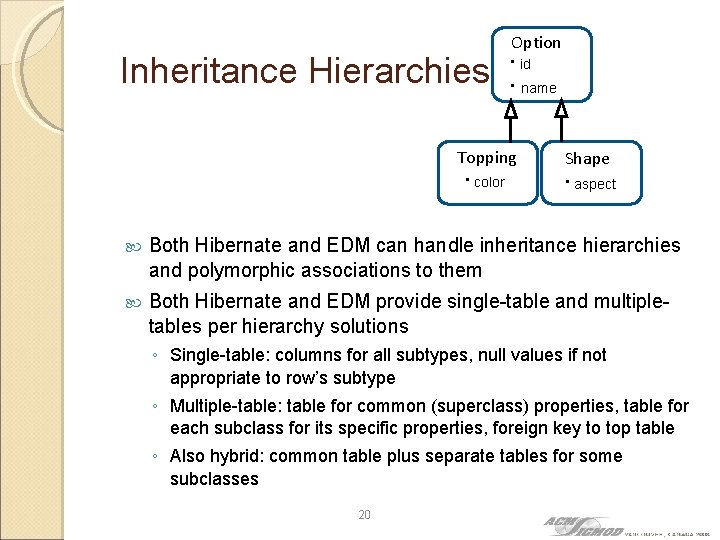
Inheritance Hierarchies Option ∙ id ∙ name Topping Shape ∙ color ∙ aspect Both Hibernate and EDM can handle inheritance hierarchies and polymorphic associations to them Both Hibernate and EDM provide single-table and multipletables per hierarchy solutions ◦ Single-table: columns for all subtypes, null values if not appropriate to row’s subtype ◦ Multiple-table: table for common (superclass) properties, table for each subclass for its specific properties, foreign key to top table ◦ Also hybrid: common table plus separate tables for some subclasses 20
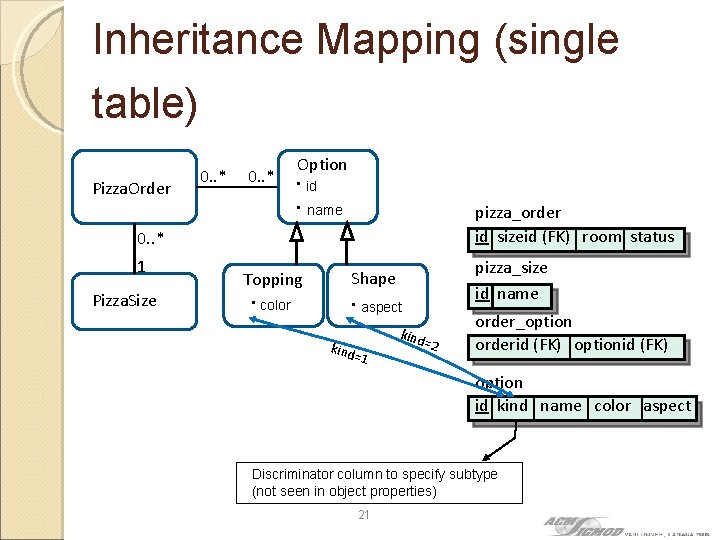
Inheritance Mapping (single table) Pizza. Order 0. . * Option ∙ id ∙ name pizza_order id sizeid (FK) room status 0. . * 1 Pizza. Size Topping Shape ∙ color ∙ aspect kind =1 kind pizza_size id name =2 order_option orderid (FK) option id kind name color aspect Discriminator column to specify subtype (not seen in object properties) 21
Inheritance using a single table The discriminator column (here “kind”) is handled by the O/R layer and does not show in the object properties The hierarchy can have multiple levels Single-table approach is usually the best performaning way But we have to give up non-null DB constraints for subtype-specific properties Alternatively, use multiple tables… 22
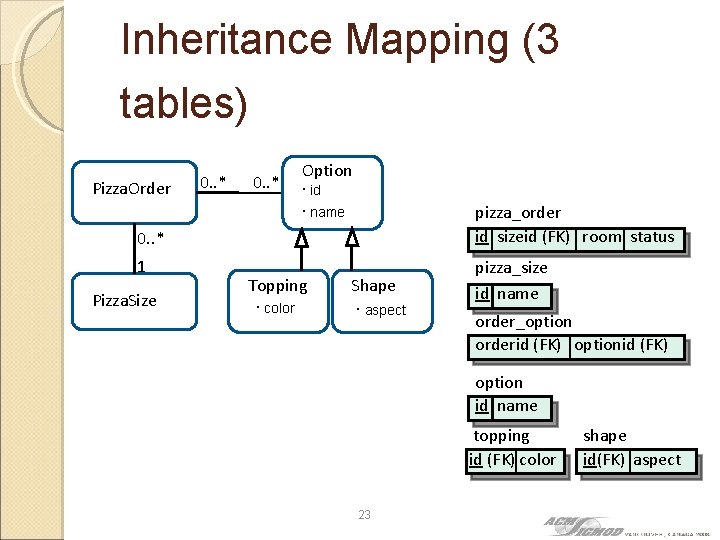
Inheritance Mapping (3 tables) Pizza. Order 0. . * Option ∙ id ∙ name pizza_order id sizeid (FK) room status 0. . * 1 Pizza. Size Topping ∙ color Shape ∙ aspect pizza_size id name order_option orderid (FK) option id name topping id (FK) color 23 shape id(FK) aspect
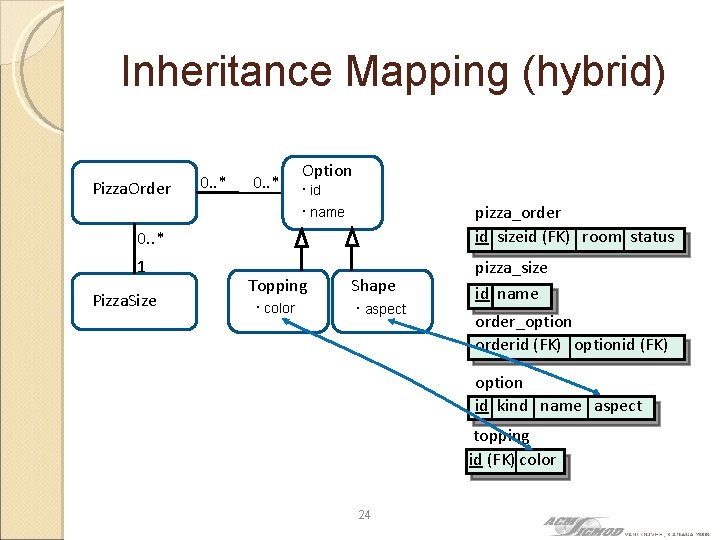
Inheritance Mapping (hybrid) Pizza. Order 0. . * Option ∙ id ∙ name pizza_order id sizeid (FK) room status 0. . * 1 Pizza. Size Topping ∙ color Shape ∙ aspect pizza_size id name order_option orderid (FK) option id kind name aspect topping id (FK) color 24
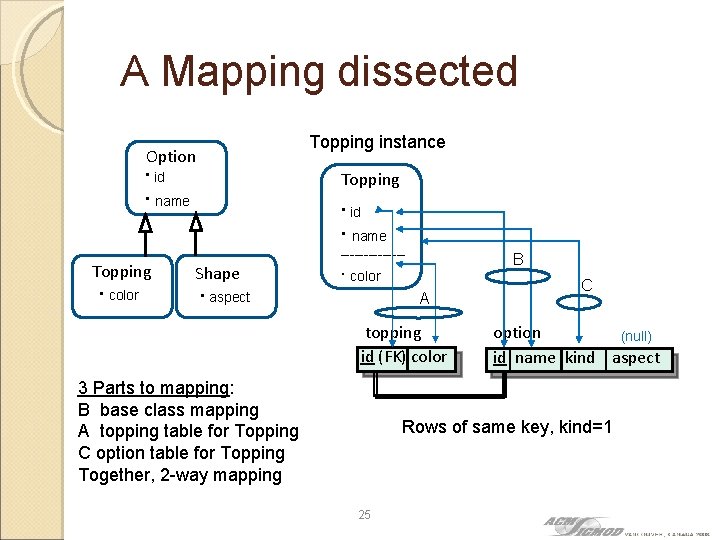
A Mapping dissected Topping instance Option ∙ id ∙ name Topping ∙ color Topping ∙ id ∙ name ------- Shape B ∙ color ∙ aspect A topping id (FK) color 3 Parts to mapping: B base class mapping A topping table for Topping C option table for Topping Together, 2 -way mapping C option (null) id name kind aspect Rows of same key, kind=1 25
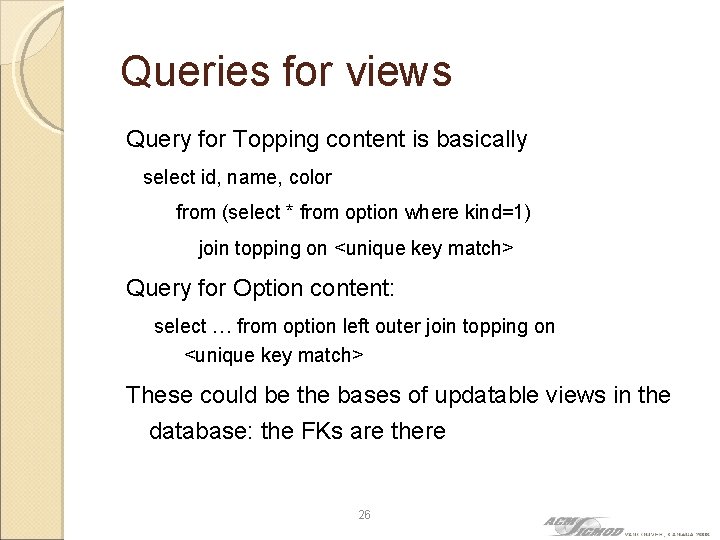
Queries for views Query for Topping content is basically select id, name, color from (select * from option where kind=1) join topping on <unique key match> Query for Option content: select … from option left outer join topping on <unique key match> These could be the bases of updatable views in the database: the FKs are there 26
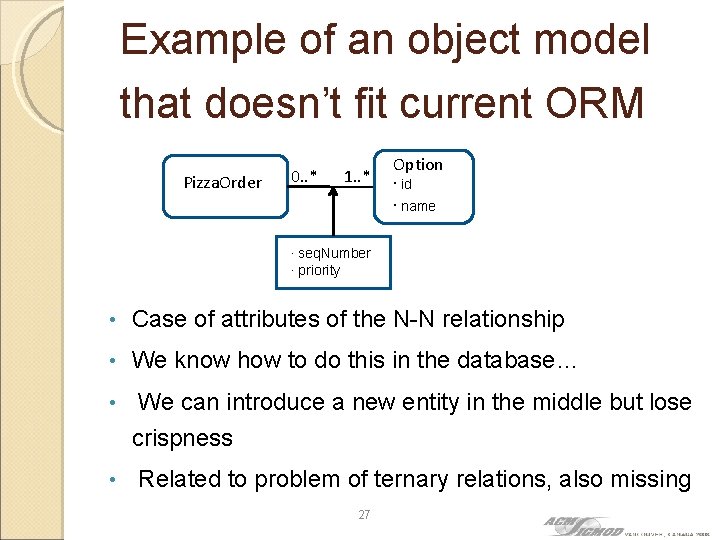
Example of an object model that doesn’t fit current ORM Pizza. Order 0. . * 1. . * Option ∙ id ∙ name ∙ seq. Number ∙ priority • Case of attributes of the N-N relationship • We know how to do this in the database… • We can introduce a new entity in the middle but lose crispness • Related to problem of ternary relations, also missing 27
The Pizza Shop Example Free pizza for students in a dorm Student can: ◦ Choose toppings, size, order by room number ◦ Check on orders by room number Admin can: ◦ Add topping choices, sizes ◦ Mark the oldest pizza order “done” Available at www. cs. umb. edu/~eoneil/orm 28
The Pizza Shop Example Implemented using Hibernate and Microsoft EDM: same architecture, similar code, same database schema Implemented as client-server app and web app: only the top-level code changes ◦ Client-server means all the app code runs on the client, with network connection to DB ◦ Web app means all the app code runs on the web server/app server, clients use browser, DB can be on another server. Transactions are explicitly coded, not using containermanaged transactions (EJB/COM+ Serviced Components) 29
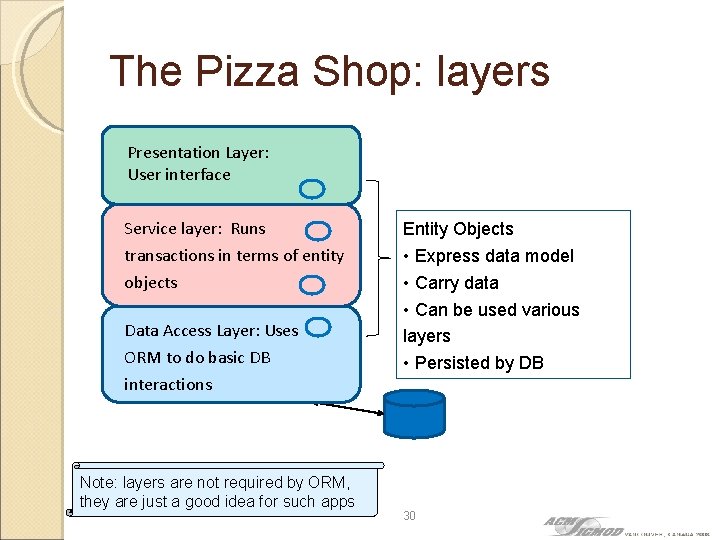
The Pizza Shop: layers Presentation Layer: User interface Service layer: Runs transactions in terms of entity objects Data Access Layer: Uses ORM to do basic DB interactions Note: layers are not required by ORM, they are just a good idea for such apps Entity Objects • Express data model • Carry data • Can be used various layers • Persisted by DB 30
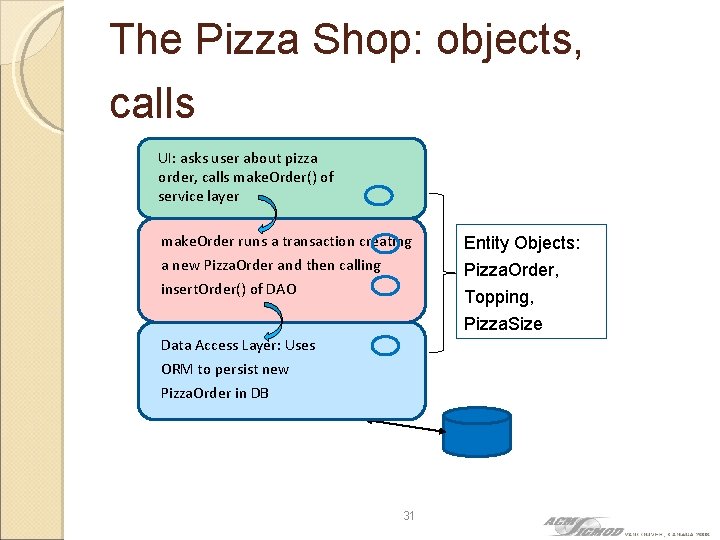
The Pizza Shop: objects, calls UI: asks user about pizza order, calls make. Order() of service layer make. Order runs a transaction creating a new Pizza. Order and then calling insert. Order() of DAO Data Access Layer: Uses ORM to persist new Pizza. Order in DB 31 Entity Objects: Pizza. Order, Topping, Pizza. Size
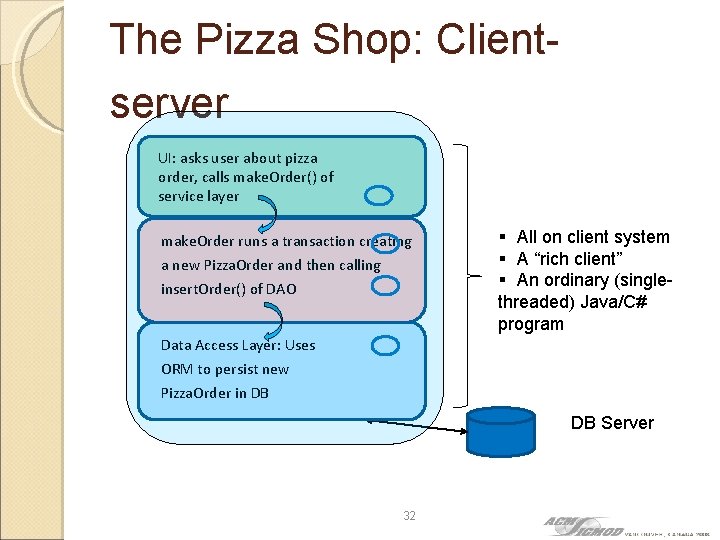
The Pizza Shop: Clientserver UI: asks user about pizza order, calls make. Order() of service layer make. Order runs a transaction creating a new Pizza. Order and then calling insert. Order() of DAO § All on client system § A “rich client” § An ordinary (singlethreaded) Java/C# program Data Access Layer: Uses ORM to persist new Pizza. Order in DB DB Server 32
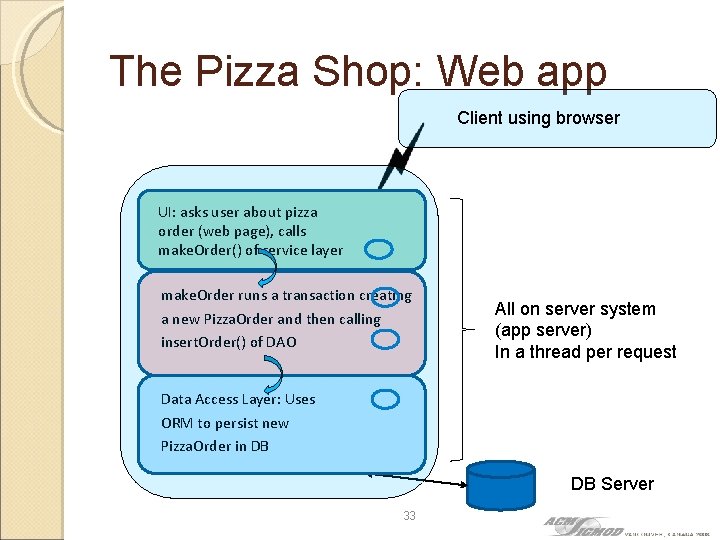
The Pizza Shop: Web app Client using browser UI: asks user about pizza order (web page), calls make. Order() of service layer make. Order runs a transaction creating a new Pizza. Order and then calling insert. Order() of DAO All on server system (app server) In a thread per request Data Access Layer: Uses ORM to persist new Pizza. Order in DB DB Server 33
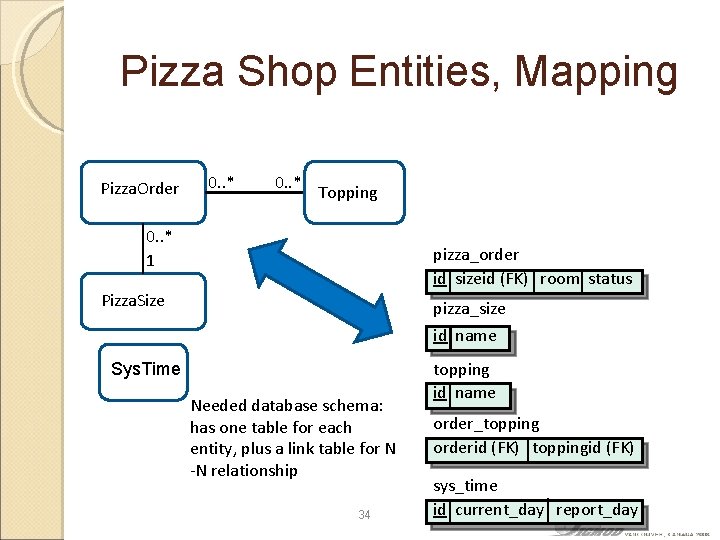
Pizza Shop Entities, Mapping Pizza. Order 0. . * Topping 0. . * 1 pizza_order id sizeid (FK) room status Pizza. Size pizza_size id name Sys. Time Needed database schema: has one table for each entity, plus a link table for N -N relationship 34 topping id name order_topping orderid (FK) toppingid (FK) sys_time id current_day report_day
Half-way point To come: ◦ Sample code using entity objects ◦ Development tools, artifacts ◦ The ORM runtime system ◦ Transactions, performance ◦ Summary, more questions Questions now? 35
Entity Objects: POJOs/POCOs POJO=plain old Java object, POCO=plain old CLR object (C#, etc. , CLR= Common Language Runtime of. NET) ◦ No special methods need to be implemented ◦ Objects are created with normal “new”, not some required factory Compare to EJB 2 Entity Java Bean, COM “managed” objects: these are hard to unit-test, tend to be “heavyweight” EDM: entity objects are POCOs, but need to extend system class Entity. Object (some say this is too invasive, non-POCO) 36
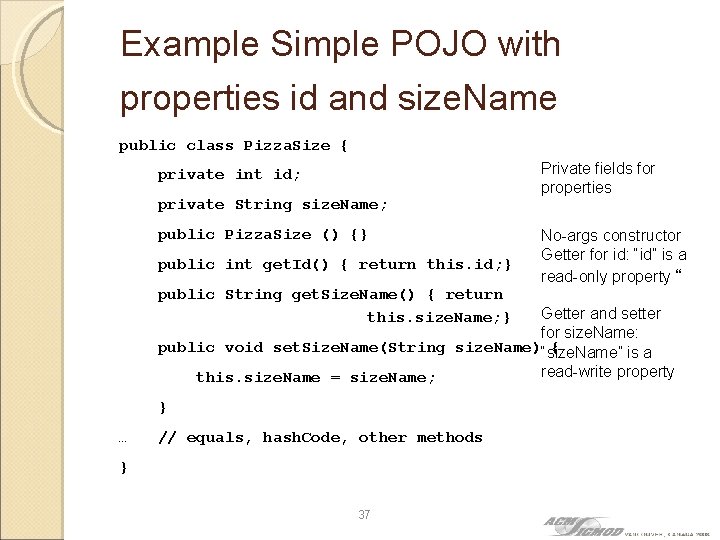
Example Simple POJO with properties id and size. Name public class Pizza. Size { private int id; private String size. Name; public Pizza. Size () {} public int get. Id() { return this. id; } public String get. Size. Name() { return this. size. Name; } Private fields for properties No-args constructor Getter for id: “id” is a read-only property “ Getter and setter for size. Name: public void set. Size. Name(String size. Name)“size. Name” { is a read-write property this. size. Name = size. Name; } … // equals, hash. Code, other methods } 37
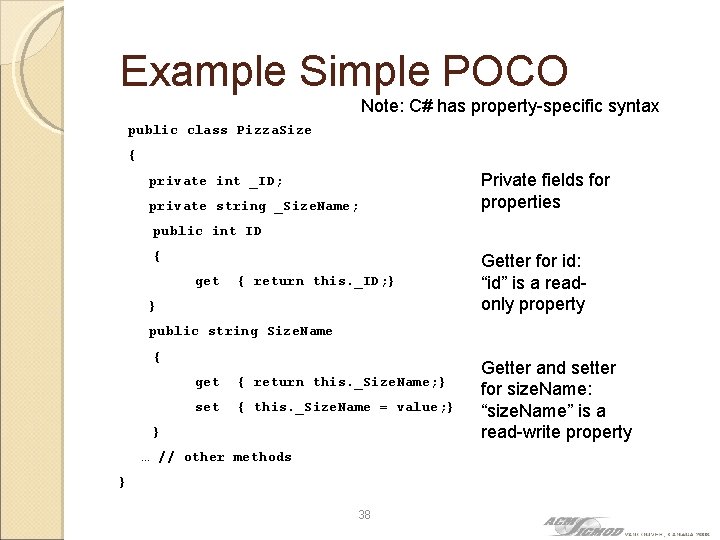
Example Simple POCO Note: C# has property-specific syntax public class Pizza. Size { private int _ID; private string _Size. Name; Private fields for properties public int ID { get { return this. _ID; } } Getter for id: “id” is a readonly property public string Size. Name { get { return this. _Size. Name; } set { this. _Size. Name = value; } } … // other methods } 38 Getter and setter for size. Name: “size. Name” is a read-write property
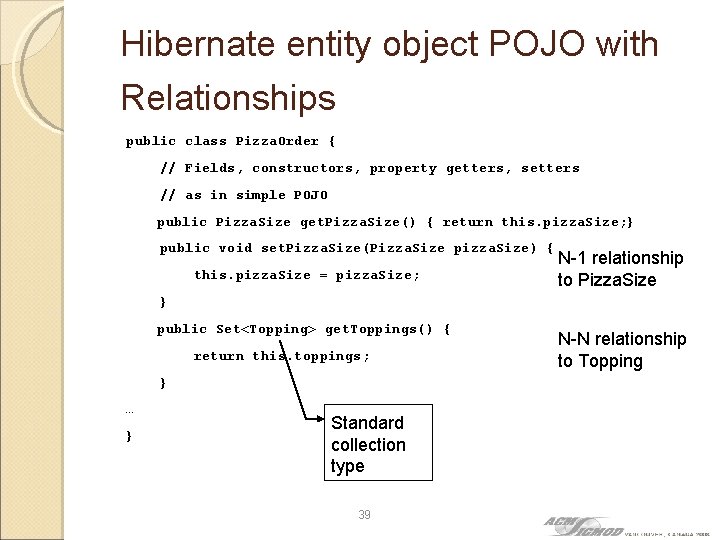
Hibernate entity object POJO with Relationships public class Pizza. Order { // Fields, constructors, property getters, setters // as in simple POJO public Pizza. Size get. Pizza. Size() { return this. pizza. Size; } public void set. Pizza. Size(Pizza. Size pizza. Size) { this. pizza. Size = pizza. Size; N-1 relationship to Pizza. Size } public Set<Topping> get. Toppings() { return this. toppings; } … } Standard collection type 39 N-N relationship to Topping
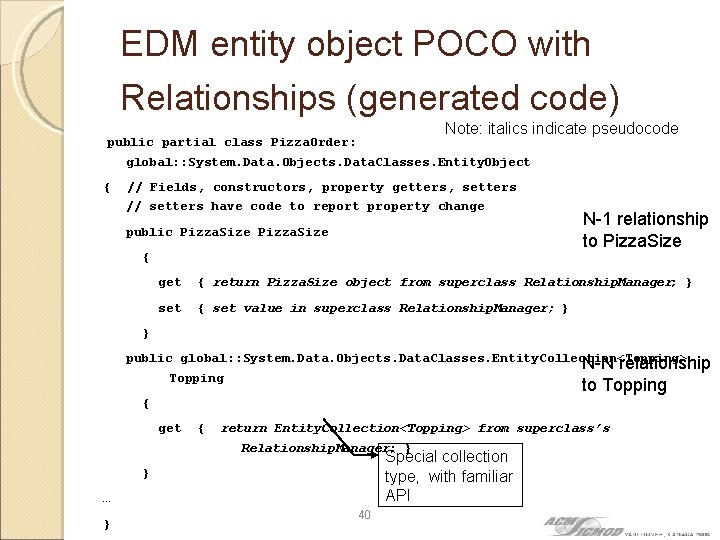
EDM entity object POCO with Relationships (generated code) Note: italics indicate pseudocode public partial class Pizza. Order: global: : System. Data. Objects. Data. Classes. Entity. Object { // Fields, constructors, property getters, setters // setters have code to report property change public Pizza. Size { N-1 relationship to Pizza. Size get { return Pizza. Size object from superclass Relationship. Manager; } set { set value in superclass Relationship. Manager; } } public global: : System. Data. Objects. Data. Classes. Entity. Collection<Topping> N-N relationship Topping to Topping { get { return Entity. Collection<Topping> from superclass’s Relationship. Manager; } Special collection type, with familiar API } … } 40
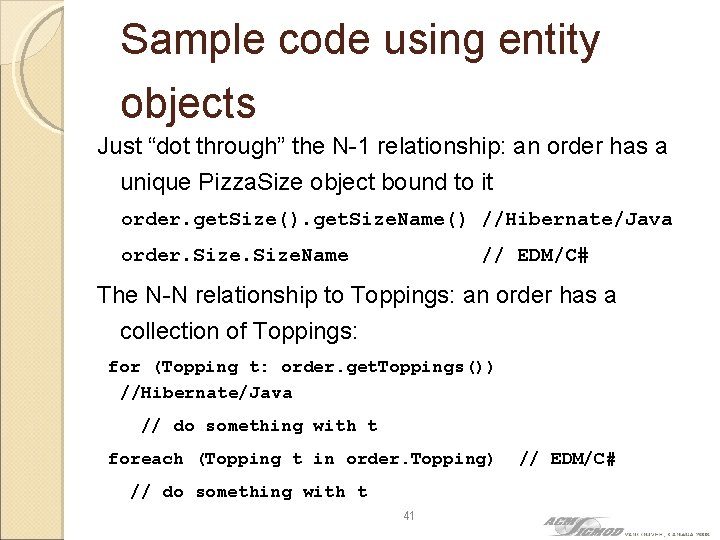
Sample code using entity objects Just “dot through” the N-1 relationship: an order has a unique Pizza. Size object bound to it order. get. Size(). get. Size. Name() //Hibernate/Java order. Size. Name // EDM/C# The N-N relationship to Toppings: an order has a collection of Toppings: for (Topping t: order. get. Toppings()) //Hibernate/Java // do something with t foreach (Topping t in order. Topping) // do something with t 41 // EDM/C#
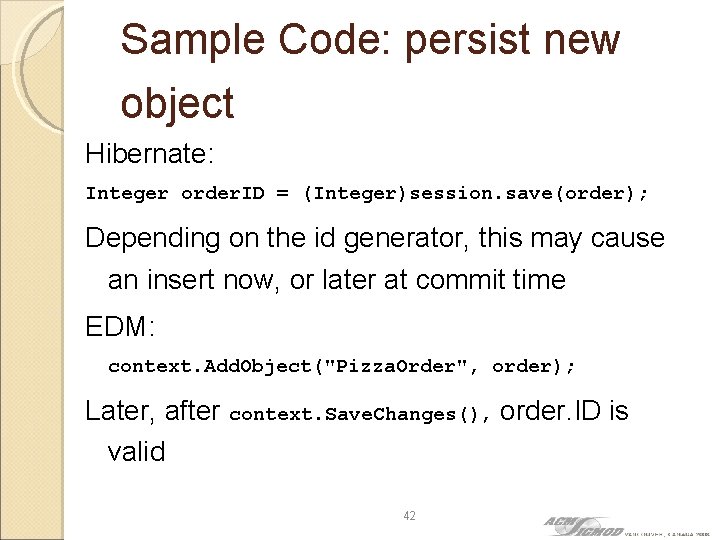
Sample Code: persist new object Hibernate: Integer order. ID = (Integer)session. save(order); Depending on the id generator, this may cause an insert now, or later at commit time EDM: context. Add. Object("Pizza. Order", order); Later, after context. Save. Changes(), order. ID is valid 42
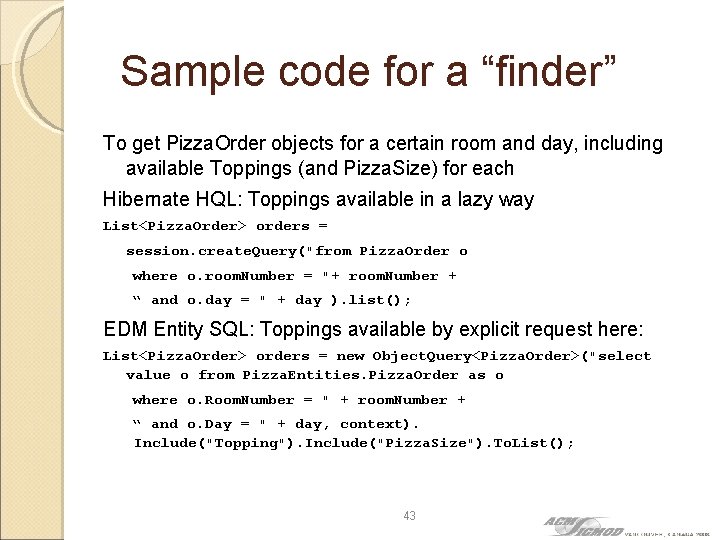
Sample code for a “finder” To get Pizza. Order objects for a certain room and day, including available Toppings (and Pizza. Size) for each Hibernate HQL: Toppings available in a lazy way List<Pizza. Order> orders = session. create. Query("from Pizza. Order o where o. room. Number = "+ room. Number + “ and o. day = " + day ). list(); EDM Entity SQL: Toppings available by explicit request here: List<Pizza. Order> orders = new Object. Query<Pizza. Order>("select value o from Pizza. Entities. Pizza. Order as o where o. Room. Number = " + room. Number + “ and o. Day = " + day, context). Include("Topping"). Include("Pizza. Size"). To. List(); 43
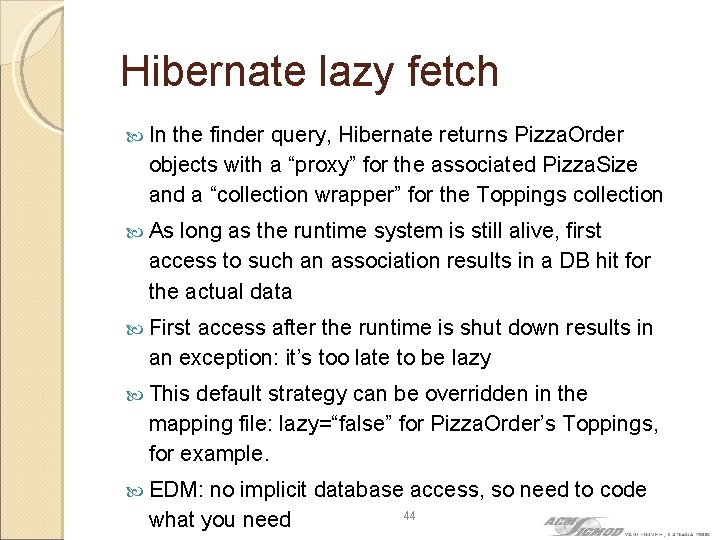
Hibernate lazy fetch In the finder query, Hibernate returns Pizza. Order objects with a “proxy” for the associated Pizza. Size and a “collection wrapper” for the Toppings collection As long as the runtime system is still alive, first access to such an association results in a DB hit for the actual data First access after the runtime is shut down results in an exception: it’s too late to be lazy This default strategy can be overridden in the mapping file: lazy=“false” for Pizza. Order’s Toppings, for example. EDM: no implicit database access, so need to code 44 what you need
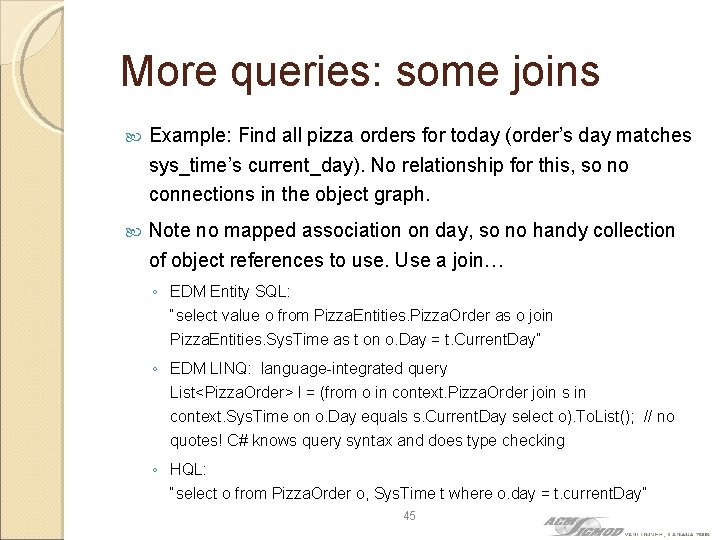
More queries: some joins Example: Find all pizza orders for today (order’s day matches sys_time’s current_day). No relationship for this, so no connections in the object graph. Note no mapped association on day, so no handy collection of object references to use. Use a join… ◦ EDM Entity SQL: “select value o from Pizza. Entities. Pizza. Order as o join Pizza. Entities. Sys. Time as t on o. Day = t. Current. Day” ◦ EDM LINQ: language-integrated query List<Pizza. Order> l = (from o in context. Pizza. Order join s in context. Sys. Time on o. Day equals s. Current. Day select o). To. List(); // no quotes! C# knows query syntax and does type checking ◦ HQL: “select o from Pizza. Order o, Sys. Time t where o. day = t. current. Day” 45
More query features Group by, having, order by Parameterized Pairs of objects returned, etc. Scalars Build queries and aggregates up queries using methods Hibernate: stored direct SQL queries procedures Control of fetch strategies 46
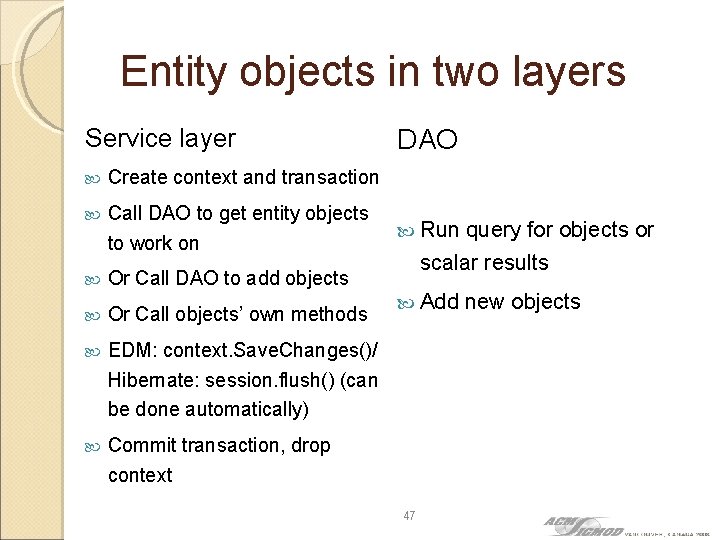
Entity objects in two layers Service layer Create context and transaction Call DAO to get entity objects to work on Or Call DAO to add objects Or Call objects’ own methods EDM: context. Save. Changes()/ Hibernate: session. flush() (can be done automatically) Commit transaction, drop context DAO Run query for objects or scalar results Add 47 new objects
Entity Objects can do more So far, entity objects carry data to/from database i. e, represent persistent data But objects should have related behavior too No problem: add methods to entity classes Suppose app needs to compute optimal ordering of toppings for building pizza List<Topping> This x. get. Toppings. In. Build. Order() should be method of Pizza. Order, an 48
Adding business methods to the entity classes Hibernate: relatively simple entity classes, can expand as needed EDM: generated code for entity classes: how can we add to it? Partial classes of C# come to the rescue: ◦ Generated code for Pizza. Order provides data methods in one partial class for Pizza. Order ◦ We code business methods in another partial class for Pizza. Order, in another source file. ◦ Compiler puts them together 49
“Rich” Domain model Domain classes (entities) manage their persistent data, and “rich” ones also provide app-related actions on their data Idea of DDD, domain-driven design (Fowler[13], Evans[14], 2004) Service layer coordinates actions between entities as needed for transactional actions Service layer should be thin, delimiting transactions and calling on domain classes for most of the work, Data-only entities dubbed “anemic domain model” 50
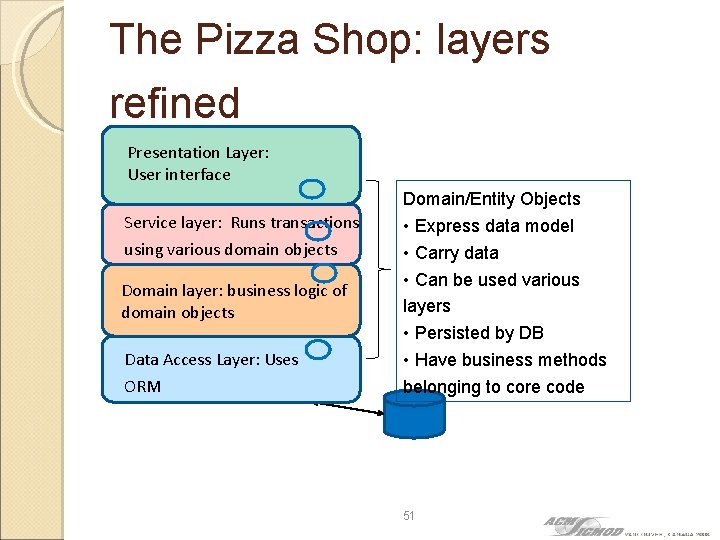
The Pizza Shop: layers refined Presentation Layer: User interface Service layer: Runs transactions using various domain objects Domain layer: business logic of domain objects Data Access Layer: Uses ORM Domain/Entity Objects • Express data model • Carry data • Can be used various layers • Persisted by DB • Have business methods belonging to core code 51
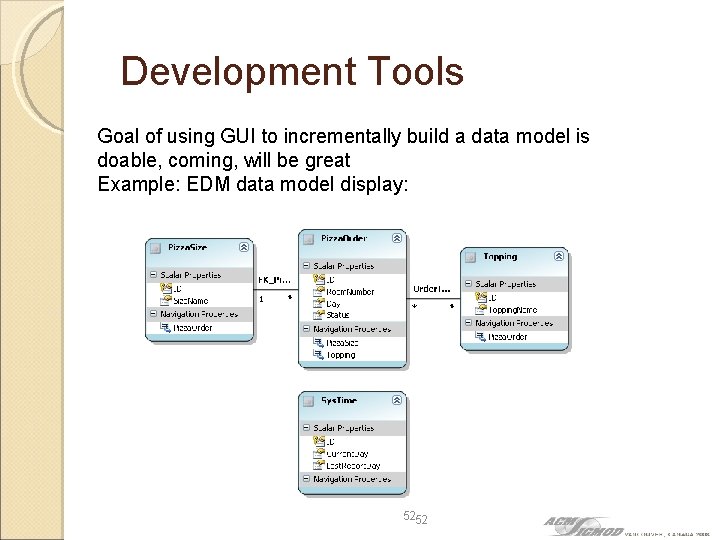
Development Tools Goal of using GUI to incrementally build a data model is doable, coming, will be great Example: EDM data model display: 5252
Development Tools The EM tools ◦ Can turn the entity model into program classes ◦ Can turn the entity model into database schema ◦ Or turn database schema into an entity model ◦ Or turn a set of classes into an entity model Pizza Shop is simple enough to be specified by database schema + one execution of tool For complex systems, you need to work with the XML mapping files to get the full use of these systems today. (JPA uses source annotations instead of XML mapping files) Luckily, only elementary XML is needed, let’s look at some files… 53
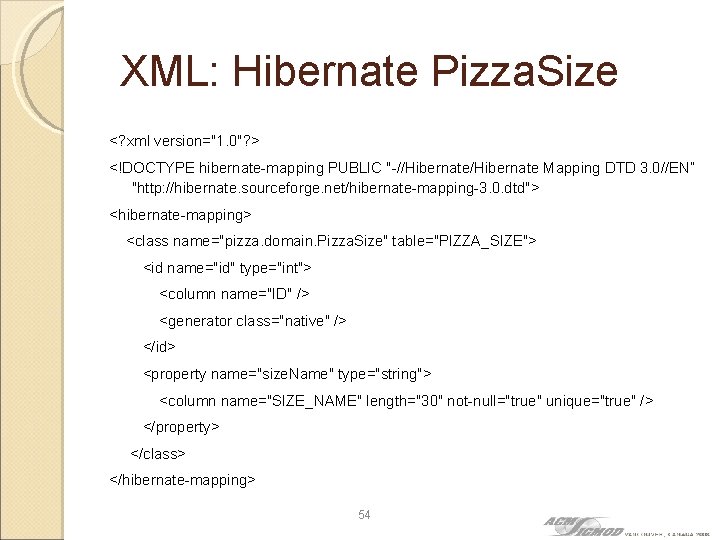
XML: Hibernate Pizza. Size <? xml version="1. 0"? > <!DOCTYPE hibernate-mapping PUBLIC "-//Hibernate Mapping DTD 3. 0//EN” "http: //hibernate. sourceforge. net/hibernate-mapping-3. 0. dtd"> <hibernate-mapping> <class name="pizza. domain. Pizza. Size" table="PIZZA_SIZE"> <id name="id" type="int"> <column name="ID" /> <generator class="native" /> </id> <property name="size. Name" type="string"> <column name="SIZE_NAME" length="30" not-null="true" unique="true" /> </property> </class> </hibernate-mapping> 54
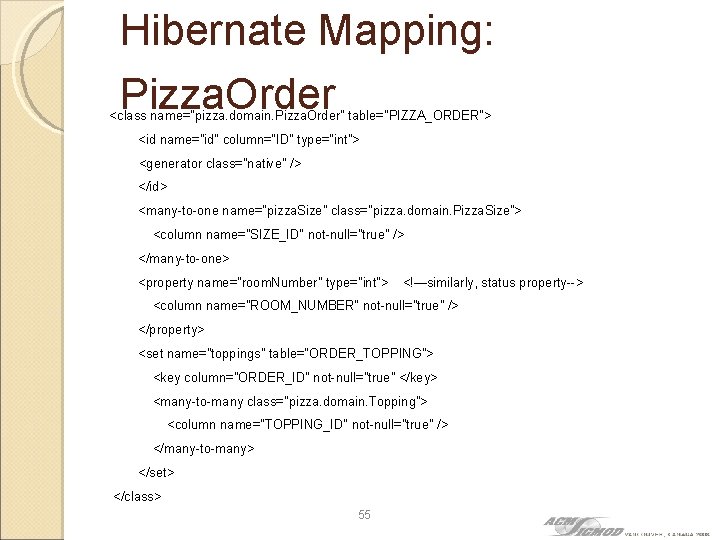
Hibernate Mapping: Pizza. Order <class name="pizza. domain. Pizza. Order" table="PIZZA_ORDER"> <id name="id" column=“ID” type="int"> <generator class="native" /> </id> <many-to-one name="pizza. Size" class="pizza. domain. Pizza. Size"> <column name="SIZE_ID" not-null="true" /> </many-to-one> <property name="room. Number" type="int"> <!—similarly, status property--> <column name="ROOM_NUMBER" not-null="true" /> </property> <set name="toppings" table="ORDER_TOPPING"> <key column="ORDER_ID" not-null="true" </key> <many-to-many class="pizza. domain. Topping"> <column name="TOPPING_ID" not-null="true" /> </many-to-many> </set> </class> 55
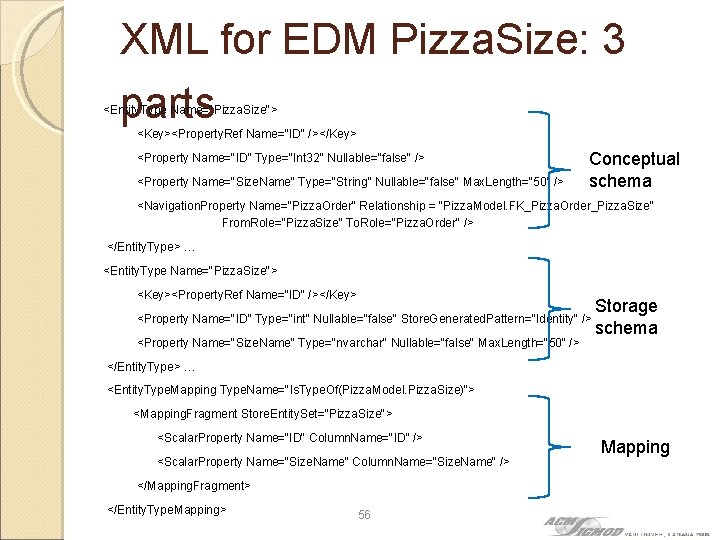
XML for EDM Pizza. Size: 3 parts <Entity. Type Name="Pizza. Size"> <Key><Property. Ref Name="ID" /></Key> <Property Name="ID" Type="Int 32" Nullable="false" /> <Property Name="Size. Name" Type="String" Nullable="false" Max. Length="50" /> Conceptual schema <Navigation. Property Name="Pizza. Order“ Relationship = "Pizza. Model. FK_Pizza. Order_Pizza. Size" From. Role="Pizza. Size" To. Role="Pizza. Order" /> </Entity. Type> … <Entity. Type Name="Pizza. Size"> <Key><Property. Ref Name="ID" /></Key> <Property Name="ID" Type="int" Nullable="false" Store. Generated. Pattern="Identity" /> <Property Name="Size. Name" Type="nvarchar" Nullable="false" Max. Length="50" /> Storage schema </Entity. Type> … <Entity. Type. Mapping Type. Name="Is. Type. Of(Pizza. Model. Pizza. Size)"> <Mapping. Fragment Store. Entity. Set="Pizza. Size"> <Scalar. Property Name="ID" Column. Name="ID" /> <Scalar. Property Name="Size. Name" Column. Name="Size. Name" /> </Mapping. Fragment> </Entity. Type. Mapping> 56 Mapping
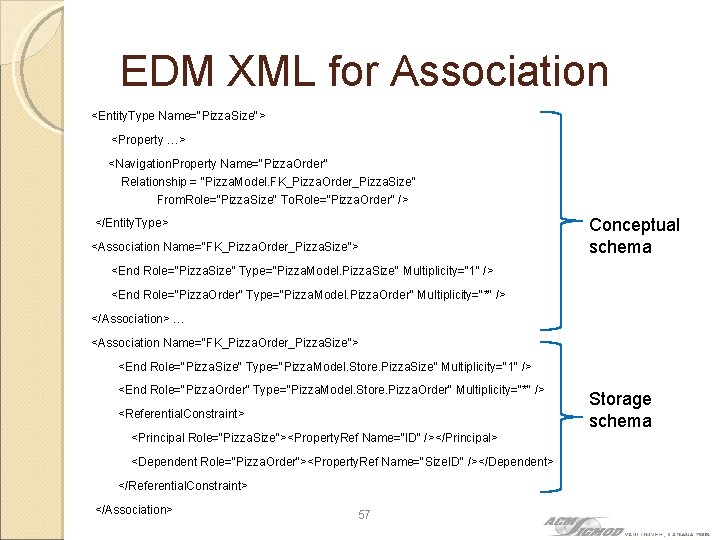
EDM XML for Association <Entity. Type Name="Pizza. Size"> <Property …> <Navigation. Property Name="Pizza. Order“ Relationship = "Pizza. Model. FK_Pizza. Order_Pizza. Size" From. Role="Pizza. Size" To. Role="Pizza. Order" /> </Entity. Type> <Association Name="FK_Pizza. Order_Pizza. Size"> Conceptual schema <End Role="Pizza. Size" Type="Pizza. Model. Pizza. Size" Multiplicity="1" /> <End Role="Pizza. Order" Type="Pizza. Model. Pizza. Order" Multiplicity="*" /> </Association> … <Association Name="FK_Pizza. Order_Pizza. Size"> <End Role="Pizza. Size" Type="Pizza. Model. Store. Pizza. Size" Multiplicity="1" /> <End Role="Pizza. Order" Type="Pizza. Model. Store. Pizza. Order" Multiplicity="*" /> <Referential. Constraint> <Principal Role="Pizza. Size"><Property. Ref Name="ID" /></Principal> <Dependent Role="Pizza. Order“><Property. Ref Name="Size. ID" /></Dependent> </Referential. Constraint> </Association> 57 Storage schema
The Entity Context Hibernate Session, EDM Object. Context, seen as “session” and “context” variables in previous code. Belongs to one thread as its object cache, usually for one transaction lifetime, one request-response cycle. Usually defers updates to the database to end of transaction Ensures only one entity object for each id As a cache, avoids rereads of database, preventing some repeated-read anomalies if running at lower isolation level. Caching: the database itself has the definitive cache, global to all apps using it… 58
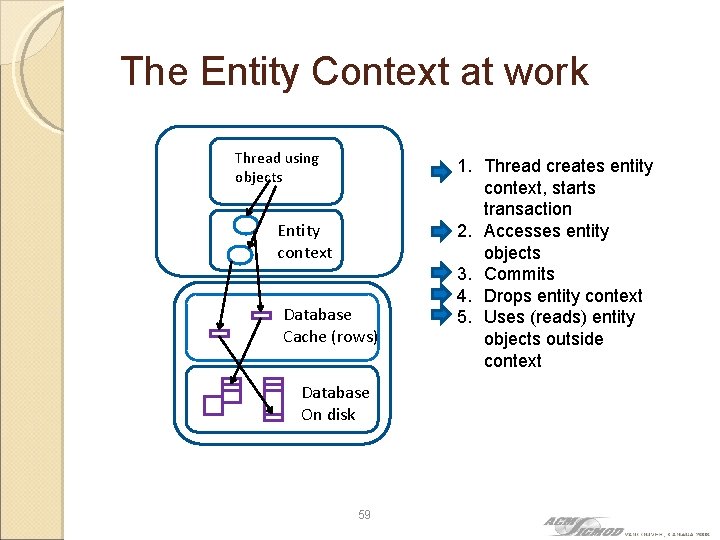
The Entity Context at work Thread using objects Entity context Database Cache (rows) Database On disk 59 1. Thread creates entity context, starts transaction 2. Accesses entity objects 3. Commits 4. Drops entity context 5. Uses (reads) entity objects outside context
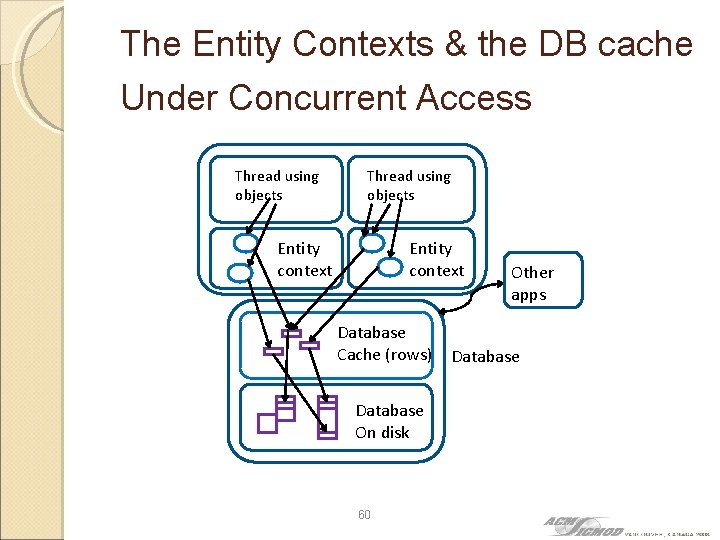
The Entity Contexts & the DB cache Under Concurrent Access Thread using objects Entity context Database Cache (rows) Database On disk 60 Other apps Database
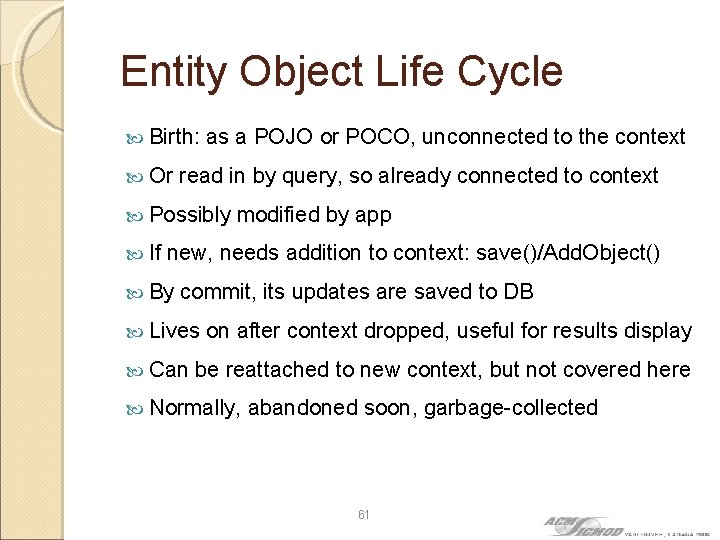
Entity Object Life Cycle Birth: Or as a POJO or POCO, unconnected to the context read in by query, so already connected to context Possibly If modified by app new, needs addition to context: save()/Add. Object() By commit, its updates are saved to DB Lives Can on after context dropped, useful for results display be reattached to new context, but not covered here Normally, abandoned soon, garbage-collected 61
Queries and the object cache When a query delivers entity objects, the id’s may already be in the cache Need to avoid duplicates, preserve app’s changes Hibernate flushes changes to DB before query by default EDM, by default, preserves the older object of a certain id, avoiding DB writes at this point 62
Transactions Hibernate and EDM are designed for transactional apps Both support transactions involving single or multiple DBs/resource managers, via JTA or DTC for distributed case (JTA=Java Transaction API, DTC= Microsoft’s Distributed Transaction Coordinator) Both support both explicit transactions and containermanaged transactions We’re considering simple case of single DB, explicit transactions Still have choice in isolation level, mainly: ◦ Read-committed (RC) ◦ Read-committed with ORM-coordinated versioning 63
Transactions RC, SR have usual meaning, handled in DB Also Snapshot Isolation for some DBs Pizza RC project uses SR, but easy to change often not enough, but RC + versioning is attractive Versioning by ORM provides “optimistic CC”: ◦ Context remembers original object state, or row version if supported by DB ◦ For changed objects, compares saved vs. current DB state at commit-time, throws an exception if changed ◦ Avoids lost updates otherwise possible with RC ◦ Refresh action available to help with retries 64
Conversations So far, each request has had one transaction, good enough for Pizza Shop Some actions perceived as a unit to the user are made up of several requests Example: Read a current bid amount, let user decide on new bid, then make the new bid Two DB transactions here, since no DB transaction should span the think time The two transactions are related: a “conversation” or “session” or “business transaction” with one user 65
Conversations Example Conversation: Look at bid, think, update bid Someone else can slip in a bid update between my look and update One solution: make my bid update contingent on the bid amount still being what I saw before, abort second transaction if not This is versioning again, now used across multiple system transactions in the same context 66
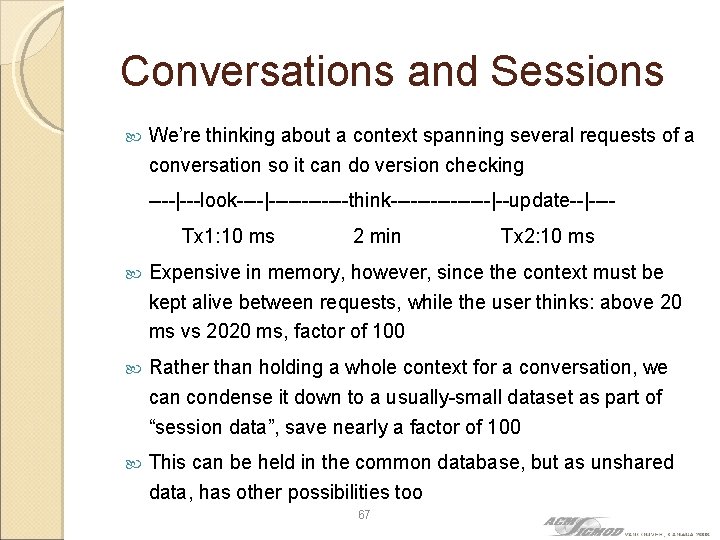
Conversations and Sessions We’re thinking about a context spanning several requests of a conversation so it can do version checking ----|---look----|------think--------|--update--|---Tx 1: 10 ms 2 min Tx 2: 10 ms Expensive in memory, however, since the context must be kept alive between requests, while the user thinks: above 20 ms vs 2020 ms, factor of 100 Rather than holding a whole context for a conversation, we can condense it down to a usually-small dataset as part of “session data”, save nearly a factor of 100 This can be held in the common database, but as unshared data, has other possibilities too 67
Performance & Scalability: Assumptions One database server with plenty of memory Warm One data is in DB server’s cache or multiple application servers No shared mutable data on app servers All shared mutable data is in the database DB server’s cache data is fast to access over a local network Standard use of pooled DB connections to avoid connection-setup delays 68
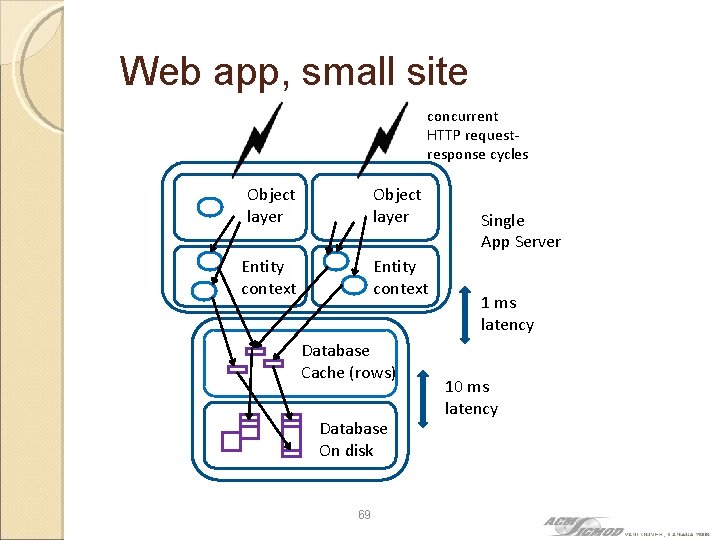
Web app, small site concurrent HTTP requestresponse cycles Object layer Entity context Database Cache (rows) Database On disk 69 Single App Server 1 ms latency 10 ms latency
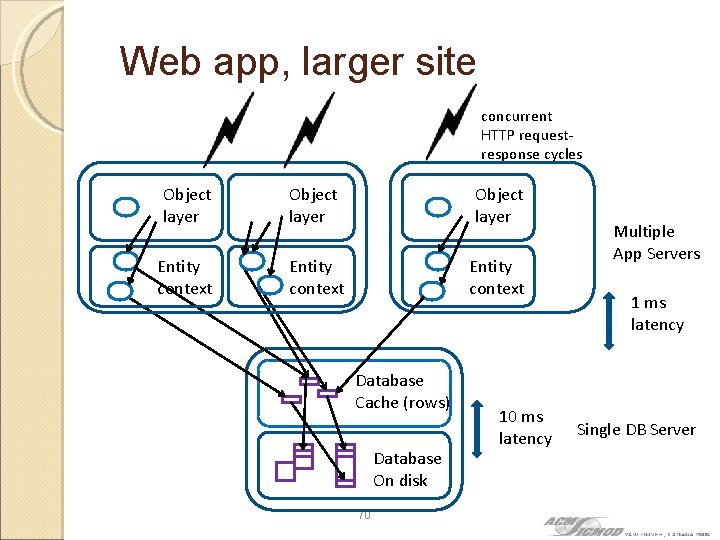
Web app, larger site concurrent HTTP requestresponse cycles Object layer Entity context Database Cache (rows) Database On disk 70 10 ms latency Multiple App Servers 1 ms latency Single DB Server
Second-level caching If this simple design is maxing out, say with 1000 s of Tx/sec ◦ And is not sharing DB with other apps ◦ And specifically is overwhelming the DB Can try second-level caching to offload the DB Example: JBoss Cache, a transactional replicated distributed cache i. e, can handle case of multiple app servers Involves more configuration, tuning, not easy Hopefully point plenty of money for consultants at this 71
Summary Relational technology continues to prove its worth, and ORM is using it in full Only one deficiency of SQL 92 uncovered: standard way to generate new unique id The object-relational impedance mismatch has been largely overcome No textbooks yet: please fix! 72
![Bibliography In proceedings (subset): [1] Adya, Atul, Blakely, Jose, Melnik, Sergey, Meralidhar, S. ,](http://slidetodoc.com/presentation_image_h/26b35ca8c869dca72a3097b504642c41/image-73.jpg "Bibliography In proceedings (subset): [1] Adya, Atul, Blakely, Jose, Melnik, Sergey, Meralidhar, S. ,")
Bibliography In proceedings (subset): [1] Adya, Atul, Blakely, Jose, Melnik, Sergey, Meralidhar, S. , and the ADO. NET Team, 2007, Anatomy of the ADO. NET Entity Framework, In Proceedings of SIGMOD 2007, ACM Press, New York, NY. [3] Bauer, Christian, King, Gavin 2006 Java Persistence with Hibernate, Manning [5] Bernstein, Phil, Melnik, Sergey. 2007 Model Management 2. 0—Manipulating Richer Mappings. In Proceedings of SIGMOD 2007, ACM Press, New York, NY, 1 -12. [7] Hibernate, http: //www. hibernate. org [10] MSDN Library, 2006 The ADO. NET Entity Framework Overview, http: //msdn 2. microsoft. com/en-us/library/aa 697427(VS. 80). aspx Added: [13] Fowler, Martin 2003 Patterns of Enterprise Application Architecture, Addison -Wesley 73
- Slides: 73