
ObjectRelational DBMS Dr Awad Khalil Computer Science Department
Object-Relational DBMS Dr. Awad Khalil Computer Science Department AUC Object-Relational DBMS, by Dr. Khalil 1
Content / / / How the relational model has been extended to support advanced database applications The object-oriented features proposed in the next SQL standard, SQL 3, including: u Row types u User-defined types and user-defined routines u Polymorphism u Inheritance u Reference types and object identity u Collection types (ARRAYs, SETs, LISTs, and MULTISETs) u Extensions to the SQL to make it computationally complete u Support for large objects: Binary Large Objects (BLOBs) u Recursion Extensions required to relational query processing and query optimization to support advanced queries Some object-oriented extensions to Oracle How OODBMSs and ORDBMSs compare in terms of data modeling, data access, and data sharing Object-Relational DBMS, by Dr. Khalil 2

Object-Relational Database Systems / / / / / Relational DBMSs are currently the dominant database technology with estimated sales of between US$30 billion and US$50 billion per year (US$100 billion with tools sales included), and growing at a rate of possibly 25% per year. The OODBMSs started in the engineering and design domains, and has also become the favored system for financial and telecommunications applications. Although the OODBMSs market is still small, the OODBMSs continues to find new application areas, such as the World Wide Web. An ORDBMS is a hybrid of the RDBMS and the OODBMS. The advanced database applications make extensive use of many object-oriented features such as a user-extensible type system, encapsulation, inheritance, polymorphism, dynamic binding of methods, complex objects including non-first normal form objects, and object identity. The most obvious way to implement an ORDBMS is to extend the RDBMS with these object-oriented types of features. There is no single extended relational model; rather, there a variety of these models. All the models share the same basic relational tables and query language, all incorporate some concept of ‘object’, and some have the ability to store methods (or procedures or triggers) as well as data in the database. Oracle, Informix, and IBM – have all extended their systems into ORDBMSs, although the functionality provided by each is slightly different. The standards activity in this area is based on extensions to the SQL standard. These DBMS, by Dr. extensions have become part of the. Object-Relational new SQL standard, commonly referred to as SQL 3. 3 Khalil
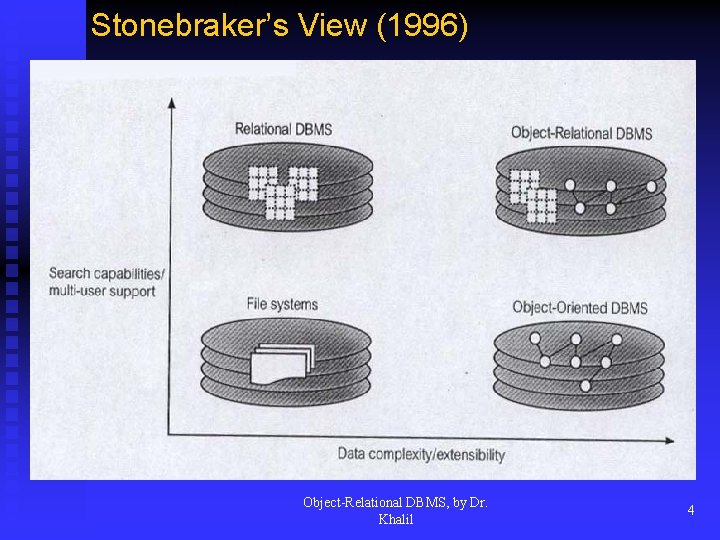
Stonebraker’s View (1996) Object-Relational DBMS, by Dr. Khalil 4
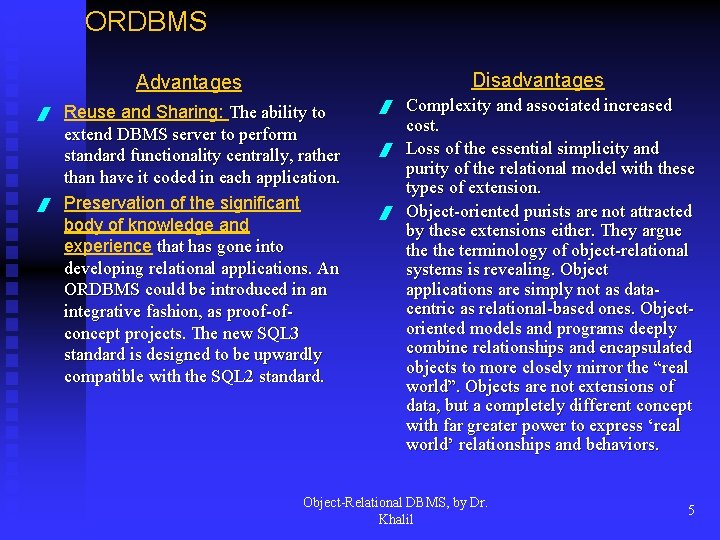
ORDBMS Disadvantages Advantages / / Reuse and Sharing: The ability to extend DBMS server to perform standard functionality centrally, rather than have it coded in each application. Preservation of the significant body of knowledge and experience that has gone into developing relational applications. An ORDBMS could be introduced in an integrative fashion, as proof-ofconcept projects. The new SQL 3 standard is designed to be upwardly compatible with the SQL 2 standard. / / / Complexity and associated increased cost. Loss of the essential simplicity and purity of the relational model with these types of extension. Object-oriented purists are not attracted by these extensions either. They argue the terminology of object-relational systems is revealing. Object applications are simply not as datacentric as relational-based ones. Objectoriented models and programs deeply combine relationships and encapsulated objects to more closely mirror the “real world”. Objects are not extensions of data, but a completely different concept with far greater power to express ‘real world’ relationships and behaviors. Object-Relational DBMS, by Dr. Khalil 5
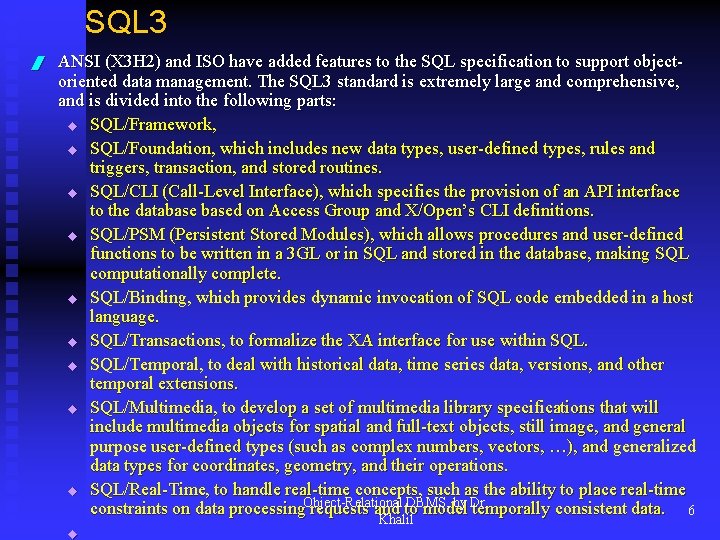
SQL 3 / ANSI (X 3 H 2) and ISO have added features to the SQL specification to support objectoriented data management. The SQL 3 standard is extremely large and comprehensive, and is divided into the following parts: u SQL/Framework, u SQL/Foundation, which includes new data types, user-defined types, rules and triggers, transaction, and stored routines. u SQL/CLI (Call-Level Interface), which specifies the provision of an API interface to the databased on Access Group and X/Open’s CLI definitions. u SQL/PSM (Persistent Stored Modules), which allows procedures and user-defined functions to be written in a 3 GL or in SQL and stored in the database, making SQL computationally complete. u SQL/Binding, which provides dynamic invocation of SQL code embedded in a host language. u SQL/Transactions, to formalize the XA interface for use within SQL. u SQL/Temporal, to deal with historical data, time series data, versions, and other temporal extensions. u SQL/Multimedia, to develop a set of multimedia library specifications that will include multimedia objects for spatial and full-text objects, still image, and general purpose user-defined types (such as complex numbers, vectors, …), and generalized data types for coordinates, geometry, and their operations. u SQL/Real-Time, to handle real-time concepts, such as the ability to place real-time DBMS, by Dr. constraints on data processing. Object-Relational requests and to model temporally consistent data. 6 Khalil u
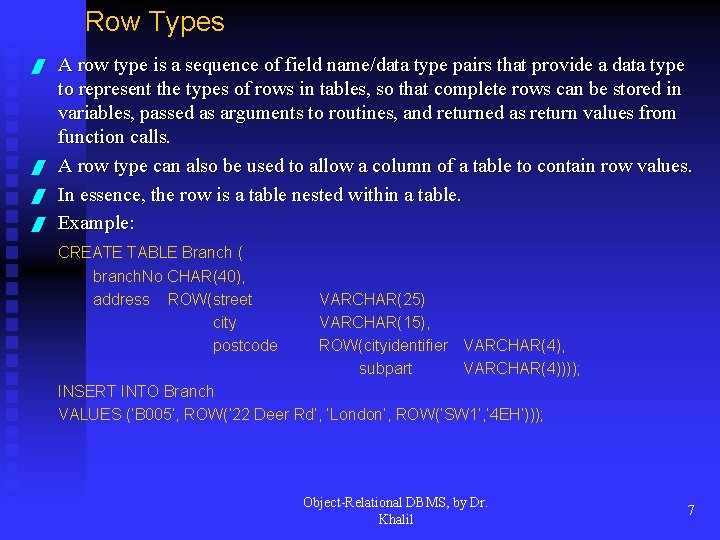
Row Types / / A row type is a sequence of field name/data type pairs that provide a data type to represent the types of rows in tables, so that complete rows can be stored in variables, passed as arguments to routines, and returned as return values from function calls. A row type can also be used to allow a column of a table to contain row values. In essence, the row is a table nested within a table. Example: CREATE TABLE Branch ( branch. No CHAR(40), address ROW(street city postcode VARCHAR(25) VARCHAR(15), ROW(cityidentifier VARCHAR(4), subpart VARCHAR(4)))); INSERT INTO Branch VALUES (‘B 005’, ROW(’ 22 Deer Rd’, ‘London’, ROW(‘SW 1’, ’ 4 EH’))); Object-Relational DBMS, by Dr. Khalil 7
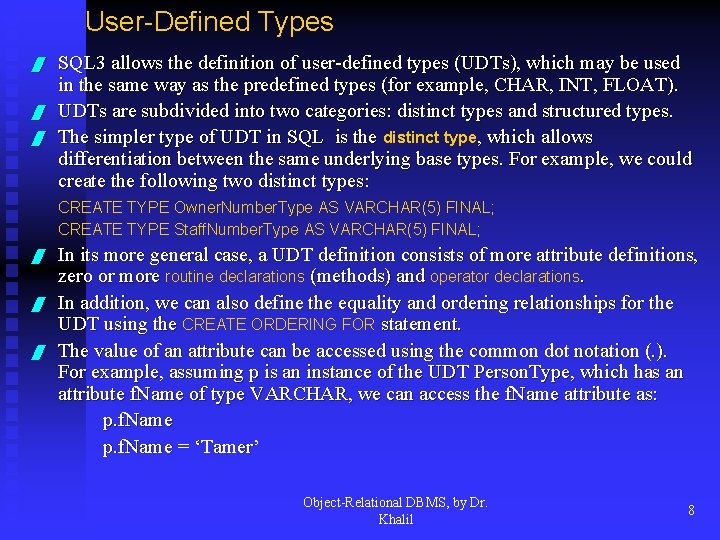
User-Defined Types / / / SQL 3 allows the definition of user-defined types (UDTs), which may be used in the same way as the predefined types (for example, CHAR, INT, FLOAT). UDTs are subdivided into two categories: distinct types and structured types. The simpler type of UDT in SQL is the distinct type, which allows differentiation between the same underlying base types. For example, we could create the following two distinct types: CREATE TYPE Owner. Number. Type AS VARCHAR(5) FINAL; CREATE TYPE Staff. Number. Type AS VARCHAR(5) FINAL; / / / In its more general case, a UDT definition consists of more attribute definitions, zero or more routine declarations (methods) and operator declarations. In addition, we can also define the equality and ordering relationships for the UDT using the CREATE ORDERING FOR statement. The value of an attribute can be accessed using the common dot notation (. ). For example, assuming p is an instance of the UDT Person. Type, which has an attribute f. Name of type VARCHAR, we can access the f. Name attribute as: p. f. Name = ‘Tamer’ Object-Relational DBMS, by Dr. Khalil 8
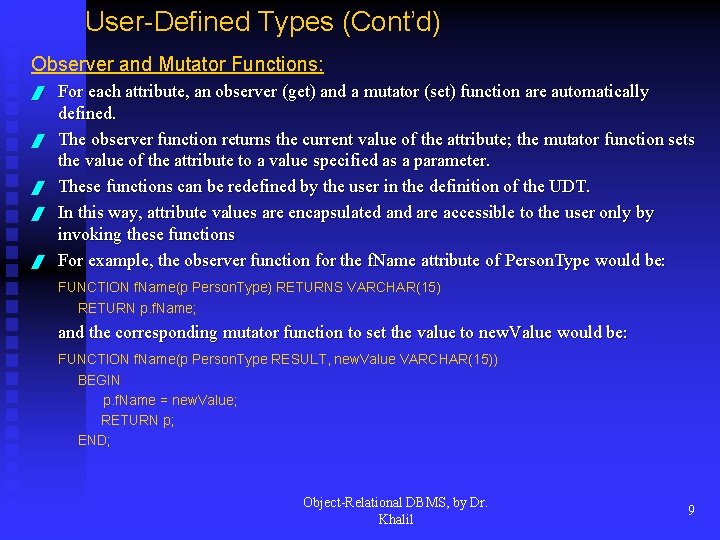
User-Defined Types (Cont’d) Observer and Mutator Functions: / / / For each attribute, an observer (get) and a mutator (set) function are automatically defined. The observer function returns the current value of the attribute; the mutator function sets the value of the attribute to a value specified as a parameter. These functions can be redefined by the user in the definition of the UDT. In this way, attribute values are encapsulated and are accessible to the user only by invoking these functions For example, the observer function for the f. Name attribute of Person. Type would be: FUNCTION f. Name(p Person. Type) RETURNS VARCHAR(15) RETURN p. f. Name; and the corresponding mutator function to set the value to new. Value would be: FUNCTION f. Name(p Person. Type RESULT, new. Value VARCHAR(15)) BEGIN p. f. Name = new. Value; RETURN p; END; Object-Relational DBMS, by Dr. Khalil 9
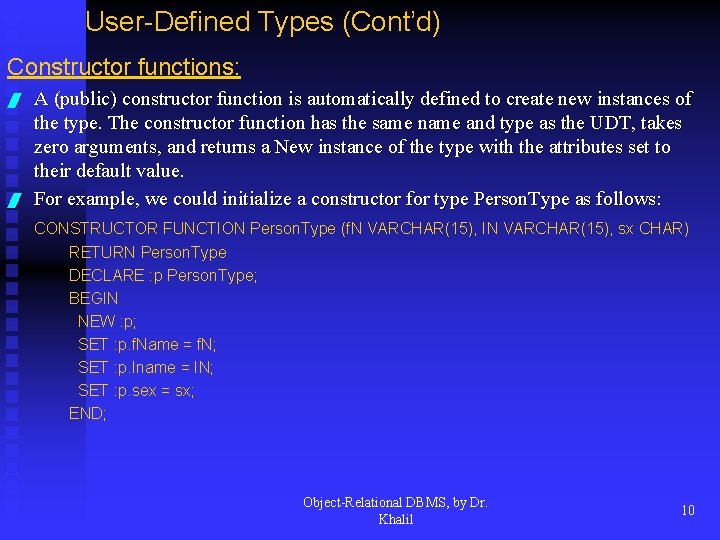
User-Defined Types (Cont’d) Constructor functions: / / A (public) constructor function is automatically defined to create new instances of the type. The constructor function has the same name and type as the UDT, takes zero arguments, and returns a New instance of the type with the attributes set to their default value. For example, we could initialize a constructor for type Person. Type as follows: CONSTRUCTOR FUNCTION Person. Type (f. N VARCHAR(15), IN VARCHAR(15), sx CHAR) RETURN Person. Type DECLARE : p Person. Type; BEGIN NEW : p; SET : p. f. Name = f. N; SET : p. Iname = IN; SET : p. sex = sx; END; Object-Relational DBMS, by Dr. Khalil 10
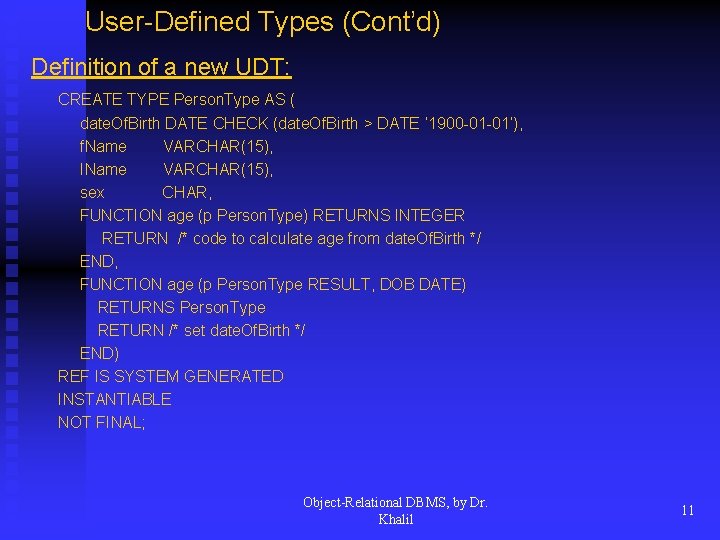
User-Defined Types (Cont’d) Definition of a new UDT: CREATE TYPE Person. Type AS ( date. Of. Birth DATE CHECK (date. Of. Birth > DATE ‘ 1900 -01 -01’), f. Name VARCHAR(15), IName VARCHAR(15), sex CHAR, FUNCTION age (p Person. Type) RETURNS INTEGER RETURN /* code to calculate age from date. Of. Birth */ END, FUNCTION age (p Person. Type RESULT, DOB DATE) RETURNS Person. Type RETURN /* set date. Of. Birth */ END) REF IS SYSTEM GENERATED INSTANTIABLE NOT FINAL; Object-Relational DBMS, by Dr. Khalil 11
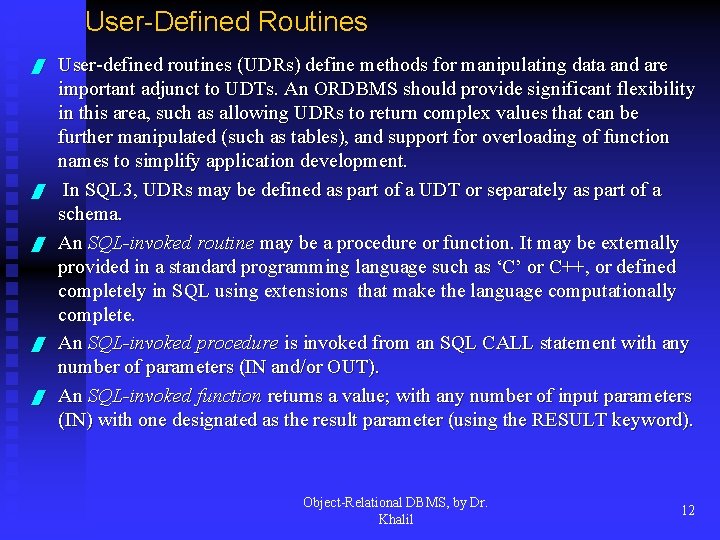
User-Defined Routines / / / User-defined routines (UDRs) define methods for manipulating data and are important adjunct to UDTs. An ORDBMS should provide significant flexibility in this area, such as allowing UDRs to return complex values that can be further manipulated (such as tables), and support for overloading of function names to simplify application development. In SQL 3, UDRs may be defined as part of a UDT or separately as part of a schema. An SQL-invoked routine may be a procedure or function. It may be externally provided in a standard programming language such as ‘C’ or C++, or defined completely in SQL using extensions that make the language computationally complete. An SQL-invoked procedure is invoked from an SQL CALL statement with any number of parameters (IN and/or OUT). An SQL-invoked function returns a value; with any number of input parameters (IN) with one designated as the result parameter (using the RESULT keyword). Object-Relational DBMS, by Dr. Khalil 12
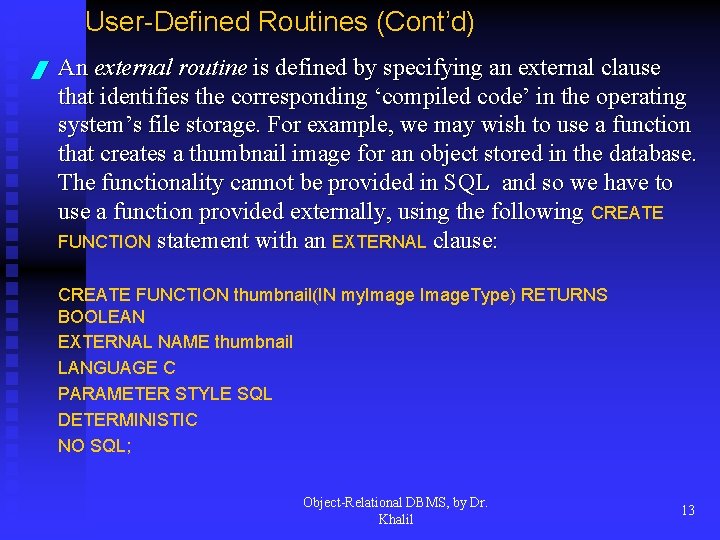
User-Defined Routines (Cont’d) / An external routine is defined by specifying an external clause that identifies the corresponding ‘compiled code’ in the operating system’s file storage. For example, we may wish to use a function that creates a thumbnail image for an object stored in the database. The functionality cannot be provided in SQL and so we have to use a function provided externally, using the following CREATE FUNCTION statement with an EXTERNAL clause: CREATE FUNCTION thumbnail(IN my. Image. Type) RETURNS BOOLEAN EXTERNAL NAME thumbnail LANGUAGE C PARAMETER STYLE SQL DETERMINISTIC NO SQL; Object-Relational DBMS, by Dr. Khalil 13
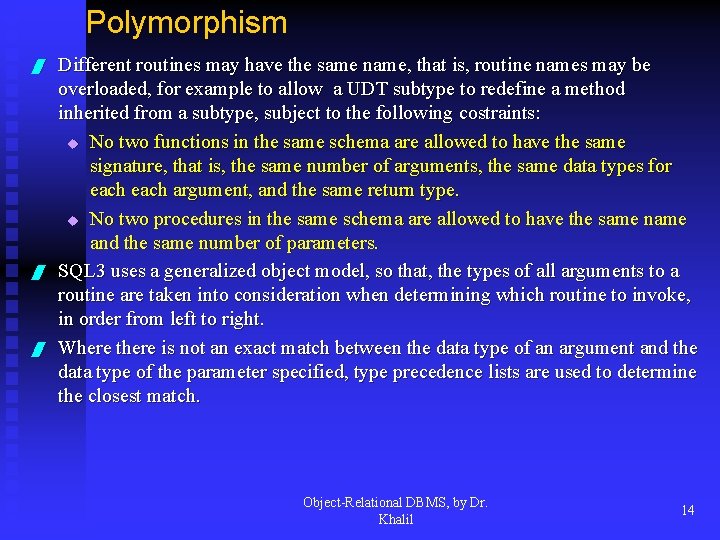
Polymorphism / / / Different routines may have the same name, that is, routine names may be overloaded, for example to allow a UDT subtype to redefine a method inherited from a subtype, subject to the following costraints: u No two functions in the same schema are allowed to have the same signature, that is, the same number of arguments, the same data types for each argument, and the same return type. u No two procedures in the same schema are allowed to have the same name and the same number of parameters. SQL 3 uses a generalized object model, so that, the types of all arguments to a routine are taken into consideration when determining which routine to invoke, in order from left to right. Where there is not an exact match between the data type of an argument and the data type of the parameter specified, type precedence lists are used to determine the closest match. Object-Relational DBMS, by Dr. Khalil 14

Reference Types and Object Identity / / / Object identity is that aspect of an object which never changes and that distinguishes the object from all other objects. Ideally, an object’s identity is independent of its name, structure, and location. The identity of an object persists even after the object has been deleted, so that it may never be confused with the identity of any other object. Other objects can use an object’s identity as a unique way of referencing it. In SQL 3, reference types can be used to define relationships between row types and uniquely identify a row within a table. A reference type value can be stored in one table and used as a direct reference to a specific row in some base table that has been defined to be of this type (similar to the notion of a pointer type in ‘C’ or C++). In this respect, a reference type provides a similar functionality as the object identifier (OID) of OODBMSs. Thus, references allow a row to be shared among multiple tables and enables users to replace complex join definitions in queries with much simpler path expressions. References also give the optimizer an alternative way to navigate data instead of using value-based join. REF IS SYSTEM GENERATED in a CREATE TYPE statement indicates that the actual values of the associated REF type are provided by the system. A base table can be created to be of some structured type. Other columns can be specified for the table but at least one column must be specified, namely a column of the associated REF type, using the clause REF IS <column. Name> SYSTEM GENERATED. This column is used to contain unique identifiers for the rows of the associated base table. The identifier for a given row is assigned when the row is inserted into the table and remains associated with that row until it is deleted. Object-Relational DBMS, by Dr. Khalil 15
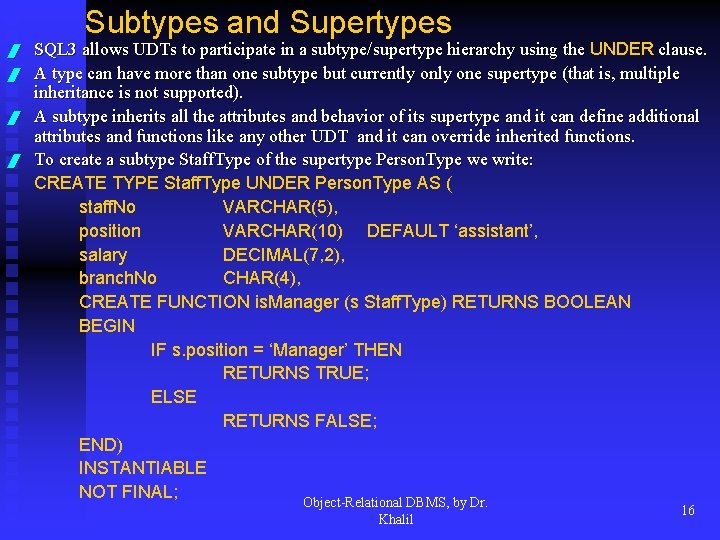
Subtypes and Supertypes / / SQL 3 allows UDTs to participate in a subtype/supertype hierarchy using the UNDER clause. A type can have more than one subtype but currently one supertype (that is, multiple inheritance is not supported). A subtype inherits all the attributes and behavior of its supertype and it can define additional attributes and functions like any other UDT and it can override inherited functions. To create a subtype Staff. Type of the supertype Person. Type we write: CREATE TYPE Staff. Type UNDER Person. Type AS ( staff. No VARCHAR(5), position VARCHAR(10) DEFAULT ‘assistant’, salary DECIMAL(7, 2), branch. No CHAR(4), CREATE FUNCTION is. Manager (s Staff. Type) RETURNS BOOLEAN BEGIN IF s. position = ‘Manager’ THEN RETURNS TRUE; ELSE RETURNS FALSE; END) INSTANTIABLE NOT FINAL; Object-Relational DBMS, by Dr. Khalil 16
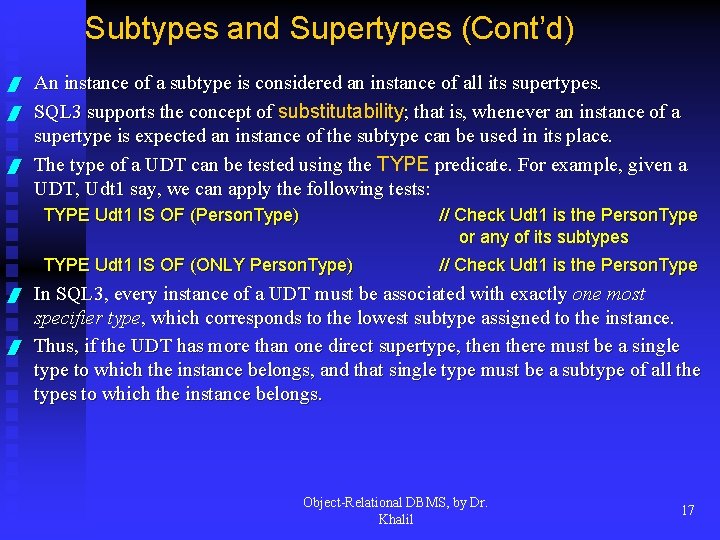
Subtypes and Supertypes (Cont’d) / / / An instance of a subtype is considered an instance of all its supertypes. SQL 3 supports the concept of substitutability; that is, whenever an instance of a supertype is expected an instance of the subtype can be used in its place. The type of a UDT can be tested using the TYPE predicate. For example, given a UDT, Udt 1 say, we can apply the following tests: TYPE Udt 1 IS OF (Person. Type) // Check Udt 1 is the Person. Type or any of its subtypes TYPE Udt 1 IS OF (ONLY Person. Type) // Check Udt 1 is the Person. Type In SQL 3, every instance of a UDT must be associated with exactly one most specifier type, which corresponds to the lowest subtype assigned to the instance. Thus, if the UDT has more than one direct supertype, then there must be a single type to which the instance belongs, and that single type must be a subtype of all the types to which the instance belongs. Object-Relational DBMS, by Dr. Khalil 17
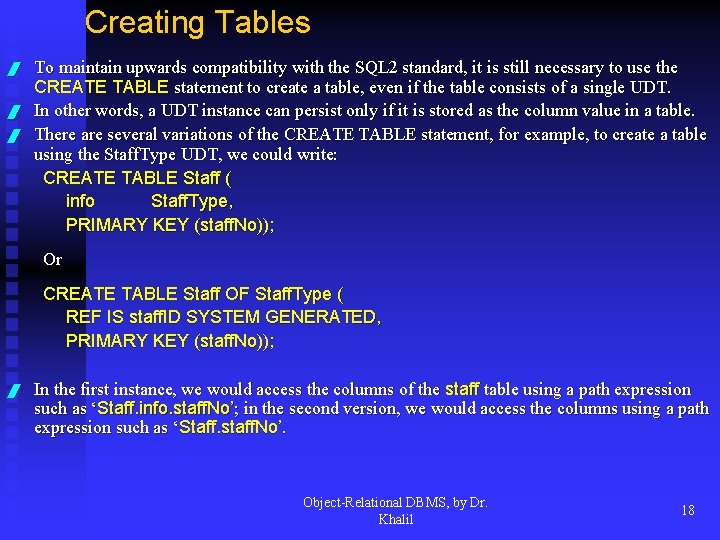
Creating Tables / / / To maintain upwards compatibility with the SQL 2 standard, it is still necessary to use the CREATE TABLE statement to create a table, even if the table consists of a single UDT. In other words, a UDT instance can persist only if it is stored as the column value in a table. There are several variations of the CREATE TABLE statement, for example, to create a table using the Staff. Type UDT, we could write: CREATE TABLE Staff ( info Staff. Type, PRIMARY KEY (staff. No)); Or CREATE TABLE Staff OF Staff. Type ( REF IS staff. ID SYSTEM GENERATED, PRIMARY KEY (staff. No)); / In the first instance, we would access the columns of the staff table using a path expression such as ‘Staff. info. staff. No’; in the second version, we would access the columns using a path expression such as ‘Staff. staff. No’. Object-Relational DBMS, by Dr. Khalil 18
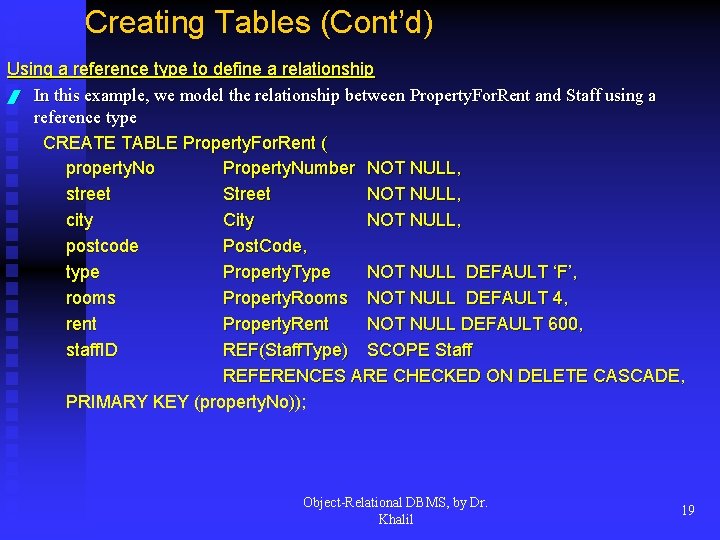
Creating Tables (Cont’d) Using a reference type to define a relationship / In this example, we model the relationship between Property. For. Rent and Staff using a reference type CREATE TABLE Property. For. Rent ( property. No Property. Number NOT NULL, street Street NOT NULL, city City NOT NULL, postcode Post. Code, type Property. Type NOT NULL DEFAULT ‘F’, rooms Property. Rooms NOT NULL DEFAULT 4, rent Property. Rent NOT NULL DEFAULT 600, staff. ID REF(Staff. Type) SCOPE Staff REFERENCES ARE CHECKED ON DELETE CASCADE, PRIMARY KEY (property. No)); Object-Relational DBMS, by Dr. Khalil 19
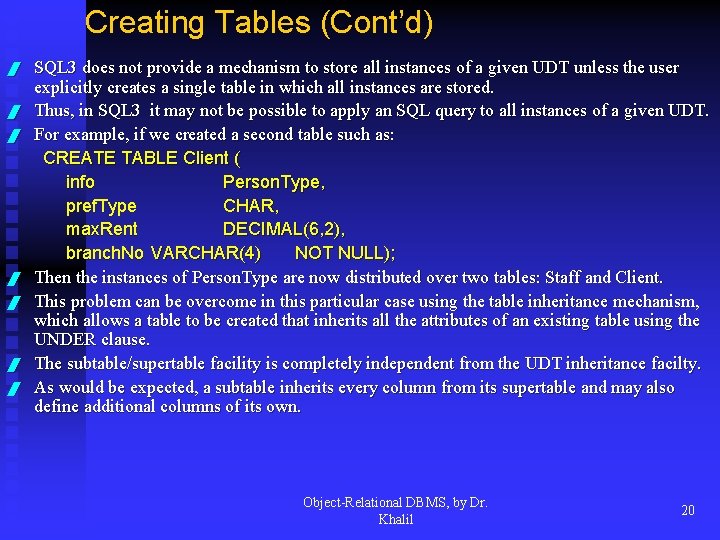
Creating Tables (Cont’d) / / / / SQL 3 does not provide a mechanism to store all instances of a given UDT unless the user explicitly creates a single table in which all instances are stored. Thus, in SQL 3 it may not be possible to apply an SQL query to all instances of a given UDT. For example, if we created a second table such as: CREATE TABLE Client ( info Person. Type, pref. Type CHAR, max. Rent DECIMAL(6, 2), branch. No VARCHAR(4) NOT NULL); Then the instances of Person. Type are now distributed over two tables: Staff and Client. This problem can be overcome in this particular case using the table inheritance mechanism, which allows a table to be created that inherits all the attributes of an existing table using the UNDER clause. The subtable/supertable facility is completely independent from the UDT inheritance facilty. As would be expected, a subtable inherits every column from its supertable and may also define additional columns of its own. Object-Relational DBMS, by Dr. Khalil 20
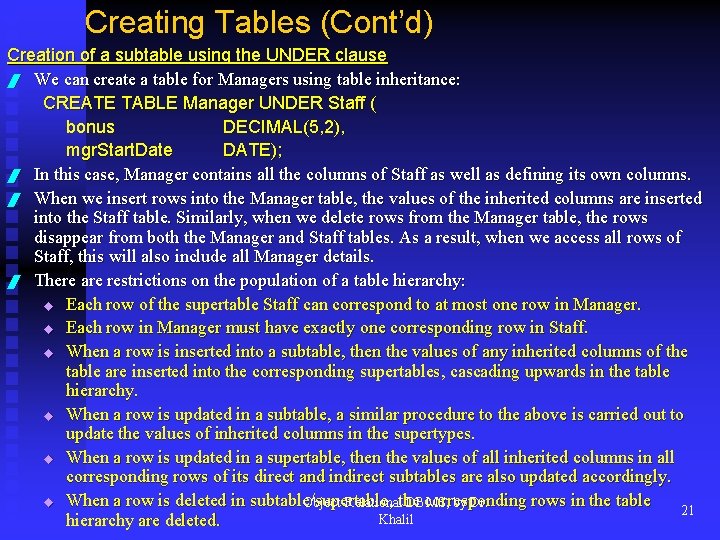
Creating Tables (Cont’d) Creation of a subtable using the UNDER clause / We can create a table for Managers using table inheritance: CREATE TABLE Manager UNDER Staff ( bonus DECIMAL(5, 2), mgr. Start. Date DATE); / In this case, Manager contains all the columns of Staff as well as defining its own columns. / When we insert rows into the Manager table, the values of the inherited columns are inserted into the Staff table. Similarly, when we delete rows from the Manager table, the rows disappear from both the Manager and Staff tables. As a result, when we access all rows of Staff, this will also include all Manager details. / There are restrictions on the population of a table hierarchy: u Each row of the supertable Staff can correspond to at most one row in Manager. u Each row in Manager must have exactly one corresponding row in Staff. u When a row is inserted into a subtable, then the values of any inherited columns of the table are inserted into the corresponding supertables, cascading upwards in the table hierarchy. u When a row is updated in a subtable, a similar procedure to the above is carried out to update the values of inherited columns in the supertypes. u When a row is updated in a supertable, then the values of all inherited columns in all corresponding rows of its direct and indirect subtables are also updated accordingly. u When a row is deleted in subtable/supertable , the corresponding rows in the table Object-Relational DBMS, by Dr. 21 Khalil hierarchy are deleted.
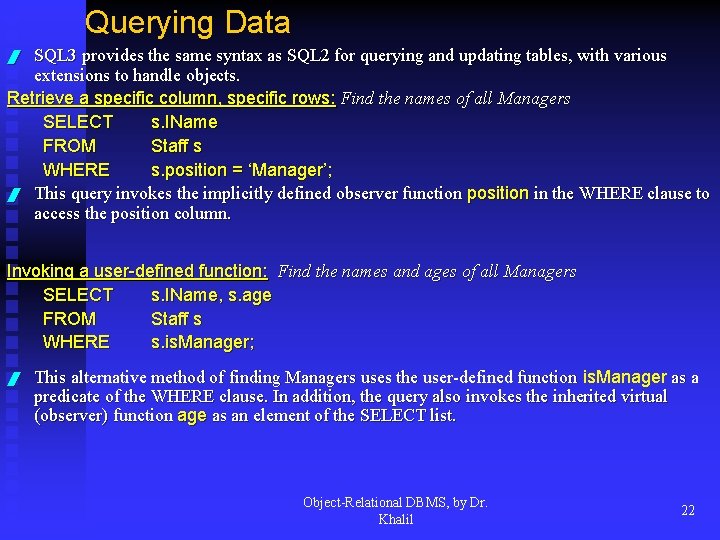
Querying Data SQL 3 provides the same syntax as SQL 2 for querying and updating tables, with various extensions to handle objects. Retrieve a specific column, specific rows: Find the names of all Managers SELECT s. IName FROM Staff s WHERE s. position = ‘Manager’; / This query invokes the implicitly defined observer function position in the WHERE clause to access the position column. / Invoking a user-defined function: Find the names and ages of all Managers SELECT s. IName, s. age FROM Staff s WHERE s. is. Manager; / This alternative method of finding Managers uses the user-defined function is. Manager as a predicate of the WHERE clause. In addition, the query also invokes the inherited virtual (observer) function age as an element of the SELECT list. Object-Relational DBMS, by Dr. Khalil 22
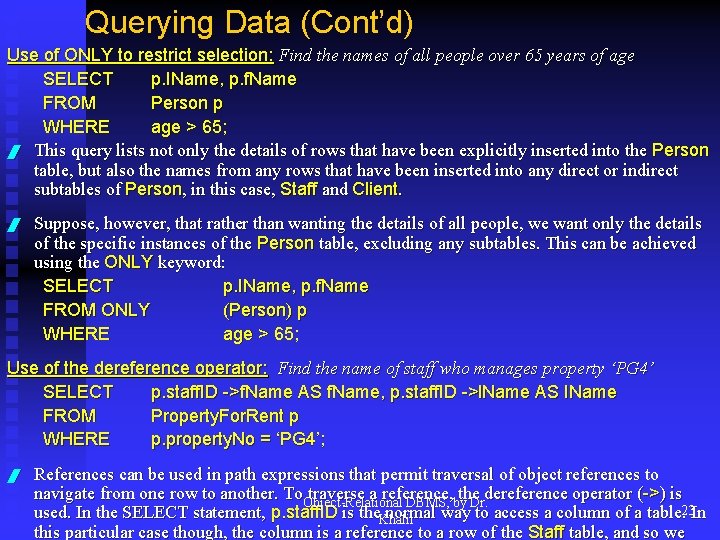
Querying Data (Cont’d) Use of ONLY to restrict selection: Find the names of all people over 65 years of age SELECT p. IName, p. f. Name FROM Person p WHERE age > 65; / This query lists not only the details of rows that have been explicitly inserted into the Person table, but also the names from any rows that have been inserted into any direct or indirect subtables of Person, in this case, Staff and Client. / Suppose, however, that rather than wanting the details of all people, we want only the details of the specific instances of the Person table, excluding any subtables. This can be achieved using the ONLY keyword: SELECT p. IName, p. f. Name FROM ONLY (Person) p WHERE age > 65; Use of the dereference operator: Find the name of staff who manages property ‘PG 4’ SELECT p. staff. ID ->f. Name AS f. Name, p. staff. ID ->l. Name AS IName FROM Property. For. Rent p WHERE p. property. No = ‘PG 4’; / References can be used in path expressions that permit traversal of object references to navigate from one row to another. To. Object-Relational traverse a reference, the dereference operator (->) is DBMS, by Dr. used. In the SELECT statement, p. staff. ID is the. Khalil normal way to access a column of a table. 23 In this particular case though, the column is a reference to a row of the Staff table, and so we
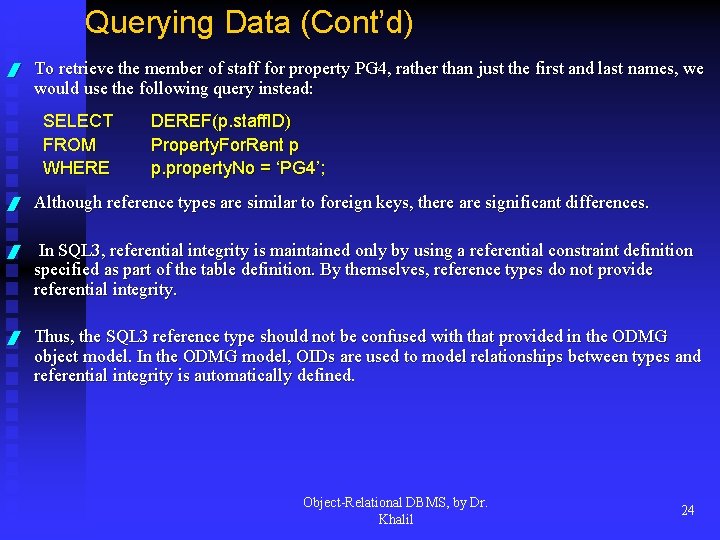
Querying Data (Cont’d) / To retrieve the member of staff for property PG 4, rather than just the first and last names, we would use the following query instead: SELECT FROM WHERE DEREF(p. staff. ID) Property. For. Rent p p. property. No = ‘PG 4’; / Although reference types are similar to foreign keys, there are significant differences. / In SQL 3, referential integrity is maintained only by using a referential constraint definition specified as part of the table definition. By themselves, reference types do not provide referential integrity. / Thus, the SQL 3 reference type should not be confused with that provided in the ODMG object model. In the ODMG model, OIDs are used to model relationships between types and referential integrity is automatically defined. Object-Relational DBMS, by Dr. Khalil 24
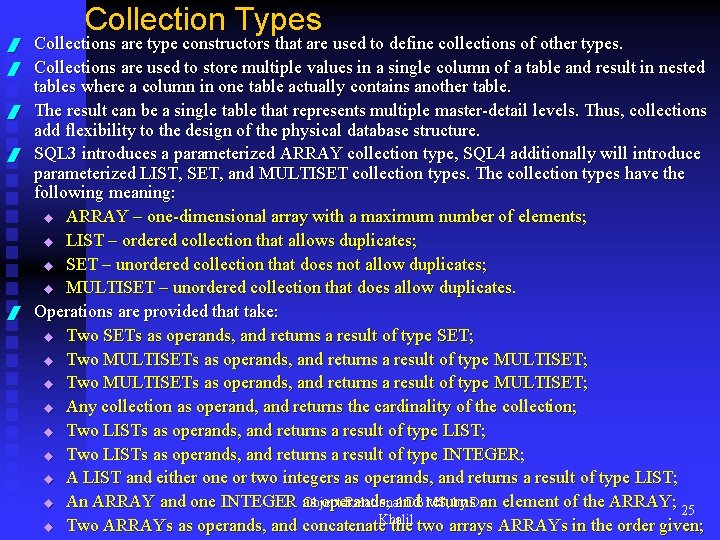
Collection Types / / / Collections are type constructors that are used to define collections of other types. Collections are used to store multiple values in a single column of a table and result in nested tables where a column in one table actually contains another table. The result can be a single table that represents multiple master-detail levels. Thus, collections add flexibility to the design of the physical database structure. SQL 3 introduces a parameterized ARRAY collection type, SQL 4 additionally will introduce parameterized LIST, SET, and MULTISET collection types. The collection types have the following meaning: u ARRAY – one-dimensional array with a maximum number of elements; u LIST – ordered collection that allows duplicates; u SET – unordered collection that does not allow duplicates; u MULTISET – unordered collection that does allow duplicates. Operations are provided that take: u Two SETs as operands, and returns a result of type SET; u Two MULTISETs as operands, and returns a result of type MULTISET; u Any collection as operand, and returns the cardinality of the collection; u Two LISTs as operands, and returns a result of type LIST; u Two LISTs as operands, and returns a result of type INTEGER; u A LIST and either one or two integers as operands, and returns a result of type LIST; Object-Relational DBMS, by Dr. u An ARRAY and one INTEGER as operands, and returns an element of the ARRAY; 25 Khalil u Two ARRAYs as operands, and concatenate the two arrays ARRAYs in the order given;
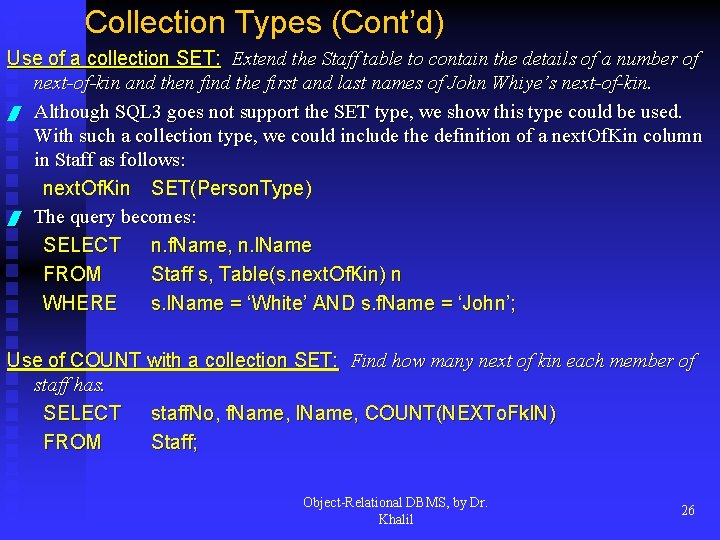
Collection Types (Cont’d) Use of a collection SET: Extend the Staff table to contain the details of a number of next-of-kin and then find the first and last names of John Whiye’s next-of-kin. / Although SQL 3 goes not support the SET type, we show this type could be used. With such a collection type, we could include the definition of a next. Of. Kin column in Staff as follows: next. Of. Kin SET(Person. Type) / The query becomes: SELECT n. f. Name, n. l. Name FROM Staff s, Table(s. next. Of. Kin) n WHERE s. l. Name = ‘White’ AND s. f. Name = ‘John’; Use of COUNT with a collection SET: Find how many next of kin each member of staff has. SELECT staff. No, f. Name, l. Name, COUNT(NEXTo. Fk. IN) FROM Staff; Object-Relational DBMS, by Dr. Khalil 26
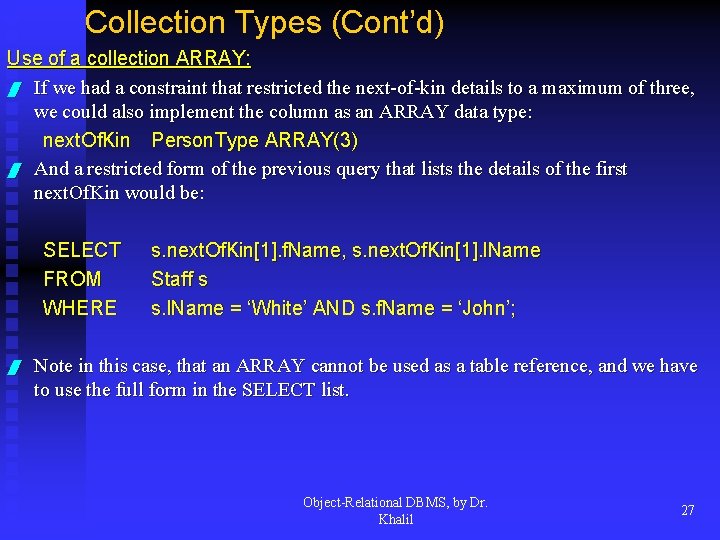
Collection Types (Cont’d) Use of a collection ARRAY: / If we had a constraint that restricted the next-of-kin details to a maximum of three, we could also implement the column as an ARRAY data type: next. Of. Kin Person. Type ARRAY(3) / And a restricted form of the previous query that lists the details of the first next. Of. Kin would be: SELECT FROM WHERE / s. next. Of. Kin[1]. f. Name, s. next. Of. Kin[1]. l. Name Staff s s. l. Name = ‘White’ AND s. f. Name = ‘John’; Note in this case, that an ARRAY cannot be used as a table reference, and we have to use the full form in the SELECT list. Object-Relational DBMS, by Dr. Khalil 27
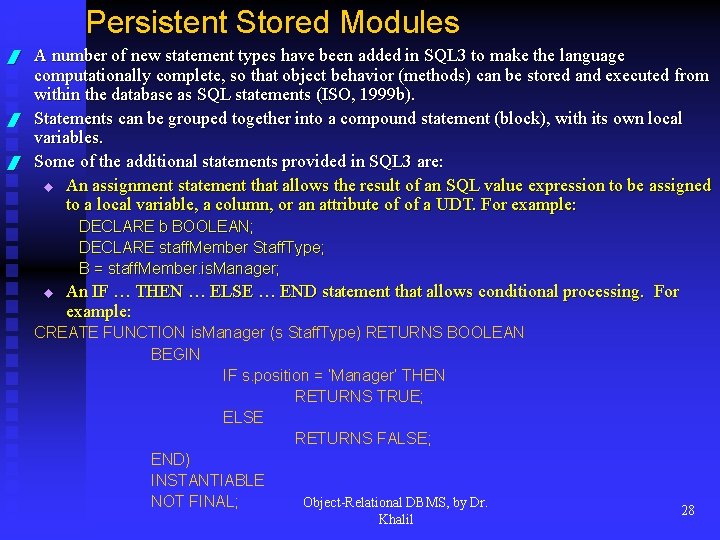
Persistent Stored Modules / / / A number of new statement types have been added in SQL 3 to make the language computationally complete, so that object behavior (methods) can be stored and executed from within the database as SQL statements (ISO, 1999 b). Statements can be grouped together into a compound statement (block), with its own local variables. Some of the additional statements provided in SQL 3 are: u An assignment statement that allows the result of an SQL value expression to be assigned to a local variable, a column, or an attribute of of a UDT. For example: DECLARE b BOOLEAN; DECLARE staff. Member Staff. Type; B = staff. Member. is. Manager; u An IF … THEN … ELSE … END statement that allows conditional processing. For example: CREATE FUNCTION is. Manager (s Staff. Type) RETURNS BOOLEAN BEGIN IF s. position = ‘Manager’ THEN RETURNS TRUE; ELSE RETURNS FALSE; END) INSTANTIABLE Object-Relational DBMS, by Dr. NOT FINAL; Khalil 28
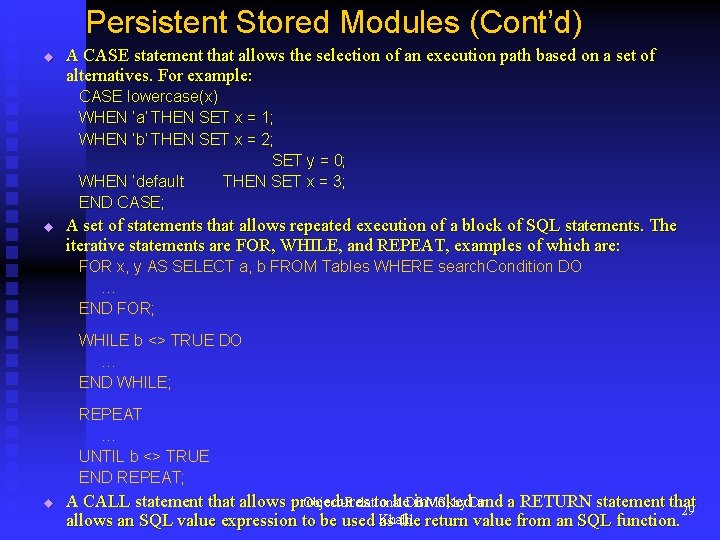
Persistent Stored Modules (Cont’d) u A CASE statement that allows the selection of an execution path based on a set of alternatives. For example: CASE lowercase(x) WHEN ‘a’ THEN SET x = 1; WHEN ‘b’ THEN SET x = 2; SET y = 0; WHEN ‘default THEN SET x = 3; END CASE; u A set of statements that allows repeated execution of a block of SQL statements. The iterative statements are FOR, WHILE, and REPEAT, examples of which are: FOR x, y AS SELECT a, b FROM Tables WHERE search. Condition DO … END FOR; WHILE b <> TRUE DO … END WHILE; REPEAT … UNTIL b <> TRUE END REPEAT; u A CALL statement that allows procedures to be. DBMS, invoked and a RETURN statement that Object-Relational by Dr. 29 allows an SQL value expression to be used Khalil as the return value from an SQL function.
Triggers / / A trigger is an SQL (compound) statement that is executed automatically by the DBMS as a side effect of a modification to a named table. It is similar to an SQL routine, in that it is a named SQL block with declarative, executable, and condition-handling sections. However, unlike a routine, a trigger is executed implicitly whenever the triggering event occurs, and a trigger does not have any arguments. The act of executing a trigger is sometimes known as firing the trigger. Triggers can be used for a number of purposes include: u Validating input data and maintaining complex integrity constraints that otherwise would be difficult, if not impossible, through table constraints; u Supporting alerts (for example, using electronic mail) that action needs to be taken when a table is updated in some way; u Maintaining audit information, by recording the changes made, and by whom; u Supporting replication. Object-Relational DBMS, by Dr. Khalil 30
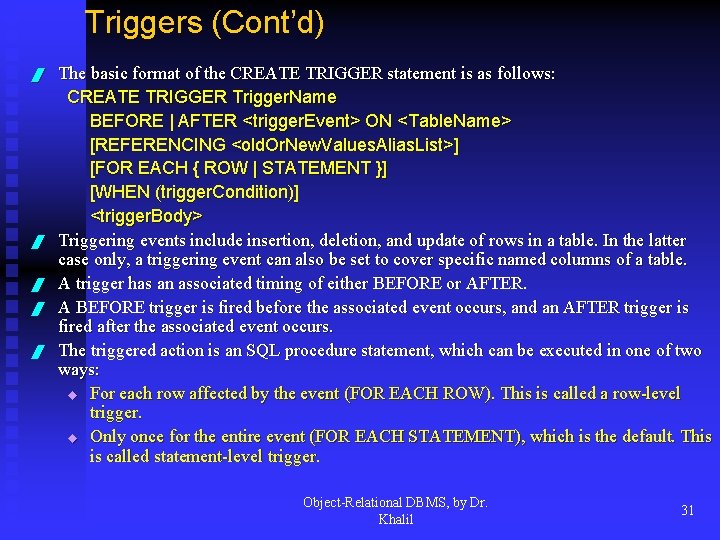
Triggers (Cont’d) / / / The basic format of the CREATE TRIGGER statement is as follows: CREATE TRIGGER Trigger. Name BEFORE | AFTER <trigger. Event> ON <Table. Name> [REFERENCING <old. Or. New. Values. Alias. List>] [FOR EACH { ROW | STATEMENT }] [WHEN (trigger. Condition)] <trigger. Body> Triggering events include insertion, deletion, and update of rows in a table. In the latter case only, a triggering event can also be set to cover specific named columns of a table. A trigger has an associated timing of either BEFORE or AFTER. A BEFORE trigger is fired before the associated event occurs, and an AFTER trigger is fired after the associated event occurs. The triggered action is an SQL procedure statement, which can be executed in one of two ways: u For each row affected by the event (FOR EACH ROW). This is called a row-level trigger. u Only once for the entire event (FOR EACH STATEMENT), which is the default. This is called statement-level trigger. Object-Relational DBMS, by Dr. Khalil 31
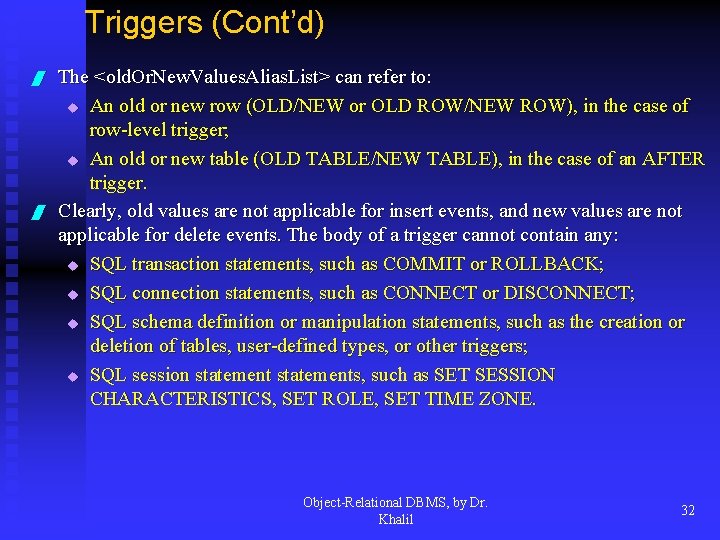
Triggers (Cont’d) / / The <old. Or. New. Values. Alias. List> can refer to: u An old or new row (OLD/NEW or OLD ROW/NEW ROW), in the case of row-level trigger; u An old or new table (OLD TABLE/NEW TABLE), in the case of an AFTER trigger. Clearly, old values are not applicable for insert events, and new values are not applicable for delete events. The body of a trigger cannot contain any: u SQL transaction statements, such as COMMIT or ROLLBACK; u SQL connection statements, such as CONNECT or DISCONNECT; u SQL schema definition or manipulation statements, such as the creation or deletion of tables, user-defined types, or other triggers; u SQL session statements, such as SET SESSION CHARACTERISTICS, SET ROLE, SET TIME ZONE. Object-Relational DBMS, by Dr. Khalil 32
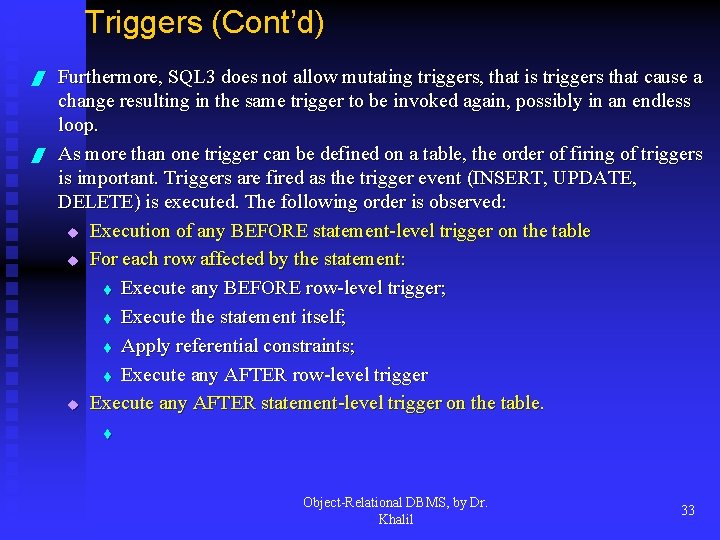
Triggers (Cont’d) / / Furthermore, SQL 3 does not allow mutating triggers, that is triggers that cause a change resulting in the same trigger to be invoked again, possibly in an endless loop. As more than one trigger can be defined on a table, the order of firing of triggers is important. Triggers are fired as the trigger event (INSERT, UPDATE, DELETE) is executed. The following order is observed: u Execution of any BEFORE statement-level trigger on the table u For each row affected by the statement: t Execute any BEFORE row-level trigger; t Execute the statement itself; t Apply referential constraints; t Execute any AFTER row-level trigger u Execute any AFTER statement-level trigger on the table. t Object-Relational DBMS, by Dr. Khalil 33
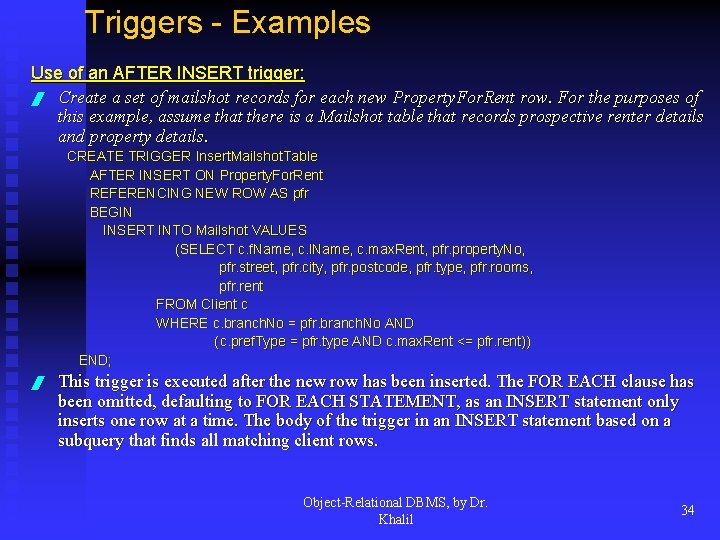
Triggers - Examples Use of an AFTER INSERT trigger: / Create a set of mailshot records for each new Property. For. Rent row. For the purposes of this example, assume that there is a Mailshot table that records prospective renter details and property details. CREATE TRIGGER Insert. Mailshot. Table AFTER INSERT ON Property. For. Rent REFERENCING NEW ROW AS pfr BEGIN INSERT INTO Mailshot VALUES (SELECT c. f. Name, c. l. Name, c. max. Rent, pfr. property. No, pfr. street, pfr. city, pfr. postcode, pfr. type, pfr. rooms, pfr. rent FROM Client c WHERE c. branch. No = pfr. branch. No AND ( c. pref. Type = pfr. type AND c. max. Rent <= pfr. rent)) END; / This trigger is executed after the new row has been inserted. The FOR EACH clause has been omitted, defaulting to FOR EACH STATEMENT, as an INSERT statement only inserts one row at a time. The body of the trigger in an INSERT statement based on a subquery that finds all matching client rows. Object-Relational DBMS, by Dr. Khalil 34
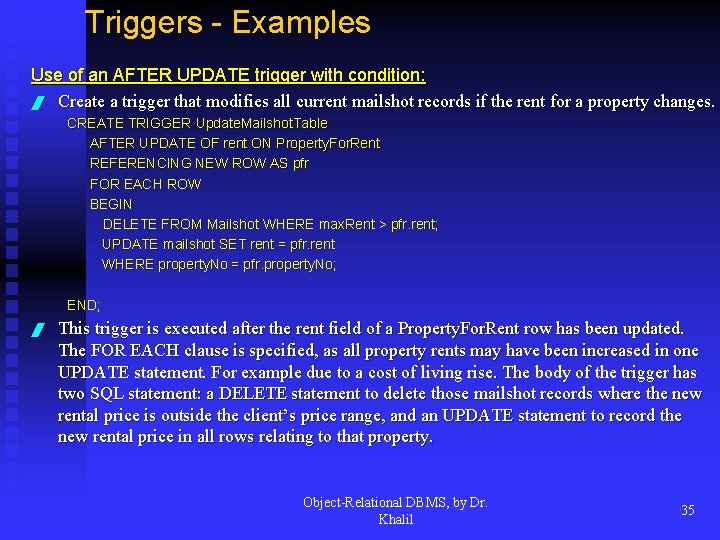
Triggers - Examples Use of an AFTER UPDATE trigger with condition: / Create a trigger that modifies all current mailshot records if the rent for a property changes. CREATE TRIGGER Update. Mailshot. Table AFTER UPDATE OF rent ON Property. For. Rent REFERENCING NEW ROW AS pfr FOR EACH ROW BEGIN DELETE FROM Mailshot WHERE max. Rent > pfr. rent; UPDATE mailshot SET rent = pfr. rent WHERE property. No = pfr. property. No; END; / This trigger is executed after the rent field of a Property. For. Rent row has been updated. The FOR EACH clause is specified, as all property rents may have been increased in one UPDATE statement. For example due to a cost of living rise. The body of the trigger has two SQL statement: a DELETE statement to delete those mailshot records where the new rental price is outside the client’s price range, and an UPDATE statement to record the new rental price in all rows relating to that property. Object-Relational DBMS, by Dr. Khalil 35
Triggers – Pros & Cons / / / Triggers can be a very powerful mechanism if used appropriately. The major advantage is that standard functions can be stored within the database and enforced consistently with each update to the database. This can dramatically reduce the complexity of applications. However, there can be some disadvantages: u Complexity: when functionality is moved from the application to the database, the database design, implementation, and administration tasks become more complex. u Hidden functionality: Moving functionality to the database and storing it as one or more triggers can have the effect of hiding functionality from the user. While this can simplify things for the user, unfortunately it can also have side effects that may be unplanned, and potentially unwanted and erroneous. The user no longer has control over what happens to the database. u Performance overhead: When the DBMS is about to execute a statement that modify the database, it now has to evaluate the trigger condition to check whether a trigger should be fired by the statement. This has a performance implication on the DBMS. Clearly, as the number of triggers increases, this overhead also increases. At peak times, this overhead may create performance problems. Object-Relational DBMS, by Dr. Khalil 36
Large Objects / / / A large object is a table field that holds a large amount of data, such as a long text file or a graphics file. There are three different types of large object data types defined in SQL 3: u Binary Large Object (BLOB), a binary string that does not have a character set or collation association; u Character Large Object (CLOB) and National Character Large Object (NCLOB), both character strings. The SQL 3 BLOB does allow some operations to be carried out in the DBMS server. A binary large object (BLOB) string is defined as a sequence of octets. The following operators operate on BLOB strings: u The BLOB concatenation operator; u The BLOB substring function; u The BLOB overlay function; u The BLOB trim function. Object-Relational DBMS, by Dr. Khalil 37
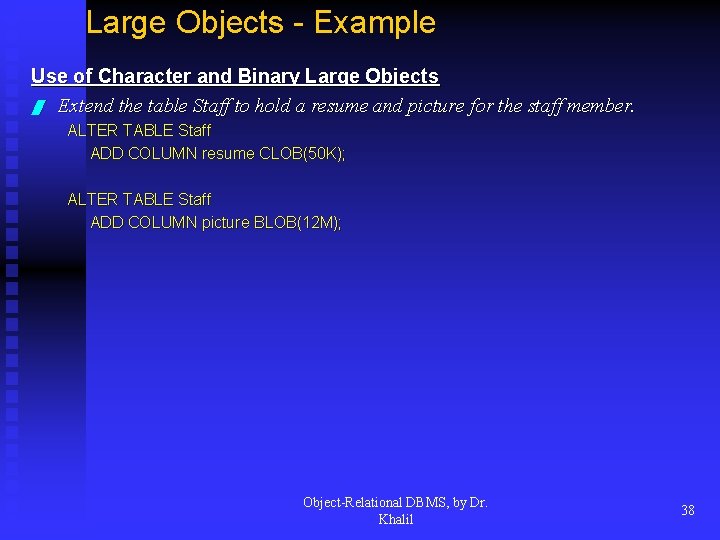
Large Objects - Example Use of Character and Binary Large Objects / Extend the table Staff to hold a resume and picture for the staff member. ALTER TABLE Staff ADD COLUMN resume CLOB(50 K); ALTER TABLE Staff ADD COLUMN picture BLOB(12 M); Object-Relational DBMS, by Dr. Khalil 38

Object-Oriented Extensions in Oracle Use of Character and Binary Large Objects / Many of the object-oriented features that appear in SQL 3 standard appear in Oracle in one form or another. / Reference: 1 - FUNDAMENTALS OF DATABASE SYSTEMS. El Masry, Third Edition. Chapter 13, Oracle 8 Object-Relational features, Pages 448 -457 2 - DATABASE SYSTEMS, A Practical Approach to Design, Implementation, and Management. Thomas Connaolly, Third Edition. Chapter 27, Pages 929 -937 Object-Relational DBMS, by Dr. Khalil 39
Thank you Object-Relational DBMS, by Dr. Khalil 40
- Slides: 40