
ObjectOriented Programming Part 1 Programming Language Concepts Object
Object-Oriented Programming Part 1 Programming Language Concepts
Object Oriented Programming • Over time, data abstraction has become essential as programs became complicated. • Benefits: 1. Reduce conceptual load (minimum detail). 2. Fault containment. 3. Independent program components. (difficult in practice). • Code reuse possible by extending and refining abstractions.
Object Oriented Programming • A methodology of programming • Four (Five ? ) major principles: 1. 2. 3. 4. 5. Data Abstraction. Encapsulation. Information Hiding. Polymorphism (dynamic binding). Inheritance. (particular case of polymorphism ? ) Will describe these using C++, because. . .
The C++ language • An object-oriented, general-purpose programming language, derived from C (C++ = C plus classes). • C++ adds the following to C: 1. Inlining and overloading of functions. 2. Default argument values. 3. Argument pass-by-reference. 4. Free store operators new and delete, instead of malloc() and free(). 5. Support for object-oriented programming, through classes, information hiding, public interfaces, operator overloading, inheritance, and templates.
Design Objectives in C++ • Compatibility. Existing code in C can be used. Even existing, pre-compiled libraries can be linked with new C++ code. • Efficiency. No additional cost for using C++. Overheadof function calls is eliminated where possible. • Strict type checking. Aids debugging, allows generation of efficient code. • C++ designed by Bjarne Stroustrup of Bell Labs (now at TAMU). • Standardization: ANSI, ISO.
Non Object-Oriented Extensions to C • Major improvements over C. 1. 2. 3. 4. 5. Stream I/O. Strong typing. Parameter passing by reference. Default argument values. Inlining. We’ve discussed some of these already.
Stream I/O in C++ • Input and output in C++ is handled by streams. • The directive #include <iostream. h> declares 2 streams: cin and cout. • cin is associated with standard input. Extraction: operator>>. • cout is associated with standard output. Insertion: operator<<. • In C++, input is line buffered, i. e. the user must press <RTN> before any characters are processed.
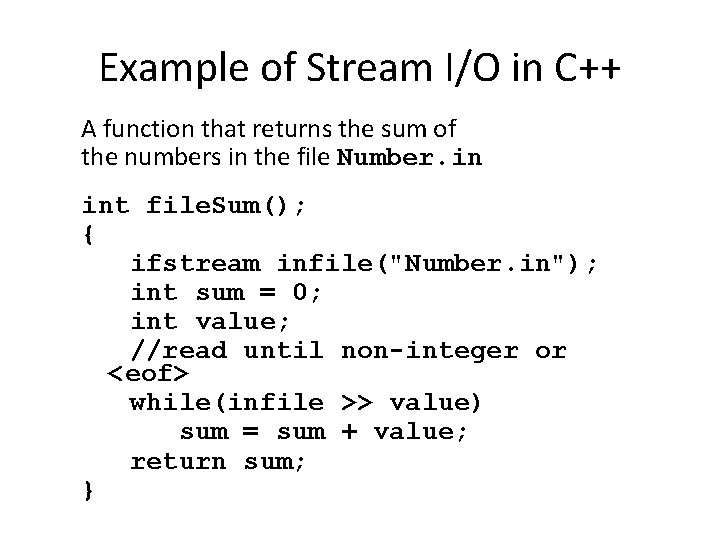
Example of Stream I/O in C++ A function that returns the sum of the numbers in the file Number. in int file. Sum(); { ifstream infile("Number. in"); int sum = 0; int value; //read until non-integer or <eof> while(infile >> value) sum = sum + value; return sum; }
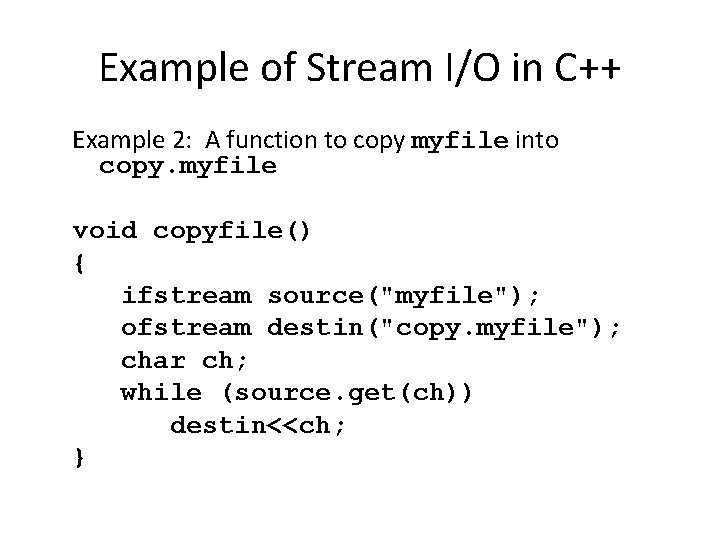
Example of Stream I/O in C++ Example 2: A function to copy myfile into copy. myfile void copyfile() { ifstream source("myfile"); ofstream destin("copy. myfile"); char ch; while (source. get(ch)) destin<<ch; }
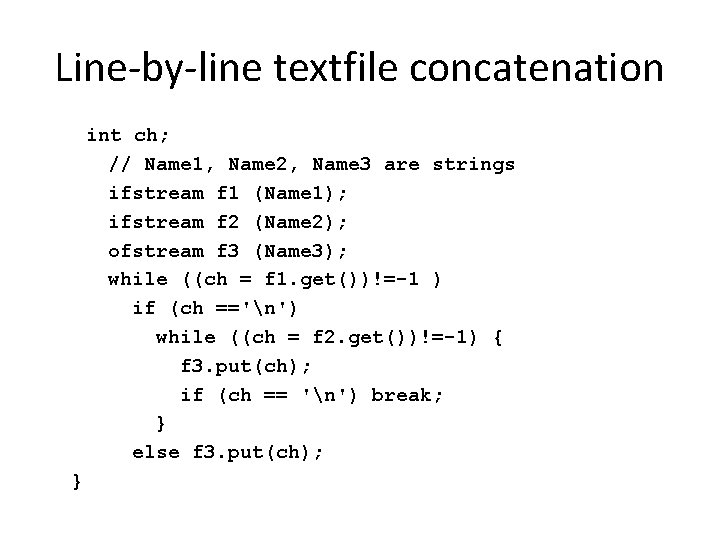
Line-by-line textfile concatenation int ch; // Name 1, Name 2, Name 3 are strings ifstream f 1 (Name 1); ifstream f 2 (Name 2); ofstream f 3 (Name 3); while ((ch = f 1. get())!=-1 ) if (ch =='n') while ((ch = f 2. get())!=-1) { f 3. put(ch); if (ch == 'n') break; } else f 3. put(ch); }
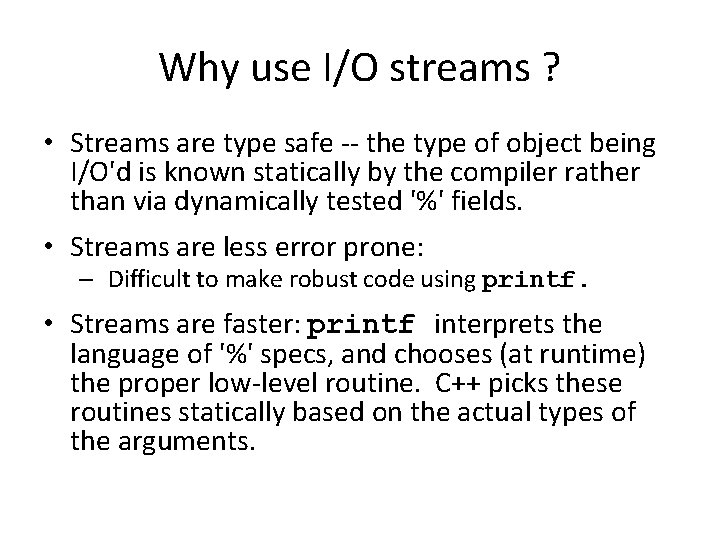
Why use I/O streams ? • Streams are type safe -- the type of object being I/O'd is known statically by the compiler rather than via dynamically tested '%' fields. • Streams are less error prone: – Difficult to make robust code using printf. • Streams are faster: printf interprets the language of '%' specs, and chooses (at runtime) the proper low-level routine. C++ picks these routines statically based on the actual types of the arguments.
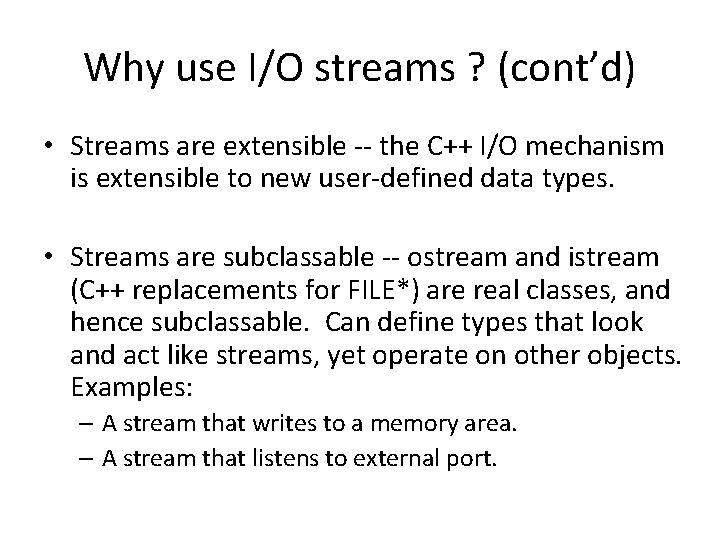
Why use I/O streams ? (cont’d) • Streams are extensible -- the C++ I/O mechanism is extensible to new user-defined data types. • Streams are subclassable -- ostream and istream (C++ replacements for FILE*) are real classes, and hence subclassable. Can define types that look and act like streams, yet operate on other objects. Examples: – A stream that writes to a memory area. – A stream that listens to external port.
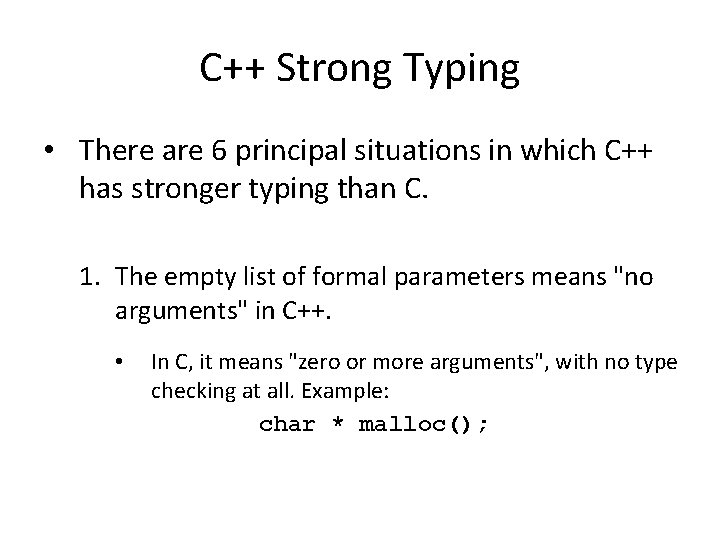
C++ Strong Typing • There are 6 principal situations in which C++ has stronger typing than C. 1. The empty list of formal parameters means "no arguments" in C++. • In C, it means "zero or more arguments", with no type checking at all. Example: char * malloc();
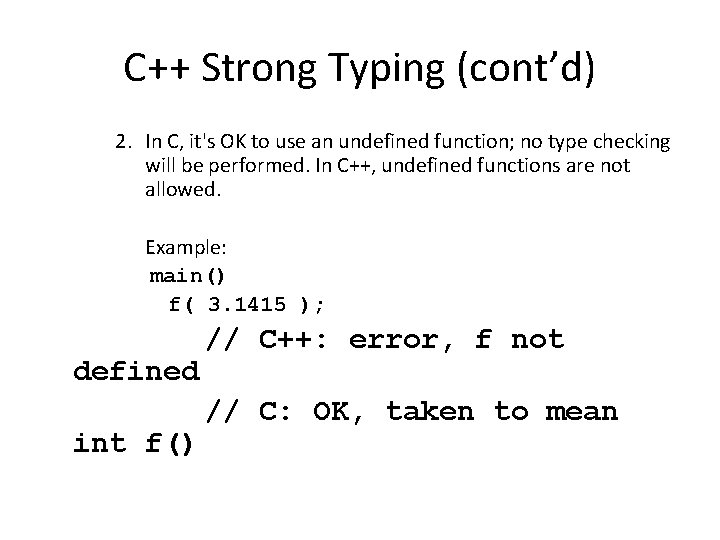
C++ Strong Typing (cont’d) 2. In C, it's OK to use an undefined function; no type checking will be performed. In C++, undefined functions are not allowed. Example: main() f( 3. 1415 ); defined int f() // C++: error, f not // C: OK, taken to mean
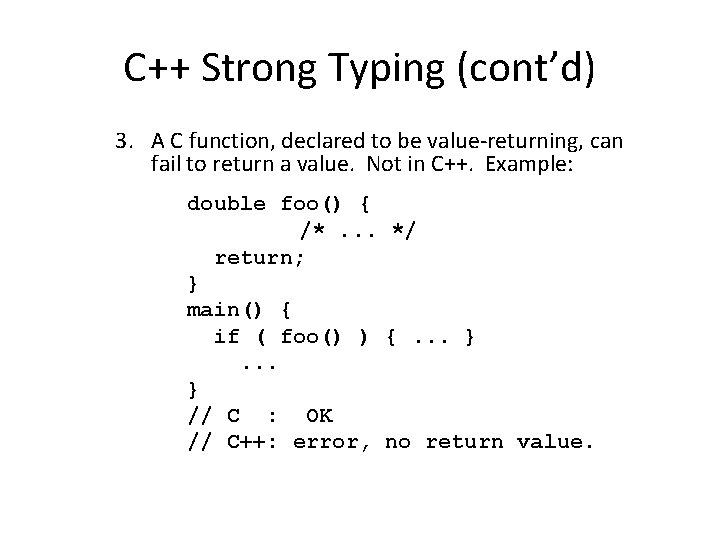
C++ Strong Typing (cont’d) 3. A C function, declared to be value-returning, can fail to return a value. Not in C++. Example: double foo() { /*. . . */ return; } main() { if ( foo() ) {. . . } // C : OK // C++: error, no return value.
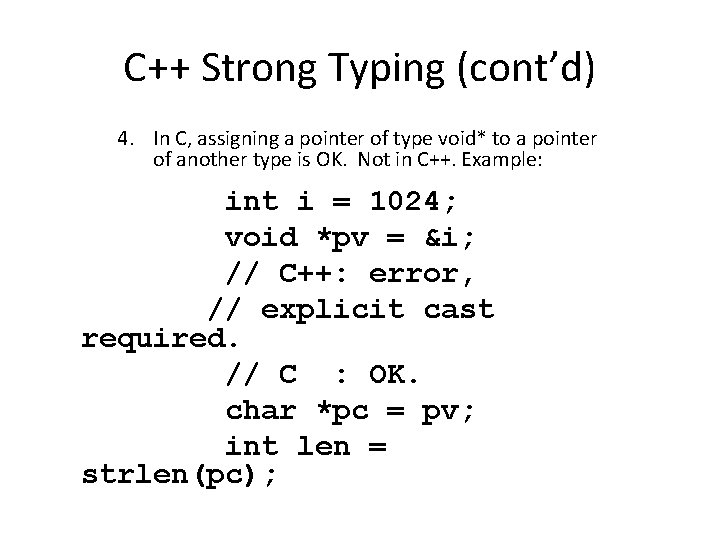
C++ Strong Typing (cont’d) 4. In C, assigning a pointer of type void* to a pointer of another type is OK. Not in C++. Example: int i = 1024; void *pv = &i; // C++: error, // explicit cast required. // C : OK. char *pc = pv; int len = strlen(pc);
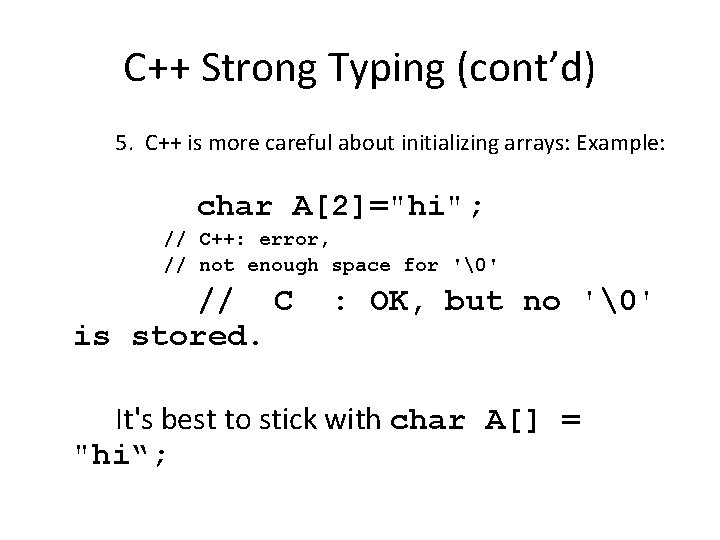
C++ Strong Typing (cont’d) 5. C++ is more careful about initializing arrays: Example: char A[2]="hi"; // C++: error, // not enough space for '' // C is stored. : OK, but no '' It's best to stick with char A[] = "hi“;
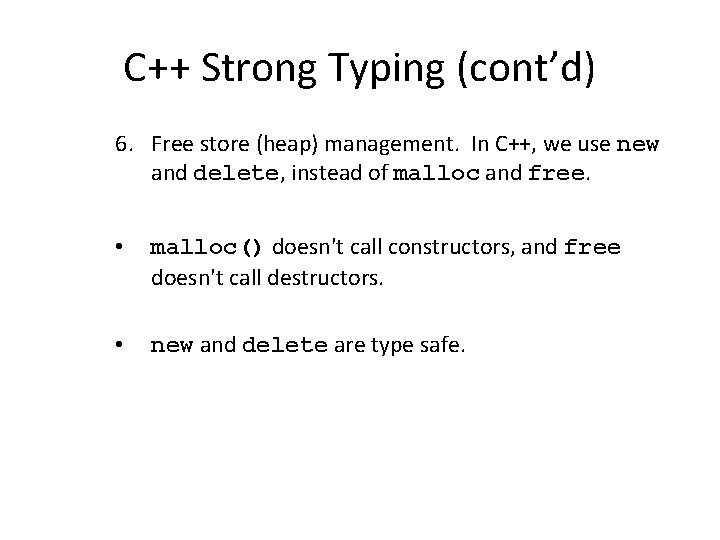
C++ Strong Typing (cont’d) 6. Free store (heap) management. In C++, we use new and delete, instead of malloc and free. • malloc() doesn't call constructors, and free doesn't call destructors. • new and delete are type safe.
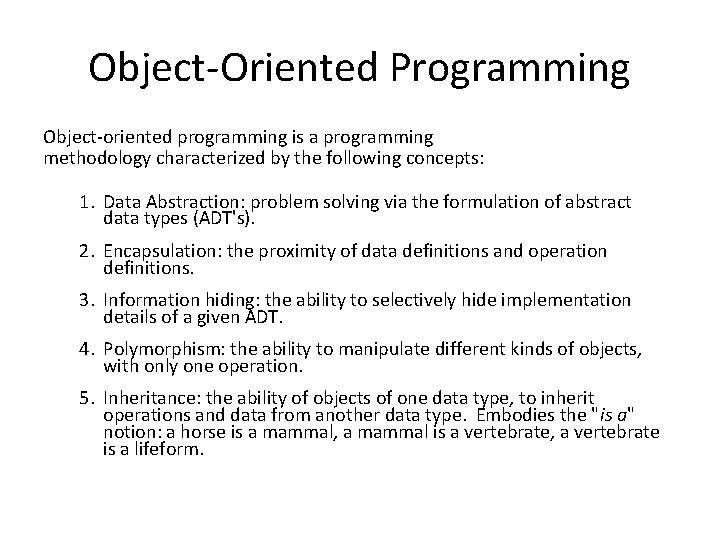
Object-Oriented Programming Object-oriented programming is a programming methodology characterized by the following concepts: 1. Data Abstraction: problem solving via the formulation of abstract data types (ADT's). 2. Encapsulation: the proximity of data definitions and operation definitions. 3. Information hiding: the ability to selectively hide implementation details of a given ADT. 4. Polymorphism: the ability to manipulate different kinds of objects, with only one operation. 5. Inheritance: the ability of objects of one data type, to inherit operations and data from another data type. Embodies the "is a" notion: a horse is a mammal, a mammal is a vertebrate, a vertebrate is a lifeform.
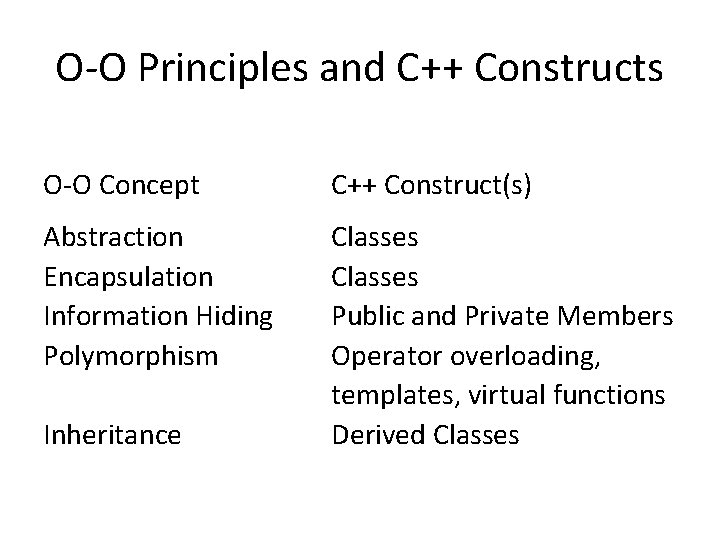
O-O Principles and C++ Constructs O-O Concept C++ Construct(s) Abstraction Encapsulation Information Hiding Polymorphism Classes Public and Private Members Operator overloading, templates, virtual functions Derived Classes Inheritance
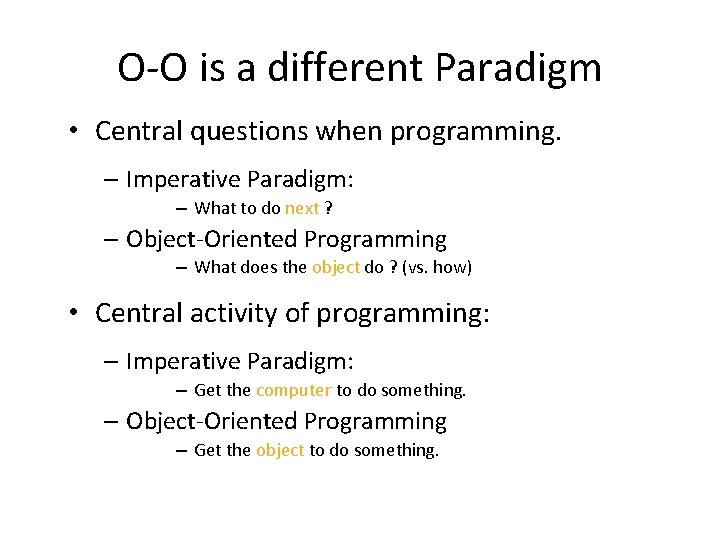
O-O is a different Paradigm • Central questions when programming. – Imperative Paradigm: – What to do next ? – Object-Oriented Programming – What does the object do ? (vs. how) • Central activity of programming: – Imperative Paradigm: – Get the computer to do something. – Object-Oriented Programming – Get the object to do something.
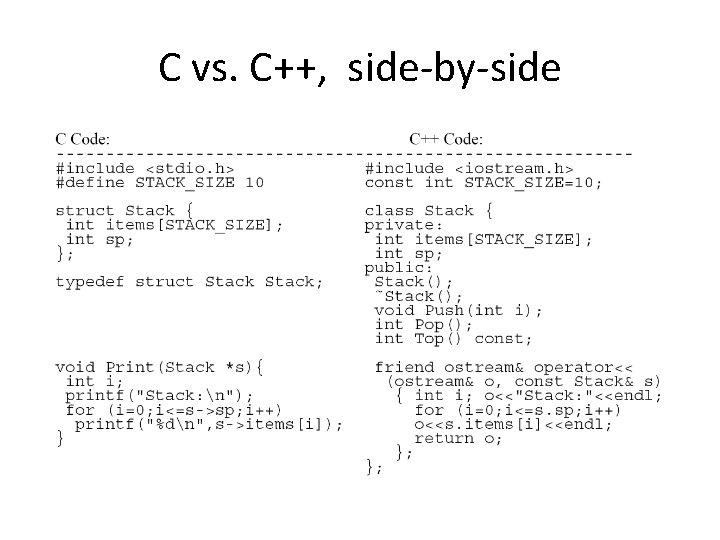
C vs. C++, side-by-side
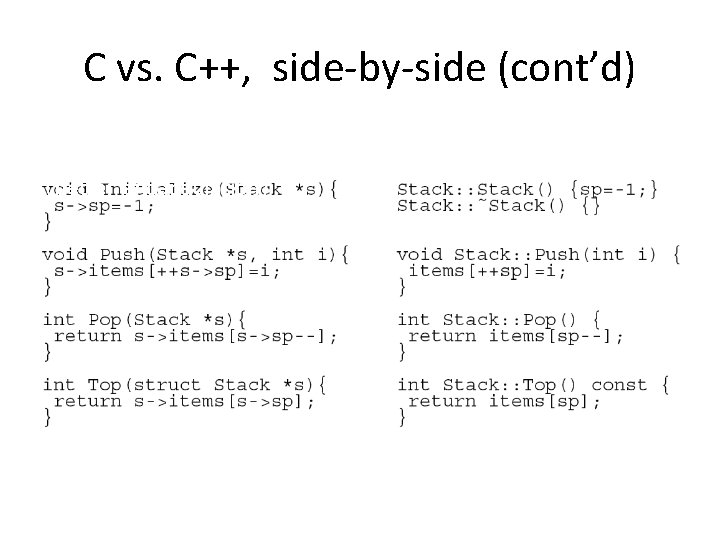
C vs. C++, side-by-side (cont’d) In C++, methods can appear inside the class definition (better encapsulation)
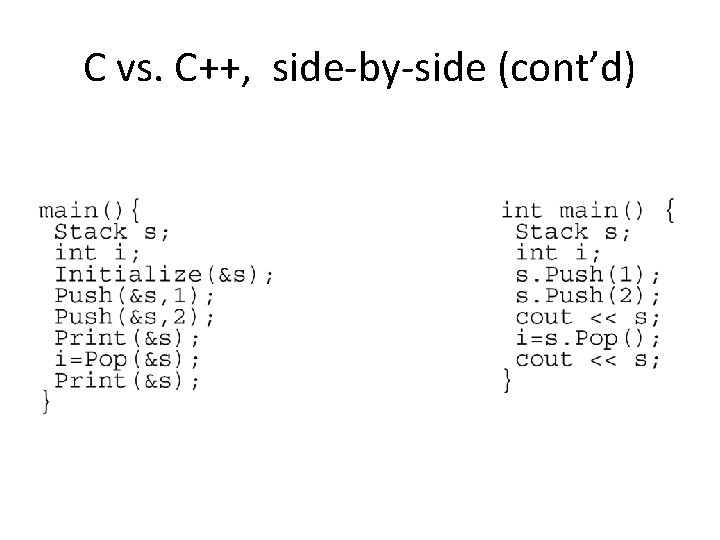
C vs. C++, side-by-side (cont’d) In C++, no explicit referencing. Could have overloaded <<, >> for Stacks: s << 1; s >> i;
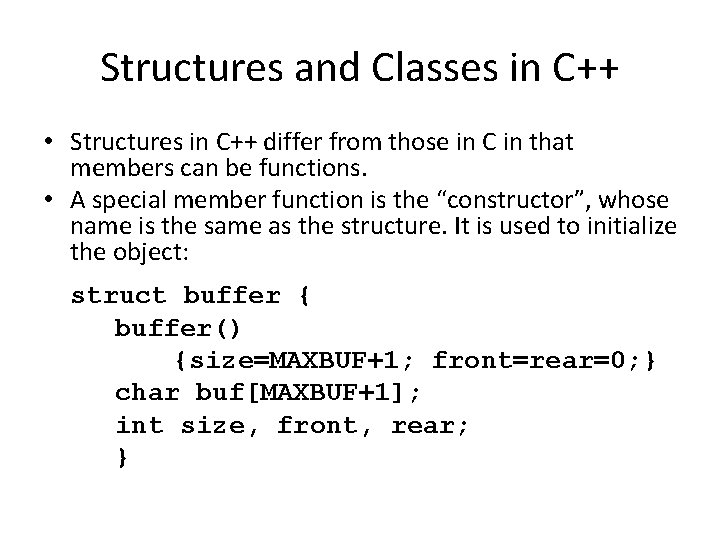
Structures and Classes in C++ • Structures in C++ differ from those in C in that members can be functions. • A special member function is the “constructor”, whose name is the same as the structure. It is used to initialize the object: struct buffer { buffer() {size=MAXBUF+1; front=rear=0; } char buf[MAXBUF+1]; int size, front, rear; }
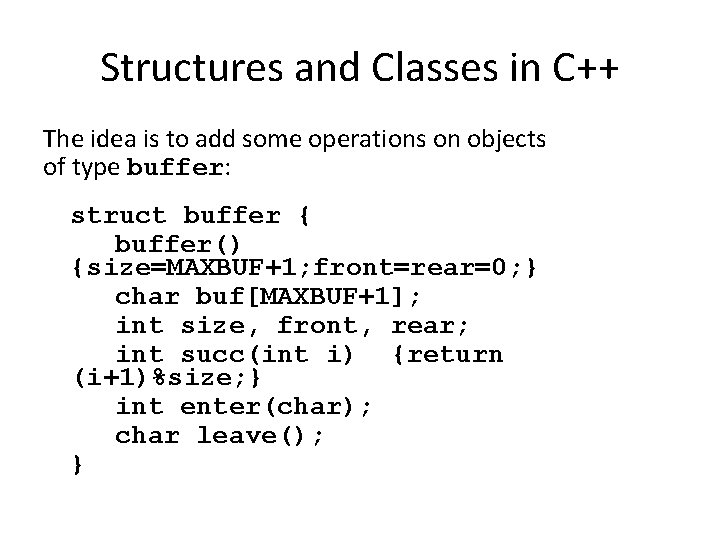
Structures and Classes in C++ The idea is to add some operations on objects of type buffer: struct buffer { buffer() {size=MAXBUF+1; front=rear=0; } char buf[MAXBUF+1]; int size, front, rear; int succ(int i) {return (i+1)%size; } int enter(char); char leave(); }
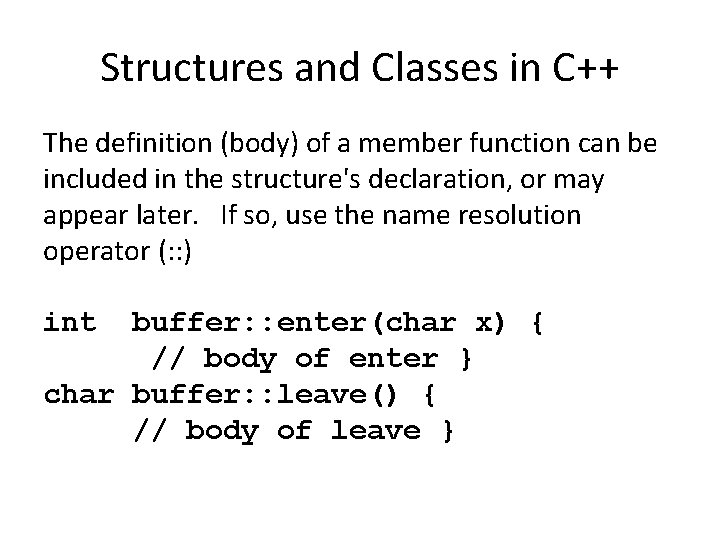
Structures and Classes in C++ The definition (body) of a member function can be included in the structure's declaration, or may appear later. If so, use the name resolution operator (: : ) int buffer: : enter(char x) { // body of enter } char buffer: : leave() { // body of leave }
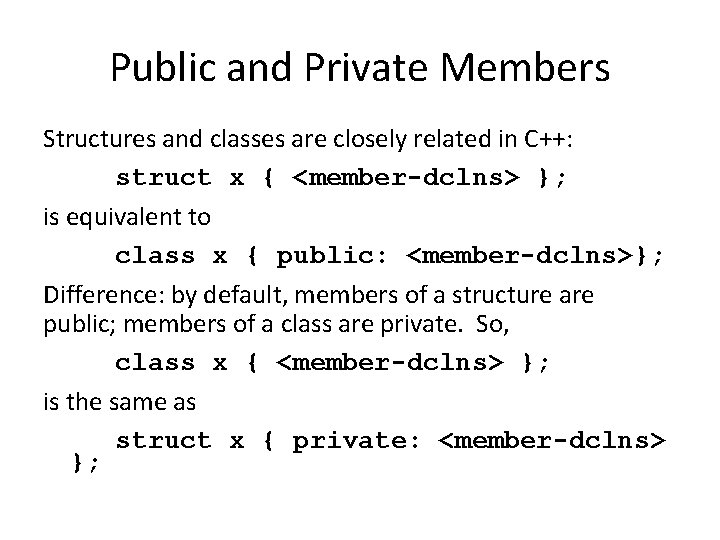
Public and Private Members Structures and classes are closely related in C++: struct x { <member-dclns> }; is equivalent to class x { public: <member-dclns>}; Difference: by default, members of a structure are public; members of a class are private. So, class x { <member-dclns> }; is the same as struct x { private: <member-dclns> };
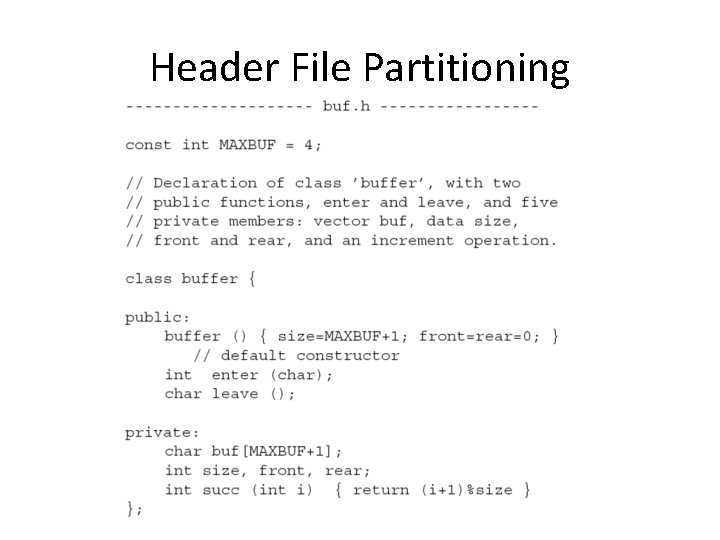
Header File Partitioning
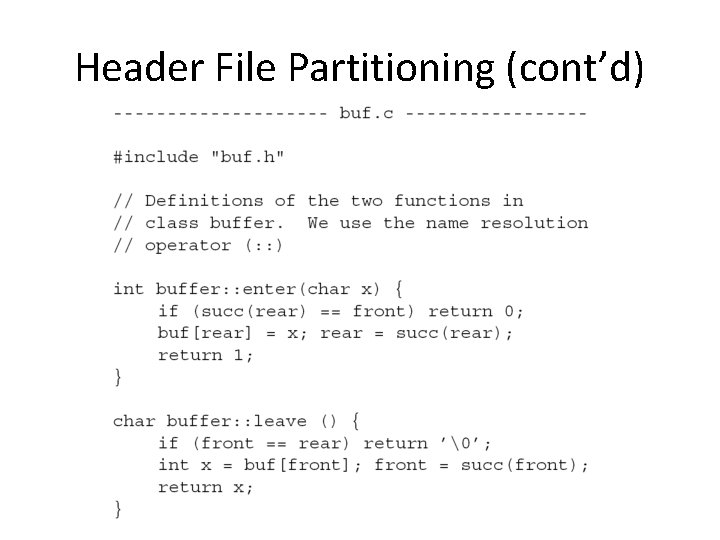
Header File Partitioning (cont’d)
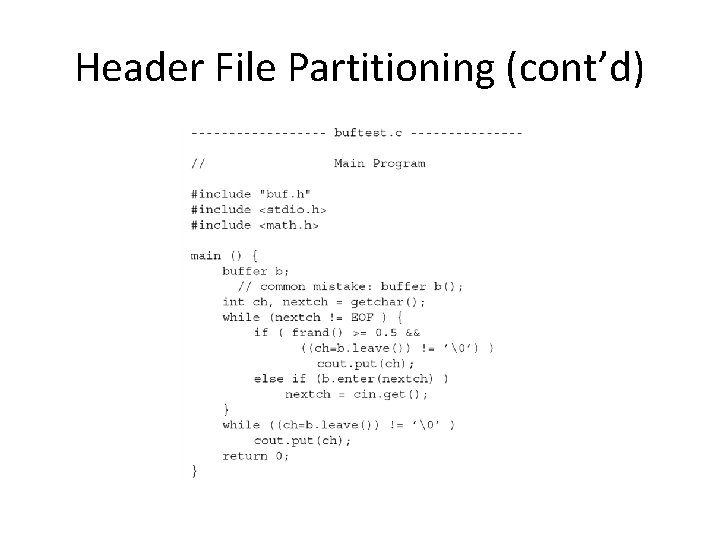
Header File Partitioning (cont’d)
- Slides: 31