
ObjectOriented Programming OOP Lecture No 21 Unary Operators
Object-Oriented Programming (OOP) Lecture No. 21
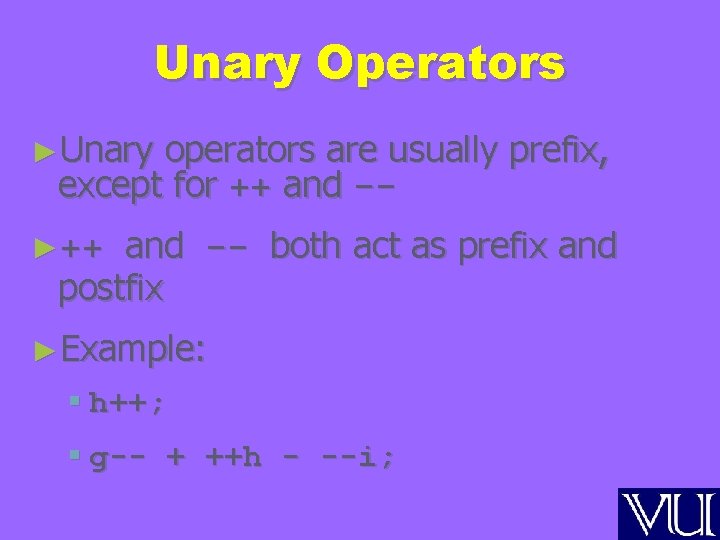
Unary Operators ►Unary operators are usually prefix, except for ++ and -- both act as prefix and postfix ►++ ►Example: § h++; § g-- + ++h - --i;
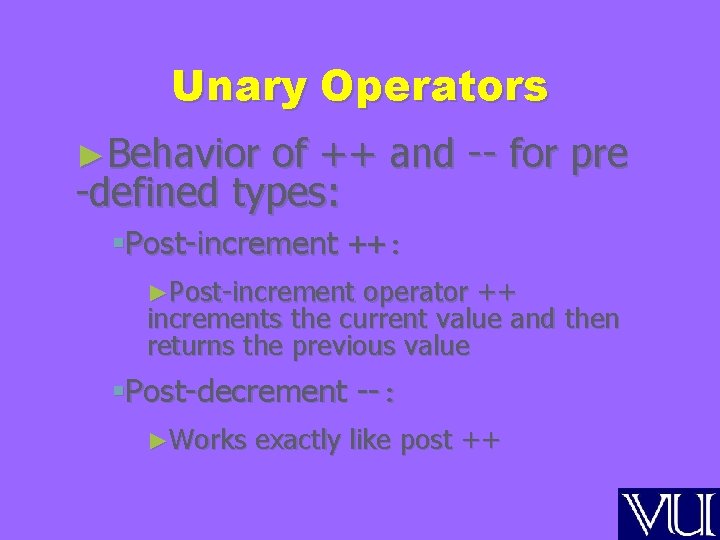
Unary Operators ►Behavior of ++ and -- for pre -defined types: §Post-increment ++: ►Post-increment operator ++ increments the current value and then returns the previous value §Post-decrement --: ►Works exactly like post ++
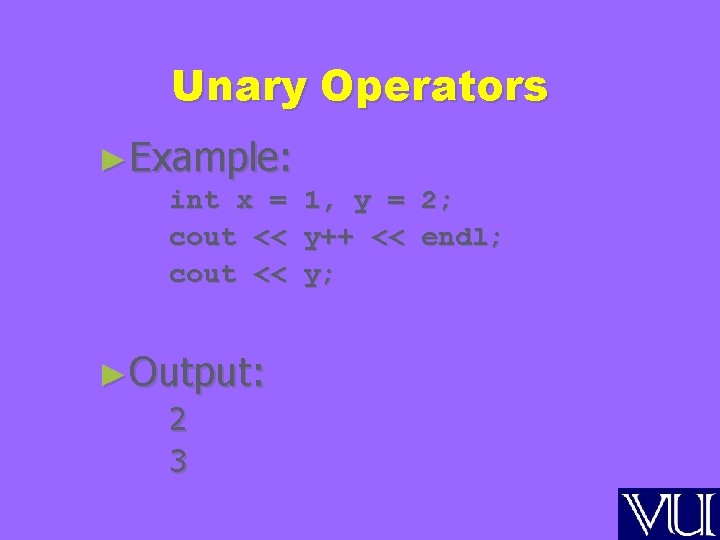
Unary Operators ►Example: int x = cout << ►Output: 2 3 1, y = 2; y++ << endl; y;
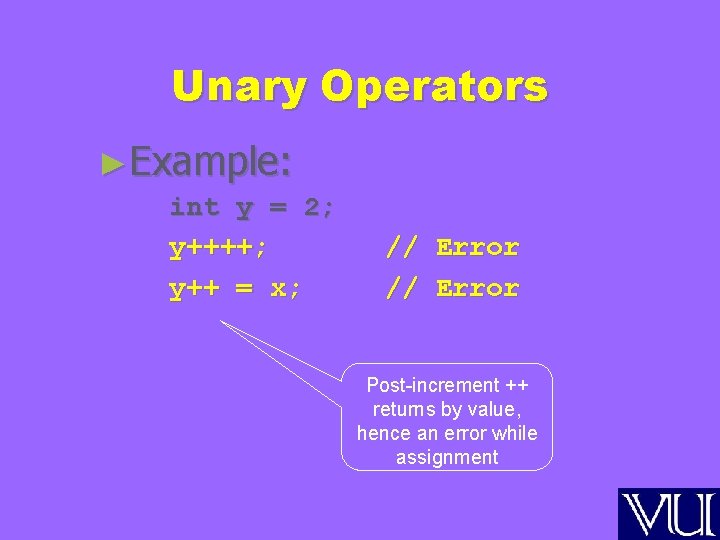
Unary Operators ►Example: int y = 2; y++++; y++ = x; // // Error Post-increment ++ returns by value, hence an error while assignment
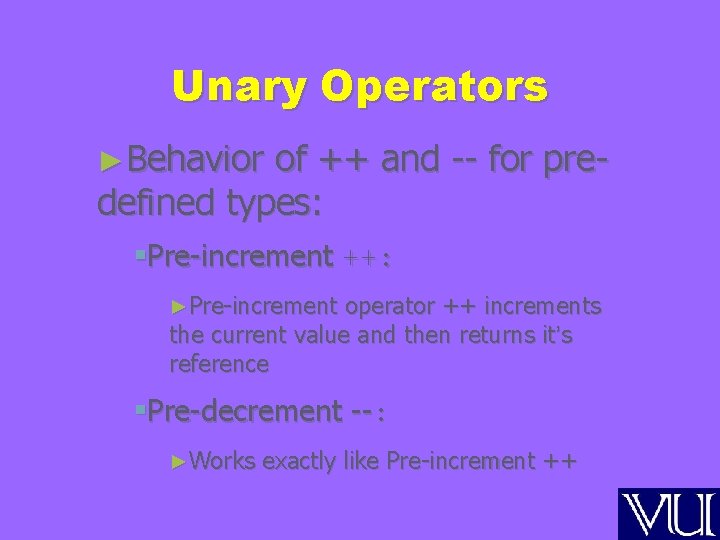
Unary Operators ►Behavior of ++ and -- for predefined types: §Pre-increment ++: ►Pre-increment operator ++ increments the current value and then returns it’s reference §Pre-decrement --: ►Works exactly like Pre-increment ++
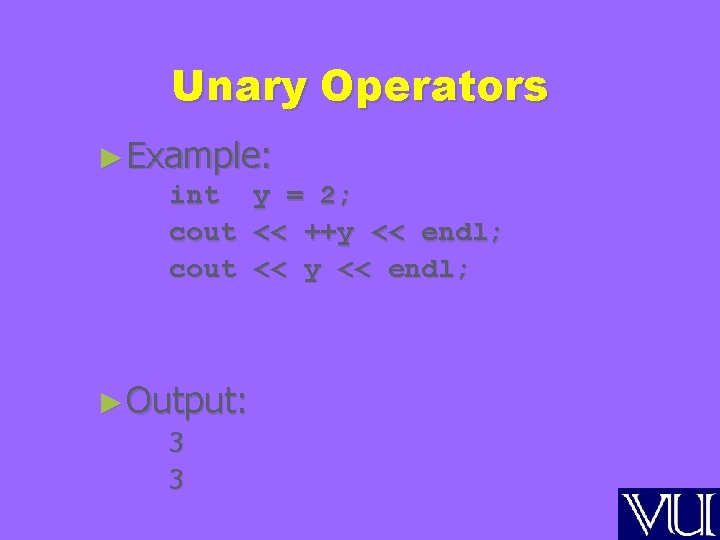
Unary Operators ►Example: int y = 2; cout << ++y << endl; cout << y << endl; ►Output: 3 3
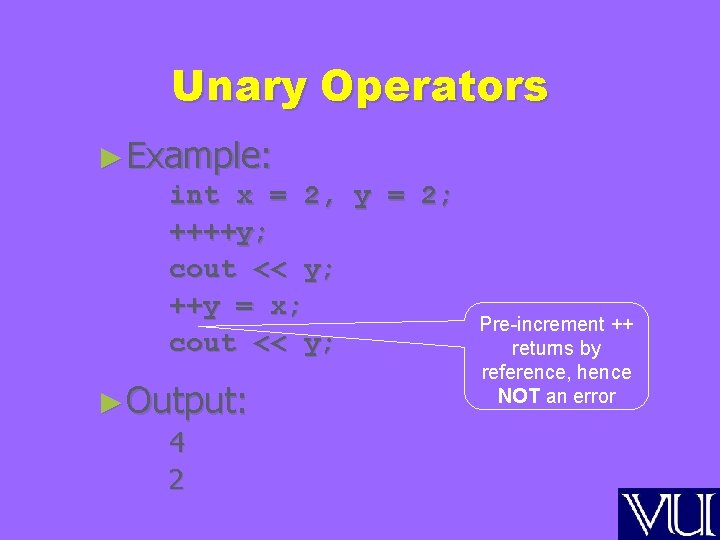
Unary Operators ►Example: int x = 2, y = 2; ++++y; cout << y; ++y = x; cout << y; ►Output: 4 2 Pre-increment ++ returns by reference, hence NOT an error
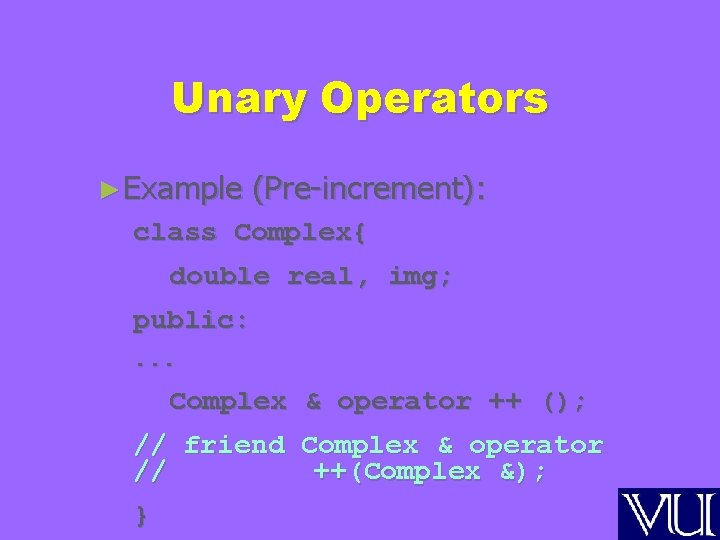
Unary Operators ►Example (Pre-increment): class Complex{ double real, img; public: . . . Complex & operator ++ (); // friend Complex & operator // ++(Complex &); }
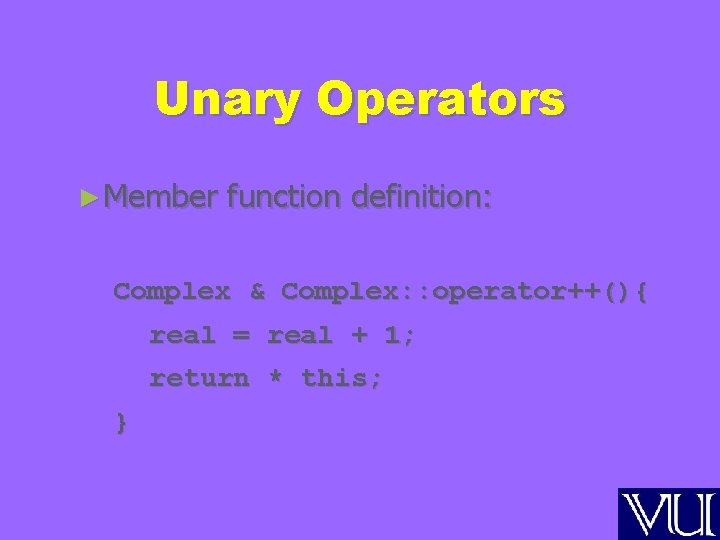
Unary Operators ►Member function definition: Complex & Complex: : operator++(){ real = real + 1; return * this; }
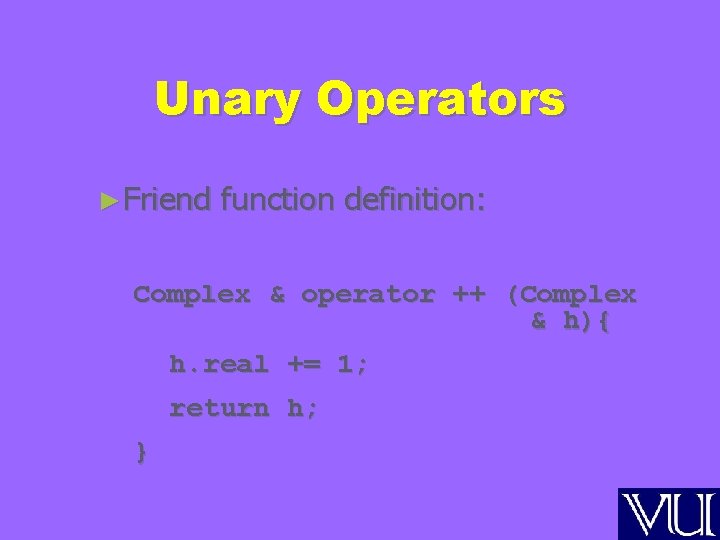
Unary Operators ►Friend function definition: Complex & operator ++ (Complex & h){ h. real += 1; return h; }
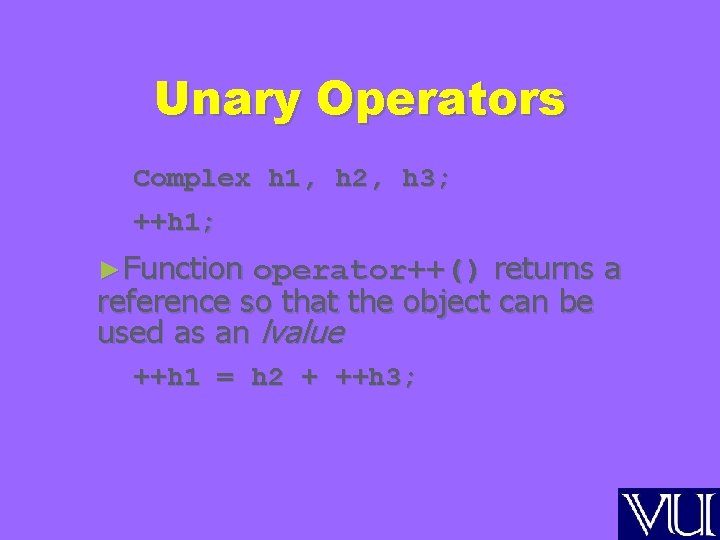
Unary Operators Complex h 1, h 2, h 3; ++h 1; ►Function operator++() returns a reference so that the object can be used as an lvalue ++h 1 = h 2 + ++h 3;
Unary Operators ►How does a compiler know whether it is a pre-increment or a post-increment ?
Unary Operators ►A post-fix unary operator is implemented using: Member function with 1 dummy int argument OR Non-member function with two arguments
Unary Operators ►In post increment, current value of the object is stored in a temporary variable ►Current ►Value object is incremented of the temporary variable is returned
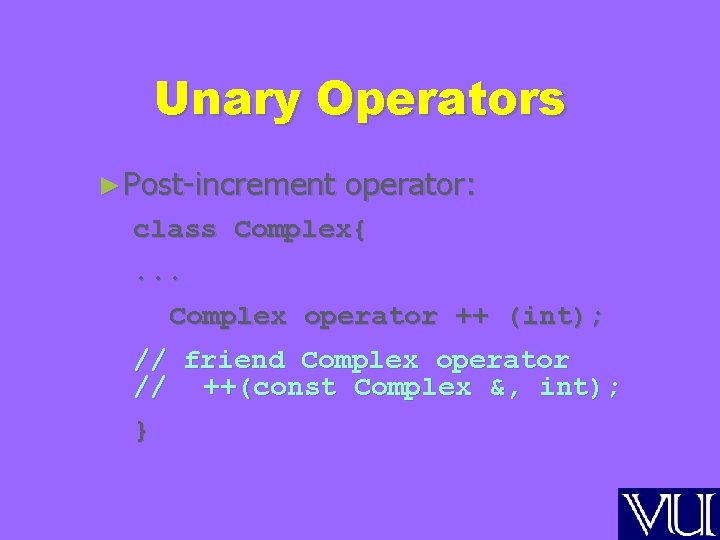
Unary Operators ►Post-increment operator: class Complex{. . . Complex operator ++ (int); // friend Complex operator // ++(const Complex &, int); }
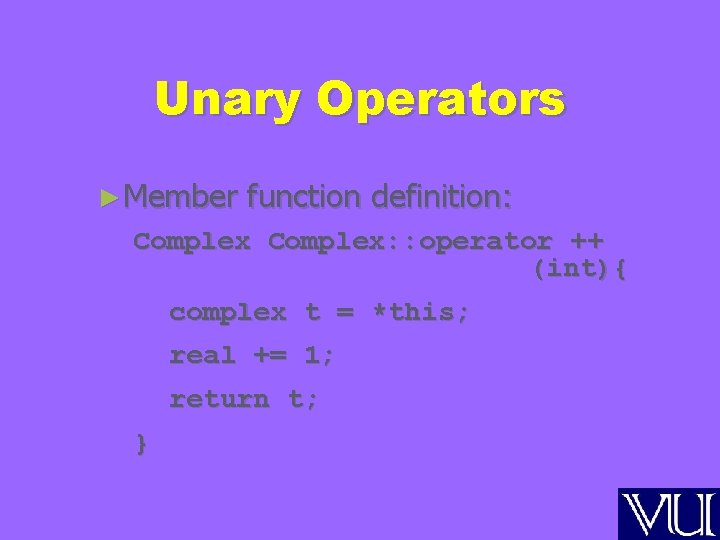
Unary Operators ►Member function definition: Complex: : operator ++ (int){ complex t = *this; real += 1; return t; }
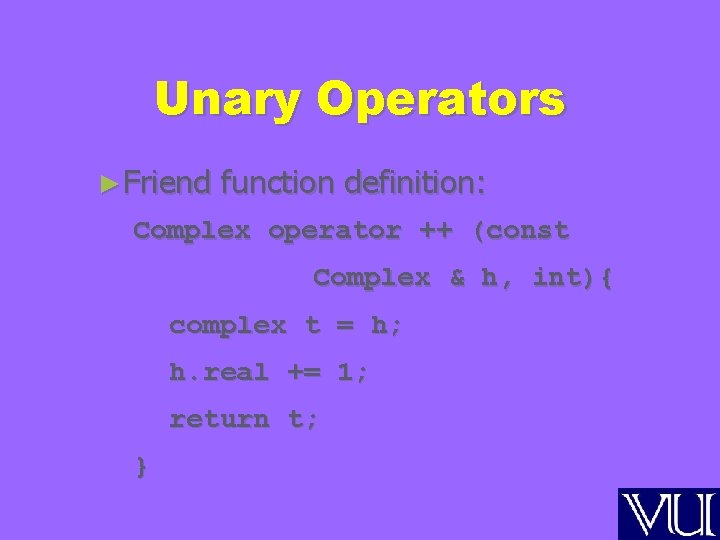
Unary Operators ►Friend function definition: Complex operator ++ (const Complex & h, int){ complex t = h; h. real += 1; return t; }
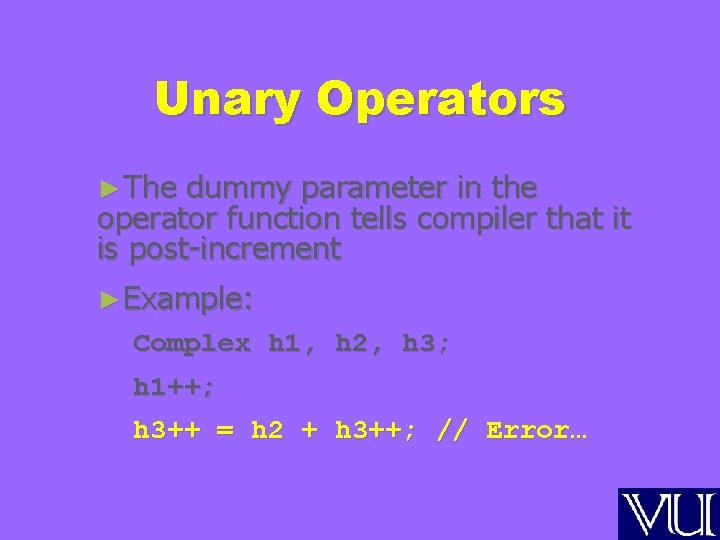
Unary Operators ►The dummy parameter in the operator function tells compiler that it is post-increment ►Example: Complex h 1, h 2, h 3; h 1++; h 3++ = h 2 + h 3++; // Error…
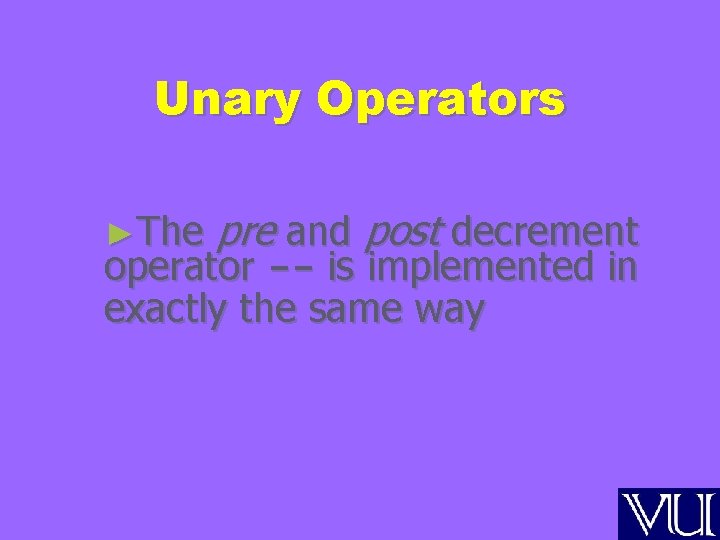
Unary Operators ►The pre and post decrement operator -- is implemented in exactly the same way
Type Conversion ►The compiler automatically performs a type coercion of compatible types ►e. g: int f = 0. 021; double g = 34; // type float is automatically converted // into int. Compiler only issues a // warning…
Type Conversion ►The user can also explicitly convert between types: C style type casting int g = (int)0. 0210; double h = double(35); // type float is explicitly converted // (casted) into int. Not even a warning // is issued now…
Type Conversion ►For user defined classes, there are two types of conversions §From any other type to current type §From current type to any other type
Type Conversion ►Conversion current type: from any other type to §Requires a constructor with a single parameter ►Conversion other type: from current type to any §Requires an overloaded operator
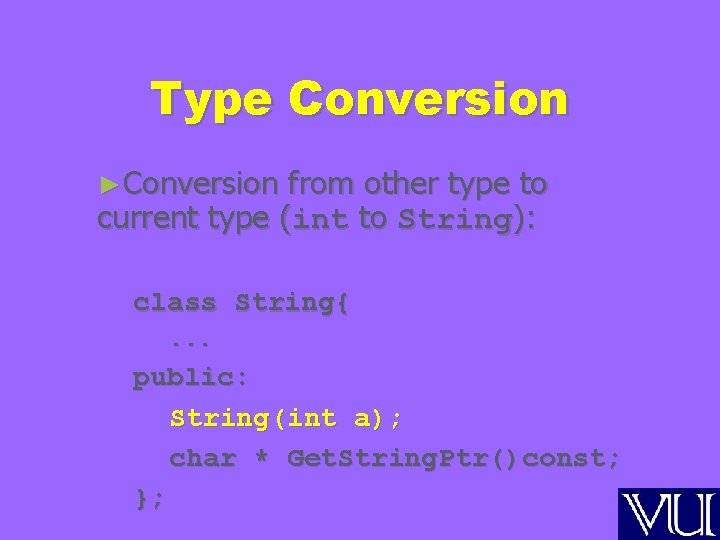
Type Conversion ►Conversion from other type to current type (int to String): class String{. . . public: String(int a); char * Get. String. Ptr()const; };
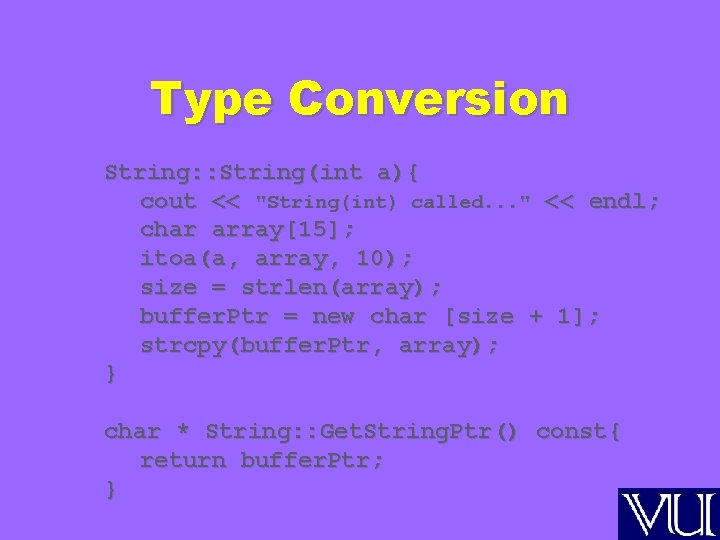
Type Conversion String: : String(int a){ cout << "String(int) called. . . " << endl; char array[15]; itoa(a, array, 10); size = strlen(array); buffer. Ptr = new char [size + 1]; strcpy(buffer. Ptr, array); } char * String: : Get. String. Ptr() const{ return buffer. Ptr; }
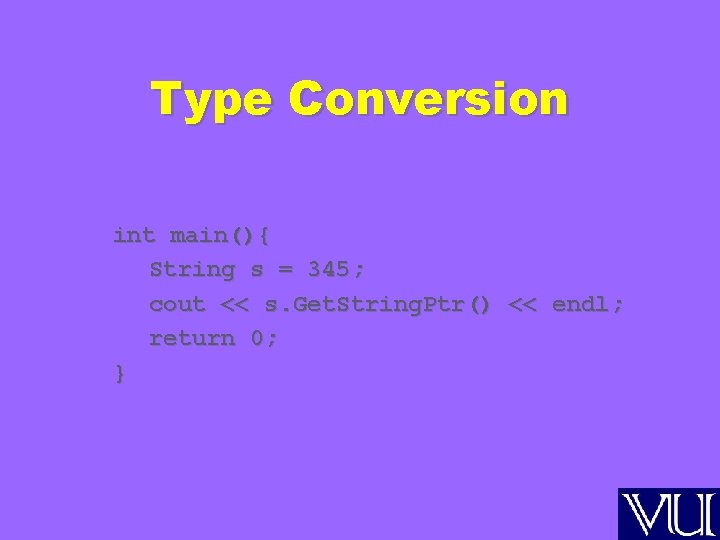
Type Conversion int main(){ String s = 345; cout << s. Get. String. Ptr() << endl; return 0; }
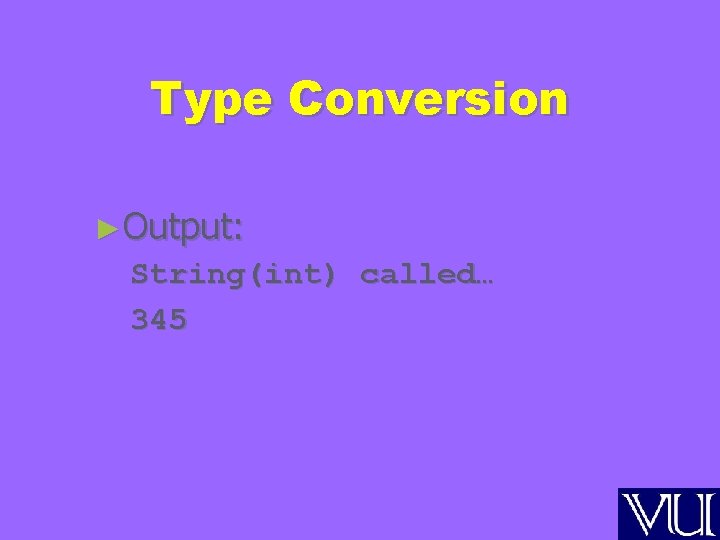
Type Conversion ►Output: String(int) called… 345
Type Conversion ►Automatic conversion has drawbacks ►Conversion takes place transparently even if the user didn’t wanted the conversion
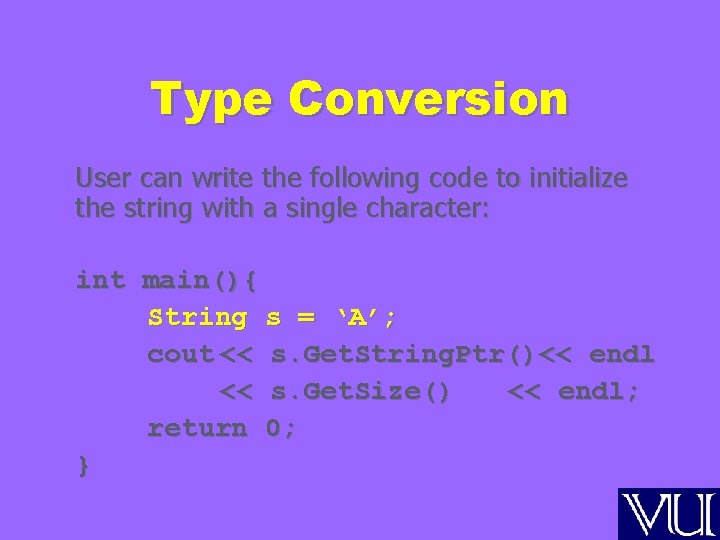
Type Conversion User can write the following code to initialize the string with a single character: int main(){ String s = ‘A’; cout << s. Get. String. Ptr()<< endl << s. Get. Size() << endl; return 0; }
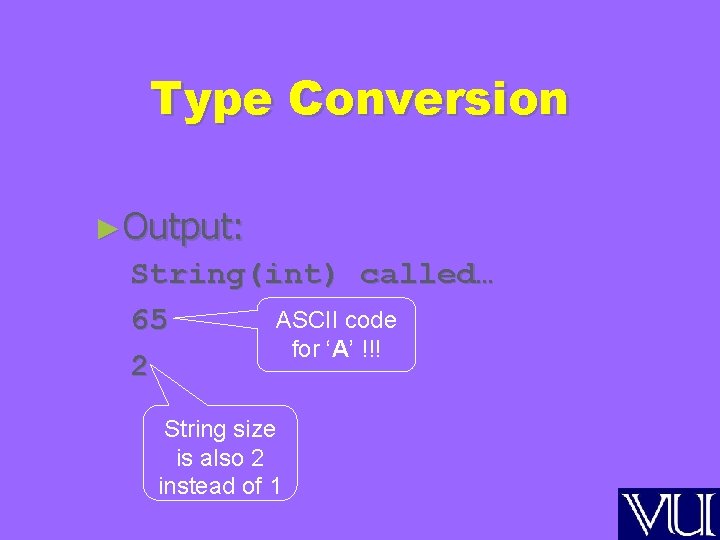
Type Conversion ►Output: String(int) called… ASCII code 65 for ‘A’ !!! 2 String size is also 2 instead of 1
Type Conversion There is a mechanism in C++ to restrict automatic conversions ►Keyword explicit ►Casting must be explicitly performed by the user
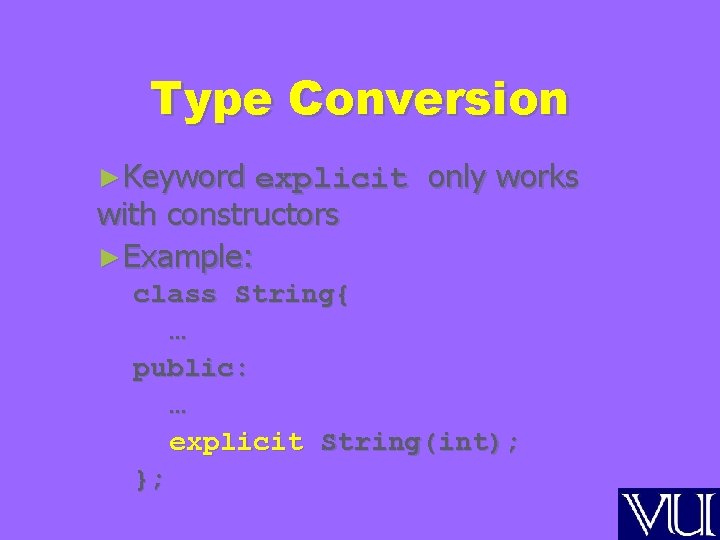
Type Conversion ►Keyword explicit only works with constructors ►Example: class String{ … public: … explicit String(int); };
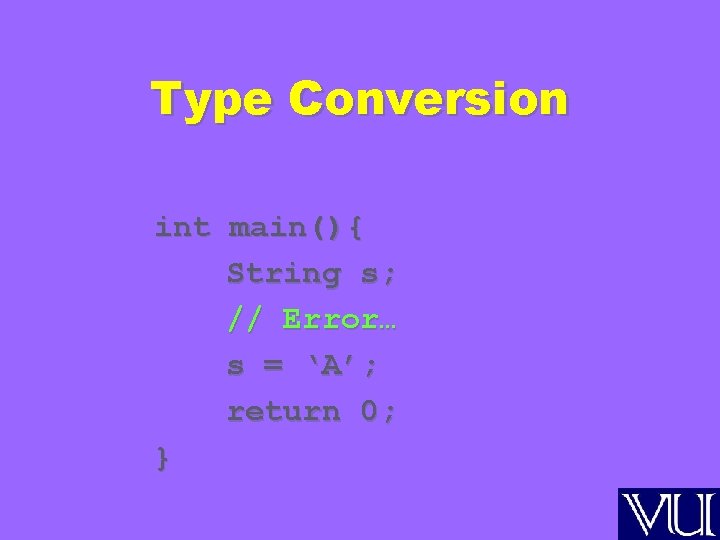
Type Conversion int main(){ String s; // Error… s = ‘A’; return 0; }
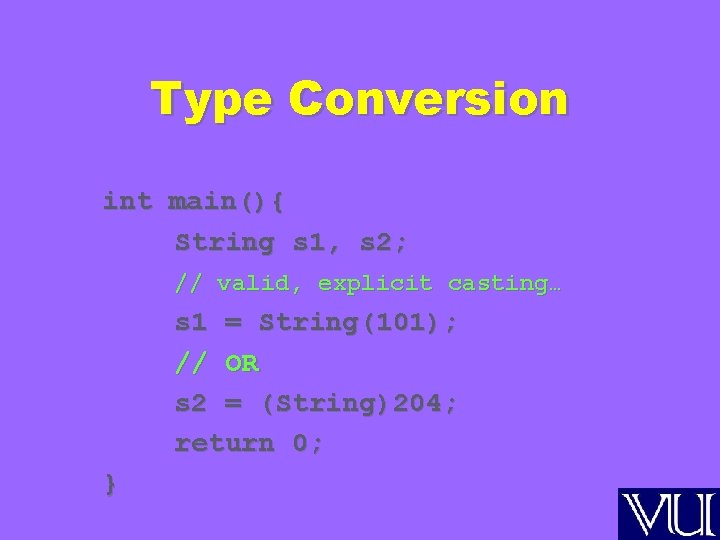
Type Conversion int main(){ String s 1, s 2; // valid, explicit casting… s 1 = String(101); // OR s 2 = (String)204; return 0; }
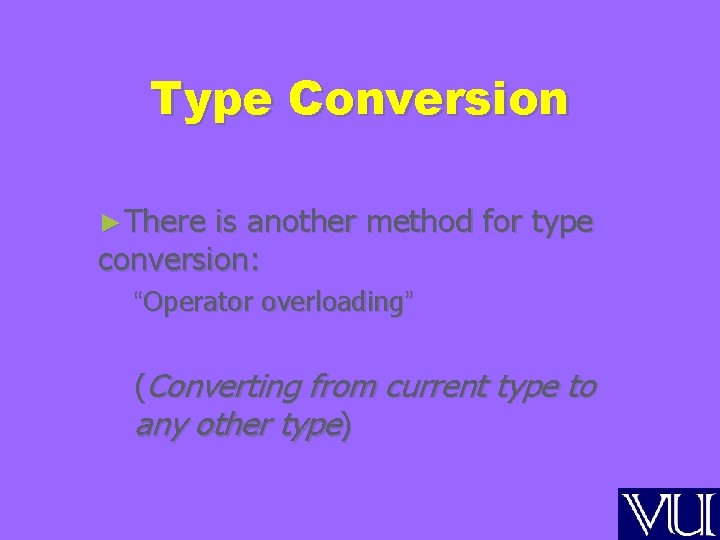
Type Conversion ►There is another method for type conversion: “Operator overloading” (Converting from current type to any other type)
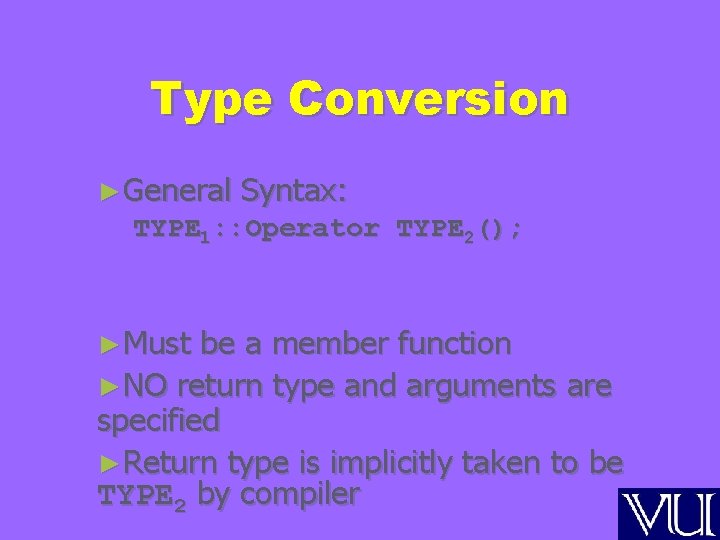
Type Conversion ►General Syntax: TYPE 1: : Operator TYPE 2(); ►Must be a member function ►NO return type and arguments are specified ►Return type is implicitly taken to be TYPE 2 by compiler
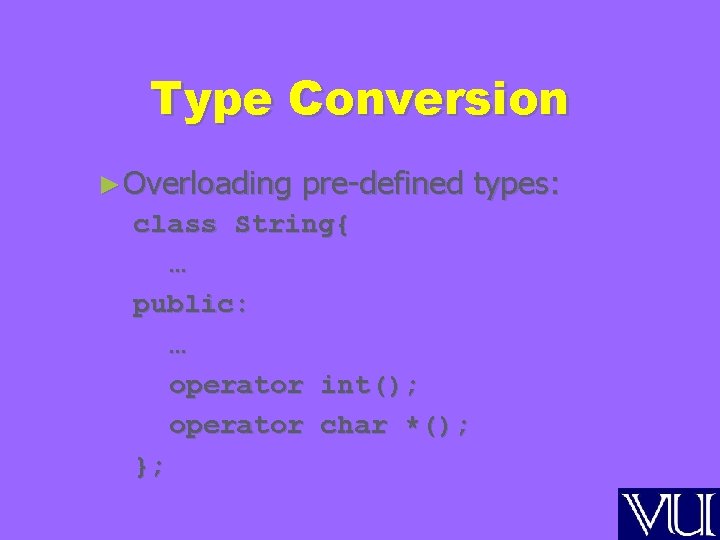
Type Conversion ►Overloading pre-defined types: class String{ … public: … operator int(); operator char *(); };
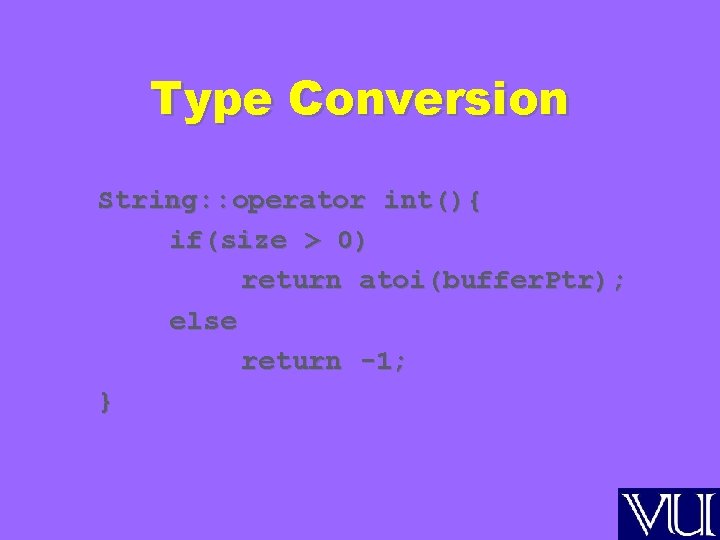
Type Conversion String: : operator int(){ if(size > 0) return atoi(buffer. Ptr); else return -1; }
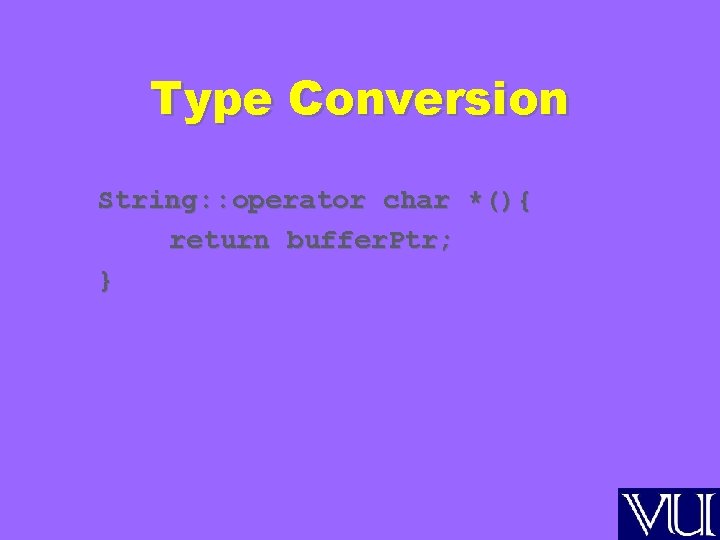
Type Conversion String: : operator char *(){ return buffer. Ptr; }
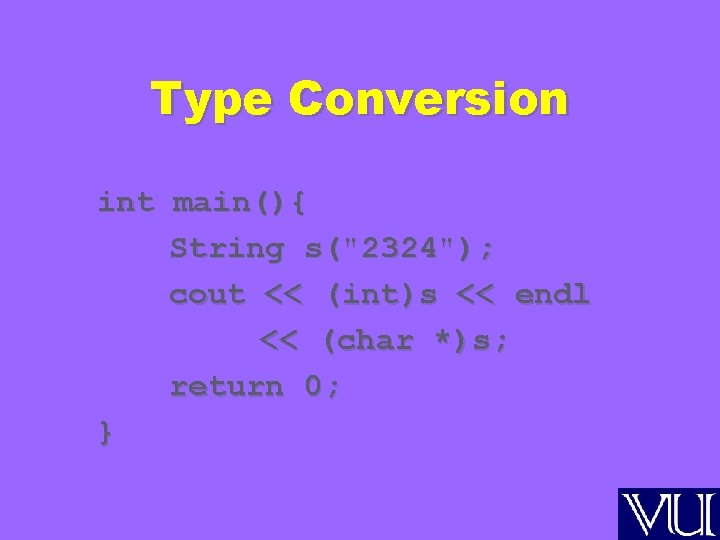
Type Conversion int main(){ String s("2324"); cout << (int)s << endl << (char *)s; return 0; }
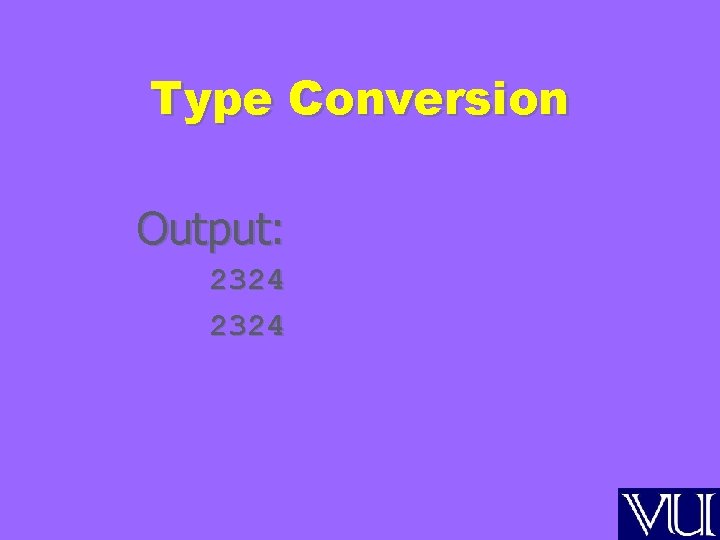
Type Conversion Output: 2324
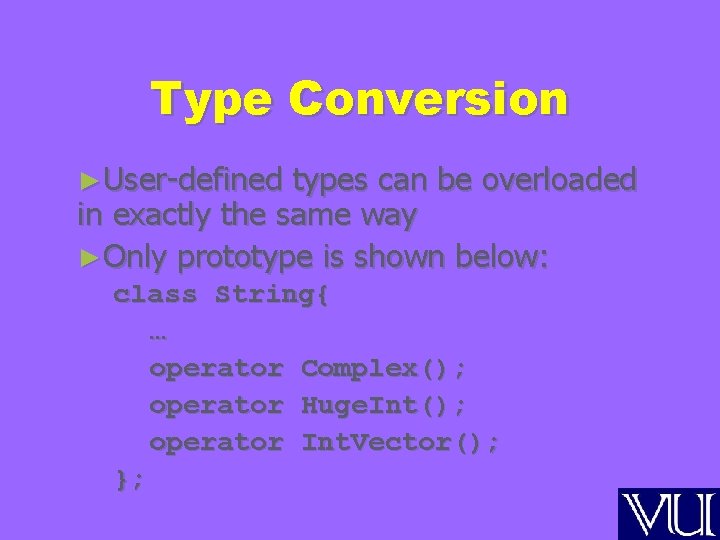
Type Conversion ►User-defined types can be overloaded in exactly the same way ►Only prototype is shown below: class String{ … operator Complex(); operator Huge. Int(); operator Int. Vector(); };
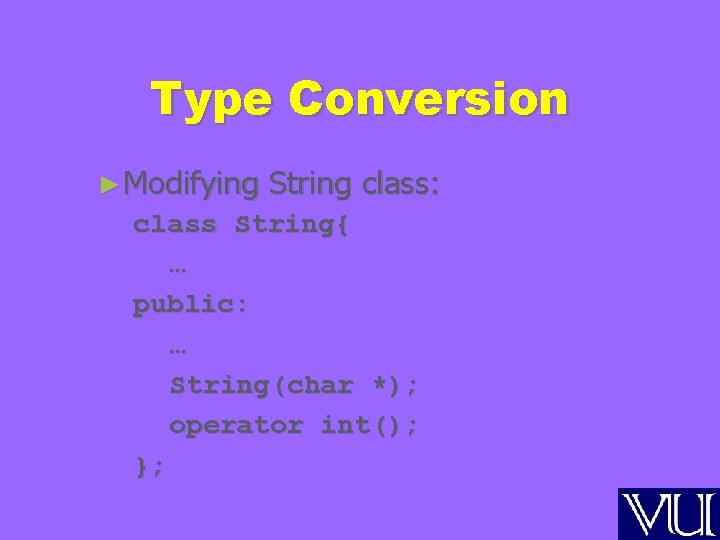
Type Conversion ►Modifying String class: class String{ … public: … String(char *); operator int(); };
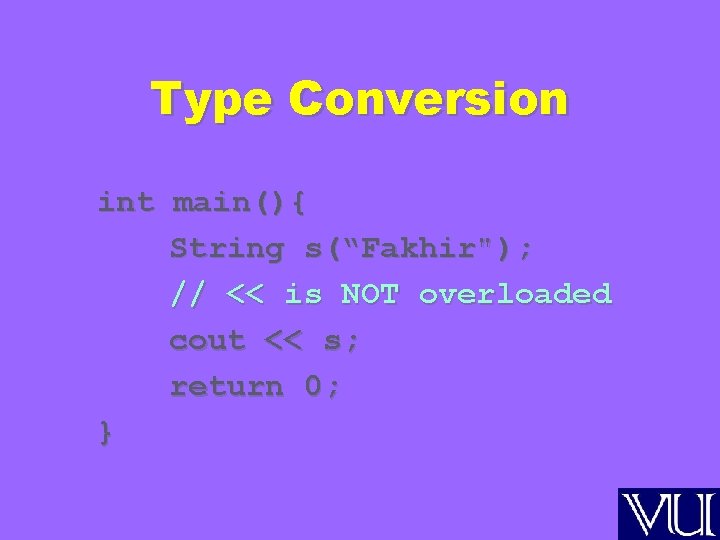
Type Conversion int main(){ String s(“Fakhir"); // << is NOT overloaded cout << s; return 0; }
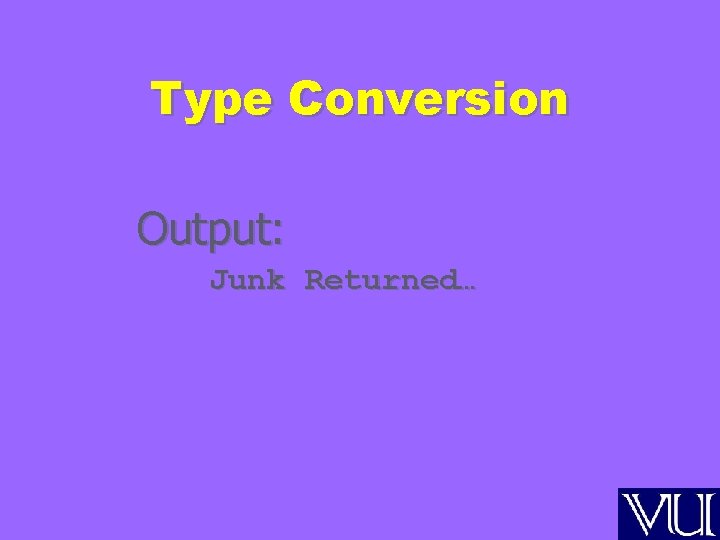
Type Conversion Output: Junk Returned…
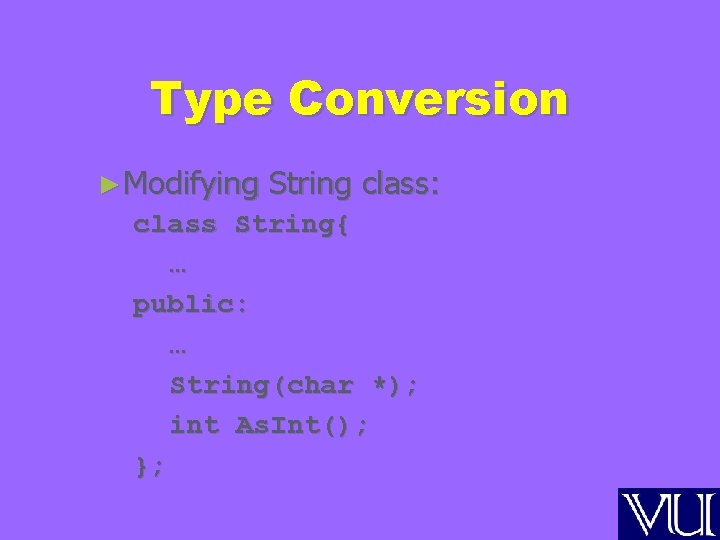
Type Conversion ►Modifying String class: class String{ … public: … String(char *); int As. Int(); };
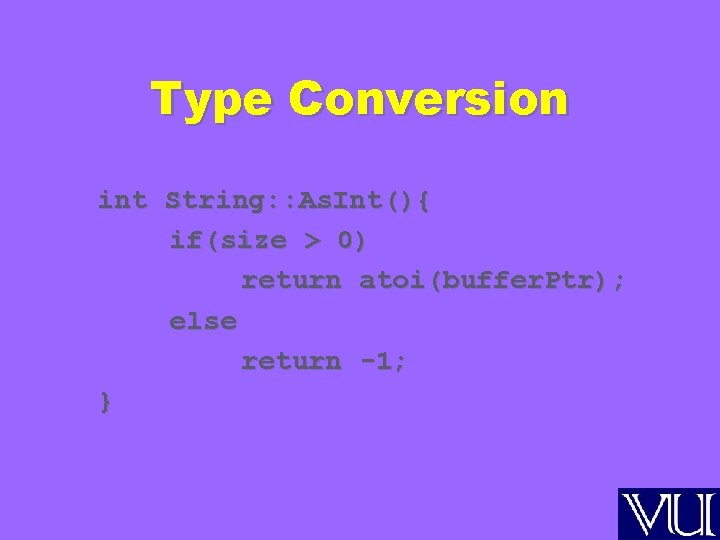
Type Conversion int String: : As. Int(){ if(size > 0) return atoi(buffer. Ptr); else return -1; }
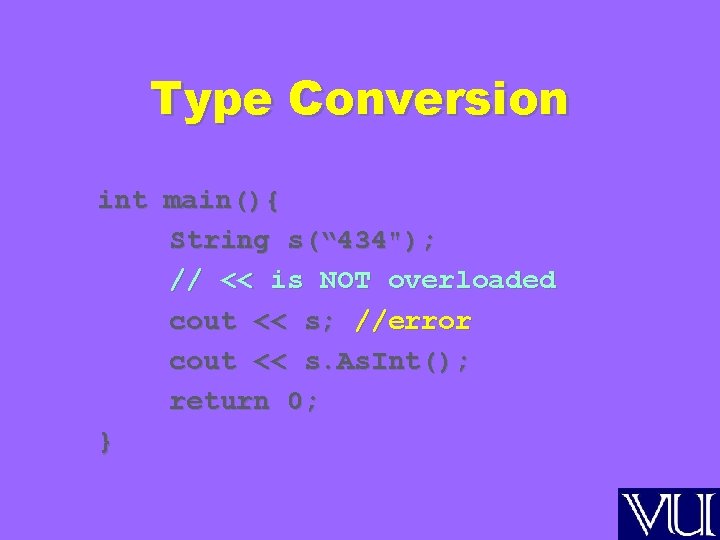
Type Conversion int main(){ String s(“ 434"); // << is NOT overloaded cout << s; //error cout << s. As. Int(); return 0; }
- Slides: 49