
ObjectOriented Development The OO Solution l The problem
Object-Oriented Development
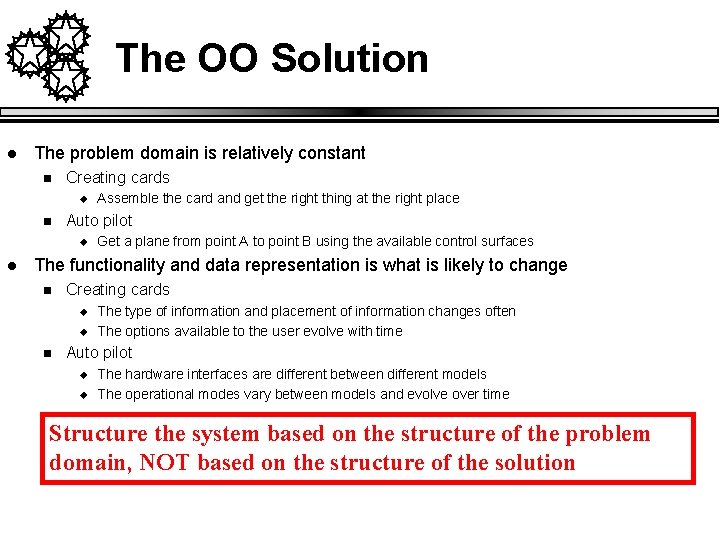
The OO Solution l The problem domain is relatively constant n Creating cards u n Auto pilot u l Assemble the card and get the right thing at the right place Get a plane from point A to point B using the available control surfaces The functionality and data representation is what is likely to change n Creating cards u u n The type of information and placement of information changes often The options available to the user evolve with time Auto pilot u u The hardware interfaces are different between different models The operational modes vary between models and evolve over time Structure the system based on the structure of the problem domain, NOT based on the structure of the solution
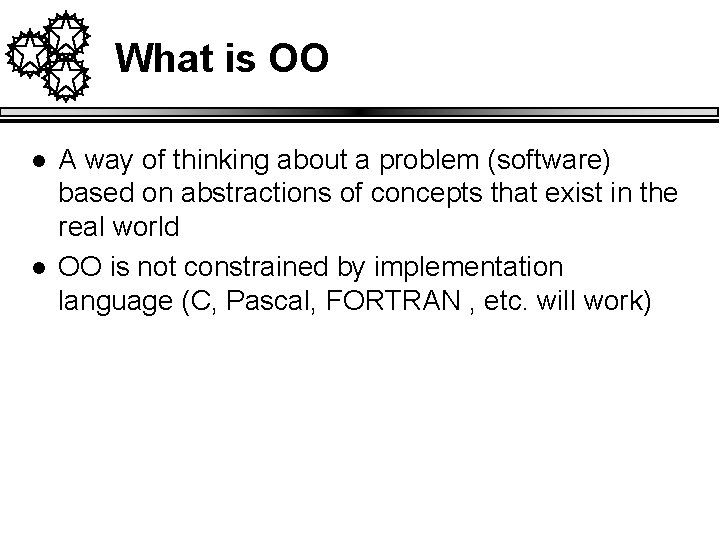
What is OO l l A way of thinking about a problem (software) based on abstractions of concepts that exist in the real world OO is not constrained by implementation language (C, Pascal, FORTRAN , etc. will work)
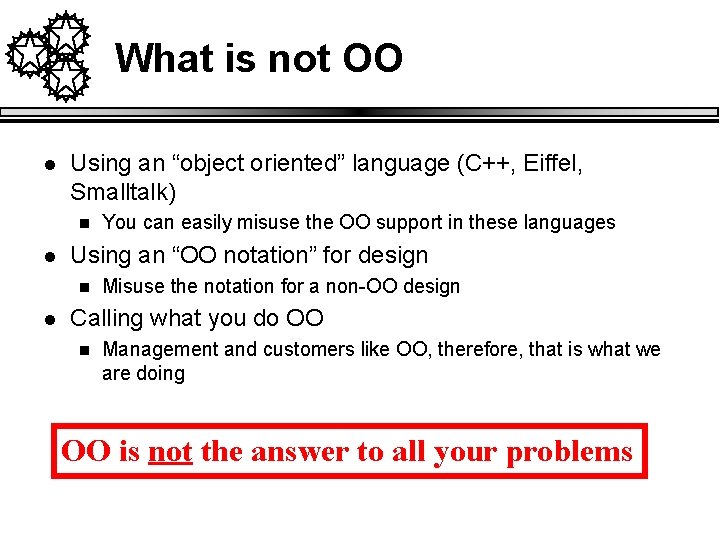
What is not OO l Using an “object oriented” language (C++, Eiffel, Smalltalk) n l Using an “OO notation” for design n l You can easily misuse the OO support in these languages Misuse the notation for a non-OO design Calling what you do OO n Management and customers like OO, therefore, that is what we are doing OO is not the answer to all your problems
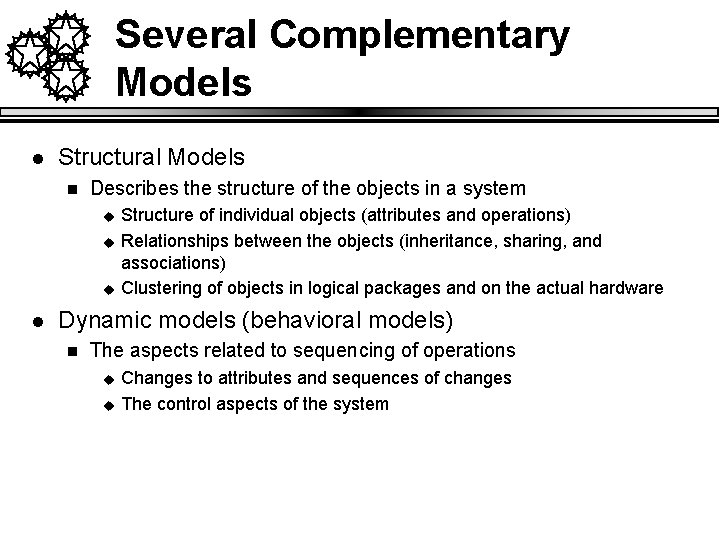
Several Complementary Models l Structural Models n Describes the structure of the objects in a system u u u l Structure of individual objects (attributes and operations) Relationships between the objects (inheritance, sharing, and associations) Clustering of objects in logical packages and on the actual hardware Dynamic models (behavioral models) n The aspects related to sequencing of operations u u Changes to attributes and sequences of changes The control aspects of the system
Intentionally Blank
The OO Development Process
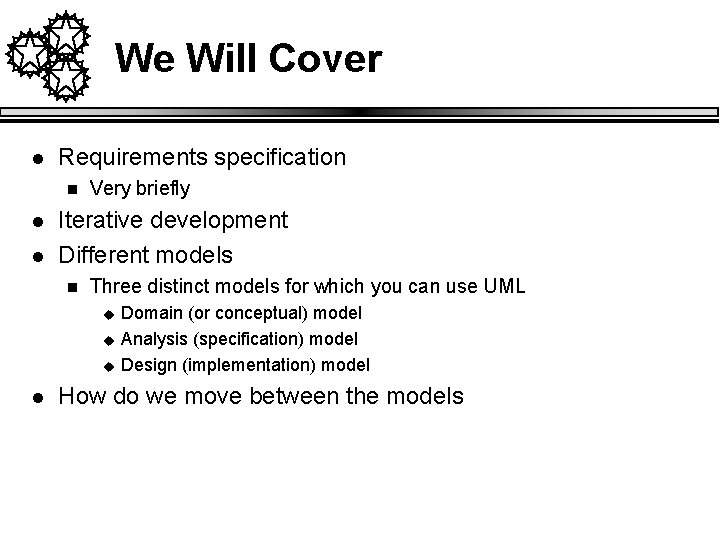
We Will Cover l Requirements specification n l l Very briefly Iterative development Different models n Three distinct models for which you can use UML u u u l Domain (or conceptual) model Analysis (specification) model Design (implementation) model How do we move between the models
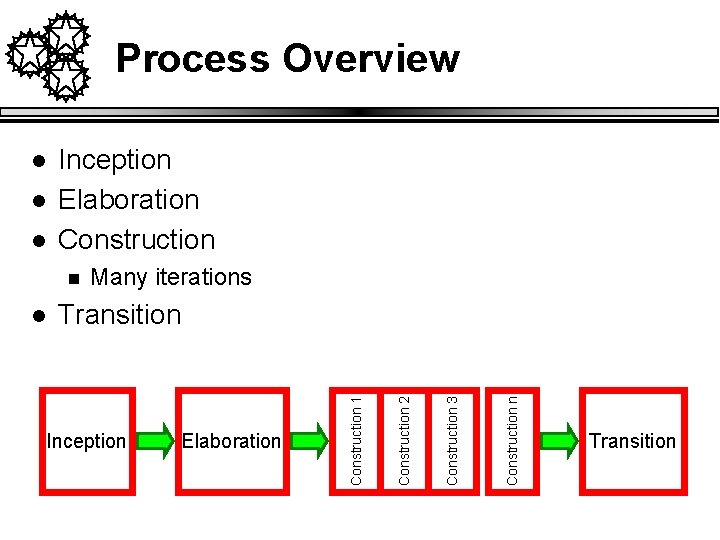
Process Overview n Transition Inception Elaboration Construction n l Many iterations Construction 3 l Construction 2 l Inception Elaboration Construction 1 l Transition
Inception l l Creation of the basic idea that we want to implement (presumably with software) Could take many shapes n n l A discussion over a beer at the pub A full fledged feasibility study Figure out (roughly) n The business case u n How much money will this make the company Project scope
Elaboration l Answer the following: n n n l What is it you are going to build? How are you going to build it? What technology are you going to use? Your decisions should be guided by the risks n n Requirements risks Technological risks Skills risks Political risks
Requirements Risks l Poor or wrong requirements a serious problem l Use UML notations to help you understand the customers requirements and the inherent structure of the problem domain n n Use-case diagrams and use cases to understand customer requirements Class diagrams, activity diagrams, and possibly other diagrams to understand the domain
Plan the Construction Phase l We will never build the entire system at once n l Categorize the use cases n n n l Incremental development “I absolutely must have this function in the system” “I can live without this feature for a little while” “This is an important function, but we might be able to live without it” Time estimate and allocate the use cases to iterations
Construction l Construct the system as a series of iterations n Each iteration is a “mini” project u l Refine your domain model n n Identify all attributes and operations Define the dynamic behavior of all objects u u l Analyze the use case, design, code, test, and integrate. State machines “Contracts” Make decisions influenced by platform and language
Transition l l The phase between the beta release and the final product Wrap up all the issues that should not be done or cannot be done during the iterations n n l Examples include performance evaluation and optimization Complete system testing No new functionality added n n Fix bugs Refactor your system a final time
Three Distinct Models l A conceptual model (domain model) n n n l An analysis model (specification model) n n l Try to figure out what is really going on Build a model to better understand the problem Used to communicate with the customer and “domain” experts Model the software that will implement the system Focus on the software structure and the module interfaces Design model (implementation model) n n A detailed design of the software Including all attributes and detailed descriptions of the operations
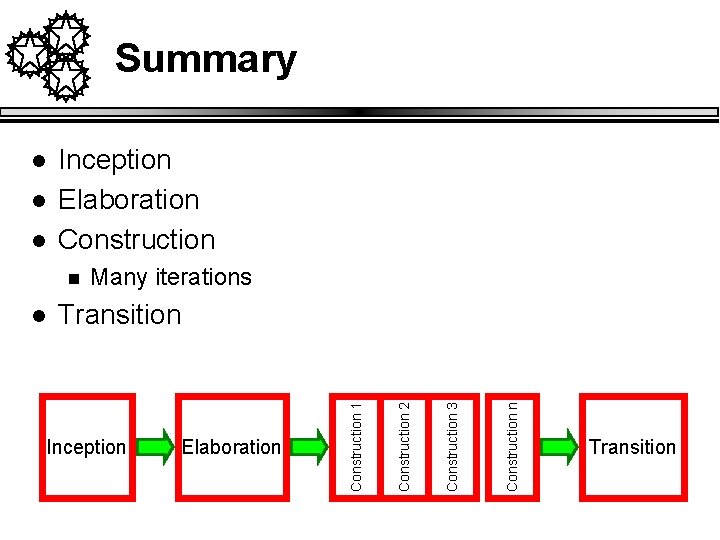
Summary n Transition Inception Elaboration Construction n l Many iterations Construction 3 l Construction 2 l Inception Elaboration Construction 1 l Transition
- Slides: 17