
ObjectOriented DBMS 11 Figure 11 34 11 Table
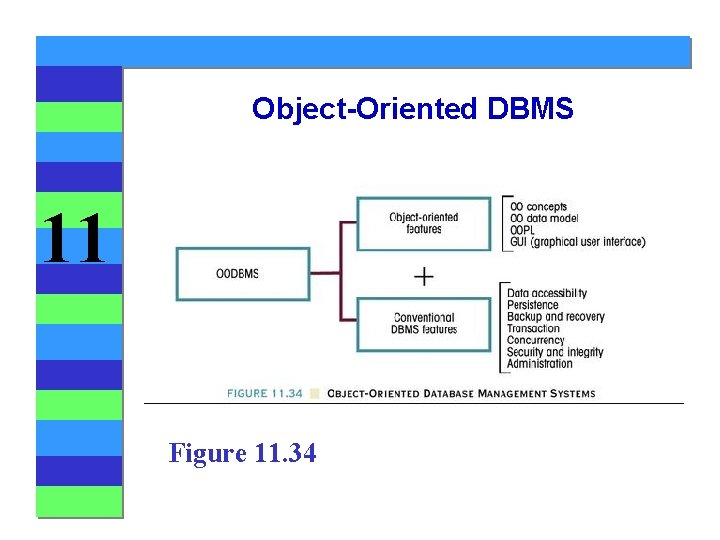
Object-Oriented DBMS 11 Figure 11. 34
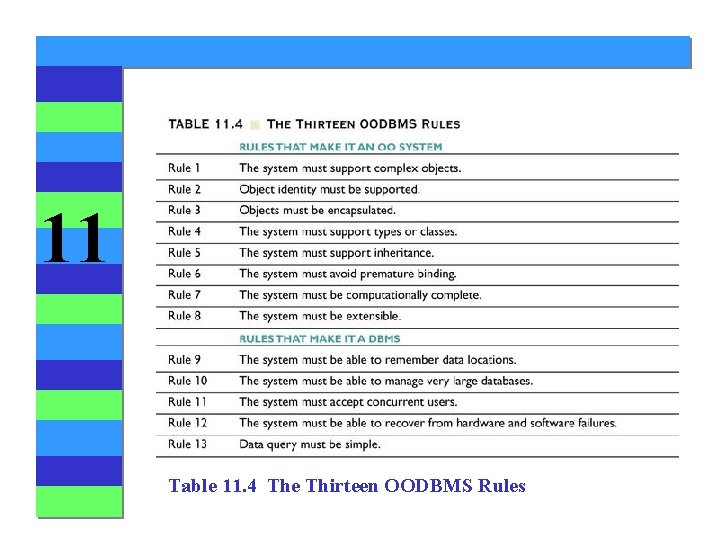
11 Table 11. 4 The Thirteen OODBMS Rules
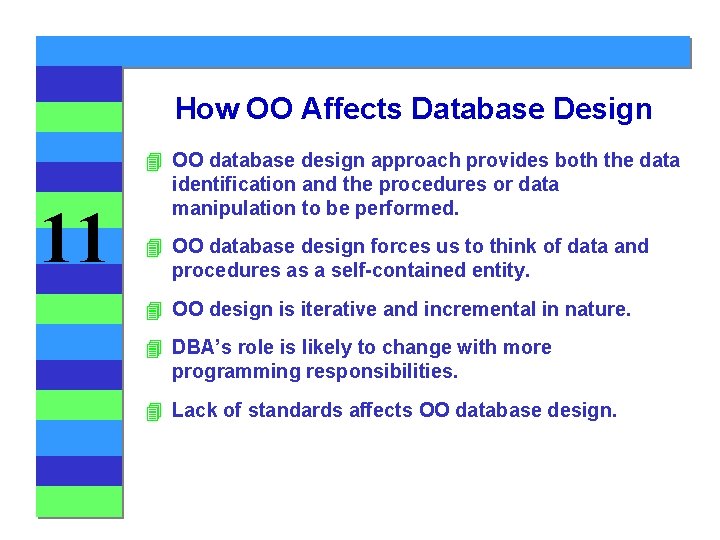
How OO Affects Database Design 11 4 OO database design approach provides both the data identification and the procedures or data manipulation to be performed. 4 OO database design forces us to think of data and procedures as a self-contained entity. 4 OO design is iterative and incremental in nature. 4 DBA’s role is likely to change with more programming responsibilities. 4 Lack of standards affects OO database design.
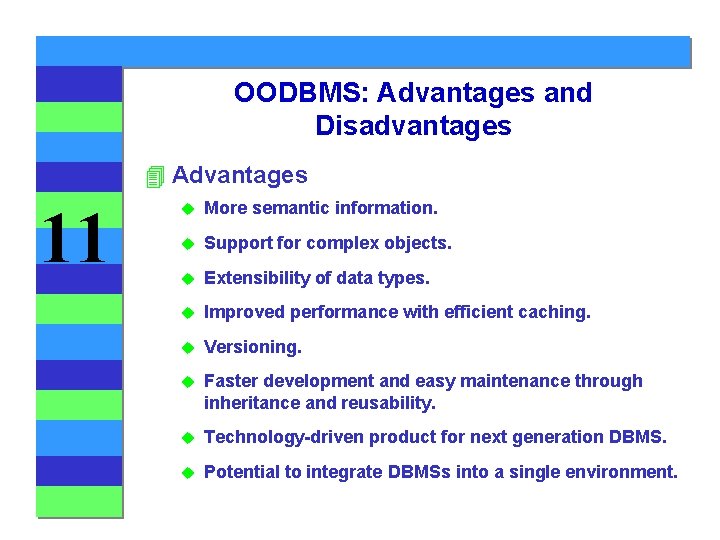
OODBMS: Advantages and Disadvantages 4 Advantages 11 u More semantic information. u Support for complex objects. u Extensibility of data types. u Improved performance with efficient caching. u Versioning. u Faster development and easy maintenance through inheritance and reusability. u Technology-driven product for next generation DBMS. u Potential to integrate DBMSs into a single environment.
OODBMS: Advantages and Disadvantages 4 Disadvantages 11 u Strong opposition from the established players. u Lack of theoretical foundation. u Retrogressive to the old pointer systems. u Lack of standard ad hoc query language. u Lack of business data design and management tools. u Steep learning curve. u Lack of resources.
How OO Concepts Have Influenced the Relational Model 11 4 New Features for Extended Relational (Object/Relational) Model u Extensibility of new user-defined (abstract) data types u Complex objects u Inheritance u Procedure calls (rules or triggers) u System-generated identifiers (OID surrogates)
How OO Concepts Have Influenced the Relational Model 11 4 Philosophy that guides the relational model’s enhancements: u Semantic and object-oriented concepts are necessary to support the new generation of applications. u These concepts can and must be added to the relational model. u The benefits of the relational model must be preserved to protect the investment in relational technology and to provide downward compatibility.
The Next Generation of DBMS 11 4 The next generation of DBMS is likely to incorporate features borrowed from: u Object-oriented database systems u Artificial intelligence systems u Expert systems u Distributed database u The Internet
- Slides: 8